Dental Bridge
September 20, 2026
Dental Implants vs Bridges: Which Option Is Right for Missing Teeth?
 Dr. Rifat Alsaman
Replacing missing teeth can restore chewing, speech, appearance, and oral function. Dental implants and bridges are common fixed replacement options. However, they use very different support systems. An implant replaces the missing tooth root inside the jawbone. A bridge uses surrounding teeth or implants for support. The appropriate option depends on bone volume, gum health, neighboring teeth, and treatment goals. Cost and treatment time also influence patient decisions. A clinical examination is essential before selecting either treatment. Research shows that implant-supported restorations can achieve high long-term survival. However, complications can still occur and require ongoing maintenance. One systematic review reported implant-supported fixed prostheses with approximately 95% five-year survival. Ten-year survival was approximately 80% for the prosthesis in that review.
What Are Dental Implants and Dental Bridges?
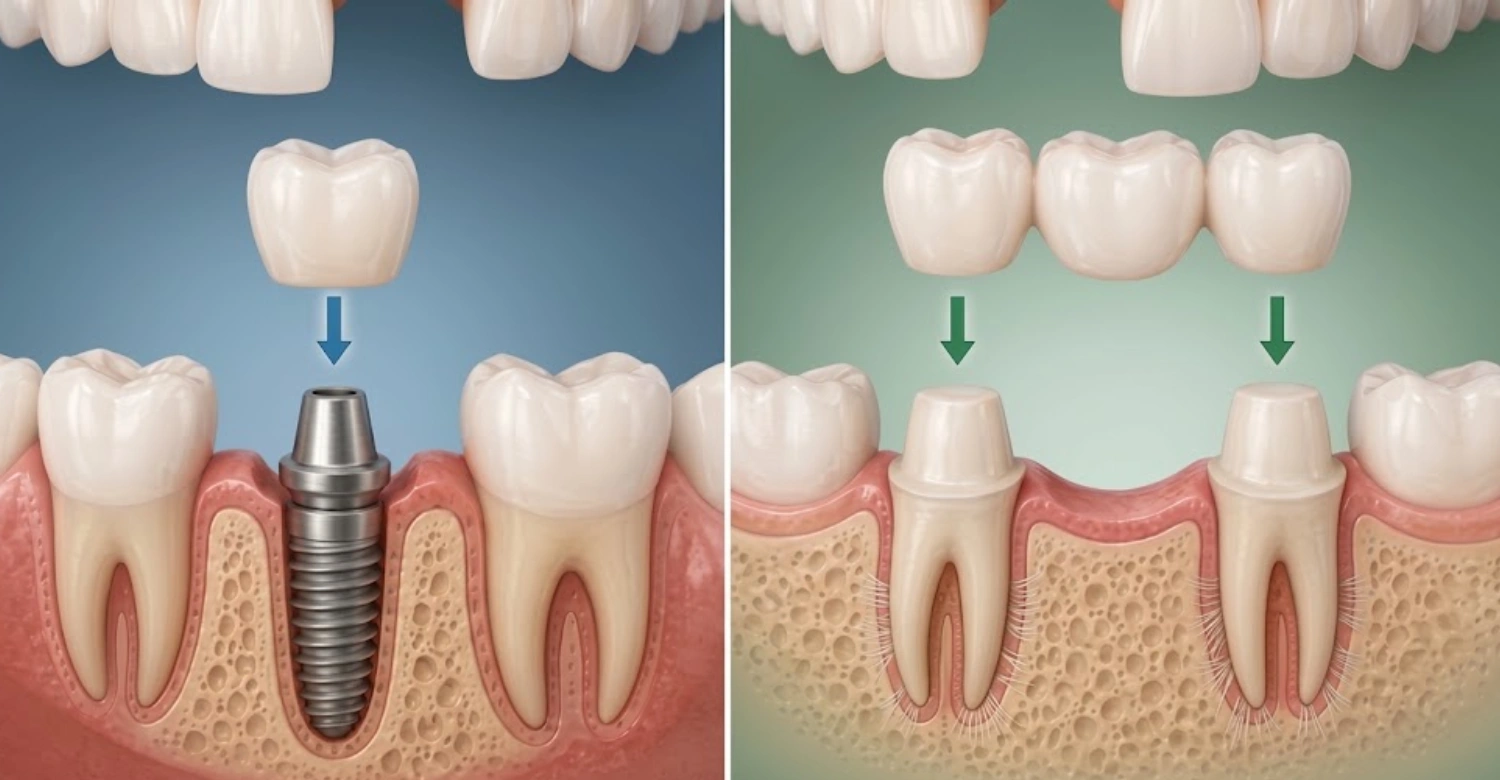
Dental implants and dental bridges are two established options for replacing missing teeth, but they work differently. A dental implant is a small titanium or other biocompatible post placed into the jawbone to replace the root of a missing tooth. After healing, it can support a dental crown or another restoration. A dental bridge, in contrast, replaces a missing tooth by attaching an artificial tooth to neighboring teeth or, in some cases, implant-supported structures. The choice between these options depends on factors such as the number and location of missing teeth, bone volume, gum health, overall oral health, treatment preferences, and budget. During a Dental Implants vs Bridges consultation, a dentist evaluates the mouth and surrounding structures before recommending the most appropriate approach.
What Is a Dental Implant?
A dental implant is a small post placed inside the jawbone. It acts as an artificial tooth root. The implant can support a crown, bridge, or other restoration. Most dental implants use titanium or compatible implant materials. After placement, bone can integrate with the implant surface. This biological process is called osseointegration. Healing time varies according to the patient and treatment plan. Some cases may require several months before final restoration. Other protocols can use immediate or early restoration when appropriate.
What Is a Dental Bridge?
A dental bridge replaces one or more missing teeth with artificial teeth. A traditional bridge usually connects to prepared neighboring teeth. The artificial replacement is called a pontic. Fixed bridges remain attached to the supporting teeth. Bridge materials can include porcelain, metal, zirconia, or combinations. The supporting teeth must provide sufficient strength and stability. Existing tooth condition therefore affects whether a bridge is suitable.
How Do Dental Implants and Bridges Replace Missing Teeth?
Both treatments fill the space created by missing teeth. Their support systems differ significantly. An implant uses an artificial root anchored in the jawbone. A traditional bridge uses neighboring teeth as supporting structures. Implant-supported bridges can use implants instead of natural teeth. The choice depends on anatomy, restoration design, and clinical findings. Missing teeth should be assessed before deciding between these options.
Implant vs Dental Bridge: The Basic Difference
The main difference involves how the replacement receives support. An implant is surgically anchored into the jawbone. A traditional bridge depends on adjacent teeth for support. An implant can therefore replace the missing root structure. A bridge primarily replaces the visible tooth portion. This distinction affects treatment planning, maintenance, and neighboring teeth. Neither option is automatically suitable for every patient.
Dental Implants vs Bridges: How Do They Compare?
Dental implants and bridges can both restore the appearance and function of missing teeth, but their treatment approaches are different. An implant replaces the missing tooth root and is positioned directly within the jawbone, while a traditional bridge relies on neighboring teeth for support. Implants generally require a surgical procedure and a healing period, whereas bridges can often be completed more quickly. Implants may also help preserve the bone around a missing tooth because they provide stimulation through the implant fixture. Bridges may be suitable when neighboring teeth already require crowns or when an implant is not appropriate. In Dental Implants vs Bridges, there is no single option that is suitable for every patient. A dentist should assess oral health, bone condition, adjacent teeth, aesthetics, treatment time, maintenance, and cost before making an individualized recommendation.
How Dental Implants Work
Implants are surgically positioned within a suitable jawbone. Bone can gradually integrate around the implant surface. An abutment then connects the implant to its restoration. A customized crown can replace the visible missing tooth. Multiple implants can also support bridges or larger restorations. Implant treatment therefore offers several restorative configurations. Patient anatomy determines which configuration is appropriate.
How Dental Bridges Work
Traditional bridges rely on supporting teeth beside the missing space. Those teeth are prepared to accommodate the restoration. The bridge is then fabricated to fit the prepared structures. The artificial tooth occupies the missing space between supports. Proper fit and hygiene are important for long-term performance. The supporting teeth must remain healthy and structurally adequate.
Implant vs Dental Bridge: Key Differences
Implants and bridges differ in support, preparation, surgery, maintenance, and treatment time. Implants require surgical placement and adequate bone conditions. Traditional bridges generally require preparation of supporting teeth. Implant treatment may require additional healing time. Bridges can sometimes provide a faster restorative pathway. Individual anatomy can change these general differences.
Tooth Support
An implant obtains support from the jawbone. A traditional bridge receives support from neighboring teeth. An implant-supported bridge uses implants as supporting structures. The support design influences treatment planning and biomechanics.
Effect on Adjacent Teeth
Traditional bridges require preparation of supporting teeth. This can involve removing some natural tooth structure. An implant restoration can often avoid preparing healthy neighboring teeth. However, surrounding teeth still require careful evaluation.
Treatment Time
Bridge treatment can sometimes be completed relatively quickly. Implant treatment often includes surgery and a healing phase. Some implant protocols can shorten treatment when clinically appropriate. Healing requirements depend on bone quality and treatment complexity.
Maintenance
Both options require regular oral hygiene and professional maintenance. Bridges require careful cleaning around supporting teeth and underneath the pontic. Implants require cleaning around the implant and restoration. Gum health remains important for both approaches.
Long-Term Considerations
Long-term outcomes depend on patient-specific biological and mechanical factors. Oral hygiene, gum health, bite forces, and maintenance affect longevity. Research demonstrates high survival rates for both tooth-supported and implant-supported restorations.
What Are the Benefits of Dental Implants?
Dental implants provide a fixed way to replace missing teeth without relying on adjacent natural teeth for support. Because the implant is positioned in the jawbone, it can provide a stable foundation for a crown, bridge, or other restoration. Implants can restore chewing ability and contribute to natural-looking results when properly planned and restored. Another potential benefit is preservation of the jawbone in the area of the missing tooth because the implant functions as an artificial tooth root. With appropriate oral hygiene and professional maintenance, implants can provide long-term tooth replacement. However, successful treatment depends on factors such as adequate bone, healthy gums, good oral hygiene, appropriate treatment planning, and general health. In Dental Implants vs Bridges, these advantages should be considered alongside the longer treatment process and surgical nature of implant placement.
Dental Implant Benefits
Implants can replace missing teeth without using neighboring natural teeth as bridge supports. They can provide stable support for individual crowns. They can also support bridges when multiple teeth are missing. Their root-like placement provides a different biomechanical foundation. Implants may also help maintain bone around the implant site. However, outcomes depend on surgical planning and maintenance.
How Implants Can Replace a Missing Tooth Without Preparing Adjacent Teeth
A single implant can support an individual crown. The crown does not require a traditional bridge connection. Therefore, healthy neighboring teeth may remain structurally untouched. This can be an important consideration during treatment planning. However, implant placement requires suitable bone and surgical assessment.
Implant-Supported Crowns and Bridges
One implant can support a single crown. Multiple implants can support a fixed bridge. This approach can replace several missing teeth with fewer implants. Treatment design depends on spacing, bone volume, and bite forces. Digital planning can help determine implant position and restoration design.
When Dental Implants May Be Considered
Implants may be considered when sufficient bone and healthy tissues are available. Medical history and healing capacity also influence treatment suitability. Smoking and certain medical conditions can affect healing. A clinical assessment should therefore precede implant placement.
What Are the Benefits of Dental Bridges?
Dental bridges can replace missing teeth without placing an implant into the jawbone. A traditional bridge uses neighboring teeth as support and can restore the visible appearance of the smile as well as chewing function. Treatment is generally less invasive than implant surgery and may be completed within a shorter period, depending on the condition of the supporting teeth and the type of bridge selected. Bridges can also be useful when neighboring teeth already need substantial restorations. They may provide a practical option for patients who are not suitable candidates for implant surgery or who prefer a non-surgical approach. However, traditional bridges require preparation of supporting teeth, and oral hygiene around the bridge is particularly important. When considering Dental Implants vs Bridges, the condition of the adjacent teeth is an important factor in determining whether a bridge is appropriate.
Dental Bridge Benefits
Bridges can replace missing teeth without implant surgery. They can restore chewing and speaking functions. Treatment may also require less surgical intervention. Traditional bridges can use existing teeth for support. Implant-supported bridges offer another design when implants are appropriate. The supporting foundation remains important for long-term success.
When a Traditional Bridge May Be Considered
A bridge may be considered when neighboring teeth provide suitable support. It can also be useful when implant surgery is unsuitable. Some patients may prefer a non-surgical restorative option. Treatment planning should consider the condition of supporting teeth.
When a Bridge Can Use Existing Teeth for Support
Traditional bridges connect artificial teeth to neighboring prepared teeth. The supporting teeth must have adequate strength and periodontal support. Existing crowns may sometimes influence bridge planning. The dentist must assess each supporting tooth individually.
Treatment Time and Restoration
Bridge treatment can often require fewer clinical stages than implant treatment. The dentist prepares the supporting teeth before taking impressions or digital scans. A temporary restoration may protect prepared teeth during laboratory fabrication. The final bridge is then checked and cemented.
Dental Implants vs Bridges: What Are the Pros and Cons?
Both options have advantages and limitations. Dental implants can replace the missing tooth root, do not normally require preparation of healthy neighboring teeth, and can provide strong long-term support. However, implant treatment involves surgery, requires sufficient bone or additional procedures when bone is inadequate, and usually takes longer than a conventional bridge. Bridges can often be completed faster and without implant surgery, but traditional bridges require supporting teeth to be prepared and may place additional demands on those teeth. Cleaning around a bridge also requires specific techniques. In Dental Implants vs Bridges, the relevant pros and cons vary according to each patient's oral anatomy, gum health, bone condition, number of missing teeth, treatment goals, time available, and financial considerations. A clinical examination is therefore more useful than choosing solely from general advantages and disadvantages.
Dental Implants vs Bridges Pros and Cons
Both options can replace missing teeth effectively. Their advantages and limitations differ according to individual circumstances. Implants require surgery and adequate bone conditions. Bridges generally require support from neighboring teeth. Treatment selection should consider biology, function, aesthetics, maintenance, and cost.
Potential Advantages of Dental Implants
Implants can avoid preparation of healthy adjacent teeth. They can provide individual tooth replacement without a traditional bridge. They can support crowns and implant bridges. Their placement also provides an artificial root structure.
Potential Limitations of Dental Implants
Implants require surgical placement and healing. Bone grafting may sometimes be necessary. Treatment can therefore take longer than conventional bridge treatment. Surgical complications and biological complications are also possible.
Potential Advantages of Dental Bridges
Bridges can provide fixed tooth replacement without implant surgery. Treatment can sometimes be completed faster. They can restore chewing and appearance effectively. Existing teeth can provide immediate structural support.
Potential Limitations of Dental Bridges
Traditional bridges require preparation of supporting teeth. Those teeth can develop biological complications later. Cleaning around the restoration also requires careful technique. Bridge replacement may eventually become necessary.
Implants or Bridges for Missing Teeth: Which Factors Matter?
Several factors should be considered when choosing between these tooth-replacement options. The number and location of missing teeth are important, as are the health and stability of the surrounding teeth. For implants, the dentist also needs to evaluate jawbone volume and quality, gum health, and factors that could affect healing. For a bridge, the supporting teeth must be strong enough to carry the restoration. Treatment time, surgical preferences, aesthetics, chewing function, maintenance requirements, and cost may also influence the decision. Some patients may benefit from an implant, while others may have clinical reasons to consider a bridge. During a Dental Implants vs Bridges assessment, dentists can use clinical examination and diagnostic imaging to evaluate these factors and develop an individualized treatment plan rather than applying the same solution to every missing tooth.
Condition of the Adjacent Teeth
Healthy neighboring teeth can influence the treatment decision. Preparing healthy teeth may be less attractive when alternatives exist. Weak or heavily restored teeth may provide different considerations. Their periodontal and structural condition should be evaluated.
Bone Volume and Jawbone Health
Implants require sufficient bone for stable placement. Bone deficiency can complicate implant positioning. Bone grafting may sometimes improve the available foundation. CBCT imaging can help evaluate three-dimensional anatomy.
Gum and Periodontal Health
Active gum disease should be controlled before definitive replacement. Healthy tissues support better restorative maintenance. Periodontal inflammation can affect natural teeth and implant tissues. Professional periodontal assessment is therefore important.
Number and Location of Missing Teeth
One missing tooth differs from several adjacent missing teeth. Posterior and anterior regions also have different functional demands. Space, bone anatomy, and bite forces influence restorative design. Multiple missing teeth may allow implant-supported bridge solutions.
Overall Oral and General Health
General health can influence healing and surgical suitability. Certain conditions can increase postoperative risks. Medications and smoking history may also influence treatment planning. A complete medical history should be reviewed before surgery.
Treatment Preferences and Long-Term Goals
Patients may prioritize treatment speed, surgery avoidance, aesthetics, or long-term maintenance. Cost can also influence treatment preferences. These preferences should be discussed alongside clinical findings. Personal goals should not replace professional suitability assessment.
Clinical Note
A treatment recommendation should follow examination findings rather than cost alone. The same missing tooth can have different treatment options. Bone, gum health, neighboring teeth, and bite conditions can change the plan.
Dr. Rifat Alsaman’s Clinical Perspective
Dr. Rifat Alsaman, Head of the Medical Team at Vitrin Clinic and cosmetic dentist, emphasizes individualized assessment. He considers both the missing tooth and surrounding oral structures. This approach helps connect restorative choices with the patient's clinical needs.
Dental Implants vs Bridges: How Does the Treatment Process Differ?
The treatment process differs considerably between implants and bridges. Implant treatment generally involves an examination and diagnostic imaging, implant placement, a healing or integration period, and subsequent attachment of the final restoration. Some patients may require preparatory procedures, such as bone grafting, before or alongside implant treatment. A traditional bridge usually involves preparing the supporting teeth, taking digital or conventional impressions or scans, creating the bridge, and fitting the final restoration. The exact timeline depends on the patient's oral condition and the type of treatment selected. Implant treatment can therefore take longer, while bridges may provide a faster restoration in suitable cases. In Dental Implants vs Bridges, treatment planning should account for healing requirements, existing dental conditions, aesthetic goals, and whether additional procedures are necessary.
Dental Implant Treatment Steps
Implant treatment generally includes diagnosis, surgery, healing, and restoration. The exact sequence depends on bone conditions and implant stability. Some patients require additional procedures before implant placement. Treatment timing therefore varies considerably between cases.
Initial Examination and Imaging
The dentist evaluates teeth, gums, bone, bite, and medical history. Digital X-rays can provide two-dimensional diagnostic information. CBCT can provide three-dimensional anatomical information when clinically indicated. Imaging helps identify anatomical limitations before surgery.
Implant Placement
The implant is surgically placed into the planned position. Local anesthesia is commonly used during the procedure. The surgical approach depends on the site and clinical complexity. Healing begins after implant placement.
Healing and Osseointegration
Bone gradually integrates with the implant surface. This process provides the foundation for the final restoration. Healing time varies according to surgical conditions. Bone grafting can extend the overall treatment timeline.
Abutment and Crown Placement
After adequate integration, the restoration phase begins. An abutment connects the implant with the crown. The crown is customized for shape, color, and function. Digital scanning can assist restorative fabrication.
Dental Bridge Treatment Steps
Bridge treatment generally involves preparing supporting teeth. Impressions or digital scans are then obtained. A temporary restoration can protect prepared teeth. The laboratory fabricates the definitive bridge.
Preparing the Supporting Teeth
The dentist removes selected tooth structure from supporting teeth. The amount depends on the restoration design and material. Adequate preparation allows proper bridge fit and retention.
Digital or Traditional Impressions
Traditional impressions or digital scans can capture the dental structures. Digital workflows can improve communication with the laboratory. The chosen technique depends on equipment and clinical requirements.
Temporary Restoration
Temporary restorations can protect prepared teeth during laboratory fabrication. They can also help maintain appearance and function. Patients should follow instructions regarding temporary restoration care.
Final Bridge Placement
The final bridge is evaluated for fit, contacts, bite, and appearance. The dentist checks supporting tissues before definitive cementation. Adjustments may be required before completion.
How Long Does Each Treatment Take?
Bridge treatment can sometimes be completed within several appointments. Implant treatment usually requires additional healing time. Immediate loading is possible in selected cases. Bone grafting or complex surgery can extend treatment further. A personalized timeline should follow clinical examination.
Do You Need a Bone Graft for a Dental Implant?
Not every patient who receives a dental implant needs a bone graft. A bone graft may be recommended when the jawbone does not have sufficient volume or quality to provide appropriate support for an implant. Bone loss can occur after tooth loss, particularly when a tooth has been missing for a long period. The need for grafting is determined through clinical examination and diagnostic imaging, which may include 3D imaging such as CBCT when appropriate. Depending on the situation, bone augmentation may be performed before implant placement or as part of a staged treatment plan. Some implant cases can be completed without grafting if adequate bone is already present. In Dental Implants vs Bridges, bone requirements are particularly relevant because traditional bridges do not require an implant to be anchored inside the jawbone.
How Bone Volume Affects Implant Treatment
Implants need adequate bone for proper positioning and stability. Bone width and height influence implant selection. Bone quality can also affect primary stability. Imaging helps identify whether additional procedures may be necessary.
When Bone Grafting May Be Considered
Bone grafting may be considered when insufficient bone limits implant placement. The procedure can increase available bone in selected situations. Grafting does not automatically mean implant treatment is impossible. Healing requirements vary according to graft type and surgical site.
How CBCT Imaging Helps Assess the Implant Site
CBCT provides three-dimensional information about the jawbone. It can show bone dimensions and important anatomical structures. This information supports surgical planning when clinically indicated. It can also help identify potential anatomical limitations.
When a Bridge May Be Considered Instead
A traditional bridge does not require implant placement in the jawbone. It can therefore avoid implant-specific bone requirements. However, suitable supporting teeth remain necessary. The decision should compare all clinically appropriate alternatives.
Dental Implants vs Bridges: Which Lasts Longer?
The longevity of either treatment depends on several factors, including oral hygiene, gum health, bite forces, material quality, clinical planning, and regular dental maintenance. Dental implants are designed as long-term tooth replacements, and the implant itself can remain functional for many years when properly maintained. However, the implant restoration and surrounding tissues can still develop complications. Dental bridges can also function for many years, but their longevity depends strongly on the health of the supporting teeth and the condition of the restoration. Neither option should be considered maintenance-free. Regular dental examinations and good daily oral hygiene are important for both. When discussing Dental Implants vs Bridges, dentists should consider expected longevity together with biological health, maintenance requirements, treatment complexity, and the patient's individual circumstances rather than focusing only on a general lifespan estimate.
How Long Can Dental Implants Last?
Implants can provide long-term tooth replacement when appropriately planned and maintained. Implant survival is not identical to restoration survival. The crown may require repair or replacement over time. A systematic review reported approximately 95.6% implant survival after five years. The same review reported approximately 93.1% after ten years.
How Long Can Dental Bridges Last?
Conventional bridges can also provide long-term function. A systematic review estimated approximately 93.8% five-year survival. Ten-year survival was approximately 89.2% for conventional fixed bridges. Individual results can differ substantially.
Factors That Affect Longevity
Longevity depends on biological, mechanical, and behavioral factors. Oral hygiene remains essential for both treatments. Bite forces and gum health can influence outcomes. Regular professional maintenance also helps identify problems early.
Oral Hygiene
Plaque accumulation can affect supporting tissues. Bridges require cleaning beneath and around the restoration. Implants require careful cleaning around the implant and crown. Daily hygiene should follow professional instructions.
Gum Health
Inflamed gums can compromise natural tooth support. Implants can also develop peri-implant inflammation. Maintaining healthy tissues supports long-term restorative stability. Regular periodontal monitoring can be beneficial.
Bite Forces and Teeth Grinding
Heavy bite forces can increase mechanical stress. Bruxism can contribute to restoration complications. A dentist may recommend protective measures when clinically appropriate. Bite evaluation should form part of complex restorative planning.
Regular Dental Maintenance
Regular checkups can identify decay, inflammation, loosening, and wear. Professional maintenance complements daily home care. Long-term monitoring is important for both bridges and implants.
What Can Cause an Implant or Bridge to Need Replacement?
Replacement can result from biological or mechanical complications. Supporting teeth can develop decay or periodontal problems. Implants can develop peri-implant disease or lose integration. Restorations can fracture, loosen, or wear. Research shows that high survival does not eliminate complications.
Dental Implants vs Bridges: What Is the Cost?
The cost of replacing a missing tooth varies significantly according to the treatment plan, materials, number of teeth involved, diagnostic requirements, and whether additional procedures are needed. Implant treatment may include the implant fixture, abutment, crown, imaging, surgery, and potentially bone grafting or other preparatory procedures. A bridge may have a lower initial treatment cost, but the final price depends on the number of units, supporting teeth, materials, laboratory work, and any necessary dental treatment. Prices also differ between countries and clinics. Therefore, a direct comparison of a single implant price with a bridge price may not represent the complete treatment cost. In Dental Implants vs Bridges, patients should request a detailed treatment plan that explains what is included, which procedures are necessary, and whether follow-up or additional restorative treatment is part of the quoted cost.
Dental Implant Cost
Implant costs vary according to the number of implants and restoration type. Diagnostic imaging, surgery, abutments, and crowns can affect the total. Bone grafting can add another treatment component. Therefore, a single advertised implant price may not represent total treatment cost.
Dental Bridge Cost
Bridge costs depend on the number of units and materials. Preparation, laboratory fabrication, and supporting teeth influence pricing. Zirconia and porcelain options may have different prices. The final quote should identify all included procedures.
What Is Included in the Total Treatment Cost?
A complete treatment estimate should explain each clinical component. Patients should compare complete treatment plans rather than isolated procedure prices. This approach helps avoid unexpected additional costs.
Consultation and Diagnostic Imaging
The assessment may include examination and dental imaging. CBCT can add cost when clinically necessary. The imaging requirement depends on treatment complexity.
Implant or Bridge Restoration
Implant treatment can include the implant, abutment, and crown. Bridge treatment can include the supporting units and pontics. Materials and laboratory choices influence the final cost.
Bone Grafting When Required
Bone grafting can add surgical and material costs. Not every implant patient requires grafting. Imaging determines whether additional bone procedures are appropriate.
Temporary and Final Restorations
Temporary restorations may be required during treatment. Final restorations require laboratory fabrication and clinical fitting. Both components should be identified in a treatment estimate.
Follow-Up and Aftercare
Follow-up visits may be included or priced separately. Patients should ask about post-treatment checks. International patients should also clarify aftercare arrangements.
Average Dental Implant and Bridge Costs in the US, UK, and Turkey
International price comparisons require caution. Healthcare systems and treatment packages differ between countries. UK NHS charges also differ from private dental prices. In England, the 2026 NHS Band 3 charge is £332.10. This band includes bridges but does not represent private implant pricing.
Average Dental Implant Cost in the US
Private implant costs in the United States vary considerably. Treatment complexity and restoration type strongly affect pricing. Patients should request an itemized treatment estimate. A single online average may not reflect the complete procedure.
Average Dental Implant Cost in the UK
Private implant pricing varies between practices and clinical cases. NHS implant access is limited to specific circumstances. Most implant treatment is therefore privately funded.
Average Dental Implant Cost in Turkey
Turkey offers multiple private dental treatment models. Prices vary according to clinic, materials, implant system, and treatment complexity. Some clinics offer packages combining several treatment components. Patients should verify exactly what each quotation includes.
Average Dental Bridge Cost in the US
Bridge prices vary according to material, units, and supporting teeth. Laboratory fees can contribute significantly to total treatment costs. Additional dental treatment may also be required.
Average Dental Bridge Cost in the UK
NHS England places bridges within Band 3 treatment. The 2026 Band 3 charge is £332.10. Private bridge fees are separate and can vary substantially.
Average Dental Bridge Cost in Turkey
Turkey has a broad private dental market. Bridge prices vary by material, design, and clinic. Patients should compare complete treatment plans instead of headline prices.
Why Dental Treatment Prices Vary Between Countries
Dental costs reflect labor, laboratory expenses, materials, technology, facility costs, and healthcare systems. Treatment packages can also differ considerably. A cheaper quote may exclude diagnostics or aftercare. Patients should compare identical treatment components before comparing prices.
Note : All images used are for editorial and illustrative purposes only and may not originate from the original news provider or associated company.
Dental Bridge vs Implant: What About Appearance and Function?
Both implants and bridges can provide natural-looking results when they are properly planned and restored. A dental implant supports an individual crown that emerges from the gum area and can be designed to resemble a natural tooth. A bridge replaces the missing tooth while connecting it to supporting teeth or structures. In terms of function, both options can restore chewing ability, although the experience can vary depending on the location of the missing tooth, bite, restoration design, and surrounding oral structures. Aesthetic results depend on factors such as tooth shade, shape, gum contours, restoration material, and the dentist and laboratory's planning. In Dental Implants vs Bridges, appearance should therefore be assessed alongside function, oral health, and long-term maintenance rather than considered as a separate factor.
Natural Appearance
Both treatments can provide natural-looking tooth replacement. Final appearance depends on restoration material and design. Tooth color, shape, gum contours, and facial proportions matter. Digital planning can support aesthetic communication.
Chewing and Speaking
Replacing missing teeth can support chewing and speech. Stability is important for comfortable function. Implant restorations can provide fixed support through jawbone anchorage. Bridges can also provide stable fixed tooth replacement.
Stability and Comfort
Properly fitted restorations should feel stable during normal function. Implant stability comes from osseointegration. Traditional bridge stability comes from supporting teeth and cementation. Bite adjustment can improve comfort when clinically necessary.
Matching the Color and Shape of Natural Teeth
Laboratory technicians customize restoration shape and shade. Digital photographs and scans can support aesthetic planning. Existing teeth influence the final color selection. Material selection also affects translucency and appearance.
Maintaining the Restoration
Daily cleaning remains essential for both options. Bridges need cleaning around the pontic and supporting teeth. Implant restorations require cleaning around implant tissues. Professional reviews help monitor changes over time.
How Do Dental Implants and Bridges Affect Surrounding Teeth?
The effect on surrounding teeth is one of the important differences between these treatments. A traditional bridge usually requires the supporting teeth to be prepared so that the bridge can be securely fitted. This means otherwise healthy adjacent teeth may need to be modified. Dental implants generally do not require preparation of neighboring natural teeth because the implant provides its own support. However, implants still require healthy surrounding gums and bone, and the tissues around an implant need regular maintenance. Bridges also require careful cleaning around and underneath the restoration to help prevent plaque accumulation. In Dental Implants vs Bridges, the condition of neighboring teeth should be evaluated carefully. If adjacent teeth already have large restorations or require crowns, a bridge may be considered as part of the overall restorative plan.
How an Implant Interacts With Adjacent Teeth
A single implant can stand independently from neighboring teeth. This can preserve healthy tooth structure. However, adjacent teeth still require periodontal and restorative evaluation. The implant restoration must also maintain appropriate contacts.
How a Traditional Bridge Uses Supporting Teeth
A traditional bridge transfers functional forces through supporting teeth. Those teeth are prepared to receive the restoration. Their strength and periodontal condition are therefore critical. Poor supporting teeth can compromise bridge suitability.
Why the Condition of Neighboring Teeth Matters
Neighboring teeth can influence both treatment design and long-term prognosis. Decay, fractures, restorations, or periodontal disease can change the options. A healthy neighboring tooth may not need preparation.
Preserving Healthy Natural Teeth During Treatment Planning
Conservative treatment planning aims to preserve healthy natural structures. Implant therapy can sometimes avoid preparation of adjacent teeth. However, implant surgery must still be clinically justified. The treatment should balance preservation, function, risk, and patient goals.
What Are the Risks and Possible Complications?
Both treatment options have potential complications, although the risks differ. Dental implant complications can include infection around the implant, poor integration with bone, damage to surrounding structures, mechanical problems, or inflammation of the tissues around the implant. Bridges can develop problems such as decay around supporting teeth, gum inflammation, loosening, fracture, or wear of the restoration. The risk of complications can be influenced by oral hygiene, smoking, gum disease, bite forces, treatment planning, and general health factors. Appropriate diagnosis and professional maintenance can help reduce preventable problems. During a Dental Implants vs Bridges consultation, patients should discuss their individual risk factors and ask what preventive measures and follow-up care are recommended. Any persistent pain, swelling, mobility, or other unexpected symptoms should be assessed by a dentist.
Potential Dental Implant Complications
Implant surgery has potential biological and mechanical complications. Infection, inflammation, inadequate integration, and restoration problems can occur. Risk varies with patient and treatment factors. Appropriate planning can help reduce avoidable complications.
Infection and Inflammation
Inflammation can affect tissues surrounding an implant. Poor plaque control can contribute to peri-implant disease. Professional monitoring can identify inflammation early.
Implant Failure or Poor Integration
Implants require adequate healing and bone integration. Poor integration can prevent successful restoration. Patient health, bone conditions, smoking, and surgical factors can influence healing.
Mechanical Complications
Crowns, screws, abutments, and ceramic materials can experience mechanical problems. Research has reported technical complications despite high implant survival.
Potential Dental Bridge Complications
Bridge complications can involve supporting teeth or restoration materials. Decay, gum problems, loosening, and fracture are possible. Proper maintenance can reduce preventable problems.
Decay Around Supporting Teeth
Plaque accumulation can increase decay risk around supporting teeth. Cleaning beneath the bridge is therefore essential. Regular examinations help detect early changes.
Gum Problems
Gum inflammation can develop around supporting teeth. Poor cleaning can increase plaque accumulation. Professional hygiene and home care support periodontal health.
Restoration Damage or Loosening
Bridges can fracture, loosen, or lose retention. Bite forces and material properties influence mechanical stress. Prompt assessment can prevent further complications.
When Complications Need Prompt Dental Assessment
Persistent pain, swelling, bleeding, mobility, or restoration loosening should be evaluated. Sudden facial swelling requires prompt attention. Severe symptoms can require urgent dental or medical care.
How Are Patients Assessed for Dental Implants or Bridges?
Assessment begins with a detailed dental examination and discussion of the patient's oral health, previous dental treatment, concerns, and treatment goals. For implants, the dentist evaluates the available bone, gum tissues, bite, neighboring teeth, and anatomical structures. Diagnostic imaging, including CBCT when clinically appropriate, can provide additional information for implant planning. For bridges, the dentist assesses the supporting teeth, their periodontal health, structural condition, alignment, and ability to support the restoration. Digital scans or other impressions may also be used to plan the final restoration. In Dental Implants vs Bridges, the assessment should consider the complete oral environment rather than only the missing tooth. A personalized treatment plan can then be developed based on confirmed clinical findings and the patient's individual needs.
Dental and Medical History
The dentist reviews previous dental treatment and general medical history. Medications and healing factors can influence treatment planning. Smoking history should also be discussed.
Clinical Examination
The examination evaluates missing spaces and surrounding structures. Bite, tooth mobility, periodontal tissues, and existing restorations are assessed. Findings guide further diagnostic testing.
Assessment of Teeth and Gums
Supporting teeth require evaluation before bridge treatment. Implant sites require assessment of surrounding gums and bone. Periodontal inflammation should be controlled when necessary.
Digital X-Rays and CBCT When Appropriate
Digital X-rays can provide useful diagnostic information. CBCT provides three-dimensional information for selected implant cases. Imaging should be prescribed according to clinical need.
Evaluation of Bone and Implant-Site Anatomy
Implant planning requires evaluation of available bone. Anatomical structures can influence implant positioning. CBCT can assist with three-dimensional assessment when indicated.
Discussing Treatment Alternatives
Patients should understand available replacement options. The dentist should explain benefits, limitations, risks, and expected maintenance. Shared decision-making supports informed treatment selection.
What We Notice Clinically
Clinically, the most important distinction between implants and traditional bridges is how each restoration receives support. An implant replaces the root structure of a missing tooth, while a traditional bridge normally depends on neighboring teeth for support. This difference affects treatment planning, maintenance, and the condition of surrounding structures. We also consider whether the patient has active gum disease, insufficient bone, heavily restored adjacent teeth, an unfavorable bite, or oral hygiene challenges that could affect treatment. The number and position of missing teeth are also important because they may influence the most appropriate restorative design. In Dental Implants vs Bridges, clinical examination should come before treatment selection. A dentist should assess the complete oral condition and explain the available options, limitations, expected maintenance, and potential need for additional procedures.
Patients Often Focus on Cost Before Suitability
Price is important, but suitability should come first. The cheapest treatment may not address the patient's clinical requirements. Complete treatment costs should include necessary diagnostic and restorative components.
A Healthy Adjacent Tooth Can Change the Treatment Decision
Healthy neighboring teeth may not require preparation. This factor can influence consideration of implant treatment. However, bone suitability and surgical risk must also be assessed.
Bone and Gum Health Can Affect Implant Planning
Implant placement depends on suitable bone and healthy tissues. Gum disease should be addressed before definitive implant treatment. Bone grafting may sometimes be required.
A Bridge Is Not Simply a Lower-Cost Version of an Implant
The two treatments use different biological and mechanical foundations. They also involve different procedures and maintenance requirements. Treatment selection should therefore consider clinical suitability.
The Number and Position of Missing Teeth Can Change the Options
A single missing front tooth differs from multiple posterior spaces. Implant-supported bridges can sometimes replace several missing teeth. Treatment design depends on anatomy and functional demands.
When Should You See a Dentist About a Missing Tooth?
A missing tooth should be discussed with a dentist rather than left unassessed for an extended period. Tooth loss can affect chewing, tooth positioning, bite relationships, and the surrounding bone and gum tissues. The impact depends on which tooth is missing, how long it has been missing, and the condition of the surrounding teeth and tissues. A dental evaluation can determine whether replacement is recommended and which options may be appropriate. Prompt assessment can also identify untreated gum disease, decay, infection, or other oral conditions that may need attention before tooth replacement. When considering Dental Implants vs Bridges, seeing a dentist early allows the clinician to evaluate the available bone and surrounding teeth before changes associated with tooth loss become more advanced.
A Newly Lost or Extracted Tooth
A newly missing tooth should be assessed promptly. Early planning can help preserve available treatment options. The dentist can evaluate healing and future replacement choices.
Difficulty Chewing or Speaking
Missing teeth can affect chewing efficiency and speech. These functional changes may justify restorative evaluation. The dentist can discuss appropriate replacement options.
Pain, Swelling, or Gum Changes Around a Missing Tooth
Pain or swelling may indicate infection or another dental condition. Gum changes should not be ignored. Prompt assessment can identify the underlying cause.
Changes in the Position of Nearby Teeth
Neighboring teeth can shift into an unoccupied space. Changes in tooth position can complicate future restoration. Early evaluation may help guide treatment planning.
When a Missing Tooth Follows Trauma
Traumatic tooth loss requires careful evaluation of surrounding tissues. Bone and gum injuries may affect replacement options. Urgent assessment can help identify additional injuries.
Tips for Patients Choosing Between Implants and Bridges
Start with a comprehensive dental examination rather than selecting a treatment based only on price or treatment speed. Ask about the condition of the neighboring teeth, gum health, available bone, expected treatment timeline, maintenance requirements, and possible complications. Patients considering implants should ask whether bone grafting or other preparatory treatment is necessary. Those considering bridges should understand how the supporting teeth will be prepared and how the restoration should be cleaned. It is also useful to request a complete cost estimate that clearly explains the procedures and restorations included. In Dental Implants vs Bridges, the appropriate option depends on individual clinical circumstances. Patients should discuss the alternatives with a qualified dentist and make a decision based on their oral health, treatment needs, preferences, and informed understanding of the available options.
Ask Why One Option Is Recommended
Ask how your anatomy influences the recommendation. Request an explanation of benefits and limitations. Understanding the reasoning supports informed decision-making.
Ask Whether Your Adjacent Teeth Are Healthy
Healthy adjacent teeth can influence bridge suitability. Ask whether preparing them is clinically necessary. Discuss alternatives that preserve natural tooth structure.
Ask Whether You Need Bone Grafting
Ask whether your bone volume supports the planned implant. If not, discuss grafting options and healing time. CBCT findings can help explain the recommendation.
Request a Complete Treatment and Cost Breakdown
Ask for every treatment component in writing. Include diagnostics, surgery, restorations, temporaries, and follow-up. This makes international treatment comparisons more meaningful.
Ask About Expected Maintenance and Follow-Up
Ask how often the restoration requires professional review. Discuss cleaning techniques and potential future maintenance. Long-term care affects both function and restoration survival.
Consider a Second Opinion for Complex Treatment
A second opinion can clarify complex restorative decisions. This can be particularly useful when several procedures are proposed. Compare clinical reasoning rather than price alone.
Relief After Dental Implants or Bridges
Recovery after dental implants or bridges varies depending on the procedure and the patient's oral condition. Mild discomfort, sensitivity, or gum tenderness can occur during the early recovery period. Following the dentist's instructions can support comfortable healing and protect the restoration.
Managing Pain and Sensitivity
Mild pain, swelling, or sensitivity can occur after dental implant placement or bridge treatment. Your dentist may recommend appropriate pain relief and specific aftercare instructions. Persistent, severe, or worsening discomfort should be professionally assessed.
Eating After Treatment
After implant surgery, softer foods may be recommended while the treatment area heals. After receiving a bridge, temporary sensitivity may make softer foods more comfortable. Patients should follow their dentist's advice and avoid foods that could irritate or damage the treated area.
Oral Care During Recovery
Maintaining good oral hygiene is important after both treatments. Patients should follow instructions for brushing and cleaning around the implant or bridge. Special cleaning methods may be recommended for areas underneath or around a bridge and around implant-supported restorations.
Side Effects of Dental Implants vs Bridges
Both treatments can cause temporary symptoms, while some complications may develop if the restoration or surrounding tissues are affected. The possible effects differ because implants are placed into the jawbone, whereas traditional bridges rely on supporting teeth.
Common Implant Side Effects
After implant placement, temporary swelling, bruising, mild pain, gum tenderness, or sensitivity may occur. Less common complications can include infection, problems with implant integration, inflammation around the implant, or mechanical issues with the restoration. Regular follow-up helps monitor healing.
Common Bridge Side Effects
Dental bridges may cause temporary sensitivity, gum tenderness, or a feeling of pressure after placement. Potential problems can include looseness, damage to the restoration, gum irritation, or decay affecting supporting teeth. Good oral hygiene and regular dental examinations are important.
When to Contact Your Dentist
Contact your dentist if you develop severe or worsening pain, significant swelling, persistent bleeding, fever, unusual discharge, a loose bridge or implant restoration, or changes in your bite. Prompt assessment can help identify and manage potential complications.
Medical Tips Before Choosing an Implant or Bridge
Before choosing between these treatments, patients should have a complete dental assessment. The dentist can evaluate the missing tooth, surrounding teeth, gums, bone, bite, and other factors that may affect treatment suitability.
Discuss Your Medical History and Medications
Tell your dentist about your medical history, current medications, allergies, previous dental procedures, and any conditions that may affect healing. This information can help the dental team identify relevant considerations before implant or bridge treatment.
Check Your Gum and Bone Health
Healthy gums and adequate bone support are particularly important for dental implants. Diagnostic imaging may be used to evaluate the jawbone when clinically appropriate. For a traditional bridge, the supporting teeth should also have sufficient strength and periodontal health to support the restoration.
At Vitrin Clinic
At Vitrin Clinic, our treatments for missing teeth include both dental implants and dental bridges, with the appropriate option determined according to each patient's individual dental condition. Dental implant treatment can include implant placement and implant-supported crowns or bridges, while bridge treatment can provide a fixed restoration supported by suitable neighboring teeth or implants. Before treatment, our dental team evaluates the teeth, gums, bite, jawbone, and surrounding structures to determine which option may be clinically appropriate. Depending on the case, CBCT, digital X-rays, and 3D intraoral scanning can support diagnosis and treatment planning. For patients comparing Dental Implants vs Bridges, our team explains the differences in treatment process, supporting structures, restoration options, expected maintenance, and aftercare based on confirmed clinical findings.
Comprehensive Assessment for Missing Teeth
At Vitrin Clinic, missing teeth are evaluated through structured dental assessment. The team examines teeth, gums, bite, and available treatment spaces. Clinical findings guide restorative planning.
CBCT and Digital Imaging When Clinically Appropriate
Vitrin Clinic can use CBCT and digital X-rays when clinically appropriate. These tools support assessment of bone and anatomical structures. Imaging helps inform implant planning when required.
Digital Treatment Planning for Implant and Restorative Cases
Digital workflows can support implant and restorative planning. Three-dimensional scans can improve communication between clinical and laboratory teams. Treatment designs are based on individual clinical findings.
Personalized Evaluation of Implant and Bridge Options
Treatment options are assessed according to tooth condition and oral anatomy. The team considers implants, bridges, and other appropriate alternatives. Patient preferences are discussed alongside clinical suitability.
Clinical Note
No treatment option should be selected from price alone. Clinical examination remains essential before definitive treatment planning. Diagnostic findings determine whether an implant or bridge is appropriate.
Dr. Rifat Alsaman’s Clinical Perspective
Dr. Rifat Alsaman, Head of the Medical Team at Vitrin Clinic and cosmetic dentist, emphasizes individualized planning. His clinical approach considers function, aesthetics, supporting tissues, and long-term maintenance.
How Vitrin Clinic Supports Your Treatment Journey
At Vitrin Clinic, we aim to coordinate the different stages of dental treatment through a structured patient journey. For international patients, this can include initial treatment planning, diagnostic assessment, coordination of appointments, treatment, restoration, and follow-up care. Patients can receive an individualized treatment plan based on their dental examination and diagnostic findings before treatment begins. Our team can also coordinate aspects of the international patient experience, including airport transfers, accommodation arrangements, and treatment scheduling, depending on the selected package. For patients exploring Dental Implants vs Bridges, treatment planning can include discussion of the clinical findings, proposed procedures, restoration options, estimated timeline, and aftercare requirements. The final treatment recommendation remains dependent on the patient's individual dental assessment.
Consultation and Treatment Assessment
Vitrin Clinic begins treatment planning with a detailed consultation. The dental team reviews clinical findings and patient treatment goals. International patients can receive structured treatment planning before procedures begin.
Digital Workflow and Treatment Planning
Digital tools can support communication throughout restorative treatment. Intraoral scanning can capture detailed dental structures. Digital planning can help coordinate implant and restorative procedures.
Coordination of Implant and Restorative Treatment
Implant surgery and final restoration require coordinated planning. Implant position must support the intended restoration. Communication between surgical and restorative teams can improve treatment organization.
Personalized Treatment Scheduling
Treatment schedules depend on procedures, healing, and restoration requirements. International patients may require coordinated appointments. Scheduling should reflect the patient's clinical treatment plan.
Follow-Up and Aftercare Support
Aftercare helps monitor healing and restoration function. Patients receive guidance regarding oral hygiene and follow-up. International patients should understand how future maintenance will be coordinated.
How Vitrin Clinic Uses Digital Dentistry for Missing Teeth
Digital dentistry can support the planning and delivery of restorative and implant treatments for missing teeth. At Vitrin Clinic, digital diagnostic tools can include CBCT imaging, digital X-rays, and 3D intraoral scanning when clinically appropriate. CBCT can provide three-dimensional information about the jawbone and relevant anatomical structures, while an intraoral scanner can capture detailed digital information about the teeth and oral tissues. These technologies can contribute to treatment planning, implant positioning, restoration design, and communication between the dental team and laboratory. Digital workflows may also help improve treatment coordination and visualization of the planned restoration. In Dental Implants vs Bridges, digital diagnostics do not replace clinical examination; instead, they provide additional information that can help dentists evaluate the patient's anatomy and develop a more precise, individualized treatment plan.
3D Intraoral Scanning
Digital intraoral scanning can capture detailed dental structures without conventional impression materials. The scans can support restoration design and laboratory communication. This technology can contribute to a more streamlined digital workflow.
CBCT-Based Implant Planning
CBCT can provide three-dimensional information about implant sites. This supports assessment of bone dimensions and anatomical structures. The scan is used when clinically justified.
Digital Smile and Restoration Planning
Digital planning can help evaluate tooth shape, proportions, and restoration appearance. The final design remains dependent on clinical anatomy. Digital visualization supports communication between patients and dental professionals.
Coordinated Laboratory Workflow
Digital files can move efficiently between clinical and laboratory teams. This can support customized crowns and bridges. Material selection remains based on clinical requirements and restoration design.
Key Takeaways About Dental Implants vs Bridges
Dental implants and bridges are both established options for replacing missing teeth, but they differ in how they are supported, how they are placed, how they affect surrounding teeth, and how long treatment may take. Implants replace the missing tooth root and generally require surgical placement and healing, while traditional bridges rely on supporting teeth and can often be completed more quickly. The condition of the jawbone, gums, adjacent teeth, bite, aesthetic requirements, maintenance expectations, treatment timeline, and overall cost can all influence the decision. There is no universally appropriate option for every patient. A comprehensive dental examination and appropriate diagnostic imaging can help determine which treatment approaches are clinically suitable. Ultimately, Dental Implants vs Bridges should be discussed with a qualified dentist who can explain the benefits, limitations, risks, costs, and expected maintenance of each option.
The Main Difference Between an Implant and a Bridge
An implant replaces the root function with an artificial fixture. A traditional bridge uses supporting teeth around the missing space. Implant-supported bridges use implants instead of natural tooth supports.
What Determines the Appropriate Option
Bone, gum health, adjacent teeth, missing tooth position, and medical history matter. Treatment goals and maintenance preferences also influence the decision. No single option is universally appropriate.
Why Cost Should Be Considered Alongside Clinical Suitability
Initial price does not represent the entire treatment value. Surgery, restoration, maintenance, and potential future procedures affect total cost. Patients should compare complete treatment plans.
When Professional Evaluation Is Important
A dentist should evaluate every missing-tooth case individually. Diagnostic imaging may be necessary for implant planning. Professional assessment helps identify risks and suitable alternatives.
Implants, Bridges, or Dentures for Missing Teeth: Which Is Better?
Implants: Root Replacement for Suitable Cases
Implants replace missing tooth roots and support crowns. They may be better when bone support and surgery are suitable.
Bridges: Fixed Gap-Filling With Neighbor Support
Bridges fill gaps by using neighboring teeth for support. They may be better when nearby teeth need crowns and surgery is not preferred.
Dentures: Removable Option; Research Vitrin Clinic
Dentures replace multiple missing teeth and are removable. For personalized guidance on implants, bridges, or dentures, research Vitrin Clinic as one option.
Reference
FAQs
Dr. Rifat Alsaman has more than 5 years of clinical experience in dentistry and currently serves as the Head of the Medical Team at Vitrin Clinic. He is dedicated to providing exceptional patient care, overseeing treatment planning, and ensuring the highest clinical standards across the team. His expertise, attention to detail, and commitment to continuous professional development have helped countless patients achieve healthier, more confident smiles.


