
Here is the updated text with sentence lengths adjusted to bring the percentage of sentences exceeding 20 words well below 25%, while keeping all heading tags, structure, and main keywords intact.
A dental cantilever bridge can replace a missing tooth without using an abutment on both sides of the gap. Instead, one or more adjacent teeth support the artificial tooth from one side. This design can be useful in carefully selected situations. It helps particularly when conventional bridge support is unavailable. However, it also creates a biomechanical disadvantage. Chewing forces are concentrated on the supporting tooth rather than distributed across multiple abutments.
This is the main reason patients often ask, why is a dental cantilever bridge not recommended? The answer depends on the tooth involved, bite forces, and periodontal health. The condition of the supporting tooth and available alternatives also matter. Long-term research shows lower survival rates for cantilever fixed partial dentures compared with conventional designs. Studies also report frequent biological or technical complications.
At Vitrin Clinic, treatment planning focuses on the long-term health of the supporting teeth and surrounding tissues. We do not focus simply on replacing the missing tooth.
What Is a Dental Cantilever Bridge?
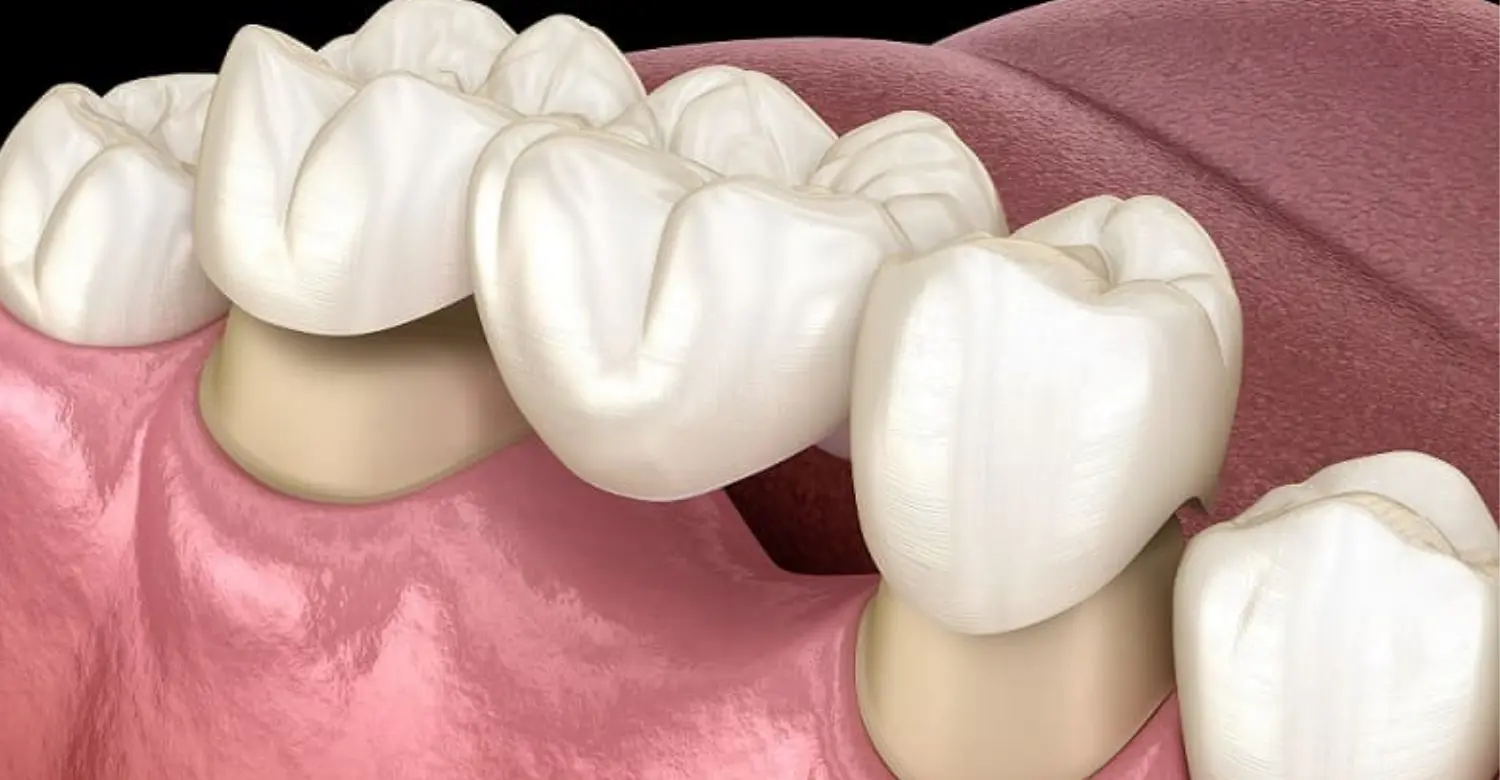
A cantilever bridge is a fixed dental restoration used to replace a missing tooth. It is used when support is available on only one side of the space. Unlike a conventional dental bridge, it does not use supporting teeth on both sides. Instead, a cantilever design extends outward from its abutment.
For example, a front tooth may be missing with only one suitable neighboring tooth available for support. In this case, a cantilever bridge may be considered. The artificial tooth extends into the empty space. Meanwhile, the adjacent tooth carries the restorative load.
The design can be conservative in selected cases. However, its mechanical behavior differs from that of a conventional bridge. Because the artificial tooth extends beyond the supporting structure, biting forces can create a lever effect. A longer extension and greater biting force lead to a greater mechanical challenge.
This is why a cantilever bridge should not be selected simply as a convenient way to replace a missing tooth.
Why Is a Dental Cantilever Bridge Not Recommended?
The primary concern is biomechanical loading. A conventional bridge distributes chewing forces across multiple supporting teeth. In contrast, a cantilever bridge places more functional demand on its single abutment.
When a patient bites on the artificial tooth, the force creates rotational stress around the supporting tooth. This is commonly described as a cantilever bridge lever arm torque. The force is not directed purely through the supporting tooth's long axis. Instead, part of the force produces a tipping or rotational effect.
Over time, excessive loading may contribute to:
Loss of retention
Abutment tooth mobility
Fracture of the supporting tooth
Damage to the restoration
Recurrent decay around the abutment
Periodontal complications
Changes in the patient's bite
Repeated need for repair or replacement
Long-term evidence on cantilever fixed partial dentures reports frequent technical and biological complications. These include loss of retention and abutment-related problems.
However, this does not mean every cantilever bridge will fail. Case selection is critical.
How Does the Cantilever Lever Effect Work?
The mechanical problem relies on a simple principle: leverage increases as force is applied farther from its supporting point.
When a patient bites directly on a cantilevered artificial tooth, the restoration acts like a short lever. The supporting tooth becomes the primary point where force transfers.
This creates additional torque around the abutment.
The risk becomes more significant when:
The artificial tooth is relatively long or extends far from the abutment.
The supporting tooth has reduced periodontal support.
The patient has strong biting forces.
The patient grinds or clenches their teeth.
The bridge is positioned in a high-load posterior area.
The occlusion is unfavorable.
The abutment tooth is already weakened.
The concept of single abutment bridge overloading is therefore central to understanding the limitations of cantilever restorations.
What Factors Increase the Risk of Cantilever Bridge Failure?
Not every patient carries the same risk. A healthy anterior tooth supporting a short cantilever behaves differently from a compromised posterior tooth carrying a large restoration.
Important factors include:
Abutment Tooth Strength
The supporting tooth needs adequate remaining tooth structure, periodontal support, root anatomy, and stability.
A tooth that is already cracked, heavily restored, mobile, or weakened by periodontal disease may not be an appropriate abutment.
Bite Force
High occlusal forces increase mechanical stress. Patients who grind or clench their teeth may place substantially greater demands on the restoration.
Location of the Missing Tooth
Posterior teeth generally experience substantial chewing forces. Therefore, extending a cantilever into a molar region can present greater biomechanical challenges than carefully selected anterior cases.
Periodontal Health
Healthy gums and supporting bones are important for any fixed restoration. If the abutment has periodontal disease or reduced bone support, adding additional functional demand can be problematic.
Restoration Design
The length of the cantilever, material selection, connector dimensions, occlusal contacts, and overall prosthetic design can all influence performance.
Ideal Clinical Indications: When Are Cantilever Bridges Still Reserved?
Although a cantilever bridge is not always the preferred restoration, it can still have a place in carefully selected patients.
An appropriate case may involve a missing anterior tooth, a strong and healthy abutment, favorable occlusion, adequate periodontal support, and a limited functional demand.
At the Vitrin Clinic, these factors are assessed together before treatment is recommended.
Dr. Rifat Alsaman, Head of the Medical Team at Vitrin Clinic and a cosmetic dentist, emphasizes that the question should not simply be whether a cantilever bridge can be placed. The more important question is whether the supporting tooth can safely tolerate the additional functional demand over time.
Anterior Teeth vs. Posterior Molars: Managing Bite Forces
The location of the missing tooth matters considerably.
Anterior teeth generally have different functional demands from posterior teeth. A carefully planned anterior cantilever bridge may be considered in selected circumstances, particularly when aesthetics and limited functional loading are important.
Posterior molars, however, are exposed to substantial chewing forces. A cantilever restoration replacing a posterior tooth can therefore place considerable stress on the single supporting abutment.
This does not establish one universal anterior cantilever bridge success rate, because outcomes depend on the individual case, design, materials, occlusion, follow-up, and study population.
Dr. Rifat Alsaman recommends evaluating the patient's bite and supporting tooth rather than relying on a general success percentage.
Anatomic Limitations: Missing Adjacent Anchor Teeth or Insufficient Bone Depth
Sometimes a cantilever bridge is considered because there is no suitable tooth on the opposite side of the missing space.
However, the absence of another anchor tooth does not automatically make a cantilever the best option.
The clinician must evaluate:
Root structure
Remaining tooth structure
Periodontal attachment
Bone support
Tooth position
Occlusal contacts
Available restorative space
Aesthetic requirements
When bone volume is inadequate for an implant, additional treatment may sometimes be required before implant placement. In other cases, a conventional bridge or another restoration may be more appropriate.
Cantilever Bridge vs. Traditional Bridge vs. Dental Implant
When comparing treatment options, patients should consider more than the initial cost.
A conventional bridge generally obtains support from adjacent teeth on both sides of the missing space. An implant, by contrast, provides independent support within the jaw and does not require a neighboring natural tooth to serve as the primary abutment.
A cantilever bridge relies on one-sided support.
Therefore, a cantilever bridge vs implant comparison should consider:
Factor | Cantilever Bridge | Traditional Bridge | Dental Implant |
Main support | One-sided tooth support | Usually two or more abutments | Implant in bone |
Adjacent tooth preparation | Often required | Required | Usually not required |
Surgery | Usually no | No | Yes |
Bone integration | No | No | Yes |
Mechanical loading | Concentrated on abutment | Distributed between abutments | Supported by implant |
Treatment time | Often shorter | Often shorter | Usually longer |
Long-term planning | Highly case-dependent | Case-dependent | Case-dependent |
The appropriate treatment depends on individual anatomy and clinical circumstances.
Cost, Longevity, and Biological Impact Comparison
A lower initial treatment cost does not necessarily mean a restoration will be the most economical over its entire lifespan.
A cantilever bridge can be relatively straightforward in selected cases, but repeated loosening, fracture, abutment problems, or replacement can increase the total treatment burden.
Conventional bridges may distribute forces more effectively but generally require preparation of supporting teeth.
Implants require surgical treatment and adequate bone conditions, but they provide independent support for the replacement tooth.
At Vitrin Clinic, Dr. Rifat Alsaman and the clinical team consider both short-term treatment requirements and long-term biological consequences before recommending a restoration.
The objective is not simply to replace a missing tooth. It is to achieve an appropriate balance between function, aesthetics, periodontal health, tooth preservation, and long-term stability.
Cantilever Bridge Bone Loss Risks
Bone loss following tooth loss is a complex biological process and should not automatically be attributed to the cantilever itself.
A cantilever bridge does not replace a natural tooth root inside the missing-tooth area. Consequently, it does not provide the same type of root-level support as an implant.
The more immediate concern with a tooth-supported cantilever is excessive loading of the abutment and its supporting periodontal tissues.
If the supporting tooth has already experienced bone loss, periodontal disease, or mobility, additional forces may make its prognosis less favorable.
This is why cantilever bridge bone loss risks should be considered alongside periodontal health rather than evaluated independently.
Complications Management: What to Do If a Cantilever Bridge Loosens or Fails
A loose cantilever bridge should be examined by a dentist rather than repeatedly pushed back into place.
A loose restoration may result from:
Cement failure
Excessive occlusal forces
Abutment decay
Tooth fracture
Restoration fracture
Periodontal deterioration
Poor fit
Repeated mechanical stress
The restoration may still be repairable, but the cause of the failure needs to be identified first.
At Vitrin Clinic, the supporting tooth and restoration can be assessed to determine whether the bridge remains suitable or whether a different replacement strategy should be considered.
Recementation vs. Replacement Protocols
Recementation can sometimes be appropriate when the bridge is intact, the abutment remains healthy, and the original cause of loosening has been addressed.
However, repeated recementation is not necessarily a long-term solution.
If the supporting tooth has developed decay, fracture, mobility, periodontal problems, or significant structural damage, replacing the restoration may be more appropriate.
Patients searching for repairing loose cantilever bridge treatment should therefore avoid relying on temporary home solutions.
Dr. Rifat Alsaman recommends identifying the underlying mechanical or biological cause before deciding whether recementation or replacement is appropriate.
What We Notice Clinically
Clinically, Dr. Rifat Alsaman, Head of the Medical Team at Vitrin Clinic and a cosmetic dentist, emphasizes that the main concern with a cantilever bridge is the additional stress placed on the supporting tooth. A bridge may look stable while the abutment is gradually experiencing excessive loading. At Vitrin Clinic, dentists assess the abutment tooth, periodontal support, bite forces, restoration fit, and surrounding tissues during follow-up examinations. Early signs such as bridge movement, repeated loosening, changes in the bite, gum inflammation, or discomfort when chewing should be evaluated promptly. Regular monitoring can help identify mechanical or biological problems before they progress to significant damage or require more extensive restorative treatment.
Early Warning Signs That Need Attention
Dr. Rifat Alsaman, Head of the Medical Team at Vitrin Clinic and a cosmetic dentist, notes that one of the most important clinical considerations is how the supporting tooth behaves over time.
A patient should arrange an examination if they notice:
Movement of the bridge
A change in the bite
Repeated loosening
Pain when chewing
Gum inflammation around the abutment
Sensitivity around the supporting tooth
Cracks or visible damage
Food repeatedly becoming trapped around the restoration
Importantly, the absence of pain does not necessarily mean that the supporting tooth is healthy.
At Vitrin Clinic, clinical examination and dental imaging may be used when appropriate to assess the restoration, abutment, periodontal tissues, and surrounding structures.
Tips for Patients
Patients with a cantilever bridge can take several practical steps to protect their restoration and supporting tooth.
Maintain Daily Oral Hygiene
Brush twice daily with fluoride toothpaste and carefully clean around the supporting tooth and bridge.
Interdental cleaning is particularly important because plaque can accumulate around bridge margins and beneath areas that are difficult to access with a normal toothbrush.
Avoid Excessive Forces
Do not use the bridge to bite ice, pens, fingernails, or other hard objects. Patients who grind or clench their teeth should discuss this with their dentist because excessive occlusal forces can increase mechanical stress.
Attend Regular Dental Examinations
Routine examinations allow the dentist to monitor the supporting tooth, gums, restoration, and bite.
Report Movement Quickly
If the bridge feels loose, do not wait for it to fall out. Early evaluation may make it easier to identify and manage the underlying problem.
Dr. Rifat Alsaman of Vitrin Clinic emphasizes that maintenance is especially important when a restoration depends heavily on one supporting tooth.
When Is a Cantilever Bridge a Better Choice Than an Implant?
A cantilever bridge is not automatically better or worse than an implant for every patient.
It may be considered when the clinical circumstances are favorable, particularly when a short anterior restoration can be supported by a healthy abutment and the patient has suitable occlusion.
An implant may be preferable when independent support is desired and the patient's bone and overall oral conditions allow implant treatment.
The decision should consider:
Bone availability
Gum health
Abutment condition
Bite forces
Tooth location
Aesthetic expectations
Treatment time
Long-term maintenance
Patient preferences
At Vitrin Clinic, Dr. Rifat Alsaman evaluates these factors before recommending a treatment option.
Is a Cantilever Bridge Always a Bad Option?
No. A cantilever bridge is not inherently unsuitable.
The key issue is case selection.
Evidence shows that cantilever fixed partial dentures can function successfully in selected circumstances, but long-term studies have also reported biological and technical complications. One systematic review found an estimated 10-year survival of 81.8% for cantilevered fixed partial dentures, with loss of retention and loss of vitality among notable complications.
Therefore, the correct clinical approach is not to reject every cantilever bridge automatically. Instead, dentists should determine whether the abutment, occlusion, restoration design, tooth location, and periodontal conditions provide an acceptable risk profile.
Final Thoughts: Why Is a Dental Cantilever Bridge Not Recommended?
So, why is a dental cantilever bridge not recommended? The primary reason is that its one-sided design can concentrate functional forces on the supporting tooth and create a lever effect. This can increase the risk of loosening, abutment damage, fracture, and other biological or technical complications.
Nevertheless, a cantilever bridge can still be appropriate for carefully selected patients, especially when the restoration is short, the supporting tooth is strong, periodontal health is favorable, and occlusal forces are controlled.
The best treatment is not necessarily the newest or most expensive option. It is the option that fits the patient's anatomy, oral health, functional requirements, aesthetic expectations, and long-term goals.
At Vitrin Clinic, Dr. Rifat Alsaman, Head of the Medical Team and a cosmetic dentist, approaches restorative treatment with these factors in mind. A comprehensive examination allows the clinical team to determine whether a cantilever bridge, conventional bridge, dental implant, or another restoration offers the most appropriate solution for the individual patient.
Reference
FAQs

Dr. Rifat Alsaman has more than 5 years of clinical experience in dentistry and currently serves as the Head of the Medical Team at Vitrin Clinic. He is dedicated to providing exceptional patient care, overseeing treatment planning, and ensuring the highest clinical standards across the team. His expertise, attention to detail, and commitment to continuous professional development have helped countless patients achieve healthier, more confident smiles.


