General Dentistry
October 1, 2026
Why Does My Jaw Hurt on One Side? Causes, Relief, and When to Seek Care
 Dr. Rifat Alsaman
Pain on one side of the jaw can come from dental, muscular, joint, sinus, nerve, or salivary causes. Jaw Hurt on One Side may begin suddenly or build gradually over several days. Timing, triggers, and related symptoms offer useful clues, but location alone cannot confirm the source. Some causes are minor, while others need prompt care. Vitrin Clinic evaluates the teeth, gums, jaw muscles, and joints together. This article explains causes, diagnosis, treatment, home relief, warning signs, prevention, and costs.
What Does Jaw Hurt on One Side Mean?
Jaw Hurt on One Side means discomfort felt mainly around one side of the lower face. It may involve the jawbone, teeth, joint, gums, or nearby tissues. The pain can feel aching, sharp, throbbing, burning, or pressure-like. Chewing, speaking, yawning, or touching the area may make it worse.
What Is One-Sided Jaw Hurt?
One-sided jaw pain is discomfort that feels clearly stronger on the right or left side. It may stay localized or spread toward the ear, temple, cheek, or neck. Joint disorders often worsen with opening or chewing. Dental infections usually cause persistent pain with swelling or biting sensitivity.
Where Can Jaw Hurt Be Felt?
Discomfort can occur over the jaw joint, cheek, lower jaw, or near individual teeth. The temporomandibular joint sits just in front of each ear. Muscle pain may spread toward the temple. Sinus inflammation can add pressure around the upper jaw. Salivary problems may cause pain beneath the tongue or jaw.
Why the Exact Location and Pattern of Pain Matter
The behavior of pain helps narrow the possible causes. Chewing pain may point to teeth, muscles, or joints. Hot or cold triggers suggest tooth sensitivity or pulp inflammation. Pain during meals may indicate a salivary blockage. Brief electric-shock sensations suggest a nerve problem. Swelling, fever, or bad taste raises concern for infection.
What Are the Most Common Jaw Hurt on One Side Causes?
Many problems can lead to Jaw Hurt on One Side, and several may occur together. Common causes include temporomandibular disorders, tooth decay, dental infection, gum disease, bruxism, sinusitis, and wisdom teeth. Less common causes include nerve disorders, salivary stones, arthritis, trauma, and jawbone infection. NIDCR describes more than 30 TMD-related conditions.
Temporomandibular Joint and Muscle Disorders
Temporomandibular disorders affect the joints connecting the lower jaw to the skull. They can also involve the muscles that control chewing. Symptoms include pain, stiffness, limited opening, painful clicking, or locking. Pain may spread toward the ear, temple, or neck.
Jaw joint pain near the ear
The temporomandibular joint sits immediately in front of the ear canal. Pain from this joint can feel very similar to an earache. It often increases while chewing or opening the mouth. Vitrin Clinic reviews the full symptom pattern before linking ear-area pain to the joint.
Pain when chewing, yawning, or opening the mouth
Jaw movement increases the workload on the chewing muscles and joints. Pain on chewing or yawning therefore suggests a muscle or joint problem. A painful tooth can behave similarly when biting presses on it. Limited opening may come from joint inflammation or a dental abscess. Persistent movement-related pain deserves clinical assessment.
Jaw stiffness, clicking, popping, or limited movement
Stiffness may develop when jaw muscles stay tense or the joint becomes irritated. NIDCR states that painless joint sounds are common and usually need no treatment. Painful clicking is different because it suggests tissue irritation. Repeated locking that limits opening or closing should be assessed.
Dental Problems Causing Jaw Hurt
Dental problems can create pain that seems to come from deep inside the jaw. Decay, pulp inflammation, cracks, abscesses, wisdom teeth, and gum disease all cause localized discomfort. Pain may worsen with biting, temperature, or pressure. Infection can add swelling, fever, or a bad taste.
Toothache and Jaw Hurt
A toothache can spread into the jaw through shared facial nerve pathways. Patients may describe a tooth problem as general jaw pressure. Deep decay can hurt without visible damage, and cracks cause sharp biting pain. In many cases of Jaw Hurt on One Side, a single tooth is the hidden source.
Cavities and deep tooth decay
Early cavities often cause no pain at all. Deeper decay may react to sweets, cold drinks, or hot foods. Advanced decay can irritate the pulp and cause lasting pain. Bacteria may eventually spread beyond the root tip. WHO highlights fluoride, plaque control, and less free sugar as key prevention measures.
Tooth abscess and dental infection
A dental abscess is a pocket of pus caused by bacterial infection. Symptoms include intense pain, swelling, bad taste, fever, and difficulty chewing. NHS states that an abscess needs urgent treatment and will not resolve alone. ADA guidance favors definitive dental treatment over antibiotics for many localized infections. Breathing or swallowing difficulty requires emergency care.
Wisdom teeth and impacted teeth
Wisdom teeth can hurt when impacted, partly erupted, or surrounded by inflamed gum tissue. Trapped food increases irritation at the back of the jaw. Pain may spread toward the ear or nearby molars. Wisdom tooth inflammation frequently causes Jaw Hurt on One Side in young adults.
Gum disease and inflamed gums
Inflamed gums can become tender, swollen, or prone to bleeding. Periodontal disease affects the tissues supporting the teeth. WHO describes swollen or bleeding gums as common signs of this disease. Tenderness often becomes noticeable during chewing or brushing. A dental assessment checks gum pockets, plaque, calculus, and tooth stability.
Jaw Hurt From Teeth Grinding and Teeth Clenching
Grinding and clenching can overload the muscles and joints used for chewing. Discomfort may feel stronger on one side when muscle activity is uneven. Symptoms often appear after waking or during stress. Bruxism is a common, often overlooked cause of Jaw Hurt on One Side.
How bruxism can strain the chewing muscles and jaw
Bruxism adds repeated muscle activity far beyond normal chewing. Muscles may become fatigued, sore, or sensitive. The joints also carry extra load during grinding. Teeth may show flattening or wear from repeated contact. However, infection or joint disorders can coexist with grinding, so assessment remains important.
Signs of daytime or nighttime clenching
Daytime clenching often happens during concentration, driving, or stressful work. Nighttime grinding may be noticed by a partner or felt as morning soreness. Other signs include worn teeth, chipped fillings, headaches, and tired cheek muscles. Vitrin Clinic may ask about sleep, daily habits, and morning discomfort.
Jaw Hurt From Sinusitis
Sinus inflammation can create pressure in the upper face and upper jaw. The roots of upper back teeth often sit close to the maxillary sinus. Sinus pressure may therefore feel like tooth or jaw pain. It usually affects several upper teeth and accompanies congestion.
How sinus pressure can affect the upper jaw and teeth
Inflammation in the maxillary sinus can press near the roots of upper premolars and molars. Patients often describe a dull ache across several upper teeth. Strong hot or cold sensitivity is less typical of sinus pressure. Correctly identifying the source helps avoid unnecessary dental procedures.
Clues that suggest sinus-related rather than dental pain
Sinus discomfort often comes with congestion, nasal discharge, or a recent cold. Several upper teeth may ache together, and bending forward may worsen it. Dental pain is usually tied to one tooth, biting, or temperature. A sinus infection and a dental problem can exist together, so unclear cases need evaluation.
Trigeminal Neuralgia and Nerve-Related Jaw Hurt
Trigeminal neuralgia causes sudden attacks of severe facial pain along the trigeminal nerve. It usually affects one side and may involve either jaw. NHS describes the attacks as sharp, shooting, or like an electric shock. Eating, speaking, brushing teeth, or touching the face can trigger them.
Sudden, sharp, or electric-shock-like facial pain
Nerve-related facial pain usually starts abruptly and stops just as suddenly. Light contact or ordinary activities can set off an attack. Attacks may repeat over days, weeks, or months. A mild ache may remain between attacks. When such pain recurs without dental findings, neurological causes should be considered.
How nerve pain differs from tooth or jaw joint pain
Nerve pain comes as brief, intense attacks with a stabbing quality. Tooth pain is often steady, throbbing, or worse with biting and temperature. TMD pain tends to follow jaw movement and muscle tension. None of these differences is definitive alone. Repeated shock-like attacks with normal dental tests may need neurological assessment.
Salivary Gland Stones
Salivary gland stones can block saliva flow and cause intermittent mouth or jaw pain. They most often form in glands beneath the lower jaw. The NHS reports pain and swelling strongly linked to eating. A blocked gland can explain Jaw Hurt on One Side that returns at mealtimes. Never use sharp objects to remove a suspected stone.
Jaw or mouth pain that worsens around meals
Eating stimulates the glands to produce more saliva. If a stone blocks the duct, saliva builds up behind it. This pressure causes pain that starts during meals and may linger. Tooth pain can also appear while eating, but swelling patterns differ. Recurrent mealtime episodes deserve evaluation.
Swelling, tenderness, and reduced saliva flow
A blocked duct may cause swelling inside the mouth or beneath the jaw. The gland may feel tender, and the mouth may feel dry. Infection can add redness, pus, or fever. NHS advises professional assessment when a stone persists or becomes infected.
Osteomyelitis and Other Jawbone Conditions
Jawbone infection, called osteomyelitis, is uncommon but can cause persistent pain, swelling, or fever. It may follow dental infection, trauma, or surgery. The pain often feels deeper than ordinary tooth sensitivity. Imaging is usually needed when bone involvement is suspected. Complex cases may need referral to oral and maxillofacial specialists.
Jaw Injury, Muscle Strain, Arthritis, and Other Less Common Causes
A blow to the face can injure the jawbone, teeth, ligaments, or muscles. Repetitive chewing can strain muscles without a major injury. Arthritis may affect the joint, causing stiffness and restricted movement. These causes matter when Jaw Hurt on One Side lacks an obvious dental reason. Deformity, bleeding, or inability to close the mouth needs urgent assessment.
How Can You Tell What Is Causing One-Sided Jaw Hurt?
Finding the cause requires looking beyond where the pain is felt. Timing, quality, triggers, and related symptoms all add information. Tooth problems often cause temperature or biting pain. TMD usually causes movement-related discomfort. Tracking these patterns makes Jaw Hurt on One Side easier to explain during a consultation.
Does the Pain Start in a Tooth or in the Jaw Joint?
Many patients struggle to tell whether pain starts in a tooth or the joint. Tooth pain often reacts to biting, cold, heat, sweets, or tapping. Joint pain usually changes with opening, chewing, or yawning. An examination compares individual teeth and both joints. Treating the wrong source leaves symptoms unresolved.
What Does a Jaw Hurt From a Tooth Usually Feel Like?
Dental pain can feel sharp, throbbing, dull, or sensitive to temperature. Pulp inflammation may cause pain that lingers after hot or cold foods. Cracked teeth may hurt when biting down or releasing. Tooth-related Jaw Hurt on One Side often spreads, hiding the exact tooth. Clinical tests and imaging help locate it.
What Does TMJ-Related Jaw Hurt Usually Feel Like?
TMD-related pain usually changes with jaw movement. Chewing, yawning, or opening wide can make it worse. Pain may involve the joint, muscles, temple, or neck. Stiffness, locking, and painful clicking are common. A painless click alone is not necessarily a disease.
What Does Sinus-Related Jaw Hurt Feel Like?
Sinus-related pain often feels like pressure or a dull ache in the upper teeth and cheek. Several upper teeth may seem affected at once. Congestion or a recent cold adds supporting clues. One tooth reacting strongly to cold deserves separate dental evaluation.
What Does Trigeminal Neuralgia Jaw Hurt Feel Like?
Trigeminal neuralgia causes brief episodes of severe, stabbing, or shock-like pain. Attacks usually affect one side and last seconds to about two minutes. Talking, shaving, eating, or brushing teeth may trigger them. Normal dental findings with continuing attacks suggest neurological assessment.
What Does Jaw Hurt From Teeth Grinding Feel Like?
Grinding pain often feels like soreness, fatigue, or a steady ache. It may be stronger after waking or long concentration. The cheeks and temples can feel tired or tender. Visible tooth wear may also be present. Clinicians check other causes before blaming grinding alone.
How Swelling, Heat, Tenderness, and Pain With Biting Can Provide Clues
Swelling often changes how urgent jaw symptoms are. Heat and tenderness near a tooth suggest inflammation or infection. Biting pain may mean the tissues around a root are inflamed. NHS lists swelling, fever, bad taste, and limited opening as abscess symptoms. Rapidly spreading swelling needs urgent care.
What Symptoms Can Occur With Jaw Hurt on One Side?
Additional symptoms often reveal more than pain intensity alone. People may notice tenderness, tooth sensitivity, swelling, clicking, headache, ear discomfort, fever, or sudden nerve-like attacks. Jaw Hurt on One Side combined with facial swelling deserves more attention than mild isolated soreness. NIDCR notes that TMD may involve stiffness, limited movement, painful joint sounds, and pain spreading to the neck. Duration also matters. Muscle irritation may settle within days, while dental infections usually worsen without treatment. Salivary stones and trigeminal neuralgia often cause repeated episodes. Jaw Hurt on One Side that persists, recurs, or worsens should be assessed rather than repeatedly masked.
Jaw Tenderness and Soreness
Tenderness may involve the chewing muscles, the joint, the gums, or tissues around a tooth. Muscle tenderness often worsens after clenching or long chewing. Joint tenderness becomes clearer when pressing near the ear or moving the jaw. Dental tenderness usually increases when one tooth is tapped or pressed. Comparing both sides shows where Jaw Hurt on One Side truly begins.
Pain While Chewing or Biting
Chewing pain can come from a tooth, gum, joint, or muscle. One painful tooth often becomes noticeable as soon as pressure is applied. Cracked teeth may cause sharp biting pain, while inflamed root tissues cause deeper pressure. Biting pain that keeps returning alongside Jaw Hurt on One Side may indicate a treatable dental problem.
Tooth Sensitivity or Toothache
Sensitivity may come from exposed dentin, decay, cracks, gum recession, or irritated pulp. Cold sensitivity that fades quickly differs from pain that lingers. Lingering thermal pain can indicate deeper pulp inflammation. Vitrin Clinic assesses the tooth and supporting tissues instead of assuming every jaw symptom comes from the joint.
Clicking, Popping, or Locking of the Jaw
Clicking and popping are common jaw sounds. When there is no pain or functional problem, these sounds may need no treatment. NIDCR states that painless clicking or popping can be normal. Painful sounds and repeated locking deserve evaluation because they can occur with TMD.
Facial or Jaw Swelling
Swelling can come from dental infection, gum inflammation, salivary blockage, trauma, or other conditions. A swollen cheek should not be assumed to be a simple joint problem. NHS identifies facial or jaw swelling as an important abscess symptom. Swelling with Jaw Hurt on One Side calls for prompt assessment. Breathing or swallowing difficulty is an emergency warning sign.
Headache, Ear Pain, or Facial Pain
Jaw disorders can send pain toward the temple, ear, cheek, or neck. TMD is therefore sometimes mistaken for an ear problem or a primary headache. Dental infection can also cause referred facial discomfort. Trigeminal neuralgia may cause severe facial attacks involving the jaw or teeth.
Fever, Bad Taste, or Other Signs of Infection
Fever and feeling unwell can suggest that an infection is spreading. A bad taste may occur when pus drains into the mouth from an abscess. Gum or facial swelling often accompanies dental infection. ADA guidance indicates that systemic signs can change antibiotic decisions.
Sudden Shooting or Electric-Shock-Like Pain
Brief shock-like attacks suggest a nerve-related pattern when no dental cause is found. Trigeminal neuralgia can produce repeated episodes affecting one side. Brushing, eating, speaking, or touching the face may trigger them. This differs from the steady pressure of most dental infections.
What Can Increase the Risk of One-Sided Jaw Hurt?
Risk rises when teeth, gums, muscles, or joints face repeated stress or inflammation. Clenching, grinding, untreated decay, gum disease, trauma, and wisdom tooth problems can all contribute. Previous TMD may increase the chance of recurrence. Poor oral hygiene raises the risk of dental disease. WHO emphasizes plaque control, fluoride, less free sugar, and avoiding tobacco.
Teeth Clenching and Teeth Grinding
Repeated clenching increases chewing muscle activity. Grinding adds tooth contact and extra mechanical loading. Symptoms often worsen during stress or after waking. Some people clench without grinding, so tooth wear may be absent. NIDCR includes reducing jaw clenching among conservative TMD measures. Oral appliances may suit selected patients after clinical assessment.
Dental Decay, Previous Dental Problems, and Gum Disease
Untreated decay can reach the pulp and cause significant pain. Older restorations can crack, leak, or develop new decay. Gum disease can inflame the tissues supporting the teeth. These conditions often cause Jaw Hurt on One Side that spreads beyond one tooth.
Wisdom Teeth and Changes in the Bite or Jaw Function
Impacted or partly erupted wisdom teeth can inflame the back of the mouth. Bite changes may alter how chewing forces are distributed. Not every bite difference causes symptoms, but a new change with pain deserves assessment. Imaging adds information when a wisdom tooth or structural problem is suspected.
Jaw Injury or Repetitive Strain
Facial injuries can damage teeth, bone, ligaments, or muscles. Sports impacts, falls, and accidents can cause localized pain. Repetitive habits can also overload the jaw without one clear injury. Excessive gum chewing and wide opening may aggravate irritated tissues. After injury, an altered bite or restricted movement needs professional assessment.
Stress, Sleep-Related Bruxism, and Muscle Tension
Stress can increase daytime clenching and awareness of jaw tension. Sleep-related bruxism may cause morning soreness and tooth wear. However, stress should not be assumed to be the only cause. Vitrin Clinic considers habits alongside physical findings when assessing muscular jaw symptoms.
Previous Temporomandibular Joint Problems
Earlier TMD symptoms can return when muscle or mechanical triggers remain. A history of locking, painful clicking, or jaw injury provides useful context. NIDCR describes TMD as a group of conditions rather than one disorder. Each new episode of Jaw Hurt on One Side therefore deserves fresh evaluation.
What We Notice Clinically
In practice, the same symptom can reflect very different problems. Patients usually describe pain by location rather than behavior. Yet movement, temperature, pressure, timing, and swelling often give stronger clues. One person may have muscle soreness, while another has an infected tooth. Vitrin Clinic focuses on finding the probable source before planning treatment.
Why the Same Jaw Hurt Can Have Very Different Causes
Pain is a protective signal, not a diagnosis. Different tissues share overlapping sensory pathways in the face. Dental, joint, muscle, sinus, and nerve signals can feel alike. Two patients describing Jaw Hurt on One Side may need completely different treatment. One may need root canal care, while another needs conservative TMD management.
Common Patient Patterns When Pain Is Confused With Toothache
Patients often blame the nearest tooth for facial pain. This happens especially when the pain is deep, intermittent, or hard to locate. TMD, sinus pressure, and trigeminal neuralgia can all feel dental. Vitrin Clinic checks how teeth respond to testing before recommending definitive procedures.
Why Pain Location Alone Does Not Always Identify the Source
Several nerves supply nearby teeth, muscles, joints, and facial tissues. Referred pain can therefore send misleading location signals. A painful joint may feel like an ear problem. Sinus pressure may feel like upper tooth pain. A nerve disorder may cause severe pain in a healthy tooth.
Why a Painful TMJ Should Be Distinguished From a Painless Jaw Click
A painless jaw click is common and often needs no treatment. NIDCR advises that painless clicking and popping can be normal. A painful click is different because it may signal irritation or dysfunction. Locking or limited opening adds further clinical significance.
Clinical Note
A useful clinical question is whether the pain has a consistent trigger. Biting pain suggests a tooth problem. Pain with repeated jaw movement suggests muscle or joint involvement. Meal-related swelling points toward a salivary blockage. Electric-shock attacks suggest a nerve mechanism. At Vitrin Clinic, these clues are always confirmed through examination and appropriate imaging.
How Is Jaw Hurt on One Side Diagnosed?
Diagnosis begins with a detailed history and physical examination. The clinician asks about onset, duration, triggers, location, related symptoms, and past dental problems. Teeth and gums are examined individually when a dental source is possible. The jaw joints and muscles are checked for tenderness and movement problems. Dental X-rays, panoramic images, or CBCT may be added when needed.
Medical and Dental History
A detailed history establishes the sequence of symptoms. The clinician may ask whether pain began after a filling, extraction, injury, or illness. Questions about grinding, headaches, ear symptoms, swelling, and fever add further clues. Vitrin Clinic uses these details to choose relevant tests rather than ordering everything.
When the pain started and whether it is constant or intermittent
Onset and duration help separate different patterns. Sudden shock-like attacks suggest a different pathway than a continuous ache. Pain starting after trauma raises separate concerns. Gradual pain may accompany decay, muscle strain, or joint irritation. Intermittent meal-related episodes can suggest a salivary blockage.
What triggers or relieves the pain
Triggers provide valuable diagnostic clues. Cold or heat may provoke tooth sensitivity. Biting can stress an inflamed tooth. Chewing and yawning may aggravate muscles or joints. Noting triggers for Jaw Hurt on One Side helps the clinician choose the right tests.
Whether the pain spreads to the ear, temple, neck, teeth, or face
Pain spread reveals shared sensory pathways. TMD can radiate toward the face, temple, neck, or ear. Dental pain often spreads into the surrounding jaw. Trigeminal neuralgia follows specific facial regions depending on the nerve branch involved. Broad facial pain without dental findings may need assessment beyond dentistry.
Dental Examination and Evaluation of the Teeth and Gums
Dental evaluation may include visual inspection, gum assessment, tapping, bite testing, and vitality testing. The dentist looks for decay, cracks, faulty fillings, gum inflammation, abscesses, or wisdom tooth problems. Comparative testing often identifies a single painful tooth. Vitrin Clinic completes this evaluation before recommending any restorative, endodontic, or surgical treatment.
Jaw Joint and Muscle Examination
The clinician assesses the temporomandibular joints as the patient opens and closes the mouth. Chewing muscles are gently pressed to check for tenderness. Opening range may be measured when restriction is suspected. Joint sounds, deviation, and locking are also recorded.
Checking jaw movement and tenderness
The clinician observes whether the jaw opens smoothly or drifts to one side. Pain during opening can reflect joint or muscle problems. Reduced opening may come from inflammation, muscle guarding, or dental infection. Comparing both sides helps identify asymmetry. This part of the examination is usually quick and noninvasive.
Assessing clicking, popping, locking, and muscle soreness
Joint sounds are recorded together with any pain they cause. A painless click carries different weight than a painful one. Locking may indicate a functional restriction needing further assessment. Muscle soreness may reflect clenching, grinding, or repetitive chewing. Reproducing the patient's familiar pain during examination supports the suspected source.
When Dental X-Rays May Be Appropriate
Dental X-rays can reveal decay, root changes, bone loss, infection, and other hidden findings. They are not needed for every jaw pain complaint. A periapical image helps evaluate one tooth and its root. Bitewing images help detect certain types of decay. Unnecessary imaging adds cost and radiation without improving diagnosis.
When Panoramic Imaging or CBCT May Be Considered
Panoramic imaging gives a broad overview of the jaws, teeth, and surrounding structures. It helps evaluate wisdom teeth, larger lesions, and multiple dental areas. CBCT provides three-dimensional detail when standard images cannot answer the clinical question. Turkish 2026 dental tariffs list panoramic imaging and tomography as separate fees. CBCT should never be ordered simply because pain exists.
When Additional Medical or Neurological Assessment May Be Needed
Medical referral is appropriate when symptoms do not fit a dental or TMD explanation. Repeated electric-shock-like attacks may need neurological assessment. Unexplained swelling or persistent systemic symptoms may need medical evaluation. Sinus symptoms may require a physician when nasal disease dominates. Difficulty breathing, swallowing, or speaking requires emergency care.
Why Imaging Should Match the Suspected Cause
Different imaging methods answer different questions. A small dental X-ray may be enough for one tooth. Panoramic imaging gives broader jaw information, while CBCT shows three-dimensional relationships. MRI is more useful for selected soft-tissue and joint questions. Imaging should support clinical reasoning for Jaw Hurt on One Side, never replace it.
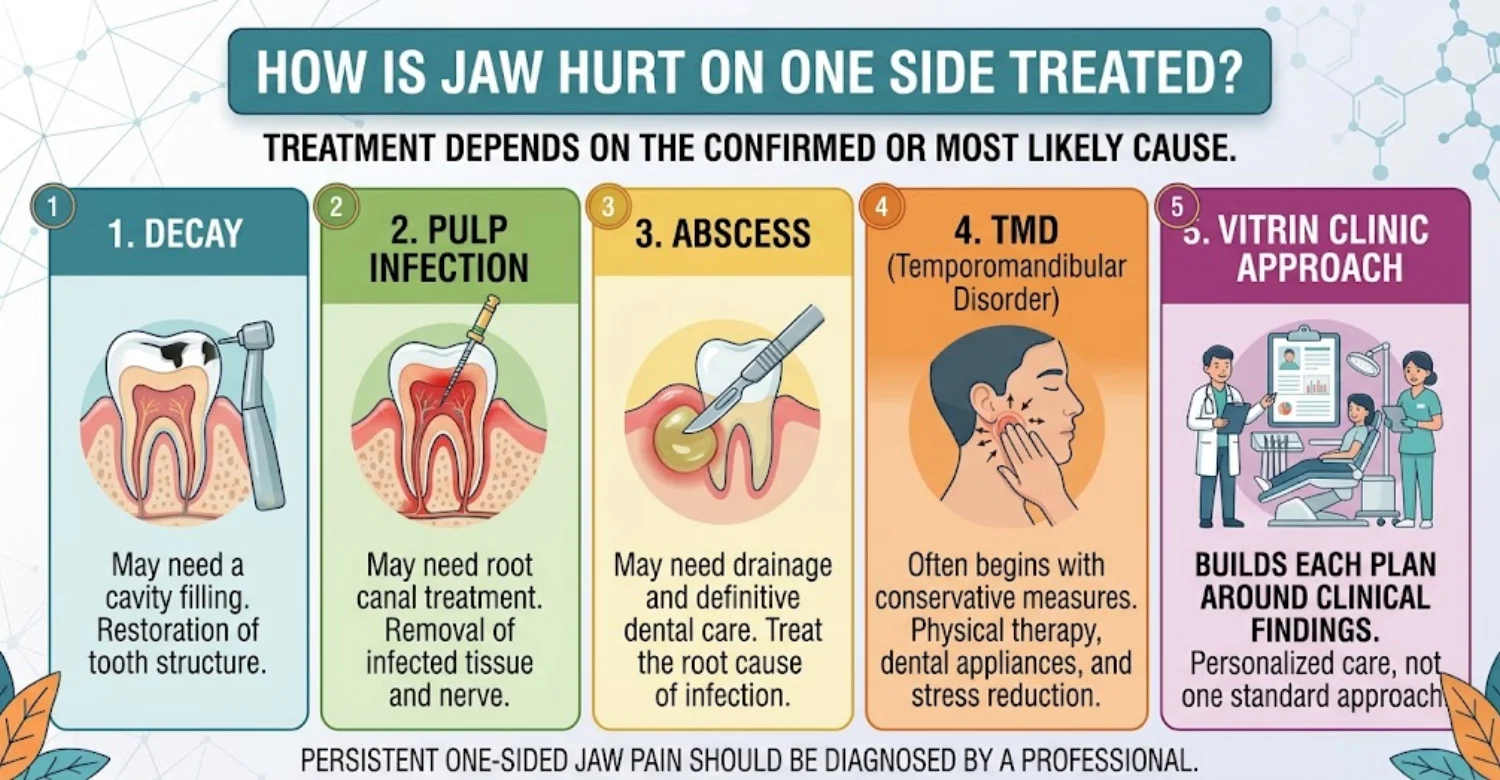
Treatment Depends on the Underlying Cause
The right treatment depends on which tissue causes the pain. A filling cannot treat a nerve disorder. An antibiotic cannot repair a cracked tooth. A mouthguard cannot replace treatment of a dental abscess. Accurate diagnosis therefore prevents unnecessary procedures. ADA guidance stresses definitive dental treatment, while NIDCR emphasizes conservative TMD care.
Treating Dental Problems Causing Jaw Hurt
Dental treatment depends on the specific diagnosis. Early decay may need a filling, and deep pulp inflammation may need root canal treatment. Teeth that cannot be restored may need extraction. Gum inflammation requires appropriate periodontal care. When a tooth causes Jaw Hurt on One Side, treating that tooth usually resolves the pain. The goal is removing the source, not only suppressing symptoms.
Cavities and tooth decay
Small cavities can often be treated with a simple filling. Larger lesions may need more extensive restoration. If decay reaches the pulp, root canal treatment may become necessary. Earlier treatment usually preserves more natural tooth structure. WHO recommends twice-daily brushing with toothpaste containing 1000 to 1500 ppm fluoride.
Tooth abscess and dental infection
A dental abscess requires definitive dental management. Treatment may include drainage, root canal treatment, or extraction. Antibiotics do not replace treatment of the source. ADA guidance reserves antibiotics for selected situations with systemic involvement. Severe swelling, fever, or airway symptoms require urgent care.
Wisdom teeth problems
Symptomatic wisdom teeth may be monitored, treated locally, or removed. Assessment considers tooth position, eruption status, surrounding tissues, and risk to neighboring teeth. Imaging helps evaluate impacted teeth and nearby anatomy. Removal is not automatically required for every wisdom tooth. Advice should be individualized to the examination findings.
Gum disease
Gum treatment depends on disease severity and the condition of supporting tissues. Professional cleaning removes plaque and calculus buildup. Deeper cleaning or other procedures may be needed when support is affected. Good home hygiene remains essential for lasting results. Vitrin Clinic evaluates gum health before restorative, cosmetic, or implant treatment.
Treating TMJ Disorders
Many TMD cases start with conservative care. NIDCR recommends softer foods, heat or cold, gentle exercises, and less clenching. Treatment varies depending on whether muscles, joints, or discs are mainly involved. Permanent changes to the bite should not be made casually. Persistent cases may need specific therapies or specialist referral.
Conservative care and jaw-rest strategies
Reducing chewing stress helps irritated muscles and joints recover. Softer foods lower repetitive loading during painful periods. Avoiding very wide openings also reduces strain. Gentle exercises and heat or cold may help selected patients. Conservative care should never delay evaluation of infection or significant swelling.
Managing clenching and grinding
Awareness is often the first step in reducing daytime clenching. Patients can check whether their teeth touch when they are not eating. Relaxing the jaw lowers unnecessary muscle activity. Reducing gum chewing also helps. Nighttime grinding may require dental assessment and sometimes an oral appliance.
Oral appliances when clinically appropriate
Oral appliances may help selected patients with bruxism or TMD symptoms. The right design depends on diagnosis, dental condition, and treatment goal. Appliances should be professionally fitted rather than bought blindly. A dentist monitors comfort, fit, and symptom response. An appliance should never mask an undiagnosed dental infection.
Treating Sinus-Related Jaw Hurt
When sinus disease is responsible, dental procedures will not solve the problem. Medical assessment suits patients whose congestion and facial pressure dominate. Management depends on whether the condition is infectious or inflammatory. Dental examination still matters when upper tooth pain is prominent. Coordinated care helps avoid unnecessary dental work.
Treating Trigeminal Neuralgia and Other Nerve-Related Pain
Trigeminal neuralgia is diagnosed from its characteristic pain pattern and clinical evaluation. Treatment is usually medical, often involving prescription neurological medicines. Dental treatment does not correct a primary nerve disorder. Imaging or neurological assessment may be considered when indicated. Patients with shock-like attacks and normal dental findings should seek neurological evaluation.
Treating Salivary Gland Stones or Jawbone Infection
Small salivary stones sometimes pass on their own. Persistent stones may need professional removal, and infection may need extra treatment. NHS warns against using sharp objects to remove a stone. Jawbone infections need targeted treatment guided by imaging. Complex cases may require oral and maxillofacial care.
When Specialist Referral or Further Treatment Is Appropriate
Referral is appropriate when symptoms persist despite initial care or the diagnosis remains unclear. Endodontists manage difficult pulp problems, and periodontists treat advanced gum disease. Oral surgeons handle complex jaw, wisdom tooth, and bone conditions. Vitrin Clinic can coordinate the relevant dental pathway when several disciplines are involved.
How Can You Get Jaw Hurt Relief at Home?
Short-term measures can make symptoms easier while you wait for professional care. However, home care does not treat every underlying cause. Softer foods, less gum chewing, and controlled opening can reduce strain. Heat or cold may give temporary comfort. ADA and CDC guidance supports suitable nonprescription pain relief for acute dental pain. Infection or swelling with Jaw Hurt on One Side still needs professional care.
Safe Short-Term Measures for Jaw Hurt Relief
Temporary measures should reduce strain without hiding warning signs. Choose softer foods and chew slowly. Avoid hard, sticky, or chewy foods while the jaw is painful. Rest the jaw without forcing unusual positions. If swelling increases, home care should not delay evaluation.
Choosing softer foods temporarily
Soft foods reduce the force needed for chewing. Good options include yogurt, eggs, soups, soft rice, and pasta. The aim is short-term comfort, not a permanent restricted diet. Very hot foods may irritate sensitive teeth. Ongoing inability to chew normally should prompt assessment.
Avoiding excessive chewing and wide mouth opening
Long chewing sessions can tire irritated jaw muscles. Gum chewing is especially repetitive and prolonged. Wide yawning can also strain the joint and muscles. Keeping movements controlled may reduce discomfort during painful periods. This advice suits suspected muscle or TMD symptoms, not infection.
Using heat or cold appropriately
Heat may soothe tense or sore muscles. A cold can reduce acute discomfort or mild swelling. Always protect the skin from direct contact with ice or very hot materials. NIDCR lists heat or cold among conservative TMD measures. Rapidly worsening swelling needs urgent care, not temperature therapy.
Reducing gum chewing and jaw-clenching habits
Gum chewing adds repeated demand on the chewing muscles. Clenching keeps muscles working even without food. Check during the day whether your teeth are touching. A relaxed jaw normally keeps the teeth slightly apart. NIDCR recommends reducing both habits for many TMD presentations.
Medical Tips for Managing Pain While Waiting for an Appointment
Write down when the pain occurs and what triggers it. Note any swelling, fever, bad taste, sensitivity, or movement problems. Bring a list of current medicines and previous dental procedures. Avoid taking extra medication simply because pain returns. If Jaw Hurt on One Side suddenly worsens, contact a dental or medical service promptly.
Over-the-Counter Pain Relief: What to Discuss With a Pharmacist or Clinician
Common options include acetaminophen and NSAIDs such as ibuprofen. ADA guidance states that NSAIDs, alone or with acetaminophen, can manage acute dental pain in patients aged 12 and over. Suitability depends on medical history, other medicines, allergies, pregnancy, and age. A pharmacist can check interactions and dose limits.
Possible Side Effects and Precautions of Common Pain Medicines
NSAIDs can irritate the stomach and may not suit some kidney, bleeding, heart, or pregnancy situations. Excess acetaminophen can harm the liver. Cold and flu products may already contain acetaminophen. People taking blood thinners should ask a pharmacist before using NSAIDs. Painkillers should never replace dental treatment.
What You Should Not Do to Treat Jaw Hurt Yourself
Do not assume antibiotics will cure every dental pain. Do not use leftover prescription medicines without guidance. Never place aspirin directly on a gum or tooth, because it burns soft tissue. Do not try to drain an abscess yourself. Persistent pain needs diagnosis, not repeated experimentation.
Avoiding sharp objects or unproven home treatments
Sharp objects can cut the gums and other oral tissues. They may also introduce bacteria into irritated areas. Salivary stones should never be dug out manually. Internet remedies may delay proper treatment. Safe home care focuses on comfort while arranging professional evaluation.
Avoiding unnecessary antibiotics or leftover prescription medicines
Antibiotics are not painkillers and do not fix most mechanical dental problems. ADA guidance advises against antibiotics for many localized tooth conditions. Using leftover medicines risks wrong treatment, side effects, and antibiotic resistance. Only a dentist or doctor should decide whether antibiotics are needed.
When Should You See a Dentist for Jaw Hurt?
See a dentist when pain persists, returns, or interferes with eating. Tooth sensitivity, biting pain, swelling, fever, or bad taste increase the need for assessment. The NHS recommends dental care for toothache lasting more than two days. Even mild but recurring Jaw Hurt on One Side deserves attention when the cause is unclear.
Jaw Hurt That Persists, Returns, or Interferes With Eating
Persistent pain should not be managed repeatedly without finding its cause. Recurring episodes may signal an unresolved dental, joint, sinus, nerve, or salivary problem. Difficulty eating can affect nutrition and daily life. NIDCR recognizes that some TMD conditions become persistent or recurrent. An assessment decides whether monitoring or treatment is appropriate.
Jaw Hurt With Toothache, Pain on Biting, or Dental Sensitivity
These symptoms make a dental source more likely. Cracks, decay, pulp inflammation, or gum problems can all cause biting or temperature pain. AAE describes sharp biting pain and lingering sensitivity as useful clinical patterns. A dentist can test teeth to locate the source. Prompt care may help save the affected tooth.
Jaw Hurt With Swelling, Fever, or Signs of Infection
Swelling and fever can signal an active infection. An abscess may cause facial swelling, bad taste, severe toothache, and high temperature. NHS states that dental abscesses require urgent dental treatment. Do not wait for swelling to disappear by itself. Airway symptoms require emergency medical attention.
When to Seek Urgent Dental Care
Urgent care is appropriate for severe pain, facial swelling, fever, or rapidly worsening symptoms. Significant difficulty chewing also deserves a same-day assessment. An abscess will not resolve on its own. Emergency dental services may be needed outside regular hours. Temporary relief from painkillers does not mean the problem has been resolved.
Emergency Warning Signs That Need Immediate Medical Attention
Some symptoms need immediate medical care rather than a routine dental visit. Breathing or swallowing problems can signal dangerous swelling. Major facial trauma may involve fractures or internal injury. Jaw discomfort with chest symptoms can represent a cardiac emergency. Seek emergency help immediately when such signs appear.
Difficulty breathing, swallowing, or speaking
Severe facial or neck swelling can spread into important airway spaces. Difficulty speaking may also indicate dangerous swelling. These symptoms must never be treated as ordinary dental pain. NHS advises emergency assessment when oral swelling affects breathing or swallowing. Go to emergency care immediately.
Severe facial, mouth, jaw, or neck swelling
Large or rapidly growing swelling may indicate spreading infection or serious injury. Swelling around the eye also needs urgent assessment. A dental abscess can produce swelling across the jaw or face. Speed of progression and related symptoms determine urgency. Severe swelling should never be treated with painkillers alone.
Serious facial or jaw injury
A strong facial impact can fracture the jaw, damage teeth, or injure surrounding tissues. Warning signs include altered bite, inability to open or close, heavy bleeding, numbness, or loss of consciousness. Do not force a displaced jaw back into place. Emergency or specialist imaging may be required.
Jaw Hurt accompanied by chest discomfort, shortness of breath, sweating, nausea, or pain in the arm, neck, or back
Jaw discomfort sometimes accompanies a heart attack or another cardiac emergency. Chest discomfort, breathlessness, sweating, or nausea should never be assumed dental. Pain spreading to the arm, neck, or back adds further concern. Call emergency services immediately according to local procedures. Do not wait for a dental appointment.
What Complications Can Happen if the Cause of Jaw Hurt Is Ignored?
Ignoring persistent symptoms allows the underlying condition to progress. Untreated infection can spread into surrounding tissues. Untreated decay can reach the pulp and cause abscesses. Persistent TMD can disrupt eating, speaking, and sleep. WHO notes that oral diseases cause significant pain but are largely preventable or treatable.
Possible Complications of Untreated Dental Infection
Dental infections can spread from one tooth into surrounding tissues. Facial swelling may grow, and fever may develop. In rare cases, severe infection threatens the airway. The NHS states that abscesses need urgent treatment and do not disappear alone. Treatment may involve drainage, root canal care, or extraction.
Possible Effects of Persistent TMJ-Related Pain
Persistent TMD can interfere with chewing and jaw movement. Long-standing Jaw Hurt on One Side may also disturb sleep and concentration. Some people develop ongoing muscle tenderness, joint pain, stiffness, or headaches. NIDCR notes that chronic TMD can affect quality of life. Not every painful click leads to serious damage. Conservative strategies usually form the first step.
Why Recurrent or Unexplained Facial Pain May Need Broader Evaluation
Recurrent facial pain can arise from dental, muscle, joint, sinus, salivary, or nerve causes. When dental testing finds nothing, more dental procedures rarely help. Trigeminal neuralgia can closely mimic tooth pain. Timely referral reduces diagnostic delays. Evaluation should expand according to the symptoms.
How Can One-Sided Jaw Hurt Be Prevented?
Prevention focuses on reducing avoidable dental disease and excessive jaw strain. Good oral hygiene lowers the risk of decay and gum disease. Regular check-ups catch problems early. These steps cannot prevent every cause of Jaw Hurt on One Side, but they reduce several common risks.
Reducing Teeth Clenching and Grinding
Notice and stop daytime clenching whenever possible. Keep the teeth apart when not eating. Reduce gum chewing and other repetitive jaw habits. Discuss morning soreness or tooth wear with a dentist. An oral appliance may suit selected patients after assessment.
Maintaining Good Oral Hygiene and Regular Dental Care
Brush twice daily with fluoride toothpaste and clean between the teeth. Limit frequent sugar intake and keep regular dental visits. WHO recommends toothpaste containing 1000 to 1500 ppm fluoride. Preventive care reduces decay and periodontal disease. Vitrin Clinic includes preventive evaluation in long-term care planning.
Managing Habits That Overload the Jaw
Avoid prolonged gum chewing when the jaw is often sore. Do not bite hard objects such as pens or ice. Avoid opening the mouth extremely wide. Choose easier foods during painful periods. If symptoms persist despite these changes, seek assessment.
Protecting the Jaw From Injury
Sports and recreation can involve facial impact. Mouthguards and protective equipment reduce dental and facial injury risk. WHO recommends protective gear for sports, cycling, and motorcycling. Follow road and workplace safety practices. Seek assessment after any injury that changes the bite.
Following Recommended Treatment and Follow-Up
Completing treatment prevents unresolved problems from returning. Follow-up matters after root canal treatment, extraction, gum therapy, or complex procedures. Report persistent symptoms instead of waiting indefinitely. Vitrin Clinic plans follow-up based on each treatment and clinical finding. Regular reviews detect recurrence or new conditions early.

Note : All images used are for editorial and illustrative purposes only and may not originate from the original news provider or associated company.
How Much Does Jaw Hurt Evaluation and Treatment Cost in ?
US
UK
Turkey
Costs vary by country, clinic, appointment type, imaging, and treatment complexity. The figures below are 2026 planning references, not fixed quotes. A basic examination usually costs far less than treatment needing imaging or specialist care. Sources also define examinations differently. The final cost rises when X-rays, CBCT, fillings, root canal care, or extractions are needed.
Country | Average / Planning Reference | Typical Range or Fee | Notes |
United States | ~$115 | 65–165 | Before separate imaging or treatment |
United Kingdom | ~$65 median | Varies by private clinic | Emergency visits may cost more |
Turkey | 1,650 | Published 2026 tariff | Includes VAT; imaging and treatment are separate |
United States: Average Initial Dental Examination Cost
A 2026 published cost guide lists dental examinations at about $65 to $165 without insurance. The midpoint is roughly $115. Imaging and cleaning may be billed separately. Insurance can change out-of-pocket costs considerably. A jaw pain evaluation may cost more when specialist examination is needed.
Around $115 as a 2026 planning reference, with published estimates commonly around 65–165 before separate imaging or treatment
The $115 figure is the midpoint of a published range, not an official fee. X-rays, cleaning, specialist visits, or treatment may be extra. Patients should confirm what the examination includes before attending. Deductibles and plan limits can also affect the final payment.
US Dental Service | 2026 Planning Cost |
Initial dental examination | ~$115 midpoint |
Published examination range | 65–165 |
X-rays | May be billed separately |
Cleaning | May be billed separately |
Specialist evaluation | Additional cost may apply |
Jaw pain treatment | Depends on diagnosis and procedure |
United Kingdom: Average Private Dental Examination Cost
A 2026 private dental market source reports a median check-up cost of about $65. Another 2026 dataset reports the same median. Emergency appointments may cost more. X-rays are often billed separately. NHS charges follow a different structure from private fees.
Around $65 median for a private dental check-up in 2026, with emergency appointments often costing more
Published 2026 UK data place the private check-up median near $65. Prices vary by clinic and appointment type. New-patient and emergency visits often cost more. Patients should check whether X-rays are included. These numbers are planning references, not guarantees.
UK Dental Service | 2026 Planning Cost |
Private dental check-up | ~$65 median |
New-patient examination | May cost more |
Emergency dental appointment | May cost more |
X-rays | Often billed separately |
Specialist assessment | Additional cost may apply |
Jaw pain treatment | Depends on diagnosis and procedure |
Turkey: 2026 Dental Examination Fee Reference
Reproductions of the Turkish Dental Association's 2026 tariff list a dentist examination at 1,650 including VAT. The tariff lists imaging such as periapical, panoramic, and tomography separately. Private clinic prices can vary. International patients should confirm what any package includes.
1,650 including VAT under the 2026 Turkish Dental Association guide tariff; additional imaging and treatment are separate
The TRY 1,650 amount is a published tariff reference, not a personal quote. Imaging and treatment procedures carry separate charges. The final cost depends on the confirmed diagnosis. Clinics may offer package pricing for international patients, so compare carefully.
Turkey Dental Service | 2026 Planning Cost |
Dentist examination | 1,650 including VAT |
Periapical imaging | Separate charge |
Panoramic imaging | Separate charge |
Tomography / CBCT | Separate charge |
Specialist assessment | Additional cost may apply |
Jaw pain treatment | Depends on diagnosis and procedure |
Average Jaw Pain Evaluation Cost in the US, UK, and Turkey
Because jaw pain can result from dental, muscular, joint, or other oral conditions, the initial examination is only one part of the potential treatment cost.
Country | Average / Main Benchmark | Published Range | Imaging & Treatment |
United States | ~$115 | 65–165 | Usually additional |
United Kingdom | ~$65 median | Varies | Often additional in private care |
Turkey | 1,650 incl. VAT | Published tariff reference | Usually separate |
Why the Final Jaw Hurt Treatment Cost Can Be Much Higher Than the Examination Fee
An examination is only the diagnostic starting point. Patients may then need X-rays, CBCT, fillings, root canal treatment, extraction, or gum therapy. Advanced problems can cost much more than the first consultation. US, UK, and Turkish sources all list imaging separately. The final estimate should follow the actual diagnosis.
Costs for X-rays, CBCT, fillings, root canal treatment, extraction, gum treatment, TMJ care, or specialist referral
Treatment needs differ greatly between patients. A simple filling costs far less than root canal treatment and a crown. An impacted wisdom tooth may need surgery and imaging. Specialist referral can also raise the total cost. Request an itemized plan before complex treatment begins.
Potential Jaw Pain-Related Cost | Effect on Total Cost |
Dental examination | Initial diagnostic cost |
X-rays | Additional imaging expense |
CBCT / 3D imaging | Higher diagnostic cost when clinically indicated |
Dental filling | Additional restorative cost |
Root canal treatment | Higher treatment cost than a routine filling |
Tooth extraction | May require additional surgical and imaging fees |
Gum treatment | Additional periodontal treatment cost |
TMJ care | May require specialist assessment and treatment |
Specialist referral | Can add consultation and diagnostic fees |
What Patients Should Check Before Accepting a Treatment Quote
Ask exactly what the quoted amount covers. Key items include consultation, imaging, anesthesia, materials, sessions, and follow-up. International patients should also ask about transfers and accommodation. Vitrin Clinic coordinates international treatment, but each plan depends on clinical findings. A written plan reduces confusion.
Whether the consultation, imaging, treatment, materials, and follow-up are included
A clear quote lists each major component. Ask whether imaging, temporary restorations, lab fees, and medications are included. Complex treatment may involve several stages. A low starting price may exclude major costs. An itemized quote makes clinic comparisons more reliable.
Quote Item | What to Confirm |
Consultation | Whether the initial examination is included |
Imaging | Whether X-rays or CBCT are included |
Treatment | Exact procedure and number of sessions |
Materials | Type of filling, crown, or other restorative material |
Anesthesia / sedation | Whether it is included or charged separately |
Follow-up | Number of reviews or adjustments included |
Additional services | Medication, laboratory fees, transfers, or accommodation |
Why published prices are planning references rather than fixed individual quotes
Published prices give general orientation only. Two patients with similar symptoms may need very different treatment. Imaging can reveal differences in bone, infection, or anatomy. Clinic location also affects prices. A personalized written estimate is always more useful than a generic online figure.
Evidence-Based Sources to Support This Article
Reliable patient education should draw on established medical, dental, and public health sources. Guidance may change as evidence develops, especially on pain relief and antibiotics. The sources below support this article's explanations. Clinical decisions should still follow individual examination findings. Online information cannot replace professional diagnosis.
NIDCR and NIH Guidance on Temporomandibular Disorders and Jaw Hurt
NIDCR describes TMD as more than 30 conditions affecting the jaw joints and chewing muscles. Its guidance covers symptoms, diagnosis, conservative care, and painless clicking. NIDCR reports that TMD affects about 5% of US adults, depending on definitions. These resources explain why TMD overlaps with other facial pain conditions.
ADA and AAE Resources for Dental Pain, Tooth Infection, and Endodontic Conditions
The ADA provides evidence-based guidance on acute dental pain and antibiotic stewardship. Its 2024 guideline recommends evidence-based pain relief for acute toothache. The AAE explains biting pain, thermal sensitivity, abscesses, bruxism, and sinus-related tooth pain. Together they support a diagnosis-first approach.
CDC and WHO Resources for Oral Health and Infection Prevention
WHO reports that oral diseases affect billions of people and identifies untreated caries as a major burden. CDC guidance emphasizes definitive dental treatment and appropriate pain relief for dental pain and swelling. These sources support prevention, responsible antibiotic use, and timely care.
NHS Guidance for Toothache, Dental Abscess, Trigeminal Neuralgia, and Salivary Gland Stones
NHS guidance explains dental abscess warning signs and emergency symptoms. Its trigeminal neuralgia page describes one-sided, electric-shock-like facial pain and common triggers. Its salivary stone guidance covers mealtime pain, swelling, and the risks of self-removal. These pages help patients recognize warning signs.
AAPD Guidance for Pediatric and Adolescent Dental Causes of Jaw Hurt
The American Academy of Pediatric Dentistry offers guidance on pediatric oral surgery and pathology. It covers impacted, injured, extra, and late-erupting teeth. Children need special consideration because their teeth and jaws are still developing. A child with Jaw Hurt on One Side, swelling, or fever needs age-appropriate assessment.
Peer-Reviewed Literature From PubMed and Related Medical Databases
Peer-reviewed studies offer deeper evidence on TMD, nerve pain, endodontics, gum disease, and oral infection. Individual studies differ in populations, definitions, and quality. Systematic reviews and professional guidelines therefore carry more weight. Clinicians can use PubMed to review current evidence for complex cases.
At Vitrin Clinic: Evaluating Jaw Hurt on One Side
Vitrin Clinic approaches Jaw Hurt on One Side through individualized clinical assessment. The aim is to find whether symptoms come from a tooth, gum, joint, muscle, or another structure. The examination does not rely on age or pain location alone. Clinical findings decide whether imaging or further assessment is needed. Treatment then follows the diagnosis made by the dental team.
Personalized Dental and Oral Examination
The first step is a detailed oral examination. Teeth are checked for decay, cracks, restorations, tenderness, and sensitivity. Gums and soft tissues are examined for inflammation and infection. The clinician also reviews the bite and chewing habits. Findings are then linked with the patient's symptom pattern.
Assessment of Teeth, Gums, Jaw Muscles, and the Temporomandibular Joint
A broad assessment matters because several structures produce similar symptoms. Teeth may be tested individually, and gums checked for periodontal changes. Chewing muscles are pressed for tenderness. The joint is assessed during movement. These combined findings guide the most appropriate next step.
Digital X-Rays and CBCT When Clinically Appropriate
Digital imaging can reveal problems invisible during a visual examination. X-rays may show decay, root changes, bone loss, or infection. CBCT adds three-dimensional detail when standard images are not enough. Imaging is not automatically required for every painful jaw. Vitrin Clinic recommends it only when clinically indicated.
3D Intraoral Scanning and Digital Assessment When Relevant
Three-dimensional intraoral scanning records dental anatomy and supports digital planning. It is especially useful when restorative, orthodontic, or cosmetic treatment follows diagnosis. Scanning does not replace clinical examination or radiographs. Vitrin Clinic uses digital workflows when they add real practical value.
Identifying Whether the Problem Requires Dental, TMJ, Periodontal, Endodontic, or Other Care
Symptoms are categorized according to the strongest clinical evidence. A painful tooth may need restorative or endodontic care. Inflamed gums may need periodontal treatment. Joint or muscle symptoms may need TMD-focused care. Suspected nerve pain may need neurological referral.
Individualized Treatment Planning Based on Clinical Findings
Treatment plans consider the teeth, gums, bone, joints, and surrounding tissues. Medical history, expectations, and previous treatment also shape the plan. Imaging may change the recommended approach. Vitrin Clinic builds plans after assessment, not from online symptom descriptions. Each recommendation reflects the patient's confirmed needs.
.jpg)
.jpg)
.jpg)
.jpg)
.jpg)
How Vitrin Clinic Supports Your Treatment Journey
Vitrin Clinic combines clinical assessment with coordination for international patients. Diagnostic findings stay directly connected to the proposed treatment. Coordinators help arrange consultations and multiple appointments. Plans can be adjusted when findings differ from the preliminary assessment. The medical team remains responsible for every clinical decision.
Initial Consultation and Review of Symptoms
The consultation starts with the location, duration, triggers, and related symptoms. Previous dental procedures and current concerns are reviewed. The examination then tests the most likely sources of Jaw Hurt on One Side. Imaging is added only to answer specific questions. Patients receive explanations based on findings, not assumptions.
Coordinating the Necessary Diagnostic Assessments
Coordination may include X-rays, CBCT, gum assessment, endodontic testing, or joint evaluation. Not every patient needs every test. The selected tests depend on the suspected source. Vitrin Clinic organizes these within one treatment pathway. This is helpful for international patients with limited travel time.
Building a Personalized Treatment Plan Around the Confirmed Cause
The treatment plan follows the clinical diagnosis. Tooth problems may need restorative, endodontic, or surgical care. Gum disease may need treatment before other procedures. TMD symptoms often start with conservative management. Vitrin Clinic treats the source rather than repeatedly treating the symptom.
Treatment Coordination for International Patients
International patients may need help with schedules, transport, accommodation, and clinic visits. Vitrin Clinic's coordination team supports this process. Treatment timing depends on the procedures required. Some cases finish quickly, while others need several stages. Patients receive a clear explanation of what each package includes.
Follow-Up and Aftercare After Dental Treatment
Follow-up depends on the procedure and healing progress. Some treatments need a review soon after completion. Report persistent swelling, worsening pain, or abnormal bleeding promptly. Vitrin Clinic provides aftercare guidance before international patients return home. New or worsening symptoms should always be communicated quickly.
Ready to transform your smile?
Talk to our team and get a personal FREE treatment plan.
Key Takeaways
Jaw Hurt on One Side has many possible causes, from dental problems to TMD and nerve disorders. The symptom pattern becomes meaningful only with clinical examination. Swelling, fever, breathing difficulty, and trauma change the urgency. Temporary relief does not remove the cause.
One-sided Jaw Hurt can come from teeth, gums, the temporomandibular joint, chewing muscles, sinuses, nerves, salivary glands, or less common conditions
The jaw contains many closely connected structures. Pain may arise from teeth, gums, joints, muscles, nerves, sinuses, glands, or bone. Different causes can feel very similar. No single symptom proves the diagnosis. Each source must be evaluated in context.
The pain pattern, associated symptoms, dental findings, and clinical examination help identify the likely source
Timing and triggers provide valuable diagnostic information. Biting pain suggests a tooth problem, while chewing pain may involve the joint. Meal-related swelling suggests a salivary blockage. Shock-like attacks suggest nerve pain. These clues become reliable only when confirmed through clinical testing.
Jaw Hurt relief can be useful temporarily, but persistent or recurrent pain should be evaluated rather than repeatedly masked
Painkillers can control symptoms while you arrange care. ADA and CDC guidance supports appropriate pain relief for acute dental pain. However, feeling better does not mean the cause has been resolved. Infections, cracked teeth, and joint disorders may continue silently. Recurrent symptoms should be evaluated.
Swelling, fever, difficulty breathing or swallowing, serious injury, or possible cardiac symptoms require prompt medical attention
These features can signal conditions needing urgent assessment. Abscesses may cause swelling and fever. Severe swelling can block breathing or swallowing. Major trauma may damage the jaw. Jaw pain with chest symptoms can indicate a medical emergency.
Professional evaluation is appropriate when Jaw Hurt persists, interferes with daily activities, or occurs with dental or systemic warning signs
Persistent symptoms deserve a diagnosis even when pain is moderate. Difficulty eating or opening the mouth signals functional impairment. Sensitivity, swelling, fever, bad taste, and biting pain add further reasons for assessment. Early evaluation helps identify treatable conditions before they become complex.
At Vitrin Clinic
Vitrin Clinic evaluates jaw and facial symptoms through an individualized dental assessment. Our treatment considers the teeth, gums, oral tissues, chewing muscles, and jaw joints. Digital X-rays, CBCT, and 3D scanning may be used when clinically appropriate. The goal is to identify the most likely cause before treatment begins. International patients receive support with appointments, transportation, accommodation, and follow-up care. Anyone experiencing emergency warning signs should seek urgent medical care immediately.
Reference
FAQs
Dr. Rifat Alsaman has more than 5 years of clinical experience in dentistry and currently serves as the Head of the Medical Team at Vitrin Clinic. He is dedicated to providing exceptional patient care, overseeing treatment planning, and ensuring the highest clinical standards across the team. His expertise, attention to detail, and commitment to continuous professional development have helped countless patients achieve healthier, more confident smiles.


