Oral Dentistry
October 11, 2025
Tooth Cap vs Crown: 5 Key Differences That Could Save Your Smile in 2026?
 Dr. Rifat Alsaman
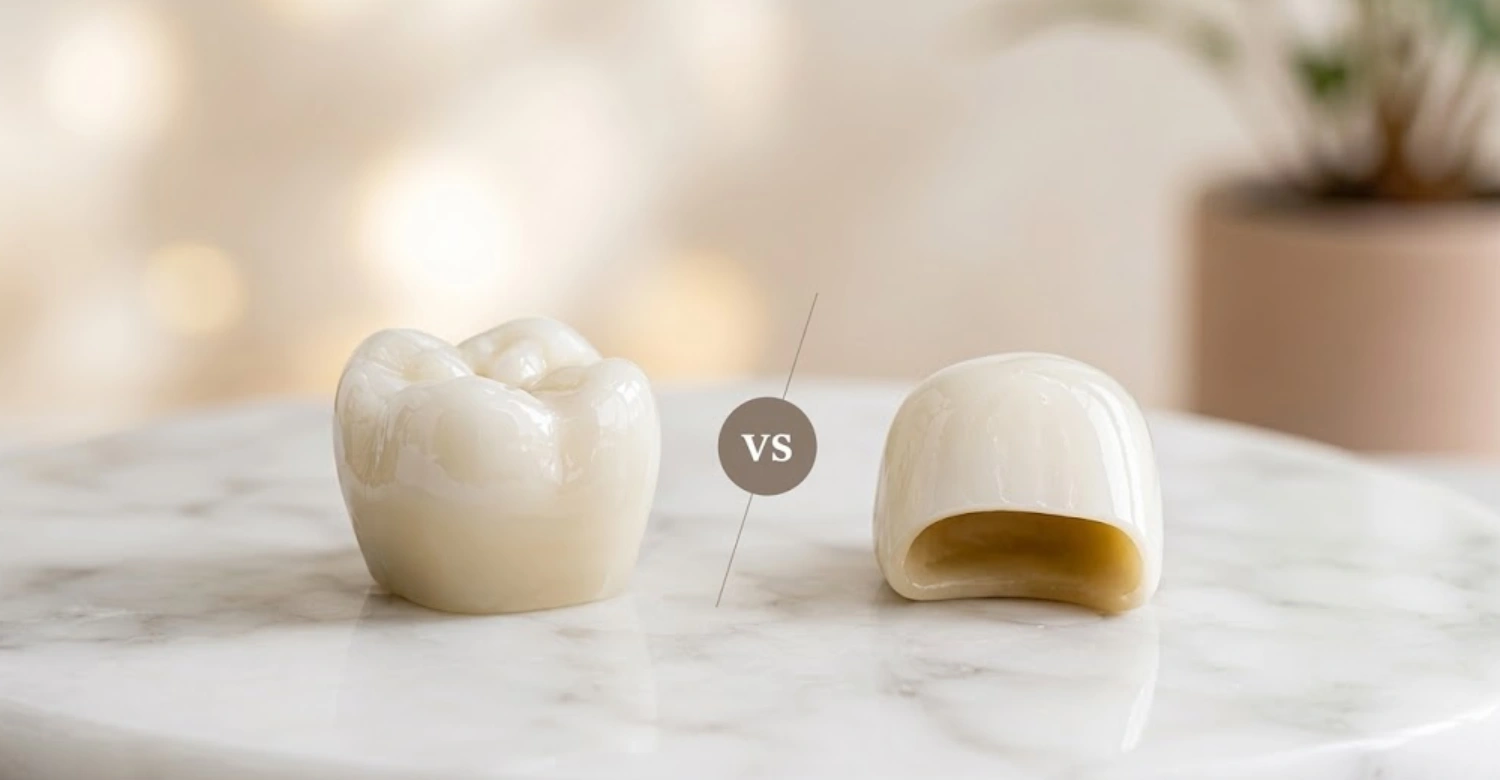
When considering dental restoration options, you may have come across the terms These two Tooth Cap vs Crown and wondered if they are different treatments. In reality, a tooth cap and a dental crown are the same restoration, just different names. "Cap" is the informal, patient-friendly term; "crown" is the official clinical terminology used by dentists and insurers. The five key differences between them are purely linguistic: who uses each term, how they appear in online searches, and how they are perceived in terms of cost. In reality, the procedure, materials, billing code, and price are completely identical. Understanding this eliminates confusion and helps patients focus on what truly matters: material choice, timing, and finding the right provider.
Quick Comparison: Tooth Cap vs Crown Same Treatment, Two Names
Before diving into the details, here is the most important thing to know upfront:
Feature | Tooth Cap | Dental Crown |
Clinical meaning | Full-coverage tooth restoration | Full-coverage tooth restoration |
Used by | Patients, general public | Dentists, dental professionals |
Origin of term | Colloquial / descriptive | Official clinical terminology |
Procedure | Identical | Identical |
Cost | Same | Same |
Materials available | Same range | Same range |
Covered by insurance | Yes (same billing code) | Yes (same billing code) |
Conclusion: There is no clinical difference. When patients search for this topic, they are searching for two names that describe one identical restoration. The rest of this article uses both terms interchangeably as dentists themselves do.
Tooth Cap vs Crown: 5 Key Differences That Could Save Your Smile in 2026?
If you have been researching this question, here is the most important thing to understand before reading anything else: in clinical dentistry, a tooth cap and a dental crown are the same restoration. There is no separate procedure called a "cap" and another called a "crown." They refer to identical treatment.
So what are the 5 key differences in this debate? There are differences in how the two terms are used, not in the treatment itself.
Tooth Cap vs Crown: What's the Difference in Terminology?
"Dental crown" is the official clinical name used by dentists, dental schools, and insurance companies worldwide. "Tooth cap" is an informal everyday word patients have used for decades because it visually describes what the restoration does: it caps over the tooth. In this terminology comparison, the difference is purely linguistic.
Tooth Cap vs Crown: How Professionals and Patients Differ
Patients overwhelmingly use "tooth cap" in casual conversation and online searches. Dental professionals use "crown" in all formal and clinical contexts. This communication gap is one of the most common sources of confusion in restorative dentistry.
Tooth Cap vs Crown: What's the Difference?
Whether you search "tooth cap cost" or "dental crown cost," you are looking for the same information. Do not assume a source using "cap" describes something cheaper or simpler than a source using "crown." In any search on this topic, the results ultimately point to the same treatment.
Insurance and Billing for Tooth Caps vs Crowns
On dental insurance claim forms, a crown restoration is listed under a single standardized billing code regardless of whether the patient called it a cap or a crown. Insurance companies do not distinguish between the two terms because there is no clinical distinction to make. This is a key billing fact that saves patients unnecessary confusion.
Tooth Cap vs Crown: Is the Cost Difference Real?
One of the most persistent misconceptions in this conversation is that a cap is the budget-friendly version of a crown. This is completely false. Because they are the same procedure using the same materials, the cost is identical. Any price difference between sources is explained by material choice, clinic location, and case complexity never by the name used.
Tooth Cap vs Crown: Comparison Table
Difference | Tooth Cap | Dental Crown |
1. Terminology | Informal / colloquial | Official / clinical |
2. Who uses it | Patients, general public | Dentists, insurers, academia |
3. Online search behavior | Common in patient searches | Common in clinical content |
4. Insurance billing | Same code as crown | Same code as cap |
5. Cost | Identical to crown | Identical to cap |
What exactly is the difference between a tooth cap and a dental crown?
This is a question that confuses many people, and for a good reason. The dental world often uses different terms that seem to describe the same thing. While many dentists and patients use these terms interchangeably, there are subtle nuances worth understanding. When you are considering a significant dental procedure, knowing the distinction can help you feel more informed and confident in your treatment choices.
Are tooth caps and dental crowns essentially the same thing?
In the vast majority of cases, yes. Both are prosthetic devices custom-made to fit over a damaged or weakened tooth, restoring its shape, size, strength, and appearance. So when your dentist says you need a dental crown, they are talking about what many patients call a tooth cap. The the cap and the full-coverage crown debate is more of a linguistic choice than a clinical distinction.
Why do dentists use different terms for the same treatment?
The use of different terms comes down to communication style. Dentists use precise clinical language, but they also simplify explanations for patients. "Cap" is accessible and descriptive. "Crown" is the official term used in dental schools and professional literature. Both sides of this terminology split are understood universally in any dental office.
Are there regional differences in how these terms are used?
Absolutely. In some regions, "cap" is prevalent in public discourse; in others, "crown" is more common. This is why online searches for these terms return a mix of both. Clinically, however, the definition is identical.
Tooth Cap vs Crown: Which Term Do Dentists Use?
"Dental crown" is the official and more professional term. But any dentist will readily understand both terms as referring to the same restoration. Understanding this distinction helps patients communicate more confidently with their provider.
Tooth Cap vs Crown: What We Notice Clinically
"In our daily practice at Vitrin Clinic, one of the most common sources of patient confusion is the terminology itself. Patients arrive asking whether they need a 'cap' or a 'crown' as if choosing between two different procedures. The first thing I clarify is that these are identical restorations. The name changes nothing about the material, the preparation, or the outcome." Dr. Rifat Alsaman, Head of the Medical Team & Cosmetic Dentist at Vitrin Clinic
As Head of the Medical Team at Vitrin Clinic, Dr. Rifat Alsaman works with international patients daily who arrive having researched their condition online often encountering both terms without ever learning they describe the same thing. This confusion is among the most frequently raised topics at first consultations.
Why delaying a tooth crown can worsen your oral health
Dr. Rifat Alsaman notes that delayed crown treatment is one of the most preventable causes of tooth loss he encounters. Patients who postpone treatment after a crown is recommended almost always arrive later with a fractured tooth that requires extraction rather than restoration.
"I can tell within seconds of looking at an X-ray whether a crown was placed at the right time or too late. A tooth that could have been restored for a fraction of the cost is now gone and the patient is looking at an implant. The window for the right decision is not always open indefinitely." Dr. Rifat Alsaman, Head of the Medical Team & Cosmetic Dentist at Vitrin Clinic
What Patients Misunderstand About Tooth Caps vs Crowns
According to Dr. Rifat Alsaman, the most persistent clinical misconception is that tooth preparation the filling down of the tooth is damaging. In fact, for a tooth that has already lost significant structure, the preparation is what makes the tooth saveable.
"Patients sometimes worry that we are 'hurting' the tooth by shaping it. What I explain is that by the time I am recommending a crown restoration, the tooth has already been compromised. We are not removing healthy structure, we are preparing a damaged tooth to receive the strongest possible protection. That distinction changes everything for most patients." Dr. Rifat Alsaman, Head of the Medical Team & Cosmetic Dentist at Vitrin Clinic
What material does Dr. Rifat Alsaman recommend for caps or crowns?
As a cosmetic dentist, Dr. Rifat Alsaman approaches material selection with both function and aesthetics in mind. His clinical recommendation is that individualizing a back molar in a patient with bruxism requires a different solution than a front tooth in a patient who prioritizes a natural smile.
"There is no universal best material. Zirconia is my most common recommendation because it delivers both strength and a beautiful result, but the right choice depends on the tooth's location, the patient's bite, their grinding habits, and their aesthetic goals. At Vitrin Clinic, we discuss all of this before any preparation begins." Dr. Rifat Alsaman, Head of the Medical Team & Cosmetic Dentist at Vitrin Clinic
Why clinical experience matters for tooth caps and crowns
The skill and experience of the dentist play a pivotal role in the outcome. Dr. Rifat Alsaman has been practicing dentistry for over a decade, with thousands of successful crown placements to his name. His extensive experience in both academic and clinical settings has honed his ability to handle complex cases, from full-mouth rehabilitations to esthetic smile makeovers.
"Each crown requires meticulous attention to detail, from tooth preparation to final cementation," Dr. Alsaman explains. "Years of experience allow me to anticipate potential challenges and ensure a precise fit that minimizes the risk of complications."
When choosing a dentist for your crown, consider their track record and specialization. A dentist who performs hundreds of crown procedures each year is more likely to deliver predictable, long-lasting results. At Vitrin Clinic, our team's collective experience ensures that you receive the highest standard of care.
How Our Dental Team Compares Tooth Caps and Crowns
Choosing a dentist for your crown procedure is a decision that should be based on qualifications and proven expertise. Dr. Rifat Alsaman earned his Doctor of Dental Surgery (DDS) degree from Izmir Katip Celebi University in Türkiye, where he received intensive clinical training across all major dental specialties. He is also a member of several professional organizations and continuously pursues continuing education to stay at the forefront of dental technology and techniques.
His role as Director of the Medical Team at Vitrin Clinic involves overseeing complex cases and ensuring that all treatments meet rigorous quality standards. "My education and ongoing training have equipped me to handle even the most challenging restorative cases," says Dr. Alsaman. "I believe in evidence-based dentistry, and I am committed to providing my patients with the safest and most effective treatments available."
When you choose a dentist with strong credentials, you can have confidence in the quality of care you receive.
Tooth Cap vs Crown: What Are the Differences?
Professional recognition is a testament to a dentist's skill and dedication. Dr. Rifat Alsaman is an active member of several prestigious dental associations, including the Turkish Dental Association and the International Congress of Oral Implantologists. He has also been invited to speak at international conferences on topics related to restorative dentistry and dental tourism.
In 2023, he received the 'Excellence in Dental Leadership' award from a prominent healthcare organization in recognition of his contributions to the field. "I am honored to be recognized by my peers," says Dr. Alsaman. "These accolades motivate me to continue pushing the boundaries of what is possible in dental care."
When choosing a dentist, consider their professional affiliations and any awards they have received, as these are indicators of their expertise and commitment to their craft.
Patient Experiences with Tooth Caps and Crowns
We believe that the best testament to our work is the feedback from our patients. On Google Reviews, Vitrin Clinic maintains a 4.9-star rating, with many patients specifically praising their crown procedures. One patient, Emma L., wrote, "I had two crowns placed by Dr. Alsaman, and the process was seamless. The crowns look and feel completely natural. I couldn't be happier!"
Another review from James T. states, "After years of struggling with a broken tooth, I finally got a crown at Vitrin Clinic. The attention to detail was incredible, and the result is perfect." These reviews are publicly available and verifiable, providing prospective patients with honest insights into our quality of care. We encourage you to read more reviews on our Google profile or Trustpilot to see why patients from around the world trust us with their smiles.
When Is a Both types of dental coverings Needed?
Dr. Rifat Alsaman uses a consistent clinical framework when assessing whether a crown is indicated:
More than 50% of the tooth's structure has been lost to decay or fracture
The tooth has undergone root canal treatment and is now brittle
A crack is visible on X-ray extending beyond the enamel into dentin
An existing large filling has failed and insufficient healthy structure remains
The patient presents with significant wear due to bruxism
"These are not ambiguous findings. When I see them, I do not recommend a filling as an alternative. I explain why a crown is the standard of care, show the patient the evidence on screen, and let them make an informed decision. Most patients, once they understand, are relieved to have a clear path forward." Dr. Rifat Alsaman, Head of the Medical Team & Cosmetic Dentist at Vitrin Clinic
What does the clinical team at Vitrin Clinic observe about international patient expectations?
As Head of the Medical Team at Vitrin Clinic, Dr. Rifat Alsaman oversees care for patients traveling from the UK, Germany, France, the Gulf, and North Africa for crown restorations.
"International patients are often surprised by two things: how comfortable the procedure is, and how natural the final crown looks. We use digital scanning and same-day CAD/CAM milling when appropriate, which means many patients complete treatment in a single extended visit, no temporary crown, no second trip. That changes the experience entirely." Dr. Rifat Alsaman, Head of the Medical Team & Cosmetic Dentist at Vitrin Clinic
Common Misconceptions About Dental Crowns and Tooth Caps
Despite how well-established this procedure is, several persistent myths cause patients to delay treatment or make uninformed decisions. Many of these myths are rooted in the terminology confusion between the two terms, and correcting them is central to any honest guide.
Misconception 1: "A tooth cap is cheaper than a crown"
The truth: They are the same treatment at the same price. Any price variation between sources quoting "caps" vs "crowns" is due to material choice, clinic location, or case complexity, never the name. The cost myth is one of the most important misconceptions to correct before starting treatment.
Misconception 2: "A cap is a less invasive version of a crown"
The truth: There is no less invasive cap that is clinically different from a crown. Both require the same tooth preparation. If a dentist describes a "cap" as quicker or smaller, ask for clarification—they may be describing a veneer or an onlay.
Misconception 3: "Caps are made of different materials than crowns"
The truth: The same materials—porcelain, zirconia, PFM, gold, and ceramic—are used for both. Material choice depends on the tooth's location, aesthetic preferences, and budget. In any material comparison, the options are identical. This is one of the most important facts patients should confirm before treatment.
Misconception 4: "You only need a crown after a root canal"
The truth: A root canal is a common reason for a crown restoration, but not the only one. Severely decayed teeth, cracked teeth, large failing fillings, and cosmetic corrections can all require full-coverage treatment.
Misconception 5: "A crown is permanent and never needs replacing"
The truth: Crowns are long-lasting but not permanent. Most last 10–15 years, with some reaching 20+ years. Eventually cement weakens, materials wear, or decay can develop at the margins.
Misconception 6: "Getting a crown means the tooth is gone"
The truth: A crown saves the tooth. The natural root remains intact. The crown simply replaces the visible part that has been damaged or compromised.
Who Is a Good Candidate for a Dental Crown?
Not every damaged tooth needs a crown. Understanding candidacy helps patients have more productive conversations with their dentist. Whether the terminology used is "tooth cap" or "crown," the candidacy criteria remain exactly the same. Reviewing these criteria is one of the most practical steps a patient can take after researching the topic.
Understanding the Risks and Complications of Tooth Caps and Crowns
While tooth caps and crowns are highly successful, being aware of potential risks and complications can help you make an informed decision. Beyond common issues like temporary sensitivity or slight discomfort, there are less frequent but significant concerns.
One such risk is an allergic reaction to the metals used in some crowns, particularly nickel or chromium, which can cause gum inflammation or a rash. Another is the possibility of nerve damage during tooth preparation, leading to pulpitis or the need for root canal therapy.
Additionally, if a crown is not properly fitted, it can create gaps that trap food and bacteria, increasing the risk of recurrent decay or gum disease. In rare cases, a crown may fracture or become loose due to excessive biting forces or teeth grinding.
Dr. Rifat Alsaman emphasizes, "A well-crafted crown should last many years, but patients must be aware that underlying issues like bruxism or poor oral hygiene can compromise its longevity. Regular check-ups are crucial to detect early signs of problems."
By understanding these risks, you can take proactive steps—such as wearing a night guard or maintaining meticulous oral hygiene—to ensure your crown remains in optimal condition.
Ideal candidates for a crown restoration include:
Patients with extensive tooth decay When decay has destroyed more than half of the tooth structure, a filling cannot provide adequate support. A full-coverage restoration becomes the standard of care.
Teeth that have undergone root canal treatment Root canal-treated teeth lose moisture and become brittle. Without crown protection, they are highly susceptible to fracture.
Cracked or fractured teeth A crown holds the pieces of a cracked tooth together. It also prevents the crack from spreading further toward the root.
Severely worn teeth Bruxism can wear teeth down significantly. Crowns restore height, function, and aesthetics.
Teeth with large, failing fillings When an old large filling breaks down and insufficient tooth structure remains, a crown provides the necessary reinforcement.
Cosmetic correction cases Severely discolored or misshapen teeth that cannot be corrected with veneers alone may benefit from a full crown.
Dental implant recipients An implant requires a crown on top to function like a natural tooth.
Who may not need a crown?
Patients with small chips, minor staining, or surface-level damage are often better served by fillings, bonding, or veneers. A good dentist will always recommend the most conservative option that adequately addresses the problem.
When a Filling Is Enough and When You Need a Crown
A filling is generally sufficient when:
The cavity or damage involves less than one-third of the tooth's chewing surface
The surrounding tooth structure is healthy and strong
There is no existing crack or fracture extending into the tooth
The tooth has never had a root canal
The damage is purely cosmetic and surface-level
A crown is typically necessary when:
Decay or damage has affected more than 50% of the tooth
A previous large filling has cracked or fallen out, leaving minimal healthy tooth
The tooth has been root canal-treated
There is a visible crack or fracture extending down the tooth
The tooth has fractured below the gum line
Example 1 Large old filling: A patient has a molar with a 20-year-old amalgam filling that is cracking. The remaining tooth walls are thin. A filling replacement alone risks shattering the tooth. A full crown is the right call.
Example 2 After root canal: A front tooth that required root canal treatment has become brittle and discolored. A porcelain crown restores both strength and appearance.
Example 3 Cracked tooth syndrome: A patient experiences sharp pain when biting in a specific spot. X-rays reveal a crack running through the cusp. A crown binds the tooth together and eliminates the pain.
Real Patient Scenarios: When Crown Restorations Make the Difference
Scenario 1 The Cracked Molar
The following real-world scenarios show how the the two prosthetic options treatment plays out in practice across different clinical situations.
Ahmed, 42, felt sharp pain every time he bit down on his left side. His dentist identified a crack running diagonally through the lower left first molar. A full zirconia crown was placed. The pain resolved immediately.
Scenario 2 After Root Canal Treatment
Sara, 31, had a root canal on her upper right premolar following an abscess. An all-ceramic crown was placed two weeks later. The tooth now looks identical to her adjacent natural teeth.
Scenario 3 Large, Failing Filling
Karim, 55, had a large amalgam filling placed in his lower left molar 25 years ago. The filling cracked and one cusp partially broke away. A PFM crown rebuilt the tooth entirely and restored his bite.
Scenario 4 Severe Wear from Grinding
Lena, 38, suffered from bruxism that had worn her front teeth down significantly. Her treatment plan included zirconia crowns on her most affected teeth and a custom nightguard to protect the restorations long-term.
Scenario 5 Dental Implant Completion
Omar, 47, had an upper molar extracted due to an untreatable infection. After the implant osseointegrated over four months, a custom porcelain-fused-to-zirconia crown was attached to the implant post. It is indistinguishable from a natural tooth.
Risks of Delaying Crown Treatment
Understanding the risks of delay is just as important as resolving the these restorative treatments terminology question. The crack spreads. A small crack that could have been stabilized by a crown can extend to the root over weeks or months. Once it reaches below the gum line, the tooth is often unsalvageable.
Decay progresses under a failing filling. By the time the patient returns, decay may have reached the pulp requiring a root canal before the crown can even be placed, significantly increasing both cost and treatment time.
The tooth fractures. Brittle root canal-treated teeth can shatter under normal chewing forces without crown protection. A fractured tooth below the gum line almost always requires extraction.
Infection risk increases. An unprotected compromised tooth creates pathways for bacteria to enter the pulp, potentially leading to abscess, bone loss, and systemic health risks.
Costs escalate. A crown alone is a predictable, manageable expense. Delay can lead to root canal + crown, or worse extraction + implant treatments that cost significantly more.
How to Choose the Best Crown Material Based on Your Needs
Your Priority | Recommended Material |
Lowest cost | PFM (Porcelain-Fused-to-Metal) |
Best aesthetics front teeth | All-ceramic / High-translucency zirconia |
Maximum durability back teeth | Full-contour zirconia |
Long-term investment | Zirconia or gold |
Combination of strength + appearance | Layered zirconia |
Budget: PFM crowns offer a reliable balance of strength and appearance at a lower price point. They have a long clinical track record and are widely available.
Appearance: For patients prioritizing aesthetics especially for front teeth all-ceramic or layered zirconia crowns are the gold standard. They mimic the translucency of natural enamel and can be shade-matched with great precision.
Strength and longevity: For back teeth under heavy chewing pressure, or for patients who grind their teeth, full-contour zirconia or gold crowns are the most durable options.
Comparison Between Crown Materials
Feature | Porcelain / All-Ceramic | Zirconia | PFM | Gold |
Aesthetics | ★★★★★ | ★★★★☆ | ★★★☆☆ | ★☆☆☆☆ |
Strength | ★★★☆☆ | ★★★★★ | ★★★★☆ | ★★★★★ |
Durability | 10–15 years | 15–20+ years | 10–15 years | 20+ years |
Suitable for front teeth | Yes | Yes | Acceptable | No |
Suitable for back teeth | With caution | Yes | Yes | Yes |
Metal-free | Yes | Yes | No | No |
Risk of chipping | Moderate | Low | Low-moderate | Very low |
Biocompatibility | Excellent | Excellent | Good | Excellent |
What are the main types of dental crowns available?
Once you resolve the these two dental restorations terminology question, the real decision is about material. The choice affects strength, appearance, and cost and the clinical team at Vitrin Clinic will guide you through every option.
What materials are used to make dental crowns?
Crown restorations are fabricated from porcelain, ceramic, zirconia, metal alloys (gold or silver), and porcelain-fused-to-metal (PFM). Each suits different applications from aesthetic front tooth restorations to durable back molar coverage.
How do porcelain restorations compare to metal crown options?
Porcelain is an excellent choice for front teeth because of its natural, tooth-like appearance and color-matching capability. However, it can be more brittle than metal, making it less ideal for molars under heavy chewing pressure. Metal crowns, particularly gold alloys, are extremely durable and rarely chip or break.
What makes zirconia crowns stand out?
Zirconia rivals the strength of metal while offering excellent aesthetics. Zirconia crowns are highly resistant to chipping and cracking, making them suitable for both front and back teeth. Modern high-translucency zirconia can be layered with porcelain for a very natural result and it is Dr. Rifat Alsaman's most frequent material recommendation at Vitrin Clinic.
Which type of crown lasts the longest?
Generally, metal crowns (especially gold) and zirconia crowns are the most durable, often lasting 15–20 years or longer with proper care. Porcelain and all-ceramic options are also durable but can be more prone to chipping under extreme pressure.
When would a dentist recommend a crown restoration?
What dental conditions require crown treatment?
A full-coverage restoration is typically recommended when a tooth is extensively damaged and can no longer be restored with a simple filling including teeth with large cavities, significant fractures, or those that have undergone root canal treatment.
How do dentists decide when to place a crown?
The decision is based on the amount of healthy tooth structure remaining, the tooth's location, and the patient's aesthetic concerns and budget. If a tooth has lost more than 50% of its structure, a crown is the standard of care.
Are there cases where a crown is not the right solution?
Yes. If the tooth is too severely damaged to support any restoration, extraction followed by an implant may be more appropriate. If the damage is minimal, a less invasive procedure like an inlay, onlay, or veneer may suffice.
What is the procedure for getting a dental crown?
How long does the crown procedure take?
The traditional process spans two appointments. The first involves preparing the tooth, taking impressions, and placing a temporary crown (60–90 minutes). The second visit, for permanent cementation, takes about 30–45 minutes. With same-day CAD/CAM technology available at Vitrin Clinic, the entire process can be completed in a single 2–3 hour visit.
What preparation is needed before getting a crown?
Your dentist will examine the tooth, take X-rays to assess the root and surrounding bone, and determine whether a root canal is needed before the crown is placed.
What happens during the crown placement procedure?
After tooth preparation and impression-taking, a temporary crown is placed while the permanent crown is fabricated. Once ready, the dentist removes the temporary, verifies the fit and shade, and cements the permanent crown into place.
What is the recovery process?
Slight sensitivity or discomfort is normal in the first few days, usually manageable with over-the-counter pain relievers. Most patients adjust within a few days. If your bite feels uneven, contact your dentist. A simple adjustment resolves this quickly.
Timeline: From First Visit to Final Crown Placement
Stage | Timeframe | What Happens |
Step 1: Initial Consultation | Day 1 | Examination, X-rays, diagnosis, treatment plan, material selection |
Step 2: Tooth Preparation | Day 1 or 2 | Local anesthesia, shaping the tooth, removing decay |
Step 3: Impression / Digital Scan | Same visit as prep | Traditional mold or digital intraoral scan |
Step 4: Temporary Crown | Placed same day as prep | Protects the tooth while the permanent crown is fabricated |
Step 5: Crown Fabrication | 3–10 business days | Dental lab crafts the crown from chosen material |
Step 6: Final Fitting & Cementation | 1–2 weeks after prep | Crown checked for fit, bite, and shade permanently cemented |
Step 7: Follow-Up | 2–4 weeks later | Bite confirmed, gum health checked, concerns addressed |
Same-day alternative: Vitrin Clinic's CAD/CAM technology allows Steps 2–6 to be completed in a single 2–3 hour visit eliminating the temporary crown phase entirely.
How much do dental crowns cost in Turkey?
Turkey has become a global hub for dental tourism, and competitive crown pricing is a major reason. Patients who arrive after researching the the former and the latter cost question will find that Turkey offers an exceptional value regardless of which term they used in their search. The cost of a crown restoration in Turkey is significantly lower than in many Western countries without compromising on quality. For patients researching this comparison internationally, Turkey consistently offers the most competitive value.
What factors affect the cost of dental crowns? Key Considerations in Any The two tooth-repair solutions Budget Decision
Type of Material Porcelain, zirconia, ceramic, metal, or PFM crowns all vary in price
Dental Clinic Location Costs differ by country, city, and clinic
Dentist's Experience Specialized dentists may charge more
Procedure Complexity Complex cases require additional time and skill
Pre-Treatment Requirements Root canals or gum treatment before the crown add to total cost
Technology Used CAD/CAM same-day crown clinics may charge higher fees
Number of Crowns Needed Total price rises with multiple restorations
Insurance Coverage The extent of reimbursement affects out-of-pocket costs
How does Turkey compare globally for crown costs?
A single crown restoration in Turkey typically costs 50–70% less than in the US, UK, or Germany, without compromising quality or materials. Many clinics, including Vitrin Clinic, offer packages for patients needing multiple crowns often including lab work, the dentist's fee, and travel support.
What are the benefits and drawbacks of dental crowns?
Benefits:
Restore strength, shape, and appearance of damaged teeth
Improve chewing function and protect against further decay
Enhance overall smile aesthetics
Protect root canal-treated teeth from fracture
Long-lasting 10–20+ years with proper care
Drawbacks:
Require irreversible tooth reduction during preparation
Can be expensive depending on chosen material
May cause temporary sensitivity post-placement
Risk of loosening over time if cement weakens
Porcelain options may chip under extreme pressure
Possible Complications and How Dentists Fix Them
Post-Placement Sensitivity
Common and usually temporary resolving within 2–4 weeks. If sensitivity persists beyond a month, the dentist investigates whether the nerve has been irritated.
Crown That Feels "High"
A quick in-office adjustment resolves this immediately after anesthesia wears off.
Loosening or Falling Off
Crown cement can weaken over years. If the crown is intact, it can usually be recleaned and recemented. If decay has developed beneath it, the tooth is retreated first.
Chipping or Cracking
Small chips may be repaired with composite resin. Significant fractures usually require crown replacement. Switching to zirconia for the replacement reduces recurrence risk.
Decay Under the Crown
The crown is removed, decay is cleaned out, and a new restoration is fabricated underscoring the importance of regular checkups and excellent oral hygiene at crown margins.
Dark Line at the Gum Line
Common with PFM restorations as the metal base becomes visible with gum recession. Replacement with an all-ceramic or zirconia crown resolves the issue.
Signs Your Crown Needs Replacement
Pain or sensitivity when biting May indicate cement failure, margin decay, or a cracked crown
Visible crack, chip, or rough edge Any structural damage should be evaluated promptly
Crown feels loose or moves Cement seal has failed; the underlying tooth is now exposed and vulnerable
Dark line at the gum line PFM crown's metal base is becoming visible; zirconia or ceramic replacement is recommended
The crown has fallen off Keep it in a clean container and contact your dentist the same day
Swelling or tenderness around the crown May indicate infection or decay at the margin
Crown is 10–15 years old with no recent assessment Even without symptoms, older restorations should be assessed by X-ray
Latest Advances in Dental Crown Technology
Digital Intraoral Scanners
Modern intraoral scanners create a precise 3D model of the prepared tooth. They eliminate uncomfortable impression material, improve accuracy, and reduce chair time.
CAD/CAM Technology
CAD/CAM systems allow dentists to design a crown digitally. They send the design to an in-office milling machine that carves the restoration from a solid block of ceramic or zirconia, often in under an hour.
Same-Day Crowns (CEREC)
Patients walk in with a damaged tooth and leave with a permanent, precisely fitted crown in a single 2–3 hour visit. This is especially valuable for international patients who cannot make a return trip.
High-Translucency Zirconia
Modern monolithic high-translucency zirconia closely mimics the optical properties of natural enamel. It is suitable for front teeth while retaining zirconia's renowned strength and fracture resistance.
Digital Smile Design (DSD)
Before any physical work begins, DSD software allows patients to preview their new smile on screen. Crown shape, size, and shade are visualized in context with the patient's face and existing teeth before any tooth is touched.
Biocompatible Metal-Free Materials
Modern zirconia and high-strength ceramics now offer metal-free alternatives. Their strength and longevity match or surpass traditional metal-containing options, ideal for patients with metal sensitivities.
How do tooth caps and crowns compare in terms of durability?
When patients research durability as part of the this pair of dental procedures question, the answer is always straightforward: durability is determined entirely by material, not by name. Crown restorations typically last 10–15 years or longer with proper care. Zirconia and metal restorations generally outlast porcelain or ceramic ones.
What causes crowns to fail or need replacement?
Tooth Decay New decay can develop around the crown's edges or margins
Loose Cement The bonding material may weaken over time
Cracks or Chips Porcelain and ceramic crowns can fracture under heavy force
Wear and Tear Grinding gradually damages the restoration
Gum Recession Receding gums may expose margins, leading to decay
Poor Fit An improperly fitted crown fails prematurely
Injury or Trauma Accidents or impact can dislodge or break the crown
How should patients care for their dental crowns?
Brush twice a day with fluoride toothpaste. Floss at least once daily, paying special attention to the gum line. Avoid biting hard objects. Routine checkups allow the dentist to spot early signs of wear or loosening before they become larger problems.
What foods should be avoided with crowns?
Very hard foods (ice, hard candies, unpopped popcorn kernels) can chip porcelain and ceramic restorations
Sticky foods (caramel, toffee, chewing gum) can pull a crown loose if cement has weakened
Biting directly into hard nuts or bones puts excessive stress on the restoration
How often should patients visit the dentist after crown placement?
Regular visits are essential whether you initially arrived asking about a these two dental restorations. The aftercare is identical.
At least every six months. X-rays may be taken to detect hidden decay beneath the crown's margins.
What are the alternatives to dental crowns?
Alternatives include dental fillings, inlays, and onlays for smaller areas of damage. Veneers may be suitable when only cosmetic improvement is needed. If the tooth cannot be saved, extraction followed by a dental implant or bridge might be recommended.
Are dental inlays and onlays viable alternatives?
Yes, for some cases. Both preserve more natural tooth structure than a full crown. They are appropriate when damage is not extensive enough to warrant full coverage.
When might dental implants be considered instead?
When a tooth is too damaged to be saved, an implant becomes the preferred option. Implants function independently, do not affect adjacent teeth, and can last a lifetime with proper care.
Questions to Ask Your Dentist Before Getting a Crown
Why do I need a crown specifically and why isn't a filling or inlay sufficient?
Which material do you recommend for my specific tooth, and why?
Will I need a root canal before the crown? How will you know?
How much tooth structure will need to be removed?
Will you place a temporary crown? What should I expect during the waiting period?
Does your clinic use digital scanning or CAD/CAM? Is a same-day crown possible in my case?
What is the expected lifespan of the material you are recommending?
What warranty or guarantee do you offer? What does it cover?
What are the signs that something has gone wrong, and when should I call you?
How do Turkish dental clinics approach crown treatments?
Turkish dental clinics focus on patient comfort, precision, and efficiency. They typically begin with thorough examination and digital imaging to plan treatment accurately, offering detailed treatment plans and cost estimates before any procedure begins.
What makes Turkish dental clinics competitive for crown procedures?
Turkey's dental industry benefits from lower labor costs and reduced overhead, allowing clinics to offer top-quality treatments at affordable prices. Dentists are often trained internationally. Many clinics invest in modern equipment, creating an attractive balance of affordability and high clinical standards.
Do Turkish dentists use the latest crown technologies?
Yes. Many Turkish dental centers invest in digital intraoral scanners, CAD/CAM systems, and 3D printers allowing for same-day crowns and digital planning for a perfect fit.
Do Turkish clinics offer warranties on crown procedures?
Many reputable Turkish clinics provide warranties ranging from one to five years for crown restorations, typically covering breakage or loosening. Always request written warranty details before starting treatment.
What accreditations should you look for?
When choosing a clinic, check for certifications from recognized dental boards. Vitrin Clinic is accredited by the Turkish Ministry of Health and follows international guidelines for infection control. The facility uses advanced sterilization techniques and state-of-the-art equipment. The team participates in regular training to maintain high standards. Dr. Rifaat Al-Samman states, "Our accreditations are a promise to our patients that we provide quality care in a safe setting."
Pros & Cons Summary: Should You Get a Dental Crown at Vitrin Clinic?
Details | |
Strong case FOR a crown | Tooth has lost >50% structure; root canal performed; visible crack or fracture; large failing filling, Vitrin Clinic's diagnostic team identifies all of these at your first consultation |
Advanced technology | Vitrin Clinic uses digital intraoral scanners and CAD/CAM milling, meaning many patients complete their crown in a single extended visit, with no temporary crown and no return trip |
International patient experience | Vitrin Clinic specializes in treating patients from the UK, Germany, France, the Gulf, and North Africa, full coordination, multilingual support, and treatment planning before you travel |
Premium materials | Vitrin Clinic works with zirconia, all-ceramic, PFM, and layered zirconia, Dr. Rifat Alsaman selects the right material for each patient's bite, location, and aesthetic goals |
Transparent pricing | Full cost breakdowns are provided before any procedure begins no surprise fees, no hidden lab charges |
Saves the tooth | Vitrin Clinic's approach prioritizes restoration over extraction, a crown placed at the right time prevents the far greater cost and complexity of an implant |
Long-lasting results | With proper care, crowns placed at Vitrin Clinic are built to last 15–20+ years using materials that match or exceed Western European clinical standards |
Irreversible preparation | Tooth reduction is a permanent step which is why Vitrin Clinic's team only recommends a crown when it is the clinically indicated solution, not a default |
Travel planning required | International patients should coordinate their visit in advance, Vitrin Clinic's patient coordinators assist with scheduling, timing, and treatment sequencing to make the trip efficient Managing Temporary Sensitivity |
Temporary sensitivity | Mild sensitivity in the first 2–4 weeks is normal and expected,Vitrin Clinic provides full aftercare guidance and remains reachable for any post-treatment questions |
Not recommended when | Damage is minor and a more conservative option filling, inlay, or veneer is clinically sufficient; Vitrin Clinic will always recommend the least invasive solution that adequately addresses the problem |
Not recommended when | The tooth is too compromised to support a crown; in those cases, Vitrin Clinic's team will present extraction and implant options with full transparency |
Key Insights Before You Decide
Insight 1 Terminology should never drive your decision. The the cap and the crown question is entirely one of linguistics, not clinical substance. Whether your dentist says cap or crown, they mean the same thing. Focus on material selection, timing, and choosing a skilled provider. Reference: Shillingburg et al. (1997). Fundamentals of Fixed Prosthodontics. Quintessence Publishing.
Insight 2 The best time for a crown is always now. Dental crowns are one of the few restorations where delay consistently results in a worse and more expensive outcome. Reference: Aquilino & Caplan (2002). Journal of Prosthetic Dentistry, 87(3), 256–263.
Insight 3 Material choice is a long-term investment. Zirconia costs more than PFM but often lasts twice as long, making it the more economical choice over a decade. Reference: Pjetursson et al. (2015). Dental Materials, 31(6), 603–623.
Insight 4 Same-day crowns are now a reliable option. CAD/CAM technology has matured to the point where same-day crowns are clinically comparable to lab-fabricated ones in the right cases. Reference: Fasbinder (2010). Journal of the American Dental Association, 141(Suppl 2), 4S–9S.
Insight 5 Turkey offers genuine value, not a compromise. The cost savings are driven by economics, not quality reductions. The materials, laboratory standards, and clinical techniques used at leading clinics like Vitrin Clinic match or exceed Western European standards. Reference: Lunt et al. (2011). OECD Directorate for Employment, Labour and Social Affairs.
Crown Longevity Depends on Hygiene
Insight 6 Your crown is only as good as what it is cemented over. Oral hygiene around the crown margin is critical. Decay beneath a crown is preventable with consistent brushing, flossing, and twice-yearly checkups. Reference: Mjör (2005). Journal of the American Dental Association, 136(10), 1426–1433.
Insight 7 A nightguard protects your investment. If you grind your teeth, a custom nightguard is an essential complement to any crown restoration. Bruxism generates forces that exceed normal chewing. Even the strongest crown material can be worn or fractured by untreated grinding. Reference: Lobbezoo et al. (2013). Journal of Oral Rehabilitation, 40(1), 2–4.
Tooth Cap vs Crown: What Is the Difference?
Same Restoration, Different Wording
A tooth cap and a crown both refer to a covering that restores a damaged tooth. In everyday speech, “cap” is often used as a simpler word for “crown.”
How the Terms Are Used
Dentists may say crown in clinical explanations, while patients may say cap. The choice of word rarely changes the treatment concept itself.
Checking Terminology with Vitrin Clinic
If you are comparing tooth cap and crown terms, Vitrin Clinic can be a research option. Confirm the recommended restoration and its coverage with the clinician.
Reference:
https://oralb.com/en-us/oral-health/life-stages/adults/tooth-cap-vs-crown-whats-difference
Insight 1 — Shillingburg et al. (1997)
Fundamentals of Fixed Prosthodontics, 3rd Edition. Quintessence Publishing.
Publisher page: https://www.quintessence-publishing.com/usa/en/product/fundamentals-of-fixed-prosthodonticsInsight 2 — Aquilino & Caplan (2002)
Relationship between crown placement and the survival of endodontically treated teeth. Journal of Prosthetic Dentistry, 87(3), 256–263.
https://pubmed.ncbi.nlm.nih.gov/11941351/Insight 3 — Sailer, Makarov, Thoma, Zwahlen, & Pjetursson (2015)
All-ceramic or metal-ceramic tooth-supported fixed dental prostheses (FDPs)? Part I: Single crowns. Dental Materials, 31(6), 603–623.
https://doi.org/10.1016/j.dental.2015.02.011Insight 4 — Fasbinder (2010)
The CEREC system: 25 years of chairside CAD/CAM dentistry. Journal of the American Dental Association, 141(Suppl 2), 3S–4S.
https://jada.ada.org/article/S0002-8177(14)63733-8/fulltextInsight 5 — Lunt, Smith, Exworthy, Green, Horsfall, & Mannion (2011)
Medical Tourism: Treatments, Markets and Health System Implications: A Scoping Review. OECD, Directorate for Employment, Labour and Social Affairs.
https://www.oecd.org/els/health-systems/48723982.pdfInsight 6 — Mjör (2005)
Clinical diagnosis of recurrent caries. Journal of the American Dental Association, 136(10), 1426–1433.
https://jada.ada.org/article/S0002-8177(14)63140-8/abstractInsight 7 — Lobbezoo et al. (2013)
Bruxism defined and graded: an international consensus. Journal of Oral Rehabilitation, 40(1), 2–4.
https://onlinelibrary.wiley.com/doi/abs/10.1111/joor.12011
FAQs
Dr. Rifat Alsaman has more than 5 years of clinical experience in dentistry and currently serves as the Head of the Medical Team at Vitrin Clinic. He is dedicated to providing exceptional patient care, overseeing treatment planning, and ensuring the highest clinical standards across the team. His expertise, attention to detail, and commitment to continuous professional development have helped countless patients achieve healthier, more confident smiles.


