
A cantilever dental bridge is a fixed restoration that replaces a missing tooth using support from a natural tooth on only one side of the gap. A traditional bridge, by contrast, is anchored on both sides. This guide explains how it works, when it is used, its benefits and drawbacks, the procedure, and what affects cantilever dental bridge cost.
What Is a Cantilever Dental Bridge?
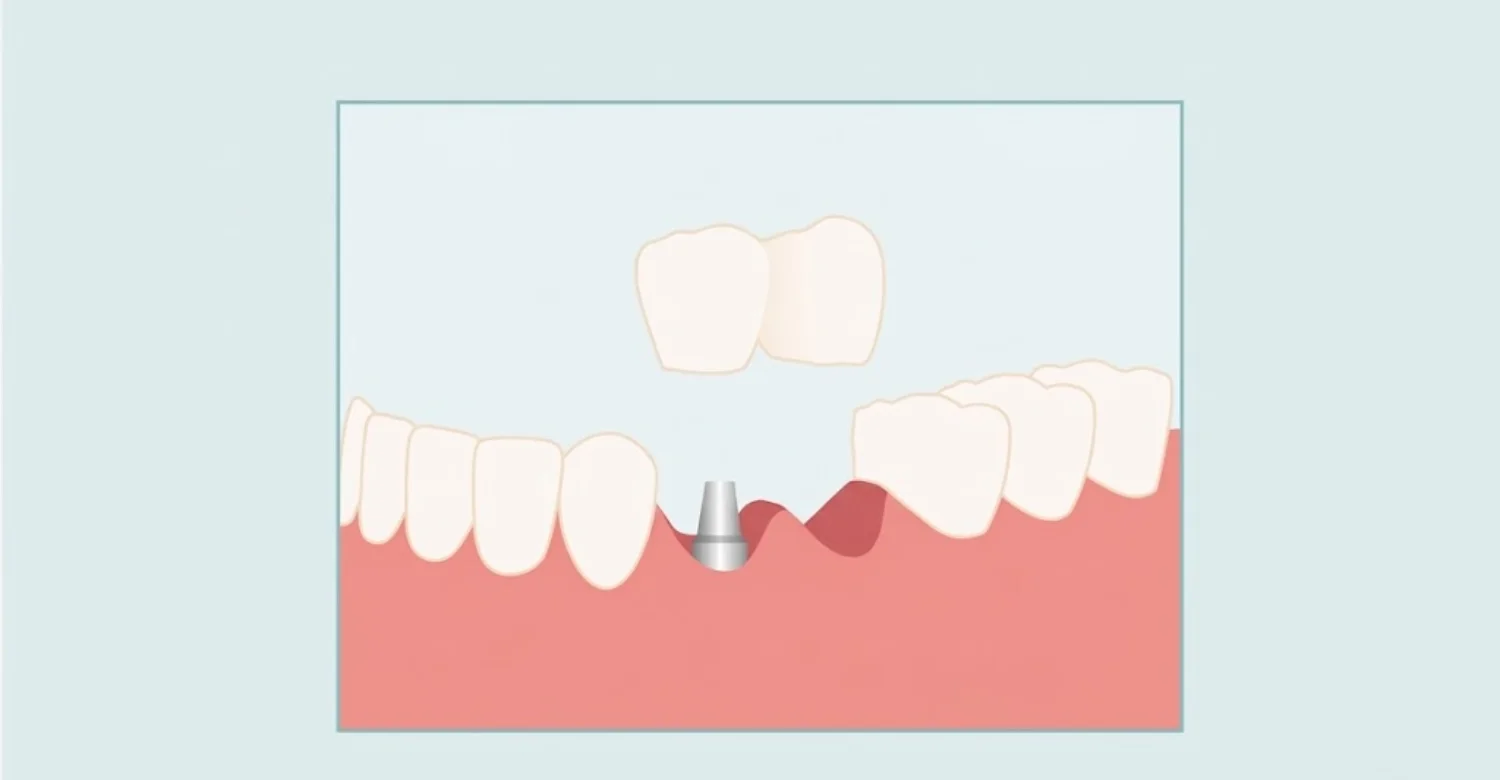
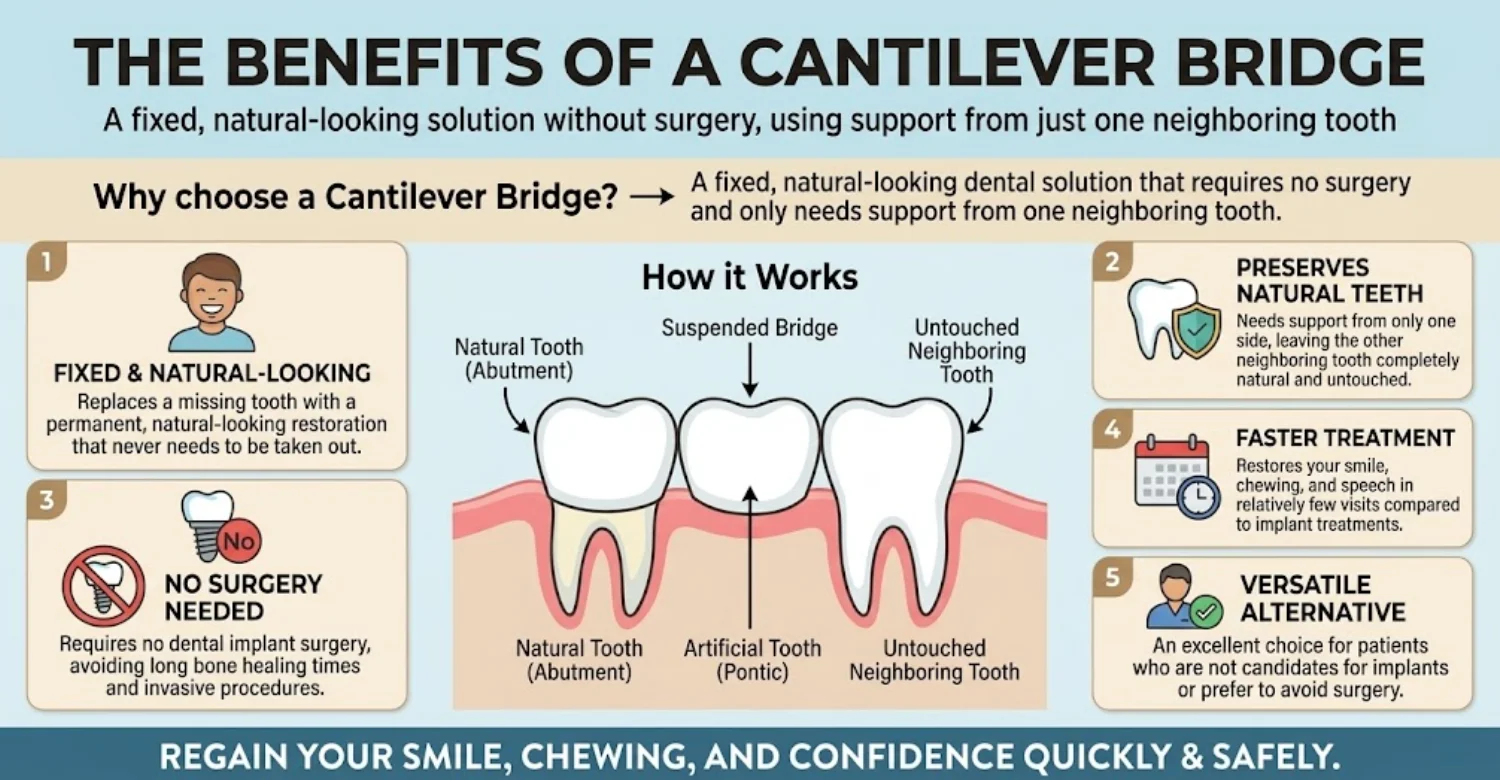
A cantilever dental bridge has two parts. The first is an artificial tooth, called a pontic. The second is a crown or bonded wing on one or more neighboring teeth on a single side. The pontic extends over the gap like a balcony. It fills the space and restores appearance and chewing without involving the teeth on the other side.
How Does a Cantilever Bridge Work?
So, how does a cantilever bridge work? The supporting tooth, called the abutment, is either crowned or fitted with a bonded wing. The replacement tooth is joined to it and suspended over the gap. When you bite, the force travels through the pontic to the abutment, which carries the entire load on its own.
What Is a Single Tooth Cantilever Bridge?
A single tooth cantilever bridge replaces one missing tooth using one supporting tooth. It is most common at the front of the mouth, for example when the canine supports a replacement for a missing lateral incisor. Because it involves fewer teeth, this type of bridge is a relatively conservative treatment.
When Is a Cantilever Bridge Used?
Dentists usually recommend a cantilever dental bridge when a single tooth is missing and a healthy, stable tooth exists on only one side of the gap. It is also used when crowning the tooth on the other side is undesirable. The supporting tooth needs strong roots, healthy gums, and good bone support. Bite forces and tooth location matter too. Front teeth with lighter loads are ideal, while back teeth that absorb heavy chewing forces are often less suitable.
Causes of the Condition
Patients usually consider a cantilever dental bridge after losing a tooth, and tooth loss has several causes. Severe decay can destroy a tooth beyond repair, so it has to be extracted. Advanced gum disease breaks down the bone and ligaments that hold teeth in place, and the teeth eventually loosen. Falls, sports injuries, and accidents can knock out or fracture teeth.
A failed root canal or crown that cannot be saved may also end in extraction. Some people are born without certain teeth, a condition called congenital absence, which most often affects the upper lateral incisors. Whatever the cause, replacing the tooth restores function and appearance and keeps the remaining teeth stable.
Note : All images used are for editorial and illustrative purposes only and may not originate from the original news provider or associated company.
Find quick remedies if your tooth hurts
Problems Caused by the Condition
A missing tooth affects much more than appearance. Chewing becomes harder, especially on the affected side. The bite can change as neighboring and opposing teeth drift or tilt into the gap. These shifts create spaces where food gets trapped, which raises the risk of decay and gum disease around the adjacent teeth.
A gap at the front can affect confidence when smiling or speaking. The remaining teeth also carry extra chewing load, which can speed up wear. Left untreated, a missing tooth can lead to bone loss in the area, further bite problems, and more complex treatment later. That is why timely replacement, for example with a bridge, is important.
What Are the Benefits of a Cantilever Bridge?
A cantilever dental bridge offers a fixed, natural-looking solution without surgery. It is especially useful when only one neighboring tooth can provide support. It usually needs fewer dental visits than implant treatment. For suitable patients, it restores both function and appearance in a relatively short time.
Cantilever Bridge Benefits
The main cantilever bridge benefit is that it replaces a missing tooth with a fixed restoration that never needs to be taken out. It needs support from only one side, so the other neighboring tooth stays untouched. There is no implant surgery, so there is no waiting period for the bone to heal around an implant. A well-designed bridge restores your smile, chewing, and speech. It can also be a good choice for patients who are not candidates for implants or who prefer to avoid surgery.
What Are the Drawbacks of a Cantilever Bridge?
Like any treatment, a cantilever dental bridge has limitations. Only one side supports the restoration, so careful case selection is essential. Understanding the cantilever bridge pros and cons helps you and your dentist decide whether this option suits your mouth.
Cantilever Bridge Drawbacks
The key cantilever bridge drawbacks start with leverage. The single supporting tooth absorbs all the biting force, which can strain it over time. For this reason, this type of bridge is not suitable for every location, especially back teeth under heavy chewing load. The bridge can loosen, debond, or fracture. Conventional designs require reshaping the supporting tooth for a crown, which cannot be undone. A precise bite assessment is critical. Cleaning under the pontic also takes extra effort, with floss threaders, interdental brushes, or water flossers.
Cantilever Bridge Procedure
The cantilever bridge procedure is usually completed in two or more visits over about two to three weeks, depending on the design and the laboratory work. Each step of cantilever dental bridge treatment aims to protect the supporting tooth while giving a comfortable, natural-looking, and long-lasting result.
Step 1: Dental Examination
The dentist examines the gap, the supporting tooth, the gums, and your overall bite. Your dental and medical history is reviewed, and your goals are discussed. This first visit decides whether a cantilever dental bridge is appropriate, or whether another option, such as an implant or a traditional bridge, would serve you better.
Step 2: X-Rays and Diagnostic Imaging
X-rays show the root length, the bone support, and any hidden decay or infection in the supporting tooth. In some cases, 3D imaging is used to assess the bone more precisely. These images confirm that the supporting tooth is strong enough to carry the extra load of the replacement tooth on its own.
Step 3: Treatment Planning
Using the examination findings and images, the dentist designs the bridge. This includes choosing the material, the shade, and the type of retainer, either a full crown or a bonded wing. Any treatment needed beforehand, such as fillings, gum therapy, or a root canal, is done first so the cantilever dental bridge rests on a healthy foundation.
Step 4: Preparing the Supporting Tooth
Under local anesthesia, the dentist reshapes the supporting tooth to make room for a crown. In resin-bonded designs, preparation is minimal and may involve only slight surface adjustments. If a crown is used, a temporary restoration is placed to protect the prepared tooth and keep your smile looking natural while the final bridge is made.
Step 5: Dental Impressions or Digital Scanning
The dentist records the prepared tooth, the gap, and the opposing teeth, using either traditional impressions or an intraoral digital scanner. Digital scanning is often faster and more comfortable. These precise records make sure the final bridge fits accurately, matches the neighboring teeth, and lines up correctly with your bite.
Step 6: Bridge Fabrication and Placement
A dental laboratory makes the bridge from the chosen material, usually within one to two weeks. At the next visit, the temporary is removed and the final bridge is tried in to check its fit, color, and contacts. Once everything is approved, it is permanently cemented or bonded to the supporting tooth.
Step 7: Bite Adjustment and Follow-Up
After placement, the dentist checks your bite carefully and adjusts the bridge so it does not take too much force during chewing or side-to-side movements. A follow-up appointment confirms that it is comfortable and that the gums are healthy. Regular checkups help your bridge last longer by catching problems early.
Cantilever Bridge vs Traditional Bridge
When comparing a cantilever bridge vs traditional bridge, the main difference is support. A traditional bridge rests on teeth on both sides of the gap, while a cantilever dental bridge relies on one side only. This difference affects stability, how biting force is distributed, and where each design works best.
How Are They Different?
A traditional bridge uses at least two supporting teeth, one on each side of the gap, while a cantilever bridge uses one side only. A traditional bridge shares the biting force evenly between its supporting teeth. A cantilever bridge concentrates the force on one tooth, which creates leverage. Traditional bridges are common for back teeth and longer gaps. A cantilever dental bridge is usually reserved for a single front tooth or low-force areas. Traditional bridges are generally more stable under heavy loads, so tooth location strongly influences which design is suitable.
Explore orthodontic options and treatments for buck teeth
Cantilever Bridge vs Dental Implant
Choosing between a cantilever bridge vs dental implant is a common decision for patients missing a single tooth. Both are fixed options. They differ in how they are supported, whether surgery is needed, and their long-term effect on the neighboring teeth and the jawbone.
How Does a Cantilever Bridge Compare With an Implant?
A cantilever dental bridge is supported by a neighboring tooth, while an implant is a titanium or zirconia post placed in the jawbone. Implants require surgery and bridges do not. An implant leaves the adjacent teeth untouched, whereas a conventional bridge requires reshaping the supporting tooth. A bridge can be finished in a few weeks, while an implant usually needs three to six months to heal. Implants need enough bone, sometimes with grafting, and they help preserve bone over time. Implants generally last longer, but bridges avoid surgery.
How Much Does a Cantilever Dental Bridge Cost?
Cantilever dental bridge cost varies widely from country to country, depending on the material, the number of units, and the clinic. A cantilever bridge usually has two units: one supporting crown and one replacement tooth. The table below compares approximate prices in Turkey, the United States, and the United Kingdom in US dollars.
Bridge Material | Turkey (per unit) | United States (per unit) | United Kingdom (per unit) | Estimated 2-Unit Cantilever Bridge |
Porcelain-fused-to-metal (PFM) | $100 – $200 | $1,000 – $1,800 | $800 – $1,600 | Turkey: $200 – $400 / US: $2,000 – $3,600 / UK: $1,600 – $3,200 |
Full zirconia | $150 – $300 | $1,500 – $3,000 | $900 – $2,500 | Turkey: $300 – $600 / US: $3,000 – $6,000 / UK: $1,800 – $5,000 |
Lithium disilicate (E-max) | $250 – $500 | $1,500 – $3,000 | $900 – $2,500 | Turkey: $500 – $1,000 / US: $3,000 – $6,000 / UK: $1,800 – $5,000 |
Resin-bonded (single wing) | From about $150 | $700 – $1,500 | $450 – $1,300 | Usually priced as a single restoration, often the most affordable option |
Factors That Affect Cantilever Dental Bridge Cost
Several factors affect cantilever dental bridge cost. Material matters, since zirconia and all-ceramic options usually cost more than metal-based designs. More supporting or replaced teeth raise the price. A weak supporting tooth may need a root canal or a post first. Extra treatments, such as extractions, gum therapy, or bone procedures, add to the cost. Laboratory fees, the complexity of the case, and the location of the clinic also play a role.
What Is the Cost of a Cantilever Bridge in Turkey?
In Turkey, a cantilever dental bridge often costs less than in many European countries or the United States, mainly because operating and laboratory costs are lower. Prices still depend on the material, the clinic, and the treatment plan. Individualized planning is essential, because the right design depends on your supporting tooth, your bite, and your gum health. When comparing packages, check what is included: the consultation, X-rays, the temporary bridge, any preliminary treatment, follow-up visits, and any warranty. At Vitrin Clinic, patients receive a clear, personalized plan after their examination.
Ready to transform your smile?
Talk to our team and get a personal FREE treatment plan.
Patient's Perspective
For many patients, a missing tooth feels embarrassing, especially when it shows in their smile. Many also find it hard to chew comfortably and worry that a bridge held on one side will not be stable enough. A common fear is that carrying the replacement tooth will damage or weaken the supporting tooth.
Patients usually expect their new bridge to feel comfortable and look like a natural tooth. Before treatment, they often ask how long it will last, whether it will hurt, how to clean it, and whether an implant would be better. Clear answers help patients feel confident about their decision.
See real patient transformations with veneers before and after
Doctor's Perspective
Clinically, the supporting tooth is the most important factor. It must have a long, healthy root, sound structure, and no active disease. Dentists assess bite forces, including grinding or clenching habits, because excessive force can overload a cantilever dental bridge. Gum and periodontal health are also checked, since inflamed or weakened gums reduce support.
Tooth location matters too: front teeth with lighter loads are generally better candidates than molars. The bone and surrounding structures are examined. Alternatives such as implants, traditional bridges, and removable options are compared. Finally, treatment is planned for long-term success, including maintenance and future dental needs.
When Is It Serious and Requires a Checkup?
Most patients adapt quickly to their new bridge, but some symptoms need professional attention. Spotting warning signs early can prevent damage to the supporting tooth, protect your gums, and help the bridge last longer. If something feels wrong, contact your dentist rather than waiting.
Warning Signs After Getting a Cantilever Bridge
Book a checkup if pain lasts more than a few days, if the gums around the bridge are swollen or bleeding, or if the bridge feels loose or moves. Pain in the supporting tooth may point to decay or a nerve problem. A checkup is also needed for difficulty biting, a cracked or chipped bridge, or a lasting bad taste or odor. A bad taste or odor can mean food is trapped or decay has started under the restoration.
When Is Urgent Dental Care Necessary?
Seek urgent dental or medical care if you have severe swelling in the mouth, swelling that spreads into the face, or a fever along with dental symptoms. These can be signs of a spreading infection. Difficulty swallowing, difficulty breathing, or bleeding that does not stop with pressure are emergencies and need immediate attention.
Understand the causes and care for perioral dermatitis
When the Patient Should Rest
Placing a cantilever dental bridge is a routine, non-surgical procedure, and most people return to normal activities the same day. Mild tenderness in the gums or supporting tooth and some sensitivity to hot and cold are normal for a few days. Avoid hard or sticky foods until the numbness wears off and any tenderness settles. If treatment included another procedure, such as an extraction, plan to rest for a day or two and follow your dentist's instructions. Surgical procedures need more recovery time than routine bridge placement.
Rest Tips
These tips help you stay comfortable after your bridge is placed:
Eat soft foods temporarily if needed. Yogurt, soups, eggs, and mashed vegetables reduce pressure on the new bridge.
Avoid chewing directly on the sensitive area. Chew on the other side until tenderness fades.
Avoid very hard or sticky foods. Nuts, ice, caramel, and chewing gum can loosen or damage the bridge.
Follow prescribed aftercare instructions. Take any recommended medication and attend follow-up visits.
Maintain gentle oral hygiene. Brush softly and clean under the pontic carefully every day.
Contact the dentist if symptoms worsen. Increasing pain, swelling, or looseness needs prompt evaluation.
About Vitrin Clinic
Vitrin Clinic provides cosmetic and restorative dental care, including the cantilever dental bridge, with a focus on careful diagnosis and individualized treatment. Every patient's supporting tooth, bite, and gum health are evaluated before any recommendation is made. This way, the chosen restoration offers the best balance of appearance, function, and long-term stability.
.webp)
.webp)
.jpg)
What We Notice Clinically
At Vitrin Clinic, we see that success depends largely on choosing the right supporting tooth. The Head of the Medical Team at Vitrin Clinic, a cosmetic dentist, emphasizes that the supporting tooth must have strong roots and healthy gums. Bite forces and tooth location must also be assessed carefully. Not every missing tooth suits a cantilever dental bridge. Heavy chewing forces, especially on back teeth, or a weak supporting tooth can overload the restoration. In those cases, a traditional bridge or an implant is the better option.
Clinical Note
A cantilever bridge should only be recommended after evaluating the supporting tooth, the bite, periodontal health, and the location of the missing tooth. Every mouth is different. Individualized treatment planning is essential to keep the restoration stable, comfortable, and healthy for many years.
Tips for the Patients
Maintain excellent oral hygiene. Brush twice daily and clean under the pontic with floss threaders or interdental brushes.
Avoid excessive biting forces. Don't bite hard objects, and ask about a night guard if you grind your teeth.
Attend regular dental checkups. Routine visits detect problems with the bridge or supporting tooth early.
Report looseness, pain, or gum swelling. Early treatment protects both the bridge and the supporting tooth.
Ask about alternative treatments before choosing a bridge. Comparing implants and traditional bridges helps you make the right choice.
Resource:
https://pubmed.ncbi.nlm.nih.gov/29660169/
https://pubmed.ncbi.nlm.nih.gov/39570465/
https://www.sciencedirect.com/science/article/pii/S0300571217301616?via%3Dihub
FAQs

Dr. Rifat Alsaman has more than 5 years of clinical experience in dentistry and currently serves as the Head of the Medical Team at Vitrin Clinic. He is dedicated to providing exceptional patient care, overseeing treatment planning, and ensuring the highest clinical standards across the team. His expertise, attention to detail, and commitment to continuous professional development have helped countless patients achieve healthier, more confident smiles.


