Invisalign
May 4, 2026
Clear Aligners for Teens: Are They the Right Orthodontic Choice for Your Teenager?
 Dr. Sami Assani

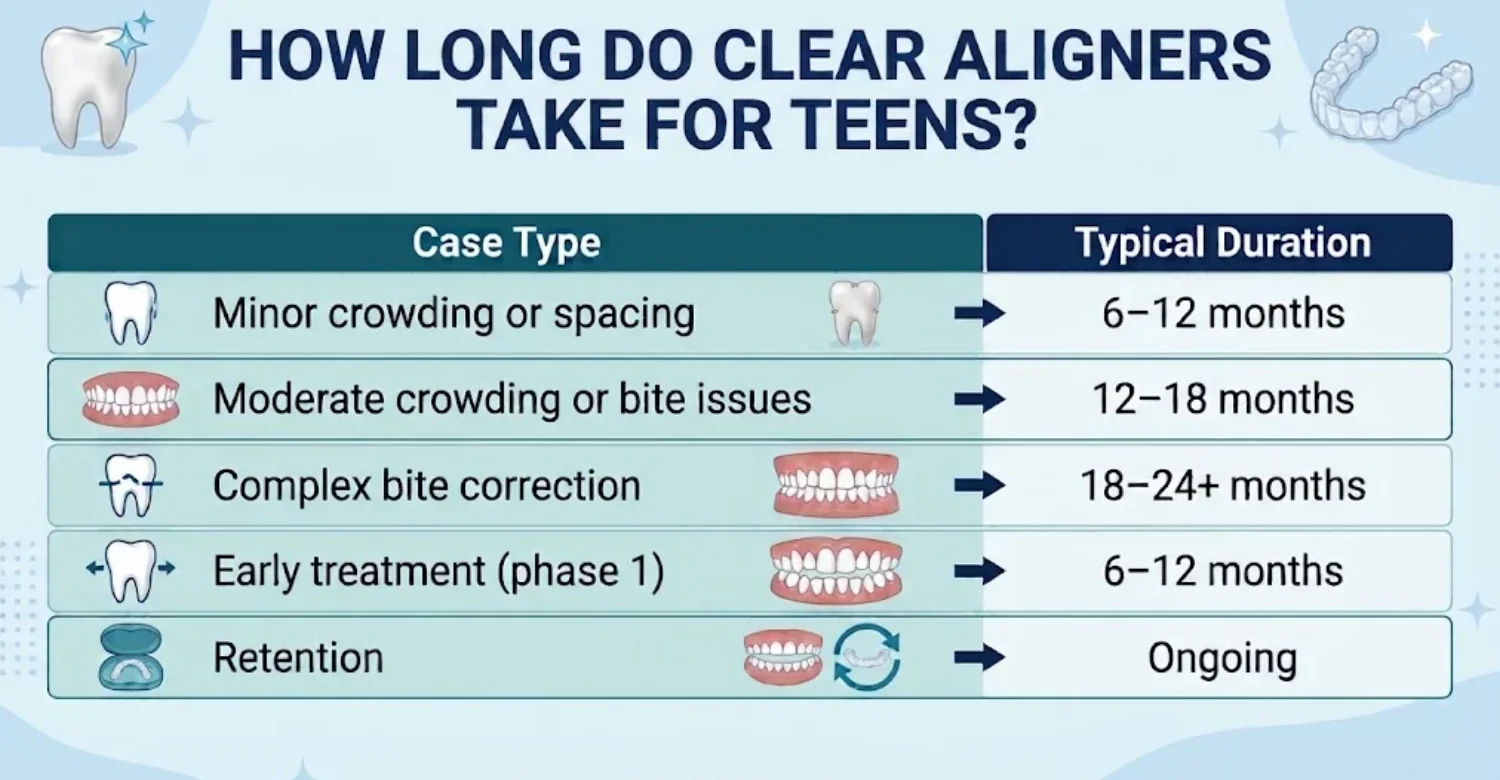
Clear aligners for teens are removable, almost invisible trays that straighten teeth without brackets or wires. They work well for most mild to moderate cases and many complex ones. Whether they suit your teenager comes down to three things: the bite, whether the permanent teeth are through, and, honestly, whether your teen will wear them 20 to 22 hours a day. If you doubt that last part, braces are the safer bet.
Key Takeaways
What they are and what they treat: Clear aligners for teens are removable, almost invisible trays that gradually straighten teeth. They correct crowding, gaps, overbite, underbite, crossbite and open bite, and they work best in mild to moderate cases.
Types: There are four main options:
Comprehensive teen aligners, which leave space for teeth still erupting.
Limited aligners for minor front-teeth problems.
Early-treatment aligners for younger children.
Aligners with jaw-advancement wings for growing teens with a large overbite.
Recovery: There is no surgery and no downtime. Each new set feels tight for one to three days, and speech usually adjusts within a few days. After treatment, retainers protect the result, usually at night and long term.
Cost: The price depends on case complexity, the number of trays and what the plan includes. For comparable cases, it is usually similar to braces. Confirm that replacement trays, refinements and retainers are covered.
.jpg)
.jpg)
.jpg)
Ready to transform your smile?
Talk to our team and get a FREE treatment plan.
Clear Aligners for Teens Compared
Feature | Metal braces | Ceramic braces | Lingual braces | Self-ligating | Clear aligners |
Visibility | Visible | Low | Hidden (behind teeth) | Visible or clear | Near-invisible |
Suitable cases | All, incl. complex | All, incl. complex | Most | All | Mild to moderate; many complex |
Typical duration | 18–30 months | 18–30 months | 18–36 months | 18–30 months | 12–24 months |
Comfort | Wires can rub | Wires can rub | Tongue irritation | Fewer ties | Smooth plastic |
Speech | Little effect | Little effect | Lisp at first | Little effect | Brief adjustment |
Cleaning | Harder | Harder | Hardest | Harder | Easy (removable) |
Food limits | Yes | Yes | Yes | Yes | None (remove to eat) |
Visits | Every 4–8 weeks | Every 4–8 weeks | Every 4–8 weeks | Every 6–10 weeks | Every 6–12 weeks |
Compliance needed | Low | Low | Low | Low | High (20–22 h/day) |
Match Your Teen's Priority
If your teen's priority is… | Best fit |
Not looking like they have braces | Clear aligners or ceramic braces |
Treating a severe or skeletal bite | Fixed braces, sometimes with an expander |
Easy brushing and no food rules | Clear aligners |
Contact sports | Clear aligners (removed, with a mouthguard) |
Playing a wind or brass instrument | Clear aligners (removed while playing) |
Forgetting things or skipping routines | Fixed braces |
Fewer clinic trips or travelling often | Aligners with remote monitoring |
Lowest cost | Metal braces |
.webp)
Are Clear Aligners Good for Teens?
For the right teenager, yes. Studies show aligners handle crowding, gaps and milder bite problems well. They are less predictable than braces for big rotations, vertical movements and major bite correction. So the honest answer to which is best? depends on the case.
How Clear Aligners Work for Teenagers
The mechanics are the same as for adults. Teen systems simply add a few features for mouths that are still growing. Knowing what these are helps you compare quotes and ask sharper questions at the consultation. It also explains why two quotes for clear aligners for teens can be so far apart. The gap usually comes from planning time, refinement rounds and extras, not the plastic itself.
How Aligners Move Teeth
Each tray in a set of clear aligners for teens is shaped slightly differently from the last. That difference applies light, steady pressure, moving teeth a fraction of a millimetre at a time. Your teen switches to a new set roughly every one to two weeks.
To help the plastic grip, small tooth-coloured bumps called attachments are bonded to some teeth. They make the trickier movements possible. The whole sequence is planned in software first, so the orthodontist can check the end result on screen.
Teen-Specific Aligner Features
Good aligner systems usually build in three things:
Eruption compensation: Space is left in the trays for permanent teeth that haven't fully come through yet.
Wear indicators: Small markers fade as the tray is worn, giving a rough sense of daily use.
Replacement aligners: Teens lose trays. Many plans include a few spares so treatment doesn't grind to a halt.
Not All Clear Aligners Are the Same
Brands differ in material, clarity and how well the plastic holds its force between changes. Smoother edges matter too. A tray that rubs the gums is a tray that ends up in a pocket.
Aligners for Younger Children (Early Treatment)
Some children start a first phase of treatment before they reach their teens. At this stage, aligners can widen a narrow arch or guide erupting teeth while the jaw is still growing. The American Association of Orthodontists recommends a first orthodontic check by age 7.
Dr. Sami’s Invisalign Excellence: Top 1% Recognition and 500+ Successful Cases
Dr. Sami received the prestigious Invisalign Apex Award, recognizing his position among the top 1% of Invisalign providers across Europe, the Middle East, and Africa (EMEA), alongside achieving Blue Diamond status and completing over 500 Invisalign cases.
.jpg)
Your Teen's Aligner Journey, Step by Step
1. Consultation. The orthodontist checks the teeth, bite, jaw growth and profile, and asks about habits like mouth breathing.
2. Records. A digital scan replaces the old putty impressions, and X-rays show any teeth still hidden in the bone.
3. Plan and 3D preview. You see a simulation of the result and the number of stages before agreeing.
4. Fitting. Attachments go on, and your teen practises putting the first trays in and taking them out.
5. Follow-ups. Progress is checked in the clinic or remotely, with refinements if needed.
6. Retention. Once the teeth are where they should be, retainers keep them there.
How Treating Teens Is Different
Treating a teenager isn't just adult treatment in a smaller mouth. Growth, erupting teeth and daily habits all change the plan. Most generic guides skip this part. It's also where clear aligners for teens either succeed or quietly fall apart. Once you understand these factors, you can judge whether your child is ready now. Sometimes waiting a few months, or choosing braces, gives a better result.
Dental Age: When Is a Teen Ready?
What matters here is dental age rather than the date on the birth certificate. Most teens are ready for clear aligners once their permanent teeth are through and the second molars are on their way. That's usually between 12 and 14.
Aligners need enough stable teeth to hold on to. A mouth full of wobbly baby teeth and half-erupted adult ones makes it hard for trays to fit properly. Eruption compensation helps, but your orthodontist will check X-rays rather than go by age.
Growing Jaws: An Advantage Aligners Can Use
Teens are still growing, and that can work in favour of clear aligners for teens. Some aligner systems have small wing-like extensions that hold the lower jaw forward. In teens with a set-back lower jaw and a large overbite, this can encourage growth.
It only works while the jaw is growing. Afterwards, the same problem may need longer treatment or surgery. That's one of the main reasons a teen should be assessed by a specialist.
Erupting Teeth and Baby Teeth
Baby teeth that hang on too long and adult teeth still on their way in can complicate things. A stubborn baby tooth may need to come out. A canine stuck in the bone may need a small procedure before any aligner can move it.
Cases like these need careful sequencing before clear aligners for teens can start. Sometimes aligners can start while a tooth is still erupting, with space built into the trays. Other times a short spell of fixed appliances comes first.
Sports, Instruments and Mouthguards
This is one area where aligners have a genuine edge. Teens who play contact sports can take them out and wear a proper mouthguard. With braces, cut lips and cheeks are more likely.
Musicians who play wind or brass instruments often prefer aligners too, because brackets press against the lips. The trays must go straight back in afterwards, because that time still counts.
Is There a Minimum Age for Clear Aligners?
There's no fixed minimum. Children as young as 6 or 7 can wear early-treatment aligners. For full treatment, most orthodontists wait for the permanent teeth.
Maturity matters at least as much as age. A responsible 12-year-old can do better than a distracted 16-year-old. And older teens who missed out on treatment earlier are still good candidates. Adults can read about their own options in adult braces options.
.jpg)
Ready to transform your smile?
Talk to our team and get a FREE treatment plan.
Clinical Note
Straight teeth come second. A healthy mouth comes first. Before clear aligners for teens are fitted, a few things need to be in order, because trays cover the teeth for 22 hours a day and can make existing problems worse.
Cavities: Any decay is treated first. Trays hold saliva away from the teeth, so an untreated cavity can grow faster underneath them.
Gum inflammation: Puffy, bleeding gums are common in teenagers. They should settle with better brushing and a professional clean before treatment begins.
Oral habits: Tongue thrusting, mouth breathing and thumb-sucking can push teeth back out of line. If they aren't addressed, an open bite can return after treatment.
Jaw joint: Clicking, pain or limited opening should be checked and recorded before any bite changes are made.
Enamel defects: Weak or chalky patches are noted, so attachments can be placed carefully and the enamel protected with fluoride.
What Clear Aligners Can Fix in Teens
Clear aligners for teens can correct most of the problems orthodontists see in teenagers:
Crowded or overlapping teeth
Gaps between teeth
Overbite and deep bite
Mild to moderate underbite
Crossbite
Open bite
Relapse after earlier treatment
Ready to transform your smile?
Talk to our team and get a FREE treatment plan.
When Aligners Aren't Enough: Braces, Expanders or Jaw Surgery
Some teen problems are in the bone, not just the teeth. A narrow upper jaw may need a palatal expander. It works best before the palate's middle seam fuses in the late teens. A severe underbite, or a jaw that has grown unevenly, may need surgery once growth has finished.
How Much Do Clear Aligners for Teens Cost?
The price of clear aligners for teens depends on complexity, the number of trays, the brand, and whether refinements and retainers are included.
Does Insurance Cover Clear Aligners for Teens?
That depends on the plan and the country. Where orthodontic cover exists, it's more common for teens than adults. Many plans treat aligners like braces, up to a lifetime limit.
Check whether the plan requires medical need. Then ask the clinic for an itemised treatment plan to submit. If you're travelling abroad for treatment, find out whether care outside your home country is reimbursed.
Payment Plans
Most clinics let you spread the cost: a deposit up front, then monthly instalments.
Before you sign, ask whether there's any interest, whether retainers are included, and what happens if treatment runs longer than planned. Clear terms now save arguments later if your teen ends up needing extra trays.
What We Notice Clinically
Dr. Sami Assani, orthodontist at Vitrin Clinic, sees one habit in teens who finish on time. They treat their aligners like glasses, not a gadget. The trays go back in straight after eating, every time. Teens who build that routine in the first two weeks rarely fall behind, he explains.
Dr. Sami Assani also finds that parents underestimate how often trays get lost. He suggests agreeing on a single storage case and one simple rule: trays never get wrapped in a napkin. In his experience, more lost aligners end up in restaurant bins than anywhere else.
Two more patterns come up again and again in his clinic. Teens who sip sweet or energy drinks with trays in are the ones who return with early decay and stained attachments, so he makes water-only a firm house rule. And teens who stop wearing retainers in their late teens often notice the lower front teeth crowding again, usually within a year or two. That’s why Dr. Sami Assani explains retention to the teen directly, not only to the parent.
Clear Aligners vs Braces for Teens
Clear aligners | Braces | |
Looks | Near-invisible | Visible (unless ceramic or lingual) |
Control of complex moves | Good, less predictable | Excellent |
Depends on teen's discipline | Yes | No |
Hygiene | Easier | Harder |
Emergencies | Rare | Broken brackets, poking wires |
Professional vs Mail-Order Aligners for Teens
Mail-order kits are not a safe shortcut for a teenager. There's no in-person exam and no X-rays. Nobody sees erupting teeth, gum problems or jaw growth. Pushing teeth onto weak bone can lead to gum recession or root damage.
Teens also need someone keeping an eye on progress and on whether the trays are actually being worn. With a mail-order kit, problems tend to come to light only once the damage shows. For clear aligners for teens, professional supervision is the bare minimum.
Orthodontist vs General Dentist: Who Should Plan Treatment?
Orthodontists complete about three years of specialist training after dental school. Some general dentists offer aligners after a short course.
With teenagers, that specialist training counts for more, because growth, erupting teeth and bite correction all call for experience. Ask who designs the treatment plan, who reviews the 3D simulation, and who will see your teen at follow-ups. The answer to all three should be a qualified orthodontist.
Life With Clear Aligners as a Teen
Most classmates won't even notice the trays. Speech usually settles within a few days, and if your teen reads aloud at home for ten minutes or so in the evenings, it tends to settle even faster.
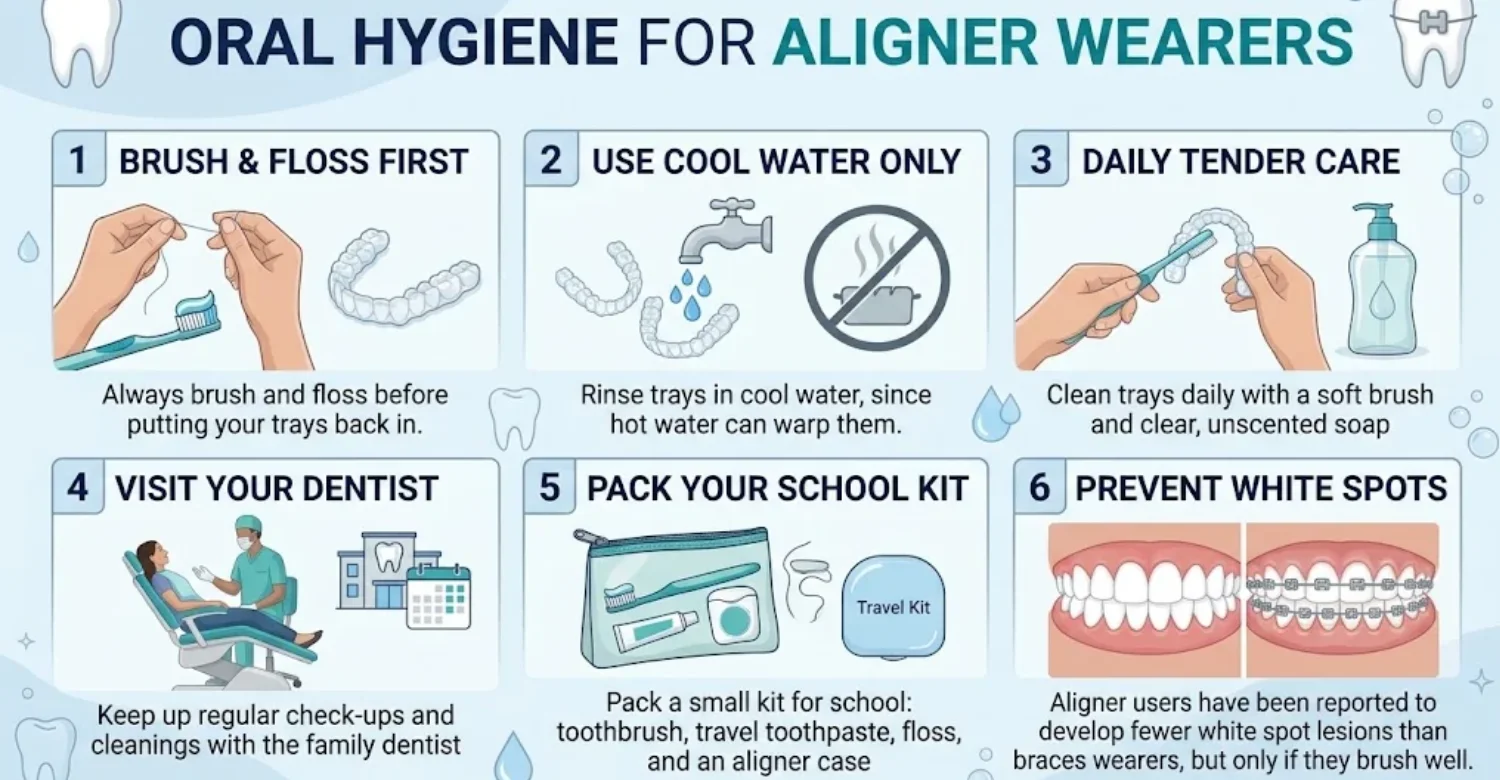
One food rule doesn't bend. Trays come out for everything except plain water, and teeth are brushed before they go back in. A fizzy drink sipped with trays in traps sugar against the teeth. That's a fast route to decay. At school, a small case and a set routine after lunch head off most problems.
Managing Discomfort With New Aligners
Each new set feels tight for one to three days. That's simply the teeth starting to move. Switching to a new set at bedtime helps, because the worst of it passes while your teen sleeps.
Soft food helps on day one. Chewies, small foam cylinders, help the trays seat properly. Over-the-counter pain relief can be used if the dentist says it's fine, and the clinic can smooth any sharp edge. If the pain lasts more than a few days, get it checked.
Lost or Broken Aligners: What to Do
If a tray goes missing or cracks, call the clinic the same day. Usually your teen moves to the next set early or back to the previous one.
Don't leave the teeth without a tray for days, because they can drift back far more quickly than most parents expect, sometimes within a week or two. Keeping the previous set as a backup makes this much easier. A loose attachment isn't an emergency, but it should be rebonded before it starts affecting how the teeth move.
Keeping Results: Retainers for Teens
Once treatment is finished, teeth naturally try to drift back. Teens are also still growing, and late growth can shift things further, which is why retainers are a long-term commitment.
Most teens wear their retainers full time at first and then switch to nights only. The choice is usually a removable clear retainer or a thin fixed wire. We compare them in fixed vs removable retainers. Habits such as low tongue posture can also push teeth out of line over time.
Finishing Touches After Aligners
Some families want brighter teeth once the aligners are done. Talk to the dentist about whitening first, as it's usually postponed for younger teens. Later on, clear retainers can sometimes double as whitening trays.
Clear Aligners for Teens at Vitrin Clinic
At Vitrin Clinic, we offer a wide range of dental treatments designed to support oral health, improve smiles, and meet each patient’s individual needs. Our services include restorative and cosmetic dentistry, dental implants, teeth whitening, and orthodontic solutions, including Invisalign treatment. For teenagers looking to improve their teeth alignment, clear aligners may provide a discreet and comfortable alternative to traditional braces when clinically suitable. Each treatment plan is tailored to the teen’s dental development, alignment concerns, and bite, with professional monitoring throughout treatment. Our team focuses on helping young patients achieve a healthier, well-aligned smile through personalized care and an approach suited to their individual needs.






Book your FREE treatment plan with Vitrin Clinic and get a personalized assessment and treatment plan from our dental team.
Patients Reviews
Ready to transform your smile?
Talk to our team and get a FREE treatment plan.
Medical Disclaimer
This article is for general information and does not replace a personal assessment by a qualified dentist. Prices are approximate 2026 averages, with UK and Turkey figures converted to US dollars, and may vary by clinic and case.
References
FAQs
Dr. Sami Assani leads clear aligner treatment at Vitrin Clinic. He is an Invisalign Apex Award recipient (top 1% of providers in EMEA) and a Blue Diamond provider with 500+ completed Invisalign cases. He is known for precise digital planning and long-term, stable results.


