Oral Dentistry
June 24, 2025
Breaking News: Crown Tooth Cost in Vitrin Clinic That Fits Your Budget

A Smile Investment That Makes Headlines
In today’s world, where dental care often comes with a hefty price tag, the crown tooth cost can feel overwhelming especially for international patients seeking quality treatment without breaking the bank. At Vitrin Clinic Istanbul, we’re turning this story around, offering world-class dental crowns at prices designed to fit your budget, without sacrificing care or craftsmanship.
If you’ve been wondering about the crown tooth cost and what to expect, this breaking news is for you. We’ll take you behind the scenes of crown treatments, reveal how pricing works, and explain why Istanbul, and particularly Vitrin Clinic, has become a top destination for dental crowns worldwide.
Crown Tooth Cost: What’s Included in the Price?
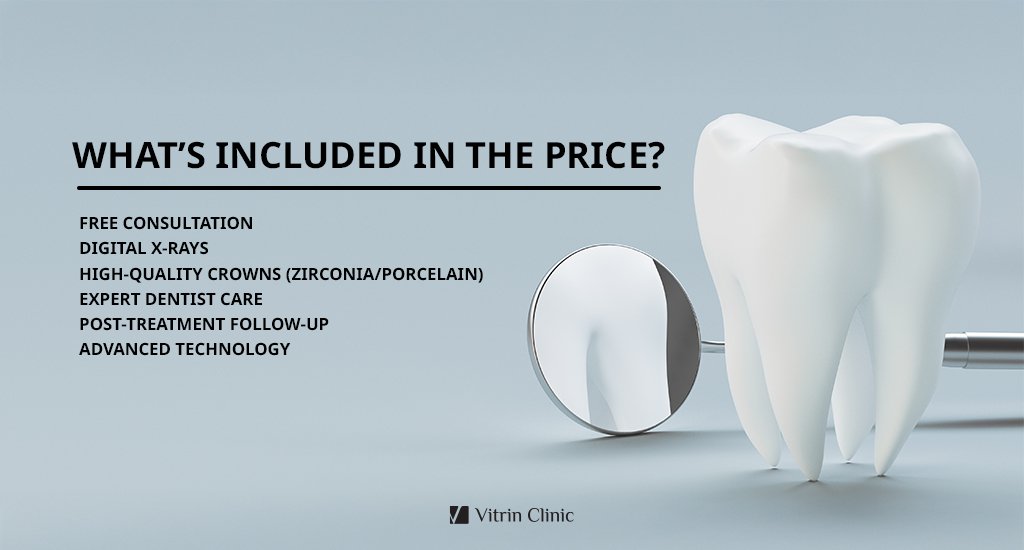
Understanding the crown tooth cost begins with knowing what you’re paying for. Unlike some clinics that surprise patients with hidden fees, Vitrin Clinic Istanbul offers transparent pricing that covers more than just the crown itself.
When you invest in a crown tooth procedure here, you receive:
A thorough dental examination and digital X-rays to customize your treatment plan.
Precision-made crowns crafted from high-quality materials such as zirconia or porcelain, designed to perfectly match your natural teeth.
Advanced dental technology that ensures a comfortable, accurate fit.
The expert care of experienced dentists who specialize in restorative and aesthetic dentistry.
Post-procedure follow-up to make sure your new crown fits comfortably and functions perfectly.
By including these essentials in the crown tooth cost, Vitrin Clinic Istanbul makes sure your investment is safe, clear, and worthwhile giving you peace of mind and a flawless smile.
Why Crown Tooth Cost Varies Around the World
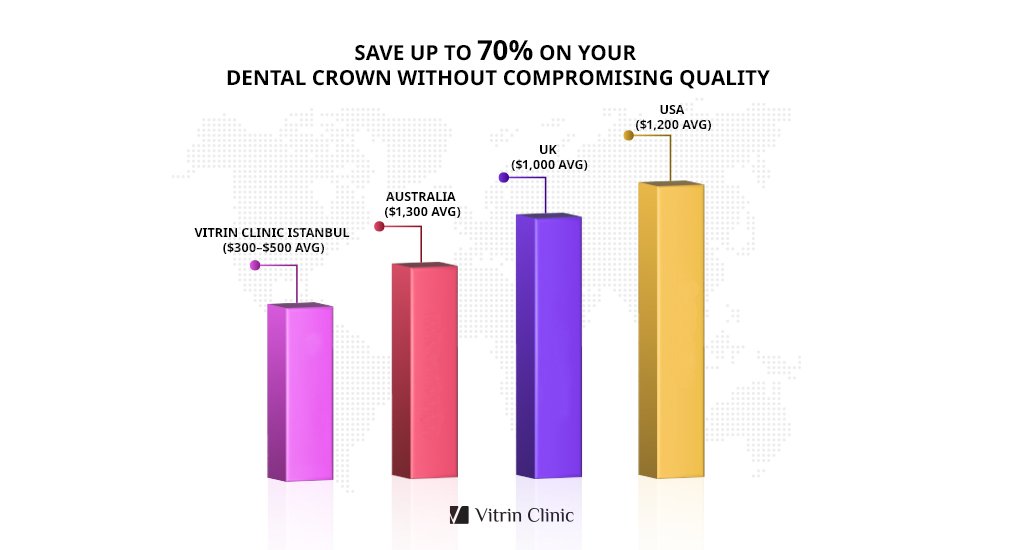
The price of a dental crown can fluctuate dramatically depending on where you go. In countries like the US, UK, or Australia, the average crown tooth cost ranges from $800 to $2,500 per tooth, making a full restoration a costly endeavor.
So, why does Istanbul offer such a different price point?
Lower overhead costs for clinics and materials.
Competitive pricing combined with exceptional quality.
A thriving dental tourism industry where care meets hospitality.
Access to highly trained dentists using cutting-edge technology at a fraction of Western costs.
For international patients, this means the chance to receive premium dental crowns for up to 70% less than in their home countries, without sacrificing quality or comfort.
What Affects Your Crown Tooth Cost at Vitrin Clinic?
At Vitrin Clinic Istanbul, the crown tooth cost depends on several personalized factors, including:
The type of crown material you choose (zirconia, porcelain-fused-to-metal, or full ceramic).
The complexity of your dental situation (simple replacement vs. full mouth restoration).
Additional procedures you might need, such as root canal treatment or gum reshaping.
Whether you opt for premium digital smile design services.
Our team takes time to evaluate your individual needs during your free consultation and then provides a detailed, all-inclusive price quote. This tailored approach ensures that your treatment plan is both effective and budget-friendly.
Why Choose Vitrin Clinic Istanbul for Your Crown Tooth Cost?
International patients often ask: “Is the crown tooth cost really worth it at Vitrin Clinic Istanbul?” The answer comes with a warm smile and plenty of reasons.
We combine world-class dental expertise with the hospitality and warmth Turkey is famous for.
Our clinic uses state-of-the-art technology for precise diagnosis and treatment.
We offer transparent, all-inclusive pricing with no hidden fees or surprises.
Your journey starts with a free online consultation to plan your visit from anywhere in the world.
From airport pickup to follow-up care, your comfort is our priority.
Thousands of satisfied international patients have experienced how affordable and high-quality dental crowns in Istanbul can be turning their investment into a lifelong smile.
Breaking News: How to Start Your Crown Tooth Journey Today
The headline is clear: getting a dental crown doesn’t have to cost a fortune. At Vitrin Clinic Istanbul, the crown tooth cost fits your budget while delivering exceptional results.
If you’ve been waiting for the right moment to restore your smile with a crown, that moment is now. Reach out to us for your free consultation and find out how easy, comfortable, and affordable your dental journey can be.
Your story deserves a happy ending and it starts with a crown that looks and feels like your natural tooth, all at a price that makes news.
How Do You Know If You Need a Dental Crown?
Not every damaged tooth needs a crown but for certain situations, a crown is the only restoration strong enough to save the tooth long-term. Understanding the signs you need a dental crown helps you catch problems early, before they turn into extractions.
Severe Tooth Decay and Large Fractures
When decay has spread too far for a filling to handle, or when a tooth has cracked under pressure (from grinding, trauma, or biting something hard), a crown becomes the safest option. Fillings work by patching a hole, but they rely on healthy tooth structure around them for support. Once decay or a fracture removes too much of that structure, a filling has nothing solid to bond to and it will eventually fail. A crown, by contrast, covers the entire tooth above the gumline, distributing chewing forces evenly and sealing out bacteria that could otherwise reach the nerve.
Common warning signs include:
Sharp pain when biting down, especially on release
A visible crack line running across the tooth
A tooth that has broken off partially, exposing an edge
Deep decay confirmed by X-ray, close to or touching the nerve
Worn Down Enamel and Misshapen Teeth
Years of grinding (bruxism), acid erosion, or simply genetics can leave teeth short, flattened, or oddly shaped. This isn't just cosmetic worn enamel exposes the softer dentin underneath, which is more sensitive and more prone to further damage. Crowns rebuild the tooth's original shape and height, restoring both bite function and appearance in one procedure.
If you're noticing that your teeth look smaller than they used to, feel sensitive to hot and cold, or that your bite feels "off," these are worth mentioning at your next dental check-up they're classic signs you need a dental crown.
What Are Dental Crowns Made From?
Material choice affects strength, appearance, and how the crown feels in your mouth. Here's a breakdown of the main options patients choose between today.
E-Max/Lithium Disilicate vs. Zirconia Crowns
The e max crowns vs zirconia comparison comes up constantly, since both are the top choices for modern, all-ceramic restorations.
E-Max (lithium disilicate) is prized for its translucency light passes through it the way it does through natural enamel, which makes it the top pick for front teeth where appearance matters most. It's strong, but slightly less impact-resistant than zirconia.
Zirconia is the strongest ceramic material used in dentistry today, making it ideal for molars that handle heavy chewing forces. Modern "high-translucency" zirconia has closed much of the old aesthetic gap, so it's now used for front teeth too, especially when extra durability is a priority.
In short: E-Max tends to win on natural light-reflection, zirconia tends to win on raw strength material is chosen based on which tooth is being restored and the patient's bite habits.
Porcelain-Fused-to-Metal (PFM) and Traditional Metal Alloys
Before all-ceramic materials became widely available, porcelain-fused-to-metal crowns were the standard, and they're still used today, particularly for back teeth or as a more budget-conscious option. A PFM crown has a metal substructure for strength, with porcelain layered over it to mimic the color of a natural tooth.
The trade-off: because there's a metal core, PFM crowns can occasionally show a thin dark line at the gumline over time, and they're generally less translucent than E-Max or zirconia. Traditional full-metal crowns (gold or other alloys) are the most durable option of all and remain a solid choice for molars that aren't visible when you smile, though most patients today prefer a tooth-colored result.
The Dental Crown Procedure Step-by-Step
Understanding the dental crown procedure steps can ease a lot of first-time anxiety. Here's what actually happens, visit by visit:
Examination and planning X-rays and a visual exam confirm the tooth needs a crown and check the health of the root and surrounding bone.
Tooth preparation The dentist reshapes the tooth, removing a thin layer of enamel on all sides so the crown will fit over it properly.
Impressions or digital scan A mold or 3D scan of the prepared tooth is taken and sent to the lab (or, in same-day clinics, milled on-site).
Temporary crown placement While the permanent crown is made, a temporary one protects the tooth.
Fitting and cementation Once ready, the permanent crown is checked for fit, color match, and bite alignment, then permanently cemented in place.
Clinical Foundation: What Is a Dental Post and When Is It Needed?
Patients often ask what is a dental post during crown consultations, especially after a root canal. A dental post is a small rod, usually made of metal or fiber-reinforced composite, inserted into the tooth's root canal to provide extra support before the crown is placed. It's not needed for every crown only when very little of the natural tooth structure remains, typically after a root canal has removed the tooth's nerve and pulp. The post anchors a core buildup, which then serves as the foundation the crown sits on, essentially rebuilding a tooth that would otherwise be too weak to hold a crown on its own.
The Technical Difference Between a Dental Crown and a Dental Cap
"Crown" and "cap" are often used interchangeably, and clinically, that's accurate there is no difference between crown and dental cap in terms of the actual restoration. "Cap" is simply the older, more informal term patients used before "crown" became the standard clinical name. Both refer to the same cover that fits over a damaged tooth. If you hear a dentist or article use "cap," they're talking about a crown the terms describe one and the same treatment.
The Pros and Cons of Dental Crowns
Like any dental procedure, crowns come with real benefits and a few trade-offs worth knowing before you commit.
Pros:
Restores full chewing function to a damaged tooth
Protects a weakened tooth from further fracture
Can dramatically improve the appearance of a discolored or misshapen tooth
Long-lasting when properly cared for
Disadvantages and Potential Post-Procedure Complications
Understanding the disadvantages of dental crowns helps set realistic expectations:
Permanent tooth reduction Prepping a tooth for a crown means removing enamel that won't grow back, so the tooth will always need a crown or similar restoration going forward.
Temporary sensitivity Some patients notice heightened sensitivity to hot and cold in the days or weeks after the procedure, which usually settles once the tooth adjusts.
Possible need for a root canal later In rare cases, a tooth that was prepared for a crown can develop nerve irritation afterward, requiring a root canal even though the tooth wasn't dead at the time of the crown.
Gum irritation or a visible margin line With older PFM crowns especially, the gum can occasionally recede slightly, revealing the crown's edge.
Cost Crowns are a bigger investment than fillings, though they're also a longer-term solution.
None of these are reasons to avoid a crown when one is genuinely needed they're simply things your dentist should walk you through so there are no surprises.
Comprehensive Post-Treatment Care and Recovery Roadmap
The first 24–48 hours after getting a permanent crown are the most sensitive. Stick to soft foods, avoid chewing directly on the new crown until any numbness wears off, and use a warm saltwater rinse if the gum tissue feels tender. Mild sensitivity to temperature is normal for a short period and typically fades within one to two weeks.
How to Look After Your Dental Crown
Knowing how to care for a dental crown properly is what determines whether it lasts 5 years or 20+. Key habits:
Brush twice daily and floss around the crown daily, just as you would a natural tooth decay can still form at the gumline where the crown meets the tooth.
Avoid chewing ice, hard candy, or using your teeth to open packaging, which can chip ceramic crowns.
If you grind your teeth at night, wear a night guard grinding is one of the leading causes of premature crown failure.
Keep up with regular dental check-ups so your dentist can catch any margin gaps or wear early.
Steer clear of extremely sticky foods (like taffy) that can pull at the crown's edges over time.
With good care, most crowns last well over a decade, and many go 15–20 years or more without issue.
Medical Alternatives to Dental Crowns
A crown isn't always the only option. Depending on how much of the tooth is damaged, your dentist may suggest one of these alternatives to dental crowns instead.
Inlays and Onlays vs. Dental Veneers
For inlays and onlays vs crowns, the deciding factor is how much of the tooth is affected. Inlays and onlays are a middle ground between a filling and a full crown they cover only the damaged portion of the tooth's chewing surface rather than encasing the whole tooth. They preserve more of the natural tooth structure, which makes them a good option when decay or damage hasn't spread too widely.
Veneers, on the other hand, are thin shells bonded only to the front, visible surface of a tooth. They're primarily a cosmetic solution used to fix discoloration, minor chips, or shape irregularities rather than a structural one. Veneers don't provide the same strength or protection as a crown, so they're not a substitute when a tooth is significantly weakened or decayed.
Tooth Extraction and Dental Implants
When a tooth is too damaged for a crown to save even with a post and core buildup, extraction followed by a dental implant becomes the alternative. An implant replaces the entire tooth, root included, with a titanium post surgically placed in the jawbone and a crown attached on top. It's a bigger procedure with a longer healing timeline, but it's often the most durable long-term solution when the natural tooth truly can't be saved.
References:
A dental crown is more than a cosmetic restoration: it protects damaged teeth, restores function, and helps preserve long-term oral health. Supporting this, the referenced study found that well-made crowns can achieve excellent longevity when combined with proper clinical techniques and regular maintenance. Choosing quality materials and following your dentist’s aftercare advice can help ensure a durable, healthy smile for many years.
https://pmc.ncbi.nlm.nih.gov/articles/PMC7408958/
https://pmc.ncbi.nlm.nih.gov/articles/PMC7040448/
https://pmc.ncbi.nlm.nih.gov/articles/PMC9663878/
FAQs

Dr.Faisal Kayalı has over 7 years ofclinical experience and is currently part of the medical team at Vitrin Clinic


