Dental Crowns
October 21, 2026
What Is the Fatigue Reliability of Dental Implant Crowns, and How Long Do They Last?
 Dr. Rifat Alsaman

Most implant-supported crowns survive well beyond ten years when the bite, design, and material suit the patient. Reviews report single implant crown survival of roughly 95–97% at five years and about 89–90% at ten years. The fatigue reliability of dental implant crowns explains why some crowns last decades while others chip early. This guide explains how fatigue works, why crowns fail, and how damage is diagnosed. It also covers treatment and costs in the US, UK, and Turkey.
Ready to transform your smile?
Talk to our team and get a personal FREE treatment plan.
What Is the Fatigue Reliability of Dental Implant Crowns?
The fatigue reliability of dental implant crowns is the chance a crown survives repeated chewing without cracking or failing. It is measured over time, not in one bite. A crown may resist a single heavy bite yet fail after millions of lighter ones. Clinicians use this concept to choose materials, crown thickness, and bite design for each patient.
What Does Dental Implant Crown Fatigue Resistance Mean?
Fatigue resistance is a crown's ability to tolerate repeated stress below its breaking point without damage growing. Every bite creates tiny stresses inside the ceramic or metal. Over time, microscopic flaws can grow into cracks if stress is concentrated. A fatigue-resistant crown slows this crack growth, so it keeps its shape and strength for longer. Materials with high fracture toughness, such as zirconia, generally resist crack growth better than glass-rich porcelain.
How Does Repeated Chewing Force Affect an Implant-Supported Crown?
An adult chews roughly 250,000 to 300,000 cycles per year, according to common laboratory estimates. Typical chewing forces range from about 70 to 150 newtons per bite. Maximum molar bite force can reach 500 to 900 newtons in healthy adults. Unlike a natural tooth, an implant has no periodontal ligament to cushion these loads. The crown, abutment, and screw therefore absorb more direct stress with each chewing cycle.
What Is the Difference Between Fatigue Strength, Fracture Resistance, and Durability?
Fatigue strength is the highest repeated stress a material survives for a set number of cycles. Fracture resistance is the single load needed to break the crown at once. Durability is the broader real-world outcome, including wear, chipping, loosening, and appearance over years. A crown can show high fracture resistance in testing yet still have modest fatigue strength. Understanding the fatigue reliability of dental implant crowns requires looking at all three measures together.
How Do Laboratory Fatigue Tests Predict Clinical Crown Performance?
Laboratory tests load crowns repeatedly in machines that mimic chewing, often in water at body temperature. Researchers then count cycles until cracking, chipping, or fracture occurs. Many studies treat about 1.2 million simulated cycles as roughly five years of clinical function. These tests help rank materials and designs before long clinical trials are available. However, they simplify a mouth that is far more variable than any machine.
Cyclic loading, load magnitude, and number of loading cycles
Cyclic loading means applying the same force again and again at a set frequency. The international standard ISO 14801 tests implant assemblies at an angle of 30 degrees. It typically runs up to five million cycles to estimate long-term endurance. Higher load magnitudes shorten the number of cycles to failure dramatically. Researchers often use step-stress tests, raising the load gradually until the crown fails.
Laboratory testing versus real-world chewing conditions
Real chewing involves changing angles, food textures, saliva, temperature shifts, and occasional accidental hard bites. Laboratory machines usually apply a single direction and a steady force. Bruxism, uneven contacts, and poor crown design rarely appear in standard tests. As a result, laboratory data can overestimate the fatigue reliability of dental implant crowns in high-risk patients. Clinical follow-up studies remain the strongest evidence for real-world performance.
.jpg)
.jpg)
.jpg)
.jpg)
How Long Do Dental Implant Crowns Last Under Repeated Chewing Forces?
Most implant crowns last 10 to 15 years, and many last longer with good maintenance. A large systematic review reported about 96% crown survival at five years and 89% at ten years. The implant fixture itself often survives longer, with ten-year survival commonly reported above 95%. This means the crown is usually the first part to need attention, not the implant.
What Factors Influence Dental Implant Crown Longevity?
Crown longevity depends on material, design, bite forces, oral habits, and maintenance. Patients with bruxism face a noticeably higher risk of chipping and screw loosening. Crowns on back molars receive heavier loads than crowns on front teeth. Precise fit, balanced contacts, and adequate thickness all improve the fatigue reliability of dental implant crowns. Regular check-ups catch small problems before they become fractures.
How Do Crown Material and Restoration Design Affect Lifespan?
Material strength sets the upper limit, but design decides how stress spreads through the crown. Monolithic zirconia offers flexural strength of about 900 to 1,200 megapascals. Lithium disilicate offers roughly 360 to 500 megapascals, while feldspathic porcelain offers about 60 to 120. Sharp internal angles, thin edges, and long unsupported cusps concentrate stress and shorten lifespan. Smooth, anatomically supported shapes distribute load more evenly.
Can an Implant Crown Wear Out Without Breaking?
Yes, a crown can lose function gradually without any visible fracture. Surface wear flattens chewing cusps, which reduces chewing efficiency and changes the bite. Glazes on ceramic crowns may wear away within a few years, leaving a rougher surface. Rough surfaces collect plaque and can wear opposing teeth faster. Small internal cracks may also grow silently before a crown finally fails.
Does a Crown on a Single Implant Behave Differently From a Full-Arch Restoration?
A single crown carries the load of one tooth on one implant. A full-arch bridge spreads chewing forces across four to eight implants. However, full-arch restorations often have long cantilevers, which multiply stress at the end implants. Studies report higher technical complication rates for full-arch prostheses, including veneer chipping in a sizable minority. Each design requires its own approach to protecting fatigue reliability of dental implant crowns.
What Causes Fatigue Failure of Dental Implant Crowns?
Fatigue failure usually results from many small stresses rather than one dramatic event. Repeated loading, excessive bite forces, and design weaknesses combine over time. Several of these causes often reduce the fatigue reliability of dental implant crowns at once. Once a microscopic crack starts, each chewing cycle can extend it slightly. Replacing a crown without fixing the cause invites repeat failure.
Repeated Biting and Chewing Forces
Every meal adds hundreds of loading cycles to an implant crown. Over ten years, a crown may experience well over two million chewing cycles. Normal forces are usually safe for well-designed crowns. The risk rises when these forces meet hidden flaws, thin areas, or poorly placed contacts. Fatigue strength in ceramics can drop to around half of initial strength after prolonged cycling.
Bruxism, Teeth Grinding, and Clenching
Bruxism is one of the strongest risk factors for mechanical complications. Sleep bruxism affects roughly 13% of adults, while awake clenching is reported in about 22–31%. Grinding forces can exceed normal chewing forces several times over and last much longer. They also apply sideways loads, which ceramics tolerate poorly. Many patients do not know they grind until damage appears.
Poor Occlusal Contact and Uneven Bite Forces
An implant crown should not carry more than its share of the bite. Because implants do not move like natural teeth, a slightly high crown takes concentrated force. Contacts on steep cusp slopes create sideways stress on the crown and screw. Unbalanced side-to-side movements can overload a single restoration repeatedly. Careful bite adjustment directly supports the fatigue reliability of dental implant crowns.
Crown Thickness, Shape, and Material Defects
Thin ceramic fails faster because stress concentrates in less material. Monolithic zirconia usually needs at least 0.5 to 1.0 millimetres of thickness. Lithium disilicate typically needs around 1.5 millimetres in back teeth. Air bubbles, porosity, and unsupported porcelain layers act as starting points for cracks. Laboratory quality control therefore plays a direct role in crown lifespan.
Abutment Design, Screw Loosening, and Connection Problems
The abutment and screw connect the crown to the implant and carry every chewing load. Reviews report abutment screw loosening in about 5–9% of single crowns over five years. A loose screw allows micro-movement, which raises stress on the crown and connection. External hex connections tend to loosen more often than internal conical connections. Correct tightening torque, usually 25 to 35 Ncm, helps maintain screw preload.
Implant Position, Bone Support, and Prosthetic Design
An implant placed at a steep angle can push the crown off-axis during biting. Off-axis loading increases bending stress on the crown, abutment, and screw. A tall crown on a short implant increases leverage on the connection. Wide crowns over narrow implants create overhangs that act like small cantilevers. Planning implant position for the final crown reduces these mechanical risks.
How Do Biting Hard Foods and Accidental Impacts Affect Crown Failure?
A sudden hard bite can crack a crown already weakened by fatigue. Ice, nut shells, olive pits, hard sweets, and bones are common triggers. Falls or sports injuries can also fracture ceramic or damage the implant connection. Often the hard food only completes damage that repeated loading started earlier. Patients sometimes blame one bite when the real cause is long-term overload.
What Are the Signs of a Fatigue-Damaged Dental Implant Crown?
Fatigue damage often starts silently and shows only small changes at first. Patients may notice a rough edge, a new click, or a bite that feels different. Early signs are easier and cheaper to treat than a full fracture. Any change in how an implant crown looks, feels, or sounds deserves a dental check.
Small Chips, Surface Cracks, and Visible Fractures
Small chips often appear first on biting edges or the outer porcelain layer. Fine surface cracks may look like thin lines and catch light when you smile. Chipping of veneering porcelain is one of the most common technical complications reported. Some reviews report porcelain chipping in roughly 3–9% of layered implant crowns over five years. A visible fracture line usually means the crown has lost structural strength. Even small chips can grow, so early assessment helps protect the fatigue reliability of dental implant crowns.
Changes in Bite Comfort or Chewing Efficiency
A crown that feels high, low, or uneven may signal wear, cracking, or a loosening screw. Patients sometimes find they avoid chewing on one side without realising why. Food may start to catch between the crown and neighbouring teeth. Discomfort when biting can come from the crown, the gum, or a natural tooth nearby. Because implants lack nerve sensation, early mechanical changes may feel subtle. Any new bite change should be checked rather than ignored.
Crown Movement, Looseness, or a New Clicking Sensation
A clicking sound or slight wobble usually points to a loose screw or cement failure. The implant itself rarely moves unless it has lost bone support. Loose crowns allow micro-movement that stresses the screw and connection with every bite. Over time, this movement can fracture the screw or damage the implant threads. Food and bacteria can also enter the gap and irritate the gum. A moving crown needs prompt professional assessment, ideally within days.
Wear Facets, Rough Edges, and Changes in Crown Shape
Wear facets are flat, shiny areas where the crown rubs against opposing teeth. They often suggest grinding or a bite contact that carries too much force. Rough edges may follow loss of the surface glaze or small chips. Changes in crown shape can alter how forces spread through the restoration. Severe facets on several teeth often indicate bruxism that also threatens the fatigue reliability of dental implant crowns. Polishing and bite adjustment can sometimes correct early wear.
How Can You Tell Whether the Crown, Abutment, or Implant Is the Problem?
Patients cannot reliably tell which component is damaged without an examination. A chip or crack usually involves only the crown. A clicking crown that rotates often suggests a loose abutment screw. A crown that moves with the whole implant, plus pain or swelling, may indicate implant failure. Dentists use clinical tests, screw access, and X-rays to locate the problem. Correct diagnosis prevents unnecessary replacement of healthy components.
Ready to transform your smile?
Talk to our team and get a personal FREE treatment plan.
What We Notice Clinically
In our clinic, most implant crown problems are mechanical rather than biological. The implant is often stable even when the crown above it has chipped or loosened. Patterns of damage frequently point to the cause, such as grinding or an uneven bite. These observations guide whether we repair, adjust, or replace a restoration.
Why a Small Crown Chip Does Not Always Mean the Implant Has Failed
A chip affects the crown surface, while the implant sits fused to bone below. Long-term studies show implant fixtures survive more often than the crowns they support. Many chipped crowns sit on implants with healthy bones and no mobility. In these cases, the solution may be polishing, repair, or a new crown alone. Removing a stable implant because of a crown chip is rarely justified.
Common Patterns in Patients With Repeated Crown Fractures
Patients with repeated fractures often share a few common features. Many have signs of bruxism, such as worn natural teeth or enlarged jaw muscles. Others have crowns with thin porcelain layers or long unsupported cusps. Some have bites that place heavy sideways contacts on the implant crown. When fractures recur, we assess the bite and habits before choosing another material. Treating only the crown often leads to the same failure again.
Distinguishing Ceramic Chipping From Screw Loosening and Implant Instability
Ceramic chipping appears as missing material with sharp or rough edges. Screw loosening usually causes rotation, clicking, or a crown that moves slightly. Implant instability involves movement of the whole fixture, often with pain or bone loss. Each problem has a different cause and treatment path. We combine visual inspection, gentle mobility tests, and radiographs to separate them. This distinction directly affects cost, treatment time, and long-term outcome.
Why a Stable Implant Can Still Have a Mechanical Restoration Problem
Osseointegration only secures the implant to bone, not the crown to the implant. The crown, abutment, and screw remain mechanical parts that fatigue under load. A perfectly integrated implant can still carry a cracked crown or loose screw. Mechanical complications are reported more often than biological implant loss in follow-up studies. This explains why fatigue reliability of dental implant crowns matters even when implant survival is excellent.
Clinical Note: Dr. Rifat Alsaman's Perspective on Implant Crown Fatigue
Dr. Rifat Alsaman reviews implant crown complications as part of a full mechanical assessment. His approach focuses on finding why a crown failed before recommending treatment. He stresses that the visible damage is often the result, not the cause. This approach helps avoid repeated failures and unnecessary procedures.
Dr. Rifat Alsaman, Head of the Medical Team at Vitrin Clinic
Dr. Rifat Alsaman leads the medical team at Vitrin Clinic and oversees implant and restorative treatment planning. He reviews complex implant cases and repeated restoration failures. His team works with international patients who often arrive with previous treatment records. Each case is assessed according to the patient's bite, habits, and existing restorations.
Why bite assessment, crown design, and the location of the damage matter before recommending replacement
Bite assessment shows whether the crown carries too much force during chewing or grinding. Crown design reveals thin areas, unsupported porcelain, or poor contact shapes. The location of the damage often points to its cause. Chips on cusp tips may suggest grinding, while cracks near the base may suggest design stress. Evaluating these details first supports the fatigue reliability of dental implant crowns after any replacement.
Which Dental Implant Crown Materials Offer Better Fatigue Resistance?
Monolithic zirconia and metal-ceramic crowns generally show the strongest mechanical performance on implants. Layered ceramics look more natural but carry a higher risk of chipping. Glass-ceramics such as lithium disilicate balance strength and appearance for lower-load areas. The best material depends on tooth position, bite force, space, and aesthetic needs.
Zirconia vs. Porcelain Implant Crowns: Which Is More Durable?
Zirconia is usually more durable than traditional porcelain under repeated chewing loads. Conventional zirconia has flexural strength around 900 to 1,200 megapascals. Feldspathic porcelain typically ranges from about 60 to 120 megapascals. Porcelain looks lifelike but chips more easily, especially on back teeth. Zirconia also resists crack growth better because of its higher fracture toughness. For most molars, zirconia offers better fatigue reliability of dental implant crowns than porcelain alone.
Monolithic Zirconia and Its Fracture Resistance
Monolithic zirconia is milled from a single solid block with no porcelain layer. This removes the weak interface where layered porcelain usually chips. Clinical studies report very low fracture rates for monolithic zirconia implant crowns, often below 2% over several years. Its main limitation is aesthetics, as it can look more opaque than natural teeth. Newer translucent zirconia improves appearance but has lower strength, around 600 to 800 megapascals.
Layered Zirconia and the Risk of Porcelain Chipping
Layered zirconia combines a strong zirconia core with an outer porcelain layer. It looks highly natural, which suits front teeth and visible smiles. However, the porcelain layer is the weak point under repeated stress. Systematic reviews report higher chipping rates for veneered zirconia than for metal-ceramic crowns. Proper core design that supports the porcelain evenly can reduce this risk. Slow cooling during firing also helps reduce internal stresses in the veneer.
Metal-Ceramic Implant Crowns and Their Mechanical Performance
Metal-ceramic crowns have a long clinical track record spanning several decades. A metal framework supports an outer porcelain layer bonded by firing. Five-year survival of metal-ceramic implant crowns is commonly reported at around 98%. They resist fracture well, but the porcelain can still chip under heavy loads. A grey margin may show if the gum recedes, which affects aesthetics. These crowns remain a reliable benchmark for comparing newer materials.
Lithium Disilicate and Other Glass-Ceramic Restorations
Lithium disilicate is a glass-ceramic known for excellent translucency and natural appearance. Its flexural strength is roughly 360 to 500 megapascals, lower than zirconia. It performs well on front teeth and premolars with moderate bite forces. On molars, it needs greater thickness, usually around 1.5 millimetres or more. It can be bonded strongly, which helps distribute stress. Patients with bruxism may be better served by a stronger material.
How Does Dental Implant Crown Wear Resistance Affect Opposing Teeth?
Wear resistance describes how well a crown resists surface loss and how it affects opposing teeth. Polished zirconia is surprisingly gentle on opposing enamel when kept smooth. Rough or unglazed zirconia, however, can wear natural teeth more quickly. Porcelain can be abrasive when its glaze wears away. Regular polishing helps protect both the crown and the opposing dentition. Balanced wear also supports the fatigue reliability of dental implant crowns over many years.
What Should Patients Consider When Choosing a Crown Material?
Patients should weigh strength, appearance, available space, and grinding habits. The tooth's position affects how much force the crown must withstand. Previous crown failures may suggest the need for a stronger option. Budget and laboratory availability can also influence the final choice. A dentist should explain why one material suits your situation better than another.
Posterior teeth and high chewing loads
Back teeth handle the highest forces, often several times greater than front teeth. Monolithic zirconia or metal-ceramic crowns are usually preferred in this region. These materials tolerate repeated heavy loading with lower chipping risk. Appearance matters less on molars, so strength often takes priority.
Front teeth and aesthetic requirements
Front teeth need natural colour, translucency, and gum harmony. Layered zirconia or lithium disilicate often provide the most lifelike results. Bite forces are lower here, which allows more aesthetic materials. Gum thickness and implant depth also influence the final appearance.
Bruxism, restoration thickness, and available space
Patients who grind or clench need stronger materials and sufficient thickness. Limited vertical space may prevent ideal crown thickness for weaker ceramics. Monolithic zirconia can work in tighter spaces because it needs less thickness. A protective night guard is often recommended alongside material choice.
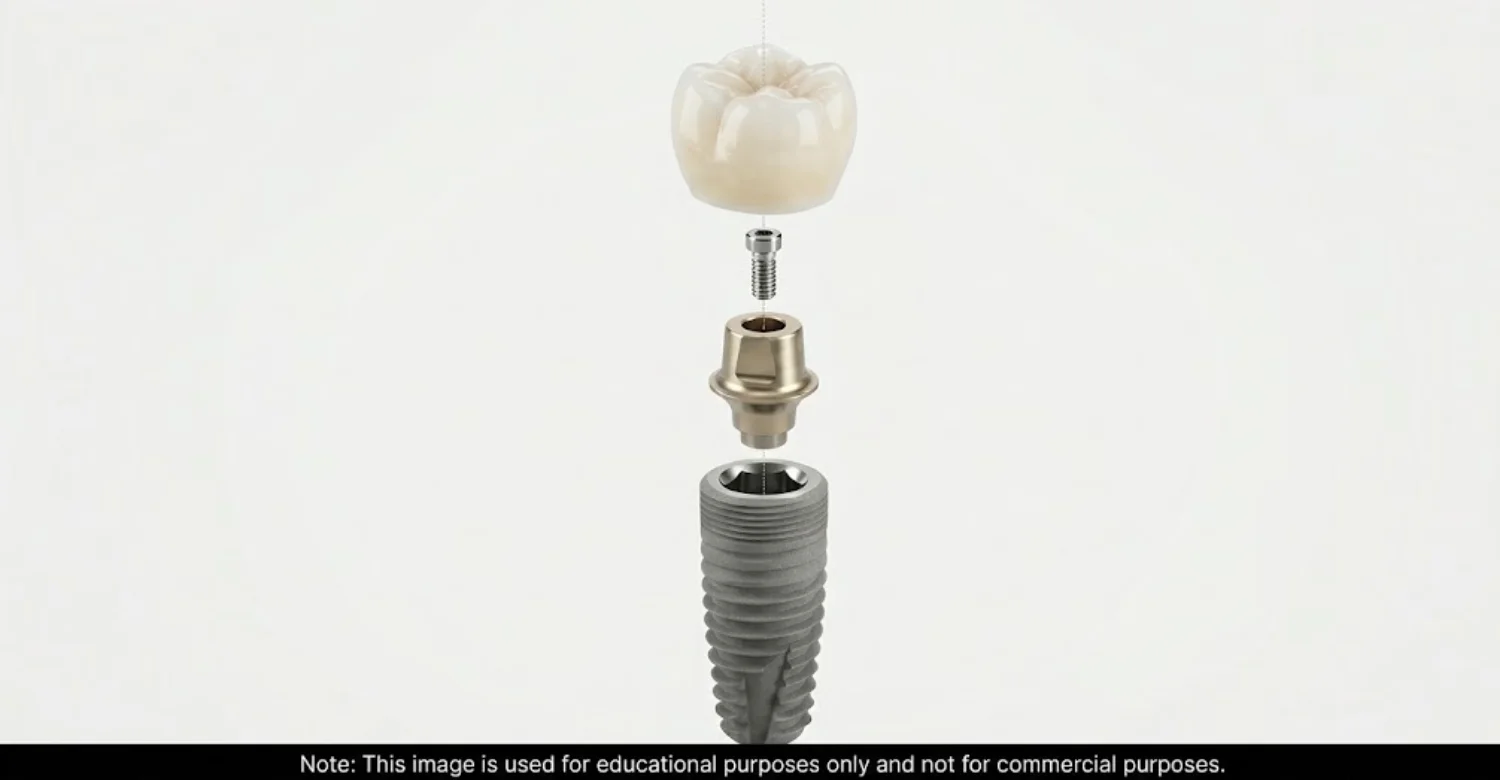
What Factors Affect Dental Implant Crown Fatigue Strength?
Fatigue strength depends on how material, design, and loading interact over time. No single factor decides whether a crown will fail. Small weaknesses in several areas can combine and shorten crown life. Understanding these factors helps patients and dentists improve the fatigue reliability of dental implant crowns.
Crown Material and Manufacturing Quality
Material choice sets the baseline strength of the crown. Manufacturing quality decides whether that strength is achieved in practice. Milled zirconia from industrial blocks usually contains fewer defects than hand-layered porcelain. Grinding adjustments after milling can create surface flaws that weaken zirconia. Proper sintering, glazing, and polishing restore surface quality and reduce crack starting points.
Restoration Thickness and Surface Finish
Thicker crowns spread stress through more material, which lowers peak stress levels. Thin areas below recommended limits can fail under normal chewing. Surface finish also matters because scratches act as tiny crack starting points. A smooth, polished surface is stronger and gentler on opposing teeth. Dentists should polish any adjusted area before the crown leaves the clinic.
Bite Force, Occlusion, and Contact Distribution
Bite force varies greatly between people, from moderate chewing to heavy clenching. Men often produce higher bite forces than women, and molars carry the most load. Contacts should be spread evenly across several teeth rather than focused on the implant. Light contacts on implant crowns during heavy biting are often recommended. Good contact distribution reduces repeated stress peaks inside the crown.
Implant Position and Crown-to-Implant Geometry
Implant angle affects whether forces travel along the implant or across it. Off-axis forces increase bending stress on the crown and screw. Crown-to-implant ratios up to about 2:1 appear acceptable in many studies. Higher ratios increase leverage and may raise screw loosening risk. Careful digital planning helps place implants where the final crown needs them.
Abutment and Screw Connection Design
The connection between abutment and implant influences how stress reaches the crown. Internal conical connections usually show fewer screw complications than external hex designs. Titanium bases bonded to zirconia crowns are now widely used. Original components from the implant manufacturer tend to fit more precisely than generic parts. Accurate fit reduces micro-movement and protects the fatigue reliability of dental implant crowns.
Bruxism and Other Sources of Excessive Mechanical Loading
Bruxism places repeated heavy loads on crowns, often during sleep. Clenching, nail biting, pen chewing, and opening packages with teeth add further stress. Some patients also use one side of the mouth exclusively. These habits multiply loading cycles far beyond normal chewing. Managing them is as important as choosing a strong material.
Patient Habits, Oral Hygiene, and Maintenance
Good hygiene keeps gum and bone healthy around the implant. Healthy bone support helps the implant handle forces as designed. Missed check-ups allow small chips or loose screws to worsen unnoticed. Smoking is linked to higher implant complication rates and poorer gum health. Patients who attend regular reviews usually keep their crowns longer.
How Does Crown Design Influence Mechanical Complications of Implant-Supported Crowns?
Crown design shapes how stress flows through the restoration. Wide, flat cusps reduce sideways forces compared with steep, sharp cusps. Narrow chewing surfaces lower the leverage acting on the implant. Rounded internal angles avoid stress concentration points. Screw-retained designs allow easier access for repair, while cemented crowns may hide excess cement. Thoughtful design can prevent many mechanical complications before they start.
What Complications Can Result From Repeated Loading of Implant Crowns?
Repeated loading can cause chipping, screw loosening, cement failure, wear, and component damage. Technical complications are common, even when implants themselves stay healthy. One review estimated that about one in three implant patients experiences a technical complication within five years. Most of these problems are repairable when detected early.
Crown Chipping and Fracture
Chipping removes small pieces of ceramic, usually from the outer porcelain layer. Fracture involves a crack through the crown's main structure. Chipping is reported more often than complete fracture in most clinical studies. Layered crowns chip more often than monolithic crowns made from one material. Small chips may be polished, while larger fractures usually require a new crown. Both problems reduce the fatigue reliability of dental implant crowns if their cause is not corrected.
Abutment Screw Loosening or Fracture
Screw loosening is one of the most frequent mechanical problems with single implant crowns. Reviews report cumulative five-year screw loosening rates of roughly 5–9% for single crowns. Loosening usually follows loss of screw preload under repeated sideways forces. If ignored, a loose screw may bend or fracture inside the implant. Retrieving a broken screw can be difficult and sometimes damages the implant threads. Early retightening and bite correction usually prevent this outcome.
Cement Failure and Crown Decementation
Cemented implant crowns can lose retention when the cement breaks down. Reviews report loss of retention in about 4–5% of cemented crowns over five years. Short abutments, temporary cements, and heavy loads increase this risk. A decemented crown may feel loose or fall out completely. Recementation is often simple if the crown and abutment remain undamaged. Excess cement left under the gum can also cause inflammation around the implant.
Wear of the Crown and Opposing Natural Teeth or Restorations
Implant crowns and opposing teeth rub against each other with every chewing cycle. Unpolished ceramics can wear opposing enamel faster than natural tooth contact. Grinding accelerates wear on both the crown and opposing teeth. Over years, wear may flatten cusps and change the bite. Regular polishing and night guards help limit wear. Monitoring wear protects the opposing dentition and the fatigue reliability of dental implant crowns.
Implant Component Damage and Possible Loss of Implant Stability
Severe overload can damage the abutment, the internal connection, or the implant body. Implant body fractures are rare, usually reported in less than 1% of cases. They occur more often with narrow implants and heavy bruxism. Damaged internal threads may prevent secure placement of a new abutment. In rare cases, the implant may need removal and replacement. Early treatment of loose or overloaded crowns lowers this risk.
How Are Mechanical Complications Different From Peri-Implantitis?
Mechanical complications affect the crown, abutment, screw, or implant structure. Peri-implantitis is a biological infection that destroys gum and bone around the implant. Studies suggest peri-implantitis affects roughly one in five implant patients at some point. Mechanical problems usually cause chips, looseness, or clicking without bleeding. Peri-implantitis often causes bleeding, swelling, pus, or receding gums. Both conditions need different treatments, so correct diagnosis matters.
Can Repeated Mechanical Problems Affect the Surrounding Gum and Bone?
Yes, mechanical problems can contribute to gum and bone issues over time. A loose crown creates gaps where bacteria and food can collect. Micro-movement at the connection may irritate surrounding soft tissue. Excess cement is a well-known trigger for peri-implant inflammation. Heavy overload may also add stress to the crestal bone in some patients. Fixing mechanical problems early helps protect the biological health of the implant.
How Is Fatigue Damage to a Dental Implant Crown Diagnosed?
Diagnosis combines a patient history, clinical examination, bite analysis, and imaging when needed. Dentists look at the crown, abutment, screw, gum, and bone together. The goal is to find both the damage and its underlying cause. Accurate diagnosis protects the fatigue reliability of dental implant crowns after treatment.
What Happens During an Implant Crown Examination?
The dentist first asks when symptoms began and what triggered them. They review previous records, implant brand, and restoration type when available. Next, they inspect the crown under magnification and good lighting. They check the gum for bleeding, swelling, or recession. Gentle pressure tests help locate any movement or discomfort. The examination usually takes 20 to 40 minutes, depending on complexity.
Checking Crown Integrity, Occlusion, and Contact Points
Crown integrity is checked for chips, cracks, rough areas, and open margins. Transillumination and magnification help reveal fine cracks that are hard to see. Articulating paper shows where the crown touches opposing teeth. Dentists check contacts in closed biting and during side-to-side and forward movements. Digital bite analysis can measure force distribution in some clinics. Heavy contacts on the implant crown are a common finding in fatigue failure.
Assessing Abutment Screws and Implant Stability
Screw-retained crowns allow direct access to check screw tightness. The dentist may remove the crown to inspect the abutment and connection. A torque wrench confirms whether the screw holds the manufacturer's recommended torque. Implant stability can be tested with gentle mobility checks or resonance frequency analysis devices. A stable implant with a loose screw points to a mechanical, not biological, problem. This distinction shapes the entire treatment plan.
When Are Dental X-Rays Needed?
Periapical X-rays are usually needed when a crown is loose, painful, or repeatedly failing. They show bone levels around the implant and the fit of the abutment. Gaps between components can indicate loosening or incorrect seating. Radiographs also reveal fractured screws or cracks in the implant body. Comparing new images with previous X-rays helps track bone changes over time. Modern digital X-rays use relatively low radiation doses.
When Might CBCT or Other Digital Diagnostics Be Appropriate?
CBCT scans provide three-dimensional images of bone and implant position. They may help when planning implant replacement or assessing complex bone loss. CBCT is not routine for simple crown chips. Intraoral scanners can capture crown shape and bite for digital design of a replacement. Digital bite tools can record force timing and distribution in some cases. Your dentist should explain why any additional scan is needed.
How Do Dentists Evaluate Suspected Bruxism and Excessive Bite Forces?
Dentists look for worn teeth, cracked enamel, scalloped tongue edges, and enlarged jaw muscles. Patients may report morning jaw tightness, headaches, or a partner noticing grinding sounds. Repeated crown fractures also raise suspicion of bruxism. A sleep study can confirm sleep bruxism when symptoms are significant. Night guards with wear marks can reveal grinding patterns. Identifying bruxism is essential for long-term fatigue reliability of dental implant crowns.
Why Is It Important to Identify the Cause Before Replacing a Crown?
A new crown placed under the same conditions may fail in the same way. Replacing a crown without correcting the bite, screw, or habit wastes time and money. Identifying the cause allows the dentist to adjust design, material, or occlusion. It also helps patients understand what they can do to prevent recurrence. Cause-focused treatment usually gives a more predictable long-term result.
How Can a Fatigue-Damaged Dental Implant Crown Be Treated?
Treatment ranges from polishing and minor repair to full crown or component replacement. The right option depends on the extent and cause of the damage. Conservative care is preferred when the crown's structure remains sound. Severe fractures or connection damage usually need replacement. Good treatment restores the fatigue reliability of dental implant crowns, not only their appearance.
Can a Chipped Dental Implant Crown Be Repaired?
Small chips can often be repaired in the mouth with composite resin. The dentist roughens the ceramic, applies a bonding agent, and adds tooth-coloured composite. These repairs can last several years in low-stress areas. Larger chips on chewing surfaces tend to fail sooner. Repair is a practical option when the crown is otherwise stable and well fitting. Your dentist will explain whether a repair is likely to hold.
When Is Crown Polishing or Minor Repair Appropriate?
Polishing suits very small chips, rough edges, or minor wear facets. It smooths sharp areas and reduces the risk of further crack growth. Polishing is quick, often completed within one short visit. Minor repair suits small defects outside heavy chewing zones. Both options preserve the existing crown and avoid laboratory costs. They are usually combined with bite adjustment to reduce future stress.
When Does a Damaged Implant Crown Need Replacement?
Replacement is needed when cracks extend through the crown's structure. Large fractures, repeated chips, or poor fit also justify a new crown. Crowns with open margins or poor shape may harm gum health. A replacement lets the dentist correct material and design, improving the fatigue reliability of dental implant crowns. Most replacement crowns are completed within one to two weeks using digital workflows.
How Is a Loose Implant Crown or Abutment Screw Managed?
The dentist accesses the screw and checks for damage to the screw or abutment. A new screw is often used because old screws lose preload properties. The screw is tightened to the manufacturer's recommended torque, then retightened after a few minutes. The bite is adjusted to reduce sideways forces on the crown. Cemented crowns may need careful removal to reach the screw. Repeated loosening suggests a bite or design problem requiring correction.
What Happens if the Implant Fixture Itself Is Damaged?
A damaged implant may have cracked walls, stripped threads, or a fractured body. Minor thread damage can sometimes be managed with special repair tools. Severe damage usually requires removing the implant. The site may need bone grafting before placing a new implant. Healing often takes three to six months before a new crown can be fitted. Fortunately, implant fixture fractures remain uncommon.
How Is Treatment Selected According to the Extent of Damage?
Treatment selection follows the location and depth of the damage. The dentist considers crown condition, screw stability, implant health, and bite forces. Patient preferences, budget, and timelines also influence the decision. The aim is to choose the least invasive option that gives a reliable result.
Conservative repair for limited surface damage
Surface chips, rough edges, and small wear areas often respond to polishing or composite repair. These options keep the original crown and avoid laboratory work. They suit patients whose bite and screw connection remain stable. Follow-up checks confirm the repair is holding well.
Crown replacement for structural fracture
Structural fractures need a new crown with improved material or design. The dentist may choose monolithic zirconia for stronger performance in heavy-bite areas. Thickness and contact design are adjusted to lower stress. A night guard may be recommended for patients who grind.
Component repair or replacement for connection-related problems
Connection problems may need a new screw, abutment, or titanium base. Original manufacturer parts are preferred for precise fit. Damaged internal threads may require specialised repair kits. In rare cases, the implant itself must be replaced to restore a secure connection.
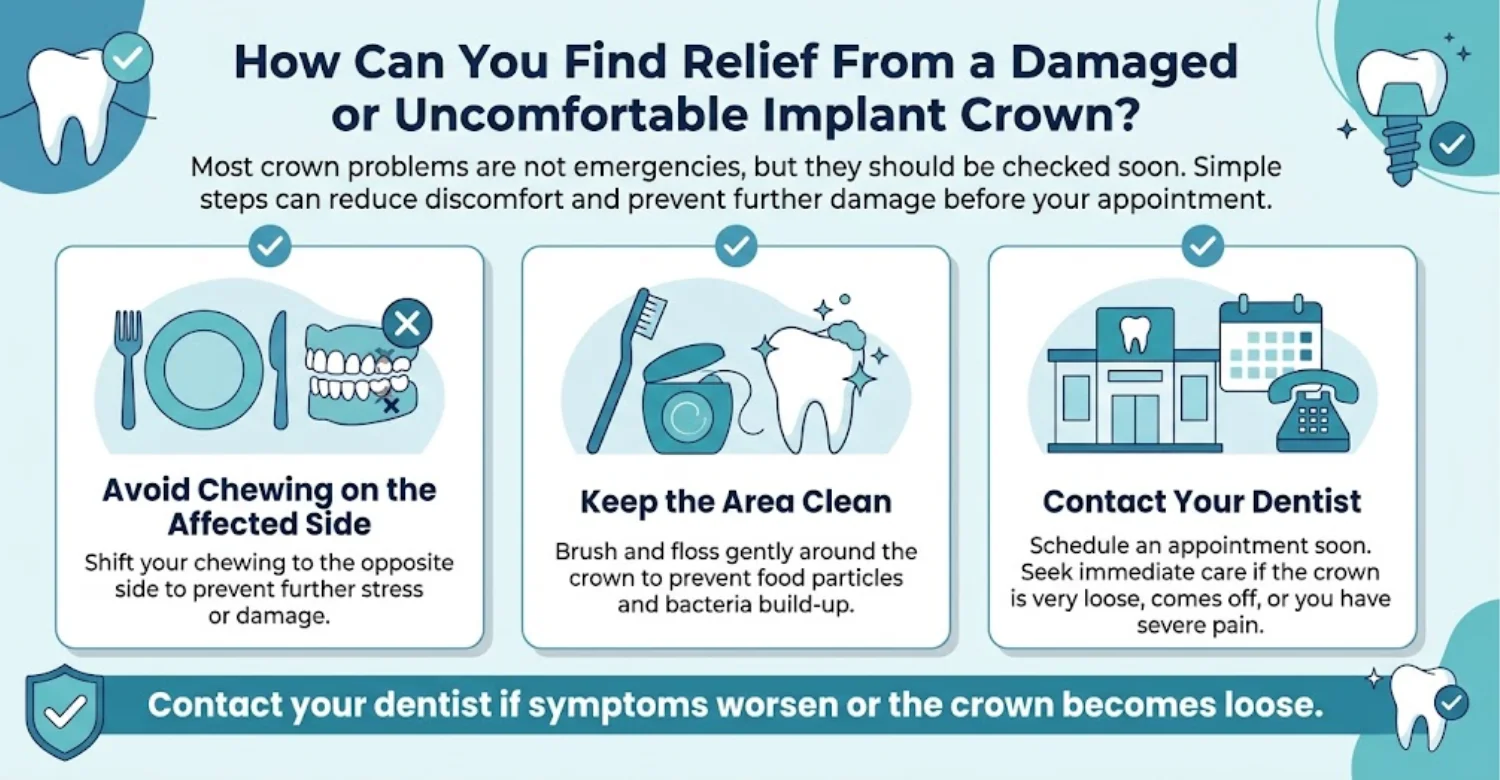
What Can You Do Safely While Waiting for a Dental Appointment?
Chew on the opposite side and choose soft foods such as yoghurt, eggs, or soup. Rinse gently with warm salt water to soothe irritated gum tissue. Keep brushing carefully around the crown to prevent plaque build-up. Over-the-counter pain relief may help if used as directed on the label. Avoid very hot, cold, or sticky foods until the crown is assessed. Note any changes in symptoms to share with your dentist.
How Can You Reduce Pressure on a Suspected Damaged Crown?
Avoid biting directly on the crown, especially with hard or chewy foods. Cut food into small pieces and chew slowly on the other side. Try to relax your jaw during the day and avoid clenching. If you already have a night guard, wear it while sleeping. Avoid chewing gum, ice, and hard sweets entirely. Reducing pressure helps prevent small cracks from becoming larger fractures.
Why Should You Avoid Gluing or Repairing a Crown at Home?
Household glues are not safe for use in the mouth and may be toxic. They can trap bacteria under the crown and cause gum infection. Glue may also prevent the crown from seating correctly later. Incorrect seating can overload the screw and damage the implant connection. Home repairs often make professional treatment harder and more expensive. Always leave crown reattachment to a dental professional.
What Should You Do if a Crown Becomes Loose or Falls Out?
If the crown is loose, avoid chewing on it and contact your dentist promptly. If it falls out, keep it clean and dry in a small container. Check whether the abutment or screw came out with it. Do not try to push the crown back with force. Avoid chewing on the exposed abutment, which can damage the connection. Most loose crowns can be refitted or replaced within a short timeframe.
Which Symptoms Require Urgent Dental Assessment?
Seek urgent assessment for swelling, severe pain, pus, or fever around the implant. A crown that moves with the whole implant also needs prompt attention. Bleeding that does not stop or a bad taste may suggest infection. Sharp fragments that cut your tongue or cheek should be checked quickly. A swallowed or inhaled crown fragment requires medical advice without delay. Prompt care protects both the implant and surrounding tissues.

Temporary Tenderness or Gum Irritation After Treatment
The gum may feel tender after removing or fitting a crown or abutment. This is usually caused by pressure from components or instruments. Mild soreness typically settles within two to five days. Warm saltwater rinses and gentle brushing support healing. Contact your dentist if tenderness lasts longer than a week.
Bite Discomfort While Occlusion Is Being Adjusted
A new crown may feel high or different until the bite is refined. Even small differences of a few tens of microns can feel noticeable. Your dentist may need one or two adjustment visits. Do not wait for a high bite to settle by itself. An uncorrected high bite can overload the crown and reduce the fatigue reliability of dental implant crowns.
Sensitivity or Soft-Tissue Irritation Around the Restoration
Implant crowns do not have nerves, but nearby gum tissue can feel irritated. Excess cement or rough margins can cause redness or swelling. Neighbouring natural teeth may become sensitive after bite adjustments. Most irritation resolves once the cause is removed or polished. Persistent irritation should be reviewed to rule out inflammation around the implant.
Risks Associated With Delayed Treatment of a Loose or Fractured Crown
Delaying treatment can turn a simple problem into a complex one. A loose crown may fracture its screw, which is harder to remove. Cracked ceramic can split further, requiring full replacement instead of polishing. Food trapping around a loose crown may lead to gum inflammation. Over time, untreated problems can threaten the implant itself. Early care is usually faster, simpler, and less expensive.
Why Repair and Replacement Decisions Require Individual Assessment
Two crowns with similar damage may need different treatments. Factors such as bite force, bone health, and crown age influence the decision. A repair that suits one patient may fail quickly in another. Individual assessment ensures the treatment matches the actual cause of failure. This approach supports the long-term fatigue reliability of dental implant crowns.
How Can Patients Reduce the Risk of Implant Crown Fatigue Failure?
Prevention focuses on controlling forces, choosing suitable materials, and keeping regular reviews. Patients play an active role through habits and home care. Simple measures like night guards and bite checks can significantly lower risk. Prevention is usually far cheaper than repair or replacement.
Can a Night Guard Help Patients Who Grind Their Teeth?
Yes, a night guard can protect implant crowns from grinding forces during sleep. Hard acrylic guards usually measure about 2 to 3 millimetres thick. They spread forces across the whole arch instead of single crowns. Guards also absorb wear that would otherwise damage ceramics and teeth. Custom-made guards fit better than over-the-counter options. They reduce damage but do not stop the grinding habit itself.
How Can Proper Bite Adjustment Reduce Excessive Loading?
Bite adjustment balances how forces spread across the teeth and implant crowns. Dentists often keep implant crowns slightly lighter in contact than natural teeth. Removing steep sideways contacts reduces bending stress on screws and crowns. Bite checks should follow any change in nearby teeth or restorations. Balanced occlusion is one of the simplest ways to protect fatigue reliability of dental implant crowns.
Why Do Crown Material Selection and Adequate Thickness Matter?
Stronger materials tolerate more cycles before cracks grow to failure. Adequate thickness spreads stress and lowers peak loads inside the crown. Thin ceramics often fail early, even when made from strong materials. Patients with bruxism usually benefit from monolithic zirconia with adequate thickness. Matching material to bite force is a key preventive step.
How Does Regular Dental Maintenance Help Detect Early Damage?
Regular visits allow dentists to spot small chips, wear, or loose screws early. Professional cleaning removes plaque that home brushing may miss. Dentists can recheck the bite as teeth naturally shift over time. Periodic X-rays help monitor bone levels around implants. Early detection usually means simpler and less expensive treatment.
Which Foods and Habits Should Patients Avoid After Crown Placement?
Avoid chewing ice, hard sweets, popcorn kernels, and nut shells. Do not use your teeth to open bottles, packets, or cut tape. Avoid biting nails, pens, or other hard objects. Limit very sticky foods that may pull on cemented crowns. Wear a sports guard during contact sports. Smoking cessation also supports gum and bone health around the implant.
How Often Should Dental Implant Crowns Be Checked?
Most patients should have implant crowns checked every six months. Patients with bruxism or previous complications may need reviews every three to four months. X-rays are often taken yearly at first, then less frequently if stable. Your dentist may suggest a different schedule based on your risk level. Consistent follow-up helps maintain long-term crown performance.
.jpg)
.jpg)
.jpg)
Tips for Patients
Informed patients make better decisions about crown materials and care. Asking clear questions helps you understand risks and expected lifespan. Simple home habits can extend crown life by years. Keeping records helps any future dentist assess your implant accurately.
What to Ask Your Dentist About Crown Material and Durability
Ask which material is recommended and why it suits your bite. Ask how long similar crowns typically last in your situation. Find out whether the crown is screw-retained or cemented. Ask about the expected risk of chipping or screw loosening. Request information about warranties and what they cover. These questions clarify the fatigue reliability of dental implant crowns in your specific case.
How to Care for an Implant-Supported Crown at Home
Brush twice daily with a soft toothbrush and low-abrasion toothpaste. Clean around the crown with floss, interdental brushes, or a water flosser. Avoid abrasive whitening pastes that can scratch ceramic surfaces. Wear your night guard if your dentist recommends one. Attend regular cleanings to remove hardened deposits safely.
How to Recognize Early Changes Before a Crown Fractures
Watch for rough spots, small chips, or new food trapping around the crown. Notice if your bite feels different or if chewing feels uneven. Listen for clicking or feel for slight movement. Look for gum redness or bleeding around the crown. Report these early signs instead of waiting for a fracture.
Why You Should Keep Records of Previous Implant and Crown Treatments
Implant records include the brand, size, connection type, and placement date. This information helps dentists find compatible parts quickly. Without records, identifying the implant system can be difficult and slower. Records of crown material and previous repairs also guide future treatment. Keep copies of X-rays and treatment summaries, especially when treated abroad.
How to Prepare for an Implant Crown Assessment
Good preparation helps your dentist reach an accurate diagnosis faster. Gather your records and note your symptoms before the visit. Clear information may reduce the need for repeated tests.
Bring previous X-rays, implant details, and restoration records when available
Bring digital copies of X-rays, CBCT scans, and implant cards. Include the implant brand, size, and placement date if known. Records of crown material and abutment type are also valuable. These details help plan repair or replacement more efficiently.
Describe when the discomfort started and whether the crown feels different when biting
Note when symptoms began and whether they followed a specific bite or event. Describe whether the crown feels loose, high, rough, or painful. Mention clicking sounds, food trapping, or gum bleeding. Share whether you grind your teeth or wake with jaw tightness.
How Much Does Dental Implant Crown Repair or Replacement Cost in the US, UK, and Turkey?
Costs vary widely by country, clinic, material, and the extent of damage. A minor repair costs far less than replacing the crown or the whole implant. Turkey is often about 60–85% cheaper than the US or UK for comparable treatment. The figures below are rounded planning estimates, so always confirm with an itemised quote.
What Is the Average Cost of Dental Implant Crown Repair?
Minor repair usually includes polishing, composite bonding, or screw retightening. Typical planning estimates are about $400 in the US, $300 in the UK, and $120 in Turkey. Costs rise if the crown must be removed or a new screw is needed. Not every fracture can be repaired reliably.
What Is the Average Cost of Replacing a Dental Implant Crown?
Replacing a crown on an existing healthy implant costs around $1,500 in the US. The UK estimate is about $750, while Turkey averages around $250. Zirconia or layered crowns may cost more than standard options. A new abutment adds to the final price.
How Do Implant Crown Costs Compare Between the US, UK, and Turkey?
US
$400
Average planning estimate
Minor implant crown repair $400
Replacement crown on an existing implant $1,500
Complete single implant with abutment and crown $4,500
TURKEY
$120
Average planning estimate
Minor implant crown repair $120
Replacement crown on an existing implant $250
Complete single implant with abutment and crown $900
UK
$300
Average planning estimate
Minor implant crown repair $300
Replacement crown on an existing implant $750
Complete single implant with abutment and crown $3,000
Turkey's crown replacement estimate is about 83% lower than the US and 67% lower than the UK. Lower operating and laboratory costs explain most of this difference. Travel, accommodation, and follow-up visits should be included in any comparison.
Which Factors Change the Final Treatment Cost?
The final cost depends on what is damaged and how complex the repair is. Material, laboratory work, and diagnostics all affect the total. An itemised quote helps you compare clinics fairly.
Crown material, laboratory work, and restoration complexity
Monolithic zirconia, layered zirconia, and lithium disilicate differ in laboratory cost. Custom shading for front teeth adds extra laboratory time. Complex shapes or full-arch work increase overall cost.
Whether the abutment, screw, or implant also needs treatment
A new screw adds a small cost, while a new abutment adds more. Retrieving a fractured screw can require extra appointment time. Replacing the implant itself turns a crown repair into a full implant procedure.
Diagnostic imaging, consultations, and follow-up appointments
X-rays, CBCT scans, and digital scans may be charged separately. Some clinics include consultations and follow-ups, while others itemise them. Ask what is included before accepting a quote.
Does the Quoted Price Include Only the Crown or the Entire Implant Restoration?
Many quotes cover only the crown, not the abutment, screw, or imaging. A complete implant price usually includes the fixture, abutment, and final crown. Temporary restorations and bone grafting are often priced separately. Always ask for a written breakdown before treatment begins.
At Vitrin Clinic: How Is Implant Crown Fatigue Assessed and Managed?
At Vitrin Clinic, assessment starts with finding why a crown failed. The team examines the crown, connection, bite, and supporting bone together. This cause-focused approach protects the fatigue reliability of dental implant crowns after treatment.
Evaluating Crown Damage, Bite Forces, and Restoration Stability
The team checks for chips, cracks, wear facets, and loose components. Bite contacts are recorded during closing and side-to-side movements. Screw stability and implant mobility are tested where appropriate.
Selecting a Suitable Crown Material Based on Clinical Needs
Material is chosen according to tooth position, bite force, space, and aesthetics. Monolithic zirconia is often considered for molars and patients who grind. More aesthetic ceramics may suit front teeth with lower loads. The right match improves the fatigue reliability of dental implant crowns for each patient.
Planning Crown Repair or Replacement According to the Cause of Failure
Repair suits limited surface damage on otherwise stable crowns. Replacement is planned when the structure or design is compromised. Bite correction and night guards are added when overload contributes to failure.
When Digital Scanning and Radiographic Assessment May Be Useful
Digital scans help design precise replacement crowns with balanced contacts. X-rays assess bone levels and component fit around the implant. CBCT is used only when three-dimensional information will change treatment decisions.
Why a Personalized Treatment Plan Is Important for International Patients
International patients often have limited time and different implant systems. A personalized plan sets realistic timelines and identifies compatible components early. It also schedules follow-up checks that patients can complete at home if needed.






How Vitrin Clinic Supports Your Treatment Journey
Vitrin Clinic guides patients from the first record review to aftercare. Each stage is explained clearly, with itemised costs and timelines. The aim is predictable treatment with fewer surprises.
Initial Consultation and Review of Previous Dental Records
Patients can share X-rays, implant cards, and photos before travelling. The team reviews these records to outline likely treatment options. This review helps estimate visit length and costs in advance.
Coordinating Clinical Examination and Appropriate Digital Diagnostics
On arrival, the team performs a full examination and needs imaging. Diagnostics are selected according to the suspected problem. Results are explained before any treatment begins.
Explaining Treatment Options, Expected Limitations, and Itemized Costs
Patients receive clear options, from repair to full replacement. Each option includes its expected benefits, limitations, and itemised price. Patients choose their treatment with full information.
Coordinating Appointments for International Patients
Appointments are scheduled to fit travel dates where clinically possible. Laboratory work is planned to minimise waiting time. The team can help coordinate transfers and accommodation details.
Providing Post-Treatment Instructions and Follow-Up Recommendations
Patients receive written aftercare instructions and a recommended review schedule. Night guard advice is provided when grinding is suspected. Treatment records are shared so local dentists can continue care.
Ready to transform your smile?
Talk to our team and get a personal FREE treatment plan.
Key Takeaways
Implant crowns are reliable, but they remain mechanical parts that respond to load. Understanding risk factors helps patients protect their investment.
What Patients Should Know About Dental Implant Crown Fatigue Reliability
Most implant crowns survive more than ten years with proper planning and care. The fatigue reliability of dental implant crowns depends on material, design, bite, and habits.
Why Material Choice, Bite Forces, and Restoration Design Matter
Strong materials resist cracks, but design and bite control decide how stress spreads. Thin crowns and heavy contacts shorten crown life.
When Crown Damage Needs Prompt Professional Assessment
Seek assessment for chips, looseness, clicking, pain, or swelling. Early treatment is usually simpler and less expensive.
How Maintenance and Personalized Treatment Planning May Reduce Mechanical Complications
Regular reviews detect small problems before fractures occur. Personalised planning improves the fatigue reliability of dental implant crowns in high-risk patients.
Protect Your Implant Crown for the Long Term at Vitrin Clinic
Experiencing crown damage or discomfort? At Vitrin Clinic, our dental crown treatment begins with a detailed examination, bite analysis, and appropriate imaging to identify the cause. From crown adjustments to replacement when needed, we create a personalized plan to restore function and help protect your implant crown. Contact Vitrin Clinic today to book your consultation and receive a personalized treatment plan.
Reference
FAQs
Dr. Rifat Alsaman has more than 5 years of clinical experience in dentistry and currently serves as the Head of the Medical Team at Vitrin Clinic. He is dedicated to providing exceptional patient care, overseeing treatment planning, and ensuring the highest clinical standards across the team. His expertise, attention to detail, and commitment to continuous professional development have helped countless patients achieve healthier, more confident smiles.


