Can I Get a Dental Implant If I Have Been Missing the Tooth for Many Years?
A dental implant after years of missing tooth is possible for most patients. Time alone rarely rules you out. What matters is how much jawbone remains, how healthy your gums are, and whether your bite has shifted.

A dental implant after years of missing tooth is possible for most patients. Time alone rarely rules you out. What matters is how much jawbone remains, how healthy your gums are, and whether your bite has shifted. Some patients go straight to implant placement. Others need a short preparation phase, such as gum treatment or bone grafting. A careful implant assessment with 3D imaging shows which path suits you. At Vitrin Clinic, many international patients begin this journey with a simple online review. If you are researching a dental implants after years of missing teeth, this patient guide explains each stage in plain, reassuring language.
Key Takeaways
A dental implant is a small titanium or zirconia post placed in the jawbone. It replaces the missing root and supports a crown, bridge, or denture, restoring chewing and protecting the bone. A dental implant after years of missing tooth works in exactly the same way as one placed soon after extraction.
Options include single implants, implant-supported bridges, implant-retained dentures, and full-arch solutions. Bone grafting or a sinus lift may be added when bone is thin.
Most people return to normal routines within a few days. The implant then bonds with the bone over about three to six months before the final crown is fitted.
Dental bone grafting costs approximately 150–600 in Turkey, 300–3,000 in the USA, and £250–£1,500 in the UK. Vitrin Clinic provides personalized, itemized quotations based on each patient's needs.
What Happens to Your Mouth When a Tooth Is Missing for Many Years? Can You Get a Dental Implant After Years of Missing Tooth?
When you plan a dental implant after years of missing tooth, it helps to understand what has changed in the meantime. A long-term missing tooth leaves more than a visible gap. The bone that once held the root slowly shrinks. Neighbouring teeth may drift, and the tooth above or below may grow into the space. The gum line can flatten, too. These changes happen quietly and painlessly, which is why many people do not notice them. The good news is that modern dentistry can manage almost all of them.
Jawbone Loss and Bone Resorption
Your jawbone stays strong because chewing forces travel through tooth roots and stimulate it. Once a root is gone, that signal stops. The body then starts removing bone it no longer needs. This process is called bone resorption. Research shows the ridge can lose around half its width within the first year after extraction. Most of that change happens in the first few months. Over the years, bone height and density can also drop. This jawbone loss is the main reason an implant assessment is so important, and why the bone scan is the first step in planning a dental implants after years of missing teeth.
Shifting Teeth and Changes in Your Bite
Teeth are not fixed in place forever. They respond to the forces around them. When a gap stays open for years, the teeth beside it often tilt or slide into the space. The opposing tooth may also over-erupt, meaning it slowly moves out of its socket towards the gap. These movements can narrow the space needed for an implant. They may also create food traps and uneven contacts. Some patients notice that chewing feels less efficient or that their bite feels off on one side. Correcting these shifts is often part of preparing for a dental implants after years of missing teeth.
Changes in Gum Tissue and Facial Appearance
As the bone shrinks, the gum over it follows. The once-rounded gum contour can become flat or dipped. This matters for appearance, especially in the front of the mouth. A crown placed on a flattened ridge may look longer than its neighbours unless the area is rebuilt. When several teeth are missing for a long time, bone loss can reduce support for the lips and cheeks. The lower face may look slightly shorter or more aged. Treatment can often restore much of this support. Rebuilding a natural gum shape is also a key goal of a dental implant after years of missing tooth in the smile zone.
.jpg)
.jpg)
.jpg)
.jpg)
.jpg)
Ready to transform your smile?
Talk to our team and get a FREE treatment plan.
Signs You May Notice After Years With a Missing Tooth
You may not feel pain, but your mouth can still send signals. Noticing them early can make a dental implant after years of missing tooth simpler to plan. Common signs include:
Food getting trapped between the teeth next to the gap
Neighbouring teeth looking tilted or slightly loose
A tooth above or below the gap appearing longer than others
Chewing mostly on one side without realising it
New sensitivity or decay on teeth beside the space
A sunken look in the cheek or lip area when several teeth are missing
Who Is Most at Risk of Faster Bone Loss?
Bone shrinks after tooth loss in everyone, but some factors speed it up. These factors do not rule out a dental implants after years of missing teeth, but they may change the plan:
Losing a tooth because of gum disease or infection
Wearing a loose removable denture that presses on the ridge
Missing several neighbouring teeth rather than just one
Smoking, which reduces blood flow to the gums and bone
Conditions that affect bone metabolism, such as osteoporosis
Missing teeth in the upper back jaw, where the sinus can expand into the space
Am I Eligible for a Dental Implant After Years of Tooth Loss?
Implant eligibility depends on your current oral and general health, not on how long ago you lost the tooth. Many people who have waited ten or twenty years are still good candidates for a dental implant after years of missing tooth. Your dentist looks at several factors together. A weakness in one area can usually be managed. For example, thin bone can be rebuilt, and gum disease can be treated first. Very few patients are completely unsuitable. The key factors include:
Jawbone volume and density: There must be enough bone, or the potential to rebuild it, to hold the implant firmly.
Gum health and periodontal disease: Active gum disease must be controlled first, as it raises the risk of infection around the implant.
Condition and position of neighbouring teeth: Decayed, infected, or badly tilted teeth may need treatment before implant placement.
Medical history and medications: Uncontrolled diabetes, past radiotherapy to the jaw, and bone-strengthening drugs such as bisphosphonates need careful planning with your doctor.
Smoking habits: Smoking slows healing and is linked to higher implant failure rates. Stopping before and after surgery helps.
Available space and bite alignment: There must be enough room between teeth and in the bite for a natural-sized crown.
If most of these points apply to you, your implant eligibility is likely good, and any gaps can usually be addressed before surgery.
Ready to transform your smile?
Talk to our team and get a FREE treatment plan.
Can I Get a Dental Implant If I Have Lost Jawbone?
Yes, in most cases. Jawbone loss is common after a long-term missing tooth, and it rarely means the end of implant options. Dentists can rebuild bone, use shorter or narrower implants, or angle implants into stronger areas. In the upper back jaw, a sinus lift can create extra height. The right approach depends on where the bone is missing and how much remains. A 3D scan measures this precisely. Your plan for a dental implant after years of missing tooth is then built around the bone you actually have.
When Is Bone Grafting Needed Before Implant Placement?
Bone grafting is needed when the ridge is too thin or too short to fully surround the implant. The graft material acts as a scaffold. Your body then grows new bone into it. Grafts may come from your own bone, donor bone, animal-derived bone, or synthetic materials. Bone augmentation is often recommended in the front of the mouth, where appearance matters most. However, not every patient with bone loss requires grafting. Mild loss can sometimes be managed with a small graft placed during implant surgery itself. Grafting is one of the most common preparatory steps for a dental implants after years of missing teeth.
How Long Should I Wait After Bone Grafting?
The waiting time depends on the size of the graft and the technique used. Small grafts placed at the same time as the implant heal alongside it. Larger grafts that rebuild ridge width or height usually need around four to nine months before implant placement. A sinus lift often needs a similar healing period. Your dentist confirms readiness with a follow-up scan. This waiting time can feel long, but it creates the stable foundation that a dental implant after years of missing tooth depends on. A delayed dental implant placed in a well-healed bone has an excellent long-term outlook.
How Do Dentists Assess a Missing Tooth Before Implant Treatment?
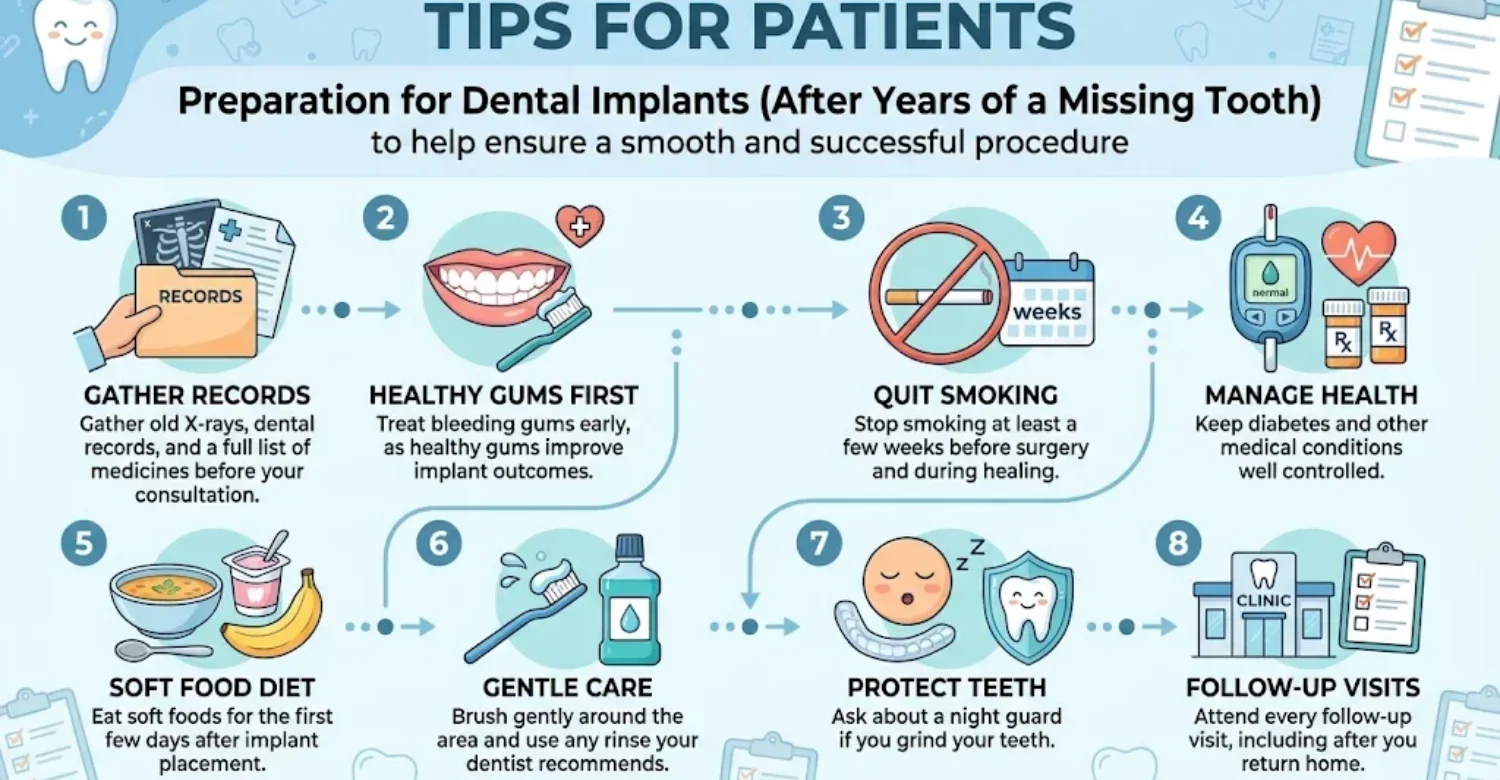
An implant assessment combines a conversation, an examination, and imaging. Each step answers a different question about your mouth. Together, they show whether a dental implants after years of missing teeth can go ahead directly or needs preparation first. This thorough process protects you from surprises later. It also allows your dentist to choose the right implant size, position, and timing. You can prepare by bringing a list of medicines, any old X-rays, and notes about past dental treatment. The assessment usually includes:
Dental and medical history: Your dentist reviews past treatment, health conditions, medications, and habits such as smoking or teeth grinding.
Clinical examination: The gums, neighbouring teeth, and bite are checked for disease, movement, and wear.
X-rays and 3D CBCT scans: A CBCT scan is a quick, low-dose 3D image. It measures bone height, width, and density, and shows nerves and sinuses. This scan is essential for a safe dental implant after years of missing tooth.
Additional procedures: Your dentist decides whether grafting, gum treatment, or tooth alignment is needed.
Individualised treatment plan: You receive a clear plan covering steps, timeline, and costs.
What Are the Steps to Getting a Dental Implant After Many Years?
Getting a dental implant after years of missing tooth follows a clear, logical sequence. First, the site is prepared so the implant has healthy surroundings. Next, the implant post is placed and given time to bond with the bone. Finally, a custom crown is attached. Some patients move through these stages quickly. Others need extra preparation, which adds months but improves the result. Each stage is planned in advance, so you always know what comes next. This predictability is especially helpful for patients travelling from abroad.
Preparing the Jawbone and Implant Site
Preparation creates the healthy base an implant needs. Any gum disease is treated first, as inflamed gums can threaten the implant later. Decay or infection in nearby teeth is also managed. If bone is lacking, grafting is completed and allowed to heal. When neighbouring teeth have tilted into the gap, short orthodontic treatment may be suggested to reopen the space. The opposing tooth may also need reshaping if it has over-erupted. This stage can seem slow, but it directly supports long-term implant success. Skipping preparation is one of the main reasons a dental implant after years of missing tooth can run into problems.
Placing the Dental Implant
Once the site is ready, surgery for a dental implants after years of missing teeth is the same as standard implant placement. It is usually done under local anaesthetic, so you feel pressure but not pain. The dentist makes a small opening in the gum and prepares a precise channel in the bone. The implant post is then positioned using measurements from your scan. Over the following three to six months, the bone grows tightly around the implant surface. This bonding process is called osseointegration. Most patients describe mild soreness for a few days, which simple painkillers usually control. A temporary tooth may be provided for appearance.
Attaching the Permanent Dental Crown
The final crown is placed once osseointegration is complete and the implant is stable. Your dentist first attaches a small connector, called an abutment. A digital scan then records the exact position of the implant and your bite. The crown is designed to match the shape, size, and shade of your neighbouring teeth. Materials such as zirconia or porcelain fused to metal are common choices. The bite is checked carefully so chewing forces spread evenly. With good care, your new tooth should look and feel natural. This final step completes your dental implant after years of missing tooth and restores full chewing function.
What If I Have Been Missing Multiple Teeth for Many Years?
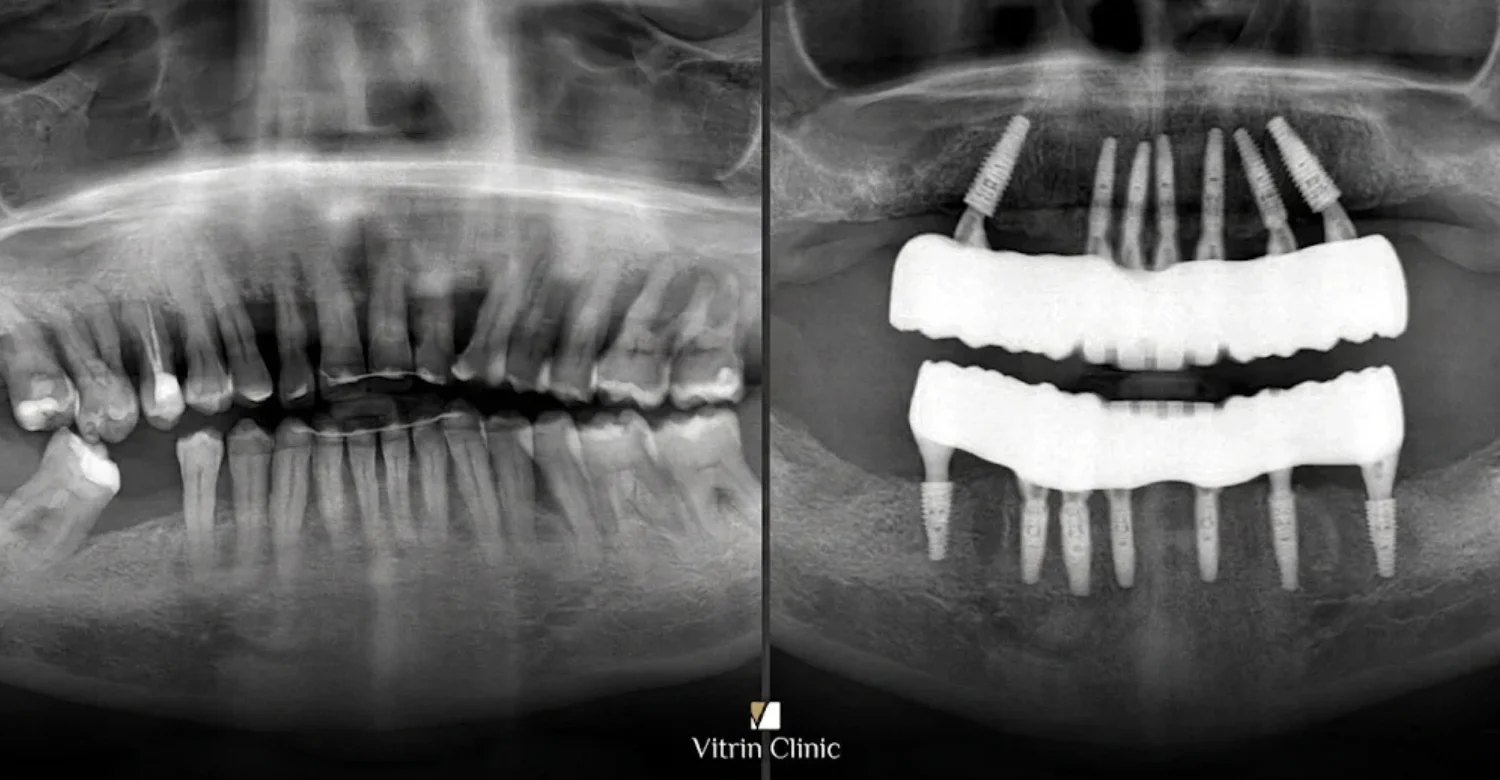
When several teeth are missing, planning a dental implants after years of missing teeth becomes more about the whole mouth than one gap. Bone loss is often greater, and the bite may have changed more. You do not always need one implant per missing tooth. Two implants can support a bridge spanning three teeth. Four to six implants can support a full arch. The number and distribution of missing teeth guide the design. Your dentist balances strength, appearance, cost, and cleaning ease.
Situation | Typical Implant Solution | Why It May Suit You |
One missing tooth | Single implant with crown | Replaces the tooth without touching neighbouring teeth |
Two to four teeth in a row | Implant-supported bridge | Fewer implants support several replacement teeth |
Many teeth missing in one jaw | Implant-retained overdenture | A removable denture clips onto implants for better stability |
All teeth missing in one jaw | Fixed full-arch solution | A permanent bridge rests on four to six implants |

Ready to transform your smile?
Talk to our team and get a FREE treatment plan.
What Are My Alternatives If I Cannot Get a Dental Implant?
Some patients cannot have implants because of certain medical conditions, medications, or personal preference. Others prefer to avoid surgery. In these cases, tooth replacement is still possible. Dental bridges and removable partial dentures are the main alternatives. Each option has different requirements and limitations. A bridge needs healthy neighbouring teeth for support. A partial denture needs stable teeth or gums to rest on. Neither replaces the tooth root, so they do not stop bone resorption in the same way an implant does. For patients who qualify, a dental implant after years of missing tooth remains the only tooth replacement that directly stimulates the jawbone.
Feature | Dental Implant | Dental Bridge | Removable Partial Denture |
Supports jawbone | Yes | No | No |
Affects neighbouring teeth | No | Usually needs them reshaped | Clasps rest on them |
Fixed or removable | Fixed | Fixed | Removable |
Surgery needed | Yes | No | No |
Typical lifespan | Many years to decades with care | Around 10–15 years | Around 5–10 years |
Best suited for | Patients with adequate or rebuildable bone | Patients with strong teeth beside the gap | Patients wanting a non-surgical, lower-cost option |
Questions That May Be on Your Mind
What happens to a tooth implant after 10 years?
With good care, most implants are still working well after ten years. Studies report survival rates of around 90–95% over this period. The crown may show wear and sometimes needs replacing. Regular check-ups help catch gum inflammation around the implant early.
Can a dental implant last 50 years?
The implant post can last for decades, and often for life, if the gums and bone stay healthy. The crown on top usually needs replacing after 10–15 years or more. Good brushing, avoiding smoking, and routine dental visits all help it last longer.
Can I bite an apple with implants?
Yes, once the implant has fully healed and the permanent crown is fitted. Avoid hard foods while it is healing. With full-arch implants, cutting apples into slices is gentler on the restoration.
Why would a dentist not recommend an implant?
The usual reasons are active gum disease, uncontrolled diabetes, heavy smoking, recent radiotherapy to the jaw, or certain bone medications. Implants are also postponed in teenagers whose jaws are still growing, and during pregnancy. In many cases, treating the problem first makes an implant possible later.
Warning Signs That Need Prompt Dental Attention
Most healing following a dental implants after years of missing teeth is smooth and uneventful. However, contact your dentist quickly if you notice:
Swelling or pain that worsens after the third day instead of improving
Bleeding that does not stop with firm pressure
Fever, pus, or a bad taste coming from the implant area
Numbness in the lip, chin, or tongue that lasts beyond the anaesthetic
An implant or temporary tooth that feels loose
What We Notice Clinically
At Vitrin Clinic, we often see patients who believed they had waited too long. Most were pleasantly surprised to learn they still qualified for a dental implant after years of missing tooth. Here is what our clinical team commonly observes:
Many long-term gaps in the lower back jaw still have enough bone for direct implant placement.
The upper back jaw tends to lose more height because the sinus expands downwards over time.
Over-erupted opposing teeth are very common and often need minor reshaping.
Patients who wore loose dentures for years usually show more ridge flattening.
Patients who quit smoking before treatment generally heal more smoothly.
Approximate Dental Implant Prices at Vitrin Clinic
Dental implant prices at Vitrin Clinic depend on the number of implants required, the implant brand, the type of restoration, and whether additional procedures such as bone grafting or sinus lifting are needed. Below are approximate prices for common dental implant treatments in Istanbul, Turkey.
Price at Vitrin Clinic
Single dental implant (including abutment and crown) = $500–$700
Implant-supported crown = $700–$900
All-on-4 dental implants (per arch) = $3,500–$7,500
All-on-6 dental implants (per arch) = $4,000–$9,000
Full-mouth dental implant rehabilitation = $7,000–$15,000
Note: Vitrin Clinic offers dental treatments at approximately 60–70% less than the average costs in the USA and UK, while maintaining high standards of dental care.
Note on Dental Sedation Costs
Conscious sedation or general anesthesia can be arranged for severe dental anxiety. These options and costs are discussed openly and itemized separately, so you know the fee before giving consent. A medical history review confirms that sedation is safe for you.
Your Journey To a Lasting Perfect Smile at Vitrin Clinic
Your dental implant journey begins with understanding your oral health and ends with a personalized plan to restore missing teeth, function, and smile aesthetics. At Vitrin Clinic, every stage is carefully coordinated, combining individualized implant treatment, international patient support, and attention to clinical detail to make your experience in Istanbul as smooth and comfortable as possible.
1. Your Initial Dental Implant Assessment
Successful implant treatment starts with a thorough evaluation of your oral health. Share your smile photographs, available dental records, and relevant medical history with our team. Our dentists assess your teeth, gums, jawbone volume and density, and bite to determine whether dental implants are suitable for you. If necessary, additional imaging, such as a 3D CBCT scan, helps evaluate bone conditions and identify whether bone grafting or other preparatory procedures may be required.
2. Your Personalized Dental Implant Treatment Plan
Every patient has different needs when replacing missing teeth. Following your initial assessment, we prepare a personalized treatment proposal outlining the recommended number and type of implants, any necessary preparatory procedures, the restoration options, estimated treatment stages, duration, and costs. If bone grafting or sinus lifting is needed, these procedures are explained as part of your plan. This gives you a clearer understanding of your options and helps you make informed decisions before travelling to Istanbul.
3. Your Stay in Istanbul, Seamlessly Arranged
From your arrival to your implant appointments, our international patient coordination team helps organize the practical details of your visit. Depending on your treatment arrangement, this may include hotel accommodation and airport, hotel, and clinic transfers. Our team also assists with appointment coordination and communication, helping you navigate each stage of your dental implant treatment while staying in Istanbul.
4. Your Dental Implant Treatment and Ongoing Care
Your implant procedure follows the agreed clinical plan, with each stage adapted to your oral health and treatment requirements. Depending on your case, treatment may involve implant placement, a healing period for osseointegration (the process through which the implant integrates with the jawbone), and the final attachment of your dental crown, bridge, or full-arch restoration. Some patients may require additional healing time or a second visit before receiving their permanent restorations. Before your departure, you receive personalized aftercare instructions and guidance on maintaining your implants, alongside follow-up support to help address questions after returning home.
.jpg)
.jpg)
.webp)
.jpg)
Clinical Note
Dr. Rifat Alsaman explains that the length of time a tooth has been missing is less important than what the 3D scan shows today. Two patients missing the same tooth for ten years can have very different bone. One may need no grafting, while the other needs a staged rebuild. For this reason, Vitrin Clinic never confirms a plan for a delayed dental implant from photographs alone. Final decisions follow a clinical examination and CBCT imaging, so every step is based on real measurements. In his experience, a dental implants after years of missing teeth succeeds when planning is unhurried and precise.
About Vitrin Clinic
Vitrin Clinic is a cosmetic and restorative dental clinic in Istanbul, Turkey, welcoming patients from around the world for personalised dental implant treatments. With a medical team headed by Dr. Rifat Alsaman, we combine detailed clinical assessments, CBCT imaging, digital planning, and modern implant systems to develop treatment plans based on each patient's oral health, bone condition, and restorative needs. Our multilingual team supports international patients throughout the process, from the initial online consultation and treatment coordination to post-treatment follow-up at home. Whether you need to replace a single missing tooth or restore an entire arch, our goal is to provide a clear treatment plan, natural-looking results, and transparent pricing.






Book your FREE treatment plan with Vitrin Clinic and get a personalized treatment plan from our dental team.
Ready to transform your smile?
Talk to our team and get a FREE treatment plan.
References:

Medically reviewed by
Dr. Rifat AlsamanDr. Rifat Alsaman has more than 5 years of clinical experience in dentistry and currently serves as the Head of the Medical Team at Vitrin Clinic. He is dedicated to providing exceptional patient care, overseeing treatment planning, and ensuring the highest clinical standards across the team. His expertise, attention to detail, and commitment to continuous professional development have helped countless patients achieve healthier, more confident smiles.
More in Dental Treatments
View all 47 min readWhat Makes You Eligible for Immediate Dental Implants?Immediate dental implant eligibility depends on bone availability, gum health, infection control, and initial implant stability.
 22 min readWill I Need a Bone Graft Before Getting Dental Implants, or Can I Avoid It?Do I need bone graft for dental implant treatment? Many patients ask this when planning to replace a missing tooth. The honest answer is: not always. Some people have enough healthy jawbone for direct implant placement.
 36 min readCan Multiple Root Canal Treatments Be Completed in One Appointment?Having several painful or damaged teeth does not always require separate dental visits.
 18 min readCan Tooth Extractions and Dental Implants Be Done on the Same Day?Yes, a tooth extraction and implant on the same day is often possible. It's called an immediate implant, and it works when the socket is free of active infection, the surrounding bone is intact and the implant can be held firmly. When those conditions aren't met, the implant is placed a few weeks or months later.
Still have a question?
Our patient coordinators answer every day of the week: before, during and long after your treatment.