What Makes You Eligible for Immediate Dental Implants?
Immediate dental implant eligibility depends on bone availability, gum health, infection control, and initial implant stability.

Immediate dental implant eligibility depends on bone availability, gum health, infection control, and initial implant stability. Tooth position and medical history also influence suitability. Some patients can receive implants immediately after extraction. Others need preparatory treatment or additional healing. Importantly, immediate implant placement differs from receiving temporary teeth on the same day. At Vitrin Clinic in Istanbul, the dentist must determine whether immediate placement, immediate loading, or staged treatment is appropriate. This guide explains eligibility requirements, medical considerations, treatment stages, complications, recovery, and costs. It also covers All-on-6 dental implants and international treatment planning.
Key Takeaways
Immediate dental implant eligibility depends on available jawbone, gum health, infection control, socket condition, and the ability to achieve primary stability.
Immediate implant placement means inserting an implant during tooth extraction; immediate loading means attaching a temporary or definitive restoration shortly afterwards.
Healthy gums, favourable bone anatomy, controlled medical conditions, and good oral hygiene can support eligibility, but no single factor guarantees suitability.
Chronic infection does not automatically prevent immediate placement, while uncontrolled acute infection or significant tissue damage may require delayed treatment.
CBCT imaging, clinical examination, and inspection of the extraction socket help determine whether immediate, early, or delayed implant placement is appropriate.
Immediate loading requires sufficient primary stability and controlled bite forces; otherwise, the implant may need to heal without a fixed temporary crown.
Immediate implants can reduce surgical stages, but they still require osseointegration and carry risks such as implant failure, infection, bone loss, and gum recession.
Vitrin Clinic determines treatment suitability through individual clinical planning, with written quotations, restoration details, and follow-up arrangements for international patients.
Ready to transform your smile?
Talk to our team and get a personal FREE treatment plan.
What Does Immediate Dental Implant Eligibility Mean at Vitrin Clinic?
Immediate dental implant eligibility describes whether your clinical condition supports implant placement during the extraction appointment. It does not automatically mean you qualify for a temporary fixed crown. The dentist must evaluate the extraction socket, available bone, gum tissues, and implant stability. Your medical history and planned restoration also influence the decision.
What Is Immediate Dental Implant Placement?
Immediate implant placement means inserting an implant directly into the extraction socket. The dentist first removes the affected tooth. The socket is then cleaned, inspected, and prepared. The implant enters a suitable supporting bone during the same appointment. This approach can reduce separate surgical stages. However, it requires careful patient selection. Adequate bone support and favourable socket anatomy remain important. Immediate placement does not eliminate osseointegration or guarantee immediate restoration.
Can You Get a Tooth Pulled and an Implant Put in the Same Day?
Yes, in suitable cases. This is called immediate implant placement. The tooth is removed, the socket is inspected, and the implant is inserted during the same appointment. It requires enough healthy bone for primary stability, controlled infection, and favourable gum and socket conditions. If the socket shows unexpected damage after extraction, the dentist may delay implant placement. A same-day implant does not always mean a same-day crown.
How Are Immediate Implant Placement and Immediate Loading Different?
These terms describe different stages of implant treatment.
Immediate placement: The implant enters the jawbone during the extraction appointment.
Immediate loading: A temporary or definitive restoration connects shortly after implant placement.
Conventional loading: The implant heals before receiving its restoration.
A patient may qualify for immediate placement without qualifying for immediate loading. Loading requires adequate initial stability and controlled bite forces. The dentist evaluates these conditions separately.
Can Vitrin Clinic Provide Temporary Teeth on the Same Day?
Same-day temporary teeth may be possible when clinical conditions support immediate loading. The implant must achieve sufficient primary stability. Bite forces must also remain appropriately controlled. The temporary restoration may require limited contact with opposing teeth. If stability is inadequate, another provisional solution may be safer. The final decision follows surgical findings, not an advance promise.
Does Immediate Implant Placement Eliminate the Healing Period?
No. Immediate placement does not remove the biological healing process. The implant still needs osseointegration. During this process, the surrounding bone develops a stable connection with the implant surface. Healing commonly takes several months. Bone quality, surgical conditions, and individual health influence the timeline. Receiving temporary teeth does not mean osseointegration is complete.
.jpg)

What Clinical Requirements Must You Meet for Immediate Dental Implants at Vitrin Clinic?
Suitable candidates generally need favourable bone anatomy, healthy supporting tissues, and adequate initial implant stability. The dentist also considers infection, tooth position, and restoration requirements. No single measurement confirms eligibility for every patient.
What Are the Criteria for Immediate Implant Placement?
Immediate implant placement generally requires several clinical conditions to be met together. Common criteria include:
Sufficient bone beyond and around the socket to achieve primary stability.
Intact or minimally damaged socket walls, particularly the facial wall.
Adequate gum thickness and a stable gum position.
No uncontrolled acute infection at the extraction site.
Healthy or well-controlled periodontal condition.
A medical history compatible with oral surgery.
Good oral hygiene and manageable bite forces.
Meeting one criterion alone does not establish suitability. The final decision follows examination, imaging, and inspection of the socket during extraction.
How Much Healthy Jawbone Is Needed for Immediate Implant Placement?
There is no universal bone measurement that establishes eligibility. Available bone must accommodate the planned implant dimensions and position. Its width, height, density, and anatomical boundaries all matter. The dentist evaluates whether a suitable bone can provide initial anchorage. CBCT imaging may help when three-dimensional information is clinically necessary. Insufficient bone may require grafting or delayed placement.
Why Are Apical and Palatal Bones Important for Implant Stability?
Apical bone lies beyond the original tooth root. Palatal bone is located towards the roof of the mouth. These areas may provide anchorage during immediate placement. Their availability can help the implant achieve primary stability. However, the implant must also maintain a suitable three-dimensional position. Sufficient bone alone cannot justify unsafe positioning.
Must the Extraction Socket Have Intact Bone Walls?
Intact socket walls generally provide more favourable conditions. However, minor defects do not automatically exclude every patient. The dentist evaluates each defect's location, size, and extent. Large facial bone defects can complicate implant positioning and tissue preservation. Staged treatment may provide better control when socket anatomy is unfavourable.
How Does Gum Health Affect Your Eligibility at Vitrin Clinic?
Healthy gums support healing and long-term implant maintenance. Active periodontal disease can increase biological risks. The dentist checks inflammation, bleeding, pocket depths, recession, and plaque control. Existing gum problems may require treatment before surgery. Patients also need effective daily oral hygiene. Healthy-looking gums alone cannot confirm eligibility because underlying bone conditions matter.
Can Thin Facial Bone Affect Immediate Implant Placement?
Yes. Thin facial bone can increase the risk of tissue changes after extraction. This bone supports the gum contour around the implant. Its resorption may contribute to recession or aesthetic changes. This concern is especially important around front teeth. The dentist may consider grafting or staged placement to protect surrounding tissues.
What Are the Guidelines for Immediate Implant Placement?
Clinical consensus statements, including those from the International Team for Implantology (ITI), describe favourable conditions for immediate placement, particularly in aesthetic areas. These commonly include intact socket walls, a facial bone wall of at least about 1 mm, a thick gum phenotype, no acute infection, and enough apical and palatal bone for primary stability. The implant should be placed in a correct three-dimensional position, usually towards the palatal side of the socket. Gaps between the implant and facial bone may be grafted. These guidelines describe favourable situations rather than strict rules. Clinicians apply them alongside individual findings.
How Does Implant Positioning Influence Treatment Suitability?
Correct three-dimensional positioning supports long-term restoration design. The implant must follow the planned crown position. It should avoid neighbouring teeth and important anatomical structures. Poor positioning can affect cleaning access, appearance, and function. Digital planning may help guide placement. However, technology cannot compensate for unsuitable anatomy or poor clinical judgement.
Who Can Qualify for Immediate Dental Implants at Vitrin Clinic?
Patients with favourable bone anatomy, manageable extraction sites, and controlled oral health may qualify. Eligibility depends on individual findings rather than tooth damage alone.
What Are the Indications for Immediate Implant Placement?
Immediate implant placement is generally indicated when a tooth must be removed and the site is favourable for implant treatment. Common indications include:
A tooth that cannot be restored because of extensive decay.
A root or crown fracture that prevents predictable repair.
Failed root canal treatment that cannot be retreated.
Root resorption affecting the tooth's long-term prognosis.
A retained baby tooth that needs replacement in a suitable adult.
Front teeth where preserving gum contour and appearance is a priority.
The indication alone is not enough. The site must also meet bone, gum, infection, and stability requirements.
Can You Receive an Immediate Implant After Extracting a Broken Tooth?
Yes, in selected cases. A fractured tooth does not automatically prevent immediate placement. The dentist must determine whether the fracture damaged surrounding bone. Root fractures, infection, and facial bone defects can change the decision. Extraction must also preserve supporting tissues. Clinical examination and imaging help establish suitability.
Are Patients with Severely Damaged Teeth Suitable for Immediate Implants?
Some patients with severely damaged teeth remain suitable. The surrounding tissues matter more than the visible damage alone. Extensive decay does not automatically make the socket unsuitable. However, infection, bone destruction, and difficult extraction can complicate treatment. The dentist evaluates these factors before recommending immediate placement.
Is It Better to Pull a Tooth or Get an Implant?
When a natural tooth can be predictably saved, preserving it is generally the preferred option. Root canal treatment, periodontal care, or a crown may keep the tooth functional for many years. Extraction followed by an implant is usually considered when the tooth cannot be restored or has a poor long-term prognosis. Implants are reliable replacements, but they are not superior to a healthy natural tooth. The dentist should explain the prognosis of saving the tooth compared with replacing it.
What Qualifies as Medically Necessary for Dental Implants?
Dental implants may be considered medically necessary when tooth loss affects chewing, speech, or oral health, and other options are unsuitable. Examples include missing teeth after trauma, disease, or tumour surgery, congenitally missing teeth, and cases where dentures cannot be retained because of bone loss. Implants may also be recommended when a bridge would require preparing healthy neighbouring teeth. Insurance definitions of medical necessity vary between providers and countries. Patients should check their policy terms and request supporting clinical documentation.
Can Patients Missing Front Teeth Receive Immediate Implants?
Yes. Selected patients can receive immediate implants in the front of the mouth. However, aesthetic requirements make these cases particularly demanding. Facial bone thickness, gum position, tissue type, and implant alignment matter. The dentist also considers the final crown's shape and emergence profile. Immediate placement is not always the preferred option.
Can You Receive Immediate Implants If Your Jawbone Is Healthy?
Healthy jawbone improves implant treatment conditions. However, bone health alone does not establish suitability. The extraction socket, gum condition, infection status, and implant position also matter. The dentist must determine whether primary stability is achievable. Medical history and bite forces influence the decision too.
Does Good Oral Hygiene Improve Your Suitability?
Yes. Effective oral hygiene helps control plaque around natural teeth and implants. Poor plaque control can contribute to inflammation and peri-implant disease. Patients should maintain consistent brushing and interdental cleaning. Existing gum disease should be managed before elective surgery. Good hygiene supports maintenance but cannot replace adequate bone anatomy.
Can International Patients Qualify for Same-Day Dental Implants in Turkey?
International patients may qualify when clinical findings support treatment. Travel schedules do not determine surgical suitability. Patients should provide recent dental records and medical information before travelling. Vitrin Clinic can review these records and discuss preliminary options. Final confirmation requires an in-person examination and appropriate imaging. Follow-up arrangements should also be planned.
Can You Get Immediate Dental Implants at Vitrin Clinic If You Have an Infection?
Infection does not automatically exclude every immediate implant case. Its severity, location, and effect on surrounding tissues determine suitability. The dentist must distinguish a history of infection from an uncontrolled active infection.
Can an Infected Tooth Receive an Immediate Implant After Extraction?
Some extraction sites with previous infection may remain suitable. Chronic periapical infection is not always an absolute contraindication. ITI consensus guidance supports selected cases when adequate bone provides primary stability. However, uncontrolled infection requires careful management. Thorough removal of infected tissue is essential. The remaining bone and soft tissues must support treatment.
Does Chronic Infection Always Prevent Immediate Implant Placement?
No. A history of chronic infection does not automatically exclude immediate placement. The dentist evaluates the site clinically and radiographically. Persistent inflammatory tissue and bone destruction require attention. A previously infected site may become suitable after appropriate management. However, every infected socket requires individual evaluation.
How Does Acute Infection Affect Implant Eligibility?
Acute infection can compromise the surgical environment. Significant inflammation may affect surrounding bone and soft tissues. It can also complicate wound management. Immediate placement should not be forced when infection remains uncontrolled. The clinician may recommend treatment before reconsidering implant surgery.
Can Infected Tissue Be Removed Before Implant Placement?
Yes. The dentist may remove infected granulation tissue during socket preparation. The socket is then inspected for remaining defects. However, cleaning the socket does not automatically make immediate placement appropriate. Remaining bone and soft-tissue conditions must support treatment.
When Might Vitrin Clinic Recommend Delaying Implant Surgery?
Vitrin Clinic may recommend delaying surgery when acute infection or extensive bone destruction exists. Unsuitable socket anatomy may also require a staged approach. Delayed treatment allows the clinician to manage underlying problems. It may also provide time for tissue healing or bone reconstruction. Patient safety should guide the treatment timeline.
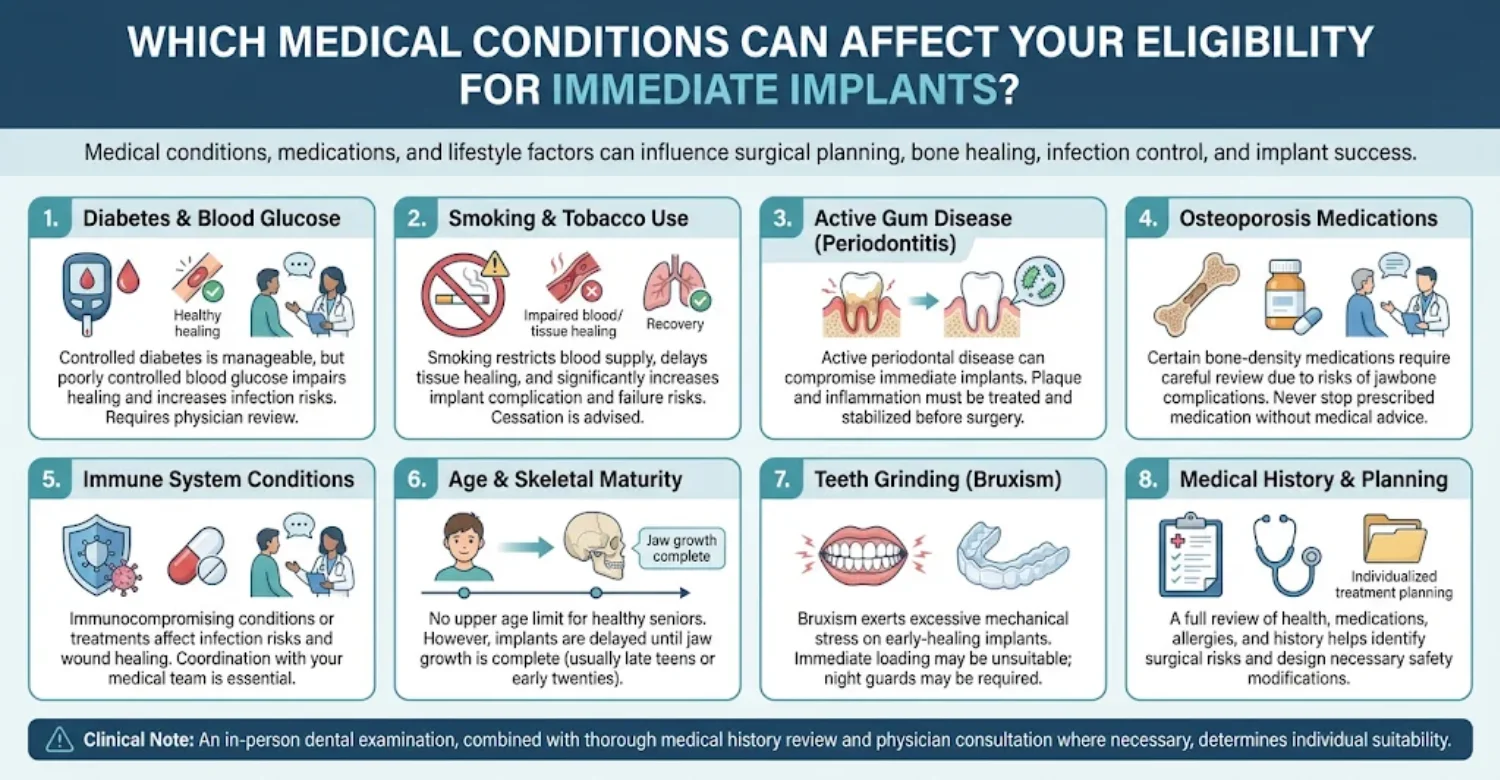
Which Medical Conditions Can Affect Your Eligibility for Immediate Implants?
Medical conditions can influence surgical planning, infection control, wound healing, and implant maintenance. The dentist needs accurate medical information before recommending treatment.
Can Patients with Diabetes Receive Immediate Dental Implants?
Yes. Selected patients with diabetes can receive dental implants. However, blood glucose control is important. Poorly controlled diabetes can impair healing and increase infection risks. The dentist should review relevant medical information and medication. Your treating physician may contribute to the decision. Treatment timing depends on individual clinical findings.
Does Smoking Affect Immediate Implant Healing?
Yes. Smoking can impair blood supply and tissue healing. It is associated with increased implant complications and failure risks. The dentist should discuss smoking frequency and cessation before surgery. Avoiding smoking during recovery is particularly important. A short smoking break does not automatically remove these risks.
Can Gum Disease Prevent Immediate Implant Placement?
Active periodontal disease can make immediate placement less suitable. Bacterial plaque and inflammation can compromise supporting tissues. Periodontal treatment may be necessary before surgery. The dentist also evaluates the remaining teeth. Controlling gum disease remains important after implant placement.
Can Osteoporosis Medications Affect Implant Treatment?
Some osteoporosis medications require careful surgical consideration. Their effects depend on the medication, duration, and medical history. Certain treatments are associated with medication-related jawbone complications. Never stop prescribed medication without medical advice. The dentist may consult your physician before recommending surgery.
Do Immune System Conditions Influence Implant Eligibility?
Yes. Some immune conditions can influence infection risk and wound healing. Their effects vary between diagnoses and treatments. The dentist needs accurate information about your condition and medication. Your medical team may help determine whether elective surgery is appropriate.
At What Age Should You Not Get Dental Implants?
There is no upper age limit for dental implants. Older adults can receive implants when their general health and bone condition support surgery. However, implants are generally not placed until jaw growth is complete. This usually occurs in the late teens or early twenties, and sometimes later in males. An implant placed too early may not follow the natural growth of the jaw. The dentist evaluates skeletal maturity, medical history, and oral health rather than age alone.
Can Teeth Grinding Affect Immediate Implant Loading?
Yes. Bruxism, or teeth grinding, can increase mechanical stress on restorations. Excessive forces may threaten an implant during early healing. The dentist evaluates your bite and grinding history. A protective night guard may be considered when appropriate. Immediate loading may be unsuitable when forces cannot be controlled.
How Does Your Medical History Influence Vitrin Clinic's Treatment Planning?
Your medical history helps identify surgical and healing risks. Vitrin Clinic should review existing conditions, medication, allergies, and previous operations. Additional medical information may be requested when necessary. The dentist then considers treatment modifications and precautions. Individual planning remains essential.
When Might Vitrin Clinic Recommend Against Immediate Implant Placement?
Immediate placement may be unsuitable when bone anatomy, infection, soft tissues, or stability cannot support treatment. A different timeline may provide safer conditions.
What Would Disqualify You for Dental Implants?
Few conditions permanently disqualify someone from dental implants, but several factors may delay or prevent treatment. These include:
Insufficient jawbone that cannot be reconstructed.
Uncontrolled diabetes or other unstable medical conditions.
Active, untreated gum disease.
Previous radiotherapy to the jaw or certain bone-related medications.
Heavy smoking that cannot be reduced.
Incomplete jaw growth in younger patients.
Inability to maintain adequate oral hygiene.
Many of these factors can be managed with treatment or medical support. The dentist should explain whether a factor is temporary or a lasting contraindication.
Can Insufficient Jawbone Prevent Immediate Implant Placement?
Yes. Insufficient bone can prevent suitable implant anchorage. The dentist evaluates available bone in three dimensions. Bone grafting may be necessary before or during implant treatment. Some cases benefit from delayed placement.
What Happens If the Extraction Socket Has Damaged Bone Walls?
Damaged socket walls can compromise implant positioning and tissue stability. Facial bone defects are particularly important around visible teeth. The dentist may recommend socket preservation or reconstruction. Severe defects may require healing before implant placement.
Can Severe Gum Recession Make Immediate Implants Unsuitable?
Yes. Existing recession can complicate the final gum contour. Thin soft tissues may increase further recession risks. The dentist considers tissue thickness and aesthetic expectations. Soft-tissue grafting or delayed placement may be discussed.
When Does Uncontrolled Infection Require Delayed Treatment?
Uncontrolled infection generally requires treatment before elective immediate placement. Persistent pus, spreading inflammation, or tissue destruction needs appropriate management. The dentist determines when the site is ready. Urgent infection management must never be postponed for travel arrangements.
Can Insufficient Primary Stability Prevent Immediate Loading?
Yes. Primary stability is essential when considering immediate loading. Excessive movement or inadequate fixation can jeopardise healing. The dentist may leave the implant unloaded. A temporary removable replacement may be considered instead.
When Might Bone Grafting Be Necessary Before Implant Placement?
Bone grafting may be necessary when available bone cannot support the planned implant. It can help reconstruct deficient areas. Timing depends on the defect and surgical conditions. Some grafting procedures occur alongside implant placement. Others require a separate healing stage.
What Alternatives Can Vitrin Clinic Consider If You Are Unsuitable?
Alternatives depend on bone and gum conditions. They may include early placement, delayed placement, socket preservation, or bone grafting. A conventional implant timeline may be more appropriate. Other tooth-replacement options can also be discussed. The recommendation should reflect clinical findings and patient preferences.
Ready to transform your smile?
Talk to our team and get a personal FREE treatment plan.
How Does Vitrin Clinic Determine Your Immediate Dental Implant Eligibility?
Vitrin Clinic should combine medical history, clinical examination, and appropriate imaging. These findings help determine whether immediate, early, or delayed placement is suitable.
What Medical and Dental Records Should You Provide?
Provide recent dental X-rays and previous implant records. Include relevant treatment reports and medical information. Previous extraction or gum-treatment records can also help. Tell the dentist about smoking and teeth grinding. Accurate information supports safer planning.
How Does a Clinical Examination Identify Potential Implant Problems?
The examination evaluates teeth, gums, oral tissues, and bite relationships. The dentist checks inflammation, recession, mobility, and periodontal pockets. The extraction area is examined for tissue damage. Neighbouring teeth are also reviewed. These findings reveal problems that imaging alone cannot fully explain.
When Does Vitrin Clinic Recommend CBCT Imaging?
CBCT may be recommended when three-dimensional bone information is necessary. It helps assess bone width, height, and anatomical boundaries. It can also reveal facial bone defects and nearby structures. The dentist should prescribe CBCT when clinically justified. It is not necessary for every dental patient.
How Does Three-Dimensional Imaging Reveal Available Jawbone?
CBCT produces three-dimensional images of jawbone anatomy. The dentist can examine the extraction site from different angles. This helps evaluate implant dimensions and positioning. It also reveals important anatomical structures. Imaging must always be interpreted alongside clinical findings.
How Are Gum Health and Extraction Socket Conditions Evaluated?
The dentist examines gum thickness, recession, inflammation, and periodontal health. The extraction socket is checked for intact walls and bone defects. Tissue condition influences the expected aesthetic result. These findings help determine whether grafting or staged treatment is preferable.
Can Your Eligibility Change After Tooth Extraction?
Yes. Extraction may reveal bone defects or tissue damage that were previously hidden. Unexpected infection may also become visible. Preliminary approval therefore cannot guarantee immediate placement. The dentist should inspect the socket before making the final decision.
How Does the Dentist Confirm Whether Immediate Placement Is Possible?
The dentist reviews the anatomy and extraction-site condition. Primary stability must be achievable without compromising implant position. Infection and soft-tissue risks are also considered. If findings are unfavourable, the treatment timeline should change.

.jpg)
How Does Dental Implant Stability Determine Your Eligibility for Same-Day Teeth?
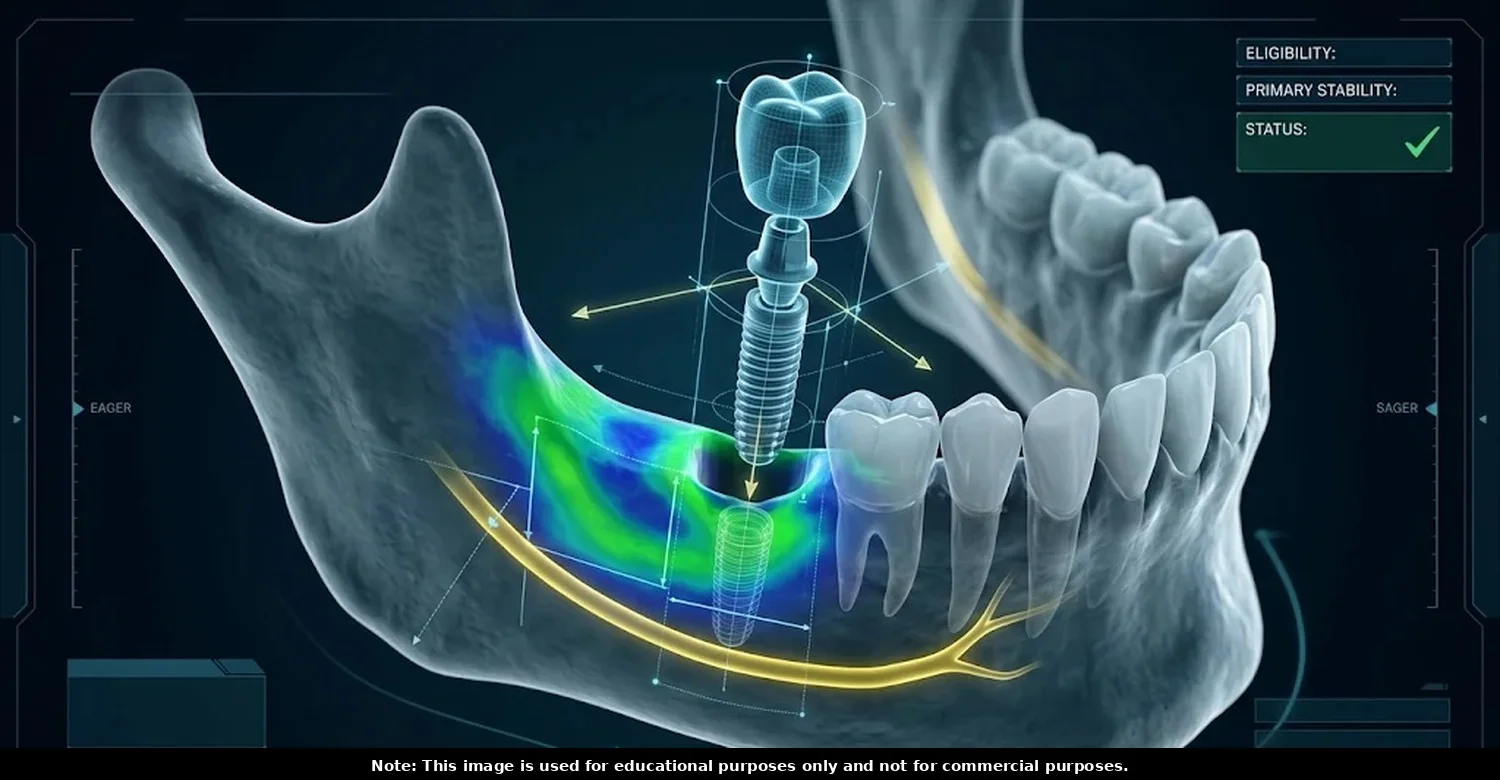
Primary stability is one of the most important requirements for immediate implant loading. It describes initial mechanical fixation after implant insertion. Biological stability develops later through osseointegration.
What Is Primary Dental Implant Stability?
Primary stability describes the implant's mechanical fixation immediately after insertion. It depends on bone quality, implant design, and surgical positioning. It differs from biological stability. Biological stability develops during osseointegration. Both stages contribute to successful implant treatment.
How Does Vitrin Clinic Evaluate Implant Stability During Surgery?
The surgeon evaluates implant fixation during insertion. Clinical measurements may provide additional information. Implant position and surrounding bone are also considered. Stability must be interpreted alongside bite forces and restoration design. One measurement cannot guarantee successful loading.
What Are Insertion Torque and ISQ Measurements?
Insertion torque measures rotational resistance during implant placement. ISQ measures stability through resonance frequency analysis. Both provide information about mechanical fixation. Their interpretation depends on the implant system and clinical circumstances. They are not interchangeable universal thresholds.
What Happens If an Implant Does Not Achieve Sufficient Stability?
The dentist may decide against immediate loading. The implant can remain unloaded while healing progresses. A temporary removable replacement may restore appearance. Additional treatment may be needed if fixation remains inadequate. Patient safety takes priority over same-day restoration.
Can an Implant Heal Without Receiving an Immediate Crown?
Yes. Many implants heal without an immediate crown. This may involve an unloaded or submerged healing approach. It reduces early functional loading. The final restoration is fitted after appropriate healing and clinical evaluation.
Can I Get a Temporary Tooth While Waiting for an Implant?
Yes. Several temporary options can replace a missing tooth during healing:
A removable partial denture, sometimes called a flipper.
A clear removable retainer with an attached tooth.
A bonded temporary bridge attached to neighbouring teeth.
A temporary crown on the implant when immediate loading is suitable.
Temporary teeth should not press on the healing implant site. The dentist selects the option according to tooth position, bite forces, and the treatment plan.
Do You Have No Teeth While Waiting for Implants?
Usually not. Most patients can wear a temporary replacement during the healing period. Options include removable partial dentures, clear retainers with attached teeth, bonded temporary bridges, or a temporary crown when immediate loading is suitable. Patients receiving full-arch treatment may receive a temporary fixed or removable prosthesis. The dentist plans the temporary option to protect the healing implant while maintaining appearance.
When Is Immediate Loading Clinically Appropriate?
Immediate loading may be considered when stability and restorative conditions are suitable. The dentist evaluates bone support, implant position, bite forces, and restoration design. Patient compliance also matters. The temporary restoration must avoid harmful loading where required.
How Does Bite Pressure Affect Immediate Implant Stability?
Excessive bite pressure can cause movement around a new implant. This may interfere with osseointegration. The dentist checks the bite and opposing teeth. Temporary restorations may require careful adjustment. Patients should follow dietary instructions during early healing.
Should You Choose Immediate, Early, or Delayed Implant Placement at Vitrin Clinic?
The most appropriate timing depends on the extraction socket, bone anatomy, soft tissues, and healing requirements. No single placement schedule suits every patient.
How Quickly Can You Get Dental Implants After Extraction?
Implant timing after extraction generally follows one of four approaches:
Immediate placement: On the same day as extraction.
Early placement with soft-tissue healing: About 4–8 weeks after extraction.
Early placement with partial bone healing: About 12–16 weeks after extraction.
Delayed placement: Usually 4–6 months or more after extraction.
The suitable option depends on infection, bone defects, gum condition, and the tooth's location. Bone grafting can extend these timelines.
What Happens During Immediate Implant Placement After Extraction?
The tooth is removed carefully. The dentist inspects and prepares the socket. The implant enters a suitable supporting bone. Any required grafting is considered. A temporary restoration may be fitted when loading conditions are favourable.
When Is Early Implant Placement a Better Option?
Early placement occurs after an initial healing period. It may be considered when soft-tissue healing is needed. It may also follow appropriate infection management. The exact timing depends on the clinical protocol. This approach can provide an alternative to immediate or delayed placement.
When Should You Wait for Complete Socket Healing?
Delayed placement may be recommended when infection or bone defects need treatment. The socket is allowed to heal before implant surgery. This can provide a different surgical environment. However, healing may change bone volume. The dentist must plan for these changes.
How Long Can I Wait Between Extraction and Implant?
There is no fixed deadline for placing an implant after extraction. However, the jawbone begins to shrink once a tooth is removed. Most of this change occurs during the first few months after extraction. Waiting several months or years can reduce bone width and height. This may require bone grafting before or during implant placement. Neighbouring teeth may also drift into the gap. Socket preservation at the time of extraction can help when implant placement is planned later.
What Happens If You Wait Too Long to Get a Dental Implant?
Waiting too long after tooth loss can cause gradual changes in the mouth. The jawbone in the gap may shrink because it no longer receives stimulation from a tooth root. Neighbouring teeth may tilt or drift, and the opposing tooth may over-erupt. The bite and chewing efficiency can also change. These changes may make implant placement more complex and may require bone grafting first. A delay does not always prevent implant treatment, but early planning can help preserve more options.
How Does Bone Grafting Influence Implant Placement Timing?
Bone grafting can influence when implant placement becomes appropriate. Small defects may sometimes receive simultaneous grafting. Larger deficiencies may require staged reconstruction. The dentist considers the graft's purpose and healing requirements. The timeline should reflect the expected tissue response.
Which Implant Placement Approach Offers the Most Suitable Clinical Solution?
There is no universally superior placement schedule. Immediate placement can combine surgical stages in selected cases. Early placement allows initial tissue healing. Delayed placement may suit more complex defects. The best approach balances anatomy, aesthetics, stability, and safety.
Which Is Better, Immediate or Delayed Implant Placement?
Neither approach is better for every patient. Immediate placement can reduce surgical visits and overall treatment time when the site is favourable. Delayed placement allows infection to resolve and tissues to heal, which can provide more predictable conditions in complex sites. Research generally shows comparable implant survival when patients are carefully selected. Immediate placement may carry a higher risk of gum recession where tissues are thin. The better option depends on individual clinical findings.
How Does Vitrin Clinic Determine the Appropriate Treatment Timeline?
Vitrin Clinic should base timing on examination and imaging. The dentist evaluates infection, bone availability, gum health, and restoration requirements. International travel arrangements can then follow the clinical plan. Convenience should never override biological healing requirements.
What Happens During the Immediate Dental Implant Procedure at Vitrin Clinic?
Immediate implant surgery involves extraction, socket preparation, implant insertion, and restoration planning. The exact sequence depends on the tooth and surrounding tissues.
How Is the Implant Position Planned Before Surgery?
The dentist first evaluates the intended final crown position. CBCT may identify available bone and anatomical boundaries. Digital planning can support implant angulation and depth. The surgeon must preserve suitable facial bone and surrounding tissues. Restoration requirements guide surgical positioning.
How Is the Damaged Tooth Extracted?
The dentist removes the tooth while preserving surrounding bone and soft tissues. Atraumatic techniques may help minimise socket damage. The approach depends on root anatomy and tooth condition. Surgical extraction may be necessary for fractured or difficult roots.
How Is the Extraction Socket Prepared?
The dentist inspects the socket after extraction. Infected tissue is removed when appropriate. The socket is cleaned and evaluated for bone defects. Preparation should preserve supporting bone. The dentist then decides whether implant insertion remains suitable.
How Is the Dental Implant Inserted?
The surgeon prepares an implant site within a suitable bone. The implant is positioned according to the restorative plan. Initial fixation is evaluated during surgery. The dentist also checks surrounding bone and tissue conditions. The implant may remain unloaded when immediate restoration is unsuitable.
When Might Bone Grafting or Soft-Tissue Treatment Be Required?
Bone grafting may help manage gaps or bone deficiencies. Soft-tissue grafting may be considered when gum thickness needs improvement. These procedures depend on the defect and aesthetic requirements. They are not necessary for every immediate implant case.
Can Vitrin Clinic Place a Temporary Crown on the Same Day?
A temporary crown may be possible when stability and bite conditions permit. It is designed for provisional use. The dentist may adjust contact with opposing teeth. Some patients need a different temporary replacement. Same-day crowns should never be promised before surgical findings.
When Will You Receive Your Permanent Implant Crown?
The permanent crown is usually fitted after sufficient healing and osseointegration. This often takes several months. Bone conditions and clinical progress influence the timeline. The dentist checks implant stability and surrounding tissues before restoration. A permanent crown should not be rushed.
What Are the Advantages and Disadvantages of Immediate Dental Implants?
Immediate placement can reduce treatment stages, but its benefits depend on careful clinical selection. Patients should understand its limitations before choosing this approach.
What Are the Main Advantages of Immediate Implant Placement?
Potential advantages include:
Combining extraction and implant surgery in one appointment.
Reducing separate surgical visits.
Shortening the overall treatment sequence in suitable cases.
Supporting temporary tooth replacement when loading is appropriate.
Potentially reducing time without a fixed provisional tooth.
These advantages are not guaranteed. Immediate placement is not suitable for every extraction site.
What Disadvantages Should You Consider Before Treatment?
Potential disadvantages include:
Strict anatomical and clinical requirements.
Greater sensitivity to extraction-site defects.
Possible gum recession or aesthetic changes.
Additional grafting requirements in selected cases.
Possible changes to the treatment plan during surgery.
Continued healing and follow-up requirements.
A conventional approach may provide better conditions in some cases.
Is Immediate Placement Always Faster Than Conventional Implant Treatment?
Not necessarily. Immediate placement can combine surgical stages. However, the implant still requires biological healing. Additional grafting or complications can extend treatment. The overall timeline depends on clinical conditions and restoration requirements.
.jpg)
.jpg)
.jpg)
What Side Effects and Complications Can Follow Immediate Dental Implants?
Side effects can include temporary swelling, discomfort, bruising, and minor bleeding. More serious complications require professional attention. Individual risks depend on surgical and medical factors.
Can Immediate Dental Implants Fail?
Yes. An implant can fail to integrate with the surrounding bone. Infection, excessive movement, poor bone conditions, and medical risks can contribute. Early failure may require implant removal. The dentist then evaluates healing and alternative treatment options.
What Is the Success Rate of Immediate Implant Placement?
Systematic reviews generally report implant survival rates above 95% for immediate placement in carefully selected patients. These results are broadly comparable to implants placed in healed sites. However, some studies show a slightly higher early failure risk with immediate placement. Aesthetic outcomes, such as gum recession, also vary between cases. Success depends on patient selection, bone conditions, surgical technique, and maintenance.
How Quickly Can a Dental Implant Fail?
An implant can fail early or late. Early failure usually happens within the first weeks or months, before osseointegration is complete. Possible causes include infection, excessive movement, poor bone quality, or smoking. Late failure can occur years after successful healing. It is often linked to peri-implantitis, excessive bite forces, or mechanical problems. Warning signs include implant movement, persistent pain, swelling, discharge, or gum recession around the implant. Regular reviews help identify problems early.
Can Immediate Implants Cause Gum Recession?
Yes. Gum recession can occur after extraction and implant placement. Thin facial bone and soft tissues increase aesthetic concerns. Implant position also influences the final gum contour. Appropriate planning can reduce certain risks but cannot eliminate them.
Can Bone Loss Affect the Final Aesthetic Result?
Yes. Changes in facial bone can alter the gum profile. This may expose part of the implant restoration. Front teeth require particular attention because small tissue changes can become visible. Grafting may be considered according to individual findings.
Can Infection Develop Around an Immediate Implant?
Yes. Infection can develop during healing or later maintenance. Symptoms may include swelling, tenderness, discharge, or persistent bleeding. Professional examination is necessary. Early treatment may help manage inflammation before further damage occurs.
Does Immediate Loading Increase the Risk of Complications?
Excessive loading can interfere with early healing. Risk depends on stability, bite forces, implant position, and restoration design. Carefully selected patients may receive immediate loading. Others benefit from unloaded healing.
How Does Vitrin Clinic Plan Treatment to Address Individual Clinical Risks?
Risk management should begin before surgery. Vitrin Clinic should review medical history, bone anatomy, periodontal health, and bite conditions. The dentist can explain possible complications and preventive measures. Patients should receive realistic expectations and written aftercare instructions.
How Long Does Recovery Take After Immediate Dental Implant Placement at Vitrin Clinic?
Recovery varies according to surgical complexity, bone condition, and individual healing. Initial discomfort generally differs from the longer osseointegration process.
Is Immediate Implant Surgery Painful?
Local anaesthesia helps control discomfort during surgery. Patients may experience soreness after the anaesthetic wears off. The dentist can recommend suitable pain relief. Medication instructions should reflect individual health conditions and other treatments.
How Much Swelling and Discomfort Should You Expect?
Mild swelling, tenderness, and bruising can occur after surgery. Symptoms may become more noticeable during the first few days. They should gradually improve. Severe or increasing swelling requires professional evaluation.
What Can You Eat After Immediate Implant Surgery?
Choose soft foods requiring minimal chewing during early recovery. Avoid pressure on the surgical area. Very hot, hard, crunchy, or sticky foods may irritate the site. Follow individual dietary instructions. Do not chew directly on an immediately loaded implant unless permitted.
How Long Does Osseointegration Take?
Osseointegration commonly takes several months. Healing may take longer when grafting or additional procedures are required. Bone quality and individual health influence the timeline. The dentist confirms readiness for final restoration through clinical evaluation.
When Can You Return to Normal Daily Activities?
Many patients resume light activities within a short period. More demanding exercise may require temporary restriction. Surgical complexity and swelling influence recovery. Follow the surgeon's instructions rather than relying on a fixed timetable.
When Can Your Temporary Crown Be Replaced with a Permanent Crown?
The permanent crown is fitted after appropriate healing and stability. The dentist also checks gum health and bite relationships. Laboratory fabrication follows the approved restoration design. The final appointment depends on clinical progress.
Which Warning Signs Require Urgent Dental Attention?
Contact your dentist if you experience persistent bleeding, worsening pain, fever, or increasing swelling. Pus or implant movement also requires prompt evaluation. Rapidly spreading facial or neck swelling needs urgent medical attention. Breathing or swallowing difficulties require emergency medical care.
How Should International Patients Arrange Follow-Up Care After Returning Home?
Arrange follow-up before leaving Istanbul. Request implant details, surgical records, radiographs, and restoration information. Identify a dentist in your home country for ongoing review. Ask Vitrin Clinic how to report postoperative concerns. Do not delay urgent treatment while waiting for international communication.
.jpg)
.jpg)
.jpg)
How Can You Relieve Discomfort After Immediate Dental Implant Surgery?
Recovery instructions can help manage routine discomfort. However, home care cannot replace professional dental treatment.
Which Recovery Measures Can Help Reduce Swelling?
Apply a cold compress externally as instructed.
Rest and initially avoid strenuous activity.
Keep your head slightly elevated when resting.
Follow prescribed medication instructions.
Maintain gentle oral hygiene around the surgical area.
Avoid smoking during healing.
Do not apply substances directly to the wound without instructions.
What Should You Avoid During Early Implant Healing?
Avoid smoking, alcohol, and excessive physical exertion. Do not disturb the surgical site with your fingers or tongue. Avoid hard foods and chewing directly over the implant. Follow instructions about rinsing and brushing.
When Should Home Recovery Measures Stop Being Enough?
Worsening symptoms require professional evaluation. Persistent bleeding, fever, increasing pain, or discharge should not be ignored. Rapidly spreading facial swelling requires urgent care. Breathing or swallowing difficulties require emergency medical assistance.
What Does Dr. Rifat's Clinical Opinion Highlight About Immediate Implant Treatment?
Immediate implant treatment should begin with a clear diagnosis, not a promised treatment date. The dentist must evaluate the extraction socket, surrounding bone, gum thickness, and planned restoration. A temporary tooth should only be considered when stability supports loading. A staged approach may provide better conditions when infection or tissue damage exists. Patients should understand that immediate placement and immediate loading are separate decisions. The final recommendation must prioritise biological stability, function, and long-term tissue health.
What Do We Notice Clinically When Evaluating Immediate Implant Candidates?
Several findings can change the treatment decision during examination or surgery. A tooth fracture may extend below the gumline. Facial bone may be thinner than expected. An extraction socket may contain a substantial defect. Gum recession may affect the final appearance. Infection may extend beyond the visible tooth. Implant stability may also be lower than anticipated. These findings explain why photographs cannot confirm surgical suitability. Clinical examination and appropriate imaging remain essential.
What Is All-on-6 Dental Implant Treatment in Turkey?
All-on-6 replaces a complete dental arch using six strategically positioned implants. It is designed for patients requiring extensive tooth replacement. The implants support a fixed full-arch prosthesis. Suitability depends on jawbone anatomy, bite forces, gum health, and medical history.
How Does All-on-6 Dental Implant Treatment Work?
The dentist removes teeth that cannot be preserved, when necessary. Six implants are positioned in suitable areas of the jawbone. Their distribution supports the planned full-arch restoration. A temporary fixed prosthesis may be fitted when stability permits. The final prosthesis follows the required healing period.
Who Is a Suitable Candidate for All-on-6 Dental Implants?
Potential candidates include patients with:
Extensive tooth loss in one or both jaws.
Multiple severely damaged teeth requiring extraction.
Adequate bone for six implant positions.
Healthy or appropriately managed gum tissues.
Medical conditions suitable for implant surgery.
The ability to maintain effective oral hygiene.
CBCT may help evaluate bone availability and anatomical limitations. Final suitability requires clinical examination.
Why Might a Dentist Recommend Six Implants Instead of Four?
Six implants provide additional support points. Their distribution may help manage forces across a full-arch restoration. However, six implants are not automatically better for every patient. Four implants may provide sufficient support in selected cases. Bone anatomy, prosthetic design, and force distribution determine the appropriate number.
Can All-on-6 Include Temporary Fixed Teeth on the Same Day?
Yes. Selected patients may receive a temporary fixed prosthesis shortly after surgery. This depends on primary stability and the complete treatment design. The dentist evaluates bite forces and implant distribution. Some patients require another temporary solution. Immediate loading must never be guaranteed before surgery.
What Happens During All-on-6 Implant Surgery?
The procedure generally includes several stages:
Clinical examination and three-dimensional imaging.
Treatment planning and implant positioning.
Extraction of teeth that cannot be preserved.
Placement of six dental implants.
Grafting when clinically necessary.
Temporary restoration when appropriate.
Healing and implant integration.
Final prosthesis design, fitting, and bite adjustment.
The exact sequence depends on individual clinical findings.
What Materials Can Be Used for an All-on-6 Final Prosthesis?
The final restoration can use different dental materials. Options depend on strength, appearance, available space, and bite forces. The dentist explains each option's advantages and limitations. Patients should confirm the material, framework, warranty terms, and laboratory charges before treatment.
How Long Does All-on-6 Treatment Take?
The surgical appointment may be completed during a treatment visit. However, biological healing takes longer. Many patients need several months before final prosthesis placement. Additional grafting can extend the timeline. The dentist establishes the schedule after reviewing healing progress.
What Are the Advantages of All-on-6 Dental Implants?
Potential advantages include:
Fixed full-arch tooth replacement.
Six implant support points.
Restoration of chewing function.
Reduced dependence on conventional removable dentures.
Replacement of multiple missing teeth.
A prosthetic design tailored to the jaw.
Results depend on suitable planning, healing, and maintenance.
What Are the Disadvantages and Risks of All-on-6?
All-on-6 involves surgery and a substantial financial commitment. Potential complications include infection, implant failure, bone loss, and prosthetic damage. Some patients need grafting or additional treatment. Cleaning beneath the bridge requires careful attention. Long-term maintenance appointments remain essential.
Is All-on-6 Suitable for Both Upper and Lower Jaws?
Yes. Both jaws can receive All-on-6 treatment. However, the upper and lower jaws differ anatomically. Bone density, sinus position, nerve location, and bite relationships influence planning. Each arch requires separate evaluation. Treatment may differ between the two jaws.
How Much Does All-on-6 Dental Implant Treatment Cost at Vitrin Clinic Compared with the USA and UK?
All-on-6 prices depend on implant systems, prosthesis materials, bone grafting, and treatment complexity. The following figures are indicative market comparisons, not confirmed quotations. Country prices may include different treatment components.
How Much Does All-on-6 Cost at Vitrin Clinic in Turkey?
The previously supplied Vitrin planning range is approximately 4,000–12,000 per jaw for All-on-4 and All-on-6 treatment planning combined. This is not a separately verified All-on-6 tariff.
For preliminary budgeting, the following range can be used as an estimate, subject to confirmation by Vitrin Clinic:
All-on-6, One Jaw (Single Arch)
Vitrin Clinic indicative planning estimate: 4,000–12,000
Vitrin Clinic indicative planning estimate
Vitrin Clinic indicative planning estimate: 4,000–12,000
6 implants supporting a complete single-arch bridge
Enhanced bite force & full-arch stability
All-on-6, Both Jaws (Full Mouth)
Vitrin Clinic indicative planning estimate: 8,000–24,000
Vitrin Clinic indicative planning estimate
Vitrin Clinic indicative planning estimate: 8,000–24,000
12 total implants across upper & lower jaws
Complete full-mouth fixed rehabilitation
How Do All-on-6 Prices Compare Between Turkey, the UK, and the USA?
UK
All-on-6 (per jaw): $12,000–$20,000
Treatment per jaw
All-on-6 per jaw: $12,000–$20,000
UK private dental clinic guide rate
Varies by implant system & final bridge material
Vitrin Clinic, Turkey
All-on-6 (per jaw): 4,000–12,000*
Treatment per jaw
All-on-6 per jaw: 4,000–12,000*
Save ~67–83% vs. USA & ~40–67% vs. UK
6 implants per jaw with FDA & CE-marked brands
US
All-on-6 (per jaw): 24,000–38,000
Treatment per jaw
All-on-6 per jaw: 24,000–38,000
US private dental clinic guide rate
Highest single-arch private investment
What Could an All-on-6 Treatment Package Include?
The following table gives indicative planning allowances for individual components. These are not confirmed Vitrin Clinic fees and should not be added to the package price unless the clinic confirms they are excluded.
eeth & Prosthesis
From 300
Indicative separate restoration costs
Temporary teeth: 300–1,000 (Confirm: Fixed or removable restoration)
Final prosthesis: 1,500–4,000 (Confirm: Material and framework)
Implants & Surgery
Included in the implant package or 1,500–4,500
Core surgical placement items
Six dental implants: Included in the implant package or 1,500–4,500 (Confirm: Brand, model, and dimensions)
Implant surgery: 500–1,500 (Confirm: Surgical and clinical fees)
Imaging, Prep & Aftercare
From 50
Indicative separate clinical items
Imaging: 50–200 (Confirm: X-rays and CBCT, if required)
Extractions: 50–300 per tooth (Confirm: Number of teeth and complexity)
Bone grafting: 200–800 per site (Confirm: Material and amount required)
Follow-up and adjustments: 100–400 (Confirm: Reviews and adjustment arrangements)
How Much Could You Save by Choosing Vitrin Clinic?
Savings depend on the final Vitrin quotation and comparable treatment inclusions. The following examples compare the lowest and highest ends of the indicative ranges.
UK vs Vitrin Clinic
Potential difference before travel costs (per jaw): $12,000–$20,000 minus the equivalent Vitrin price
Comparison per jaw
Formula: $12,000–$20,000 minus the equivalent Vitrin price
Calculated before UK–Turkey travel expenses
Exact savings confirmed via free scan review
USA vs Vitrin Clinic
Potential difference before travel costs (per jaw): 12,000–34,000
Comparison per jaw
Potential savings per jaw: 12,000–34,000
Calculated before international travel expenses
Substantial net savings even across two trips
Does the All-on-6 Price Include Bone Grafting and Temporary Teeth?
Not necessarily. These items may be priced separately or included in a treatment package. Ask whether the quotation covers extractions, grafting, temporary restorations, final prostheses, imaging, and follow-up.
What Factors Influence Your Final Vitrin Clinic Quotation?
Several factors can influence the final price:
Number of arches being treated.
Implant manufacturer, model, and number.
Final prosthesis material and framework.
Bone volume and need for grafting.
Number and complexity of extractions.
Temporary restoration requirements.
Laboratory work and additional appointments.
Medical and surgical complexity.
What Other Factors Influence Immediate Dental Implant Costs in Turkey, the USA, and the UK?
Immediate implant treatment costs involve more than implant placement. Extraction, temporary restorations, grafting, and final crowns can change the total.
How Much Does a Single Immediate Dental Implant Cost in Different Countries?
The following ranges provide general market guidance for a single implant and crown. They are not confirmed Vitrin Clinic prices.
UK Private Guide
From 1,800
UK private dental benchmark
Single implant with crown: 1,800–3,500
Bone graft per site: 200–1,500
Immediate-loading additional fee: 200–700
Turkey Market Guide
From 500
Implant, grafting & immediate loading
Single implant with crown: 500–1,800
Bone graft per site: 130–600
Immediate-loading additional fee: 0–400
USA Private Guide
From 3,000
US private dental benchmark
Single implant with crown: 3,000–6,000
Bone graft per site: 300–3,000
Immediate-loading additional fee: 500–1,500
Does Tooth Extraction Change the Total Treatment Cost?
Yes. Simple extraction and surgical extraction involve different levels of complexity. Multiple extractions may increase surgical costs. Infection management or socket preservation can add further expenses. Confirm these items in the written quotation.
Can Bone Grafting Increase Your Implant Treatment Budget?
Yes. Costs depend on the defect, grafting material, and surgical technique. Extensive reconstruction may require a separate operation. Patients should confirm whether grafting is included in their quotation.
Does Immediate Loading Cost More Than Conventional Implant Treatment?
Some clinics charge additional fees for immediate provisional restorations. Others include them within treatment packages. The final price depends on laboratory work and restoration design. Compare complete treatment costs rather than the loading fee alone.
Why Should You Compare Complete Treatment Packages Rather Than Headline Prices?
A low implant price may exclude essential components. Compare implant brands, abutments, temporary teeth, final restorations, imaging, grafting, and follow-up. Confirm who handles complications after returning home. These details help establish the actual treatment cost.
Ready to transform your smile?
Talk to our team and get a personal FREE treatment plan.
How Can International Patients Plan Immediate Dental Implant Treatment at Vitrin Clinic in Turkey?
International patients should arrange preliminary records, clinical confirmation, realistic travel dates, and follow-up. Travel planning should follow the clinical treatment schedule.
Can Vitrin Clinic Review Your Dental Records Before Travelling?
Yes. Patients can submit available dental photographs, X-rays, and treatment records. This helps the team understand the initial problem. However, preliminary reviews cannot confirm immediate dental implant eligibility. An in-person examination remains necessary.
Which Dental X-Rays and Scans Should You Send Before Your Visit?
Provide recent panoramic X-rays and relevant periapical images when available. Include previous CBCT scans if suitable for clinical review. Send clear photographs of the affected teeth and gums. The dentist determines whether additional imaging is necessary.
How Many Appointments Might Immediate Implant Treatment Require?
The number depends on the treatment plan. Consultation, imaging, surgery, and restoration appointments may be required. Some patients need additional grafting or adjustments. Final restoration may require another visit after healing.
How Long Should You Stay in Istanbul After Implant Surgery?
Your stay depends on planned procedures and postoperative requirements. Immediate placement does not mean treatment finishes during one visit. The dentist should specify expected appointments before you book flights. Allow flexibility for unexpected clinical findings.
What Happens If Immediate Dental Implant EligibilityPlacement Becomes Unsuitable After Examination?
The dentist should explain the findings and revise the plan. Early placement, delayed placement, or grafting may be considered. Patients should receive an updated written estimate. International travel should never pressure anyone into unsuitable surgery.
How Does Vitrin Clinic Coordinate Treatment and Laboratory Appointments?
Treatment coordination involves clinical appointments, imaging, surgery, and laboratory communication. Digital scans may support restoration planning when appropriate. The team should explain provisional and final restoration stages. Patients should confirm the expected schedule before travelling.
How Can You Arrange Follow-Up Care After Returning to Your Country?
Request copies of implant records and postoperative instructions. Confirm the implant brand, model, dimensions, and restoration details. Arrange local dental reviews when appropriate. Maintain communication with Vitrin Clinic about healing concerns and future appointments.
.jpg)
.jpg)
.jpg)
What Should You Ask Vitrin Clinic Before Agreeing to Immediate Dental Implant Eligibility ?
Clear questions help establish whether eligibility reflects clinical findings rather than convenience. Discuss both the surgical decision and the complete treatment plan.
Am I Eligible forImmediate Dental Implant EligibilityPlacement and Immediate Loading Separately?
Ask the dentist to explain both decisions independently. Immediate placement does not automatically establish suitability for immediate loading. Request the clinical reasons supporting each recommendation.
Is My Jawbone Suitable for Immediate Implant Stability?
Ask about bone width, height, density, and socket condition. Find out whether facial bone defects exist. Discuss any grafting requirements before surgery.
Will I Receive Temporary Teeth on the Day of Surgery?
Ask whether the proposed temporary restoration will be fixed or removable. Confirm stability requirements and bite restrictions. Request an alternative plan if immediate loading proves unsuitable.
Could I Need Bone Grafting or Additional Procedures?
Ask whether your scan shows bone deficiencies. Clarify whether grafting, soft-tissue treatment, or additional extractions may be required. Confirm how these procedures affect costs and recovery.
What Happens If Immediate Implant Placement Is Unsuccessful?
Ask how the dentist will respond to unexpected defects or inadequate stability. Discuss alternative placement timing and temporary tooth replacement. Understand the financial implications of changing the treatment plan.
What Alternatives Will Vitrin Clinic Recommend If I Am Unsuitable?
Ask about early placement, delayed placement, and bone reconstruction. Discuss the advantages and limitations of each approach. The recommendation should reflect your clinical findings.
What Does My Written Treatment Plan Include?
Request an itemised quotation covering surgery, implants, restorations, imaging, and additional procedures. Confirm follow-up arrangements and applicable warranty conditions. Ask which services are excluded.
What Is the Complete Immediate Dental Implant Eligibility Journey at Vitrin Clinic in Turkey?
The Vitrin Clinic journey should connect preliminary planning, clinical confirmation, treatment, restoration, and follow-up. Each stage should reflect your individual clinical requirements.
How Can You Start Your Immediate Dental Implant Journey with Vitrin Clinic?
Begin by contacting Vitrin Clinic and explaining your missing or damaged teeth. Share your treatment goals and available dental records. The team can discuss preliminary steps towards determining your eligibility.
How Does Vitrin Clinic Review Your Dental Photos, X-Rays, and Medical History Before Travelling?
The team reviews available records and relevant medical information. Previous X-rays can help identify possible bone and dental concerns. Photographs provide additional visual context. However, they cannot confirm the final surgical decision.
How Do You Receive Your Initial Digital Treatment Plan from Vitrin Clinic?
The preliminary plan outlines possible treatment stages and estimated requirements. It should distinguish confirmed information from details requiring examination. A written quotation should clarify expected procedures and exclusions. Final decisions follow clinical findings in Istanbul.
What Happens During Your First Clinical Visit to Vitrin Clinic in Istanbul?
The dentist examines your teeth, gums, and oral tissues. Your medical history and treatment expectations are reviewed. Existing imaging is evaluated. Additional diagnostic procedures may be recommended when necessary. This appointment helps establish whether immediate placement is realistic.
How Does Vitrin Clinic Confirm Your Immediate Implant Eligibility After Examination?
The dentist evaluates the extraction site, available bone, infection, and soft tissues. Implant positioning and primary stability requirements are considered. The clinician then recommends immediate, early, or delayed placement. The decision should reflect individual findings.
How Are CBCT Imaging and Digital Scanning Used for Implant Planning When Indicated?
CBCT provides three-dimensional information about jawbone anatomy. Digital scanning captures dental structures needed for restoration planning. These technologies can support implant positioning and prosthetic design. Their use depends on clinical requirements.
How Does Vitrin Clinic Organise Your Implant Surgery and Treatment Schedule?
The clinic coordinates surgical appointments, laboratory requirements, and provisional restorations. The schedule should account for expected healing. Additional procedures must be explained beforehand. Travel arrangements should remain flexible.
What Happens During Your Immediate Implant Placement Appointment?
The dentist removes the affected tooth when necessary. The socket is inspected and prepared. The implant is positioned if suitable conditions remain. The surgeon evaluates primary stability before considering restoration.
Can Vitrin Clinic Arrange a Temporary Restoration on the Same Day?
A provisional restoration may be arranged when immediate loading is appropriate. Its design depends on implant position and bite forces. Otherwise, another temporary replacement may be recommended. The dentist explains the available approach.
How Does Vitrin Clinic Coordinate Laboratory Work for Your Final Implant Crown?
The team coordinates digital or conventional records with the dental laboratory. Restoration design considers implant position, bite, and aesthetic requirements. The final material should be confirmed before fabrication. Clinical checks precede delivery.
When Will You Need to Return for Your Permanent Implant Restoration?
The return appointment depends on osseointegration and tissue healing. The dentist evaluates implant stability and surrounding gums. The final restoration is fitted after appropriate clinical confirmation. Additional appointments may be needed for adjustments.
How Does Vitrin Clinic Support International Patients After They Return Home?
Patients should receive postoperative instructions and copies of their records. The team should explain how to report complications. Local dental follow-up remains important. Future maintenance should be planned before travelling home.
Ready to transform your smile?
Talk to our team and get a personal FREE treatment plan.
Can You Confirm Your Immediate Dental Implant Eligibilitywith Vitrin Clinic?
Confirming immediate dental implant eligibility requires clinical examination, suitable imaging, and an individual treatment decision. No photograph or preliminary quotation can replace direct clinical evaluation.
Why Does Your Bone Condition Determine Whether Immediate Implants Are Suitable?
Jawbone provides the foundation for implant fixation. Its available volume and anatomy influence implant positioning. Bone defects may require reconstruction or another placement timeline. Suitable bone support remains essential.
Why Should You Have Your Implant Stability Evaluated Before Receiving Same-Day Teeth?
Primary stability determines whether early loading can be considered. Excessive implant movement can interfere with osseointegration. The dentist must evaluate stability and bite forces before approving temporary fixed teeth.
How Can Vitrin Clinic Help You Explore the Most Suitable Implant Treatment Plan?
Vitrin Clinic can review your records and discuss potential treatment options. Clinical examination helps clarify bone and tissue conditions. The resulting plan should explain procedures, costs, risks, and follow-up requirements.
Are You Ready to Start Your Immediate Dental Implant Journey in Turkey?
Your next step is arranging a clinical review of your dental records. Request an individual treatment plan and written quotation. Remember that eligibility depends on clinical suitability, not simply the desire for same-day treatment.
Reference

Medically reviewed by
Dr. Rifat AlsamanDr. Rifat Alsaman has more than 5 years of clinical experience in dentistry and currently serves as the Head of the Medical Team at Vitrin Clinic. He is dedicated to providing exceptional patient care, overseeing treatment planning, and ensuring the highest clinical standards across the team. His expertise, attention to detail, and commitment to continuous professional development have helped countless patients achieve healthier, more confident smiles.
More in Dental Treatments
View all 22 min readWill I Need a Bone Graft Before Getting Dental Implants, or Can I Avoid It?Do I need bone graft for dental implant treatment? Many patients ask this when planning to replace a missing tooth. The honest answer is: not always. Some people have enough healthy jawbone for direct implant placement.
 19 min readCan I Get a Dental Implant If I Have Been Missing the Tooth for Many Years?A dental implant after years of missing tooth is possible for most patients. Time alone rarely rules you out. What matters is how much jawbone remains, how healthy your gums are, and whether your bite has shifted.
 36 min readCan Multiple Root Canal Treatments Be Completed in One Appointment?Having several painful or damaged teeth does not always require separate dental visits.
 18 min readCan Tooth Extractions and Dental Implants Be Done on the Same Day?Yes, a tooth extraction and implant on the same day is often possible. It's called an immediate implant, and it works when the socket is free of active infection, the surrounding bone is intact and the implant can be held firmly. When those conditions aren't met, the implant is placed a few weeks or months later.
Still have a question?
Our patient coordinators answer every day of the week: before, during and long after your treatment.