What Should You Check in a Dental Clinic's Cancellation and Refund Policy Before Booking?
A dental treatment cancellation policy is one of the first documents worth reading, even before you compare prices. Most patients focus on the treatment plan, the materials, and the final cost.

A dental treatment cancellation policy is one of the first documents worth reading, even before you compare prices. Most patients focus on the treatment plan, the materials, and the final cost. Far fewer read the small print about cancellations, deposits, and refunds.
That small print matters. Dental care often involves several visits, custom-made laboratory work, and reserved surgery time. When a patient cancels, the clinic may already have spent money on that case. A fair policy balances those costs against your right to change your mind.
For international patients, the stakes are higher. Flights, hotels, and time off work all depend on your appointment date. Cancelling dental appointments abroad without understanding the terms can lead to unexpected charges or a lost deposit.
This guide explains the key details to review before you pay a deposit or confirm a booking. It covers notice periods, fees, refunds, rescheduling, exceptions, and disputes, in plain language.
Key Takeaways
Read the dental treatment cancellation policy before paying any deposit.
Confirm notice periods, how they are counted, and which time zone applies.
Cancellation fees in dentistry differ from no-show charges, so know which one applies.
Laboratory-made items, such as crowns and veneers, are usually non-refundable once production starts.
Rescheduling is often easier and cheaper than cancelling.
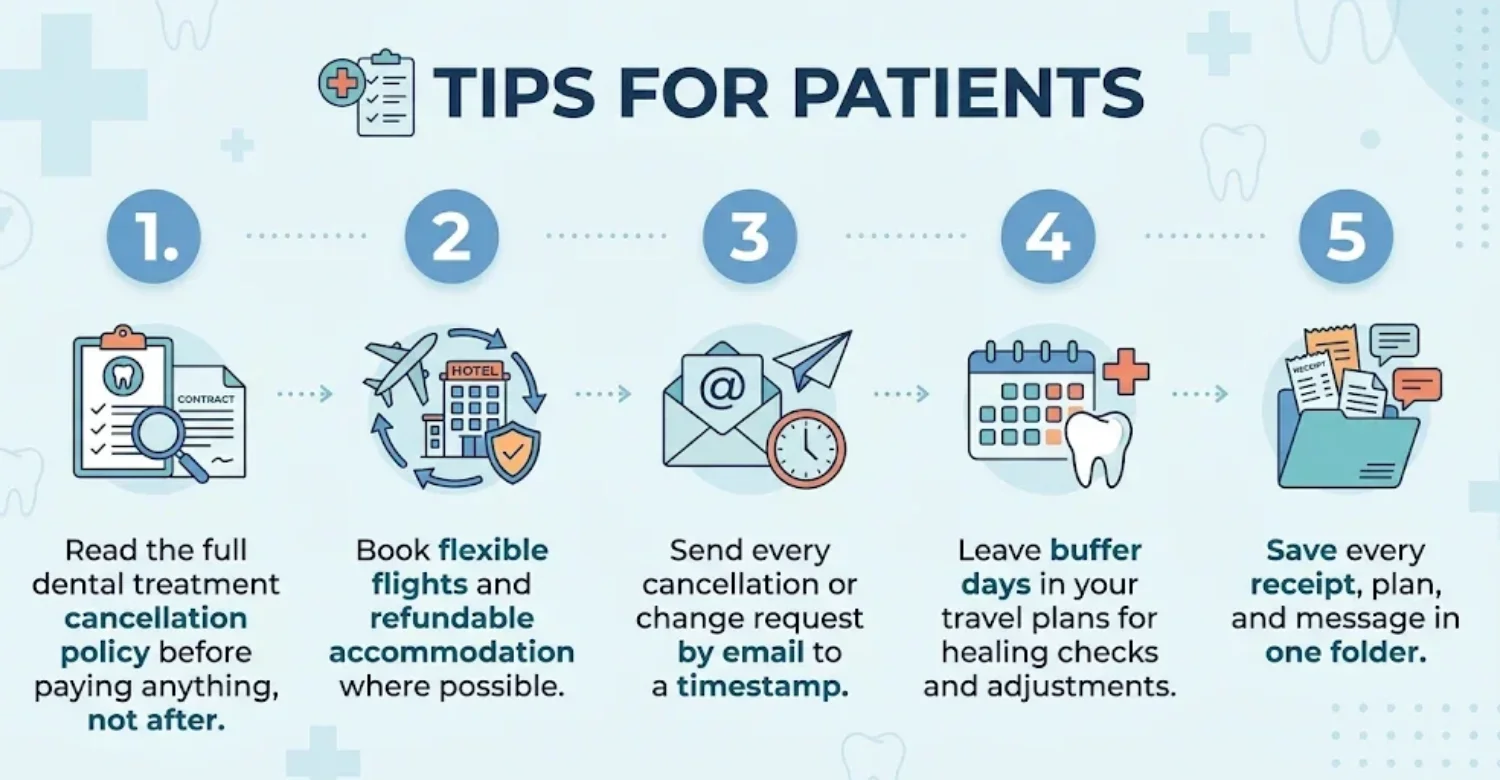
Keep every agreement, receipt, and message in writing.
Never delay urgent dental care because of a booking fee.
What Should You Know About Dental Treatment Cancellation Policy Notice Periods and Deadlines?
Every dental treatment cancellation policy starts with one question: how far ahead must you tell the clinic? Notice periods often range from 24 hours for routine visits to several days or more for surgery or treatment that needs laboratory preparation.
Advance cancellations, made before the deadline, are usually free or carry a small fee. Last-minute cancellations, made after the deadline, often lead to a charge or partial loss of the deposit.
Check exactly how the deadline is counted:
Working days exclude weekends and public holidays, so the real deadline may arrive earlier than you expect.
Calendar days count every day, including weekends.
Time zones matter if you live abroad. Ask whether the deadline uses the clinic's local time.
Finally, ask whether deadlines differ by treatment or appointment type. A check-up slot is easy to refill. A full-day implant surgery is not, so its notice period is often longer.
.jpg)
.jpg)
.jpg)
.jpg)
Ready to transform your smile?
Talk to our team and get a FREE treatment plan.
Cancellation Fees and No-Show Charges?
Many clinics charge a fee when an appointment is cancelled late or missed entirely. A clear dental treatment cancellation policy explains both charges separately.
Cancellation Fee | No-Show Charge | |
What it means | You cancel, but after the notice deadline | You do not attend and do not inform the clinic |
Typical impact | A smaller charge or partial deposit loss | A larger charge or full deposit loss |
Why it exists | Covers time that is hard to rebook | Covers a wasted slot and prepared resources |
Some clinics use a sliding scale: the shorter the notice, the higher the fee. Others apply one flat charge.
Cancellation fees in dentistry also vary by appointment type. A short consultation may carry no fee at all. A specialist appointment or a lengthy procedure, such as placing several implants, may carry a higher one. The dentist, the assistant, and the treatment room were reserved for hours.
Transparency is the key point. Every fee in your dental treatment cancellation policy should be stated in writing before you book. If a fee appears only after you cancel, ask the clinic to show where it was disclosed.
Deposit Requirements and Payment Conditions?
Deposits are common for longer treatments and for international patients. They secure your time slot and may cover early costs, such as laboratory orders. Your dental treatment cancellation policy should explain how deposits work before you pay one.
Before paying, confirm:
Whether a deposit is required for your treatment, or only for certain procedures such as implants, veneers, or crowns.
The amount and due date. Some clinics ask for a fixed sum. Others ask for a percentage of the treatment estimate.
Whether it is deducted from the final bill. It usually should be, but this must be stated clearly.
Accepted payment methods, such as bank transfer, card, or cash, and any card surcharges or transfer fees.
Payment currency, since exchange rates can change between booking and treatment.
Deposit Refund Eligibility and Refund Conditions?
Not every deposit is refundable, and your dental treatment cancellation policy decides which part is. Your dental treatment deposit refund depends on the terms you accepted when you paid.
Look closely for:
Whether the deposit is refundable if you decide not to proceed.
Situations where the clinic keeps part or all of it, such as late cancellation or work already started.
Notice-based refunds. Many policies refund more when you give more notice.
Deductions for administrative, banking, or processing fees.
Different rules for consultation deposits and treatment deposits.
Clear dental treatment refund conditions spell all of this out in plain language. A phrase such as "non-refundable under all circumstances" deserves a direct question before you pay.
It also helps to understand why some costs cannot be returned. Once your crowns or veneers are made in a laboratory, they fit your teeth alone. They cannot be used for anyone else. A fair dental treatment cancellation policy explains this openly rather than hiding it.
Rescheduling and Transferring Payments?
Rescheduling is often easier than cancelling. Many clinics would rather move your appointment than lose you as a patient. Still, your dental treatment cancellation policy may set limits.
Check these points:
Fee-free changes. Can you move your appointment without extra charges if you give enough notice?
Required notice. Rescheduling deadlines are often the same as cancellation deadlines, but not always.
Deposit transfer. Ask whether your deposit carries over to the new date automatically.
Limits on changes. Some clinics allow one or two free changes, then begin charging.
New conditions. The new date depends on availability. Prices or payment terms may also change if treatment moves far into the future.
For patients travelling abroad, ask how long a transferred deposit stays valid. If it expires after a set period, a long delay in your plans could mean losing it.
Refund Processing Times and Methods?
Once a refund is approved, the next question is timing. Your dental clinic refund policy should give an expected timeframe.
Confirm the following:
Processing time at the clinic. This is how long the clinic needs to approve and send the refund.
Refund method. Most refunds return to the original payment method. Some clinics may offer a bank transfer instead.
Bank processing time. Card refunds and international transfers can take extra working days to reach your account.
Written confirmation. Ask for an email or receipt showing the refund amount and the date it was sent.
Currency conversion. If you paid in a foreign currency, the amount you receive may differ because of exchange rates and bank fees.
Also ask who covers international transfer fees. This small detail can reduce the final amount you receive. A complete dental treatment cancellation policy answers this question in advance.
Exceptions for Emergencies and Unexpected Circumstances?
Life does not always follow a booking calendar. Sudden illness, a family emergency, or a cancelled flight can make attending impossible.
A good dental treatment cancellation policy considers exceptions in these cases. Check:
Which situations qualify, such as hospital admission, acute illness, or bereavement.
What evidence is needed, such as a medical report or a flight cancellation notice.
Whether fees can be waived or reduced, or whether the deposit can move to a later date instead.
How requests are assessed and how quickly the clinic will reply.
Some health changes also make treatment unsafe on the planned date. Examples include a fever, an active infection, poorly controlled blood pressure or blood sugar, or a recent heart attack. Postponing in these situations protects your safety. Tell the clinic honestly and early. A fair dental treatment cancellation policy treats medical safety as a valid reason to reschedule.

Ready to transform your smile?
Talk to our team and get a FREE treatment plan.
What Happens If the Dental Clinic Cancels Your Appointment?
Cancellations can happen on the clinic's side too. A dentist may be unwell, equipment may need repair, or a laboratory delivery may be delayed.
Your dental booking cancellation terms should explain what happens next:
Alternative appointment. The clinic should offer a new date as soon as possible.
Your options. If the new date does not suit you, you should be able to choose another or decline.
Refund rights. If you choose not to reschedule, you should generally receive a refund of your deposit or advance payment, since you did not cause the cancellation.
Operational reasons. The policy should explain how the clinic handles staff absences or technical problems.
A well-written dental treatment cancellation policy covers both sides, not only the patient's obligations. For travellers, ask whether the clinic helps with extra costs, such as changed flights or hotel nights. Many clinics do not cover these.
Cancellation Policies for Different Dental Treatments?
A single dental treatment cancellation policy may contain separate rules for different appointment types. This reflects how much time and material each one requires.
Appointment Type | What Is Usually Reserved or Prepared | Typical Cancellation Sensitivity |
Consultation or check-up | Short chair time | Low, often flexible |
Cosmetic procedures (veneers, smile design) | Long sessions, digital design, laboratory work | Medium to high |
Dental implants | Surgical time, sterile set-up, implant components | High |
Lengthy or multi-visit treatment | Several reserved sessions | High |
Laboratory work has the biggest effect on refunds. Crowns, veneers, bridges, implant abutments, and dentures are custom-made for your mouth. Once production starts, those costs are usually non-refundable.
Treatment packages and multi-visit plans may also carry extra conditions. Cancelling after the first stage may change the pricing of the remaining stages. Ask how each stage is billed under the dental treatment cancellation policy before you commit.
Written Confirmation and Access to the Full Policy?
A policy only protects you if you can read it. Before booking, check whether the full dental treatment cancellation policy appears on the clinic's website or in your treatment plan.
Good practice includes:
Requesting a written copy if the terms are not clearly displayed.
Confirming verbal promises in writing. If a coordinator agrees to a special refund arrangement by phone, ask for it by email.
Keeping records. Save booking confirmations, payment receipts, treatment plans, and messages with the clinic.
Checking for policy changes. Some clinics reserve the right to update their terms. Ask which version applies to you and how changes are announced.
As a general principle, the dental treatment cancellation policy you agreed to at booking should apply to that booking. A dated copy helps if questions arise later.
How to Dispute a Cancellation Fee or Refund Decision?
Disagreements are uncommon, but it helps to know the steps. Start with the clinic. Check whether it has a formal complaints procedure and who handles it, such as a patient coordinator or practice manager.
When you submit a complaint:
Put it in writing.
Include your booking reference, dates, and payment receipts.
Attach relevant evidence, such as medical notes.
Quote the part of the dental treatment cancellation policy you believe applies.
State clearly what outcome you are asking for.
Ask how long the clinic takes to respond and what happens if the issue stays unresolved.
If the dispute continues, review the patient rights and consumer protection options in the country where the clinic operates. In Turkey, for example, consumers can apply to consumer arbitration committees for many disputes. If you paid by card, your card provider may also offer a dispute process. Rules and time limits vary, so act promptly.

Ready to transform your smile?
Talk to our team and get a FREE treatment plan.
When to Seek Immediate Dental or Medical Attention?
Never delay urgent care because of a booking or cancellation fee. Seek prompt care if you notice:
Facial or neck swelling that is spreading.
Difficulty breathing, swallowing, or opening your mouth.
Fever together with dental pain or swelling.
Bleeding that continues despite 30 minutes of firm pressure with gauze.
A knocked-out adult tooth. Seek care within the hour, as fast treatment improves the chance of saving it.
Severe pain that over-the-counter painkillers do not control.
Numbness that lasts much longer than expected after a procedure.
Spreading swelling with breathing or swallowing problems needs emergency care immediately.
Clinical Note
Cancellations are not only an administrative matter. Dr. Rifat Alsaman, Head of the Medical Team and cosmetic dentist at Vitrin Clinic, explains that many dental treatments follow a biological timeline. After an extraction or implant placement, healing checks are planned at specific stages. Temporary crowns and veneers are designed to last weeks, not months. Long delays can let prepared teeth shift, temporaries loosen, or gum tissue change shape. This may mean new scans or impressions. Rescheduling promptly protects both your results and your budget.
From Your First Consultation to Your New Smile: The Vitrin Experience?
Your journey towards a new smile starts with understanding your dental needs and creating a treatment plan that reflects your individual goals. At Vitrin Clinic, every step is thoughtfully coordinated, combining personalised dental care, dedicated international patient support, and attention to detail. From your initial consultation to your aftercare, our team works to make your dental experience in Istanbul as smooth, comfortable, and well-organised as possible.
1. Your Initial Smile Assessment
Every successful treatment begins with a clear understanding of your oral health. Start by sharing photographs of your teeth and smile, any available dental records, and relevant medical history with our team. Our dentists carefully review the information to evaluate your initial dental needs, considering your teeth, gum health, existing restorations, and bite. This preliminary assessment helps identify suitable treatment options and determine whether further examinations or diagnostic imaging may be required.
2. Your Personalised Treatment Plan
Your smile deserves an approach based on your individual dental condition, not a one-size-fits-all package. Following the initial assessment, our team prepares a personalized treatment proposal outlining the recommended procedures, treatment sequence, estimated duration, and anticipated costs. We also explain the available options and relevant considerations, helping you understand what each stage involves and make an informed decision before travelling to Istanbul.
3. Your Stay in Istanbul, Seamlessly Arranged
Planning dental treatment abroad involves more than arranging clinic appointments. Our international patient coordination team helps organise the practical aspects of your visit, from arrival arrangements to treatment scheduling. Depending on your agreed treatment package, this may include hotel accommodation and airport, hotel, and clinic transfers. Our team also assists with communication and appointment coordination throughout your stay, helping you feel supported at every stage of your experience.
4. Your Smile Transformation and Ongoing Care
Once you arrive, your treatment proceeds according to the agreed plan, with the final clinical approach confirmed following an in-person examination. Each procedure is tailored to your dental condition, with careful consideration of both aesthetics and oral function. Before returning home, our team provides personalised aftercare instructions and guidance on maintaining your dental results. You can also access follow-up support after your visit, so you know where to turn if you have questions or need further guidance.
Approximate Dental Treatment Prices at Vitrin Clinic
Initial consultations at Vitrin Clinic are free and include a written treatment plan with clear, fixed pricing and no hidden fees. Final costs depend on clinical diagnostics and chosen materials. You can review the plan or decline before paying for any treatment.
Estimated Price Breakdown by Procedure
Treatment
Hollywood Smile
Dental Implants
Subperiosteal Implants
Invisalign
Veneers
Dental Crowns
Dental Bridge
Periodontics
Gingival Esthetics
Endodontics (Root Canal Treatment)
Same Visit Dentistry
Teeth Whitening
Approximate Price at Vitrin Clinic
$3,500–$5,500 per full smile makeover
$500–$865 per implant, depending on the system
Price upon request
$800–$3,500
$200–$250 per tooth
From $150 per tooth
$500–$1,200 for a traditional 3-unit bridge
Depends on gum treatment required
Price upon request
Approximately $150–$200 per tooth
Depends on the procedures included in treatment plan
Approximately $150–$350 per session
Note: Vitrin Clinic offers dental treatments at approximately 60–70% less than the average costs in the USA and UK, while maintaining high standards of dental care.
Note on Dental Sedation Costs
Conscious sedation or general anesthesia can be arranged for severe dental anxiety. These options and costs are discussed openly and itemized separately, so you know the fee before giving consent. A medical history review confirms that sedation is safe for you.
.jpg)
.jpg)
.jpg)
.jpg)
.jpg)
What Patients Often Ask
What is a reasonable cancellation policy?
A reasonable policy gives clear notice periods, often 24–48 hours for routine visits and longer for surgery or lab-based treatment. Its fees match the time and materials the clinic has already committed. It also lets you reschedule and makes exceptions for genuine emergencies.
How do I cancel an appointment with my dentist?
Contact the clinic as early as possible, ideally by email or written message so you have a timestamp. Include your full name, appointment date and booking reference. Ask whether you can reschedule and what happens to your deposit.
How to politely cancel a dentist appointment?
Be brief and early. For example: "I'm sorry, I can no longer attend my appointment on [date]. Could you please offer me a new date and confirm how my deposit will be handled?" Giving notice early is the most considerate thing you can do.
Is a free cancellation a refund?
Not always. "Free cancellation" means no fee is charged if you cancel within the deadline. Whether your deposit comes back as money or stays as credit for a later appointment depends on the clinic's dental treatment refund conditions, so confirm this in writing.
Why do dentists cancel appointments?
Common reasons include dentist illness, equipment repairs, delayed laboratory work, or a clinical emergency with another patient. A well-run clinic tells you early and offers a new date or a refund.
What is a red flag for a dentist?
Red flags on the booking side include:
No written policy
Fees that only appear after you cancel
Pressure to pay a large deposit before you have a treatment plan
Vague answers about refunds
What We Notice Clinically
In our daily work with international patients, a few patterns stand out:
Most cancellation problems come from unclear expectations, not bad intentions. Patients who read the dental treatment cancellation policy before paying rarely face disputes.
Last-minute changes often follow travel problems, such as rescheduled flights. Flexible tickets reduce this risk.
Patients who skip planned follow-ups during staged treatment are more likely to need extra adjustments later.
Some patients hide a recent illness for fear of losing a deposit. We would always rather know, because safe timing matters more than the calendar.
Patients who keep organized written records resolve questions far faster.
Vitrin Clinic: Combining Clinical Expertise with Personalized Care?
Vitrin Clinic is a cosmetic and restorative dental clinic in Istanbul, Turkey, welcoming patients from around the world. Our medical team is led by Dr. Rifat Alsaman, Head of the Medical Team and cosmetic dentist. We provide treatments including dental implants, veneers, crowns, smile design, and full-mouth restoration. Our team supports international patients in several languages, from the first consultation to the final check. Before you book, we explain our dental treatment cancellation policy, deposit terms, and payment conditions clearly, so you can plan your trip with confidence.






Book your FREE treatment plan with Vitrin Clinic and get a personalized treatment plan from our dental team.
Ready to transform your smile?
Talk to our team and get a FREE treatment plan.
References:

Medically reviewed by
Dr. Rifat AlsamanDr. Rifat Alsaman has more than 5 years of clinical experience in dentistry and currently serves as the Head of the Medical Team at Vitrin Clinic. He is dedicated to providing exceptional patient care, overseeing treatment planning, and ensuring the highest clinical standards across the team. His expertise, attention to detail, and commitment to continuous professional development have helped countless patients achieve healthier, more confident smiles.
More in Discovery & Decision
View all 39 min readShould You Prioritise Cosmetic or Functional Dental Treatment?Understanding cosmetic vs functional dentistry helps patients decide which dental concerns need attention first. Some procedures improve smile appearance, while others protect teeth, restore chewing, or treat disease.
 18 min readHow Should You Prioritise Multiple Dental Problems When Planning Treatment?When several dental problems need attention, prioritising dental treatment helps protect oral health and prevent avoidable complications.
 27 min readHow Do You Know If You Are Ready for Extensive Dental Treatment?Extensive dental treatment requires careful planning before appointments begin.
 25 min readCan You Combine Dental Treatment with a Holiday in Turkey?Many international patients do it, and with good planning it can be safe, comfortable, and enjoyable. A dental holiday means travelling abroad for dental care and enjoying the destination around your appointments.
Still have a question?
Our patient coordinators answer every day of the week: before, during and long after your treatment.