Dental Implant
January 6, 2026
4 Implant Bridge: A Fixed, Long-Lasting Solution for Missing Teeth
 Dr. Rifat Alsaman
The 4 implant bridge offers a revolutionary approach to tooth replacement. It gives patients a permanent, stable solution for multiple missing teeth or complete arch restoration. This advanced dental treatment uses four strategically positioned dental implants to support a fixed prosthetic bridge. It eliminates the inconvenience and instability of traditional removable dentures. The 4 implant bridge restores full oral function, natural aesthetics, and confidence through a minimally invasive procedure that uses modern implant technology. Patients see immediate improvements in chewing ability, speech clarity, and overall quality of life. This comprehensive restoration method has transformed countless smiles. It offers durability and comfort that conventional tooth replacement options cannot match.
What Is a 4 Implant Bridge and How Does It Work?
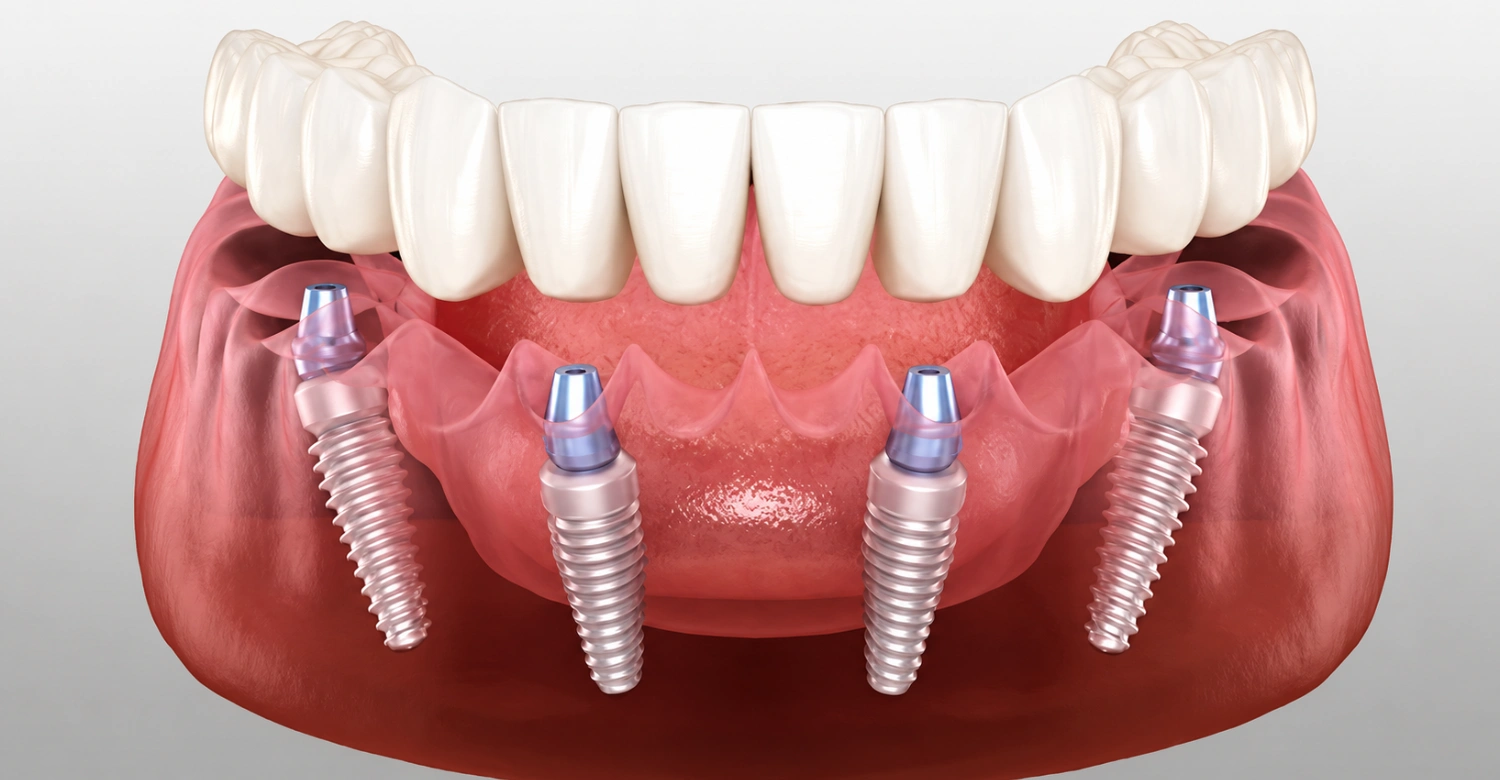
Understanding the 4 implant bridge starts with its fundamental design: four titanium implants placed in the jawbone to anchor a fixed prosthetic restoration. This approach combines the stability of dental implants with the coverage of a bridge. It creates a permanent solution that functions much like natural teeth. The bridge on 4 dental implants can replace several adjacent teeth or an entire upper or lower arch, depending on the patient's needs. Unlike removable partial dentures or traditional bridges, it doesn't rely on adjacent natural teeth for support. The 4 implant bridge stands independently through direct integration with jawbone tissue.
The dental abutment is the connecting piece that attaches the crown or bridge to the implanted fixture. Endosteal implants, placed directly into the jawbone, are the most commonly used type. Posterior implants are typically angled up to 45 degrees. This maximizes contact with available bone while avoiding the sinuses and nerves. It often eliminates the need for bone grafting.
Definition and Purpose
A 4 implant bridge is a fixed dental bridge supported by four implants. It's designed to replace multiple missing teeth or an entire dental arch with a non-removable prosthetic restoration. This treatment addresses significant tooth loss through a permanent solution. It restores function and aesthetics without relying on remaining natural teeth for support. Also known as a 4 tooth implant bridge, it offers superior stability compared to removable prosthetics. It also requires fewer implants than approaches where each missing tooth gets its own implant. The purpose goes beyond simple tooth replacement. It includes preserving jawbone density, maintaining facial structure, and restoring normal oral function that improves nutrition and overall health.
How a Bridge on 4 Dental Implants Works
Four implants are placed strategically in the jawbone. Typically, two go in the anterior region and two in the posterior areas, to optimize load distribution and stability. The bridge attaches to the implants through specialized abutments. These connect the titanium posts to the prosthetic superstructure, creating a rigid, non-removable restoration. The design is engineered for stability, strength, and function. Implant placement is planned to withstand chewing forces while spreading stress evenly across all anchor points. This configuration lets the bridge support comprehensive restorations replacing 10-14 teeth per arch. That's remarkably efficient compared to placing individual implants for each missing tooth.
All on 4 Bridge vs Traditional Dentures: Key Differences
Comparing the all on 4 bridge to traditional dentures reveals stark contrasts. Stability, comfort, maintenance, and long-term outcomes all differ for patients facing complete tooth loss. The term "all on 4 dentures" sometimes appears in searches, but the all on 4 bridge is fundamentally different from removable dentures. Traditional dentures rest on soft tissues and rely on suction and adhesives for retention. This leads to inevitable movement during eating and speaking. All on four dentures, by contrast, actually refer to implant-supported prosthetics. They stay fixed in position through their connection to four dental implants. Understanding these differences helps patients see why the all on 4 investment offers superior value despite higher initial costs.
Stability and Comfort Comparison
Fixed implants provide absolute stability compared to removable dentures. They eliminate the movement, clicking sounds, and insecurity that plague traditional prosthetic wearers. The all on 4 bridge requires no adhesives or daily removal. It functions as an integrated part of the oral cavity throughout all activities. Patients report dramatic comfort improvements after switching from conventional dentures to all on four implants. They note the elimination of pressure sores, tissue irritation, and bulky palate coverage. The implants distribute chewing forces directly to the jawbone rather than compressing soft tissues. This prevents the discomfort and tissue changes that come with long-term denture wear.
Bone Preservation and Oral Health
The all on 4 bridge prevents jawbone loss. It transmits functional forces directly to bone tissue, stimulating the natural remodeling that maintains bone density and volume. Traditional dentures accelerate bone resorption. They rest on soft tissues without providing the stimulation bone needs for maintenance. This bone preservation supports facial structure. It prevents the sunken, aged appearance that develops as alveolar ridges deteriorate under conventional dentures. The all on four bridge also doesn't cover the palate on upper arch restorations. This preserves taste sensation and natural speech patterns. These oral health advantages accumulate over years. The all on 4 investment becomes increasingly valuable with time.
Long-Term Quality of Life
Improved chewing efficiency transforms dietary choices and nutrition for all on 4 bridge patients. They can confidently eat foods that were impossible with traditional dentures. Speech clarity improves dramatically, too. Fixed implants eliminate the bulky materials and movement that interfere with proper tongue positioning. Confidence in social situations soars when patients stop worrying about denture slippage, clicking sounds, or embarrassing moments during meals. The psychological impact extends beyond physical improvements. Studies document enhanced self-esteem, more social engagement, and better overall life satisfaction among recipients. These quality-of-life gains justify the investment for most patients.
Benefits of a 4 Tooth Implant Bridge
The 4 tooth implant bridge delivers advantages that go far beyond basic tooth replacement. It addresses functional, aesthetic, psychological, and long-term oral health concerns at once. Patients get the stability of implant-supported restorations without the extensive surgery and cost of placing individual implants for every missing tooth. The fixed bridge eliminates daily removal rituals, messy adhesives, and the social anxiety that comes with removable prosthetics. It also preserves jawbone density through functional loading. This stimulates natural bone remodeling and prevents the facial structure collapse seen with traditional dentures over time.
Strong and Stable Tooth Replacement
The 4 implant bridge is fixed and not removable by the patient. It offers unmatched stability during daily activities, including eating challenging foods and speaking with confidence. Unlike removable partial dentures, it doesn't shift or move. There's no slipping while eating or speaking, since the bridge is securely anchored to integrated titanium posts. This rock-solid stability transforms the patient experience. It eliminates the frustration and embarrassment that comes with prosthetic movement. The bridge distributes chewing forces directly to the jawbone through the implants. This creates a biomechanically sound restoration that can handle significant functional demands. Patients often say it feels like having their natural teeth back.
Improved Chewing and Speech
The 4 implant bridge restores bite force close to natural tooth levels. Patients can enjoy a varied diet without the restrictions of removable prosthetics or missing teeth. Chewing efficiency improves dramatically. The stable bridge eliminates the movement and discomfort that makes eating difficult with conventional dentures. Speech clarity improves too, since the bridge doesn't cover the palate like upper dentures do. Its fixed nature also prevents the slurring or clicking sounds tied to loose removable appliances. Patients can speak confidently in professional and social settings without worrying about prosthetic movement. Restoring normal oral function affects nutrition, social engagement, and overall quality of life in ways that go far beyond the mouth.
Natural Appearance and Comfort
The 4 implant bridge is designed to look like natural teeth. Prosthetic teeth are carefully selected and arranged to complement each patient's facial features, skin tone, and aesthetic preferences. Modern materials and fabrication techniques create restorations that are nearly indistinguishable from natural teeth in appearance, translucency, and texture. The bridge provides a comfortable fit with proper bite alignment. It eliminates the pressure points, irritation, and bulkiness common with removable partial dentures. Patients adapt quickly, often saying it feels completely natural within days. The combination of strong aesthetics and comfort makes the 4 implant bridge an ideal solution for patients seeking comprehensive tooth replacement.
Types of 4 Implant Bridges
Various configurations exist to fit different clinical scenarios. These range from replacing several adjacent teeth to full arch restorations for complete tooth loss. Understanding the differences between standard designs and premium options like the all on 4 zirconia bridge helps patients make informed decisions. The right bridge type depends on the number of missing teeth, remaining bone structure, aesthetic priorities, budget, and functional needs. Each variation offers advantages suited to particular situations, and modern materials science keeps expanding the options. Consulting an experienced implant dentist helps ensure the optimal configuration for each patient. A 4-implant system is often technically called an All-on-4 bridge in clinical settings.
Standard 4 Implant Bridge
The standard 4 implant bridge is used for replacing multiple adjacent teeth. It offers a cost-effective solution that balances quality, durability, and affordability. This configuration can support partial or full-arch restorations, depending on the extent of tooth loss and the patient's anatomy. Traditional materials include metal frameworks with porcelain-fused-to-metal teeth or composite resin teeth on a titanium bar. These proven materials have decades of clinical success behind them. The standard bridge is an accessible entry point for patients seeking implant-supported tooth replacement without premium materials, though outcomes remain excellent with proper care.
All on 4 Zirconia Bridge
The all on 4 zirconia bridge is a premium full-arch restoration, where a zirconia bridge is supported by four implants. It combines superior aesthetics with exceptional strength and biocompatibility. Zirconia, known for strength and aesthetics, has revolutionized implant dentistry by offering a metal-free alternative that doesn't sacrifice durability. This advanced material has a natural tooth-like appearance, with translucency that mimics natural enamel. That makes the all on 4 zirconia bridge nearly indistinguishable from natural teeth. The monolithic zirconia construction avoids the chipping or delamination that can affect porcelain-layered restorations. Many patients seeking the highest quality solution choose the zirconia option despite its premium price. They value the superior long-term aesthetics and material performance.
Implant-Supported Denture
The implant-supported denture offers a removable or semi-fixed option. Patients can detach it for thorough cleaning, which appeals to those who prefer traditional denture removability with added implant stability. This design gives some patients easier maintenance and simpler cleaning access. It still provides dramatically improved stability over traditional suction-based dentures, even though it costs less than a permanently fixed bridge. However, severe bone loss may still require grafting or consideration of zygomatic implants for upper arch cases.
4 Implant Bridge vs Snap-In / Removable Dentures
The key distinction: fixed bridges are permanent, and only the dentist can remove them. They function much like natural teeth. Snap-in dentures, in contrast, are removable by the patient. Attachment mechanisms like locator abutments or ball attachments allow detachment for cleaning while keeping secure retention during use. Fixed bridges offer higher stability with no micro-movement. Removable designs may show minimal displacement under extreme forces. They also need periodic replacement of retention inserts, usually every 1-2 years, as wear reduces retention force. Removable designs offer easier cleaning access. Fixed bridges eliminate the worry of misplacing or damaging the prosthetic.
Clinical Note: Early cavities frequently cause no pain or visible change. That's why self-checks at home miss them so often. A dental exam with X-rays detects decay between teeth and under the enamel, before it reaches a stage the patient would actually feel.
All on 4 Zirconia Bridge vs Other Materials
Material selection significantly affects the performance, appearance, longevity, and cost of a 4 implant bridge. Understanding the differences between available options matters. The all on 4 zirconia bridge has gained popularity as patients and dentists recognize its advantages over acrylic, composite, and porcelain-fused-to-metal restorations. Conventional materials have served well historically. Advances in ceramic technology have positioned zirconia as the premium choice for patients prioritizing aesthetics, durability, and biocompatibility. Comparing zirconia implants to alternatives helps patients make informed decisions aligned with their priorities, budget, and long-term goals. Each material suits different clinical situations and patient preferences.
What Is a Zirconia Implant Bridge?
A zirconia implant bridge is built from high-strength ceramic material. It combines exceptional durability with outstanding aesthetics, representing the latest evolution in dental prosthetic technology. This advanced ceramic is metal-free and biocompatible. It eliminates concerns about metal allergies, galvanic reactions, or the grayish shadowing metal frameworks can create near the gumline. Zirconia has strength comparable to metal while keeping the natural translucency and color of tooth enamel. That makes it ideal for the all on 4 zirconia bridge. The material resists wear, staining, and plaque accumulation better than traditional options, which supports long-term success. Manufacturing uses CAD/CAM technology for a precise fit and optimal aesthetics in every fabrication.
Zirconia vs Acrylic or Porcelain Bridges
The all on 4 zirconia bridge shows higher durability and wear resistance than acrylic or hybrid composite alternatives. It maintains its appearance and function for decades rather than needing replacement every 5-10 years. Acrylic and composite materials cost less initially, but they're more prone to staining, wear, and fracture under the forces of chewing. Zirconia offers better long-term aesthetics, since it doesn't discolor like acrylic and avoids the chipping that affects porcelain layered over metal. It maintains its original appearance throughout its lifespan with minimal maintenance. The initial investment is higher, but a zirconia bridge often proves more economical long-term by avoiding premature replacement.
Advantages of All on 4 Zirconia Implants
All on 4 zirconia implants offer natural tooth color that can be customized to match adjacent teeth or create an ideal aesthetic for complete arch restorations. The material's translucency, and its ability to be shaded throughout its thickness, creates lifelike restorations that blend seamlessly with the patient's smile. These premium restorations suit patients who prioritize aesthetics, longevity, and biocompatibility over cost. Zirconia also resists bacterial adhesion better than other materials. That may reduce peri-implantitis risk and promote better long-term implant health. Its strength allows more conservative bridge designs with natural contours, which are easier to clean than bulkier alternatives.
Step-by-Step Procedure for a 4 Implant Bridge
The bridge on 4 dental implants procedure follows a carefully planned sequence. It's designed to maximize success and give patients predictable outcomes and manageable timelines. Understanding each phase helps patients prepare and set realistic expectations. Modern digital planning has refined the placement process, improving precision while reducing surgical time and discomfort. Most patients complete implant placement in a single appointment. The full treatment timeline still extends several months, to allow proper healing before the final restoration. The staged approach delivers both immediate satisfaction, through provisional restorations, and long-term success through proper implant integration.
Initial Consultation and Treatment Planning
Assessment begins with an oral exam and 3D imaging using cone beam computed tomography (CBCT). This evaluates bone quality, quantity, anatomical structures, and optimal implant positions. Bone quality and bite relationships inform the treatment plan. They also identify any procedures needed before implant placement, like extractions or minor bone augmentation. Digital planning software allows virtual placement of the four implants with submillimeter precision. It accounts for prosthetic requirements and ensures the final bridge will function well. This planning phase typically includes diagnostic wax-ups or digital smile designs showing expected outcomes. The consultation ends with a detailed timeline and cost estimate. The stability of the arch relies entirely on the strategic placement of the four implants.
Implant Placement Surgery
Four implants are placed in the jawbone according to the pre-surgical digital plan. Positioning is optimized for load distribution, aesthetic outcomes, and biomechanical efficiency. The procedure uses local anesthesia or sedation, depending on patient preference and anxiety levels. Most patients choose conscious sedation for comfort during the 2-3 hour surgery. Computer-guided placement, using customized surgical guides from planning data, enhances surgical precision. If necessary, failing teeth are extracted the same day, with implants placed into fresh extraction sockets or adjacent bone sites. This minimally invasive approach reduces tissue trauma and promotes faster healing than traditional extensive surgery.
Temporary Bridge Placement
A temporary bridge may go in the same day as implant placement, when initial stability and bone quality allow immediate loading. This provisional restoration restores appearance and function right away. Patients can smile confidently and eat soft foods while healing progresses over the following months. The immediate temporary bridge prevents the psychological distress of an edentulous period. It also maintains soft tissue architecture around the implants. Fabrication happens either same-day using digital workflows, or beforehand based on planning data. Most patients are surprised by how natural and functional their temporary bridge feels.
Final Bridge Placement
The permanent bridge goes in after healing, typically 3-6 months post-surgery, once osseointegration is complete and implant stability is confirmed. Final bite and aesthetics get adjusted at this appointment, incorporating feedback from the temporary phase. The definitive bridge uses premium materials chosen during planning, whether standard composite, porcelain-fused-to-metal, or zirconia. Precision fit is verified through careful inspection and adjustment before final cementation or screw retention. Most patients say their final bridge feels completely natural within days.
Recovery After 4 Implant Bridge Surgery
Recovery progresses through predictable stages. Most patients experience minimal disruption to daily routines when they follow proper post-operative protocols. Understanding what to expect helps patients recognize normal healing versus complications that need attention. Modern surgical techniques, better pain management, and immediate provisional restorations have dramatically improved the patient experience. Individual healing varies based on the extent of surgery, bone quality, and general health. Still, most patients report an easier recovery than they expected. Proper aftercare during the first weeks sets the foundation for long-term success. Patients should understand the difference between temporary and permanent prosthetics during the healing phase.
Short-Term Recovery
Mild swelling and discomfort peak 2-3 days after placement, then progressively ease over the first week with medication and home care. Soft food recommendations restrict patients to foods needing minimal chewing, like smoothies, soups, mashed vegetables, scrambled eggs, and yogurt. Cold compresses on the face during the first 48 hours minimize swelling. Prescribed pain medications and antibiotics prevent discomfort and infection around the surgical sites. Most patients manage well with over-the-counter pain relievers after the first few days. Many resume work within 2-4 days, depending on job requirements. Careful oral hygiene, using prescribed antimicrobial rinses, protects the implant sites while avoiding direct brushing of surgical areas during the first week.
Long-Term Healing and Osseointegration
Implants fuse with bone through osseointegration, a biological process that unfolds gradually over 3-6 months as bone cells colonize the titanium surface. Follow-up appointments monitor healing progress, check implant stability, and adjust the temporary bridge as needed. During integration, patients function normally with their provisional restoration while gradually expanding their diet. Complete osseointegration creates a permanent biological bond between the implant foundation and surrounding bone. This establishes the stability needed for long-term success. Most patients forget about the healing process, enjoying their temporary restoration until it's time for the final bridge.
Maintenance of a 4 Implant Bridge
Wear and Adjustment Needs
Even a well-functioning bridge needs periodic professional maintenance. This addresses normal wear, bite changes, and material fatigue over years of use. Fixed bridges may develop minor component loosening, requiring screw tightening or occasional replacement of retention screws that fatigue over time.
How to Keep Your 4 Implant Bridge in Good Condition
Keeping the bridge in excellent condition requires daily cleaning. This includes flossing under the bridge with specialized threaders or interdental brushes, and using a water irrigator to reach areas manual cleaning can't. Regular checkups every 3-6 months let your dentist monitor implant health, prosthetic condition, and bite relationships.
4 Post Dental Implants vs Other Implant Systems
Comparing 4 post dental implants to alternative approaches helps patients understand the advantages of different implant-supported strategies. The four-post system is one methodology among several for addressing complete tooth loss. Each has distinct characteristics around surgical complexity, cost, and outcomes. Understanding how it compares to single-tooth implants and other full-arch systems like All on 4 supports informed decision-making.
Four Post Dental Implants vs Single Implants
The four post dental implants system provides full arch restoration. Single implants, by contrast, replace one tooth at a time. These are fundamentally different approaches to extensive tooth loss. Efficiency and cost strongly favor the four-post approach for patients missing entire arches. Placing 10-14 individual implants would dramatically increase surgical time, cost, and recovery complexity. Single implants work well for replacing one or a few isolated missing teeth where adjacent teeth are healthy. They become impractical for complete arch situations, where the four-post approach offers better value.
Who Is a Good Candidate for a 4 Implant Bridge?
Ideal candidates have multiple missing teeth and want a permanent, fixed alternative to removable partial dentures or traditional tooth-supported bridges. The bridge accommodates various clinical situations, from replacing several adjacent teeth to full arch restoration for complete tooth loss. Good oral and systemic health improves candidacy, though many medical conditions are manageable with the right protocols and medical clearance. Adequate bone volume and density at the implant sites is necessary. Still, the strategic four-implant design often allows treatment even with moderate bone loss that would complicate traditional implant approaches. A thorough evaluation by an experienced implant dentist determines candidacy based on individual anatomy and health.
Snap-in dentures cost can vary based on the number of implants needed and the materials used. Removable implant-retained options exist for patients who want some detachability. Fixed bridges provide the ultimate stability, convenience, and natural feel of truly permanent teeth that most patients seeking this treatment want.
Patients with Multiple Missing Teeth
The 4 implant bridge is ideal for partial or full tooth loss affecting multiple adjacent teeth or an entire arch. Patients unhappy with removable dentures often find the fixed stability transformative. It eliminates the daily inconvenience and social anxiety of removable prosthetics. Patients facing extraction of multiple failing teeth, from decay, periodontal disease, or structural damage, often benefit more from a comprehensive bridge than from trying to save compromised teeth. Even younger patients who lost teeth to trauma or congenital conditions appreciate the long-term value and natural function, compared to repeated conventional treatments over a lifetime.
Patients Seeking a Fixed Solution
Patients who prefer non-removable teeth find the 4 implant bridge well suited to a permanent restoration that functions like natural dentition. Candidates with adequate bone or minimal grafting needs qualify for straightforward treatment. The strategic four-implant placement maximizes available bone. The bridge appeals to patients frustrated with removable partials: difficulty eating certain foods, speech interference, and the daily hassle of removal and cleaning. Patients prioritizing long-term oral health benefit from the bone preservation it offers. This prevents the progressive resorption seen with tooth-supported bridges and removable prosthetics. The fixed nature suits active lifestyles and professional demands where prosthetic reliability isn't negotiable.
Cost of a 4 Implant Bridge: What to Expect
The 4 implant bridge cost is a significant investment in oral health, function, and quality of life. Pricing depends on materials, complexity, and geographic location. Understanding the financial side helps patients plan and make informed decisions about materials and timing. The initial expense exceeds conventional options like removable partials or traditional bridges. Still, the long-term value becomes clear when you factor in durability, lower maintenance, and prevention of future dental problems. Most practices offer financing that makes the bridge accessible through manageable monthly payments. International dental tourism destinations offer substantial savings while maintaining quality, making premium treatments like the zirconia bridge more affordable. Many patients ask if they can wear dentures while implants heal, before receiving their final bridge.
Average Cost Range
The 4 implant bridge typically costs $15,000 to $35,000, depending on materials and complexity. Partial arch restorations sit at the lower end; full arch zirconia bridges command premium pricing. Material selection significantly affects total cost. Zirconia versus non-zirconia bridges differ by $5,000-$10,000, due to the ceramic's superior properties and more complex fabrication. Standard bridges using conventional materials offer excellent value for budget-conscious patients. Those prioritizing ultimate aesthetics and longevity may invest in the zirconia option. Geographic location matters too: major metropolitan and coastal areas charge more than suburban or rural practices. International treatment, particularly in countries like Turkey, offers 50-70% savings while using identical implant systems and materials as Western clinics.
Factors That Affect the Cost
Implant brand influences price. Premium manufacturers like Nobel Biocare, Straumann, and Zimmer Biomet charge more than budget alternatives, though quality differences often justify the premium. Bridge material selection, whether zirconia, porcelain, or acrylic, dramatically affects cost. The zirconia bridge represents the highest investment, due to material costs and advanced fabrication. Clinic expertise and dentist experience also affect pricing. Seasoned practitioners typically charge more but deliver superior outcomes. Additional cost factors include pre-surgical CT imaging, surgical guide fabrication, extractions or bone grafting, sedation choice, and whether immediate provisional restoration is included. Premium facility amenities and comprehensive aftercare programs also contribute to price variation.
Cost vs Long-Term Value
The 4 implant bridge is durable. It often functions well for 15-20+ years before needing significant intervention, and proper maintenance extends that even further. Patients need fewer future dental treatments than with alternatives like tooth-supported bridges, which stress abutment teeth and often lead to their eventual loss. Amortized over its functional lifespan, the cost often proves comparable to, or better than, the cumulative cost of maintaining conventional prosthetics that need regular adjustments, relines, and eventual replacement. The value extends beyond finances: better nutrition from improved chewing, more confidence socially and professionally, and prevention of bone loss complications. Most recipients say the investment was worthwhile based on quality-of-life improvements alone.
Common Risks and Complications of 4 Implant Bridges
The 4 implant bridge has a high success rate, exceeding 95% in properly selected patients. Still, understanding potential risks and complications supports informed consent and early problem recognition. Most adverse outcomes are preventable through careful patient selection, meticulous surgical technique, proper material selection, and diligent post-operative care. Decades of clinical history have identified risk factors and developed strategies to minimize complications. Choosing an experienced implant dentist, trained specifically in implant-supported prosthetics, significantly reduces complication risk across all treatment phases. Patients who follow aftercare instructions and keep up with professional monitoring see excellent long-term outcomes.
Implant or Bridge Failure
Implant failure, meaning loss of osseointegration, affects roughly 2-4% of properly placed implants. It's most often due to inadequate bone quality, infection, or excessive early loading before complete integration. Causes include compromised health factors like uncontrolled diabetes or smoking, inadequate oral hygiene leading to peri-implantitis, or biomechanical overload from improper bridge design. Prevention strategies include thorough patient screening, meticulous surgical technique, appropriate healing periods, and patient education about oral hygiene. Bridge fracture or loosening occasionally occurs, particularly with lower-quality materials or inadequate framework design. Modern zirconia bridge restorations resist fracture exceptionally well. Early detection through regular monitoring allows intervention before minor issues progress to complete failure.
Bite or Fit Issues
Occlusal problems or prosthetic design issues occasionally emerge after bridge delivery. They can cause discomfort, uneven wear, or functional limitations while chewing. Precise planning during the diagnostic and design phases matters a great deal, since errors in implant position or prosthetic design can create bite discrepancies. Adjustments are often needed after placement, to optimize how the bridge contacts opposing teeth as patients adapt over the first weeks. Poor fit between the bridge and implant abutments can lead to screw loosening, microgaps, and eventually peri-implantitis, threatening implant survival. Most bite issues resolve through straightforward adjustments at follow-up appointments, though significant problems may rarely require a bridge remake.
How to Reduce Risks
Choosing an experienced implant dentist, trained specifically in this procedure, is the most critical factor in minimizing complications. Practitioners who regularly perform this procedure develop refined clinical judgment, efficient surgical skills, and better aesthetic results. Regular checkups allow early detection of problems before they become serious. Meticulous oral hygiene around the bridge prevents the bacterial buildup that leads to peri-implantitis, the leading cause of late implant failure. Patients should avoid smoking, maintain good glycemic control if diabetic, and follow all post-operative instructions to maximize longevity.
Not Suitable for Every Patient
This procedure relies on just four implants to support an entire arch. That requires a certain level of jawbone density and quality. Patients with severe bone loss may not be ideal candidates. They might need additional procedures, such as bone grafting, which increases both cost and treatment time.
Uneven Pressure Distribution
Since only four implants support a full arch, chewing forces can concentrate on specific points. Over time, this may stress the implants or prosthetic components. That raises the risk of wear, loosening, or even implant failure.
Adaptation and Comfort Issues
Some patients need time to adjust to the new feeling in the mouth. Some initially struggle with speaking or chewing comfortably, especially if the prosthesis isn't perfectly adjusted.
Cost as a Consideration
The 4 implant bridge is generally more affordable than placing individual implants for every missing tooth. It remains, however, a significant financial investment compared to traditional dentures.
Tips for Patients
Use a toothpaste with 1,450 ppm fluoride. After brushing, spit rather than rinse with water, so the fluoride stays on the teeth longer. If you snack on something sugary, have it with a meal instead of spreading sweets across the day. It's the frequency of acid attacks, not the total amount, that drives a cavity.
Why Choose Vitrin Clinic for a 4 Implant Bridge
Vitrin Clinic is a premier destination for patients seeking exceptional 4 implant bridge treatment. It combines clinical expertise with patient-centered care in a modern, fully-equipped facility. Our commitment to excellence reflects decades of combined specialist experience and thousands of successful cases. International patients choose Vitrin Clinic for significant cost savings, typically 50-70% less than Western countries, without compromising quality, materials, or care standards. Every part of the experience, from initial consultation through long-term maintenance, is designed to exceed expectations. Our specialists' expertise, advanced technology, transparent communication, and comprehensive aftercare set Vitrin Clinic apart in implant dentistry.
Expert Implant Dentists
Our team includes implant specialists trained specifically in implant bridges, with advanced certification in full arch rehabilitation and complex implant-supported restorations. Success rates exceeding 97% across thousands of completed cases reflect the clinical expertise and attention to detail our practitioners bring to every treatment. Each specialist stays active in continuing education, regularly attending international conferences and advanced training to stay current with evolving best practices. This commitment ensures patients receive treatment informed by the latest scientific evidence and technical innovation. Our dentists' experience spans straightforward cases to complex situations requiring simultaneous extractions, bone augmentation, or compromised anatomy.
Advanced Technology and Materials
Vitrin Clinic uses cutting-edge digital planning and guided surgery technology. This improves precision during placement while minimizing surgical trauma and recovery time. Our digital workflow includes high-resolution CBCT imaging, intraoral scanning, and planning software that allows virtual implant positioning with submillimeter accuracy before surgery. Premium zirconia bridge options reflect our commitment to offering the highest quality materials available, fabricated with advanced CAD/CAM milling for superior fit, aesthetics, and longevity. Surgical guides made from digital planning data ensure implants are placed exactly as designed, eliminating guesswork and reducing procedure duration. This technology-driven approach improves outcomes, shortens surgical time, and enables more predictable immediate loading of provisional prosthetics.
Transparent Pricing and Ongoing Care
Vitrin Clinic provides clear treatment plans with detailed cost breakdowns. This eliminates surprise charges and allows confident financial planning from the first consultation. Our all-inclusive pricing typically covers surgical implant placement, abutments, temporary and final bridge fabrication, follow-up appointments during integration, and necessary adjustments. Long-term aftercare support extends beyond treatment completion. Our team stays available to answer questions or address concerns throughout the lifespan of your restoration. International patients get comprehensive coordination assistance, including accommodation recommendations, airport transfers, translation services, and English-speaking support staff. The combination of value, premium materials, and unwavering support makes Vitrin Clinic the ideal choice for your treatment.
Key Takeaways About the 4 Implant Bridge
The benefits include superior stability, restored chewing function, natural appearance, bone preservation, and dramatic quality-of-life improvements over removable alternatives. The procedure requires strategic placement of four implants, often with immediate provisional prosthetics providing instant function during healing. Material selection significantly affects aesthetics and longevity, with the zirconia bridge as the premium option for patients prioritizing ultimate quality and durability. Recovery progresses quickly. Most patients resume normal activities within days and enjoy a near-normal diet within weeks. The 4 tooth implant bridge is a reliable alternative to removable dentures, with proven long-term success rates exceeding 95% in properly treated patients.
Schedule Your 4 Implant Bridge Consultation at Vitrin Clinic
Contact Vitrin Clinic today to schedule your consultation for a 4 implant bridge. Discover how we can restore your smile, confidence, and oral function. Our experienced specialists will evaluate your situation, answer your questions about the process, and develop a personalized treatment plan for your needs and goals. We provide detailed information about expected outcomes, treatment timeline, material options including the premium zirconia bridge, and transparent cost estimates with no hidden fees. International patients get complete support services, making travel for treatment convenient, comfortable, and stress-free from inquiry through final restoration delivery. Don't let missing teeth limit your life. Discover how our expertise and commitment to excellence can transform your oral health and overall wellbeing.
What Are the Real Risks and Complications of All-on-4?
All-on-4 is one of the most extensively studied full-arch implant protocols in dentistry. Clinical data spans more than two decades. That track record is reassuring, but it doesn't mean the procedure is risk-free. Being upfront about what can go wrong, and how often, is part of real informed consent.
Peri-implantitis. Inflammation and progressive bone loss around an implant, driven by bacterial plaque buildup at the gum line. It's the leading cause of late implant failure. It's also largely preventable with consistent hygiene and professional maintenance.
Mechanical complications. Screw loosening, prosthetic chipping, or fracture of the bridge material happen more often than implant loss itself. This is especially true for patients who grind their teeth or haven't been fitted with a night guard. These are usually repairable without removing the implants.
Early implant failure. This occurs within the first few months, before osseointegration completes. It's usually linked to poor primary stability at placement, infection, or excessive load on a healing implant. It's uncommon in properly planned cases.
Nerve or sinus involvement. All-on-4 uses tilted posterior implants to avoid the sinus cavity and the mandibular nerve canal. So the risk here is lower than with some traditional implant layouts, though it isn't zero, especially with atypical anatomy. This is why 3D CBCT imaging and digital surgical planning matter so much.
Bite and prosthetic misfit. A prosthesis that doesn't distribute chewing forces evenly across all four implants can overload specific anchor points. That accelerates wear or loosening over time.
The honest summary: most All-on-4 complications are manageable, and many are preventable through careful case selection, hygiene, and follow-up. A high success rate is a statistic about populations, not a guarantee for any one patient.
Implant Survival Rate vs. Prosthetic Survival Rate: What's the Difference?
These two numbers get used interchangeably in marketing, but they measure different things.
Implant survival rate measures whether the titanium implant itself remains fused to bone and functional in the jaw. Published long-term data on All-on-4 generally reports implant survival rates in the 94-98% range at 5-10+ years of follow-up.
Prosthetic survival rate measures whether the bridge, the visible teeth and framework attached to the implants, remains in service without needing replacement. Bridges can need repair, reline, or remake due to chipping, wear, or material fatigue, even when every underlying implant is perfectly healthy.
In practical terms: an implant can survive for 15+ years while the prosthesis attached to it gets remade once or twice in that time from normal wear. Ask your provider for both numbers when comparing treatment options, not just one blended "success rate."
What Happens If an Implant Fails? (The Recovery Path)
Implant failure isn't the dead end it's sometimes made out to be. The typical path looks like this:
Diagnosis - Mobility, persistent pain, or bone loss around a specific implant is identified, usually during a routine check-up.
Removal - The failed implant is removed under local anesthesia, a far less involved procedure than the original placement surgery.
Healing and assessment - The site heals for roughly 2-4 months, sometimes longer if grafting is needed to rebuild bone volume.
Replacement or redesign - A new implant is often placed in the same or an adjacent position, without redesigning the whole bridge. If bone volume doesn't allow a straightforward replacement, a graft or a different implant angulation may be proposed.
Prosthetic reattachment - Once the new implant is stable, the existing bridge can usually be adjusted and reattached rather than remade from scratch.
A single implant failure is, in the vast majority of cases, a localized and treatable event, not the same as the whole treatment failing. Regular follow-up visits are what keep this recovery path short.
All-on-4 vs. Traditional Implants: A Safety Comparison
Factor | All-on-4 | Traditional Implants (6-8+ per arch) |
Number of surgical sites | 4 | 6-8, sometimes more |
Bone grafting needs | Often avoided via tilted posterior implants | More frequently required, especially in the posterior jaw |
Surgical time / invasiveness | Shorter, generally less invasive | Longer, more surgical sites |
Load per implant | Higher (fewer implants sharing full arch forces) | Lower (forces spread across more implants) |
Redundancy if one implant fails | Lower — losing 1 of 4 is a bigger proportional loss | Higher — losing 1 of 6-8 is easier to compensate for |
Track record | Extensive, 20+ years of published outcomes | Extensive, decades longer overall implant history |
Typical cost | Lower (fewer implants, less grafting) | Higher (more implants, more grafting) |
Neither approach is universally safer; they carry different trade-offs. All-on-4 reduces surgical burden and grafting needs, but it places more functional demand on each implant, with less redundancy if one fails. Traditional multi-implant approaches spread load more conservatively, but involve more surgery and often more grafting. The right choice depends on bone quality, bite forces, and how a patient's mouth is built. That's why this decision belongs in a real consultation.
How Experienced Should My Surgeon Be?
Experience is one of the strongest predictors of outcome in full-arch implant dentistry. Worth asking any clinic:
Case volume with this exact protocol. All-on-4 planning is a distinct skill from single-tooth implant placement. Ask how many full-arch cases the surgeon has personally completed, not just how many years they've practiced dentistry overall.
Training and credentials. Look for formal training in full-arch rehabilitation or guided implant surgery, with documented continuing education in the specific protocol offered.
Digital planning capability. Surgeons who routinely use CBCT imaging and computer-guided surgical planning tend to have more predictable outcomes, since implant position is verified before the patient is ever in the chair.
How they handle complications, not just how they describe successes. A surgeon who can explain how they've managed a failed implant or a bite issue is often more trustworthy than one who claims a flawless record.
What Does Recovery and Aftercare Really Involve?
Weeks 1-2: Soft-food diet, prescribed antimicrobial rinses, cold compresses for swelling, and avoiding smoking or alcohol, both of which measurably slow healing.
Weeks 2-6: Gradually reintroducing firmer foods as swelling resolves, while still avoiding anything hard, crunchy, or sticky that could disturb the healing implant sites.
Months 2-6: The osseointegration window. There's often little to feel day-to-day, but this is exactly when follow-up visits matter most, checking implant stability and the bite for early signs of overload.
Ongoing, for life: Daily cleaning under the bridge with floss threaders, interdental brushes, or a water flosser (a standard toothbrush alone can't clean under a fixed bridge), plus professional cleanings every 3-6 months. This ongoing maintenance is the single biggest controllable factor in long-term survival. Most late failures trace back to inconsistent hygiene, not the implant hardware itself.
A night guard is worth discussing if there's any history of teeth grinding, since bruxism is one of the more common preventable causes of prosthetic wear and screw loosening.
The Biological Foundation of Full-Arch Stability
An All-on-4 bridge only holds up long-term if the biology underneath it holds up first. Two things decide that. One is how well the implant surface fuses to bone. The other is how evenly four implants share the daily forces of chewing. Both are measurable. That's why full-arch planning goes far beyond simply placing four posts in the jaw.
Osseointegration Dynamics and Bone-to-Implant Contact (BIC) Percentages
Bone to implant contact (BIC) is the percentage of an implant's surface in direct contact with living bone, not soft tissue. Higher BIC generally means stronger anchorage. It also means a lower risk of early failure. Modern endosteal implant anchorage relies on surface treatments like sandblasting and acid-etching. These treatments increase micro-roughness, which helps bone cells attach faster. BIC itself isn't visible chairside, so clinicians instead use implant stability quotient (ISQ) readings during healing as a practical stand-in.
Biomechanical Load Distribution: The Physics of Tilted Posterior Implants
Tilting the two posterior implants up to 45 degrees isn't a shortcut. It's a deliberate approach to biomechanical stress distribution. Angulation lets the implant engage a longer column of bone, and it shortens the cantilever behind it. Forces then travel along the implant's long axis instead of at a shearing angle, which reduces bending load on any single anchor point. Poor angulation does the opposite: it concentrates stress unevenly, a known contributor to screw loosening and localized bone loss.
Surgical Modifications and Advanced Protocols
Not every patient has straightforward anatomy, and not every case should follow the same loading timeline. Two decisions shape the surgical plan more than any others: how much usable bone is actually present, and whether the provisional bridge can go on the same day.
Managing Severe Maxillary Atrophy: When to Consider Zygomatic Implants
When upper jawbone volume has resorbed too far, standard implants can't achieve adequate anchorage. Zygomatic implants for full arch cases offer an alternative. These longer implants anchor into the dense zygomatic (cheekbone) bone instead of the atrophied maxilla, which often bypasses the need for extensive grafting. Maxillary atrophy rehabilitation with this method is more surgically demanding. It's generally reserved for patients already told bone grafting is their only remaining option, and it requires a surgeon with specific zygomatic training, not general implant experience alone.
Immediate Loading vs. Delayed Loading Protocols in Full-Arch Rehabilitation
An immediate loading protocol attaches a temporary bridge the same day as surgery. This is only possible when primary stability is high enough. Delayed loading instead leaves implants undisturbed, or lightly loaded, for several months first. Immediate loading gives patients same-day function and avoids a toothless healing period, but it depends heavily on bone density and torque values at placement. Delayed loading is the more conservative choice in lower-density bone or complex grafted cases.
Prosthetic Component Interplay and Complication Management
The implants are only half of the system. Small connector components between the implant and the bridge decide whether the final restoration fits and survives.
Dual-Axis Control: The Role of Multi-Unit Abutments in Correcting Angulation
Multi-unit abutments sit between a tilted implant and the prosthetic bridge. Unlike orthodontics, which repositions natural teeth gradually, multi-unit abutments correct implant angulation permanently at the point of connection. Their job is dual-axis control: they correct divergent implant angles into one shared, parallel path. This lets a bridge seat passively over four implants placed at different angles. Without accurate multi-unit abutment selection, even a well-placed implant can leave a bridge that won't seat cleanly. That mismatch is a common cause of screw loosening and micro-gaps.
Distal Cantilever Lengths and Their Impact on Structural Integrity
The distal cantilever is the part of the bridge extending backward past the last implant, unsupported underneath. A longer distal cantilever adds more leverage on the posterior implant with every bite on that side. That raises the risk of screw loosening, framework fracture, or implant overload. Most full-arch protocols cap cantilever length against the anterior-posterior spread of the four implants a ratio measured during planning, not decided later at the lab.
What We Notice Clinically
"In my experience, the patients who do best with All-on-4 aren't just the ones with good bone quality they're the ones who understand the maintenance commitment before they ever sit in the chair," says Dr. Rifat Alsaman, Head of the Medical Team at Vitrin Clinic and a cosmetic dentist. "Most of the complications we see clinically trace back to two things: inconsistent hygiene around the bridge, and untreated grinding habits that overload the prosthesis. Both are preventable."
Dr. Rifat Alsaman also notes that digital planning has changed what clinicians can predict before surgery even begins: "With CBCT imaging, we're no longer guessing at bone density or nerve position. We can see the exact case in front of us and plan implant angulation around it, rather than around a generic average patient."
On the question of surgeon experience, Dr. Rifat Alsaman is direct: "Full-arch cases are not an extension of single-implant skills; they're a different discipline. At Vitrin Clinic, every All-on-4 case goes through the same digital-planning and risk-assessment process, because consistency is what protects long-term outcomes, not any single surgery."
This clinical perspective from Dr. Rifat Alsaman, Head of the Medical Team at Vitrin Clinic, reflects what the Vitrin Clinic team sees across real patient cases, not just what the published literature reports.
About Vitrin Clinic
Vitrin Clinic is a cosmetic dental clinic based in Istanbul, Turkey. It treats international patients from across Europe, the Middle East, and beyond. The clinic's Head of the Medical Team, Dr. Rifat Alsaman, a cosmetic dentist, oversees treatment planning and clinical standards across the practice, including full-arch cases like the All-on-4 bridge. Vitrin Clinic combines digital implant planning, CBCT-guided surgery, and in-house prosthetic fabrication. Support for international patients runs from first consultation through follow-up care after they return home.
References
FAQs
Dr. Rifat Alsaman has more than 5 years of clinical experience in dentistry and currently serves as the Head of the Medical Team at Vitrin Clinic. He is dedicated to providing exceptional patient care, overseeing treatment planning, and ensuring the highest clinical standards across the team. His expertise, attention to detail, and commitment to continuous professional development have helped countless patients achieve healthier, more confident smiles.


