Dental Implant
January 4, 2026
Endosteal Implants: What They Are, How They Work, and What They Cost
 Dr. Rifat Alsaman
An Endosteal Implants is a titanium post surgically placed directly into the jawbone to replace a missing tooth root. It's the most widely used type of dental implant, and for good reason: because it anchors inside the bone itself rather than resting on top of it, it fuses with surrounding bone tissue over several months in a process called osseointegration — creating a foundation strong enough to support a crown, bridge, or denture permanently.
This guide walks through what makes this implant type different from the alternative (subperiosteal implants), what the procedure and recovery actually involve, realistic cost figures, and the risks worth understanding before committing to treatment.
What Is an Endosteal Implant and How Does It Work?
The word "endosteal" comes from a Greek root meaning "within the bone" — a direct description of how it's placed. Rather than sitting on or above the jawbone, the post is inserted into a precisely drilled channel inside the bone itself, where it becomes a replacement for the natural tooth root.
Endosteal Pronunciation and Meaning
If you're wondering about endosteal pronunciation, it is commonly pronounced “en-DOS-tee-ul”. The term comes from a Greek root meaning “within the bone,” which describes exactly where this type of dental implant is placed. Rather than sitting on or above the jawbone, the implant post is inserted into a precisely prepared channel inside the bone, where it eventually integrates with the surrounding tissue through osseointegration.
Definition and Design
Most implants of this type are cylindrical or tapered, screw-shaped, and made of titanium or a titanium alloy — a material chosen specifically because it's biocompatible and rarely triggers rejection by the body. They come in a range of diameters and lengths so a dentist can match the implant to the available bone and the position of the tooth being replaced, whether that's a front tooth requiring precise aesthetics or a molar bearing heavier chewing forces.
Because bone quality and anatomy vary so much from one patient — and even one tooth position — to another, no single implant size fits every case. Digital planning software now lets clinicians select and virtually place the right implant before ever picking up a drill.
How It Functions
Once placed, the post takes over the biomechanical role the natural tooth root used to play: absorbing and distributing the forces of chewing into the jawbone. A small connector called an abutment is attached to the top of the implant and protrudes just above the gumline; this is what a crown, bridge, or denture is ultimately secured to.
A single implant can support one individual crown. Several implants, spaced strategically, can anchor a fixed bridge spanning multiple missing teeth, or provide stable attachment points for a full denture in patients who've lost most or all of their teeth. This adaptability — from single-tooth replacement to full-arch rehabilitation — is one of the main reasons this implant type dominates modern practice.
Osseointegration: Why It Lasts
The defining biological event in implant treatment is osseointegration — the process by which bone cells grow directly onto the titanium surface and fuse with it at a cellular level. This typically takes three to six months, during which no symptoms are usually felt; the bonding happens quietly beneath the gum.
Once complete, the resulting connection is, in a mechanical sense, at least as strong as the original bond between a natural tooth and its socket. This is the fundamental difference between an implant and a removable prosthetic: one is fused to living bone, the other simply sits on top of the gum.
Not every situation allows for a scheduled, unhurried treatment plan. If you're dealing with a broken or failed implant and need guidance on timing, it's worth understanding when a situation calls for an emergency dental implant consultation rather than a routine appointment.
Endosteal Implant vs. Subperiosteal Implant: Key Differences
Dental implants fall into two broad categories, and understanding the difference helps explain why one has become the default choice for the overwhelming majority of patients.
Placement method. An implant of this type is inserted directly into the jawbone through a drilled channel. A subperiosteal implant, by contrast, uses a custom metal framework that rests on top of the bone, beneath the gum tissue, with posts protruding through the gum to hold the prosthetic. It never actually integrates into the bone the way an endosteal design does.
Bone requirements. Traditionally, sufficient bone height and width were prerequisites for placing an implant in the bone. Patients with significant bone loss — often from years of missing teeth, periodontal disease, or age — sometimes didn't qualify without additional surgery. Subperiosteal implants were developed largely to serve this group, since they don't depend on adequate bone volume in the same way.
Where things stand today. Bone grafting, ridge augmentation, and sinus lift procedures have advanced enough that the majority of patients who once would have been steered toward a subperiosteal implant can now receive a standard implant instead, with grafting used to build up the missing bone first. As a result, subperiosteal implants have become uncommon; they're reserved for a narrow set of legacy or highly complex cases where grafting isn't feasible or desired.
Longevity and outcomes. Because it fuses with living bone, this implant type has a stronger long-term track record — multiple decades of published clinical follow-up support success rates that are widely reported in the 90–95%+ range when placed by an experienced surgeon in a suitable candidate. Subperiosteal implants, lacking true bone integration, have historically shown less predictable long-term performance, which is a major reason dentistry has moved away from them.
Advantages Over Other Tooth-Replacement Options
Compared with a fixed bridge or a removable denture, an implant placed in the bone offers several structural advantages that aren't matched by either alternative:
It preserves jawbone density by continuing to transmit chewing forces into the bone, something a denture or bridge cannot do.
It doesn't require reshaping or grinding down the teeth on either side, unlike a traditional bridge.
With proper care, the implant itself often remains stable for decades; only the crown on top typically needs replacement, usually after 10–15 years of wear.
Full-arch cases — where a patient needs most or all teeth replaced — use the same underlying technology at scale. If that's closer to your situation, full mouth dental implants explain how multiple implants can support an entire arch of fixed teeth.
Step-by-Step Endosteal Implant Procedure
Treatment unfolds in stages over several months. Individual appointments are generally brief and well-tolerated, even though the overall timeline is long.
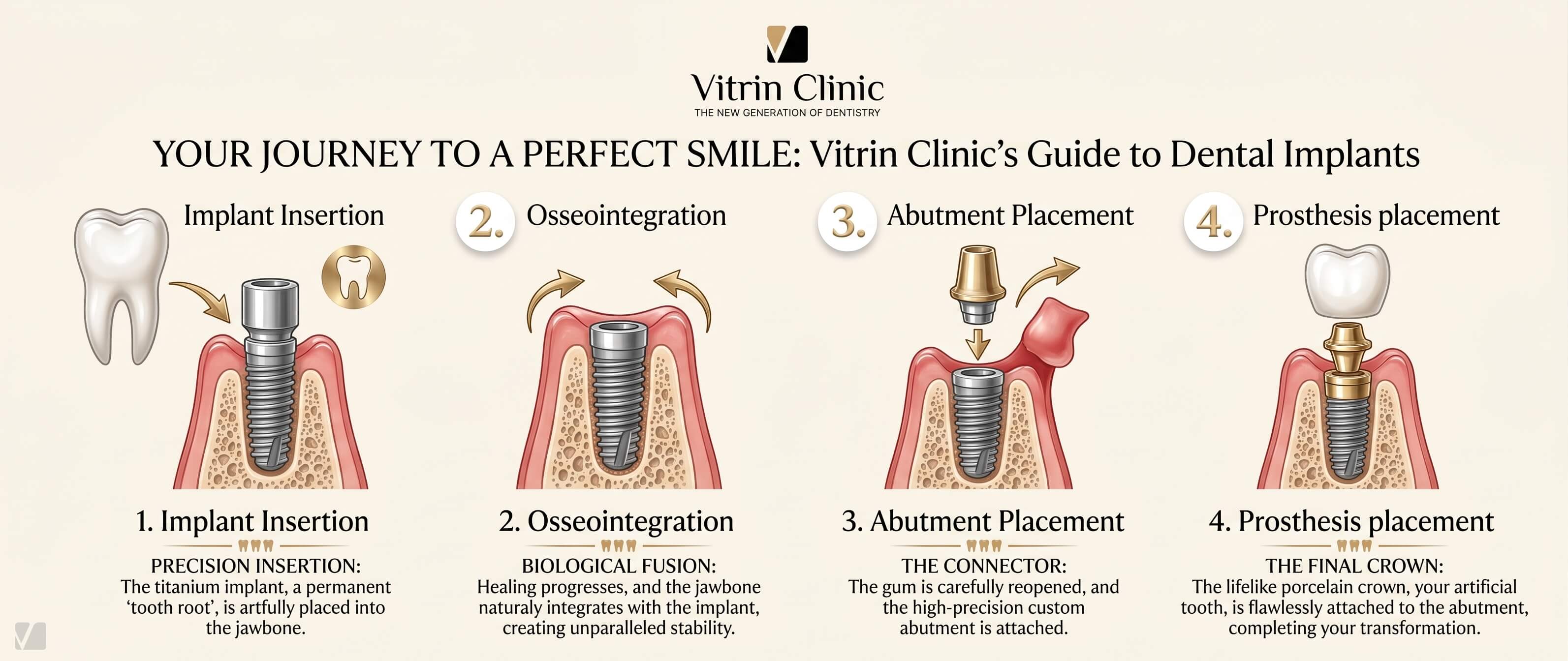
1. Initial Consultation and Assessment
Treatment starts with a full evaluation of oral health, medical history, medications, and treatment goals. X-rays and 3D CT imaging reveal how much bone is available, where nerves and sinuses sit, and whether any preparatory work is needed before an implant can be placed. Digital planning software then allows the dentist to virtually position the implant — depth, angle, and exact location — before any surgery happens, and to give a realistic timeline and cost estimate covering every phase of treatment.
2. Tooth Extraction and Bone Preparation (If Needed)
If a damaged tooth is being replaced, extraction usually comes first. In some cases the implant can be placed the same day as the extraction; in others, the site needs time to heal before implant surgery. Where the jawbone lacks sufficient volume, bone grafting adds the material needed to support the implant later, typically requiring three to six months to integrate. Sinus lift procedures serve a similar purpose in the upper back jaw, where the sinus cavity often limits available bone height.
It's worth reading up on possible dental implant complications at this stage, before surgery, so you know what warning signs to watch for during healing rather than after something has already gone wrong.
3. Implant Placement Surgery
Under local anesthesia, the dentist makes a small incision to expose the bone, then uses specialized drills to create a precise channel matching the treatment plan. The implant is threaded or pressed into place, and the gum tissue is closed over or around it depending on the surgical approach. The procedure itself usually takes 30–60 minutes per implant, and most patients report pressure rather than pain thanks to effective anesthesia.
Before finishing, the dentist checks primary stability — how firmly the implant sits in the bone immediately after placement. In select cases with excellent primary stability, a temporary crown can go on the same day; far more commonly, the implant is left undisturbed to heal for three to six months while osseointegration converts that initial mechanical grip into permanent biological fusion.
4. Abutment and Crown Placement
Once integration is confirmed — usually with a follow-up X-ray — the abutment is attached, and impressions are taken to fabricate a custom crown matched to the surrounding teeth in color, shape, and contour. The final crown is secured to the abutment, the bite is checked and adjusted, and any last refinements are made so the restoration feels natural rather than "off."
Benefits of Endosteal Implants for Tooth Replacement
Natural Look and Function
Because the implant is anchored directly in bone, it delivers the same stability as a natural tooth root, allowing normal eating, speaking, and smiling without the slippage or clicking sometimes associated with removable dentures. Custom crowns are color- and shape-matched closely enough that, in most cases, the restoration is not noticeably different from the surrounding teeth.
If preserving healthy adjacent teeth matters more to you than the cost difference, it's worth comparing this option against an adhesive bridge, a more conservative alternative that avoids implant surgery but comes with its own trade-offs in longevity.
Long-Term Durability
The titanium used in modern implants is highly biocompatible and corrosion-resistant. Once osseointegration is complete, published long-term follow-up studies commonly report success rates in the 90–95%+ range, even decades after placement, with most complications — when they do occur — showing up within the first year. Many patients treated decades ago are still functioning well on their original implants; typically only the crown needs replacement after a decade or more of wear, not the implant itself.
Preservation of Jawbone
Natural tooth roots stimulate the jawbone every time you bite down, which is part of what keeps that bone dense over time. Once a tooth is lost, that stimulation disappears and the bone begins to resorb — research on post-extraction bone loss suggests roughly a quarter of bone width can be lost within the first year alone. An implant restores this mechanical stimulation and helps prevent that resorption, which is why replacing a missing tooth with an implant soon after extraction is generally recommended over waiting.
Endosteal Implant Recovery: What to Expect
Recovery happens in two very different phases.
Immediate Post-Operative Care (First Week)
Expect mild to moderate swelling, peaking around day two or three, and possibly some bruising. Discomfort is usually well controlled with prescribed or over-the-counter pain medication. Ice packs during the first 24 hours help limit swelling. Soft foods are recommended for the first few days, avoiding direct chewing near the surgical site, and hot liquids, alcohol, and smoking should be avoided while the site is healing. Most patients return to normal daily activity within two to three days, though strenuous exercise is usually best avoided for about a week.
Long-Term Healing (Three to Six Months)
This is the osseointegration phase — bone gradually fusing to the implant surface, occurring without any noticeable symptoms. Lower-jaw implants typically integrate faster, in around three to four months, since the bone there tends to be denser; upper-jaw implants usually need five to six months. Smoking, poorly controlled diabetes, and inadequate oral hygiene are the main factors known to slow or compromise this process. Regular follow-up appointments, sometimes with X-rays, confirm that integration is progressing normally before moving on to the restoration phase.
Top Reasons Dentists Recommend This Implant Type
Decades of clinical research and real-world use have established endosteal implants as the default recommendation for most tooth-loss situations, for a few consistent reasons:
Broad suitability. From a single missing front tooth to a full-arch reconstruction, the same underlying implant technology adapts to virtually any clinical scenario, and patients across a wide age range are typically good candidates, including many with a history of bone loss once grafting is factored in.
High, well-documented success rates. Long-term studies tracking patients for many years consistently report sustained success rates in the 90–95%+ range, a reliability that stems from titanium's biocompatibility with bone and decades of refinement in implant surface design and surgical protocol.
Restoration flexibility. A single implant can carry an individual crown; several can anchor a fixed bridge; and a strategically placed set can stabilize a full denture — meaning the same core approach scales to whatever the situation requires, without needing to compromise on stability at any point along that spectrum.
Endosteal Implant Cost: A Full Breakdown
Cost is usually the deciding factor once a patient has decided implants are the right treatment path, so it deserves more than a passing mention.
Average Cost Range
A single, complete implant — covering surgical placement, the abutment, and the final crown — typically runs $3,000 to $6,000 USD in Western Europe and North America. Multiple-implant cases, such as bridges or full-arch restorations, scale up from that baseline, though an implant-supported bridge can often replace several teeth using fewer implants than one-per-tooth, which reduces the overall per-tooth cost.
At Vitrin Clinic, the same standard of treatment — including internationally recognized implant systems and the equivalent scope of care — typically costs 60–70% less than these Western figures. The gap reflects differences in operating costs and cost of living in Istanbul relative to Western Europe or North America, not a reduction in the materials or clinical standards used.
What Actually Drives the Final Price
Several variables determine what any individual patient will actually pay, which is why online price ranges are only ever a starting point:
Surgeon experience. More experienced specialists often charge higher fees, generally reflecting a track record of predictable outcomes.
Implant brand and system. Premium systems from established manufacturers, with decades of published research behind them, typically cost more than budget alternatives — but also tend to have stronger long-term data supporting their reliability.
Preparatory procedures. Bone grafting, sinus lifts, or extractions needed before implant placement add to the total and should be itemized separately in any quote.
Number of implants and restoration type. A single crown, a multi-unit bridge, and a full-arch fixed restoration represent very different scopes of treatment and cost accordingly.
Geographic location. The same procedure, performed to the same clinical standard, costs meaningfully more in a major Western city than in Istanbul — a gap sometimes referred to as geographic arbitrage in medical tourism.
Cost vs. Long-Term Value
A bridge may look less expensive upfront, but bridges typically need replacement every 10–15 years, and dentures need relining or replacement every 5–7 years — each with an ongoing cost that an implant, once integrated, generally avoids. An implant that lasts 20–25+ years, with only the crown occasionally needing replacement, tends to work out as the lower lifetime cost once those repeated replacement cycles are factored in — on top of the bone-preservation benefit that neither a bridge nor a denture provides.
Because bone volume, the number of teeth involved, and any preparatory work all vary by patient, an exact price can only come from a consultation with imaging — general ranges online can't substitute for that.
Endosteal Implant Complications and How to Prevent Them
Success rates are high, but understanding what can go wrong — and why — helps patients catch problems early rather than after they've become serious.
Common Complications
Peri-implantitis is the most frequent issue: an inflammatory condition resembling gum disease that affects the tissue around an implant and, left untreated, can progress to bone loss around it.
Infection can occur during initial healing or, less commonly, develop years later. Warning signs include pain, swelling, pus discharge, or a persistent bad taste; caught early, infections generally respond well to antibiotics and improved hygiene, though chronic cases sometimes require removal and later replacement.
Implant loosening indicates either failed osseointegration (if it happens early) or advanced bone loss from untreated peri-implantitis or excessive biting force (if it happens years later). A properly integrated implant should never feel loose or move when touched — any mobility is a reason to see a dentist promptly.
Mechanical issues, such as abutment loosening or crown fracture, and nerve involvement near the surgical site are both uncommon but possible, which is part of why precise 3D imaging before surgery matters.
Reported failure rates across the published literature generally sit below 5% when treatment is performed by an experienced clinician in an appropriately selected patient.
Prevention Strategies
Proper surgical planning. Comprehensive 3D imaging and digital surgical guides let the dentist avoid nerves, sinuses, and other anatomical structures, and position the implant exactly as planned rather than relying on estimation during surgery.
Consistent oral hygiene. Daily brushing and flossing around the implant, ideally with soft-bristled brushes and non-abrasive toothpaste, plus interdental brushes or a water flosser, prevents the bacterial buildup that leads to peri-implantitis. Antimicrobial rinses can supplement — not replace — mechanical cleaning.
Regular professional checkups. Examinations roughly every six months, with periodic X-rays, catch inflammation, bone loss, or mechanical issues early, when they're far easier to manage conservatively rather than after significant damage has occurred.
Why Choose Vitrin Clinic for Endosteal Implants
Vitrin Clinic has been practicing dentistry in Istanbul since 2007, and holds an average rating above 4.5 out of 5 on Trustpilot from verified patient reviews — a track record that's worth checking independently rather than taking on faith from any clinic's own marketing.
Every implant case begins with 3D cone-beam CT imaging and digital treatment planning, using implant systems from established international manufacturers — the same category of systems used in Western clinics. Custom surgical guides derived from that planning are used to position each implant precisely, and every patient receives a written, itemized cost estimate before treatment begins, covering the implant, abutment, crown, and any preparatory work, so nothing is a surprise partway through.
If you'd like a treatment plan and cost estimate specific to your own bone structure and number of missing teeth, book a free consultation to get imaging-based numbers rather than a general estimate.
Key Takeaways
An endosteal implant is a titanium post placed directly into the jawbone to replace a missing tooth root, fusing with bone through osseointegration over three to six months before supporting a crown, bridge, or denture. It has become the default choice in modern implant dentistry because of its strong, well-documented long-term success rates, its ability to preserve jawbone density, and its versatility — from single-tooth replacement to full-arch rehabilitation. Complications are uncommon and largely preventable with an experienced surgeon and consistent oral hygiene, and while the upfront cost is higher than a bridge or denture, the multi-decade lifespan of a well-placed implant generally makes it the better long-term value.
FAQs
Dr. Rifat Alsaman has more than 5 years of clinical experience in dentistry and currently serves as the Head of the Medical Team at Vitrin Clinic. He is dedicated to providing exceptional patient care, overseeing treatment planning, and ensuring the highest clinical standards across the team. His expertise, attention to detail, and commitment to continuous professional development have helped countless patients achieve healthier, more confident smiles.


