Dental Implant
July 11, 2025
All on 4 Dental Implants in Turkey: Cost, Procedure &Why Choosing Vitrin Clinic ?
 Dr. Rifat Alsaman

All on 4 Dental Implants in Turkey offer a fixed full-arch replacement for patients who have lost most or all of their teeth. The technique uses four strategically positioned implants to support a complete upper or lower dental arch. In selected cases, angled posterior implants can make better use of available bone and reduce the need for extensive grafting.
For international patients, treatment costs are an important consideration. However, the final price depends on more than the number of implants. Implant systems, prosthetic materials, temporary teeth, surgical complexity, and additional procedures can all affect the quotation.
At Vitrin Clinic in Istanbul, treatment plans are based on each patient's oral condition, bone structure, and restorative needs. This guide explores the procedure, costs, implant options, recovery, and what to consider before travelling for treatment.
Key Takeaways
All on 4 Dental Implants in Turkey replace a full dental arch using four strategically positioned implants.
Vitrin Clinic's published starting price is $2,000 per arch or $4,000 for both arches.
The final cost depends on implant systems, restoration materials, and additional procedures.
Implant brands available at Vitrin Clinic include Straumann, Nobel Biocare, BEGO, and Neodent.
Temporary fixed teeth may be provided shortly after surgery when clinically suitable.
Permanent teeth are generally fitted after sufficient implant healing.
A clinical examination is necessary to confirm suitability and treatment requirements.
Ready to transform your smile?
Talk to our team and get a personal FREE treatment plan.
What Is the All on 4 Treatment Concept?
All on 4 Dental Implants in Turkey is a full-arch rehabilitation approach that uses four strategically positioned dental implants to support a fixed set of replacement teeth. It can be considered for patients who have lost most or all teeth in the upper or lower jaw, or whose remaining teeth cannot be predictably maintained.
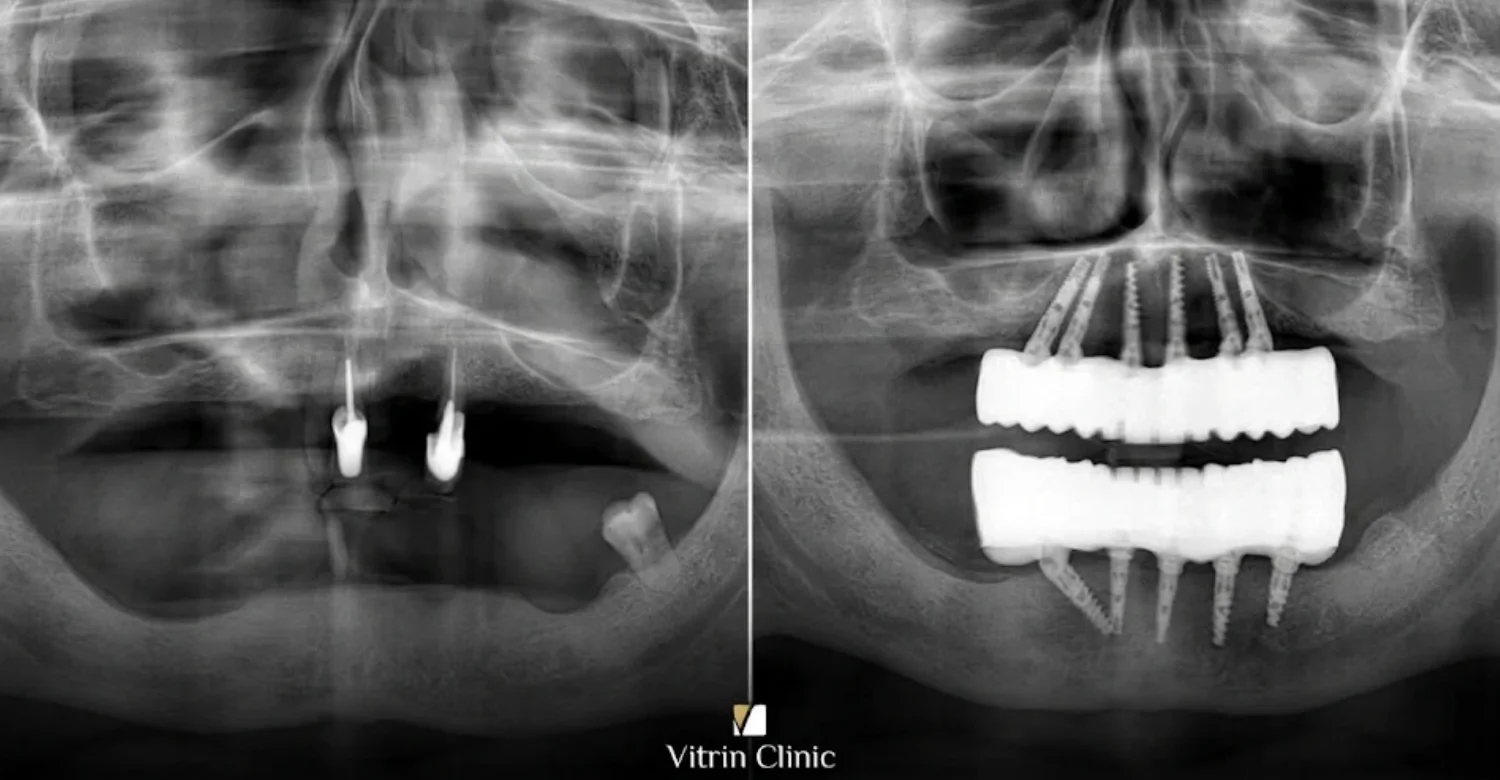
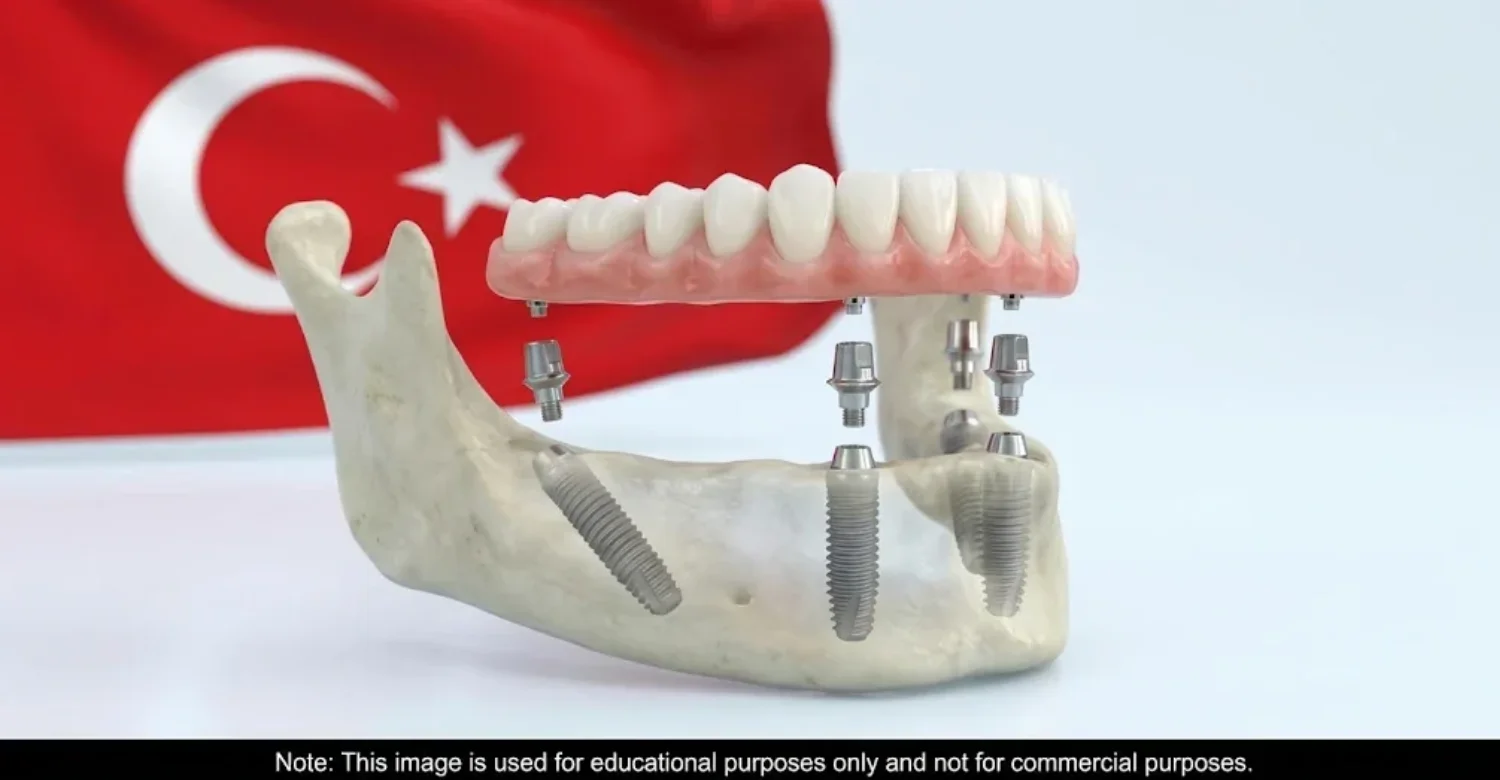
The treatment usually involves placing two implants towards the front of the jaw and two towards the back. The posterior implants may be angled to make better use of the available bone and accommodate important anatomical structures. This positioning can help provide support across the dental arch while potentially reducing the need for extensive bone grafting in selected cases.
How Does the All on 4 Restoration Work?
The four implants act as anchors for a connected full-arch prosthesis. Rather than replacing every missing tooth with an individual implant, the dentist distributes the support across these strategically planned positions.
Once the implants have been placed, the restoration is attached through prosthetic components designed for the selected implant system. The bridge replaces the visible teeth and is intended to remain fixed during everyday activities such as eating and speaking.
Unlike conventional removable dentures, patients do not take the bridge out for daily cleaning. However, the area underneath the restoration still requires careful cleaning to prevent plaque accumulation and inflammation around the implants.
Can Patients Receive Fixed Teeth Immediately?
Some patients may receive a fixed temporary bridge shortly after implant surgery. This approach is known as immediate loading or immediate provisionalisation.
However, receiving temporary teeth immediately is not automatic. The implants must achieve adequate primary stability, and other factors must support safe loading. These include bone quality, implant positioning, bite forces, and the patient's ability to follow post-operative instructions.
If these conditions are not met, the dentist may recommend allowing the implants to heal before attaching a fixed restoration.
Is All on 4 Dental Implants in Turkey an Implant Brand?
No. All on 4 Dental Implants in Turkey are a treatment concept, not a specific implant manufacturer or implant model. Different manufacturers offer implant systems and prosthetic components that may be used in full-arch rehabilitation.
The exact system depends on the patient's anatomy and the clinical plan. Patients should confirm the implant manufacturer, model, connection type, and compatible prosthetic components before treatment.
Why Choose All on 4 Dental Implants in Turkey?
Turkey offers more affordable full-arch implant treatment, access to established implant systems, personalised treatment planning, and coordinated support for international patients.
Why Choose Vitrin Clinic for All on 4 Dental Implants in Turkey Treatment?
Vitrin Clinic offers individual treatment planning, multiple implant system options, digital diagnostic technology, and support for international patients. All on 4 treatments start from $2,000 per arch, depending on clinical needs and the final treatment plan.
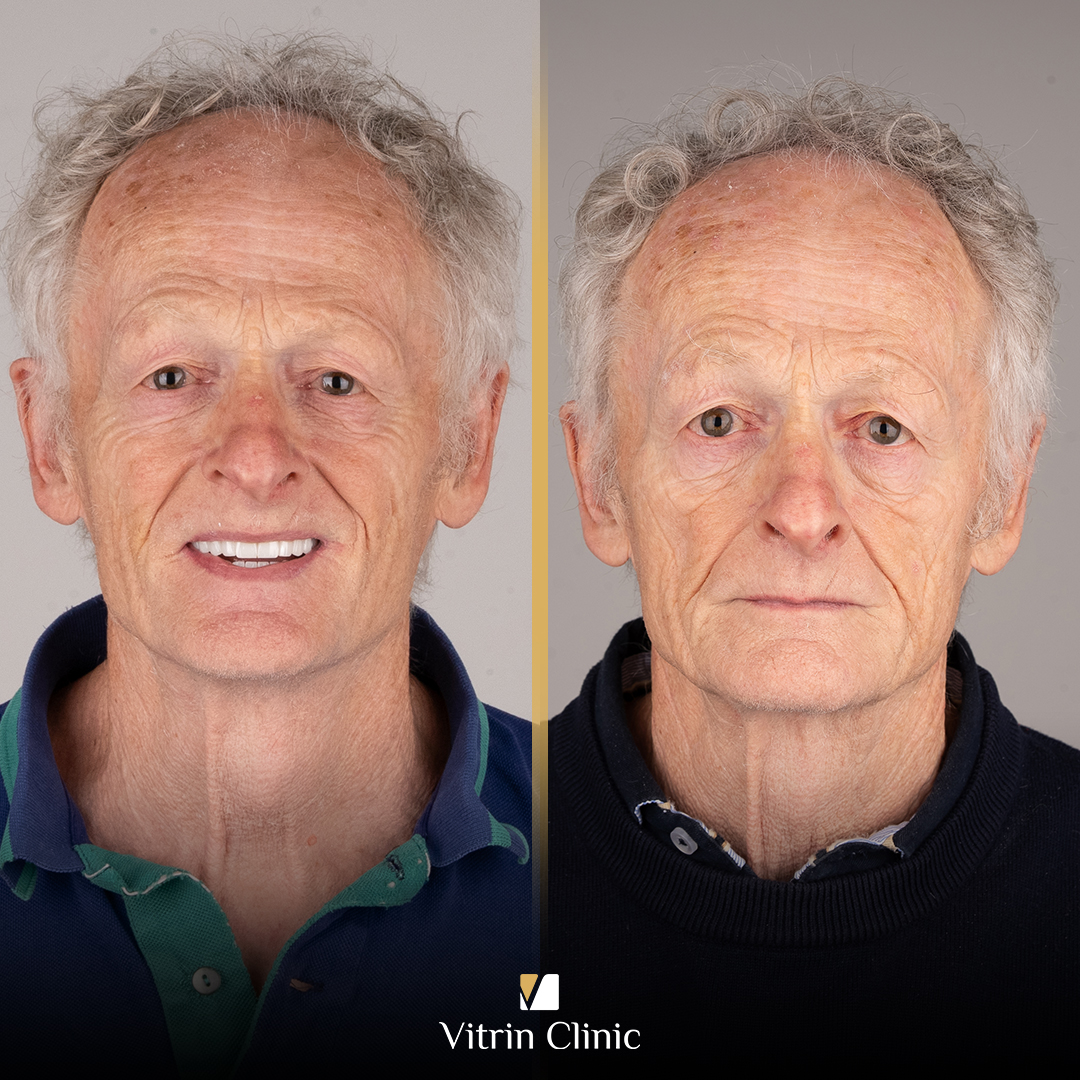
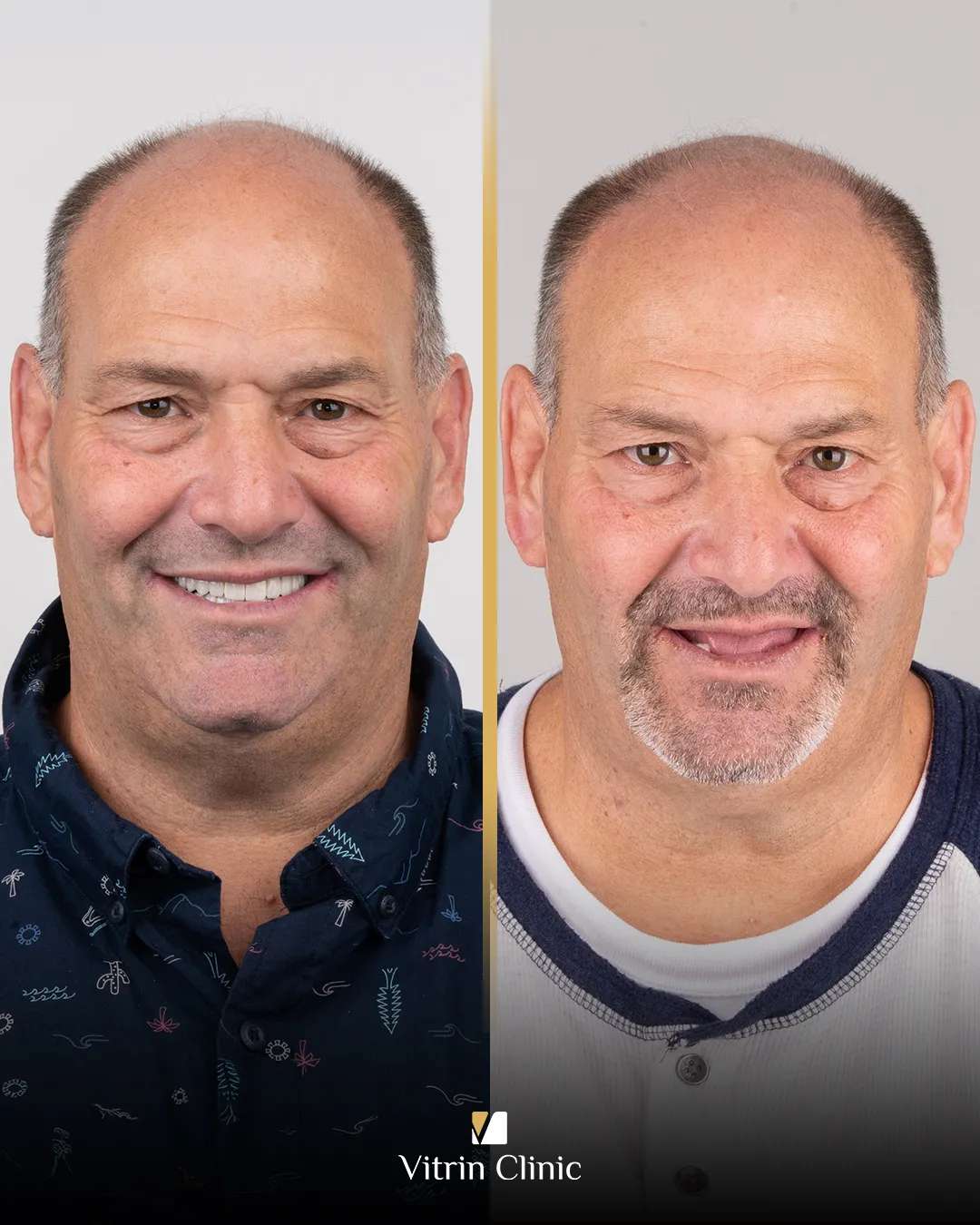
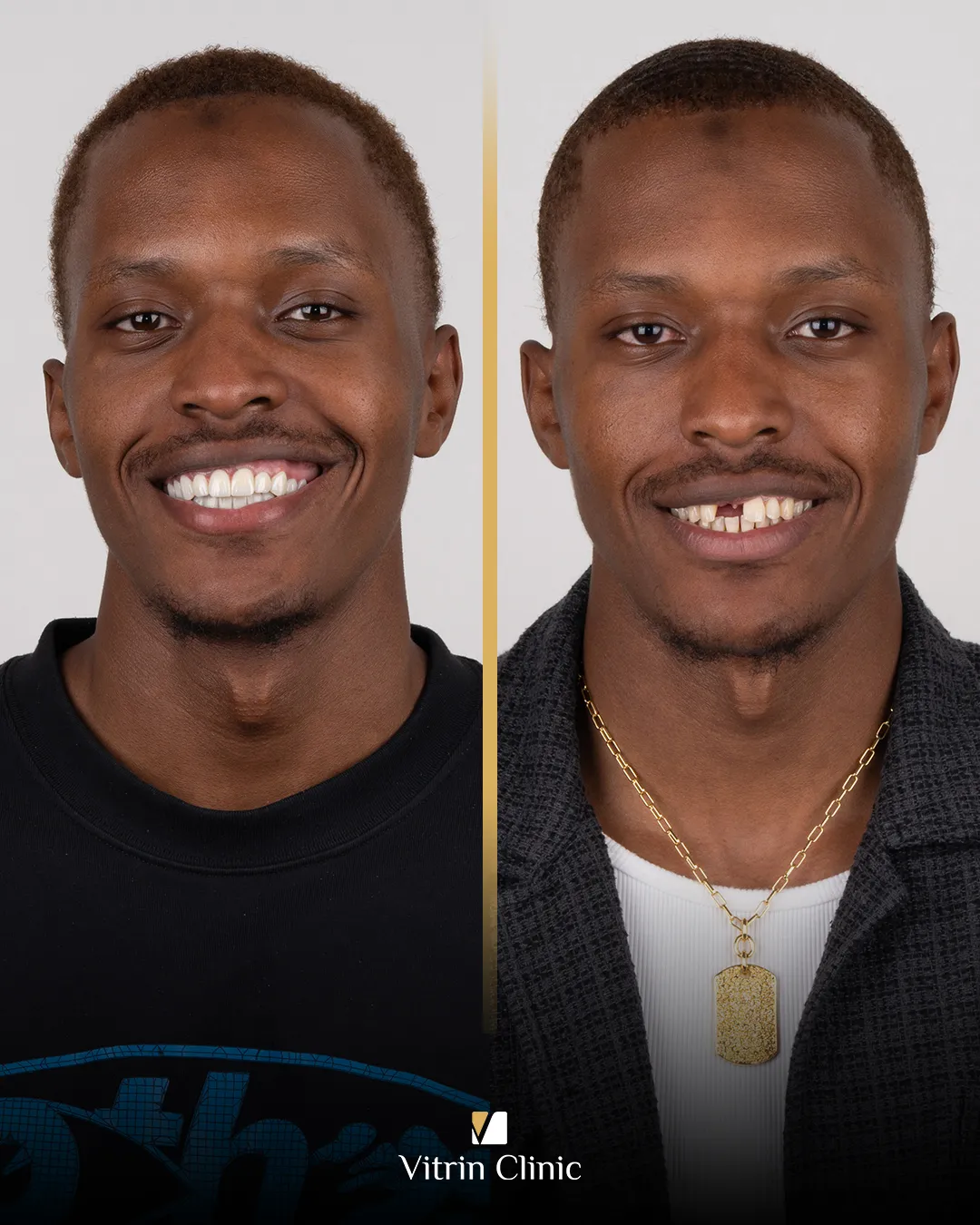
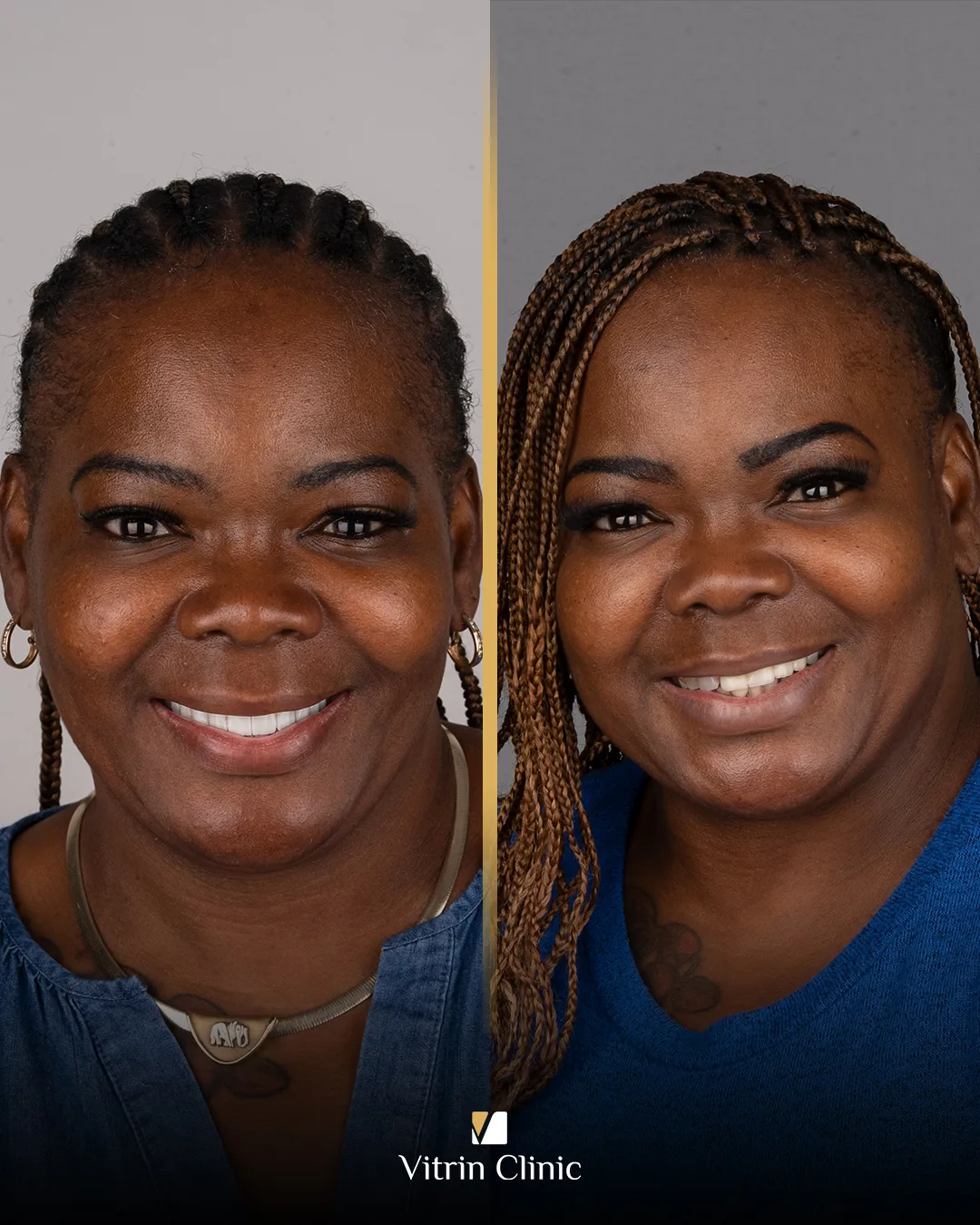
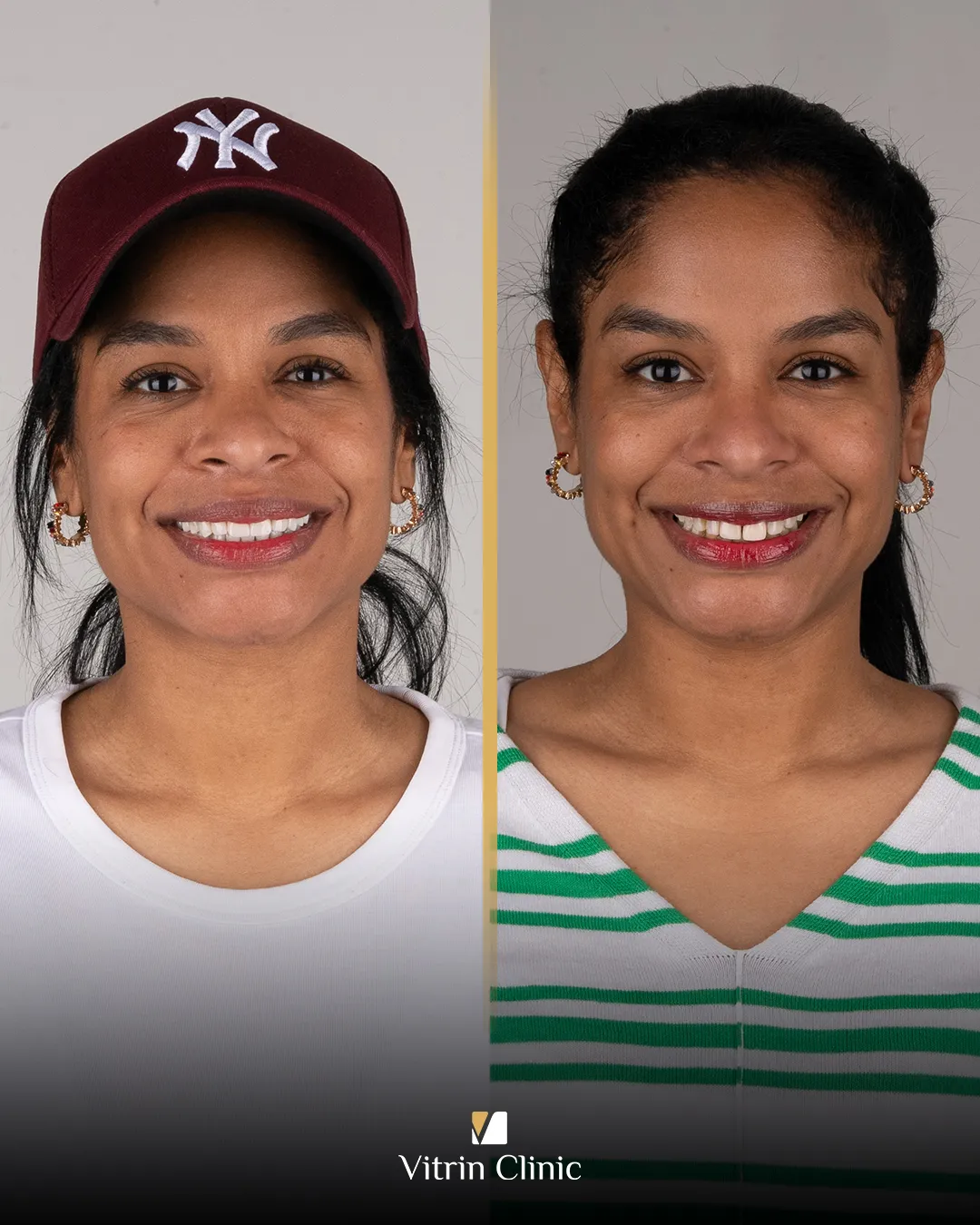
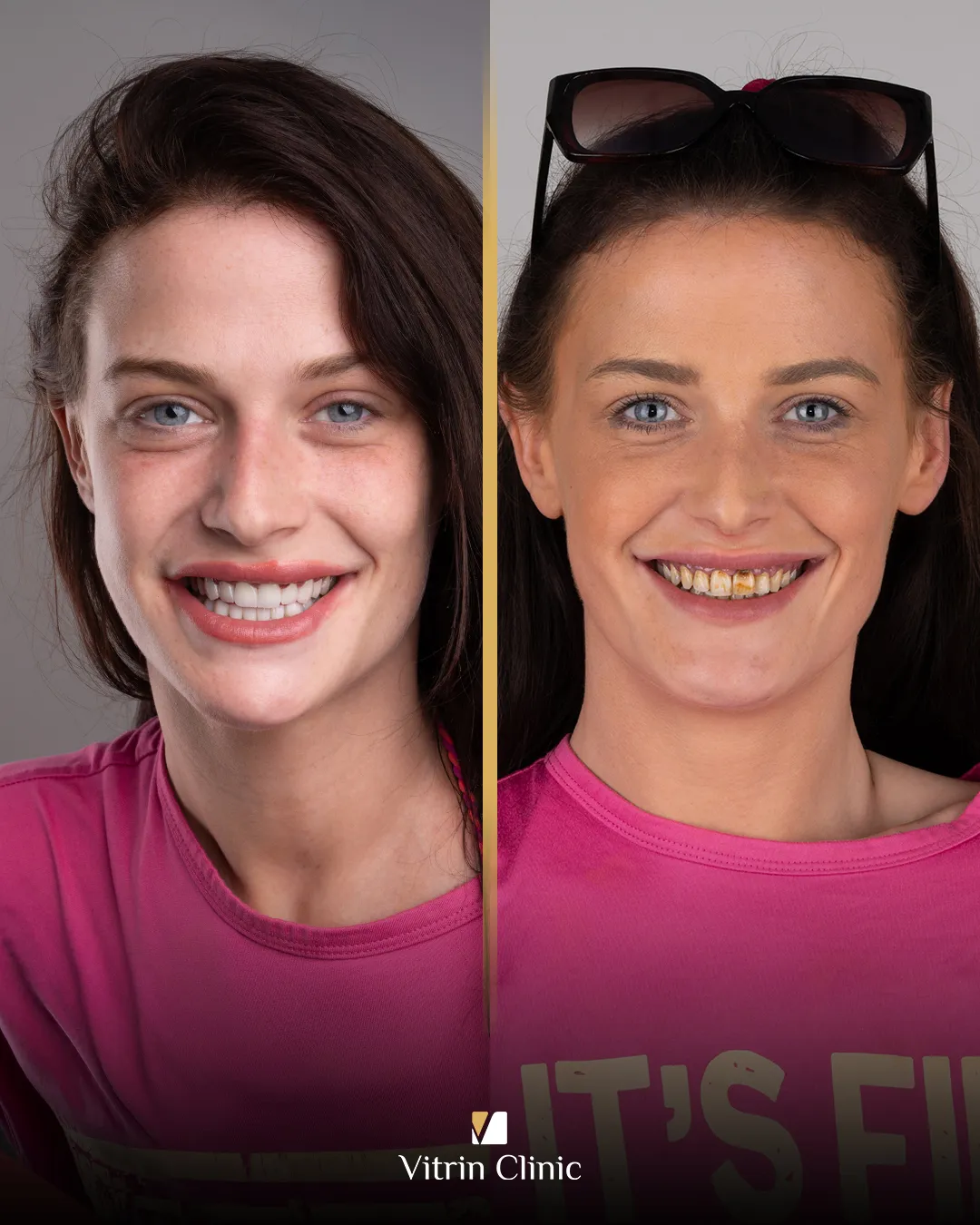
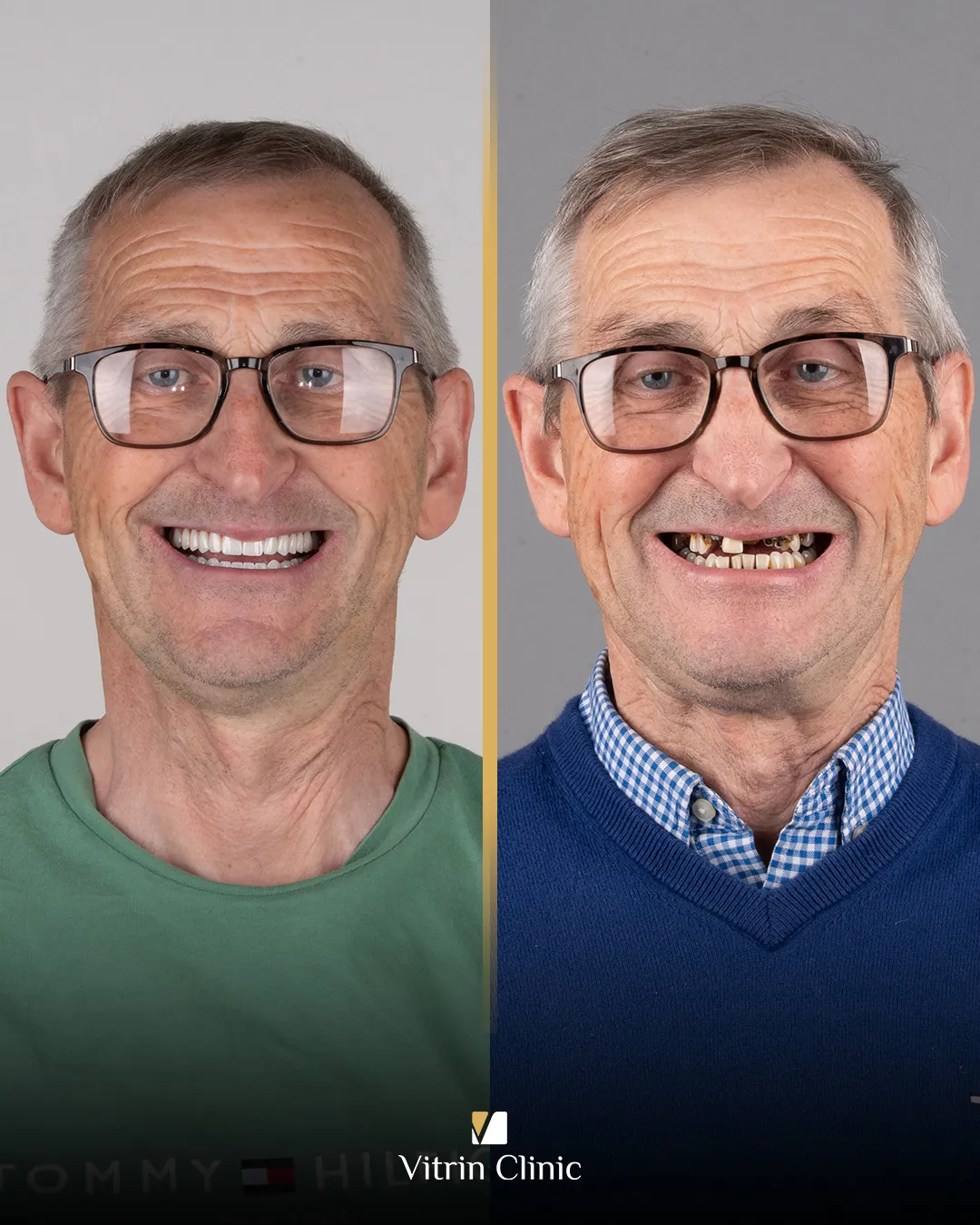
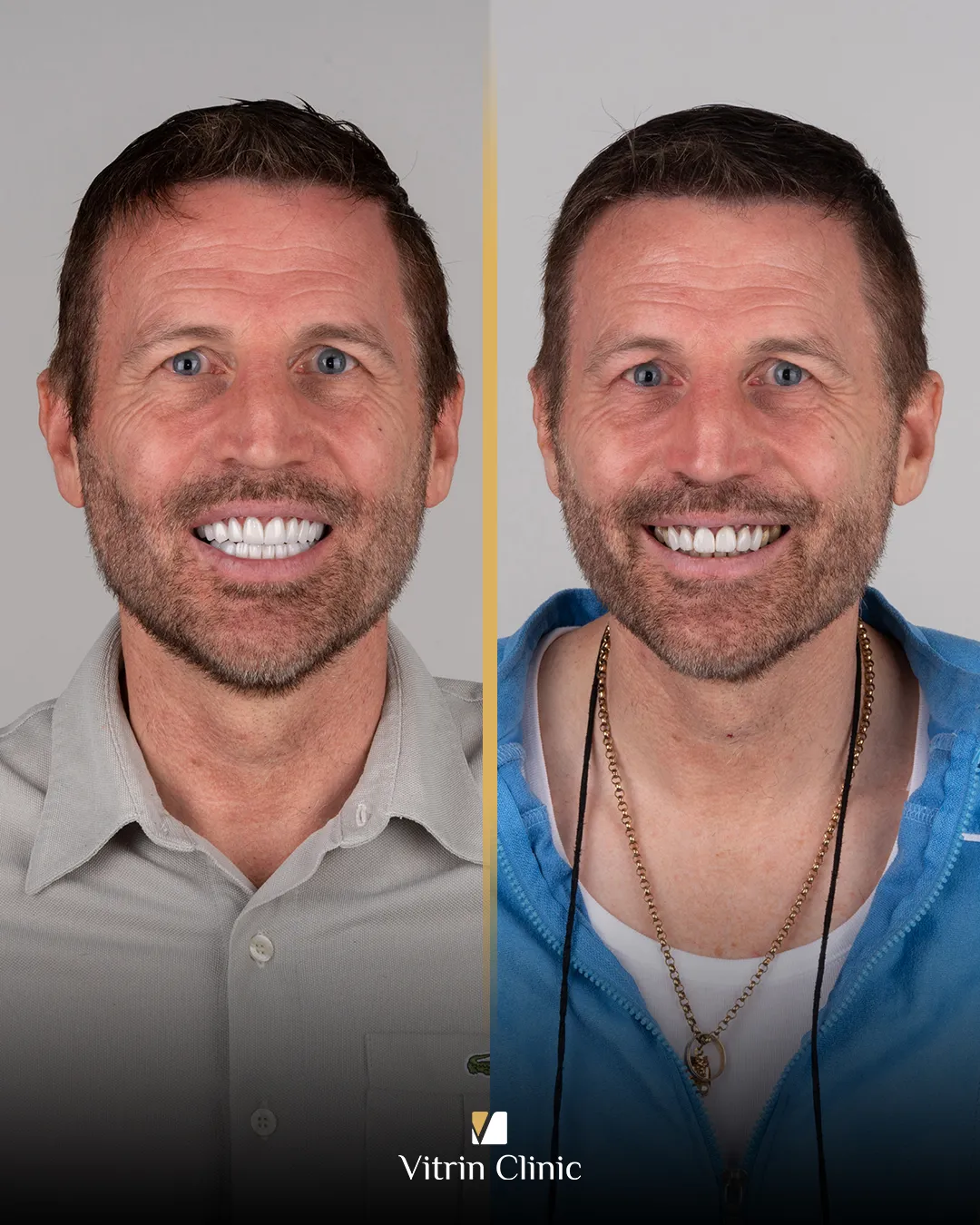
All on Four Turkey - Before and After Gallery
.jpg)
Why Are Patients Choosing Turkey for Full-Arch Implant Treatment?
All on 4 Dental Implants in Turkey attract international patients for several reasons, including differences in private dental treatment costs between countries and access to different implant systems and full-arch restoration options.
For patients considering treatment abroad, the decision involves more than comparing prices. It also requires understanding the proposed clinical approach, the materials used, the treatment schedule, and the arrangements for follow-up care.
1. Differences in Treatment Costs
One reason patients consider Turkey is the difference between advertised full-arch implant prices in Turkey and private dental fees in their home countries.
At Vitrin Clinic, the published starting price for All on 4 is $2,000 per arch, with both arches starting from $4,000. These figures are starting prices, not guaranteed quotations for every patient.
The final cost depends on several factors, including the selected implant system, restoration material, bone condition, and any additional procedures required.
Patients should compare quotations based on the same treatment scope. A lower advertised price may not include the same surgical procedures, temporary restoration, definitive prosthesis, or follow-up arrangements.
2. Access to Different Implant Systems
Turkey offers access to implant systems from several international manufacturers. These systems differ in implant design, surface characteristics, connections, and compatible restorative components.
Vitrin Clinic lists systems from manufacturers including Straumann, Nobel Biocare, BEGO, Neodent, and Medigma Biomedical.
However, having several brands available does not mean that every system is suitable for every patient. The dentist should select the implant model according to bone anatomy, implant positioning, and the planned prosthesis.
Patients should request the exact manufacturer and model in writing rather than relying on a brand name alone.
3. Full-Arch Treatment Planning
Full-arch rehabilitation requires coordination between implant placement and the design of the replacement teeth. Implant positions must provide suitable support while allowing the final bridge to fit the patient's bite and oral anatomy.
The planning process should consider available bone, gum health, anatomical structures, chewing forces, and cleaning access beneath the restoration.
A well-explained treatment plan helps patients understand why a particular implant approach is recommended and whether additional procedures may be necessary.
4. Treatment Coordination for International Patients
Travelling for dental treatment involves more than attending surgery. Patients also need to organise appointments, accommodation, travel dates, and follow-up arrangements.
Before travelling, patients should receive clear information about the proposed treatment stages and recommended length of stay. They should also confirm whether temporary teeth can be fitted, when the definitive restoration is expected, and whether a second visit will be required.
5. Comparing the Complete Treatment Package
The most useful comparison is based on what each quotation actually includes. Patients should check whether the following items are covered:
Initial consultation and clinical examination.
Required diagnostic imaging.
Implant fixtures and surgical placement.
Extractions or additional procedures, if needed.
Temporary fixed restoration, when suitable.
Definitive full-arch prosthesis.
Post-operative care and follow-up appointments.
Any accommodation or transfer arrangements offered.
Not every package includes all these services. Patients should request an itemised written quotation that separates included services from optional arrangements and additional charges.
Ultimately, choosing Turkey should involve comparing clinical planning, implant identification, restoration materials, total costs, and aftercare not price alone.
All on 4 Dental Implants in Turkey Cost : How Do Prices Compare in 2027?
The cost of All on 4 Dental Implants in Turkey varies between clinics because treatment plans do not always include the same components. Implant manufacturers, prosthetic materials, laboratory work, surgical requirements, and aftercare arrangements can all affect the final quotation.
Some clinics advertise a starting price for implant surgery, while others quote a broader package that includes temporary and definitive teeth. Patients should therefore compare the complete treatment rather than relying on the headline price alone.
The following figures reflect the published price estimates supplied for this comparison. They are intended as general reference points and should be checked against current clinic quotations before publication or booking.
Published Turkish Price Comparison
Entry & Median Market Benchmarks
Median advertised price: Approximately $3,000
Cost per arch
Lower published prices: From $1,600
Median advertised price: Approximately $3,000
Standard baseline implant systems
Vitrin Clinic
From $2,000
Cost per arch
Vitrin Clinic: From $2,000
~33% below the $3,000 median advertised price
Includes consultation, 3D CT scan & FDA/CE-certified implant systems
Higher Published Prices
Upper market tier: Up to $4,254
Cost per arch
Higher published prices: Up to $4,254
Reflects premium implant brands and upgraded prosthetic materials
Vitrin Clinic's starting rate is over 50% lower than upper published prices
These figures illustrate the range of advertised prices for full-arch implant treatment in Turkey. They do not necessarily represent identical treatment packages.
For example, a lower quotation may cover implant placement but exclude the final bridge, additional procedures, or certain laboratory costs. A higher quotation may include a different implant system, restoration material, or more extensive services.
Vitrin Clinic's published starting price is $2,000 per arch. Patients should request a written breakdown to understand which surgical and prosthetic components are covered by this starting price.
Vitrin Clinic Full-Arch Treatment Prices
Vitrin Clinic lists several implant-supported treatment options. The starting prices below vary according to the number of implants and the proposed restoration.
All-on-4
Starting price per arch: $2,000
4 implants per arch
All-on-4 (4 implants per arch): $2,000
Full mouth, both arches (8–16 implants): From $4,000
All-on-6 & 3-on-6
Starting price per arch: From $2,800
6 implants per arch
All-on-6 (6 implants per arch): $2,800
3-on-6 (6 implants per arch, 3 bridges): $2,900
Enhanced load distribution & bridge flexibility
All-on-8 & Full Mouth
Starting price per arch: $3,500
8 implants per arch
All-on-8 (8 implants per arch): $3,500
Full mouth, both arches (8–16 implants): From $4,000
Maximum anchor points for full-arch stability
These treatments are not interchangeable simply because they replace missing teeth. Each approach uses a different implant distribution or prosthetic design and may involve different clinical requirements.
All on 4
uses four implants to support a full-arch restoration. It may be suitable when the available bone and planned implant positions provide adequate support.
All-on-6
uses six implants per arch. Additional implants may provide more support points, but the suitability of this approach depends on bone anatomy, implant distribution, and the planned prosthesis.
All-on-8
uses eight implants per arch. It involves a different distribution of implant support and may be considered when the clinical plan requires or allows additional implants.
3-on-6
is a different full-arch restoration concept. It uses three connected prosthetic sections supported by six implants. Its design and clinical requirements differ from a conventional All on 4 bridge.
Full-mouth treatment
refers to rehabilitation of both the upper and lower arches. The number of implants required depends on the condition of each jaw and the treatment design. The starting price should not be interpreted as a fixed price for every full-mouth case.
The dentist must determine which approach can provide appropriate support after examining the patient's bone, gums, bite, and overall oral condition.
All on 4 Cost Comparison: Turkey vs. UK vs. USA
The cost of All on 4 Dental Implants in Turkey can differ significantly from private treatment prices in the UK and USA. The following table compares the supplied estimates for one arch and both arches.
UK
From 12,000
Full-arch & full-mouth restoration
One arch: 12,000–16,000
Both arches: 24,000–32,000
Private UK clinic standard rate
Turkey – Vitrin Clinic
From $2,000
Full-arch & full-mouth restoration
One arch: From $2,000
Both arches: From $4,000
Save ~83–87% vs. UK & ~87–94% vs. USA
US
From 15,000
Full-arch & full-mouth restoration
One arch: 15,000–35,000
Both arches: 30,000–70,000
Highest domestic private expense
What Makes All on 4 Dental Implants in Turkey Prices Different Between Countries?
The cost of All on 4 Dental Implants in Turkey compared with the UK or USA reflects several financial and clinical factors. Understanding these differences helps patients compare treatment quotations more accurately.
1. Operating Expenses
Clinic operating costs vary between countries. These include staff salaries, facility expenses, laboratory fees, equipment, and other business costs.
Differences in these expenses can influence the prices clinics charge. However, lower operating costs do not automatically indicate lower clinical standards or guarantee a particular treatment outcome.
2. Implant Systems and Components
Implant manufacturers offer different systems with specific designs, connections, and restorative components. The selected system can affect the cost of the implant fixtures and compatible prosthetic parts.
Patients should confirm the exact manufacturer and implant model in their treatment plan. Comparing prices based only on a brand name may overlook important differences between individual systems.
3. Prosthetic Materials
The material used for temporary and definitive teeth can influence the total price. Acrylic-based restorations, PMMA, and zirconia have different manufacturing processes, properties, and costs.
Patients should ask which material will be used at each treatment stage. They should also confirm whether the definitive restoration is included in the advertised price or quoted separately.
4. Additional Surgical Procedures
Not every patient can proceed with implant placement using the same surgical approach. Some may need extractions, bone grafting, or other procedures before or during implant treatment.
These additional requirements can increase the total cost. Their necessity should be established through clinical examination and appropriate diagnostic imaging.
5. Laboratory Work and Customisation
Full-arch restorations require careful planning and fabrication. Laboratory work may include designing the bridge, selecting prosthetic components, and adjusting the restoration to the patient's bite and anatomy.
The complexity of the restoration and the materials selected can affect laboratory costs. Patients should ask whether laboratory work and adjustments are included in the quotation.
6. Package Inclusions and Aftercare
Some quotations cover implant surgery only. Others may include temporary teeth, definitive restorations, post-operative appointments, and additional services.
The scope of aftercare also matters, particularly for international patients who return home during the healing period. Patients should clarify how follow-up support is provided and which services require additional payment.
A lower advertised price does not necessarily mean the treatment includes the same services. An itemised quotation makes comparisons more meaningful.
What Should an All on 4 Dental Implants in Turkey Treatment Package Include?
Before booking All on 4 Dental Implants in Turkey, patients should establish exactly what their quotation covers. A package may include the surgical stage without covering every part of the restorative process.
The following table summarises the components listed in Vitrin Clinic's package information.
Treatment component | Package information |
Initial consultation | Listed |
Diagnostic imaging | CBCT and X-rays listed |
Implant fixtures | Included |
Implant surgery | Included |
Local anaesthesia | Included |
Temporary prosthesis | Included |
Final prosthetic restoration | Listed |
Post-operative care | Included |
Remote follow-up support | Available |
Hotel and airport transfers | Available on request |
Understanding the Package Components
Initial Consultation
The consultation helps the clinical team understand the patient's dental history, concerns, and treatment expectations. It is also an opportunity to discuss possible treatment options and the expected stages of care.
Diagnostic Imaging
Dental X-rays and other imaging help evaluate the teeth, jawbone, and surrounding structures. CBCT may be used when clinically indicated to provide additional information for implant planning.
Implant Fixtures and Surgery
The implant fixtures are the components placed in the jawbone to support the future restoration. Implant surgery involves preparing the planned sites and positioning the implants according to the treatment plan.
Local Anaesthesia
Local anaesthesia is used to numb the treatment area during surgery. The clinical team determines the appropriate anaesthesia approach according to the procedure and patient's medical history.
Temporary Prosthesis
A temporary restoration may be provided after surgery when clinical conditions allow. It can help patients avoid spending the healing period without teeth.
However, immediate fixed teeth are not suitable for everyone. Implant stability, bone quality, bite forces, and other clinical factors influence whether immediate loading is appropriate.
Final Prosthetic Restoration
The definitive bridge is the long-term restoration planned for the patient. Its material, design, and fitting schedule should be confirmed before treatment.
Patients should specifically ask whether the final restoration is included in the quoted price. They should also confirm the material and any additional laboratory or fitting charges.
Post-Operative Care
Post-operative care may include instructions about cleaning, diet, medication where prescribed, and follow-up appointments. Patients should understand which reviews are included and how additional clinical visits are arranged.
Remote Follow-Up Support
Remote communication can help international patients share updates and ask questions after returning home. However, it cannot replace an in-person examination when symptoms or complications require direct clinical attention.
Hotel and Airport Transfers
Accommodation and airport transfers may be available on request. Patients should confirm availability, costs, dates, and the exact services provided before booking their trip.
Which Implant Systems Are Available at Vitrin Clinic?
The implant manufacturer is one factor in full-arch treatment planning. Different systems have their own implant designs, connections, and restorative components. The dentist selects a system according to bone anatomy, implant positioning, and prosthetic requirements.
Vitrin Clinic lists implant systems from several manufacturers:
1. Straumann – Switzerland
Straumann offers several implant designs, including BLX, TLX, and Bone Level systems. Each system has different design features and connection options.
BLX: This system has a tapered implant design developed to support primary stability. Its design may be considered in different bone conditions, depending on the clinical situation and surgical plan.
TLX: The TLX system combines a tapered implant body with a tissue-level design. Its connection is positioned near the soft-tissue level, which can influence restorative planning and access for cleaning.
Bone Level: These implants are positioned at the bone level. They offer restorative flexibility for cases where the implant-to-abutment connection is planned closer to the crestal bone.
Roxolid: This is a high-strength material made from a titanium-zirconium alloy. It is used in selected Straumann implant designs and may allow smaller implant dimensions in certain clinical situations.
SLActive: This is a chemically modified, hydrophilic implant surface. It is designed to interact with blood and support the early stages of bone healing.
The dentist chooses between these options according to available bone, the required implant dimensions, and the planned restoration.
2. Nobel Biocare
Nobel Biocare provides implant systems and restorative components for single-tooth, multiple-tooth, and full-arch treatments. Its portfolio includes NobelActive, NobelParallel, and NobelReplace.
NobelActive: This system features an implant design intended to achieve high primary stability. It may be considered in cases involving softer bone or immediate implant placement when clinical conditions allow.
NobelParallel: This system has a parallel-walled implant design and a conical connection. It provides a straightforward option within the Nobel Biocare implant range.
NobelReplace: This system offers a conical connection and a range of restorative components. Its design supports different implant and prosthetic configurations.
Nobel Biocare is also closely associated with the All on 4 Dental Implants in Turkey treatment concept. The concept uses four strategically positioned implants to support a fixed full-arch restoration in suitable cases. However, the number and positioning of implants must be determined through individual treatment planning.
3. BEGO – Germany
BEGO's Semados implant portfolio includes RSX Pro and SCX systems. These designs differ in implant shape, shoulder configuration, and connection options.
Semados RSX Pro: This system has a conical implant design and a self-tapping thread. Its design includes platform switching, which is intended to help manage the implant-abutment interface and surrounding crestal bone.
Semados SCX: This system belongs to BEGO's cylindrical implant range. It has a different implant-body and shoulder design from the conical RSX family.
Restorative components: BEGO provides compatible prosthetic components, including options for fixed restorations. The selected abutments and connection must match the exact implant model.
The choice between BEGO systems depends on the available bone, implant position, and the type of restoration planned.
4. Neodent – Brazil
Neodent, part of the Straumann Group, offers the Grand Morse implant system. Its portfolio includes the Helix GM implant.
Grand Morse connection: This is a standardized prosthetic connection used across Grand Morse implants, regardless of implant diameter. It helps simplify the selection of compatible restorative components.
Helix GM: This implant features a fully tapered body, a hybrid contour, an active apex, and a progressive thread design. These features are intended to provide versatility across different bone conditions.
Acqua surface: Selected Neodent implants are available with this hydrophilic surface. Its surface characteristics are designed to improve interaction with biological fluids during the early healing phase.
Grand Morse systems can be used in different restorative situations, from single-tooth replacement to full-arch rehabilitation. The exact implant model and loading protocol depend on clinical findings.
5. Medigma Biomedical
Medigma Biomedical provides dental implant systems, abutments, and associated restorative components. Its product range includes titanium implants intended to support single crowns, bridges, and other implant-supported restorations.
The exact implant design, connection type, and compatible components depend on the selected product model. For this reason, patients should ask for the specific Medigma implant model rather than relying on the manufacturer name alone.
What Should You Confirm Before Choosing an Implant System?
The implant brand is only one part of the treatment decision. Before surgery, patients should request written confirmation of:
The implant manufacturer and exact model.
The implant dimensions and connection type.
The abutments and prosthetic components planned.
The material selected for the temporary and final restoration.
Whether the proposed system is suitable for the patient's bone and full-arch treatment plan.
These details help patients understand which components will be used and make future maintenance or treatment planning easier. No implant brand is automatically the best choice for every patient.
How Is Your All on 4 Dental Implants in Turkey Treatment Planned at Vitrin Clinic?
Planning All on 4 Dental Implants in Turkey involves more than selecting four implant positions. The clinical team must determine whether the available bone can support the implants, whether the gums are healthy enough for treatment, and how the final restoration will function within the patient's bite.
At Vitrin Clinic, treatment planning follows the patient's medical history, oral condition, anatomical findings, and restorative requirements. Each stage helps the dentist identify potential risks and decide whether All on 4 is appropriate or whether another approach may be more suitable.
1. Reviewing Medical and Dental History
The first stage involves understanding the patient's general health and previous dental treatment. Medical conditions, prescribed medications, allergies, previous surgeries, and smoking habits may affect surgical planning and healing.
Dental history is also important. The team reviews previous extractions, gum disease, existing restorations, and any history of implant treatment.
This information helps identify factors that may require additional precautions, further investigations, or changes to the proposed treatment schedule.
2. Examining the Mouth and Remaining Teeth
A clinical examination allows the dentist to evaluate the condition of the teeth, gums, and other oral tissues. If natural teeth remain, the dentist considers whether they can be maintained or whether their condition makes extraction necessary.
The examination may include checking for:
Gum inflammation, bleeding, or signs of periodontal disease.
Tooth decay, infection, and damaged restorations.
The condition of the remaining teeth and supporting tissues.
Jaw relationship and bite alignment.
Signs of teeth grinding or excessive chewing forces.
The available space for the planned full-arch restoration.
The dentist also considers how the replacement teeth should sit in relation to the lips, cheeks, and opposing arch. These details influence both function and appearance.
3. Evaluating Bone Anatomy with Diagnostic Imaging
Implants require sufficient supporting bone for suitable positioning and stability. Dental X-rays help examine relevant structures, while CBCT may be used when clinically indicated to provide a three-dimensional view of the jaw.
This imaging can help the dentist evaluate:
Bone height, width, and general anatomy.
The position of important structures, such as nerves and the sinus.
Areas where bone volume may be limited.
Potential implant positions and angulation.
Whether additional procedures may need consideration.
CBCT is not automatically required for every patient. The dentist determines whether it is necessary based on the clinical examination and available diagnostic information.
4. Selecting Implant Positions and Identifying Additional Procedures
Once the relevant findings are reviewed, the dentist plans the number, dimensions, and positions of the implants.
In a conventional All on 4 approach, two implants are generally positioned towards the front of the jaw, while the posterior implants may be angled. This arrangement is designed to distribute support across the arch and make use of available bone.
However, the proposed positions depend on the patient's anatomy. Some patients may need extractions, bone grafting, or another preparatory procedure. Others may require a different implant arrangement if four implants cannot provide appropriate support.
The dentist should explain why the proposed configuration is suitable and discuss alternatives where necessary.
5. Planning the Temporary and Definitive Restoration
Implant placement and prosthetic design must be considered together. The final bridge needs to fit the patient's bite, provide suitable chewing function, and allow effective cleaning underneath the restoration.
The clinical team considers the following factors:
The planned position and shape of the replacement teeth.
The relationship between the upper and lower jaws.
The space available for the prosthesis.
The restoration material and its functional requirements.
Access for daily cleaning and professional maintenance.
Whether a temporary fixed restoration can be fitted after surgery.
The temporary and definitive restorations may use different materials and serve different purposes. Patients should understand which restoration is planned at each stage and when the final bridge is expected to be fitted.
6. Deciding Whether Immediate Loading Is Appropriate
Some patients may receive temporary fixed teeth shortly after implant placement. However, this depends on the stability achieved during surgery and other clinical factors.
The dentist considers bone quality, implant positioning, primary stability, bite forces, and the patient's ability to follow post-operative instructions.
If the conditions are not suitable for immediate loading, the implants may need to heal before the temporary fixed restoration is attached. This decision should be based on clinical findings rather than a standard promise of same-day teeth.
7. Reviewing the Treatment Plan with the Patient
Before treatment begins, patients should understand the proposed procedure, expected timeline, restoration materials, and possible additional costs.
The treatment discussion should cover:
The selected implant manufacturer and exact model.
The number and planned positions of implants.
Any extractions or additional surgical procedures.
The temporary and definitive prosthesis.
The expected healing period and loading schedule.
Possible complications and alternative treatment options.
The total quotation and confirmed package inclusions.
Follow-up care and long-term maintenance.
Patients should have an opportunity to ask questions and receive a written treatment plan before proceeding.
Dr. Rifat Alsaman's Clinical Approach
Dr. Rifat Alsaman, Head of the Medical Team at Vitrin Clinic, emphasises the importance of individual clinical planning for full-arch implant treatment.
The proposed implant arrangement, surgical approach, and loading protocol should reflect each patient's bone anatomy, gum condition, bite, and restorative requirements. A treatment plan that works for one patient may not be appropriate for another.
This is why the decision to proceed with All on 4 should follow a complete clinical examination and review of the relevant diagnostic findings.
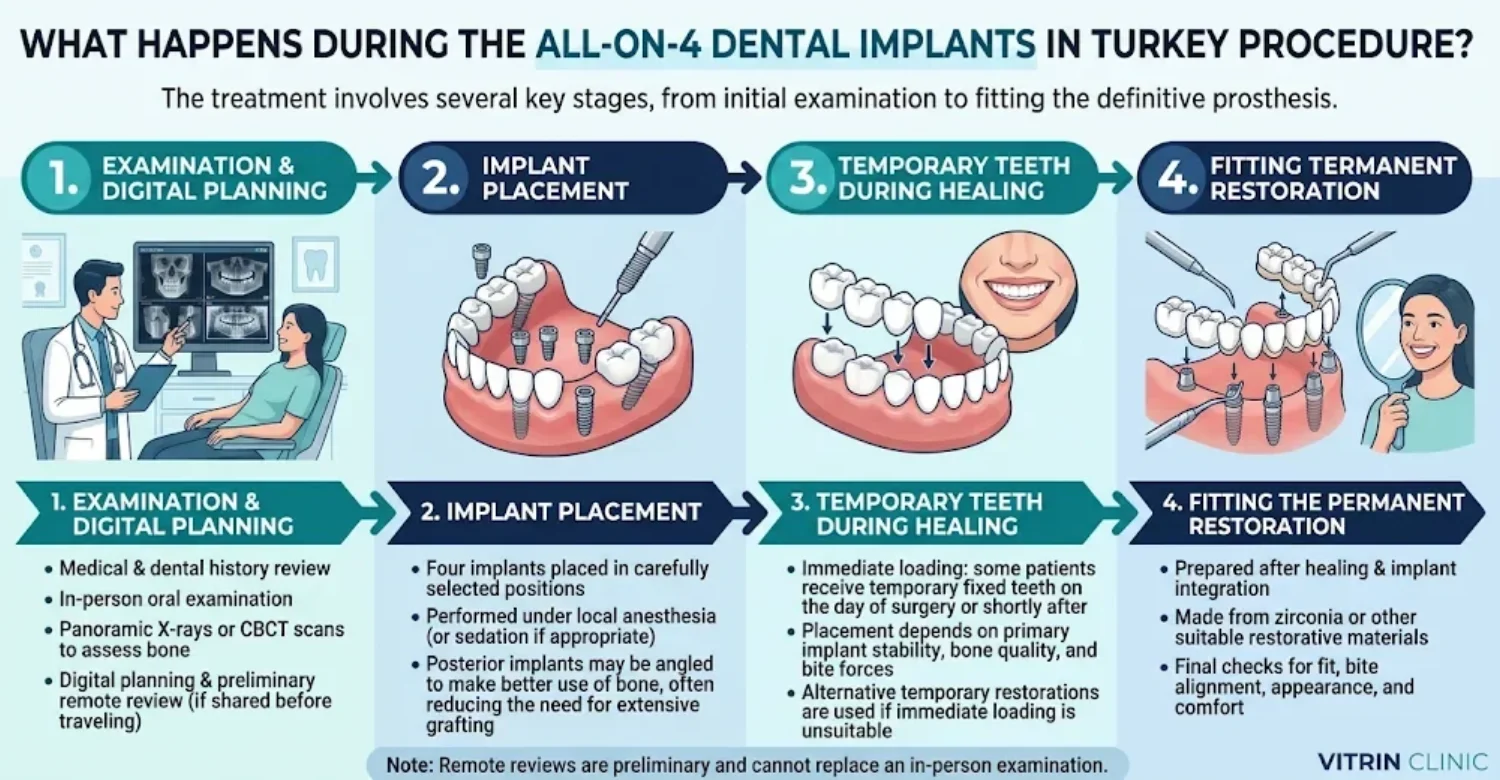
What Happens During the All on 4 Dental Implants in Turkey Procedure?
The treatment usually involves several stages, from the initial examination to the fitting of the definitive prosthesis.
1. Examination and Digital Planning
The dentist reviews the patient's medical and dental history and examines the oral condition. Panoramic X-rays or CBCT scans may be required when clinically indicated to assess bone volume and anatomical structures.
Patients can share previous records before travelling. However, remote reviews are preliminary and cannot replace an in-person examination.
2. Implant Placement
Four implants are placed in carefully selected positions to support the full-arch restoration. The procedure is generally performed under local anaesthesia. Sedation may be considered when appropriate.
The posterior implants may be angled to make better use of available bone. In selected cases, this can reduce the need for extensive bone grafting, although additional procedures may still be necessary.
3. Temporary Teeth During Healing
Some patients may receive temporary fixed teeth on the day of surgery or shortly afterwards. This is known as immediate loading.
It depends on primary implant stability, bone quality, bite forces, and other clinical factors. If immediate loading is unsuitable, the dentist may recommend a different temporary restoration or a delayed loading approach.
4. Fitting the Permanent Restoration
The definitive prosthesis is prepared after sufficient healing and implant integration. Depending on the treatment plan, it may be made from zirconia or another suitable restorative material.
Before completion, the clinical team checks the fit, bite alignment, appearance, and comfort of the restoration.
Ready to transform your smile?
Talk to our team and get a personal FREE treatment plan.
How Long Does All on 4 Dental Implants in Turkey Treatment Take, and How Many Visits Are You Needed at Vitrin Clinic ?
Most patients should plan around two main treatment stages when receiving All on 4 Dental Implants in Turkey. The first visit usually covers examination, implant surgery, and temporary teeth when clinically suitable. The second visit takes place after sufficient healing, when the definitive restoration can be fitted.
Treatment stage | What happens |
First visit | Examination, planning, surgery, temporary teeth when suitable, and post-operative review |
Healing period | Osseointegration while the implants bond with the jawbone |
Second visit | Final scans, bite checks, prosthesis fitting, and adjustments |
For the first visit, patients may need to allow approximately 7–10 days for appointments, surgery, and post-operative checks. This is a planning estimate, not a fixed requirement. The second visit depends on healing progress, laboratory workflow, and the restoration design.
Can the Entire Treatment Be Completed in One Trip?
Temporary teeth do not mean the full treatment is complete. The implants still need time to integrate with the jawbone before the definitive prosthesis is fitted.
For this reason, patients should not assume that one visit includes both surgery and permanent teeth. The clinic should confirm which restoration will be provided during each visit and the expected timing of the next stage.
Which Materials Are Used for All on 4 Dental Implants in Turkey Teeth?
The material affects the restoration's appearance, strength, maintenance, and cost. Two commonly used materials are zirconia and PMMA acrylic resin.
Feature | Zirconia | PMMA |
Material | Ceramic | Acrylic resin |
Common use | Definitive restorations | Commonly temporary restorations |
Appearance | Tooth-coloured and customisable | Tooth-coloured and adjustable |
Strength | High, depending on design | Lower wear resistance |
Staining | Generally more stain-resistant | More prone to staining |
Repair | May require laboratory repair | Some damage can be repaired |
Cost | Usually higher | Usually lower |
Zirconia
is a high-strength ceramic that can be used for definitive full-arch restorations. Its design and surface polishing matter, as poorly finished surfaces may contribute to wear on opposing teeth. Significant damage may require laboratory work or replacement.
PMMA
is an acrylic resin commonly used for temporary teeth during implant healing. It can be adjusted and repaired in certain cases, but it is more susceptible to wear, scratches, and staining over time.
The suitable material depends on bite forces, available space, aesthetic requirements, healing stage, maintenance needs, and budget. Patients should confirm which material is planned for both temporary and permanent teeth.
Who Is a Suitable Candidate for All on 4 Dental Implants in Turkey?
All on 4 Dental Implants in Turkey may be suitable for adults who have lost most or all of their teeth, or whose remaining teeth have a poor long-term prognosis.
Potential candidates may include patients who:
Need replacement of an entire upper or lower dental arch.
Have severely damaged teeth that cannot be restored predictably.
Prefer a fixed implant-supported restoration.
Have suitable bone support for the planned implant positions.
Can maintain daily oral hygiene and attend follow-up appointments.
However, suitability depends on more than tooth loss. Active gum disease, severe bone loss, uncontrolled medical conditions, smoking, certain medications, and poor oral hygiene may affect treatment planning.
These factors do not automatically rule out implants. Some patients may need preliminary treatment, medical coordination, or an alternative approach.
Does Everyone Qualify for Immediate Temporary Teeth?
No. Being suitable for implant surgery does not automatically mean a patient can receive fixed temporary teeth immediately.
Immediate loading requires adequate primary stability and favourable healing conditions. Poor bone support, unstable bite forces, active infection, and certain medical or lifestyle factors may make immediate loading unsuitable.
In these cases, the dentist may recommend delayed loading while the implants heal.
What Are the Main Benefits of All on 4 Dental Implants in Turkey?
For suitable patients, All on 4 Dental Implants in Turkey can offer several functional and practical advantages. The treatment uses four strategically positioned implants to support a fixed full-arch restoration. It can be an option for patients who have lost most or all teeth in one jaw or have remaining teeth that cannot be predictably maintained.
1. Replacing a Full Arch with Four Implants
One of the main advantages of All on 4 is its ability to support a complete row of replacement teeth using four dental implants. Instead of replacing every missing tooth with an individual implant, the treatment distributes the load across four strategically positioned implant fixtures.
This approach can provide a fixed replacement for an entire upper or lower arch. It may be particularly useful for patients who have extensive tooth loss and need a comprehensive rehabilitation plan.
However, four implants are not suitable for every jaw. Bone volume, bone quality, implant distribution, and bite forces must be considered before selecting this approach.
2. A Fixed Alternative to Removable Dentures
Traditional dentures rest on the gums and can move during speaking or eating. All on 4 restorations are attached to dental implants, so patients do not remove them as part of their daily cleaning routine.
This fixed design can reduce movement and improve stability during everyday activities. Patients may find it easier to speak and eat compared with wearing loose or poorly fitting dentures.
The final restoration is usually removed only by a dental professional when maintenance or clinical treatment is required. Patients should still follow daily cleaning instructions to protect the implants and surrounding tissues.
3. Making Use of Available Jawbone
Another potential advantage is the strategic positioning of the posterior implants. In suitable cases, these implants are placed at an angle to make better use of the available bone.
This approach may reduce the need for extensive bone grafting in some patients. It can also help distribute support across the arch while accommodating anatomical structures.
However, angled implants do not eliminate the need for grafting in every case. Significant bone loss, unsuitable anatomy, or other clinical findings may require additional procedures or a different treatment approach.
4. The Possibility of Receiving Temporary Fixed Teeth
Some patients may receive a fixed temporary restoration shortly after implant surgery. This is often called immediate loading or immediate provisionalisation.
Having temporary teeth can help patients avoid spending the healing period without teeth. It may also support everyday activities such as speaking and eating soft foods while the implants integrate with the surrounding bone.
However, immediate loading is not suitable for everyone. It depends on factors such as primary implant stability, bone quality, implant positioning, bite forces, and the patient's ability to follow dietary instructions.
If the implants do not achieve the required stability, the dentist may recommend a healing period before attaching a fixed restoration.
5. Improved Chewing Function and Everyday Stability
A fixed implant-supported restoration can provide more stable chewing support than conventional removable dentures. Because the prosthesis is anchored to implants, it is less likely to shift during normal oral function.
This may make eating a wider range of foods more manageable after healing and adaptation. However, patients usually need to begin with a soft-food diet and gradually return to firmer foods according to their dentist's instructions.
Chewing ability also depends on the final prosthesis, bite alignment, muscle adaptation, and the health of the surrounding tissues. The treatment does not guarantee that every patient will regain their original chewing function.
6. Treatment Planning Tailored to Individual Anatomy
All on 4 is a treatment concept, not a one-size-fits-all procedure. Implant positions, angles, dimensions, and prosthetic design must be planned around each patient's jaw anatomy.
The dentist considers several factors, including:
Available bone volume and density.
The position of nerves and other anatomical structures.
Gum condition and oral hygiene.
Bite relationship and chewing forces.
Facial support and the planned tooth position.
The space available for the prosthesis and cleaning access.
Digital scans and appropriate diagnostic imaging help guide this planning. CBCT imaging may be used when clinically indicated to evaluate bone anatomy and important structures.
7. A Structured Treatment Approach for Extensive Tooth Loss
For patients who have lost most or all teeth, treating an entire arch with a coordinated implant-supported restoration can simplify the overall rehabilitation plan.
Rather than planning separate replacements for numerous missing teeth, the dentist designs one connected prosthesis supported by strategically positioned implants. This allows the implant positions, tooth arrangement, and bite to be planned together.
The approach can be particularly useful when remaining teeth have a poor long-term prognosis. However, any teeth that can be maintained should be evaluated before extraction is considered.
8. Potential Support for Jawbone Preservation
After tooth loss, the jawbone in the affected areas can gradually change because it no longer receives stimulation through natural tooth roots.
Dental implants transfer functional forces to the surrounding bone. This can help maintain bone in the areas around successfully integrated implants compared with leaving those areas without implant support.
However, implants do not prevent all bone changes throughout the jaw. Bone levels can still change over time, particularly when inflammation develops or oral hygiene and maintenance are inadequate.
Are These Benefits Guaranteed?
No. The benefits of All on 4 depend on individual clinical conditions, implant stability, healing, prosthetic design, and long-term maintenance. Some patients may need bone grafting, additional implants, a different loading schedule, or an alternative treatment.
A clinical examination and appropriate diagnostic imaging help determine whether this approach is suitable. Patients should receive a written treatment plan explaining the proposed implants, restoration, expected healing period, possible risks, and follow-up requirements before proceeding.
Ready to transform your smile?
Talk to our team and get a personal FREE treatment plan.
All on 4 vs. All-on-6: Which Full-Arch Option Fits Your Needs?
Both treatments use implants to support a fixed full-arch restoration. The main difference is the number of implants, but the choice involves more than counting support points.
Feature | All on 4 | All-on-6 |
Implants per arch | 4 | 6 |
Support points | Four | Six |
Load distribution | Across four implants | Across six implants |
Bone requirements | Depends on available bone | Depends on available bone |
Surgical planning | Four implant positions | Six implant positions |
Suitability | Based on anatomy and bite | Based on anatomy and bite |
Six implants may provide additional support points in selected cases. However, more implants do not automatically mean a better outcome. Four well-positioned implants may adequately support the planned restoration for a suitable patient.
How Much More Does All-on-6 Cost at Vitrin Clinic?
Treatment | Starting price per arch | Starting price for both arches |
All on 4 | $2,000 | $4,000 |
All-on-6 | $2,800 | $5,600 |
Difference | $800 | $1,600 |
Based on these starting prices, All-on-6 costs approximately 40% more per arch. The final difference depends on implant systems, restoration materials, and additional procedures.
What Does Recovery After All on 4 Surgery Involve?
Recovery varies according to the surgical procedure and individual healing response. Some swelling, bruising, tenderness, and discomfort may occur during the first few days.
Patients should follow the treating dentist's instructions, including:
Taking prescribed medication as directed.
Eating soft foods during the recommended period.
Avoiding excessive pressure on temporary teeth.
Maintaining oral hygiene using the recommended cleaning method.
Avoiding smoking during healing.
Attending scheduled follow-up appointments.
Patients should contact their dental team if pain or swelling becomes worse, bleeding persists, pus develops, or the temporary prosthesis becomes loose.
How Long Does Implant Healing Take?
The implants undergo osseointegration, the process through which bone bonds with the implant surfaces. This usually takes several months, but the timeline varies with bone quality, general health, smoking, and additional procedures.
Recovery stage | What patients may experience |
First 1–3 days | Swelling, tenderness, and possible minor bleeding |
First week | Early soft-tissue healing and dietary restrictions |
Weeks 2–6 | Gradual improvement while implant integration continues |
Following months | Continued bone integration and clinical monitoring |
Final restoration | Permanent prosthesis fitted when clinically ready |
How Should You Clean and Maintain an All on 4 Bridge?
Daily cleaning is essential for protecting the implants and the tissues supporting an All on 4 bridge. Although the restoration replaces a full row of teeth, plaque and food particles can still collect around the implant connections, underneath the bridge, and along the gumline.
If these deposits are not removed regularly, they may contribute to gum inflammation and peri-implant disease. Patients should therefore clean both the visible surfaces and the areas beneath the fixed restoration.
The recommended cleaning tools depend on the bridge design and the space available underneath it.
Interdental brushes: These small brushes help clean accessible spaces beneath the bridge and around implant-supported components. The dentist or hygienist should recommend the correct size to avoid damaging the surrounding tissues.
Water flossers: A water flosser directs a stream of water around the restoration and beneath accessible areas. It can help dislodge food particles and reduce debris in places that are difficult to reach with a toothbrush.
Super floss: This type of floss has a stiffened end and a thicker cleaning section. It can be guided beneath the bridge to clean around implant-supported structures.
Soft toothbrushes: A soft-bristled toothbrush helps remove plaque from the visible teeth, gumline, and accessible restoration surfaces without applying excessive pressure.
Specialist cleaning products: Depending on the restoration and individual needs, the dental team may recommend additional tools or products to improve daily plaque control.
Why Is Professional Maintenance Important?
Home cleaning is only one part of long-term All on 4 care. Regular professional appointments allow the dentist to examine the tissues around the implants and check whether the restoration remains stable.
During these visits, the dental team may:
Check for bleeding, swelling, or signs of inflammation around the implants.
Examine the areas beneath the bridge for plaque accumulation.
Check the condition of implant-supported components and prosthetic screws.
Review bite alignment and identify uneven pressure.
Examine the restoration for chips, cracks, or excessive wear.
Recommend professional cleaning or adjustments when necessary.
The frequency of maintenance appointments depends on individual risk factors and oral health. Patients with a history of gum disease, smoking, or difficulty cleaning beneath the bridge may need closer monitoring.
What Risks Should Patients Understand Before Treatment?
Like any surgical procedure, All on 4 Dental Implants in Turkey carry potential risks. Some complications may occur during surgery or early healing, while others can develop after the final restoration is fitted.
Understanding these risks helps patients make informed decisions and recognise when professional attention is needed.
1. Infection Around the Implant or Surgical Site
Bacterial infection can develop around the surgical area during healing. It may cause pain, swelling, redness, discharge, or an unpleasant taste.
Infection can also affect the tissues surrounding an implant after treatment. Maintaining good oral hygiene and following post-operative instructions help reduce avoidable risks. Persistent or worsening symptoms require prompt clinical review.
2. Delayed Healing
Healing does not progress at the same rate for every patient. Smoking, certain medical conditions, poor oral hygiene, and other health factors may interfere with tissue recovery.
Delayed healing can affect the timing of prosthetic treatment. The dentist may recommend additional reviews or postpone loading the implants until the tissues and implants are ready.
3. Implant Failure
An implant must integrate with the surrounding jawbone to provide stable support. Sometimes this process does not occur as expected, and the implant may become loose or fail.
Possible contributing factors include insufficient primary stability, infection, bone-related problems, excessive loading, and certain medical or lifestyle factors.
If an implant fails to integrate, it may need to be removed. Further treatment depends on the remaining bone, the cause of failure, and the overall restoration plan.
4. Peri-Implant Disease
Peri-implant diseases affect the tissues surrounding dental implants. Peri-implant mucositis involves inflammation of the soft tissues, while peri-implantitis also involves progressive loss of supporting bone.
Signs may include bleeding during cleaning, redness, swelling, tenderness, or discharge. Some cases may initially cause few noticeable symptoms.
Daily plaque removal and professional monitoring are important for prevention and early detection.
5. Screw Loosening or Component Problems
The prosthesis is connected to the implants through specific prosthetic components. Over time, screws may loosen because of repeated chewing forces or other mechanical factors.
Patients may notice movement, clicking, or a change in how the bridge feels. These symptoms should be checked by a dentist rather than managed at home.
The dental professional can examine the connection and determine whether tightening, repair, or component replacement is needed.
6. Prosthesis Damage or Wear
The temporary or definitive restoration may experience wear, chipping, or fracture. The likelihood depends on the restoration material, bite forces, prosthesis design, and habits such as teeth grinding.
Minor damage may require repair, while more extensive fractures may need replacement of part or all of the restoration.
Patients should report changes promptly, especially if the bridge develops sharp edges or becomes uncomfortable.
7. Bite Discomfort and Uneven Pressure
An uneven bite can place excessive pressure on certain parts of the restoration or implants. This may cause discomfort when chewing and contribute to mechanical complications.
The dentist checks the bite during treatment and follow-up appointments. Adjustments may be necessary if the patient's bite changes or the restoration develops uneven contact.
8. Difficulty Cleaning Beneath the Bridge
The space beneath a full-arch restoration must allow adequate access for daily cleaning. If the design makes this area difficult to reach, plaque and food debris may accumulate.
The dentist should consider cleaning access when planning the prosthesis. Patients should also receive practical instructions and demonstrate that they can use the recommended cleaning tools.
What Can Increase the Risk of Complications?
Several factors may affect implant healing and long-term maintenance, including:
Smoking and tobacco use.
Untreated gum disease.
Inadequate daily oral hygiene.
Poorly controlled medical conditions.
Teeth grinding or clenching.
Excessive or uneven bite forces.
Missing professional maintenance appointments.
Regular reviews cannot eliminate every risk. However, they help identify changes early and allow the dental team to recommend appropriate treatment.
What is the number of trips to Turkey needed for All on 4 treatment?
Most patients need two trips to Turkey: the first for implant placement and, when suitable, temporary teeth; the second for fitting the final restoration after the healing period. The exact number and timing depend on healing, clinical findings, and the treatment plan. Some cases may require a different schedule.
What Should You Expect from the Patient Journey at Vitrin Clinic?
Travelling abroad for full-arch implant treatment involves both clinical planning and practical arrangements. International patients need to understand what happens before surgery, during their stay in Istanbul, and after returning home.
Vitrin Clinic's patient coordination team helps patients organise appointments and understand the planned treatment stages. The exact schedule depends on the patient's oral condition, required procedures, and agreed treatment plan.
Before Travelling to Istanbul
The process can begin with sharing dental photographs, previous X-rays, scans, and relevant medical information. The clinical team may review these records to provide preliminary guidance about possible treatment options.
This initial review helps identify questions that may need further investigation. However, it does not replace an in-person clinical examination or guarantee that All on 4 will be suitable.
Before booking flights, patients should confirm:
The proposed treatment and number of appointments.
Whether extractions or additional procedures may be required.
The recommended length of stay.
Which implant system and restoration are planned.
The written quotation and package inclusions.
Any accommodation or transfer arrangements available.
During Your Stay
The treatment journey generally begins with an in-person clinical examination. The dentist reviews the teeth, gums, oral tissues, bite, and available bone.
Appropriate diagnostic imaging helps evaluate the jaw and plan implant positions. CBCT may be used when clinically indicated.
Once the dentist confirms the treatment plan, the surgical stage can proceed. This may involve removing teeth that cannot be maintained, preparing the implant sites, and placing the implants.
A temporary fixed restoration may be fitted shortly after surgery when the implants achieve suitable primary stability and other clinical conditions allow. Otherwise, the dentist may recommend a different healing schedule.
Patients also receive post-operative instructions covering oral hygiene, medication where prescribed, diet, and follow-up appointments.
Why Should You Confirm the Travel Schedule in Advance?
Full-arch treatment does not follow exactly the same timeline for every patient. Surgical requirements, healing response, and immediate-loading suitability can all affect the number of appointments.
Patients should not assume that the final permanent restoration will be completed during the first visit. In many treatment plans, the temporary restoration is used during healing, with the definitive prosthesis fitted at a later stage.
The recommended stay, appointment dates, and any return visit should therefore be confirmed with the clinic before travel.
What Happens After You Return Home?
Returning home does not mean the treatment process is finished. The implants still need to heal and integrate with the surrounding bone, and the temporary restoration may require monitoring.
Patients should continue following their cleaning instructions and attend the recommended follow-up appointments. Any persistent pain, swelling, bleeding, movement, or changes in the bridge should be reported promptly.
Before leaving Istanbul, patients should request copies of:
The implant manufacturer and exact model.
Implant dimensions and relevant component details.
Available treatment records and diagnostic images.
Details of the temporary and planned definitive restoration.
Post-operative and daily cleaning instructions.
The recommended follow-up schedule.
Remote communication can help patients share updates and ask questions after returning home. However, it cannot replace an in-person examination when clinical problems require direct assessment.
Ready to transform your smile?
Talk to our team and get a personal FREE treatment plan.
What Should You Check Before Choosing an All on 4 Clinic in Turkey?
Choosing a clinic requires more than comparing advertised prices. Patients should understand who will perform the treatment, which implant components will be used, and how the clinic will manage follow-up care.
Before committing to All on 4 Dental Implants in Turkey, consider the following points.
1. The Dentist's Full-Arch Experience
Ask about the treating dentist's experience with full-arch implant rehabilitation. This includes implant surgery, prosthetic planning, bite management, and the treatment of complications.
You should also understand which clinician is responsible for the surgical and restorative stages.
2. Exact Implant Manufacturer and Model
A manufacturer name alone does not identify the implant used in your treatment. Different systems from the same company may have different designs and restorative connections.
Request the exact model and ask for written confirmation of the implant and compatible prosthetic components.
3. Individual Treatment Planning
A suitable treatment plan should consider more than the number of missing teeth. It should account for bone anatomy, gum health, bite forces, anatomical structures, and the position of the planned teeth.
Ask how the dentist will determine whether four implants can provide appropriate support or whether another approach is more suitable.
4. Temporary and Definitive Restoration Materials
The temporary and permanent bridges may use different materials. Ask which material is planned for each stage and why it is suitable for your case.
You should also understand whether the final restoration is included in the quotation or charged separately.
5. A Clear Written Quotation
An advertised starting price may not cover every part of treatment. Request an itemised breakdown showing the costs of surgery, implants, temporary teeth, definitive restoration, and any additional procedures.
The quotation should also explain which services are included and which may involve extra charges.
6. Aftercare and Maintenance
Implant treatment requires long-term monitoring. Ask how follow-up appointments are arranged after you return home and whom to contact if a problem develops.
You should also clarify any warranty conditions, their exclusions, and the process for managing complications.
7. Access to Your Treatment Records
Patients should receive the information needed to maintain their treatment after leaving the clinic. This includes implant identification, relevant scans, treatment records, and prosthetic details.
These records can be useful for future maintenance and professional reviews.
8. A Plan for Possible Complications
Ask what happens if an implant fails to integrate, the temporary bridge becomes damaged, or additional treatment is needed.
A responsible clinic should explain possible scenarios and how they may affect treatment time and cost.
Is There an Upper Age Limit for All-on-4 Treatment in Turkey?
No fixed upper age limit for All-on-4 in Turkey
There is no fixed upper age limit for All-on-4 treatment in Turkey. Suitability depends on general health, bone support, medication use, and healing capacity.
Health checks matter more than age
Older adults may still be considered for All-on-4 after a medical assessment. Uncontrolled conditions or medicines that affect bleeding or healing can change suitability.
Research Vitrin clinic as an option
Ask Vitrin clinic how it assesses older adults for All-on-4 in Turkey. Confirm the consultation, medical review, and follow-up steps before deciding.
Why Choose Vitrin Clinic for All on 4 Treatment in Istanbul?
At Vitrin Clinic, full-arch treatment planning starts with the patient's oral condition and restoration requirements. The clinical team considers jawbone structure, gum health, bite alignment, and prosthetic design before recommending an implant approach.
Digital imaging and scanning support treatment planning when clinically indicated. These tools help the clinical team evaluate relevant anatomical details and plan implant positioning.
International patients can also share previous dental records for preliminary guidance before travelling. However, final recommendations depend on an in-person clinical examination and the findings at the clinic.
Vitrin Clinic lists implant systems from several manufacturers, including Straumann, Nobel Biocare, BEGO, Neodent, and Medigma Biomedical. The specific implant model is selected according to the clinical plan and should be confirmed in the written quotation.
The clinic's published starting price for All on 4 is $2,000 per arch. The final quotation depends on the selected implant system, restoration material, and any additional procedures required.
Patients should request written confirmation of the treatment components, package inclusions, and any additional charges before booking.
Request your FREE Treatment Plan to discuss your options with Vitrin Clinic.
Important Tips Before Starting Treatment
Preparing for All on 4 Dental Implants in Turkey can help patients understand the treatment process and plan their recovery more effectively. Before committing, review the following points.
Share your medical history: Inform the dentist about medical conditions, medications, allergies, previous surgeries, and smoking habits. These details may affect surgical planning and healing.
Provide previous dental records: Existing X-rays, scans, and treatment records can help the clinical team understand your dental history before travel.
Confirm the implant system: Ask for the manufacturer, exact model, and compatible prosthetic components. Keep this information with your treatment records.
Understand the restoration materials: Confirm which materials will be used for temporary and definitive teeth. Ask about their expected maintenance requirements.
Review package inclusions: Check whether surgery, implant fixtures, temporary teeth, final prosthesis, and additional procedures are included in the quotation.
Discuss the healing timeline: Understand how long osseointegration may take and when the definitive restoration can be fitted. The timeline varies between patients.
Request an itemised quotation: Ask for a written breakdown of treatment costs and any possible additional charges.
Clarify aftercare arrangements: Find out how follow-up appointments, maintenance, and potential complications will be managed after returning home.
Confirm travel dates: Finalise the clinical schedule and recommended stay before booking flights or accommodation.
Follow clinical instructions: Follow the dentist's pre-operative and post-operative guidance, including dietary and oral hygiene recommendations.
Good preparation helps patients understand their responsibilities before and after surgery. Daily cleaning and regular professional maintenance remain essential throughout the life of the restoration.
Conclusion: Is All on 4 in Turkey the Right Option for You?
All on 4 Dental Implants in Turkey offer a fixed full-arch solution for suitable patients. At Vitrin Clinic, treatment starts from $2,000 per arch, with the final cost depending on clinical needs, materials, and additional procedures.
The right approach starts with an individual treatment plan, not simply the lowest advertised price. Contact Vitrin Clinic for your FREE Treatment Plan and explore your options in Istanbul.
Medical Disclaimer
This article is for informational purposes only and does not replace professional dental advice or diagnosis. Suitability, risks, costs, and outcomes vary between patients. A clinical examination and appropriate diagnostic imaging are required before treatment decisions are made.
References
FAQs
The cost depends on the implant system, prosthetic material, and additional procedures. Vitrin Clinic's published starting price is $2,000 per arch or $4,000 for both arches. The final quotation depends on the patient's clinical requirements and agreed treatment components.
Dr. Rifat Alsaman has more than 5 years of clinical experience in dentistry and currently serves as the Head of the Medical Team at Vitrin Clinic. He is dedicated to providing exceptional patient care, overseeing treatment planning, and ensuring the highest clinical standards across the team. His expertise, attention to detail, and commitment to continuous professional development have helped countless patients achieve healthier, more confident smiles.


