Dental Implant
September 10, 2025
Bone Graft for Implants: Cost, Procedure & Recovery
 Dr. Rifat Alsaman
Bone Graft for Implants: Do You Really Need One?
Medically reviewed by Dr. Rifat Alsaman, Head of the Medical Team at Vitrin Clinic · Last updated: [insert date]
If your dentist has told you that you need a bone graft before getting a dental implant, you're not alone — jawbone loss after missing teeth is common, and a bone graft is simply how dentists rebuild that foundation so an implant has something solid to fuse with. This guide covers everything you need to know: what a bone graft for teeth actually involves, the different material options, healing timelines, realistic costs, and when you can expect to get your implant afterward.
What Is a Bone Graft for Teeth and Implants?
A bone graft for teeth is a surgical procedure that rebuilds jawbone that has thinned, shrunk, or lost density — most often after tooth loss, gum disease, or trauma. It matters specifically for implant treatment because implants depend on solid, adequate bone to fuse with and stay stable for years. Without enough bone volume, an implant can shift, loosen, or fail to properly integrate.
At Vitrin Clinic, detailed 3D imaging determines exactly how much bone rebuilding — if any — your case actually requires before any surgery is planned.
Why This Matters Before Implant Placement
When a tooth is lost, the bone underneath it starts to shrink within months, since it no longer receives the stimulation a natural tooth root would normally provide. That bone loss can prevent an implant from anchoring securely, because implants need a firm, sufficiently thick foundation to fuse with over time. A bone graft for implants restores that foundation, giving the implant the strength and long-term stability it needs for a lasting result.
When Do You Need a Bone Graft for a Tooth Implant?
You may need this procedure if:
Your jawbone is too thin or soft to support an implant on its own
You've had one or more missing teeth for a long time, allowing bone to resorb
You've experienced bone loss from infection, gum disease, or injury
At Vitrin Clinic, our team uses advanced 3D imaging to determine exactly how much grafting — if any — your case needs, as part of a free consultation. If you're weighing this against a full-mouth restoration, full mouth dental implants explains how multiple implants and grafting can work together for patients with significant bone loss.
The Bone Graft Procedure: Step-by-Step
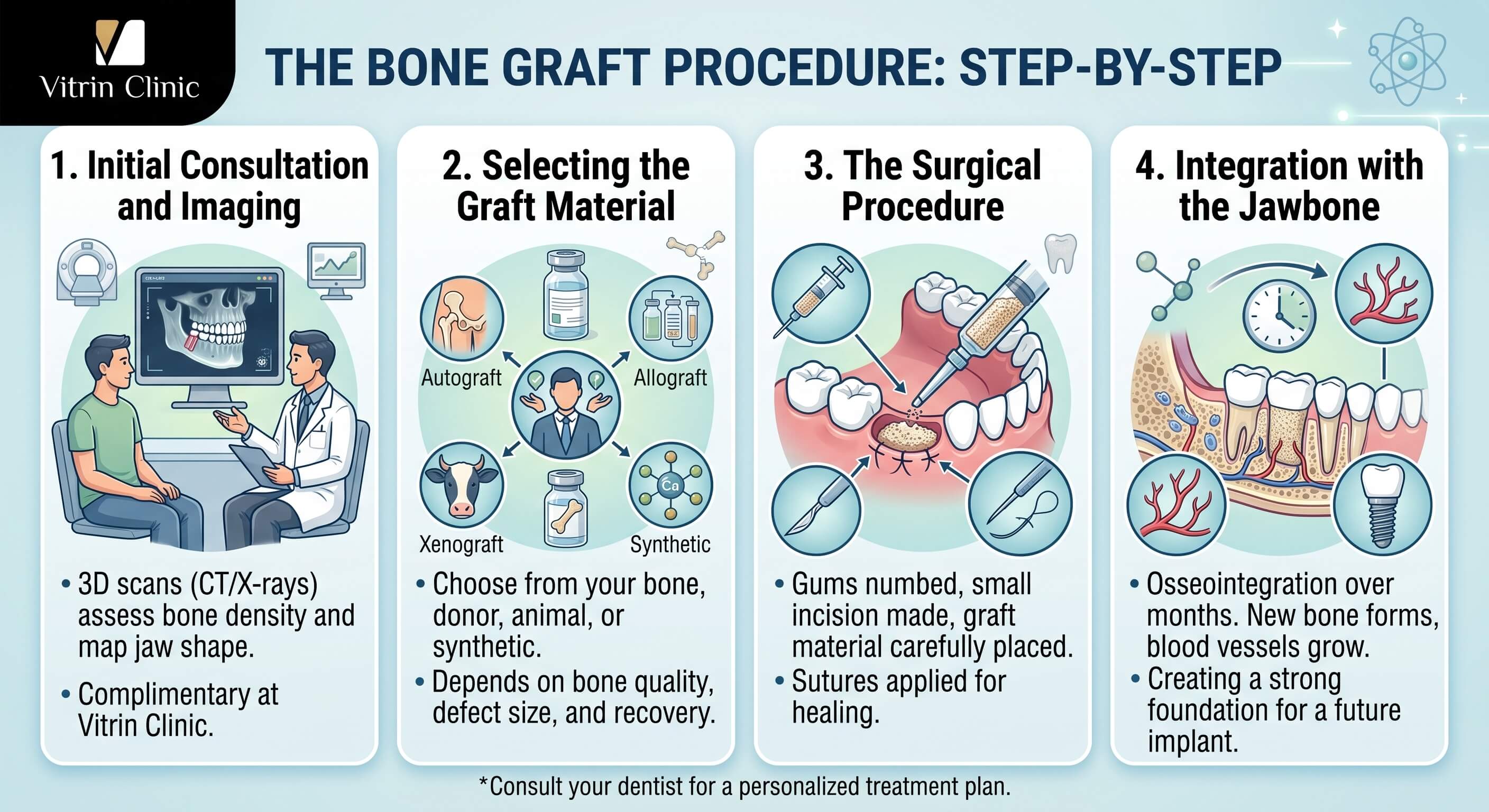
The process follows four clear stages: an initial consultation with 3D imaging, selection of the right graft material, the surgical placement itself, and a healing period where the graft fuses with your natural bone.
1. Initial Consultation and Imaging
Treatment starts with a 3D scan or X-ray to assess bone density and map the exact shape of your jaw. At Vitrin Clinic, this is included as part of a complimentary consultation. This imaging lets the implantologist identify weak spots, measure available bone, and design a grafting plan tailored to your anatomy and treatment goals.
2. Selecting the Graft Material
Different materials suit different cases — your own bone, donor bone, animal-derived bone, or synthetic minerals (covered in detail below). The choice depends on your bone quality, the size of the defect, and your own preferences around recovery time and material source.
3. The Surgical Procedure
The dentist numbs the area, makes a small incision, and places the graft material where it's needed to rebuild lost volume. Sutures are applied, and healing begins almost immediately. The procedure itself is typically completed in under an hour for most cases. It's worth understanding the possible dental implant complications tied to bone grafting and implant surgery generally, so you know what to watch for during recovery.
4. Integration with the Jawbone
Over time, your body gradually replaces the graft material with your own natural bone — a process called osseointegration. It usually takes a few months, with the exact timeline depending on graft size and your overall bone health. During this period, blood vessels grow into the graft and new bone cells form around it, creating a strong, living foundation ready to support an implant.
Types of Bone Graft Materials
Understanding your options helps you make an informed choice alongside your dentist.
Autograft (Your Own Bone)
Harvested from another area of your body — typically the hip or chin — an autograft offers the best possible biological compatibility, since it comes from your own living tissue. It requires a second surgical site, meaning slightly longer recovery, but integrates exceptionally well with essentially no rejection risk. It's widely considered the strongest option when bone quality and stability are the top priority.
Allograft (Donor Bone)
Sourced from a human donor, allografts are thoroughly processed, sterilized, and screened for safety. This option avoids the need for a second surgical site, meaning less discomfort and a faster overall recovery — a popular choice for patients who want reliable bone regeneration without the added healing time of harvesting their own bone.
Xenograft (Animal Source)
Typically sourced from bovine (cow) bone, xenografts are well-processed, purified, and commonly used in dental restoration worldwide. They act as a scaffold that slowly resorbs as your own bone grows in to replace it over several months.
Synthetic Materials (Alloplast)
Made from minerals such as calcium phosphate, synthetic grafts involve no donor or animal tissue at all. Manufactured under strict quality controls, they offer consistent, predictable results with minimal infection risk, and are especially popular for smaller defects or ridge preservation cases.
Healing Timeline: When Can You Get a Dental Implant After a Bone Graft?
Healing happens in stages — from initial swelling and tenderness in the first days, through soft tissue closure over the following weeks, to full bone integration over several months.
Immediately After Surgery
Expect some swelling, mild pain, and limited mouth movement in the first few days. Ice packs and prescribed medication help manage these symptoms. Most patients resume normal daily activities within a few days, though strenuous exercise and hard foods should be avoided until your dentist confirms the site is stable.
Week-by-Week Recovery
Weeks 1–2: Swelling subsides; stitches may be removed
Weeks 3–4: Soft tissue heals
Months 3–6: Bone integrates and strengthens
So, When Can You Get a Dental Implant After a Bone Graft?
Most patients are ready for their implant 4 to 6 months after grafting, depending on healing progress and graft complexity. Simpler grafts (like small ridge preservation cases) may allow earlier placement; larger reconstructions, such as block grafts, typically need additional healing time. Your implantologist confirms readiness through follow-up imaging, ensuring the graft has fully integrated before it's asked to support an implant long-term.
Benefits and Risks of Bone Grafting for Implants
Key Benefits
A bone graft restores lost bone volume, giving your jaw the density needed to support an implant securely for years. It also improves implant stability, reducing the risk of failure or shifting after placement, and helps prevent the facial sagging that comes from long-term bone loss — preserving a more natural facial structure over time.
Common Risks and Complications
Serious complications are uncommon when the procedure is performed by an experienced specialist. Infection is the most frequently reported issue, usually manageable with antibiotics and proper aftercare. Graft rejection is rare, particularly with biocompatible materials like allografts or synthetics. Mild swelling or discomfort is normal and temporary, typically fading within a week.
Reducing Healing Time and Avoiding Infection
Following post-operative instructions is the single most important factor in fast, complication-free healing: avoid smoking and alcohol (both slow blood flow and delay tissue repair), keep the surgical area clean with any prescribed rinses, avoid disturbing the site with your tongue or fingers, and attend every follow-up visit so any issues are caught early.
How Much Does a Bone Graft for Teeth Cost?
Cost varies widely depending on the material used, the size of the graft, and whether the procedure is simple or complex.
General price ranges:
Simple grafts (minor ridge preservation, small-area cases): $300–$800
Complex grafts or sinus lifts: $1,000–$3,000+
Vitrin Clinic offers transparent, itemized pricing and flexible payment plans, typically well below equivalent US, UK, and European rates, with every consultation provided free of charge. If you're planning the full treatment journey, it's worth reviewing overall digital dental implant costs alongside your grafting estimate so you have a complete picture before committing.
What Affects the Final Price
The type of material (autograft, allograft, xenograft, or synthetic) affects pricing directly, as does the size and location of the graft — larger or harder-to-reach areas need more material and time. Whether it's a simple graft or a more complex procedure like a sinus lift is usually the single biggest factor in the final number.
Advanced Bone Grafting Techniques
Beyond standard grafting, more complex bone loss patterns call for specialized techniques.
Alveolar ridge preservation (socket grafting) is performed immediately after a tooth extraction to stop the natural collapse of the jawbone, preserving ridge width and height before major shrinkage occurs — often recommended for patients planning an implant later in their treatment.
Sinus lift procedures raise the sinus floor to create more bone volume in the upper back jaw, an area where bone is naturally thinner. This is essential when the sinus sits too close to the jaw for an implant to be placed safely.
Guided bone regeneration (GBR) uses a protective membrane over the grafted area, keeping soft tissue from growing into the site too quickly while new bone forms underneath — one of the more reliable ways to rebuild volume for moderate ridge defects.
Block bone grafts are used for more significant bone loss that smaller techniques can't correct alone. A solid block of bone, often harvested from the patient's own jaw or hip, is secured in place with small screws — this needs a longer healing period but offers an especially strong foundation.
Horizontal vs. vertical bone regeneration: horizontal regeneration widens a jawbone that's become too thin side-to-side; vertical regeneration adds height to bone that's resorbed downward, often after long-term tooth loss. Which approach fits depends on your specific bone loss pattern, identified through 3D imaging.
Is a Bone Graft Right for You?
A bone graft is likely right for you if imaging shows your jawbone is too thin, soft, or resorbed to safely anchor an implant on its own — or if you've had missing teeth for years, lost bone to infection or trauma, or simply want the strongest possible foundation for your implant. The only way to know for certain is a 3D scan and evaluation, which Vitrin Clinic provides free of charge.
Not Every Patient Needs One
Alternatives exist for some cases: short or narrow-diameter implants that fit smaller bone areas without additional augmentation, All-on-4 techniques that anchor implants in the jaw's denser regions, and zygomatic implants for patients with severe upper jaw bone loss. Your implantologist will assess your bone volume to determine whether an alternative can safely avoid grafting altogether.
Tips for a Smooth Recovery
Eat soft foods — soup, yogurt, mashed vegetables — for the first few days, and avoid anything hard, crunchy, or chewy near the surgical site. Sleep with your head slightly elevated to reduce swelling, and use a cold compress on the outside of your cheek during the first 48 hours. Skip smoking, alcohol, and vigorous exercise until your dentist gives the go-ahead, since all three slow blood flow and delay healing. Rinse gently with any prescribed solution rather than brushing directly over the area, and don't skip a follow-up appointment even if you feel fine.
Clinical Perspective: What Our Team Sees in Practice
Dr. Rifat Alsaman, Head of the Medical Team and cosmetic dentist at Vitrin Clinic, notes that timing and imaging accuracy matter more than the specific graft material chosen in most cases. Patients who follow the recommended healing window before implant placement — rather than rushing ahead — consistently see better long-term integration. He also points out that patients who undergo guided bone regeneration or socket grafting right after extraction tend to need less extensive grafting later, since the ridge is preserved before major bone loss occurs.
His guidance on warning signs: mild, temporary swelling is normal and not a sign of failure, but persistent pain, fever, or discharge after the first week always warrants a same-week check-up rather than a wait-and-see approach.
Preparing for Surgery: What to Expect
Preparation starts with a full medical and dental evaluation, including 3D imaging to precisely map bone density and jaw structure. Patients are usually asked to avoid smoking, blood thinners, and alcohol in the days before surgery, which reduces bleeding and supports healing.
Before any bone graft or implant procedure, Vitrin Clinic requires informed consent from every patient without exception — a full explanation of the procedure, materials used, expected outcomes, and possible risks in your own language, with time to ask questions before you sign.
Why Choose Vitrin Clinic
Vitrin Clinic is a dental clinic in Istanbul, Turkey, that has treated international patients since 2007, combining 3D imaging and guided bone regeneration technology with a patient-first approach to every grafting and implant case. Led by Dr. Rifat Alsaman, our specialists guide patients through every step — from a free consultation through full recovery.
Book a free consultation to get an imaging-based assessment of whether you need a bone graft, and what it would cost in your specific case.
Key Takeaways
A bone graft for implants rebuilds jawbone that's too thin or soft to support a dental implant on its own, using your own bone, donor bone, animal-derived material, or a synthetic substitute. The procedure itself typically takes under an hour, but full integration takes three to six months — meaning most patients can expect their implant around four to six months after grafting. Costs range roughly from $300 for simple cases to $3,000+ for advanced procedures like sinus lifts, and complications are uncommon with an experienced surgeon and good aftercare.
References:
FAQs
Dr. Rifat Alsaman has more than 5 years of clinical experience in dentistry and currently serves as the Head of the Medical Team at Vitrin Clinic. He is dedicated to providing exceptional patient care, overseeing treatment planning, and ensuring the highest clinical standards across the team. His expertise, attention to detail, and commitment to continuous professional development have helped countless patients achieve healthier, more confident smiles.


