Oral Dentistry
July 18, 2025
Denture Adhesives: Types, Top Brands, and How to Choose the Right One for You
 Dr. Rifat Alsaman
For millions of people who wear dentures, comfort and functionality are top priorities. While a well-fitted denture can work perfectly on its own, many patients turn to denture adhesives for extra confidence, stability, and all-day comfort — especially as gum and bone structures naturally shift over time.
At Vitrin Clinic, we understand how important a secure smile is for both health and confidence. In this guide, we break down everything you need to know about denture adhesives — from the types and top brands to how to choose the best one for your needs, and how it compares to leading products on the market like Fixodent and Poligrip.
Quick answer: For most people, a zinc-free cream such as Super Poligrip Free or Fixodent Complete Original offers the most reliable all-day hold. Adhesive pads work best for sensitive gums, and powders suit patients who want a lighter, mess-free feel. If you're relying on adhesive daily just to keep your dentures in place, that's usually a sign your dentures need refitting — not more glue.
What Are Denture Adhesives?
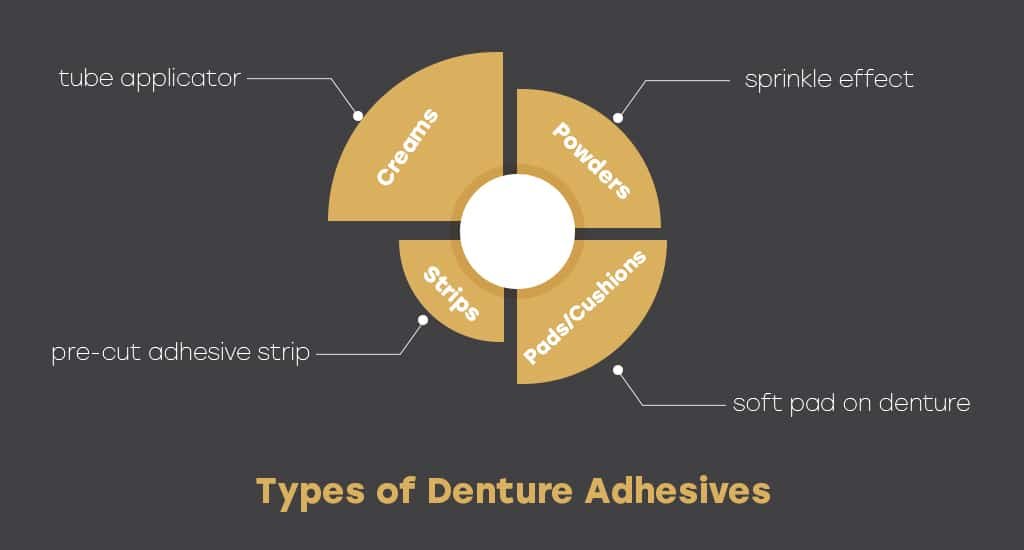
Denture adhesives — also called denture glue, denture fixatives, or denture adherents — are non-toxic products used to enhance the fit and hold of dentures in your mouth. They come in several forms: creams, powders, strips, and pads, and they're especially useful when dentures start to feel loose or uncomfortable over time.
Denture adhesives aren't new. Early formulations date back to 1913, and it wasn't until 1935 that the American Dental Association formally recognized them as a legitimate dental product — a recognition that still shapes how these products are regulated today.
While dental adhesives are not a substitute for a properly fitted denture, they're a helpful tool for boosting retention, reducing movement while eating or speaking, and preventing sore spots caused by a shifting denture.
How Do Denture Adhesives Work?
Most adhesives rely on polymers — typically carboxymethyl cellulose (CMC) and polyvinyl methyl ether maleic acid (PVM-MA) — that swell on contact with saliva. This creates a viscous layer that fills microscopic gaps between the denture base and the gum ridge, forming a seal that resists movement during chewing and speaking.
Soluble adhesives (creams, powders) dissolve gradually throughout the day and need reapplication. Insoluble adhesives (pads, strips, thermoplastic materials) stay largely intact and are activated by moisture rather than dissolved by it — which is why they tend to last longer for patients with a very wet or a very dry mouth.
Types of Denture Adhesives
There are five main types of denture adhesives. Each has its own benefits, and the right choice often depends on your personal comfort, denture fit, and lifestyle.
1. Adhesive Creams
Best for: Secure, all-day hold
Adhesive creams are the most common type and come in tubes. They form a tight bond when applied to clean dentures and pressed against the gums. Some brands market a thicker version of this same product as "gel denture adhesive" — it's essentially a cream formula with a firmer texture, not a different active ingredient.
Pros: Strong hold through chewing; good fit against the gums; performs best a few hours after application. Cons: Can be hard to remove completely; overuse may leave an unpleasant taste or affect denture fit.
How to Use:
Clean and dry your dentures.
Apply a thin strip of cream along the ridges — one application per day is enough.
Insert and press firmly for a few seconds, then wipe off any excess and wait 5 minutes before eating or drinking.
At the end of the day, rinse thoroughly and clean both your dentures and mouth.
2. Adhesive Powders
Best for: A light hold with minimal mess
Powders are ideal for patients who want an easier cleanup and a lighter feel in the mouth. Most contain cellulose gum, which expands 50–150% in volume on contact with saliva.
Pros: No taste or smell; easy, thin application. Cons: Doesn't last as long as creams and may need reapplying; relies on saliva, so it's less effective for dry mouths.
How to Use:
Moisten your clean dentures.
Sprinkle powder evenly along the denture base.
Press dentures into place and hold for a few seconds.
Rinse thoroughly before bed.
3. Adhesive Strips
Best for: Convenience and targeted application
Strips are pre-cut, mess-free options activated by moisture rather than dissolved by it, which makes them a good option for patients with excess saliva. You'll sometimes see these sold as "denture tape" — same product category, different name.
Pros: Precise, targeted hold; easy to clean and swap out; longer-lasting grip than creams for some patients. Cons: May slightly change your bite over time; adhesion can be weaker than creams for heavy chewers.
How to Use:
Dry your dentures completely.
Apply the strip along the ridges, not too close to the edge, without touching the sticky side.
Lightly moisten and smooth out any bubbles or wrinkles.
Insert and press dentures firmly in place for a few seconds.
4. Adhesive Pads (Cushions)
Best for: Sensitive gums or an ill-fitting denture
Adhesive pads create a cushioning effect and offer gentle support for sore gums or ridges that have changed shape over time.
Pros: Soft and cushiony for tender gums; no risk of overapplication; clean, neat application with no spreading residue. Cons: May shift how your denture fits over time; can feel like pressure for very sensitive gums.
How to Use:
Place on clean, dry dentures.
Peel both sides of the backing and apply evenly along the ridges, avoiding the edges.
Press firmly and insert your dentures.
5. Thermoplastic Adhesives
Best for: Long-lasting, custom-molded fit
Thermoplastic adhesives soften when heated and mold to the gums as they cool, creating a fit that's tailored to your mouth. They're more biocompatible than chemical-based adhesives and don't need to be reapplied daily.
Pros: Doesn't dissolve, so it won't slip even when wet; fills gaps under dentures to reduce irritation; lasts longer than creams or powders. Cons: Requires hot water to soften, which makes it less convenient; must be reheated to reuse; incorrect molding can cause pressure or discomfort; not compatible with every denture type.
How to Use:
Soften the material in hot water.
Brush and floss your teeth first.
Spread the softened adhesive evenly on the denture surface.
Insert and press gently, letting it mold to your gums as it cools.
Hold in place for a few seconds until it sets. Reheat and reshape to reuse.
Denture Adhesive vs. Denture Repair Glue: Know the Difference
If you're searching for something like "glue to repair broken dentures" or a "denture repair kit," you're actually looking for a different product than the ones in this guide.
Denture adhesive (covered in this article) sits between your gums and the denture to improve grip and comfort. It has no structural strength and should never be used to mend a crack, fix a broken clasp, or reattach a detached tooth.
Denture repair glue uses a dental-grade acrylic resin to structurally rebond broken denture pieces. These are sold as standalone "denture repair kits" and are meant as a temporary fix only.
If your denture is cracked, chipped, or a tooth has come loose, don't reach for daily adhesive — that's a job for a repair kit as a short-term measure, and ideally for your dentist or a dental lab for a permanent, bite-accurate fix. A denture repaired with the wrong material can throw off your bite and cause further damage.
Top Denture Adhesive Brands
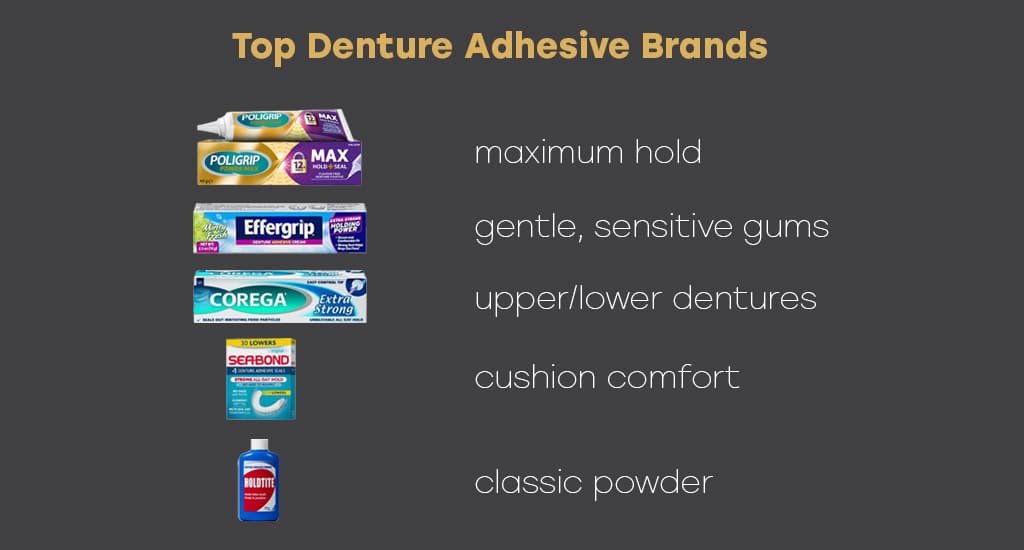
Not all adhesives are created equal. Here are the top-rated denture adhesives trusted by patients and recommended by dental professionals:
Brand | Type | Best Known For |
Secure® Denture Adhesive | Cream | Water-insoluble hold, ideal for dry mouth or long wear |
Fixodent Ultra Max Hold | Cream | Strong, all-day hold for upper and lower dentures |
Effergrip® Adhesive Cream | Cream | Zinc-free, effective for sensitive mouths |
Corega® Extra Strong | Cream | Popular European brand for upper/lower dentures |
Sea-Bond® Adhesive Seals | Pad/Wafer | Pre-cut, cushion-like pads for comfort |
Holdtite® Powder | Powder | Classic powder with reliable adhesion |
Super Poligrip Free | Cream | Zinc-free, dentist-recommended for daily use |
Fixodent vs. Poligrip vs. Polident: Which Is Better?
This is one of the most common questions patients ask us, so here's a direct comparison:
Adhesive | Zinc-Free Options | Typical Hold Time | Best For |
Fixodent | Yes (Complete Original, Ultra Max) | Up to 12 hours | Strong grip, narrow applicator suited to lower dentures |
Poligrip (Super Poligrip) | Yes (Free formula) | Up to 12 hours | Sensitive gums, reduces food particle buildup |
Polident | Yes | Up to 12 hours | Combined adhesive + cleansing routine, milder formula |
In practice: Fixodent and Poligrip perform very similarly in independent hold tests, so the "better" choice usually comes down to sensitivity and texture preference rather than raw strength. Patients with sensitive gums often report Poligrip's zinc-free formula feels gentler, while Fixodent's narrower applicator tip makes it easier to control on lower dentures. Polident is generally chosen by patients who want an adhesive from the same brand family as their cleansing tablets. As always, if none of these hold your denture securely for a full day, that's a sign to see your dentist rather than switch brands again.
Budget-Friendly Denture Adhesive Options
You don't need to spend a lot to get a reliable hold. A few things to keep in mind if you're comparing options on price:
Compare cost per week of use, not per tube. A cheaper tube that needs reapplying three times a day works out more expensive than a pricier one that holds a full day.
Powders are usually the cheapest per application since a thin layer goes a long way.
Zinc-free formulas cost slightly more than older zinc-based versions, but the extra cost is worth it to avoid long-term zinc exposure.
Be cautious with unbranded "natural" adhesives that don't list active ingredients — cheap isn't the same as well-formulated, and an unlisted ingredient set makes it harder to catch an allergy risk.
Major drugstore brands (Fixodent, Poligrip, Corega, and most store-brand equivalents) remain the most cost-effective, well-tested choice for most patients.
Where to Buy Denture Adhesive
Denture adhesives are sold over the counter — no prescription needed. You can find them at:
Pharmacies and drugstores (Walgreens, CVS, Boots, and similar chains) — these typically carry the major brands like Fixodent, Poligrip, and Sea-Bond
Supermarkets — a smaller range, usually basic cream or powder options
Online retailers — the widest selection, including zinc-free, thermoplastic, and specialty brands not always stocked in stores
Your dentist's office — some clinics carry or recommend a specific brand suited to your denture type
Key Factors to Consider When Choosing a Denture Adhesive
1. Hold Strength
You want an adhesive that lasts through meals and daily activities. Look for one that offers 12–24 hours of hold and is resistant to moisture.
2. Comfort
For those with sensitive gums, adhesive pads or strips are less likely to cause irritation than creams.
3. Ease of Application & Removal
Creams and powders can be harder to clean off than pads or strips — choose what fits your daily routine.
4. Ingredients
If you're avoiding zinc or have allergies, check the ingredient list carefully. Zinc-free formulas are now widely available across every major brand.
5. Medical Conditions
If you have dry mouth, gum sores, or bone loss, certain adhesives — like Secure® or cushion pads — work better than standard creams. Always consult a dental professional before choosing.
Best Adhesives for Specific Needs
For Bone Loss
Super Poligrip Free or Fixodent Complete (zinc-free) provide strong stabilization. Cushion-type adhesives are also more comfortable for receded gumlines, since they fill space rather than relying purely on suction.
For Upper Dentures
Upper dentures generally hold more securely because they cover more of the palate, giving adhesives a larger surface area for suction. Cushion-style adhesives (Ezo-type pads) work well here by filling small gaps and improving the seal.
For Lower Dentures
Lower dentures are harder to stabilize since they cover less surface area and sit closer to the tongue's movement. Secure® Adhesive or Fixodent Complete Original (with its narrow applicator tip) are strong picks — both are ideal because they're not fully water-soluble and adhere well even with a naturally dry mouth.
For a Zinc-Free Routine
If you want to avoid zinc entirely: Super Poligrip Free, Effergrip®, and Cushion Grip Thermoplastic are all reliable zinc-free options that don't compromise on hold.
For Partial Dentures
Partial dentures need a gentler approach since they sit alongside natural teeth and metal clasps. Fixodent Extra Hold is soft enough not to damage the denture material or irritate the clasps, while still holding securely. Apply adhesive only to the fitting surface — never near the clasps themselves, as buildup there can affect how the partial clicks into place.
For Sore or Sensitive Gums
If your gums are tender or easily irritated, adhesive pads or cushions are generally the better choice over creams or powders, since they distribute pressure more evenly and reduce direct friction. Look for zinc-free, fragrance-free formulas, as flavoring agents like peppermint or wintergreen oil can trigger irritation in sensitive mouths.
For Dry Mouth
Standard creams and powders rely on saliva to activate and swell, so they tend to underperform in a dry mouth. Secure® Denture Adhesive and other water-insoluble, non-saliva-dependent formulas hold better in these cases. If dry mouth is a persistent issue, mention it to your dentist — it can also affect denture fit and oral health more broadly.
How Long Does Denture Adhesive Last?
Quick answer: Most creams, powders, strips, and pads are formulated for up to 12 hours of hold. Thermoplastic adhesives are engineered to last several days between reapplications. No over-the-counter adhesive is intended to stay in place for a full week — regardless of how long a product claims to hold, dentures should still be removed and cleaned daily, and your gums need that daily break to stay healthy.
Actual hold time depends on the product, how well your denture fits to begin with, what you eat, and how much you talk. If an adhesive is consistently wearing off in just a few hours, it's a sign to have your denture fit checked rather than switching to a stronger product.
Possible Side Effects and Safety
Denture adhesives are generally safe when used as directed, but a few things are worth knowing:
Zinc exposure: Older zinc-containing formulas, when significantly overused over months or years, have been linked in case reports to zinc-related neurological problems. This is why most major brands — including Poligrip, Fixodent, and Sea-Bond — now offer zinc-free versions, which most dentists recommend as the safer default.
Gum irritation or altered taste: Some users report mild irritation, a lingering aftertaste, or (rarely) an allergic reaction to a specific ingredient, such as latex in some pad backings.
Trapped food and bacteria: Applying more adhesive than needed can trap food particles and bacteria against the gum tissue, leading to irritation or odor over time.
If you notice swelling, a rash, or ongoing discomfort after using a particular adhesive, stop using it and check with your dentist.
How to Remove Denture Adhesive
Proper removal helps avoid gum irritation and keeps your mouth and dentures healthy.
Rinse your mouth with warm water to gently loosen residue without discomfort.
Gently rock your dentures back and forth to loosen them — don't pull.
Remove the dentures carefully, without tugging or using sharp objects.
Rinse away remaining adhesive with warm water and a soft brush.
Clean your dentures thoroughly using a proper denture cleanser to remove food and bacteria.
Store dentures properly in a container of clean water overnight.
Dealing With Stubborn Adhesive Residue
For leftover residue that warm water and brushing don't fully clear, dedicated denture-cleaning solutions (enzymatic soaking tablets or solutions) are designed to dissolve adhesive buildup from both the denture surface and your gums without scratching the acrylic. Avoid alcohol-based mouth rinses or sharp tools to scrape off residue — both can damage the denture surface or irritate your gum tissue.
Who Should Not Use Denture Adhesives?
Not everyone should use adhesives. Avoid them if you:
Have gum sores or ulcers
Are allergic to ingredients (e.g., latex or zinc)
Have poorly fitting dentures — you likely need a refitting, not more glue
Have a medical condition affecting healing (e.g., uncontrolled diabetes)
When in doubt, speak with your dentist before starting or continuing regular adhesive use.
Are There Natural Alternatives?
Yes — while not as strong as commercial adhesives, some natural, short-term options include:
Aloe Vera Gel: Gentle and soothing for sensitive gums.
Beeswax + Coconut Oil Mixture: Offers mild hold and moisture; coconut oil also softens the gums.
Cornstarch and Water Paste: A mild, homemade adhesive that holds for a short time.
Clove Oil: Has anti-inflammatory properties but should be used sparingly.
These work best as short-term or occasional options and generally aren't a substitute for a properly fitted denture.
Keeping Dentures in Place Without Adhesive
Adhesive shouldn't be a long-term fix for a poorly fitting denture. Here's how to improve hold without relying on glue every day:
Get your dentures refitted regularly — bone and gum shape change over time.
Eat softer foods when your fit feels less secure.
Avoid sticky or very hard foods that can dislodge a denture.
Chew evenly on both sides to maintain balance and reduce slipping.
Stay hydrated — adequate saliva helps keep dentures stable.
Keep dentures clean and plaque-free daily to prevent bacteria buildup.
Consider mechanical support like denture grips or locks, or ask about implant-supported options.
Everyday Denture Care: Gum and Toothpaste Tips
A couple of small daily habits make a real difference in comfort, separate from the adhesive itself:
Chewing gum: Regular chewing gum sticks readily to denture acrylic and can pull a denture loose. If you want to chew gum, look for sugar-free, non-stick gum, or simply avoid gum while wearing dentures with adhesive applied.
Toothpaste: Skip regular whitening or abrasive toothpaste on your dentures — the abrasives that whiten natural enamel will scratch and dull denture acrylic over time. Use a toothpaste or cleanser specifically labeled for dentures, or a mild soap-based cleanser instead.
Ready for a More Comfortable Smile?
At Vitrin Clinic, we go beyond temporary fixes. If you're struggling with loose dentures or relying on adhesive every day just to get through it, it might be time to consider a better long-term solution — like implant-supported dentures or precision-fit prosthetics.
Book a FREE Consultation today and let our specialists help you find the perfect solution for lasting comfort and confidence.
Located in Istanbul, we welcome local and international patients seeking world-class care and beautiful smiles.
FAQs
Dr. Rifat Alsaman has more than 5 years of clinical experience in dentistry and currently serves as the Head of the Medical Team at Vitrin Clinic. He is dedicated to providing exceptional patient care, overseeing treatment planning, and ensuring the highest clinical standards across the team. His expertise, attention to detail, and commitment to continuous professional development have helped countless patients achieve healthier, more confident smiles.


