Dentures in Turkey
February 8, 2026
Dental Implants in Turkey Cost: What Are the 2027 Prices and Treatment Options?
 Dr. Rifat Alsaman

Dental implants in Turkey cost less than treatment in many Western countries, but the final price depends on more than the implant itself. Implant brand, number of fixtures, crown material, bone condition, surgical complexity, and prosthetic design all influence the total treatment cost.
At Vitrin Clinic in Istanbul, we provide dental implant treatments for international patients, from single-tooth replacement to full-mouth rehabilitation. Our medical team develops individual treatment plans based on oral health, jawbone conditions, and functional requirements.
Our standard All-on-X treatments start from $2,000 per arch, with both arches starting from $4,000. Single implant treatment is generally priced according to the selected implant system and restorative components.
In this comprehensive 2027 guide, we compare dental implant prices in Turkey, UK, and US. We also explain different implant procedures, material options, additional surgical costs, treatment timelines, and what patients should consider before choosing their treatment.
Key Takeaways
Dental implant costs in Turkey depend on implant systems, restoration materials, bone conditions, and treatment complexity.
Options include single implants, All-on-4, All-on-6, All-on-8, and full-mouth rehabilitation.
Vitrin Clinic's All-on-X treatment starts from $2,000 per arch and $4,000 for both arches.
Titanium and zirconia are two implant material options, each with different clinical characteristics.
Additional procedures, such as bone grafting, sinus lifts, and extractions, can increase treatment costs.
Implant treatment may require two visits, with several months of healing before final restoration.
Long-term results depend on proper oral hygiene, regular professional monitoring, and appropriate aftercare.
International patients should compare complete treatment quotations, package inclusions, and follow-up arrangements before travelling.
Ready to transform your smile?
Talk to our team and get a personal FREE treatment plan.
Understanding Dental Implant Pricing and Treatment Costs in Turkey
The cost of dental implant treatment in Turkey depends on several elements, from the implant materials and specialist experience to the clinic's operating expenses. Turkish dental clinics offer access to established implant systems at competitive prices, partly due to lower operational costs and currency exchange differences. Knowing how these factors affect treatment fees helps international patients compare options and prepare financially. Turkey's established dental tourism sector also provides treatment packages that can make the overall costs easier to understand.
How Do Dental Implants Replace Missing Teeth Over the Long Term?
Dental implants are small titanium posts placed surgically into the jawbone to act as artificial tooth roots. They provide support for replacement teeth, including individual crowns, bridges, and dentures. Following placement, the implant gradually bonds with the surrounding bone through osseointegration. This creates a stable base for the final restoration and allows it to function similarly to natural teeth. With suitable oral hygiene and regular professional care, dental implants can remain functional for many years. Their cost in Turkey offers international patients an opportunity to explore this long-term tooth replacement option at competitive prices.
What Determines the Final Price of Dental Implant Treatment in Turkey?
The total cost of dental implant treatment in Turkey is shaped by several factors. The selected implant brand, material specifications, jawbone condition, and number of implants required can all affect the quotation. Some patients may also need additional procedures, such as bone grafting or a sinus lift, which can increase treatment expenses. In Istanbul, prices may differ between districts because clinics have varying operating costs. Other considerations include the complexity of surgery, the type of final crown, the technology used, and the treating specialist's experience. Differences in package contents can also lead to variations in advertised prices. For a detailed cost breakdown, please consult our updated price list.

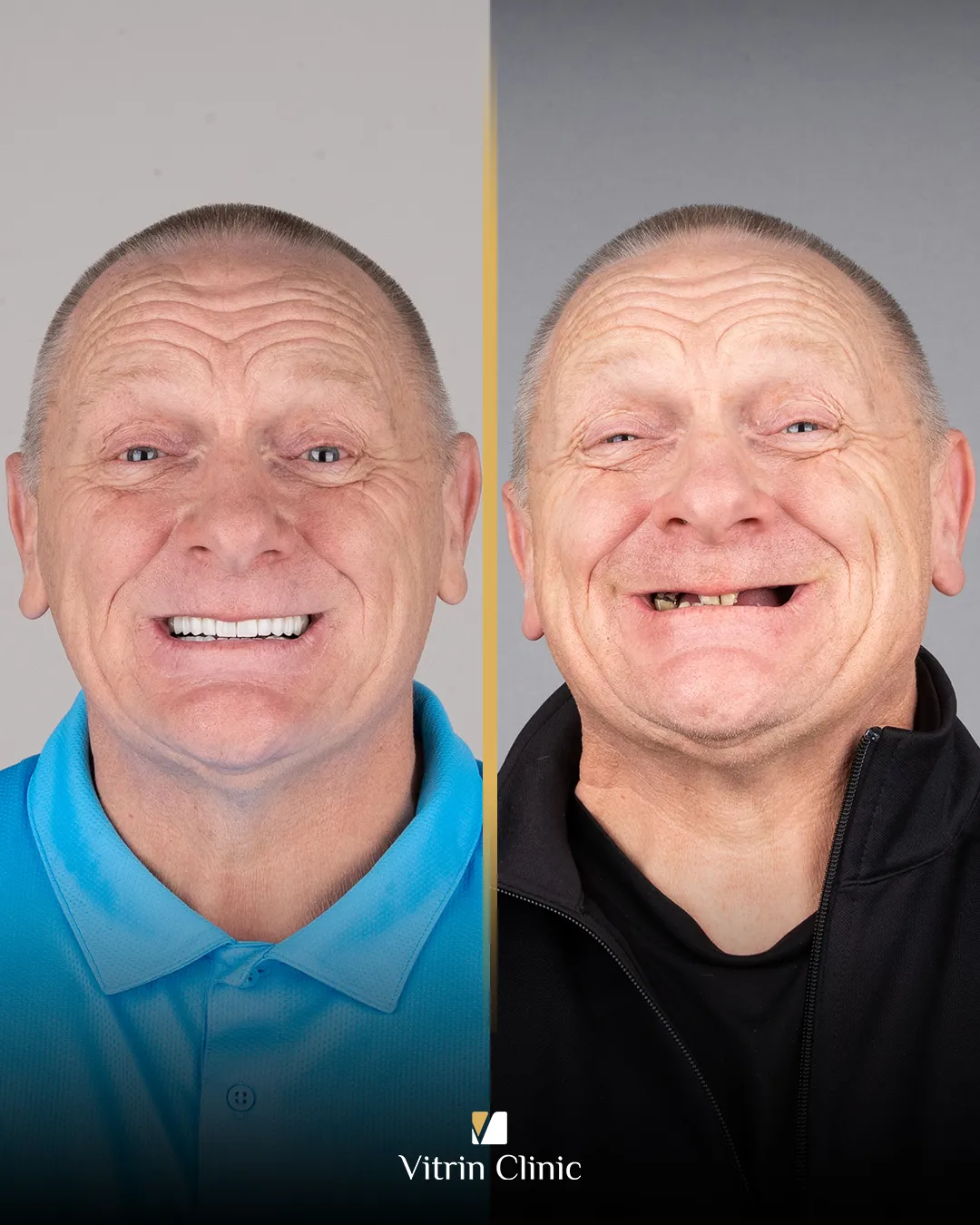

How Much Do Dental Implants in Turkey Cost in 2027?
Dental implant costs in Turkey depend on the restoration type and any additional procedures required. A single implant has a different cost structure from a full-arch All-on-4 restoration. Replacing several missing teeth may also require fewer implants than the total number of missing teeth.
The following 2027 price ranges offer an approximate budgeting reference for international patients.
What Are the Average Dental Implant Prices in Turkey?
Full-Arch Systems
From 2,600
Approximate Turkey market range
Implant-retained snap-in denture, per arch: 2,600–5,850
All-on-4, per arch: 3,250–8,450
All-on-6, per arch: 3,900–10,400
Single & Bridge Restorations
From 500
Approximate Turkey market range
Single implant with crown: 500–1,800
Three-unit dental bridge: 650–2,100
Individual & multi-tooth replacement
Bone & Sinus Prep
From 130
Approximate Turkey market range
Bone grafting, per site: 130–600
Sinus lift: 800–1,950
Establishes bone support for implants
How Much Do Dental Implants Cost at Vitrin Clinic?
At Vitrin Clinic, treatment quotations are based on the implant system, number of fixtures, restoration material, and any additional procedures required.
Our current starting-price structure includes:
Single & All-on-4
From $700
Vitrin Clinic price (USD)
Single dental implant: 700–1,500
All-on-4, one arch: From $2,000
All-on-4, both arches: From $4,000
All-on-6 Systems
From $4,000
Vitrin Clinic price (USD)
All-on-6, one arch: 4,000–9,000
All-on-6, both arches: 8,000–18,000
Enhanced bite force & full-arch stability
All-on-8 Support
5,000–11,000
Vitrin Clinic price (USD)
All-on-8, one arch: 5,000–11,000
8 implants per jaw for maximum durability
Includes free consultation & 3D CBCT scan
The single-implant range refers to implant treatment pricing. It should not automatically be understood as an all-inclusive cost covering the implant, abutment, and final crown.
For full-arch treatment, the final quotation depends on prosthetic materials, temporary and final restorations, and any additional surgical procedures.
Vitrin Clinic explains these components in a written treatment plan before treatment begins. This helps patients understand the proposed treatment and expected costs before making a decision.
What Should a Single Dental Implant Price Include?
A single dental implant quotation may cover several treatment components. However, advertised prices do not always include every part of the final restoration.
The written quotation should clarify whether it includes:
Implant fixture: The artificial tooth root surgically placed in the jawbone.
Abutment: The connector that joins the implant to the final crown.
Final crown: The visible replacement tooth attached to the implant.
Surgical placement: The procedure and associated clinical fees.
Diagnostic imaging: Dental X-rays or CBCT imaging when clinically indicated.
Temporary restoration: A temporary tooth when required during the healing period.
An advertised implant price may cover the implant fixture only, rather than the complete tooth restoration. Patients should request an itemised quotation before comparing prices.
How Do Dental Implant Costs in Turkey Compare with US and UK?
One reason international patients consider Dental Implants in Turkey Cost is the difference in private treatment prices. However, a fair comparison requires checking exactly what each quotation includes.
For example, an implant fixture price alone cannot be compared with a complete restoration that includes the abutment and crown. The following sections outline the approximate costs of different implant treatments across these countries.
How Much Does a Single Dental Implant Cost in Turkey, US, and UK?
A single dental implant restoration typically consists of three main components:
Implant fixture: The artificial tooth root surgically placed in the jawbone.
Abutment: The connector that joins the implant to the restoration.
Crown: The visible replacement tooth attached to the implant.
The following figures provide approximate private-treatment budgeting ranges.
UK
Single Implant with Crown: 1,800–3,500
Single implant with crown
Single implant with crown: 1,800–3,500
Private UK clinic standard rate
Domestic specialist dental care
Turkey
Single Implant with Crown: 500–1,800
Single implant with crown
Single implant with crown: 500–1,800
Up to ~70–80% savings vs. UK & USA
Full professional clinic standard care
US
Single Implant with Crown: 3,000–6,000
Single implant with crown.
Single implant with crown: 3,000–6,000
US private clinic standard rate
Highest domestic private expense
What Factors Explain Dental Implant Price Differences Between Countries?
Dental implant prices vary because of differences in clinic operating costs, materials, and clinical requirements. Staff salaries, laboratory fees, imported implant systems, and equipment expenses all affect treatment prices. The cost also depends on the patient's needs, including the number of implants and whether additional procedures, such as bone grafting or sinus lifts, are required. Furthermore, some clinics include crowns, abutments, and diagnostic scans in their quotations, while others charge for them separately. These differences explain why treatment prices can vary significantly between countries.
Laboratory and manufacturing costs
Dental laboratories produce crowns, bridges, and implant-supported prostheses. Technician fees, materials, and production arrangements differ between countries.
Clinic operating expenses
Staffing, rent, equipment maintenance, insurance, and other operating costs contribute to treatment prices.
Implant systems and components
Different implant systems have different purchasing costs. Their abutments and prosthetic components can also affect the overall quotation.
Treatment complexity
Bone grafting, sinus augmentation, extractions, and extensive prosthetic work can increase the total treatment cost.
Restoration materials
Zirconia and metal-ceramic crowns have different material and laboratory requirements. These differences can affect their prices.
At Vitrin Clinic, treatment recommendations are based on clinical requirements. The implant system is not selected solely because it has the lowest purchase price.
How Much Does All on 4 Cost in Turkey Compared with US and UK?
All on 4 replaces an entire dental arch using four strategically positioned implants to support a fixed prosthesis. It may be considered for patients who have lost most or all teeth in an arch.
UK
All-on-4 per arch: 10,000–18,000
All-on-4 per arch
All-on-4 per arch: 10,000–18,000
Private UK clinic standard rate
Domestic specialist dental care
Turkey
All-on-4 per arch: 3,250–8,450
All-on-4 per arch
All-on-4 per arch: 3,250–8,450
Save ~64% vs. UK & ~74% vs. USA
Full-arch fixed bridge & implant fixtures
USA
All-on-4 per arch: 18,000–30,000
All-on-4 per arch
All-on-4 per arch: 18,000–30,000
US private clinic standard rate
Highest domestic private expense
At Vitrin Clinic, the standard All-on-X starting price is $2,000 per arch. Treatment for both arches starts at $4,000.
Before comparing quotations, patients should check whether the price includes:
The number and brand of implants.
Surgical placement fees.
Abutments and multi-unit components.
Temporary fixed prosthesis.
Final prosthetic material.
Extractions, if required.
Bone grafting, if necessary.
Follow-up and maintenance arrangements.
What Is the Dental Implants in Turkey Cost Compared with USA and UK?
All-on-6 uses six implants to support a fixed full-arch restoration. The additional implant positions may offer another way to distribute functional forces across the arch.
However, six implants are not automatically better or more suitable for every patient. The decision depends on bone availability, implant distribution, bite forces, and the planned prosthetic design.
UK
All-on-6 per arch: 12,000–20,000
All-on-6 per arch
All-on-6 per arch: 12,000–20,000
Private UK clinic standard rate
Domestic specialist dental care
Turkey
All-on-6 per arch: 3,900–10,400
All-on-6 per arch
All-on-6 per arch: 3,900–10,400
Save ~55% vs. UK & ~77% vs. USA
6 implants per jaw with full fixed bridge
USA
All-on-6 per arch: 24,000–38,000
All-on-6 per arch
All-on-6 per arch: 24,000–38,000
US private clinic standard rate
Highest domestic private expense
How Much Does Full-Mouth Dental Implant Treatment Cost Across These Countries?
Full-mouth dental implant treatment generally involves restoring both dental arches. Depending on the patient's needs, the plan may include All-on-4, All-on-6, All-on-8, or another implant-supported rehabilitation design.
The total cost depends on several factors:
Whether one or both arches require treatment.
The number of implants needed.
Existing teeth that require extraction.
Any bone grafting procedures.
The type of temporary restoration.
The material used for the final bridge.
The complexity of bite reconstruction.
At Vitrin Clinic, treatment for both arches under the standard All-on-X starting-price structure begins at $4,000. More extensive rehabilitation may require a higher budget, particularly when additional surgery or different prosthetic materials are needed.
A full-mouth quotation should clearly state whether it covers both arches, the temporary restoration, and the final prostheses.
How Do Single Implants, All-on-4, All-on-6 and All-on-8 Differ?
Each implant approach addresses a different pattern of tooth loss. Although all four involve Dental Implants in Turkey Cost, they differ in the number of implants used, the type of restoration, and the clinical situations they may address.
Single Dental Implants: When Is One Implant Enough?
A single dental implant replaces one missing tooth. It is placed in the jawbone and supports an individual crown after the necessary healing and restoration stages.
Key characteristics:
Replaces one missing tooth.
Usually avoids preparing adjacent healthy teeth.
Restores chewing function in the affected area.
Requires sufficient bone or suitable augmentation.
Needs consistent cleaning and long-term maintenance.
All-on-4: How Can Four Implants Support a Full Arch?
All-on-4 uses four implants to support a fixed full-arch prosthesis. Some implants may be angled to make use of available bone and avoid certain anatomical structures.
For selected patients, this design may reduce the need for extensive bone augmentation. However, it does not eliminate the need for bone grafting in every case.
All-on-6: What Does Six-Implant Support Offer?
All-on-6 uses six implants to support a fixed restoration across an entire dental arch. The additional implants provide another possible distribution of support across the jaw.
However, using six implants does not automatically produce a better result. Suitability depends on bone availability, implant positioning, bite forces, and the planned restoration.
All-on-8: When Might Eight Implants Be Considered?
All-on-8 uses eight implants to support a fixed full-arch restoration. It may be considered when the patient's anatomy and restorative requirements justify additional implant support.
The decision requires careful planning. A higher implant count is not necessarily more appropriate for every patient.
What Are 3-on-6 Dental Implants, and How Do They Differ from All-on-6?
The 3-on-6 technique uses six dental implants to support three separate fixed bridges across one dental arch. Unlike a conventional full-arch design, the restoration is divided into three sections.
This approach may be considered for selected patients who need extensive tooth replacement. Its suitability depends on bone availability, implant positioning, bite forces, and the planned restoration.
How Do Three Separate Bridges Work?
Each bridge is supported by the implants positioned for that section of the arch. The three restorations work together to replace missing teeth, but they remain separate prosthetic units.
3-on-6 vs All-on-6: What Are the Main Differences?
Feature | 3-on-6 | All-on-6 |
Implant number | Six | Six |
Restoration design | Three separate bridges | One full-arch restoration |
Support | Distributed across three prosthetic sections | Supports a full-arch prosthesis |
Treatment planning | Requires planning for three connected sections of tooth replacement | Requires planning for one full-arch restoration |
Suitability | Depends on anatomy and restorative requirements | Depends on anatomy and restorative requirements |
How Do Single Implants and Full-Arch Implant Options Compare?
Feature | Single implant | All-on-4 | All-on-6 | All-on-8 |
Main purpose | Replace one tooth | Restore one arch | Restore one arch | Restore one arch |
Implant number | Usually one | Four | Six | Eight |
Restoration | Individual crown | Fixed bridge | Fixed bridge | Fixed bridge |
Potential application | Individual tooth loss | Selected full-arch cases | Selected full-arch cases | Selected full-arch cases |
Cost structure | Per tooth | Per arch | Per arch | Per arch |
Ready to transform your smile?
Talk to our team and get a personal FREE treatment plan.
Titanium vs Zirconia Dental Implants: How Do the Materials Compare?
The material used for a dental implant is an important part of treatment planning. Titanium and zirconia have different physical properties, clinical evidence, and available implant designs. Understanding these differences can help patients discuss suitable options with their dentist.
Titanium Dental Implants: Why Are They Widely Used?
Titanium implants have a long history of clinical use and extensive research in implant dentistry. They are widely used because of their established osseointegration properties and broad range of available prosthetic components.
Potential advantages:
Extensive clinical evidence and long-term use.
Well-established implant designs.
Wide availability of prosthetic components.
Options for different implant positions and restorative needs.
Well-documented clinical applications.
Important considerations:
Titanium is a metal.
Implant positioning and surrounding tissue conditions remain important.
Patients with specific concerns about metal materials should discuss them during treatment planning.
Zirconia Dental Implants: When Is a Ceramic Option Considered?
Zirconia implants are ceramic implants made from zirconium dioxide. Their metal-free composition may make them an option for selected patients, depending on their clinical needs and the available implant system.
Potential advantages:
Metal-free ceramic material.
White appearance.
May offer aesthetic considerations in selected clinical situations.
Important considerations:
Clinical evidence varies between zirconia implant systems.
Long-term research is less extensive than for established titanium systems.
Implant designs and prosthetic options may be more limited.
Suitability depends on individual clinical findings.
Which Is More Suitable: Titanium or Zirconia Implants?
Consideration | Titanium | Zirconia |
Material | Metal | Ceramic |
Colour | Metallic | White |
Clinical evidence | Extensive | Less extensive overall |
Available designs | Broad range | More limited |
Prosthetic options | Extensive | System-dependent |
Patient suitability | Case-dependent | Case-dependent |
At Vitrin Clinic, we review each patient's dental condition and restorative requirements before discussing suitable implant materials. Neither material is automatically the best choice for everyone. The recommendation should reflect the patient's clinical needs and the characteristics of the selected implant system.
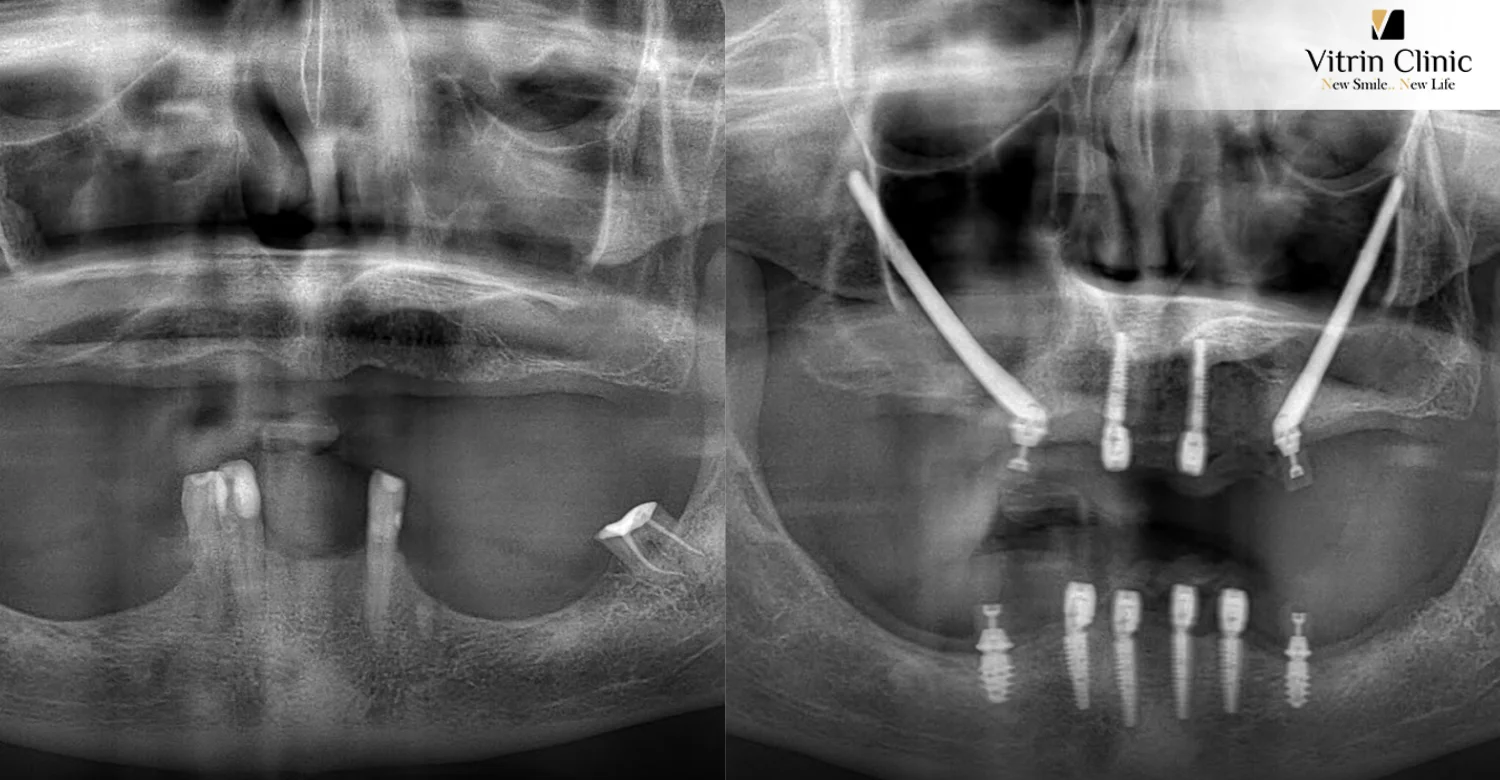
Which Dental Implant Brands Are Available, and What Affects Their Cost?
Dental implant brands differ in their designs, surface technologies, prosthetic connections, and available components. These differences can influence treatment planning and the overall cost. Popular implant systems include Straumann, Nobel Biocare, BEGO, Neodent, Medigma Biomedical, and Maxeus.
What Are the Most Recognised Dental Implant Systems?
Several dental implant brands offer different implant designs and prosthetic solutions. Popular systems include:
Straumann: Offers implant solutions for different bone conditions and restorative needs.
Nobel Biocare: Provides implant systems for individual teeth and full-arch restorations.
BEGO: Offers implant systems and prosthetic components for different tooth replacement needs.
Neodent: Provides implant solutions for individual and extensive restorative treatments.
Medigma Biomedical: Offers dental implant systems and related components for restorative procedures.
Maxeus: Provides dental implant solutions for tooth replacement and restorative treatment.
The most suitable system depends on the patient's bone condition, treatment plan, prosthetic requirements, and the dentist's clinical judgment.
Straumann
Straumann offers implant systems for different clinical situations. Its product range includes solutions designed to address varying bone conditions and restorative requirements.
Nobel Biocare
Nobel Biocare provides implant systems and prosthetic components for individual tooth replacement and full-arch restorations.
BEGO
BEGO offers dental implant systems and prosthetic components designed for different clinical and restorative requirements.
Neodent
Neodent offers implant systems for individual tooth replacement and more extensive restorative treatments.
Medigma Biomedical
Medigma Biomedical provides dental implant systems and components for implant-supported restorations. The selected system depends on the patient's clinical needs and planned prosthesis.
Maxeus
Maxeus offers dental implant solutions for tooth replacement procedures. The appropriate implant selection depends on bone conditions, implant positioning, and restorative requirements.
Does Choosing a Premium Implant Brand Guarantee Better Results?
Not necessarily. A recognised brand does not guarantee a successful outcome on its own. The result depends on several clinical and patient-related factors, including:
Accurate diagnosis: Identifying the condition of the jawbone, gums, and remaining teeth.
Implant positioning: Placing the implant according to the available bone and planned restoration.
Bone quality and volume: Ensuring adequate support or identifying the need for additional procedures.
Surgical technique: Following an appropriate surgical plan.
Prosthetic design: Selecting a restoration that suits the implant position and bite.
Oral hygiene and maintenance: Keeping the implant and surrounding tissues healthy.
Patient-related healing factors: Considering general health and factors that may affect healing.
Brand selection is one part of treatment planning, not a substitute for sound clinical judgment.
At Vitrin Clinic, we explain the proposed implant system and its components within the treatment plan. Patients can review the recommended option and understand its role in their planned restoration before treatment begins.
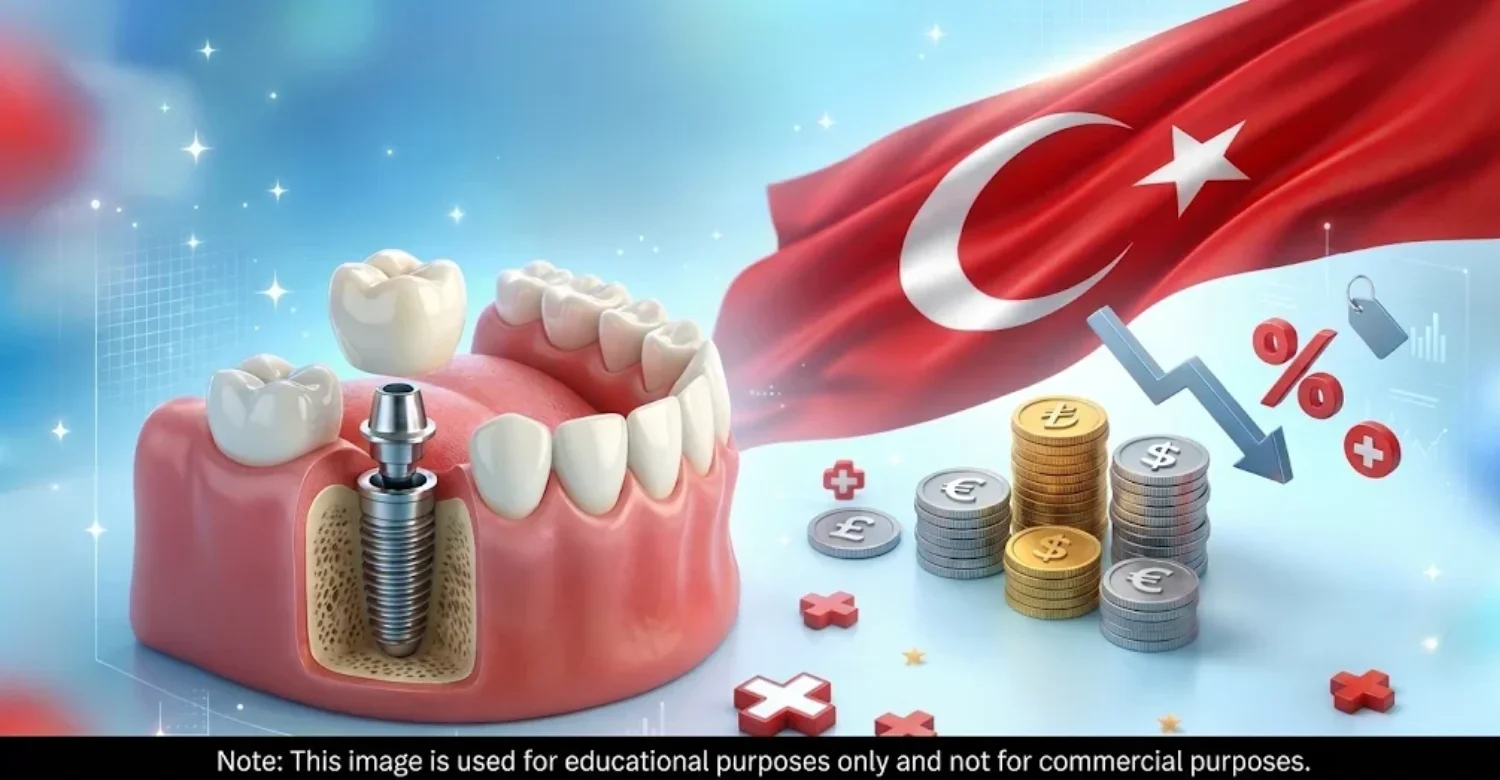
Which Additional Procedures Can Increase Dental Implant Costs?
Not every patient can proceed directly to implant placement without additional treatment. Some patients have insufficient bone volume, active gum disease, damaged teeth, or anatomical conditions that affect implant positioning.
Depending on the clinical findings, additional procedures may be needed before or during implant treatment. These procedures can increase the overall cost and influence the treatment timeline.
How Much Does Dental Bone Grafting Cost?
Bone grafting may be recommended when the jawbone does not provide enough volume to support the planned implant. The procedure adds graft material to the affected area to support bone regeneration.
The cost depends on several factors:
Size and location of the bone defect.
Type and quantity of graft material.
Number of treatment sites.
Surgical complexity.
Whether grafting is performed separately or during implant placement.
UK
Approximate bone graft cost per site: 200–1,500
Approximate bone graft cost per site
Bone graft per site: 200–1,500
Private UK clinic standard rate
Varies by graft volume & complexity
Turkey
Approximate bone graft cost per site: 130–600
Approximate bone graft cost per site
Bone graft per site: 130–600
Substantial savings vs. UK & US rates
Includes synthetic, xenograft & allograft options
US
Approximate bone graft cost per site: 300–3,000
Approximate bone graft cost per site
Bone graft per site: 300–3,000
US private clinic standard rate
Higher fees for complex or block grafts
What Is the Cost of Sinus Lift Surgery in Turkey, UK, and US?
A sinus lift increases the available bone height in selected areas of the upper jaw. It may be recommended when the position of the sinus leaves insufficient bone for the planned implant.
Two common techniques are used:
Internal sinus lift: A more limited elevation performed through the implant preparation site in selected cases.
Lateral window sinus lift: The surgeon creates access through the side of the upper jaw to elevate the sinus membrane and place graft material when required.
UK
Approximate sinus lift cost: 800–2,500
Approximate sinus lift cost
Sinus lift cost: 800–2,500
Private UK clinic standard rate
Varies by unilateral vs. bilateral lift
Turkey
Approximate sinus lift cost: 800–1,950
Approximate sinus lift cost
Sinus lift cost: 800–1,950
Up to ~50–60% savings vs. USA rates
Covers internal & lateral window procedures
USA
Approximate sinus lift cost: 1,500–5,000
Approximate sinus lift cost
Sinus lift cost: 1,500–5,000
US private clinic standard rate
Higher fees for grafting materials & membranes
How Much Does Tooth Extraction Add to Implant Treatment Costs?
Some patients need damaged or non-restorable teeth removed before receiving dental implants. Extraction may take place before implant placement or during the same surgical appointment.
The timing depends on factors such as infection, bone condition, and the overall treatment plan. Surgical extractions generally involve greater complexity than straightforward extractions and may cost more.
Why Gum Disease Has to Be Treated Before Dental Implants treatment?
Active periodontal disease should be managed before implant placement. Inflammation and infection around natural teeth can affect the supporting tissues and increase the risk of complications around dental implants.
Depending on the patient's condition, treatment may involve professional cleaning, periodontal therapy, or other procedures.
At Vitrin Clinic, gum health is reviewed as part of implant planning. This helps identify problems that may need attention before implant placement rather than treating surgery as an isolated procedure.
Dental Implants, Bridges or Dentures: Which Offers Better Value?
Replacing missing teeth involves choosing between several treatment options. Dental Implants in Turkey Cost, conventional bridges, and removable dentures differ in how they are supported, their maintenance requirements, and their costs.
The most cost-effective option depends on the patient's oral health, clinical needs, and long-term treatment goals.
How Do Dental Implants Differ from Conventional Bridges?
A conventional dental bridge replaces a missing tooth by using neighbouring teeth as supports. An implant-supported crown, by contrast, uses an implant placed in the jawbone to support the replacement tooth.
Feature | Dental implant | Conventional dental bridge |
Support | Implant placed in the jawbone | Adjacent teeth |
Preparation of neighbouring teeth | Usually not required | Usually required |
Surgical procedure | Yes | Usually no |
Bone stimulation | Transfers functional forces to the surrounding bone | Does not replace the natural tooth root |
Maintenance | Implant and surrounding gum care | Bridge and supporting tooth care |
Treatment time | Often several months | Usually shorter |
How Much Does a Dental Implant Cost Compared with a Bridge?
Published 2027 guide prices for a three-unit dental bridge include:
UK
Three-unit bridge: 1,500–3,500
Three-unit bridge
Three-unit bridge: 1,500–3,500
Private UK clinic standard rate
Varies by ceramic or zirconia material
Turkey
Three-unit bridge: 650–2,100
Three-unit bridge
hree-unit bridge: 650–2,100
Substantial savings vs. UK & USA rates
Includes zirconia & porcelain-fused options
USA
Three-unit bridge: 2,000–5,000
Three-unit bridge
Three-unit bridge: 2,000–5,000
US private clinic standard rate
Highest domestic private expense
Are Dental Implants More Suitable Than Removable Dentures?
Traditional removable dentures replace missing teeth without requiring implant surgery. They may suit patients who cannot undergo implant placement or prefer a removable restoration.
However, conventional dentures have some limitations:
They may move while eating or speaking.
They can require periodic adjustments.
Their fit may change as the jawbone changes over time.
They need daily cleaning outside the mouth.
They may require replacement as their fit and condition change.
Implant-supported dentures use dental implants to improve retention and stability. They are different from conventional removable dentures and may be considered when the patient's clinical condition allows implant treatment.
Ultimately, the choice between implants, bridges, and dentures depends on bone conditions, medical history, functional requirements, maintenance expectations, and budget. A clinical examination helps determine which option is appropriate.
Ready to transform your smile?
Talk to our team and get a personal FREE treatment plan.
What Does a Dental Implant Package at Vitrin Clinic Include?
At Vitrin Clinic, patients receive a written quotation explaining the proposed treatment, its costs, and the services included. The following table summarises the available starting prices and the components that require individual confirmation.
Dental Implant Treatment Costs at Vitrin Clinic
Treatment or service | Vitrin Clinic price(approx) |
Single dental implant | 700–1,500 |
All-on-4, one arch | From $2,000 |
All-on-4, both arches | From $4,000 |
All-on-6, one arch | 4,000–9,000 |
All-on-8, one arch | 6,000–10,000 |
Bone grafting, per site | 150–650 |
Sinus lift | 170–1,250 |
Tooth extraction | 50–220 |
CBCT imaging | 50–150 |
Intraoral scanning and implant planning | 50–200 |
Temporary prosthesis | 200–600 |
Final prosthesis | 500–2,000 |
Airport transfers | 50–150 |
Which Clinical and Diagnostic Services May Be Included?
Depending on the patient's needs, the diagnostic stage may include:
Initial dental examination.
Relevant digital dental imaging.
CBCT imaging when clinically indicated.
Intraoral scanning.
Implant treatment planning.
Surgical preparation.
What Does Implant Surgery Cover?
The surgical stage may include implant placement, local anaesthesia, and the components required for the planned procedure.
Bone grafting, sinus lifts, tooth extractions, and other additional procedures should be identified in the quotation when required. Patients should confirm whether these are included or charged separately.
Are Temporary and Final Dental Restorations Included?
A temporary prosthesis may be fitted shortly after implant placement when immediate loading is clinically appropriate. The final restoration is generally fitted after the required healing and osseointegration period.
Vitrin Clinic explains which temporary and final restorations are included in the treatment plan. Any additional laboratory or prosthetic fees should also be clarified before treatment begins.
What International Patient Services Can Vitrin Clinic Arrange?
Depending on the agreed package, services may include:
Airport transfers.
Hotel arrangements.
Local transportation.
Appointment coordination.
Communication with the clinical team.
Patients should request written confirmation of accommodation, transfers, and other services before booking their trip.
What Is Not Usually Included in Dental Implant Packages in Turkey?
Dental implant packages can differ between clinics and treatment plans. Some services may be included in the advertised price, while others may be charged separately.
Patients should check whether their quotation includes or excludes:
International flights: Flights to and from Turkey are not necessarily included.
Travel insurance: Patients may need to arrange their own travel insurance.
Bone grafting: Additional grafting may be charged separately when clinically required.
Sinus lift surgery: This procedure may involve an additional surgical fee.
Additional extractions: Complex or multiple extractions may affect the total cost.
Advanced imaging: CBCT scans or other diagnostic procedures may be charged separately.
Sedation or general anaesthesia: These services may involve additional fees if required.
Extra hotel nights: Longer stays or accommodation for accompanying guests may not be covered.
These exclusions are not the same for every package. Patients should request a written breakdown of included services and possible additional expenses before confirming treatment.
What Should You Include in Your Dental Implant Budget in Turkey?
The implant price is only one part of the overall treatment budget. International patients should account for dental procedures, travel expenses, and future maintenance before making arrangements.
1. What Should the Dental Treatment Quotation Include?
The written quotation should clearly list the implant system and number of implants. It should also specify whether abutments, crowns, temporary teeth, and final restorations are included.
Checking these details helps patients understand exactly what the quoted treatment covers.
2. Could Additional Procedures Increase the Total Cost?
Some patients need procedures before or during implant treatment. These may include tooth extractions, bone grafting, sinus lift surgery, or periodontal treatment.
The final cost depends on which procedures are clinically necessary and how complex they are.
3. How Much Should You Set Aside for Flights and Accommodation?
Travel expenses depend on the departure country, booking date, season, and length of stay. Patients should also consider whether accommodation will be needed during healing and restoration stages, particularly when treatment requires more than one visit.
4. Have You Accounted for Local Transportation?
Airport transfers and journeys between the clinic and accommodation may add to the travel budget. Patients should confirm whether these arrangements are included in the agreed treatment package or need to be booked separately.
5. What Should You Budget for Long-Term Implant Maintenance?
Dental Implants in Turkey Cost require ongoing professional monitoring. Future expenses may include routine dental reviews, professional cleaning, and prosthetic maintenance when needed.
Patients should also understand how to arrange follow-up care after returning home.
How Can You Calculate Your Total Dental Implant Budget?
Include every major expense when estimating the overall cost:
Total budget = Dental treatment + Additional procedures + Flights + Accommodation + Local transport + Future maintenance.
At Vitrin Clinic, we help international patients understand the proposed treatment costs before arranging appointments. The written treatment plan should clarify the included procedures and any additional expenses that may arise from clinical findings.
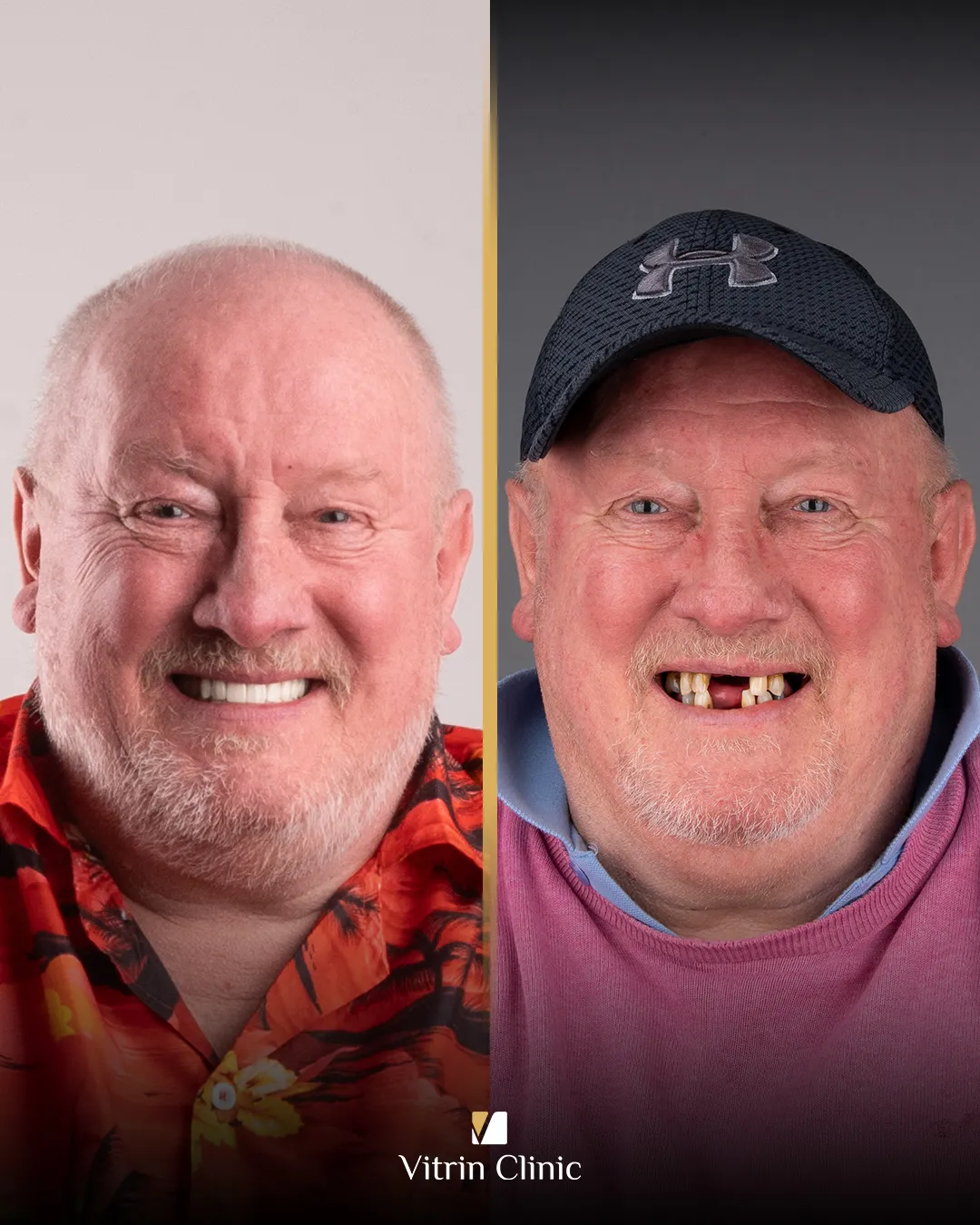
Who Can Be Considered for Dental Implant Treatment?
Dental implants may be suitable for adults missing one tooth, several teeth, or an entire dental arch. However, having missing teeth alone does not establish implant suitability. The dentist must review the patient's oral health, bone condition, and medical history.
Is There Enough Bone to Support Dental Implants?
The jawbone needs sufficient volume and suitable conditions to support implant placement. Patients with bone loss may require grafting or an alternative treatment plan.
Do Your Gums Need Treatment Before Implant Placement?
Healthy or appropriately treated gums are important for implant treatment. Active periodontal infection should be managed before proceeding with implant placement.
Which Medical Conditions Can Affect Implant Suitability?
Certain medical conditions and medications may influence surgical planning and healing. Diabetes control, smoking habits, previous radiotherapy, and medications affecting bone metabolism may require additional consideration.
Why Is Oral Hygiene Important Before and After Implant Treatment?
Patients need to maintain good oral hygiene throughout implant treatment and afterwards. Poor plaque control can increase the risk of inflammation around implants, including peri-implant disease.
At Vitrin Clinic, our medical team reviews these factors before recommending implant treatment. The final decision depends on individual clinical findings.
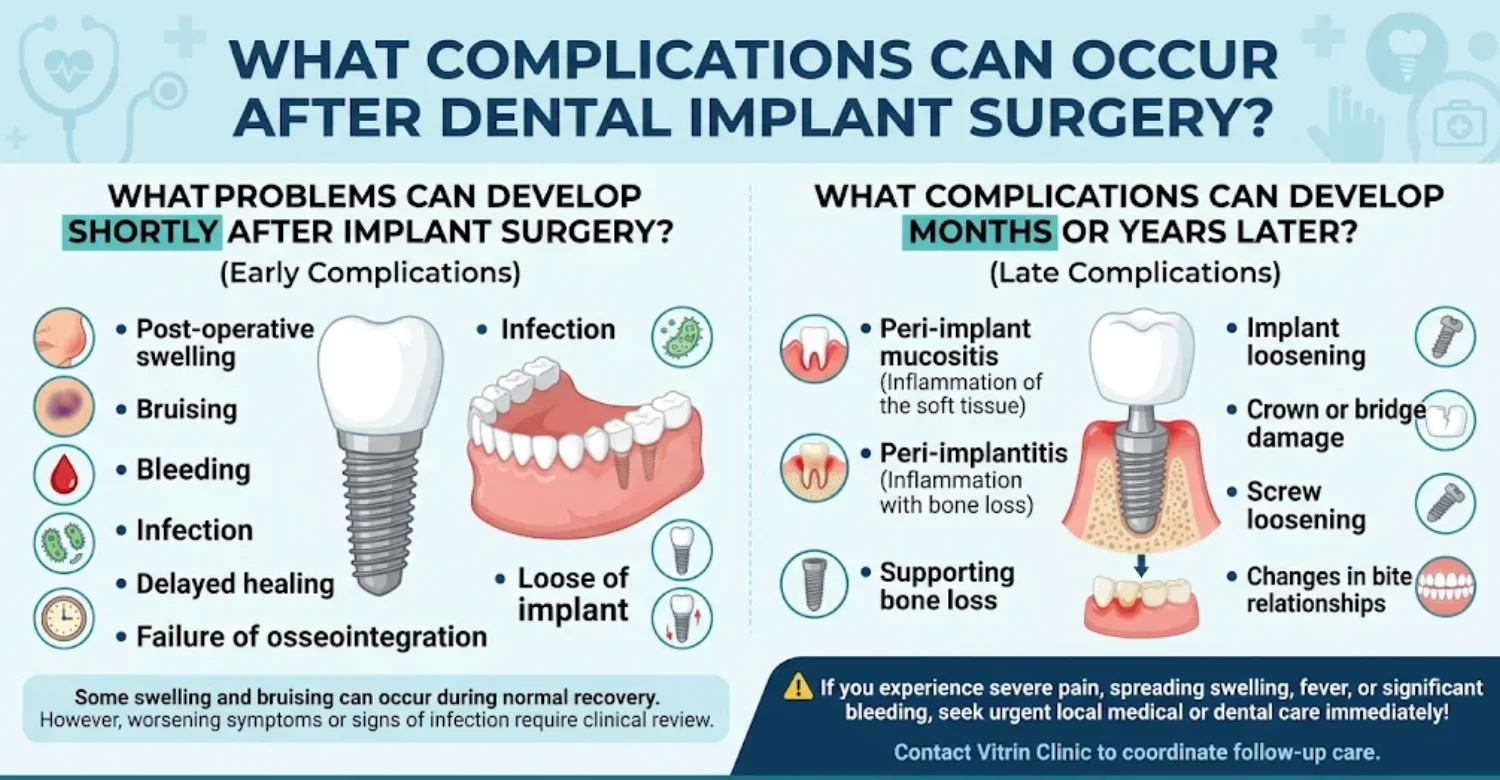
What Complications Can Occur After Dental Implant Surgery?
Dental implant surgery is a clinical procedure with potential complications. Understanding the possible risks helps patients make informed decisions and recognise when they need professional care.
What Problems Can Develop Shortly After Implant Surgery?
Early complications may include:
Post-operative swelling.
Bruising.
Bleeding.
Infection.
Delayed healing.
Failure of osseointegration.
Some swelling and bruising can occur during normal recovery. However, worsening symptoms or signs of infection require clinical review.
What Complications Can Develop Months or Years Later?
Problems may also arise after the implant has integrated with the bone and received its restoration. These can include:
Peri-implant mucositis: Inflammation of the soft tissue surrounding the implant.
Peri-implantitis: Inflammation around the implant associated with supporting bone loss.
Supporting bone loss: Reduction in the bone surrounding the implant.
Implant loosening: Loss of implant stability.
Crown or bridge damage: Fractures, wear, or other prosthetic problems.
Screw loosening: Loosening of components connecting the restoration.
Changes in bite relationships: Alterations that affect how the teeth meet during chewing.
What Are the Treatment Options If a Dental Implant Fails?
Treatment depends on the cause and severity of the problem. The clinical team may need to manage infection, remove the implant, allow the area to heal, or consider replacement treatment.
Dental implants cannot be guaranteed to last a lifetime. Their long-term performance depends on biological conditions, mechanical factors, and patient-related habits and health.
Patients who experience severe pain, spreading swelling, fever, or significant bleeding after returning home should seek urgent local medical or dental care. They should not delay treatment while waiting to travel back.
Patients should also inform Vitrin Clinic so the team can review their treatment history and help coordinate appropriate follow-up care.
What Should You Know About Dental Implant Warranties?
Dental implant warranties may cover different parts of the treatment. An implant fixture warranty is not necessarily the same as a warranty for the crown, bridge, or other prosthetic components.
Before treatment, patients should clarify:
Whether the warranty covers the implant fixture, prosthetic restoration, or both.
Which complications or types of damage are covered.
Whether regular professional reviews are required.
Whether specific oral hygiene or maintenance conditions apply.
How warranty claims are handled after returning home.
Whether replacement components or additional treatment involve separate costs.
Warranty conditions vary according to the implant manufacturer, clinic policy, and treatment agreement. Patients should request the applicable terms in writing rather than assuming that every component has the same coverage.
A warranty does not guarantee that an implant will last for life or prevent biological and mechanical complications.
Ready to transform your smile?
Talk to our team and get a personal FREE treatment plan.
How Can You Keep Dental Implants Healthy After Treatment?
Dental implants need consistent daily hygiene and regular professional monitoring. Although implants cannot develop natural tooth decay, the surrounding gums and tissues can still become inflamed or infected.
What Should Your Daily Dental Implant Cleaning Routine Include?
We recommend the following daily hygiene habits:
Brush twice a day.
Use a suitable soft-bristled toothbrush.
Clean carefully around implant-supported crowns and bridges.
Use interdental brushes when recommended.
Follow the cleaning instructions provided by your dental team.
Why Are Regular Professional Implant Reviews Important?
Routine dental reviews help monitor the condition of the implants and surrounding tissues. During these appointments, the dental team may check:
Gum condition.
Plaque accumulation.
Bleeding and inflammation.
Implant stability.
Prosthetic fit.
Bite relationships.
Professional maintenance helps identify potential problems before they become more difficult to manage.
Which Lifestyle Habits Can Affect Dental Implant Health?
Smoking can interfere with healing and increase the risk of implant complications. Patients should follow post-operative dietary instructions and avoid excessive loading of the implants during the healing period.
Following the dentist's advice and attending recommended reviews are important parts of long-term implant care.
How Can You Choose a Dental Implant Clinic in Turkey?
Choosing a dental implant clinic requires more than comparing advertised prices. Patients should review the clinical team, proposed implant system, treatment details, and arrangements for follow-up care.
Before making a decision, consider the following:
Dentist's qualifications: Check the treating dentist's qualifications, relevant training, and experience with the proposed implant procedure.
Implant brand and model: Ask which implant system is recommended and request its details in writing.
Treatment planning: Make sure the proposed number and positions of implants are explained.
Restoration materials: Confirm the materials planned for temporary and final crowns or bridges.
Itemised quotation: Request a written breakdown of implant components, surgical procedures, and additional costs.
Clinical documentation: Ask how diagnostic imaging and clinical findings inform the treatment plan.
Aftercare arrangements: Understand how follow-up appointments and possible complications are managed after returning home.
Patient case examples: Review genuine clinical cases where appropriate patient consent has been obtained.
A suitable clinic should explain the proposed treatment, its limitations, and the expected costs clearly. Patients should have enough information to make an informed decision without relying on price or promotional claims alone.

.jpg)
How Many Visits Does Dental Implant Treatment at Vitrin Clinic Require?
Dental implant treatment at Vitrin Clinic may require one or two visits, depending on the patient's clinical condition and restoration plan. Receiving a temporary restoration on the day of surgery does not mean the implant has completed its biological healing process.
First Visit: What Happens During Examination and Implant Placement?
The first visit may include several stages:
Clinical examination: Reviewing oral health, remaining teeth, and gum condition.
Dental imaging: Evaluating bone structure and planning implant positions.
Treatment confirmation: Finalising the proposed procedures and restoration plan.
Tooth extraction: Removing damaged or non-restorable teeth when required.
Implant placement: Surgically positioning the implants in the jawbone.
Bone grafting: Adding graft material when clinically indicated.
Temporary restoration: Providing temporary teeth when the implant position and stability make this suitable.
The appointment length depends on the number of implants, additional procedures, and surgical complexity.
Healing Period: How Long Does Osseointegration Take?
After implant placement, the surrounding jawbone needs time to integrate with the implant surface. This biological process is called osseointegration.
Healing commonly takes around 2–6 months, although the timeline varies between patients. Bone grafting, implant location, bone quality, and individual healing factors may extend this period.
Second Visit: When Are the Final Crowns or Bridges Fitted?
Once the implant has healed sufficiently and is ready for restoration, the final prosthetic stage may include:
Digital impressions or scans.
Abutment and prosthetic preparation.
Crown or bridge fitting.
Bite adjustment.
Final clinical review.
The timing and number of appointments depend on individual healing progress and the confirmed treatment plan. The dentist must verify that the implant is ready before proceeding with the final restoration.
How Long Should You Stay in Turkey During Each Implant Visit?
The required stay in Turkey depends on the surgical procedures, clinical reviews, and prosthetic work planned for each visit. Patients should confirm the expected appointment schedule before booking flights or accommodation.
Treatment stage | What happens |
Before travelling | Preliminary review of dental records and treatment planning |
First visit | Clinical examination, imaging, extractions if needed, and implant placement |
Initial recovery | Post-operative checks and temporary restoration when suitable |
Healing at home | Osseointegration, commonly around 2–6 months |
Second visit | Implant review, impressions or scans, and final restoration fitting |
Some treatment plans may require around 5–7 days for a visit, but this is not a fixed requirement for every patient. The appropriate stay depends on the surgery, recovery, laboratory arrangements, and the dentist's clinical review.
Patients should receive an individual appointment schedule before travelling. They should also allow for possible changes if additional treatment or recovery time is needed.
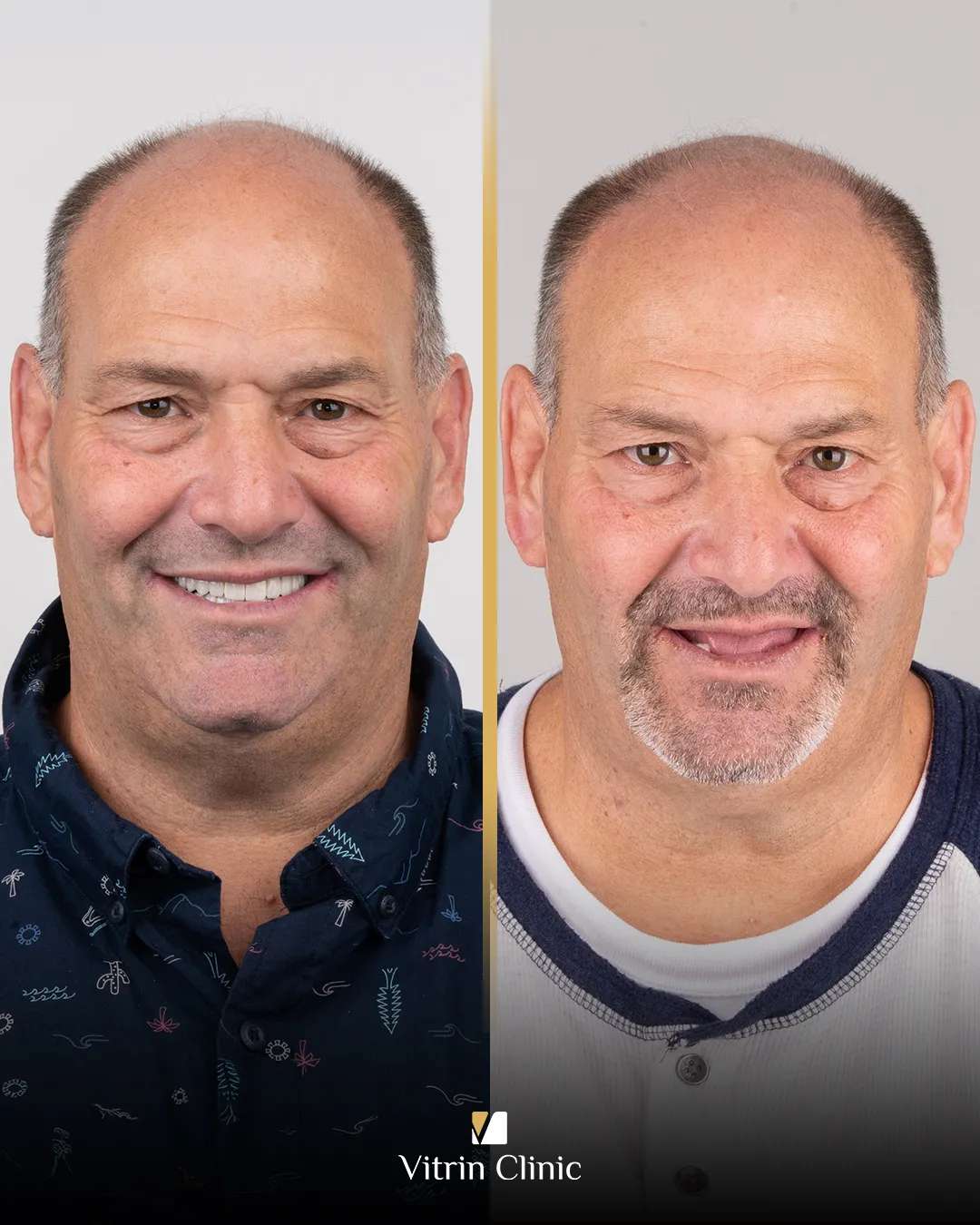
Can You Receive Dental Implants and Temporary Teeth in One Day?
Some patients may qualify for immediate loading, which involves fitting a temporary fixed restoration shortly after dental implants surgery. However, this approach is not suitable for every patient.
The decision depends on several clinical factors:
Primary implant stability.
Bone quality and volume.
Implant positioning.
Bite forces.
Number and distribution of implants.
Overall medical and dental conditions.
Temporary teeth are designed to serve during the healing period. They are not automatically equivalent to the final prosthesis, which is fitted after sufficient healing and clinical review.
At Vitrin Clinic, we determine whether immediate temporary teeth are appropriate after reviewing the patient's clinical findings.
.jpg)
.jpg)
Why Do International Patients Choose Vitrin Clinic for Dental Implants in Turkey Cost?
At Vitrin Clinic, dental implant treatment is planned around clinical diagnosis, individual requirements, and the final restoration. We aim to help patients understand their proposed treatment before surgery begins.
How Does Dr. Rifat Alsaman Lead the Medical Team?
Our medical team is led by Dr. Rifat Alsaman, Head of the Medical Team and cosmetic dentist. The team reviews each patient's dental condition, available bone, implant requirements, and prosthetic considerations before confirming the proposed treatment approach.
Which Digital Technologies Support Implant Planning at Vitrin Clinic?
We use digital technologies to support diagnosis and treatment planning. Depending on the patient's clinical needs, these may include:
Digital dental X-rays.
CBCT imaging.
Intraoral 3D scanning.
Digital prosthetic planning.
Implant position assessment.
These technologies provide useful diagnostic information but do not replace clinical examination or professional judgment. Additional imaging is recommended when clinically indicated.
How Is Each Dental Implant Treatment Plan Personalised?
Every patient has different anatomical and restorative requirements. Our team considers several factors before recommending an implant approach:
Number of missing teeth.
Available bone volume.
Suitable implant brand and system.
Prosthetic material options.
Bite and chewing forces.
Additional surgical requirements.
Expected treatment stages.
We explain the recommended procedures and estimated costs before treatment proceeds.
How Does Vitrin Clinic Coordinate Treatment for International Patients?
Our international patient coordinators help organise the treatment journey in Istanbul. They support appointment scheduling, communication, and relevant travel arrangements.
Patients receive information about the proposed treatment stages and follow-up requirements. This helps them understand the practical arrangements involved in travelling for dental implant treatment.
What Does the Dental Implant Treatment Quotation Include?
We provide written treatment proposals outlining the planned procedures and relevant costs. Our aim is to make the treatment scope clear before patients make their decision.
The quotation should explain the relevant implant components, temporary restorations, final teeth, and any additional procedures included in the plan.
How Can You Get Your FREE Dental Implant Treatment Plan from Vitrin Clinic?
Planning dental implant treatment in Turkey begins with understanding your dental condition and restorative requirements.
At Vitrin Clinic, our medical team can review dental photographs, previous X-rays, and available CBCT scans for an initial evaluation. These records help inform the preliminary treatment discussion but do not replace an in-person clinical examination.
We then prepare a personalised treatment proposal outlining:
Recommended implant treatment.
Proposed implant quantity and system.
Available restoration material options.
Additional procedures, if required.
Estimated treatment stages.
Expected treatment costs.
Our team in Istanbul can help you understand the proposed treatment and organise the practical arrangements for your visit.
Ready to transform your smile?
Talk to our team and get a personal FREE treatment plan.
Conclusion
Dental Implants in Turkey Cost can offer an effective tooth replacement option at a competitive cost. However, the final price depends on the number of implants, implant system, restoration material, and any additional procedures required.
At Vitrin Clinic, we develop individual treatment plans based on each patient's dental condition and restoration needs. Reviewing the proposed procedures, costs, and aftercare arrangements helps patients make informed decisions before travelling to Istanbul.
Medical Disclaimer
This article is for general informational purposes only and does not replace professional dental advice, diagnosis, or treatment. Dental implant suitability, risks, and costs vary between patients. A clinical examination and appropriate diagnostic imaging are required before treatment decisions are made.
Reference
FAQs
A single dental implant with a crown generally costs around 500–1,800 in published Turkish market guides. At Vitrin Clinic, implant pricing is approximately 700–1,500, depending on the implant system and individual treatment requirements. Your written quotation should confirm whether the abutment and final crown are included.
Dr. Rifat Alsaman has more than 5 years of clinical experience in dentistry and currently serves as the Head of the Medical Team at Vitrin Clinic. He is dedicated to providing exceptional patient care, overseeing treatment planning, and ensuring the highest clinical standards across the team. His expertise, attention to detail, and commitment to continuous professional development have helped countless patients achieve healthier, more confident smiles.


