Dental Implant
October 13, 2026
What Is Hybrid Dental Implant Rehabilitation, and Is It Right for You?
 Dr. Rifat Alsaman
Hybrid Dental Implant Rehabilitation replaces a full arch of missing or failing teeth with a fixed bridge on implants. It suits patients who want stable teeth that do not come out at night. Unlike loose dentures, the new teeth are screwed onto implants and stay firmly in place. This guide explains candidacy, materials, steps, costs, risks, and long-term care in plain language. It also shares insights from Dr. Rifat Alsaman at Vitrin Clinic.
Quick facts
Treatment type: fixed full-arch teeth supported by four to six implants.
Typical timeline: temporary teeth within days, final teeth after three to six months.
Planning cost range per arch: about $3,250 in Turkey to $38,000 in the US.
Long-term care: daily cleaning plus professional maintenance every three to six months.
.jpg)
.jpg)
.jpg)
.jpg)
.jpg)
.jpg)
What Is Hybrid Dental Implant Rehabilitation?
Hybrid Dental Implant Rehabilitation restores a whole upper or lower arch using implants and one connected prosthesis. The word "hybrid" describes the design. It combines features of a fixed bridge with features of a denture. The prosthesis replaces teeth and, in many cases, lost gum and bone volume. It is fixed to the implants with screws, so patients cannot remove it themselves. Only the dental team can take it off for cleaning, repairs, or checks. This design gives patients the stability of fixed teeth with a lighter, more repairable structure. Understanding how it works helps you compare it fairly with dentures, overdentures, and individual implants.
Definition of a Hybrid Implant-Supported Prosthesis
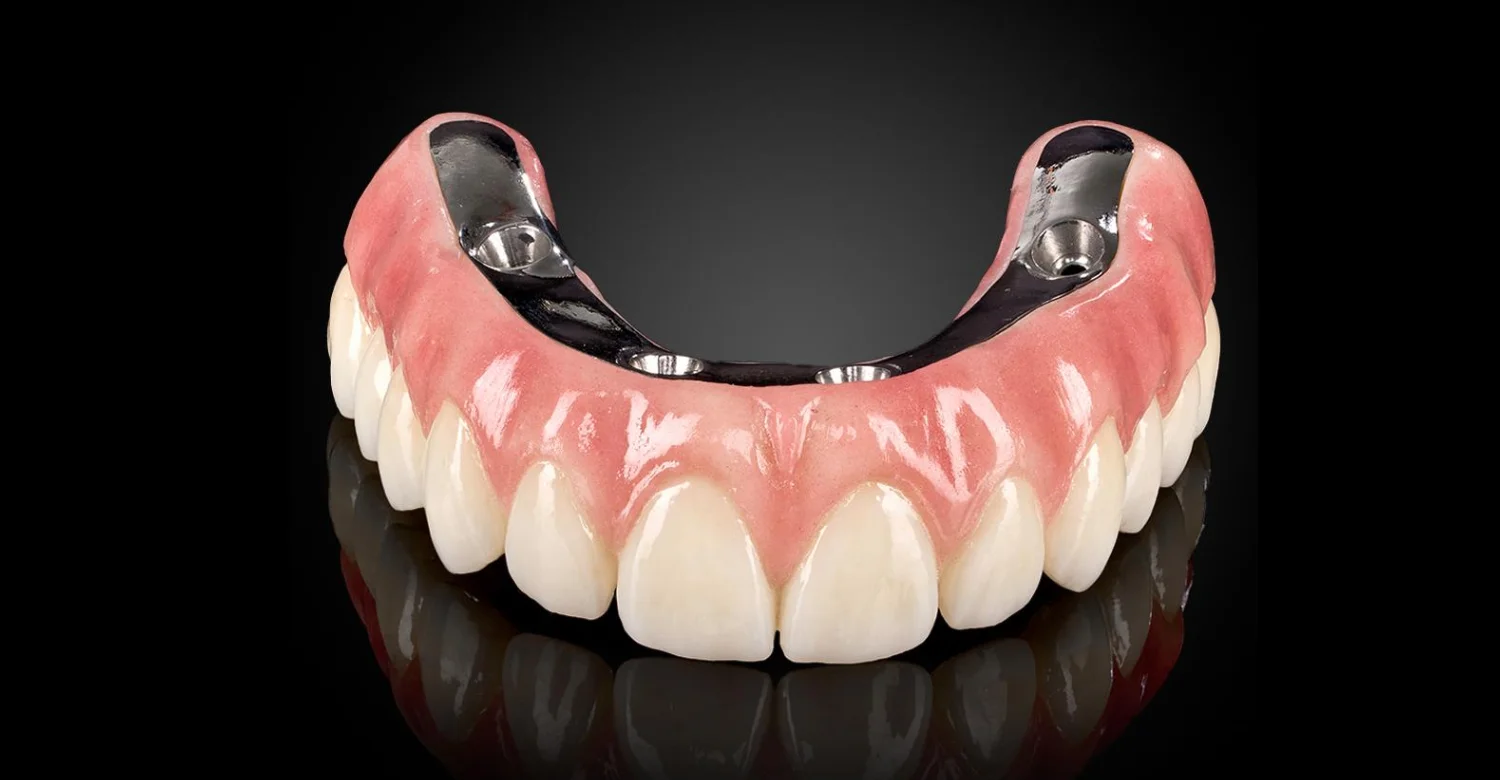
A hybrid implant-supported prosthesis is a full-arch set of artificial teeth attached to several dental implants. It usually includes pink gum-coloured material that recreates missing soft tissue. Underneath, many designs use a rigid framework made from titanium, other metals, or zirconia. Teeth made from acrylic, composite, or ceramic are bonded onto that framework. The whole unit connects to implants through small abutments and retaining screws. Because it is screw-retained, the dentist can remove it during maintenance visits. This removability by the clinician, not the patient, is a key practical feature. It allows professional cleaning, screw checks, and repairs without damaging the implants.
How a Full-Arch Hybrid Dental Restoration Replaces Missing Teeth
A full-arch hybrid restoration replaces every tooth in one jaw with a single connected bridge. The implants act like artificial roots anchored inside the jawbone. Bone grows tightly onto the implant surface in a process called osseointegration. The bridge then transfers chewing forces through the implants into the bone. This is different from dentures, which press on the gums and slide during chewing. The restoration usually holds ten to fourteen teeth per arch, depending on space and bite design. Back teeth may be shortened slightly to reduce leverage on the rearmost implants. The result is a complete, stable row of teeth that looks natural when you smile.
What Makes a Fixed Hybrid Denture on Dental Implants Different From Traditional Dentures?
Traditional dentures rest on the gums and rely on suction, adhesive, or muscle control. They can move while eating or speaking, especially on the lower jaw. A fixed hybrid denture is screwed onto implants and does not move during normal function. Upper hybrid designs usually avoid covering the palate, which helps taste and temperature perception. Patients do not remove them at night or soak them in cleaning solutions. Implants also load the bone, which may help slow the shrinkage seen under dentures. Research shows ridges under long-term dentures can keep resorbing for decades. Studies suggest the lower ridge may shrink about four times faster than the upper ridge.
How Hybrid Implant Restorations Support Chewing Function, Appearance, and Speech
Implant-supported teeth usually restore much stronger chewing than conventional dentures. Studies report denture wearers often bite with less than a quarter of natural-tooth force. Fixed implant bridges can bring biting force much closer to natural levels. Better chewing allows a wider diet, including fresh vegetables, salads, and firmer proteins. Appearance improves because the prosthesis supports the lips and cheeks. Pink material can replace collapsed gum contours that made the face look older. Speech often becomes clearer because the teeth no longer slip or click. Most patients adapt to new tongue positions within a few weeks of wearing the teeth.
What Is the Difference Between a Temporary Hybrid Prosthesis and a Final Restoration?
The temporary prosthesis is the first set of fixed teeth placed during healing. It is usually made from acrylic or PMMA because this material is light and easily adjusted. It protects the healing areas and lets you eat soft foods and smile with confidence. The final restoration is fabricated once the implants have integrated and the gums have settled. This usually takes about three to six months after surgery. Final teeth are stronger and more precisely shaped than temporary ones. They often include a reinforced framework of titanium or zirconia. The temporary phase also acts as a test drive for appearance, speech, and bite.
Why Do Patients Need Hybrid Dental Implant Rehabilitation?
Patients usually need Hybrid Dental Implant Rehabilitation when most teeth in one arch are lost or cannot be saved predictably. Tooth loss is common worldwide and increases sharply with age. The WHO's 2022 oral health report estimated complete tooth loss in about 7% of adults aged 20 and over. The same report estimated it at roughly 23% among people aged 60 and older. In the United States, CDC data suggest about one in eight adults aged 65 and over have no natural teeth. Many more people keep a few weak teeth that cannot support daily chewing. For these patients, replacing the whole arch can be simpler than repairing tooth after tooth.
Common Causes of Extensive Tooth Loss
Extensive tooth loss rarely has one single cause. It often results from several problems acting together over many years. Decay, gum disease, cracked teeth, and failed dental work can combine to weaken an entire arch. Medical conditions, smoking, and limited access to care can speed up this process. Understanding the cause matters because it influences risk after implants are placed. For example, a history of gum disease suggests that strict maintenance will be essential. The sections below explain the most common reasons patients reach a full-arch decision.
Advanced Tooth Decay and Severe Dental Damage
Untreated decay can destroy tooth structure until little remains above the gum line. WHO estimates that untreated decay in permanent teeth affects about 2 billion people worldwide. Large cavities may reach the nerve and cause infection or abscesses. Teeth with extensive decay often need root canals, posts, and crowns to survive. When many teeth are affected, repeated treatments can become costly and unpredictable. Cracks, heavy wear, and fractured roots can also leave teeth unsalvageable. At that stage, extraction and full-arch replacement may provide a more stable outcome.
Advanced Gum Disease and Supporting Bone Loss
Periodontitis is a chronic infection that destroys the bone and ligaments holding teeth. The WHO estimates severe periodontal disease affects about 19% of adults, more than one billion cases. As support is lost, teeth loosen, drift, and develop gaps. Patients may notice bleeding gums, bad breath, and receding gums. In advanced stages, several teeth may become mobile at the same time. Saving them may require complex surgery with uncertain long-term results. When remaining support is poor, removing hopeless teeth and placing implants may be considered. A history of periodontitis does raise implant risk, so infection control comes first.
Failed or Unsuitable Existing Dental Restorations
Many patients arrive with old bridges, crowns, or implants that are no longer working. Bridges may fail when supporting teeth develop decay or fractures under the crowns. Crowns can loosen repeatedly when little natural tooth remains beneath them. Some patients have several single implants placed at different times without an overall plan. This patchwork can create bite problems, food traps, and uneven appearance. Replacing failed work tooth by tooth may cost more than a planned full-arch solution. A full review of existing restorations helps decide what can be kept and what should be replaced.
Long-Term Difficulty With Conventional Dentures
Some patients wear dentures for years but never feel comfortable with them. Lower dentures are especially difficult because the tongue and cheeks push them out of place. Sore spots, gagging, and food trapped under the denture are common complaints. Many people avoid social eating or speaking because they fear the denture will move. Bone shrinkage over time makes the fit progressively worse. Relines can help temporarily, but they do not stop the underlying resorption. For these patients, implant support can change daily comfort and confidence significantly.
Dental and Functional Problems That May Lead Patients to Consider Full-Arch Rehabilitation
Patients usually consider full-arch treatment when daily function becomes difficult. Common problems include painful chewing, loose teeth, and frequent dental infections. Many people limit their diet to soft foods and avoid fibre-rich options. Research links poor chewing ability with lower intake of fruits, vegetables, and protein in older adults. Others feel embarrassed by gaps, dark teeth, or a sunken facial profile. Repeated emergency visits and rising repair costs are also strong motivators. A collapsed bite can cause jaw discomfort and uneven wear on remaining teeth. When several of these problems coexist, a full-arch plan deserves careful evaluation.
When Replacing an Entire Dental Arch May Be More Appropriate Than Treating Individual Teeth
Saving natural teeth is always the first goal when a predictable outcome is possible. However, some arches contain too many compromised teeth to treat individually. Each weak tooth carries its own risk of failure in the coming years. When most teeth have poor prognosis, treating them one by one may delay the inevitable. It can also mean many surgeries, long treatment periods, and repeated costs. A full-arch approach allows the dentist to plan teeth, gums, and bite together. It also allows implants to be placed in the best bone positions. The decision should follow a tooth-by-tooth prognosis, not a general preference.
Who Is a Suitable Candidate for Hybrid Dental Implant Rehabilitation?
Good candidates for Hybrid Dental Implant Rehabilitation are generally healthy adults with many missing or failing teeth in one arch. They need enough bone, or bone that can be improved, to anchor several implants securely. Stable general health and controlled medical conditions are also important for healing. Commitment to daily cleaning and regular check-ups is just as important as bone volume. Age alone is rarely a barrier, and many patients in their seventies and eighties do well. Long-term studies show implant survival in older adults is similar to younger groups. The final decision depends on a full examination, imaging, and an honest discussion of risks.
Dental and Bone Conditions Dentists Evaluate Before Treatment
Dentists first examine bone height, width, and density where implants may go. They check the position of nerves, sinuses, and other anatomical structures. Active infections, cysts, and remaining root fragments must be identified and treated. Gum thickness and the amount of firmly attached gum tissue are also assessed. The dentist evaluates the opposing arch because it affects bite forces and material choice. Jaw relationships determine how much space is available for the prosthesis. Some designs need at least 15 to 20 millimetres of vertical space for strength. Smile line and lip support influence where the prosthesis edge will sit.
Is a Hybrid Implant-Supported Prosthesis Suitable for Patients With Significant Bone Loss?
Many patients with significant bone loss can still receive a fixed hybrid prosthesis. The All-on-4 concept was developed partly to avoid grafting in resorbed jaws. Tilted rear implants can use denser bone in front of the sinuses or nerves. This often allows longer implants and better anchorage without major grafting. Pink prosthetic gum can compensate for lost bone volume and restore facial support. When bone loss is severe, short implants, grafting, or zygomatic implants may be considered. Zygomatic implants anchor in the cheekbone and are reserved for very advanced upper jaw resorption. Imaging shows exactly which option is realistic for each patient.
How Smoking, Diabetes, and Gum Disease May Affect Implant Treatment
Smoking reduces blood flow and slows healing around surgical sites. A 2015 meta-analysis by Chrcanovic found smokers had over twice the implant failure risk of non-smokers. Smoking also increases the risk of peri-implantitis later in life. Diabetes can affect healing when blood sugar is poorly controlled. Studies suggest well-controlled diabetic patients achieve implant survival similar to healthy patients. Dentists often request a recent HbA1c result before planning surgery. A history of periodontitis is linked to higher peri-implantitis risk. These risks do not always rule out treatment, but they require extra planning and maintenance.
How Bruxism and Bite Forces Influence Prosthesis Design
Bruxism means grinding or clenching the teeth, often during sleep. It places heavy, repeated forces on implants, screws, and prosthetic teeth. Studies associate bruxism with more mechanical complications and higher implant failure risk. Signs include worn teeth, cracked restorations, jaw muscle tenderness, and morning headaches. For bruxers, dentists may add implants or choose a stronger framework. They may also shorten cantilevers and flatten cusps to reduce sideways forces. Monolithic zirconia or reinforced designs often resist fracture better than acrylic teeth. A night guard is usually recommended once the final prosthesis is fitted.
When Bone Grafting or a Sinus Lift May Be Considered
Bone grafting adds volume where the jaw is too thin or short for implants. It may be needed after long-term tooth loss, infection, or trauma. A sinus lift raises the sinus floor in the upper back jaw to create room for implants. Reviews report implant survival in grafted sinuses commonly above 90%. Grafting can extend treatment time by several months before implants are loaded. Tilted implants or zygomatic implants may sometimes avoid grafting altogether. The choice depends on anatomy, health, timeline, and patient preference. Your dentist should explain why grafting is or is not recommended in your case.
When Alternative Treatments May Be More Appropriate
A fixed hybrid prosthesis is not always the best choice for every patient. Patients with several healthy teeth may benefit more from individual implants or bridges. A removable implant overdenture may suit patients with limited budgets or limited dexterity. Overdentures are also easier to clean for some elderly or medically complex patients. Conventional dentures may remain appropriate when surgery is not medically advisable. Patients taking certain bone medications may need special assessment before implant surgery. Uncontrolled systemic disease or recent head and neck radiation can also change the plan. A good clinician presents alternatives honestly, rather than steering everyone toward one solution.
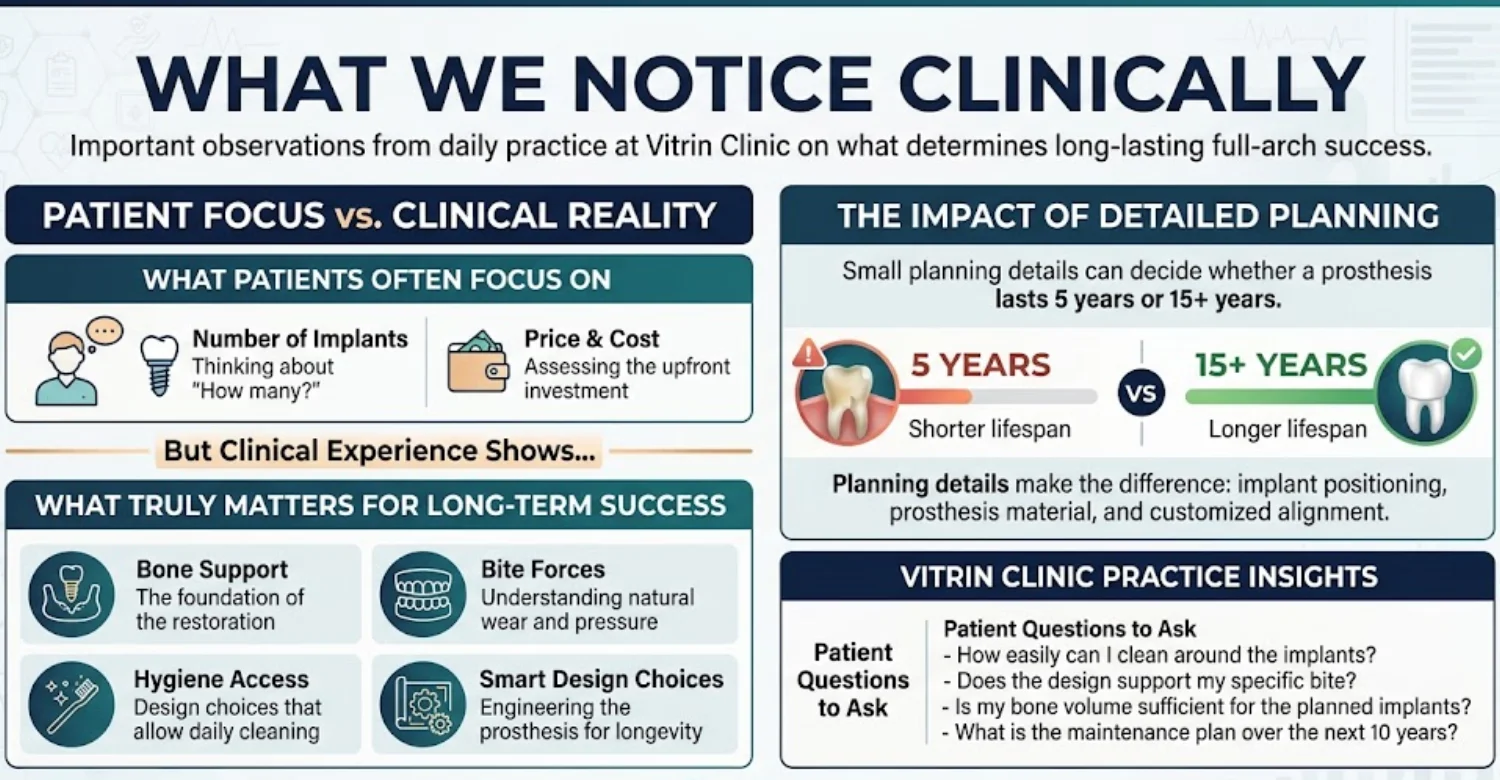
Why Missing Teeth, Bone Support, and Bite Function Must Be Evaluated Together
Counting missing teeth gives only part of the clinical picture. Two patients with identical gaps may have very different bone, gums, and bite forces. Bone tells us where implants can be placed safely. The bite tells us how much force those implants must resist every day. Gum health indicates how well the area will tolerate long-term maintenance. Evaluating these factors separately can lead to a plan that looks good but fails mechanically. Combining them helps us choose implant number, angulation, prosthesis material, and design. This integrated view reduces surprises after treatment is completed.
Common Patient Misconceptions About Fixed Hybrid Dentures
Many patients believe implant teeth cannot get gum disease or need little care. In reality, tissues around implants can become inflamed and lose bone. Some think the prosthesis will last forever without repairs or replacement. Acrylic teeth often wear and may need renewing within several years. Others expect final teeth on the day of surgery, which is usually a temporary set. Some assume more implants always mean better results, which is not always true. Another myth is that cheaper quotes include the same components as expensive ones. Clear explanations at consultation help prevent disappointment later.
Why an Implant-Supported Fixed Bridge Is Not the Same as a Removable Implant Overdenture
A fixed bridge is screwed onto implants and only the dentist removes it. An overdenture clips onto implants or bars and the patient removes it daily. Fixed bridges feel more like natural teeth and usually offer stronger chewing. Overdentures are often cheaper and easier to clean thoroughly at home. Overdentures usually need fewer implants, sometimes only two in the lower jaw. They also provide good lip support for patients with major bone loss. However, overdentures still move slightly and need periodic clip replacement. Both options can work well when matched to the right patient.
Why the Number of Implants Alone Does Not Determine the Best Treatment
Patients often ask whether four or six implants are better. The answer depends on bone quality, arch shape, bite force, and opposing teeth. Four well-placed implants in dense bone can outperform six implants in poor positions. Implant spread across the arch matters more than the implant count alone. Long cantilevers can overload the rear implants, regardless of implant number. Heavy bruxers or soft upper bones may benefit from additional implants. More implants also mean more cost, surgery time, and cleaning areas. In Hybrid Dental Implant Rehabilitation, the best number suits the biology and mechanics of your case.
Clinical Note : Dr. Rifat Alsaman
Dr. Rifat Alsaman leads the medical team at Vitrin Clinic and focuses on cosmetic and restorative dentistry. His clinical approach emphasises planning the final teeth before choosing implant positions. This prosthetic-first approach helps align function, appearance, and cleaning access from the start. In his view, Hybrid Dental Implant Rehabilitation succeeds when surgery and prosthetics are planned as one process. He encourages patients to understand trade-offs rather than chase the cheapest or quickest option.
The Importance of Assessing Bone Support, Bite Forces, Prosthesis Design, and Daily Cleanability Before Selecting a Restoration
According to Dr. Alsaman, bone support decides where implants can go safely. Bite forces decide how strong the framework and teeth must be. Prosthesis design decides how the teeth look and how well the lips are supported. Daily cleanability decides how long the implants stay healthy. He notes that ignoring any one factor can undermine an otherwise good plan. For example, a beautiful prosthesis is risky if patients cannot clean underneath it. That is why the team checks brush access before finalising the design. Patients also practise cleaning techniques before leaving the clinic.
.webp)
.webp)
.webp)
.webp)
How Is Hybrid Dental Implant Rehabilitation Diagnosed and Planned?
Planning for Hybrid Dental Implant Rehabilitation starts with a detailed examination, medical review, and imaging. Modern planning often uses 3D scans and digital software to design the final teeth first. The implant positions are then chosen to support that design safely. Good planning reduces surgical risk, improves aesthetics, and shortens chair time. It also allows the team to anticipate grafting needs before the surgery day. Patients should expect several diagnostic steps before any treatment begins. The following sections explain what happens at each stage.
What Happens During the Initial Dental Examination?
The first visit usually starts with a conversation about your goals and concerns. The dentist reviews your dental history, previous treatments, and any denture problems. They examine each tooth for decay, mobility, fractures, and infection. Gum pockets are measured to assess the severity of gum disease. The dentist checks jaw joints, muscles, and how your teeth meet when closing. Photographs record your smile, lip line, and facial profile. Panoramic X-rays are commonly taken to give an overview. This visit ends with a discussion of possible options and further tests needed.
How Dental X-Rays and CBCT Scans Help Assess Implant Sites
Standard X-rays show teeth, roots, and general bone levels in two dimensions. Cone-beam computed tomography, or CBCT, shows the jaw in three dimensions. CBCT measures bone height, width, and density at each potential implant site. It locates the mandibular nerve, sinuses, and other structures that must be avoided. Studies show CBCT changes treatment plans in a meaningful proportion of complex implant cases. Radiation doses vary by device but are generally lower than medical CT scans. Many professional guidelines recommend cross-sectional imaging for implant planning. These scans make surgery safer and more predictable.
How Digital Scanning and Bite Analysis Support Full-Arch Treatment Planning
Intraoral scanners capture detailed 3D images of teeth and gums without messy impressions. These scans can be merged with CBCT data in planning software. The team can then design virtual teeth and place implants beneath them. This approach is often called prosthetically driven planning. Bite analysis records how the jaws meet and move during chewing. It helps decide tooth height, bite level, and the space needed for the prosthesis. Surgical guides can be printed from the digital plan to transfer implant positions accurately. Studies report guided surgery generally improves placement accuracy compared with freehand techniques.
How Dentists Evaluate Gum Health, Jawbone Volume, and Existing Teeth
Healthy gums are essential because implants need a stable soft-tissue seal. The dentist measures bleeding, pocket depth, and any recession around remaining teeth. Active gum disease is usually treated before implants are placed. Jawbone volume is assessed on CBCT in all three dimensions. Bone quality is also estimated, since softer bone may need different surgical techniques. Each remaining tooth receives a prognosis: good, questionable, or hopeless. Teeth with a good prognosis may be kept if they fit the overall plan. This evaluation prevents removing salvageable teeth or keeping teeth that will soon fail.
Which Medical Conditions and Medications Should Patients Disclose Before Implant Surgery?
Patients should share their full medical history, even if it seems unrelated to dentistry. Important conditions include diabetes, heart disease, bleeding disorders, and immune problems. Radiation therapy to the head or neck must always be disclosed. Medications that affect bone, such as bisphosphonates or denosumab, require careful assessment. Blood thinners may need special planning, but should not be stopped without medical advice. Steroids, immunosuppressants, and some cancer drugs can affect healing. Patients should also mention allergies, smoking habits, and alcohol use. Honest disclosure helps the team plan safe surgery and appropriate aftercare.
How a Personalized Treatment Plan Determines Implant Position, Prosthesis Type, and Timing
A personalized plan combines the clinical findings with the patient's goals and budget. It specifies how many implants are needed and where they will be placed. It identifies whether extractions, grafting, or sinus lifts are required. The plan selects the prosthesis type, such as fixed hybrid or overdenture. It recommends materials based on bite forces, aesthetics, and maintenance needs. It also states whether immediate loading is realistic or a delay is safer. Timing is set out for surgery, healing, and final teeth delivery. A written itemised plan makes it easier to understand costs and compare options.
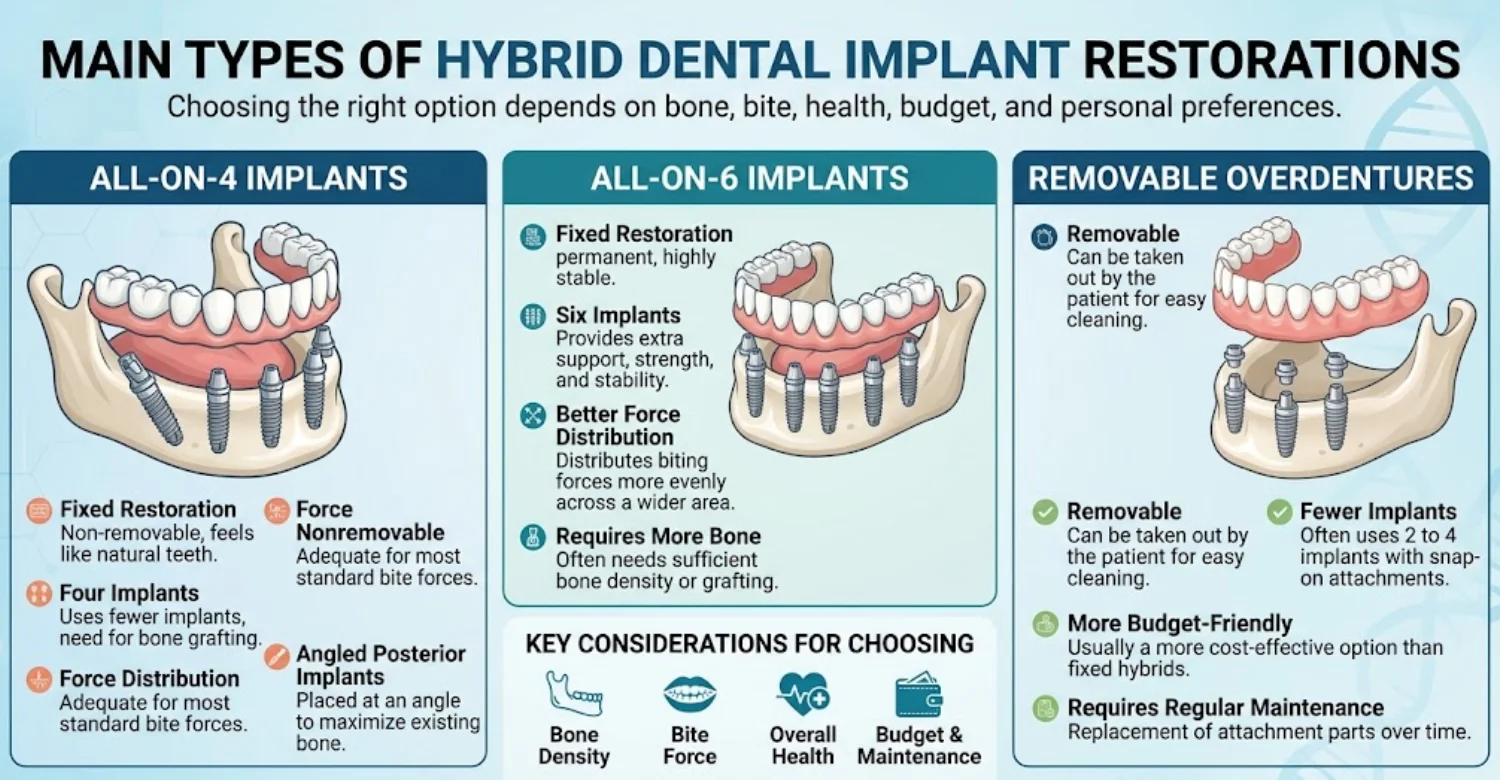
All-on-4 Hybrid Dental Prosthesis
The All-on-4 concept supports a full arch of teeth on four implants. It was developed in the 1990s and popularised by Dr. Paulo Maló. The design often allows immediate temporary teeth on the day of surgery. It is widely used for patients with moderate bone loss who want to avoid grafting.
How Four Strategically Placed Implants Can Support a Full-Arch Restoration
Two implants are placed upright in the front of the jaw. Two longer implants are placed in the back at an angle of up to about 45 degrees. Tilting allows the rear implants to avoid the sinus or nerve. It also spreads the implants further apart, improving support for the back teeth. The implants are connected by the rigid prosthesis, which shares forces between them. Angled abutments correct the tilt so screw holes emerge in suitable positions. This geometry often allows ten to twelve teeth without bone grafting.
Potential Benefits and Clinical Considerations of All-on-4
Long-term follow-up studies from the developer's group report implant survival around 94% to 98% at ten years. Benefits include fewer implants, lower cost, and frequently avoiding grafting. Immediate temporary teeth are possible in many suitable cases. However, losing one implant affects a larger share of total support. The design depends on good primary stability and careful bite control. Heavy bruxers or patients with soft bones may need extra implants. Results also depend heavily on surgical experience and prosthetic precision.
All-on-6 Hybrid Implant Restoration
All-on-6 supports a full arch on six implants rather than four. It is often chosen when bone volume allows more implants across the arch. The design provides additional support and may reduce stress on individual implants. Many clinicians use it for larger arches, heavy bites, or zirconia prostheses.
How Six Implants May Distribute Support Across a Dental Arch
Six implants spread chewing forces across more anchorage points. This can reduce the load on each implant and its retaining screw. Additional rear implants may shorten cantilevers at the back of the prosthesis. Shorter cantilevers usually mean less bending stress on the framework. If one implant fails, the remaining five may still support the bridge. This redundancy gives some patients greater long-term security. However, six implants require more bone and longer surgery.
When Additional Implants May Be Considered
Dentists may recommend more implants when bone density is low, especially in the upper jaw. They may also do so for patients with strong bites or bruxism. Large arches with long distances between implants can benefit from extra support. Patients wanting a heavier zirconia prosthesis may need more anchorage. Opposing natural teeth or implants can generate higher forces than opposing dentures. Some upper jaws receive six to eight implants for these reasons. Extra implants are a planning decision, not an automatic upgrade.
All-on-4 vs. All-on-6: How Do Dentists Choose?
Dentists choose between four and six implants by weighing bone, bite, and anatomy. Four implants may be preferred when bone is limited and grafting should be avoided. Six implants may suit patients with good bone and higher functional demands. Research shows both approaches can achieve high survival when properly planned. Systematic reviews generally report full-arch implant survival above 95% over medium-term follow-up. Cost differences reflect extra implants, components, and surgical time. Patient preferences and budget also play a legitimate role. The right choice is the one supported by your scans and bite analysis.
Feature | All-on-4 | All-on-6 |
Implants per arch | 4 | 6 |
Grafting needed | Often avoided | More bone often required |
Load distribution | Good with tilted implants | Broader and more redundant |
Typical cost | Lower | Higher |
Hybrid Denture vs. Implant Overdenture
A hybrid denture is fixed and removed only by the dentist. An implant overdenture is removable and snaps onto implants or a bar. Both use implants to improve stability compared with conventional dentures. The choice affects comfort, cleaning, cost, and long-term maintenance.
Differences in Stability, Removability, Cleaning, and Maintenance
Fixed hybrid dentures do not move and usually feel more like natural teeth. Overdentures are stable but can rock slightly under heavy chewing. Patients remove overdentures daily to clean them and the implants. Fixed prostheses require cleaning underneath with brushes, floss, or water flossers. Overdenture attachments wear and often need replacement every one to two years. Fixed hybrids need periodic screw checks and occasional tooth repairs. Both types require professional maintenance visits to protect the implants.
How Bone Conditions, Manual Dexterity, and Patient Preferences Affect the Choice
Patients with severe bone loss may benefit from an overdenture's broad support. Overdentures can also provide strong lip support when facial tissues have collapsed. Patients with limited hand dexterity may find removable cleaning easier. Arthritis, tremor, or reduced eyesight can make cleaning under fixed bridges difficult. Patients who strongly dislike removing teeth often prefer the fixed option. Budget also matters because overdentures generally need fewer implants. The best choice balances clinical findings with everyday practicality.
Which Materials Are Used in a Hybrid Dental Prosthesis?
Hybrid prostheses can be made from several materials, each with distinct strengths. Common options include acrylic resin, titanium-reinforced acrylic, zirconia, and metal-ceramic designs. Material choice affects strength, appearance, weight, repairability, and cost. It also affects how the prosthesis interacts with opposing teeth. No single material is perfect for every patient. The sections below compare the most common choices.
Acrylic Resin and PMMA Hybrid Prostheses
Acrylic resin and PMMA are widely used for temporary and some final prostheses. PMMA is a dense, industrially cured acrylic that can be milled precisely. These materials are light, affordable, and easy to adjust or repair chairside. They are gentle on opposing teeth because they are relatively soft. However, acrylic wears faster and can stain over time. Without a framework, long-span acrylic bridges may crack under heavy forces. Many clinicians use all-acrylic prostheses mainly during the healing phase.
Titanium or Metal Frameworks With Acrylic Teeth
This classic design uses a milled titanium bar covered with acrylic gums and denture teeth. The titanium framework provides strength and resists bending under chewing loads. Acrylic teeth absorb some impact and are kind to opposing teeth. Broken or worn teeth can usually be replaced without remaking the framework. Reviews report that chipping or wear of acrylic veneering is the most common complication. Some studies found such problems in roughly one third of prostheses within five years. Many patients need tooth replacement every five to ten years. Even so, the framework itself often lasts much longer.
Zirconia Hybrid Dental Restorations
Zirconia is a strong, tooth-coloured ceramic used for full-arch prostheses. Monolithic zirconia is milled as one solid piece, often with layered porcelain only at the front. It resists staining, wear, and plaque accumulation better than acrylic. Zirconia can look very natural when shaded and characterised by a skilled technician. Some studies report lower rates of chipping with monolithic designs than layered ceramics. However, zirconia is harder to repair if a fracture occurs. It is also heavier, more expensive, and less forgiving of fit errors. Careful bite adjustment is essential to protect opposing teeth.
Metal-Ceramic and Other Framework Options
Metal-ceramic prostheses use porcelain fused to a cast or milled metal framework. They have a long track record in fixed dentistry. Porcelain offers good aesthetics but can chip, especially in heavy bites. Repairs may require removing the prosthesis and sending it to the laboratory. Newer options include PEEK, fibre-reinforced composites, and high-performance polymers. These materials are lighter and more flexible but have less long-term data. Hybrid designs may combine zirconia frameworks with individual crowns. Your dentist should explain the evidence behind any material offered.
How Durability, Appearance, Repairability, and Cost Differ Between Materials
Each material balances different priorities in a different way. Acrylic is affordable and repairable but wears faster. Titanium-acrylic combines strength with easy repairs but needs periodic tooth renewal. Zirconia offers excellent appearance and durability but costs more and is harder to repair. Metal-ceramic is strong but porcelain chipping can complicate maintenance. The table below summarises typical trade-offs.
Material | Durability | Appearance | Repairability | Relative cost |
Acrylic / PMMA | Moderate | Good | Easy | Lowest |
Titanium + acrylic | Good | Good | Easy | Moderate |
Zirconia | Very high | Excellent | Difficult | Highest |
Metal-ceramic | High | Very good | Moderate | High |
How Bruxism and Opposing Teeth Influence Material Selection
Grinders place extreme forces on prosthetic teeth every night. Acrylic may wear quickly in bruxers but protects opposing teeth. Zirconia resists wear but can transmit greater force to implants and opposing teeth. If the opposing arch also has zirconia, forces can become very high. Opposing natural teeth may wear if zirconia is not perfectly polished. A conventional denture opposing the prosthesis generates lower forces overall. These factors influence whether a softer or harder material is safer. A protective night guard is often advised regardless of material.
Clinical Note : Personalizing Hybrid Implant Restoration Materials
Material choice should follow clinical findings rather than fashion or marketing. Patients often ask for zirconia because they hear it is the strongest option. Strongest does not always mean most suitable for every bite or budget. A personalized choice considers forces, aesthetics, hygiene, and future repair needs.
Dr. Rifat Alsaman's Clinical Perspective on Balancing Function, Aesthetics, Hygiene, and Long-Term Maintenance
Dr. Alsaman explains that he starts with the bite before discussing appearance. If forces are high, he prioritises framework strength and protective design. For patients with demanding aesthetics, he considers zirconia with careful shading. For patients prioritising easy repairs, titanium-acrylic may be the wiser option. He also checks how easily each design can be cleaned underneath. He reminds patients that every material needs maintenance, including zirconia. In his experience, realistic expectations lead to higher long-term satisfaction. The goal is a prosthesis patients can live with comfortably for many years.
Ready to transform your smile?
Talk to our team and get a personal FREE treatment plan.
How Is the Hybrid Implant Restoration Procedure Performed?
The procedure follows a structured sequence from consultation to final teeth. Each step builds on the previous one, so skipping stages can increase risk. Some patients complete surgery and temporary teeth within a few days. Others need grafting or extra healing before implants can be loaded. The final teeth usually arrive several months later after osseointegration. The seven steps below describe a typical pathway.
Step 1 : Initial Consultation, Diagnosis, and Treatment Planning
The journey begins with a consultation, examination, and imaging. The dentist reviews your medical history and discusses your expectations. CBCT scans, intraoral scans, and photographs are usually taken. The team designs the future teeth and plans implant positions digitally. You receive an explanation of options, timelines, and costs. This is the time to ask questions about materials, risks, and maintenance. A clear written plan should be agreed before any irreversible treatment starts.
Step 2 : Tooth Extractions and Preparatory Dental Procedures, When Needed
Remaining hopeless teeth are removed, often during the same surgical session as implant placement. The sockets are cleaned thoroughly to remove infected tissue. Bone may be smoothed or reduced to create space for the prosthesis. Some patients need grafting or a sinus lift before implants can be placed. Active gum disease in the opposing arch may also be treated at this stage. Preparatory steps aim to create a healthy, stable foundation. Skipping them can compromise implant healing and long-term success.
Step 3 : Dental Implant Placement and Surgical Planning
Implants are placed under local anaesthesia, often with sedation for comfort. Many full-arch surgeries take about two to four hours per arch. The surgeon follows the digital plan, sometimes using a printed surgical guide. Implant stability is measured, often as insertion torque in newton-centimetres. High stability suggests the implants may support immediate temporary teeth. Multi-unit abutments are attached to provide a common platform for the prosthesis. Gums are then sutured around the abutments. Most patients go home the same day with detailed aftercare instructions.
Step 4 : Temporary Fixed Prosthesis and Immediate-Loading Considerations
When conditions allow, a temporary fixed prosthesis is attached within about 24 to 72 hours. This is called immediate loading. It means patients rarely spend time without teeth. The temporary is usually lightweight acrylic with no back cantilevers. Its bite is adjusted to minimize heavy contacts during healing. Patients must follow a soft diet to protect the healing implants. Systematic reviews show immediate loading achieves survival similar to delayed loading in selected patients.
Why Not Every Patient Qualifies for Immediate Loading
Immediate loading requires high implant stability at placement. Many protocols require insertion torque of at least about 30 to 35 newton-centimetres. Soft bone, extensive grafting, or infection can make early loading unsafe. Heavy bruxism or uncontrolled diabetes may also increase the risk of failure. In these cases, implants heal without load for several months. Patients may wear a removable temporary denture during this period. Delaying loading is a safety decision, not a sign of poor treatment.
Step 5 : Healing and Osseointegration
Osseointegration is the process by which bone bonds directly to the implant surface. It usually takes about three months in the lower jaw. The upper jaw often needs four to six months because its bone is softer. During healing, patients wear the temporary prosthesis and follow dietary instructions. Review visits check gum healing, bite, and implant stability. Smoking during this period can significantly impair bone healing. Gums and bone also remodel, which can change the fit of the temporary teeth. That is why final impressions wait until tissues have stabilised.
Step 6 : Final Hybrid Prosthesis Fabrication and Fitting
Once healing is complete, the team records precise scans or impressions of the implants. A verification jig may be used to confirm accuracy before fabrication. The laboratory builds a framework that fits passively on all implants. Passive fit means no tension when screws are tightened. Try-in stages allow patients to approve shape, shade, and lip support. The final prosthesis is then screwed onto the abutments. Screw access holes are sealed with tooth-coloured material.
Step 7 : Bite Adjustment, Final Checks, and Maintenance Instructions
The dentist checks how the teeth meet when chewing and moving sideways. Heavy contacts are adjusted to spread forces evenly. Screws are tightened to the manufacturer's specified torque values. Patients receive training on cleaning under and around the prosthesis. A night guard may be made for patients with grinding habits. The first maintenance appointment is usually scheduled within a few months. Clear written aftercare instructions help patients protect their new teeth.
How Long Does Hybrid Dental Implant Rehabilitation Take From Surgery to Final Teeth?
Hybrid Dental Implant Rehabilitation usually takes three to six months from surgery to final teeth. With immediate loading, patients leave with temporary teeth within days. Patients needing grafting or sinus lifts may wait six to twelve months overall. International patients often need two trips: one for surgery and one for final teeth. The first trip usually lasts about five to ten days. The second trip often requires several days for try-ins and fitting. Healing speed varies by bone quality, health, and smoking status. Your plan should list each visit and its expected duration.
What Is the Average Hybrid Dental Implant Rehabilitation Cost in US , UK and Turkey ?
The cost of Hybrid Dental Implant Rehabilitation varies widely between countries and clinics. Published planning ranges suggest US prices are often three to four times higher than Turkish prices. UK prices usually sit between US and Turkish ranges. These figures are planning estimates, not fixed quotes. Final costs depend on implant number, materials, grafting, and follow-up. All figures below are shown in US dollars per arch for easier comparison. A personal itemised quote is the only reliable way to know your cost.
What Factors Affect Hybrid Dental Implant Rehabilitation Cost?
Several factors combine to shape the final price of Hybrid Dental Implant Rehabilitation. Clinical complexity, materials, and additional procedures have the greatest effect. Implant brand, laboratory quality, and clinician experience also influence the cost. For international patients, travel and accommodation add further expenses. Understanding these factors helps patients compare quotes fairly.
Number of Implants and Complexity of the Surgical Procedure
Each implant adds the cost of the fixture, abutment, and surgical time. Moving from four to six implants can raise the total noticeably. Complex anatomy may require guided surgery or longer operating time. Zygomatic implants are considerably more expensive and require specialised training. Extractions of many teeth also add surgical time and complexity.
Acrylic, Titanium Framework, and Zirconia Prosthesis Costs
The prosthesis can represent a large share of the total cost. Acrylic or PMMA prostheses are usually the most affordable option. Titanium-reinforced acrylic costs more because of framework milling. Monolithic zirconia is often the most expensive due to materials and lab time. Some quotes include only an acrylic temporary, with the final upgrade charged separately.
Bone Grafting, Tooth Extractions, Sedation, and Other Additional Procedures
Bone grafting and sinus lifts can add significant cost to a plan. Each extraction may be charged separately or included in a package. IV sedation or general anaesthesia usually costs extra. CBCT scans, surgical guides, and medications may also appear as separate items. Asking which procedures are included prevents unexpected bills.
Temporary Restorations, Final Prosthesis, Aftercare, and Follow-Up
Some quotes include both temporary and final prostheses, while others do not. Follow-up visits, screw checks, and repairs may be charged separately. Night guards are often an additional cost. Maintenance visits every three to six months continue for life. Patients should budget for future tooth replacement, especially with acrylic designs.
Travel, Accommodation, and Treatment Coordination for International Patients
Patients travelling abroad must budget for flights, hotels, and transfers. Two trips are usually required for surgery and final teeth. Some packages include hotel stays and airport transfers. Patients should also allow for meals, insurance, and possible extra nights. Coordination services can simplify planning but should be clearly priced.
Average All-on-4 Hybrid Dental Rehabilitation Cost by Country
All-on-4 costs differ significantly between the US, UK, and Turkey. The figures below are estimated planning midpoints per arch with published ranges. They reflect typical full-arch treatment rather than complex grafting cases.
United States : Estimated Midpoint of $24,000 per Arch, With a Published Planning Range of 18,000–30,000
In the US, an estimated midpoint is about $24,000 per arch. Published planning ranges run from about $18,000 to $30,000. Higher costs reflect clinic overheads, specialist fees, and laboratory charges. Zirconia prostheses and sedation often push quotes toward the upper end. Dental insurance usually covers only a small fraction of full-arch treatment.
United Kingdom : Estimated Midpoint of $14,000 per Arch, With a Published Planning Range of 10,000–18,000
In the UK, the estimated midpoint is about $14,000 per arch. Planning ranges commonly run from about $10,000 to $18,000. Full-arch implants are generally private treatment rather than standard NHS care. Prices vary between regions, with London clinics often charging more. Payment plans are widely offered to spread costs.
Turkey : Estimated Midpoint of $5,850 per Arch, With a Published Planning Range of 3,250–8,450
In Turkey, the estimated midpoint is about $5,850 per arch. Published ranges run from about $3,250 to $8,450. That midpoint is roughly 75% lower than the US midpoint and nearly 60% lower than the UK. Lower operating costs explain much of the difference. Patients should still confirm implant brands, materials, and follow-up arrangements.
Average All-on-6 Hybrid Dental Rehabilitation Cost by Country
All-on-6 typically costs more than All-on-4 because of extra implants and components. The table below shows estimated planning midpoints and ranges per arch.
United States : Estimated Midpoint of $31,000 per Arch, With a Published Planning Range of 24,000–38,000
US All-on-6 treatment has an estimated midpoint of about $31,000 per arch. Planning ranges commonly run from about $24,000 to $38,000. The extra implants and longer surgery explain the higher cost. Zirconia final teeth often place quotes near the top of the range.
United Kingdom : Estimated Midpoint of $16,000 per Arch, With a Published Planning Range of 12,000–20,000
UK All-on-6 treatment has an estimated midpoint of about $16,000 per arch. Planning ranges run from about $12,000 to $20,000. The gap between UK All-on-4 and All-on-6 midpoints is about $2,000. Material choice and grafting needs strongly affect the final figure.
Turkey : Estimated Midpoint of $7,150 per Arch, With a Published Planning Range of 3,900–10,400
Turkish All-on-6 treatment has an estimated midpoint of about $7,150 per arch. Published ranges run from about $3,900 to $10,400. The midpoint is about 77% lower than the US midpoint. Patients should add travel costs before comparing totals with home-country quotes.
What Could Hybrid Dental Implant Rehabilitation Cost for Both Arches?
Many patients need treatment on both arches, which roughly doubles the total cost. Some clinics offer modest discounts when both arches are treated together. Doing both arches in one session can also reduce travel for international patients. The estimates below simply double the per-arch midpoints.
Estimated All-on-4 Planning Midpoints for Both Arches : US $48,000, UK $28,000, and Turkey $11,700
For All-on-4 on both arches, estimated midpoints are about $48,000 in the US. The UK midpoint is about $28,000 for both arches. Turkey's midpoint is about $11,700 for both arches. The US-Turkey difference is therefore roughly $36,300 before travel costs.
Estimated All-on-6 Planning Midpoints for Both Arches : US $62,000, UK $32,000, and Turkey $14,300
For All-on-6 on both arches, the estimated US midpoint is about $62,000. The UK midpoint is about $32,000 for both arches. Turkey's midpoint is about $14,300 for both arches. Even after flights and hotels, the difference often remains substantial.
Both arches | US | UK | Turkey |
All-on-4 midpoint | $48,000 | $28,000 | $11,700 |
All-on-6 midpoint | $62,000 | $32,000 | $14,300 |
How to Compare Dental Implant Quotes Between Countries
Comparing quotes for Hybrid Dental Implant Rehabilitation requires more than checking the final number. Two quotes with similar prices may include very different components. A low headline price may exclude the final prosthesis or follow-up care. Careful comparison protects both your budget and your long-term results.
Confirm Whether the Quote Includes Both Surgery and the Final Prosthesis
Some quotes cover only implants and temporary teeth. The final prosthesis may be priced separately and cost thousands more. Ask whether the quote includes extractions, abutments, temporary teeth, and final teeth. Confirm whether the final teeth are acrylic, titanium-acrylic, or zirconia.
Check Implant Brands, Prosthesis Materials, Number of Visits, and Follow-Up Arrangements
Ask which implant brand will be used and whether parts are available internationally. Widely distributed brands make future repairs easier in your home country. Confirm the number of trips and the expected length of each visit. Ask how follow-up, repairs, and complications will be handled after you return home.
Request an Itemised Treatment Plan Before Comparing Total Costs
An itemised plan lists every procedure, material, and fee. It allows you to compare like with like across clinics and countries. It also highlights optional items you may not need. Ask for warranty terms and what they cover in writing.
Vitrin Clinic Treatment Pricing
These are Vitrin Clinic’s prices for dental implant treatments, offering more affordable options compared with the US and UK.
Treatment type | 🇬🇧 UK | 🇺🇸 USA | 🇹🇷 Turkey |
|---|---|---|---|
Single dental implant Implant post + abutment + crown | $2,400 – $5,700≈ | $3,000 – $6,000≈ | $500 – $700≈ |
Implant-supported crown Crown on existing implant | $1,270 – $2,540≈ | $1,500 – $3,000≈ | $700 – $900≈ |
All-on-4 Per arch, fixed full-arch restoration | $10,000 – $22,000≈ | $18,000 – $30,000≈ | $3,500 – $7,500≈ |
All-on-6 Per arch, 6-implant full-arch restoration | $12,700 – $25,400≈ | $20,000 – $35,000≈ | $4,000 – $9,000≈ |
Full mouth reconstruction Both arches, upper + lower | $29,000 – $50,000+≈ | $36,000 – $70,000+≈ | $7,000 – $15,000≈ |
3D CT scan & consultation | Charged separately | Charged separately | Free & included |
Estimated saving | — | — | Up to 70% less |
* Prices are averages for reference only and may vary based on individual case requirements, implant brand, bone condition, and treatment complexity. A personalised quote is provided following your free consultation.
What Are the Side Effects and Potential Complications of Hybrid Dental Implants?
Like any surgery, full-arch implant treatment carries risks and side effects. Most short-term effects are mild and settle within one to two weeks. Long-term complications can affect the implants, gums, or prosthesis. Knowing the warning signs helps patients seek help early. Research shows many complications can be managed successfully when detected promptly. The sections below explain what is normal and what is not.
Common Short-Term Effects After Implant Surgery
Short-term effects are a normal response to surgery and extractions. They usually peak within the first two to three days. Most patients return to light daily activities within a few days. Following aftercare instructions helps keep these effects manageable.
Temporary Swelling, Bruising, Tenderness, and Minor Bleeding
Swelling usually peaks around 48 to 72 hours after surgery. Bruising may appear on the cheeks or neck and fade within about a week. Tenderness around the gums and jaw is common during early healing. Minor oozing of blood can occur during the first day. Gentle pressure with gauze usually controls it. Sleeping with the head raised may help reduce swelling. Cold packs during the first day can also help.
Potential Technical Complications of a Hybrid Implant-Supported Prosthesis
Technical complications affect the prosthesis or its components rather than the bone. They are more common than biological complications in many long-term studies. Most can be repaired without losing implants. Regular checks help detect them early.
Prosthesis Chipping, Wear, Fracture, or Screw Loosening
Acrylic teeth can wear, chip, or debond from the framework over time. Ceramic layers may chip under heavy bite forces. Frameworks rarely fracture but can do so with poor design or severe grinding. Screws may loosen, especially in the first year after fitting. A loose screw may cause clicking, movement, or gum soreness. Prompt tightening or replacement usually prevents further damage. Ignoring a loose prosthesis can overload the remaining implants.
Bite Changes and Problems With Prosthesis Fit
Bite changes can occur as tissues remodel or teeth wear. Patients may notice uneven contacts or difficulty closing comfortably. Opposing natural teeth may shift or wear over time. Poor fit can trap food or cause gum irritation under the prosthesis. Bite adjustments and relines are routine maintenance procedures. Persistent discomfort should always be reviewed by the dentist.
Biological Complications Affecting Dental Implants
Biological complications involve the gums and bone around implants. They are often linked to plaque, smoking, and missed maintenance. Early stages are reversible with professional cleaning and better hygiene. Advanced stages can lead to bone loss and implant failure.
Peri-Implant Mucositis and Peri-Implantitis
Peri-implant mucositis is inflammation of the gums around implants without bone loss. It is reversible when plaque control improves. A widely cited 2015 meta-analysis estimated mucositis in about 43% of patients. Peri-implantitis involves inflammation plus progressive bone loss. The same analysis estimated peri-implantitis in roughly 22% of patients. Risk factors include past periodontitis, smoking, poor hygiene, and irregular maintenance.
Gum Inflammation, Bone Loss, and Implant Mobility
Signs of inflammation include redness, swelling, bleeding, and tenderness. Bone loss may occur silently and is often detected on X-rays. Pus or deep pockets suggest more advanced disease. An implant that becomes mobile usually has lost integration and cannot be saved. Early treatment may include deep cleaning, antiseptics, or surgical repair. Regular X-ray monitoring helps catch bone changes early.
Which Warning Signs Require Prompt Dental Assessment?
Some symptoms need prompt attention rather than waiting for the next check-up. Early assessment can prevent minor problems becoming major ones. Patients should keep the clinic's contact details easily accessible. International patients should know how to reach their treating team remotely.
Persistent or Worsening Pain, Increasing Swelling, Pus, or Fever
Pain that worsens after the third day may signal infection. Swelling that increases rather than settles needs review. Pus, a bad taste, or fever suggests infection that requires assessment. Do not start antibiotics without professional advice.
A Loose Prosthesis, Changes in Bite, or Difficulty Chewing
A prosthesis that moves or clicks may have a loose or broken screw. Sudden bite changes can indicate a fracture or implant problem. Difficulty chewing after previously good function deserves examination. Avoid chewing on the affected side until reviewed.
Rapidly Spreading Swelling or Difficulty Breathing or Swallowing as Reasons for Emergency Care
Rapidly spreading swelling in the face or neck is a medical emergency. Difficulty breathing or swallowing requires immediate emergency care. Go to the nearest emergency department or call local emergency services. Contact your dental team once you are safe.
What Does Research Say About Long-Term Complications of Full-Arch Implant Restorations?
Long-term studies show full-arch implant treatment is highly successful but not maintenance-free. Most reviews report implant survival above 95% over five to ten years. Prosthesis survival is also high, though repairs are common. This means Hybrid Dental Implant Rehabilitation should be viewed as a long-term commitment.
Evidence on Prosthesis Materials, Mechanical Complications, Implant Survival, and Maintenance Needs
In Hybrid Dental Implant Rehabilitation, systematic reviews show mechanical complications are more frequent than implant loss. Acrylic tooth wear and chipping are among the most common issues. Some reviews report veneer chipping in about one third of metal-acrylic prostheses within five years. Monolithic zirconia shows lower chipping rates in available medium-term studies. Screw loosening occurs but is usually simple to resolve. A five-year study by Costa and colleagues found peri-implantitis in 18% of patients attending maintenance. The rate was about 44% in those without regular maintenance. These findings show why lifelong follow-up matters.
Note : All images used are for editorial and illustrative purposes only and may not originate from the original news provider or associated company.
How Can Patients Relieve Discomfort After Hybrid Implant Surgery?
Most discomfort after full-arch surgery is moderate and manageable. Pain usually peaks during the first two to three days. Following your dentist's instructions is the safest way to stay comfortable. Simple measures like cold packs, rest, and soft foods help considerably. Medication should be used only as directed by your clinician. The sections below summarise safe relief strategies.
Safe Relief Strategies During Early Recovery
Early recovery focuses on protecting the surgical sites and controlling swelling. Rest during the first 24 to 48 hours supports healing. Avoid strenuous exercise, smoking, and alcohol during the early phase. Keep the head elevated when resting or sleeping.
Following the Dentist's Individualized Pain-Control and Cold-Pack Instructions
Your dentist will give instructions tailored to your health and surgery. Cold packs are usually applied in short intervals during the first day. A common pattern is about 15 to 20 minutes on, then a break. Never place ice directly on the skin. Take pain relief exactly as instructed, not only when pain becomes severe.
Choosing Suitable Soft Foods and Avoiding Excessive Pressure on Healing Areas
A soft diet protects healing implants, especially with immediate temporary teeth. Suitable foods include soups, yoghurt, eggs, mashed vegetables, and soft fish. Avoid hard, crunchy, or sticky foods such as nuts and toffee. Cut food into small pieces and chew gently. Many protocols recommend a soft diet for about six to eight weeks.
Maintaining Oral Hygiene Without Disturbing Surgical Sites
Keeping the mouth clean reduces infection risk during healing. Follow your dentist's advice on when to start rinsing. Gentle salt-water or prescribed rinses are often recommended. Use a soft brush around the temporary teeth without scrubbing the stitches. Water flossers should only be used once your dentist approves them.
Medical Tips for Using Pain Relief Medication After Implant Surgery
Pain relief medication should be chosen and dosed by a qualified clinician. Your medical history, current medicines, and allergies all matter. Research suggests combining certain non-opioid painkillers can provide effective dental pain relief. However, combinations are not safe for everyone.
Following Professional Advice on Medication Choice and Dosage
Take only the medicines your dentist or doctor recommends. Follow the stated dose, timing, and maximum daily limit. Do not combine products that contain the same active ingredient. Ask before taking any additional over-the-counter medicine.
Potential Side Effects of Pain Relievers, Including Stomach Irritation, Bleeding Risk, and Kidney-Related Concerns With Certain NSAIDs
Anti-inflammatory painkillers, called NSAIDs, can irritate the stomach lining. They may increase bleeding risk, particularly with blood thinners. Some NSAIDs can affect kidney function, especially in older or dehydrated patients. They may not suit people with ulcers, kidney disease, or certain heart conditions. Your clinician will weigh these risks before recommending them.
Possible Drug Interactions, Allergies, and Reasons to Discuss Existing Medications With a Clinician
Painkillers can interact with blood pressure tablets, blood thinners, and some antidepressants. Allergies to aspirin or other NSAIDs must always be reported. Liver conditions may affect which medicines are safe. Bring a full medication list to your appointments. This helps your clinician choose the safest option.
Why Patients Should Not Start Antibiotics or Change Prescribed Medication Without Professional Guidance
Antibiotics should only be used when prescribed for a specific reason. Unnecessary use can cause side effects and contribute to antibiotic resistance. Stopping prescribed antibiotics early may also be unsafe. Never change doses of regular medicines without asking the prescribing clinician.
When Should Postoperative Discomfort Be Reassessed by a Dentist?
Contact your dentist if pain is worsening after the third day. Seek review if swelling increases, bleeding persists, or pus appears. Fever, a bad taste, or a loose temporary also need assessment. Numbness lasting beyond the day of surgery should be reported promptly. Trust your instincts if something feels wrong.
Ready to transform your smile?
Talk to our team and get a personal FREE treatment plan.
How Should Patients Care for Hybrid Dental Implants Long Term?
Long-term success depends heavily on daily cleaning and professional maintenance. Implants cannot decay, but the surrounding gums and bone can become diseased. Plaque collects under and around the prosthesis just like on natural teeth. Patients who follow maintenance programmes have significantly lower peri-implantitis rates. Caring for your Hybrid Dental Implant Rehabilitation is a lifelong habit, not a short-term task. The sections below explain the essential routines.
Daily Cleaning Techniques for a Fixed Hybrid Denture
Brush all surfaces of the prosthesis at least twice daily with a soft brush. Use low-abrasive toothpaste to protect acrylic and polished surfaces. Focus on the area where the prosthesis meets the gums. Clean underneath the bridge daily using floss threaders or super floss. Water flossers can help remove debris from hard-to-reach areas. Studies suggest water flossers may reduce bleeding around implants more than traditional floss. Finish with a rinse if your dentist recommends one.
Using Suitable Interdental Brushes and Implant-Specific Cleaning Tools
Interdental brushes clean between implants and under the prosthesis effectively. Choose sizes that fit snugly without forcing them. Brushes with plastic-coated wires are gentler on implant surfaces. Single-tuft brushes reach around abutments and back implants. Your hygienist can recommend the correct sizes for your prosthesis. Replace brushes when bristles become worn or bent.
How Often Should Patients Attend Dental Checkups and Professional Maintenance?
Most patients need professional maintenance every three to six months. High-risk patients, such as smokers or those with past periodontitis, may need shorter intervals. Visits include gum checks, cleaning, and bite review. The prosthesis may be removed periodically for deep cleaning and screw inspection. X-rays are taken at intervals to monitor bone levels. Consistent attendance is one of the strongest predictors of long-term success.
Recognizing Early Signs of Gum Inflammation Around Dental Implants
Early inflammation often causes little or no pain. Watch for bleeding when brushing or cleaning under the prosthesis. Redness, swelling, or tenderness around the implants are warning signs. Persistent bad breath or bad taste may indicate trapped debris or infection. Gum recession exposing metal parts should also be reported. Early treatment is simpler and more successful than treating advanced disease.
How Smoking, Bruxism, Diet, and Oral Hygiene Affect Long-Term Maintenance
Smoking increases the risk of peri-implantitis and implant loss. Quitting at any stage brings measurable benefits to healing and gum health. Bruxism increases screw loosening, tooth wear, and fractures. Very hard foods, ice, and bones can chip prosthetic teeth. Sugary diets encourage plaque accumulation around implants. Consistent hygiene remains the single most important habit you control.
When a Protective Night Guard May Be Recommended
A night guard is recommended for patients who grind or clench during sleep. It absorbs forces that could otherwise damage teeth, screws, and implants. Guards are custom-made to fit the prosthesis precisely. Patients with zirconia opposing zirconia often benefit significantly. Guards should be cleaned daily and checked at maintenance visits. They usually need replacement when worn or cracked.
Can a Hybrid Implant-Supported Prosthesis Be Repaired or Replaced?
Yes, most hybrid prostheses can be repaired or replaced without new implants. This is a key advantage of Hybrid Dental Implant Rehabilitation using screw-retained designs. Acrylic teeth can often be replaced on the existing framework. Chipped ceramic can sometimes be polished or repaired. A new prosthesis can be made on healthy implants when needed. Many acrylic prostheses need refurbishing after about five to ten years. Keeping records of implant brands and components simplifies future repairs.
Tips for Patients Considering Hybrid Dental Implant Rehabilitation
Prepare for Your Consultation: Gather your dental records, previous X-rays, and treatment history before your appointment.
Ask About Treatment Options: Discuss the proposed implant system, prosthesis materials, expected outcomes, and possible alternatives.
Understand the Treatment Timeline: Ask how many visits are required, how long healing may take, and when the final prosthesis can be placed.
Compare Clinics Carefully: Evaluate the dental team's experience, diagnostic technology, treatment planning, and follow-up care rather than focusing only on price.
Plan Your Dental Travel: If traveling abroad, confirm appointment schedules, accommodation, transportation, and arrangements for follow-up visits.
Set a Realistic Budget: Request an itemized estimate covering consultations, imaging, surgery, prosthetic components, temporary restorations, and aftercare.
Discuss Potential Risks: Ask about possible complications, maintenance requirements, and what to do if the prosthesis becomes loose or damaged.
Prioritize Long-Term Maintenance: Understand the daily cleaning routine and professional check-up schedule needed to maintain your implant-supported restoration.
What to Prepare Before an Implant Consultation
Gather recent dental X-rays, scans, and treatment records if available. Prepare a list of medical conditions, medications, and allergies. Write down your goals, concerns, and any previous denture problems. Bring photographs of your smile from earlier years if appearance matters to you. Think about your budget range and preferred timeline. These details help the team give accurate advice quickly.
Questions to Ask About Implant Brands, Materials, Healing, and Final Restoration
Ask which implant system will be used and how long it has been on the market. Ask whether replacement parts are available in your home country. Ask what the temporary and final teeth will be made from. Ask how long healing will take before final teeth. Ask what happens if an implant fails or the prosthesis breaks. Ask what maintenance schedule the clinic recommends. Clear answers reflect a well-organised clinic.
What to Know Before Traveling Abroad for Full-Arch Dental Treatment
International Hybrid Dental Implant Rehabilitation usually requires at least two trips. Allow enough time for surgery, early review, and possible adjustments. Avoid flying immediately after surgery if your clinician advises waiting. Check clinic credentials, clinician qualifications, and patient reviews carefully. Confirm communication arrangements for questions after you return home. Ask whether a local dentist can support maintenance in your country. Travel insurance that covers medical treatment abroad is worth considering.
How to Plan for Recovery Time, Follow-Up Visits, and Unexpected Costs
Plan several days of light activity after surgery. Many patients take about one week off work, depending on their job. Schedule follow-up visits before booking flights where possible. Budget a reserve for unexpected repairs, extra nights, or medications. Long-term maintenance fees should be included in your overall plan. A realistic budget reduces stress throughout treatment.
Why Patients Should Prioritize Long-Term Maintenance Over the Lowest Initial Price
The cheapest quote can become expensive if complications arise later. Poorly planned Hybrid Dental Implant Rehabilitation may need costly revisions within a few years. Quality implants, accurate frameworks, and good follow-up protect your investment. Clinics offering clear aftercare pathways often provide better long-term value. Compare total lifetime costs, not only the first invoice. Your implants should be planned to last decades with proper care.
At Vitrin Clinic : Personalized Planning for Hybrid Dental Implant Rehabilitation
At Vitrin Clinic, Hybrid Dental Implant Rehabilitation begins with understanding each patient's mouth and goals. The team led by Dr. Rifat Alsaman focuses on evidence-based planning and clear communication. Every plan considers bone, gums, bite, appearance, and maintenance together. Patients receive explanations of options rather than a single standard package. The sections below outline how this personalised approach works.







Evaluating Missing Teeth, Gum Health, Bone Support, and Bite Function Before Treatment
The team examines remaining teeth and decides which can be saved. Gum health is assessed and treated before surgery when needed. Bone support is measured carefully using clinical findings and imaging. Bite function is analysed to understand forces and jaw movements. These findings guide every later decision in the plan.
Using Digital Imaging, CBCT, and 3D Scanning When Clinically Appropriate
CBCT scans are used when clinically justified to assess implant sites in three dimensions. Intraoral scans capture teeth and gums accurately without traditional impressions. Digital planning allows the team to design teeth before placing implants. This approach supports safer surgery and more predictable results. Imaging is chosen according to clinical need, not routine habit.
Comparing Suitable Full-Arch Treatment Options and Prosthesis Materials
Patients are shown the suitable options for their case, including fixed and removable designs. The team explains the differences between All-on-4, All-on-6, and overdentures. Material choices are compared for strength, appearance, repairability, and cost. Patients are encouraged to ask questions before making decisions. The aim is an informed choice, not a rushed one.
Developing an Individualized Treatment Plan Based on Clinical Findings and Patient Goals
Each plan combines clinical evidence with the patient's priorities. It specifies implant number, positions, prosthesis type, and timing. It also explains any extractions, grafting, or preparatory treatment required. Patients receive a clear written summary of the proposed treatment. Plans are reviewed and adjusted when new findings appear.
Understanding Treatment Components, Cost Inclusions, and Follow-Up Needs
Patients receive an itemised explanation of what their quote includes. This covers implants, abutments, temporary teeth, final teeth, and follow-up visits. Any items not included are explained clearly in advance. The team also outlines expected long-term maintenance needs. Transparency helps patients compare options with confidence.
How Vitrin Clinic Supports Your Treatment Journey
Full-arch treatment involves several stages, appointments, and decisions. Vitrin Clinic supports patients throughout their Hybrid Dental Implant Rehabilitation journey from first contact to aftercare. Support is especially important for international patients managing travel. The sections below describe each stage of support.
Initial Consultation and Review of Available Dental Records
Patients can share existing X-rays, scans, and dental records before the first visit. The team reviews these records to give preliminary guidance. A full examination is still required to confirm the final plan. This early review helps patients understand likely options and timelines.
Coordinating Diagnostic Assessment and Personalized Treatment Planning
The clinic coordinates examinations, imaging, and planning appointments efficiently. Results are discussed with patients in clear, practical language. The team explains why each step is recommended. Treatment begins only after the patient understands and agrees with the plan.
Organizing Appointments for International Patients
International patients receive help scheduling visits around travel dates. The team explains how many trips are likely and how long each lasts. Appointments are arranged to allow adequate healing and review. Patients are advised on practical planning before booking flights.
Explaining Treatment Stages, Expected Recovery, and Aftercare Responsibilities
Patients learn what to expect at each stage before it begins. The team explains normal recovery symptoms and warning signs. Aftercare instructions are provided verbally and in writing. Patients are trained in cleaning techniques before leaving the clinic.
Supporting Follow-Up Planning and Communication After Treatment
Follow-up visits are planned to monitor healing and long-term health. Patients know how to contact the team with questions after returning home. The clinic can share records with local dentists to support maintenance. Ongoing communication helps resolve concerns early.
Ready to transform your smile?
Talk to our team and get a personal FREE treatment plan.
Key Takeaways
Full-arch implant treatment can transform comfort, function, and confidence. Its success depends on careful planning, suitable materials, and lifelong maintenance. The points below summarise the most important lessons from this guide.
What Patients Should Know About Hybrid Dental Implant Rehabilitation
Hybrid Dental Implant Rehabilitation replaces a full arch with fixed teeth on four to six implants. Temporary teeth are often fitted within days of surgery. Final teeth usually follow after three to six months of healing. Long-term studies report implant survival commonly above 95% at five to ten years.
Why Candidacy, Bone Support, Prosthesis Material, and Bite Function Matter
Not every patient suits the same design or material. Bone support determines implant positions and the need for grafting. Bite forces influence implant number and material strength. Matching these factors carefully reduces complications and repairs.
How to Compare Treatment Costs Without Overlooking Important Inclusions
Estimated per-arch midpoints range from about $5,850 in Turkey to $31,000 in the US. Always confirm whether quotes include final teeth and follow-up care. Compare itemised plans, implant brands, and materials rather than headline prices. Remember to add travel costs when comparing international options.
Why Consistent Oral Hygiene, Professional Maintenance, and Follow-Up Are Essential
Implants can develop gum inflammation and bone loss without proper care. Regular maintenance has been linked to much lower peri-implantitis rates. Daily cleaning under the prosthesis is essential for long-term health. Successful Hybrid Dental Implant Rehabilitation depends on this partnership between patient and clinic.
When Pain, Swelling, Fever, or Prosthesis Movement Requires Professional Assessment
Worsening pain after the third day needs assessment. Increasing swelling, pus, or fever suggests possible infection. A loose or moving prosthesis should be checked promptly. Difficulty breathing or swallowing requires emergency care immediately.
At Vitrin Clinic
Vitrin Clinic offers personalized Hybrid Dental Implant Rehabilitation planned around your bone, bite, and goals. The team, led by Dr. Rifat Alsaman, combines digital planning with clear communication. You will receive an honest explanation of suitable options, materials, and costs. Contact Vitrin Clinic to book a consultation and receive a personalised treatment plan.
Reference
FAQs
Dr. Rifat Alsaman has more than 5 years of clinical experience in dentistry and currently serves as the Head of the Medical Team at Vitrin Clinic. He is dedicated to providing exceptional patient care, overseeing treatment planning, and ensuring the highest clinical standards across the team. His expertise, attention to detail, and commitment to continuous professional development have helped countless patients achieve healthier, more confident smiles.


.webp&w=3840&q=75)