Dental Implant
August 26, 2026
All on 4 vs All on 6 Dental Implants: Which Is Better?
 Dr. Rifat Alsaman
Choosing between full-arch implant solutions can feel complicated when both options promise a fixed, functional smile. All on 4 vs All on 6 Dental Implants depends on bone availability, implant positioning, bite forces, restoration design, and long-term maintenance. Four implants can support a complete fixed arch when carefully positioned and appropriately planned. Six implants can provide additional implant distribution and may offer greater flexibility for certain patients. However, implant number alone does not determine treatment quality or long-term success. A comprehensive examination helps identify which approach matches your anatomy and restorative needs. CBCT imaging can reveal bone volume, anatomical structures, and potential implant positions before surgery. Your dentist should also evaluate periodontal health, occlusion, systemic factors, and hygiene ability. At Vitrin Clinic, treatment planning can combine clinical assessment with digital diagnostics to develop an individualized full-arch strategy.
All on 4 vs All on 6 Dental Implants: What's the Difference?
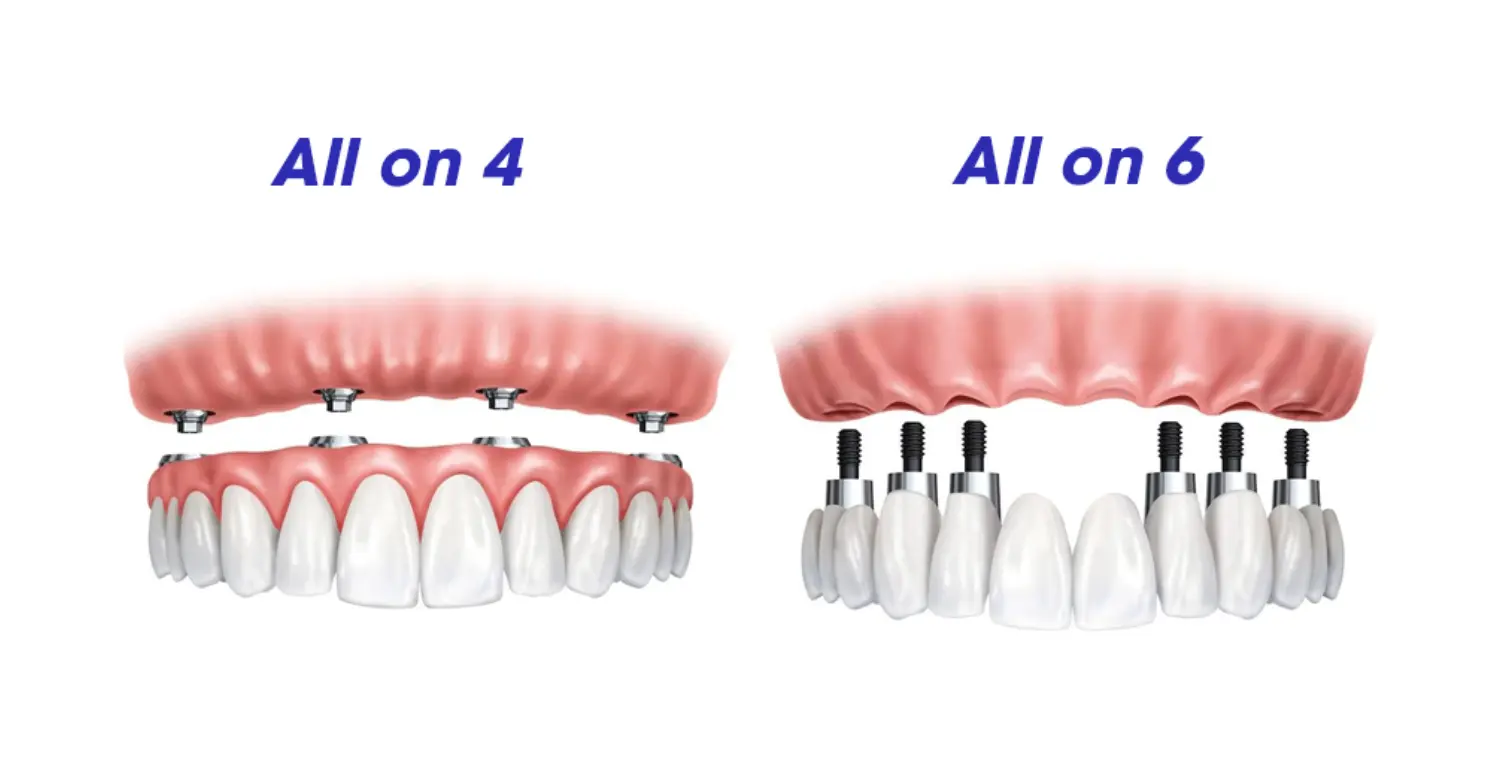
The primary difference involves the number and distribution of implants supporting a complete fixed dental arch. This comparison compares four strategically positioned implants with six implants supporting the restoration. All-on-4 commonly uses two posterior implants placed at an angle when anatomy permits. This strategy can help utilize available bone while avoiding certain anatomical structures. All-on-6 uses two additional implants, potentially distributing chewing forces across more support points. The ideal choice depends on bone anatomy, arch shape, restorative requirements, and implant stability. Evidence does not establish that six implants automatically outperform four implants in every patient. Instead, treatment should be based on prosthetic and surgical planning. Your dentist should determine whether four or six implants provide predictable support. A personalized assessment therefore matters more than simply choosing the larger implant number.
What Are All-on-4 Dental Implants?
All-on-4 is a full-arch implant concept using four dental implants to support a fixed prosthetic restoration. This decision often begins with understanding how four implants can replace an entire arch. Two implants are typically positioned toward the front of the jaw. Two posterior implants may be angled to improve available bone engagement. This configuration can reduce the need for extensive grafting in selected patients. However, not every patient has suitable anatomy for this approach. Implant placement requires careful evaluation of bone volume, density, nerve location, sinus anatomy, and prosthetic space. The restoration attaches to specially designed abutments connected with the implants. A temporary fixed prosthesis may sometimes be provided during the healing period. Long-term success still depends on hygiene, implant stability, prosthetic design, and professional maintenance.
How All-on-4 Supports a Full Arch
Four implants can support a complete fixed arch when their positions provide adequate mechanical support. All on 4 vs All on 6 Dental Implants requires understanding that implant distribution matters as much as implant quantity. The posterior implants can be angled to increase the available support area. This configuration may create an effective prosthetic foundation despite limited posterior bone. The implants connect to a rigid full-arch prosthesis designed to distribute functional forces. Implant stability must be sufficient before immediate loading is considered. Not every patient qualifies for immediate temporary teeth. Bone quality, insertion torque, occlusion, and surgical conditions influence loading decisions. Research involving complete-arch fixed prostheses demonstrates high survival rates for appropriately selected implant configurations. However, survival statistics represent groups rather than guarantees for individual patients. Proper planning therefore remains essential for predictable full-arch rehabilitation.
Why Four Implants Can Be Enough
Four implants can be enough because carefully distributed implants can provide substantial support for a rigid full-arch restoration. This choice should therefore not be judged solely by implant quantity. The prosthetic design helps distribute functional forces across the available implants. Strategic posterior implant positioning can increase the effective support area. This approach can also reduce treatment complexity for appropriately selected patients. Four implants may be particularly useful when posterior bone availability is limited. However, implant stability must be confirmed before deciding on loading protocols. The patient's bite pattern can also influence mechanical demands. Bruxism or strong chewing forces may require additional precautions. Clinical evidence supports four implants as a viable foundation for selected fixed full-arch restorations. Individual anatomy ultimately determines whether this approach is suitable.
What Are All-on-6 Dental Implants?
All-on-6 uses six strategically distributed implants to support a complete fixed dental arch. The right configuration differs here because two additional implants can increase the number of support points. The implants are generally distributed across the available anterior and posterior bone. This distribution may help spread functional forces across the arch. Six implants can also provide additional support for certain prosthetic designs. However, additional implants require sufficient bone and suitable surgical positions. More implants do not automatically eliminate biological or mechanical risks. Each implant still requires adequate bone integration and long-term hygiene access. The final restoration must also fit the patient's anatomy and functional requirements. Your dentist should assess whether six implants offer meaningful clinical advantages. At Vitrin Clinic, digital planning can help evaluate implant positions before surgery.
How All-on-6 Supports a Full Arch
Six implants can provide multiple support points beneath a full-arch prosthesis. All on 4 vs All on 6 Dental Implants highlights how additional implants can influence load distribution. Greater implant distribution may reduce the amount of force carried by individual implants. This can be useful when anatomy allows appropriate implant placement across the arch. The final prosthesis still requires accurate passive fit and appropriate occlusal design. Implant positions should be planned around available bone and restorative requirements. Six implants may also provide greater flexibility when designing the prosthesis. However, additional implants increase surgical sites and treatment complexity. They may also increase total treatment costs compared with four implants. Clinical decisions should therefore balance potential mechanical advantages against biological and financial considerations. The patient's individual anatomy remains the central factor.
Why Six Implants May Provide Additional Support
Six implants can create additional support points beneath a fixed full-arch restoration. This assessment therefore involves more than comparing numbers. Additional implants can potentially distribute functional forces across a broader implant network. This may be beneficial for patients with suitable bone throughout the arch. Prosthetic planning determines whether those additional support points provide meaningful advantages. Implant positions should avoid anatomical structures while maintaining appropriate restorative emergence. The dentist must also consider hygiene access around every implant and prosthetic component. Six implants may offer redundancy if one implant later develops a complication. However, this does not guarantee better long-term outcomes for every patient. Studies generally report high survival rates for both full-arch approaches. Treatment selection should therefore focus on predictable biology, biomechanics, and maintenance.
All-on-4 vs All-on-6 at a Glance
The two approaches share the goal of replacing an entire dental arch with a fixed implant-supported restoration. The appropriate options mainly differ in implant number, distribution, surgical requirements, and potential prosthetic support. All-on-4 uses four implants and may suit patients with limited posterior bone. All-on-6 uses six implants and may provide additional support when sufficient bone exists. Four implants can reduce the number of surgical implant sites. Six implants may distribute forces across more support points. Treatment cost commonly increases when additional implants and components are required. Recovery depends more on surgical complexity and individual healing than implant number alone. Long-term maintenance remains essential with either approach. Evidence supports both strategies when patients receive appropriate planning and follow-up. Your dentist should compare anatomy, function, aesthetics, cost, and maintenance before recommending an option.
All-on-4 vs All-on-6 Benefits
Understanding the potential benefits requires looking beyond implant quantity and considering the entire restorative system. All on 4 vs All on 6 Dental Implants can offer different advantages depending on anatomy and treatment objectives. Both approaches can provide fixed teeth instead of removable dentures. They may improve chewing function, speech, confidence, and smile appearance after appropriate rehabilitation. All-on-4 can reduce the number of implants required for full-arch treatment. It may also allow strategic use of available bone in selected cases. All-on-6 can provide additional implant support when adequate bone is available. The broader implant distribution may benefit certain prosthetic designs and functional demands. Neither option should be described as universally superior. Clinical assessment determines which benefits are most relevant for each patient. Vitrin Clinic can use individualized planning to match treatment design with the patient's oral conditions.
Benefits of All-on-4 Dental Implants
All-on-4 can provide a fixed full-arch solution using fewer implants than conventional approaches. This determination shows how strategic positioning can make four implants clinically useful. The approach may reduce surgical implant sites compared with six-implant treatment. It can also be advantageous when posterior bone is limited. Angled posterior implants may help access available bone while avoiding selected anatomical structures. Some patients may receive temporary fixed teeth during the treatment process. This can provide functional and aesthetic benefits while implants heal. Treatment may also avoid extensive grafting in appropriately selected cases. However, grafting requirements depend on individual anatomy rather than the treatment label. Long-term success requires excellent hygiene and regular professional monitoring. The most important benefit is achieving a stable restoration through appropriate patient selection.
Benefits of All-on-6 Dental Implants
All-on-6 can provide additional implant support for a complete fixed dental arch. Treatment selection becomes particularly relevant when sufficient bone allows six implants to be positioned strategically. Additional implants may help distribute functional forces across more support points. This can provide useful flexibility for certain prosthetic designs and bite conditions. Six implants may also offer additional support when posterior bone is adequate. However, every implant increases the number of surgical and maintenance sites. Patients therefore need excellent hygiene around the entire prosthesis. Six implants can also involve higher treatment costs because more components are required. Clinical outcomes depend on biological integration, prosthetic design, and patient factors. Research demonstrates strong survival outcomes for appropriately planned full-arch implant restorations. The potential advantage comes from suitable distribution, not simply from using more implants.
Dr. Rifat Alsaman's Opinion: Choosing the Right Implant Approach
Dr. Rifat Alsaman emphasizes that implant number should follow clinical requirements rather than become the treatment objective. All on 4 vs All on 6 Dental Implants should be selected after evaluating bone, occlusion, prosthetic needs, and long-term maintenance. Four implants can provide excellent support when positioned correctly and supported by appropriate prosthetic design. Six implants may be preferable when additional support is clinically justified. CBCT imaging helps reveal anatomical limitations before implant placement. Occlusal assessment also helps identify excessive forces that could affect the restoration. Patient hygiene ability should influence the final treatment plan. The dentist should explain benefits, limitations, risks, costs, and maintenance requirements clearly. This patient-centered approach avoids choosing treatment based only on implant quantity. At Vitrin Clinic, individualized full-arch planning can help patients understand their available treatment options. The final decision should always be clinically justified.
All-on-4 vs All-on-6 Cost
Treatment costs vary substantially because full-arch rehabilitation involves surgery, implants, abutments, temporary teeth, and final prosthetic components. This clinical decision can therefore have different total costs. Six implants generally require more implant fixtures and associated components. However, the number of implants is only one part of the final treatment price. Bone grafting, extractions, sedation, diagnostic imaging, and temporary restorations can affect expenses. The final prosthetic material can also create major price differences. Zirconia and other high-strength restorative options may have different laboratory costs. Geographic location and clinician experience can further influence treatment fees. Patients should compare complete treatment plans instead of comparing implant prices alone. A lower initial price may not represent the same materials or services. Vitrin Clinic can provide a personalized treatment plan after clinical evaluation. Exact pricing should be confirmed following examination and treatment planning.
What Determines All-on-4 Cost?
Several clinical and restorative factors determine the overall cost of four-implant full-arch treatment. Cost comparisons should include the complete treatment rather than implant fees alone. Diagnostic imaging can add costs before surgery begins. Tooth extraction may be required when remaining teeth cannot be restored. Bone grafting may also become necessary depending on available bone. Implant brand and component selection can influence the treatment price. Temporary prostheses may be included or charged separately. The final full-arch restoration represents another major cost component. Material selection can affect laboratory fees and long-term restorative characteristics. Sedation and additional surgical procedures may also influence the total. Patients should request an itemized quotation before treatment. This makes it easier to compare equivalent treatment plans between clinics.
What Determines All-on-6 Cost?
All-on-6 treatment costs reflect surgery, six implants, restorative components, temporary teeth, and the final prosthesis. All on 4 vs All on 6 Dental Implants cost differences often result from the additional implants and components. Diagnostic imaging remains necessary for accurate surgical planning. Bone grafting may increase costs when sufficient bone is unavailable. Extraction requirements can also change the treatment budget. Prosthetic material influences the final restoration cost considerably. Laboratory design and customization can create additional differences between treatment plans. The surgeon's expertise and clinic facilities may also influence fees. Patients should confirm whether aftercare and follow-up appointments are included. Comparing only the implant fixture price can produce misleading conclusions. A complete quotation should cover surgery, temporary teeth, final restoration, and expected additional procedures. This provides a clearer basis for financial decisions.
Is All-on-6 More Expensive Than All-on-4?
All-on-6 is commonly more expensive because it involves two additional implants and related components. Cost differences can nevertheless vary between individual treatment plans. The final price depends on surgical complexity and restorative materials. Bone grafting can affect either approach and may significantly change the total cost. Temporary and permanent prostheses can also have different prices. Some clinics package treatment components differently, making direct comparisons difficult. Patients should therefore compare itemized treatment plans rather than headline prices. A six-implant plan may provide additional support when clinically indicated. However, paying more does not automatically mean receiving a better outcome. The appropriate treatment should provide predictable function and long-term maintenance. Patients should discuss financial considerations alongside clinical recommendations. Vitrin Clinic can develop treatment plans based on individual needs rather than implant quantity alone.
Clinical Note: Why Cost Should Not Be the Only Factor
Cost matters, but it should not become the primary factor determining implant treatment. The implant decision requires balancing price against anatomy, function, longevity, and maintenance. Choosing fewer implants solely to reduce cost may be inappropriate when additional support is clinically necessary. Choosing six implants solely because they cost more can also be unjustified. Implant positioning, prosthetic design, and biological health strongly influence treatment outcomes. Patients should ask whether grafting is needed and which materials will be used. They should also clarify temporary restoration details and maintenance arrangements. Published implant studies report high survival outcomes, but individual results vary considerably. A treatment plan should therefore prioritize predictable clinical performance. At Vitrin Clinic, patients can discuss treatment goals, expected costs, and maintenance requirements before proceeding. The best financial decision supports long-term oral health rather than short-term savings.
All-on-4 vs All-on-6 Bone Requirements
Bone availability is one of the most important considerations when planning full-arch implant treatment. All on 4 vs All on 6 Dental Implants may require different implant positioning depending on bone anatomy. Tooth loss can cause progressive resorption of the jawbone. Severe resorption can reduce available implant sites, particularly in posterior regions. All-on-4 may sometimes use strategically angled posterior implants to access available bone. All-on-6 may require sufficient bone across additional implant positions. However, treatment does not automatically require six implants simply because bone appears adequate. CBCT imaging provides three-dimensional information about bone height, width, and anatomical structures. Bone density and quality also influence implant stability. Previous infections or periodontal disease may affect treatment planning. The dentist must evaluate both biological and prosthetic requirements before surgery. Bone availability should therefore guide implant positioning and treatment selection.
How Bone Loss Affects Full-Arch Implants
Bone loss can change the available locations, dimensions, and quality of implant placement sites. Planning must therefore account for three-dimensional bone anatomy. Tooth loss commonly causes gradual narrowing and reduction of the supporting ridge. Advanced bone loss can make conventional posterior implant placement challenging. Important anatomical structures may also restrict implant positioning. Strategic implant angulation can sometimes help utilize remaining bone. However, angled implants still require adequate bone engagement and appropriate restorative positioning. CBCT imaging helps clinicians evaluate these limitations before surgery. Bone density can also affect primary implant stability and loading decisions. Grafting may be considered when available bone cannot support the planned implants. The treatment objective remains stable biological integration with an appropriate prosthetic design. Individual imaging findings ultimately determine whether four or six implants are practical.
All-on-4 vs All-on-6 for Severe Bone Loss
Severe bone loss can make full-arch implant treatment more challenging, but it does not automatically eliminate treatment possibilities. This decision may involve different strategies when the posterior bone is severely resorbed. Four strategically positioned implants can sometimes utilize available anterior bone effectively. Six implants may be difficult when additional posterior sites lack adequate volume. Bone grafting can sometimes increase available implant placement options. Alternative implant strategies may also be considered depending on anatomy. The maxilla and mandible present different anatomical challenges. The upper jaw often has lower bone density and nearby sinus anatomy. The lower jaw presents important nerve anatomy that requires careful planning. CBCT imaging is essential for identifying these structures before surgery. Severe bone loss therefore requires individualized planning rather than a fixed implant-number rule.
Can All-on-4 Work With Limited Bone?
All-on-4 can sometimes work with limited bone because strategic implant positioning may utilize available anatomical structures. All on 4 vs All on 6 Dental Implants can favor four implants when posterior bone is insufficient. Angled posterior implants may help increase the available prosthetic support area. This approach can reduce dependence on severely resorbed posterior regions. However, adequate bone must still exist at every planned implant position. Implant stability must be evaluated before deciding whether immediate loading is appropriate. CBCT imaging helps determine whether the available bone can safely accommodate the planned implants. Severe deficiency may still require grafting or alternative treatment strategies. The approach should never be selected simply because it avoids grafting. Clinical predictability depends on implant stability, bone quality, prosthetic design, and patient health. A qualified implant dentist should make the final recommendation after comprehensive imaging.
When Is Bone Grafting Necessary?
Bone grafting may be necessary when available bone cannot safely accommodate the planned implant positions. Planning determines whether grafting can be avoided or becomes beneficial. The need depends on bone height, width, density, and anatomical limitations. Some patients have enough bone for strategic implant placement without grafting. Other patients may require additional augmentation before implant placement. Grafting can increase treatment time and may require an additional healing period. Sinus augmentation can sometimes be considered when posterior upper-jaw bone is inadequate. Ridge augmentation may be used when horizontal or vertical bone deficiencies are significant. The decision should come from three-dimensional imaging and prosthetic planning. Avoiding grafting is not automatically better if it compromises implant positioning. The safest treatment is the one providing predictable support and healthy long-term function.
All-on-4 vs All-on-6 Stability and Strength
Stability is essential because full-arch restorations must withstand repeated chewing forces every day. The right configuration involves comparing how implant number and distribution influence mechanical support. Four strategically positioned implants can provide substantial stability when bone quality and implant positioning are favorable. Six implants can distribute forces across additional support points when adequate bone is available. However, stability does not depend on implant quantity alone. Implant length, diameter, angulation, bone quality, prosthetic design, and occlusion also influence performance. A systematic review of complete-arch restorations has reported high implant survival across different implant configurations. These findings suggest that appropriately planned treatment can be predictable with different implant numbers. Patients should therefore avoid assuming that more implants automatically mean stronger treatment. Clinical assessment should determine the configuration that best supports the planned restoration.
How Implant Number Affects Stability
Implant numbers can influence how forces are distributed throughout a full-arch restoration. All on 4 vs All on 6 Dental Implants provides two different approaches to creating implant support. Six implants can provide additional contact points beneath the prosthesis. Four implants can still provide strong support when they are strategically positioned. The distance between implants also influences the mechanical behavior of the restoration. Posterior implant positioning can increase the effective support area. Implant angulation may help optimize available bone in selected patients. Bone density affects primary stability during the surgical stage. Prosthetic rigidity also contributes significantly to overall stability. A well-designed restoration can distribute forces efficiently across the implant system. Therefore, dentists evaluate the complete biomechanical arrangement instead of counting implants alone.
All-on-4 vs All-on-6 Chewing Strength
Chewing strength depends on implant stability, prosthetic design, bite forces, and the condition of the supporting tissues. This assessment may produce strong functional outcomes when either configuration is appropriately planned. Six implants can potentially distribute chewing forces across more support points. Four implants can also support substantial functional loads through strategic positioning. The final prosthesis must be designed to manage the patient's individual occlusal forces. Patients with strong bite forces or bruxism may require additional protective strategies. Restoration material can also influence fracture resistance and long-term performance. Implant diameter and bone quality contribute to mechanical stability as well. Patients should avoid judging chewing performance based only on implant number. Professional adjustment after restoration delivery can help establish balanced occlusion. Regular maintenance is equally important for preserving long-term function.
Does All-on-6 Provide Better Support?
Six implants can provide additional support points, but this does not mean that every patient needs six implants. The appropriate option should be assessed according to anatomy and prosthetic requirements. Additional implants may help distribute functional forces across a wider area. This can be valuable when sufficient bone exists for appropriate implant placement. However, six implants also create additional surgical and maintenance sites. Every implant requires healthy surrounding tissue and effective daily plaque control. The restoration must also remain accessible for professional cleaning. Clinical studies report successful outcomes with both four- and six-implant full-arch concepts. Evidence therefore supports individualized treatment rather than a universal preference for six implants. A dentist may recommend six implants when the additional support provides a meaningful clinical advantage. Otherwise, four appropriately positioned implants may be sufficient.
What We Notice Clinically: Stability Depends on More Than Implant Number
Clinical stability reflects several interacting factors rather than the number of implants alone. All on 4 vs All on 6 Dental Implants should therefore be evaluated through a complete biomechanical assessment. Bone quality determines how effectively implants can achieve primary and long-term stability. Implant positioning affects force distribution throughout the restoration. Prosthetic design determines how chewing forces reach the implant system. Occlusion can increase mechanical stress when excessive contacts are present. Bruxism may further increase repeated loading and prosthetic complications. Oral hygiene affects the biological stability of tissues surrounding implants. Professional maintenance allows clinicians to identify inflammation or mechanical problems early. Published evidence generally demonstrates high survival for appropriately planned full-arch implant treatment. The most predictable approach is therefore the one that matches anatomy, biomechanics, and maintenance capability.
All-on-4 vs All-on-6 Success Rate and Long-Term Results
Long-term outcomes depend on both biological integration and mechanical performance. This determination should therefore be evaluated using implant survival and prosthetic outcomes. Systematic reviews have reported high survival rates for implant-supported complete-arch restorations. One review reported approximately 97.5% five-year survival for maxillary complete-arch fixed prostheses. The same review reported approximately 97.9% five-year survival for mandibular prostheses. These statistics demonstrate strong overall predictability but do not guarantee individual outcomes. Implant loss, peri-implant disease, prosthetic fracture, and hygiene complications can still occur. Smoking, uncontrolled periodontal inflammation, poor hygiene, and excessive bite forces can increase risk. Regular maintenance is therefore essential after treatment. The quality of planning and follow-up can strongly influence long-term performance. Patients should discuss both biological and prosthetic risks before treatment.
Understanding Dental Implant Success Rates
Dental implant success rates measure clinical outcomes using defined criteria established by individual studies. Success comparisons require careful interpretation of those definitions. Implant survival means that an implant remains present and functional at a specified follow-up point. Success can involve additional criteria related to bone levels, inflammation, mobility, and complications. Different studies may use different follow-up periods and definitions. Patient selection can also influence reported outcomes. Full-arch studies often include carefully selected patients treated by experienced clinicians. Therefore, published percentages should not be presented as guarantees. Research consistently demonstrates that modern implant therapy can achieve high long-term survival. However, prosthetic complications can occur even when implants remain integrated. Patients should evaluate both implant survival and restoration maintenance when considering treatment.
All-on-4 Long-Term Results
Four-implant full-arch restorations can provide durable functional rehabilitation when treatment is appropriately planned. All on 4 vs All on 6 Dental Implants research has demonstrated favorable long-term outcomes for selected patients. Strategic implant positioning can create an effective support foundation for the full-arch prosthesis. Long-term performance depends on bone integration and biological health around each implant. Prosthetic complications can include screw loosening, material wear, or restoration fracture. Maintenance appointments help identify these issues before they become more significant. Oral hygiene is especially important because the prosthesis can make cleaning more technically demanding. Smoking can negatively affect periodontal and peri-implant health. Occlusal forces should also be monitored over time. Published evidence supports four-implant full-arch treatment as a predictable option for appropriately selected patients. Individual prognosis still depends on patient-specific factors.
All-on-6 Long-Term Results
Six-implant full-arch restorations can also provide durable support when implants are appropriately positioned and maintained. Comparisons show that both configurations can achieve strong clinical outcomes. Additional implants may provide greater distribution of support beneath the prosthesis. However, each implant remains vulnerable to biological complications if plaque accumulates around the restoration. Mechanical complications can also affect the prosthesis despite successful implant integration. Long-term care should include professional examinations and appropriate radiographic monitoring. Patients should receive individualized hygiene instructions for cleaning beneath and around the restoration. Bite evaluation may be needed when mechanical complications develop. Smoking cessation can improve the biological environment around implants. Evidence supports high survival for complete-arch implant restorations when appropriate protocols are followed. Six implants should therefore be viewed as an individualized treatment option rather than an automatic upgrade.
Factors That Influence Long-Term Implant Success
Several patient and treatment factors can influence long-term implant outcomes. The chosen configuration should be evaluated alongside these biological and mechanical considerations. Healthy peri-implant tissues provide an important foundation for long-term stability. Bone quality and quantity influence implant integration and positioning. Occlusal forces can affect both implants and prosthetic components. Smoking may negatively affect healing and peri-implant tissue health. Poor oral hygiene can increase inflammation around implants. Regular maintenance helps detect biological and mechanical complications earlier. Prosthetic material and design can also influence long-term maintenance needs. Patient compliance affects how consistently professional recommendations are followed. Published survival statistics reflect populations rather than individual guarantees. A comprehensive maintenance plan should therefore begin before the final restoration is delivered.
Oral Hygiene
Daily oral hygiene is essential for protecting tissues surrounding full-arch implants. All on 4 vs All on 6 Dental Implants require consistent cleaning regardless of whether four or six implants are used. Food debris can accumulate beneath the prosthesis and around implant components. Special floss, interdental brushes, water flossers, and appropriate cleaning aids may be recommended. Professional hygiene appointments can remove deposits that home care cannot completely eliminate. Peri-implant inflammation can progress when plaque remains uncontrolled. Patients should learn how to access difficult areas beneath their restoration safely. Cleaning techniques may change depending on prosthetic design. Regular examinations allow clinicians to evaluate tissue health and implant stability. Evidence emphasizes the importance of supportive maintenance after implant rehabilitation. Excellent hygiene can therefore contribute significantly to long-term implant health.
Smoking
Smoking can negatively influence healing and the biological environment surrounding dental implants. Outcomes can therefore be affected by tobacco exposure. Nicotine and other components of tobacco smoke can influence blood flow and tissue healing. Smoking is also associated with increased risk of peri-implant complications in clinical research. Patients who smoke should discuss their habits openly with the implant team. Smoking cessation before surgery can improve the conditions for healing. Continued smoking after treatment may increase long-term biological risks. Dentists can provide appropriate cessation guidance or recommend professional support. Vaping should also be discussed because long-term implant-specific evidence continues to develop. The safest approach is to minimize tobacco exposure around implant treatment. Individual risk assessment should form part of the treatment consultation.
Bone Quality
Bone quality influences primary implant stability and the biological environment surrounding dental implants. Planning must account for differences in bone density across the jaw. The upper jaw often contains less dense bone than the lower jaw. Bone quality can affect insertion stability during implant surgery. It may also influence decisions about immediate provisional loading. CBCT imaging provides important information about bone dimensions and anatomical structures. Clinical examination adds information that imaging alone cannot provide. Poor bone quality does not automatically prevent implant treatment. Alternative positioning or staged treatment may sometimes improve predictability. The surgeon should select implant dimensions and positions based on individual anatomy. Long-term success requires stable osseointegration and healthy surrounding tissues.
Bite Forces
Bite forces can significantly influence the mechanical demands placed on a full-arch restoration. All on 4 vs All on 6 Dental Implants should therefore consider occlusion and parafunctional activity. Bruxism can expose implants and prosthetic components to repeated excessive loading. Strong chewing forces may increase the risk of mechanical complications. The restoration should be designed according to the patient's functional requirements. Occlusal contacts can be adjusted to reduce unfavorable force patterns. A protective night guard may sometimes be recommended for suitable patients. Prosthetic material can also influence resistance to functional wear and fracture. Regular examinations can identify early signs of excessive mechanical stress. Patients should report unusual movement, discomfort, or changes in their bite promptly. Long-term monitoring helps maintain a balanced functional environment.
Regular Maintenance
Regular professional maintenance is essential after full-arch implant rehabilitation. This comparison requires ongoing monitoring regardless of implant number. Maintenance visits can evaluate implant stability, peri-implant tissues, prosthetic components, and occlusion. Professional cleaning helps control deposits around difficult-to-access areas. Radiographic assessment may be recommended when clinical findings indicate a need. The frequency of appointments depends on individual risk factors and clinical findings. Patients with previous periodontal disease may require closer monitoring. Prosthetic screws and components can also require periodic evaluation. Early detection of complications can simplify management and protect the restoration. Home hygiene remains essential between professional appointments. Long-term implant care should therefore be considered part of treatment rather than an optional service.
All-on-4 vs All-on-6 Recovery Time
Recovery varies according to surgical complexity, bone condition, extractions, grafting, and individual healing. This decision does not have a universally fixed recovery timeline. Both treatments involve surgical implant placement and require biological healing. Some patients may receive temporary fixed teeth shortly after surgery. Immediate loading depends on primary stability and clinical suitability. Swelling and discomfort are commonly greatest during the first several days. Soft foods may be recommended while tissues recover. Osseointegration generally requires several months before the final restoration is completed. Patients receiving grafting may require additional healing time. Six implants can involve more surgical sites, but this does not necessarily mean dramatically longer recovery. Your clinician should provide a personalized recovery plan based on the actual procedure performed.
All-on-4 Recovery Timeline
Recovery after four-implant full-arch surgery usually occurs through several stages. All on 4 vs All on 6 Dental Implants recovery depends on surgical complexity rather than implant count alone. Swelling and tenderness commonly occur during the initial postoperative period. Many patients gradually return to normal daily activities as symptoms improve. Temporary teeth may be provided when immediate loading is clinically appropriate. Soft foods can help protect healing tissues during the early stage. Patients should follow prescribed medication and oral-care instructions carefully. Osseointegration continues beneath the gums while the temporary restoration is used. The final prosthesis is generally placed after sufficient healing and clinical assessment. Healing can take longer when grafting or extensive extractions are involved. Your dentist should confirm when normal chewing and hygiene routines can safely resume.
All-on-6 Recovery Timeline
Recovery after six-implant surgery follows many of the same biological stages as four-implant treatment. Recovery depends on the procedures performed during surgery. Six implant sites may create additional areas requiring postoperative monitoring. However, the presence of two additional implants does not automatically double recovery time. Swelling and discomfort typically depend more on surgical trauma and additional procedures. Temporary fixed teeth may be provided when primary stability permits immediate loading. Patients generally follow a soft-food protocol during early healing. Osseointegration continues over subsequent months before the permanent restoration is finalized. Bone grafting can extend the overall treatment timeline when required. Regular follow-up allows clinicians to monitor healing and prosthetic function. Individual recovery instructions should always take priority over generic timelines.
Is Recovery Faster With All-on-4?
All-on-4 may involve fewer implant sites, but this does not guarantee faster recovery. Recovery depends on the entire surgical procedure. Extraction numbers, bone grafting, infection, and tissue condition can influence healing more significantly. A four-implant procedure with extensive grafting may take longer than an uncomplicated six-implant procedure. Immediate loading can also affect the patient's early functional experience. The decision to provide temporary fixed teeth depends on implant stability and clinical criteria. Patients should avoid comparing recovery solely by implant count. Pain, swelling, and functional restrictions vary considerably between individuals. Following postoperative instructions can support uncomplicated healing. Regular follow-up helps identify infection or mechanical problems early. Your implant dentist can provide the most accurate timeline after reviewing your surgical plan.
Tips for Patients: Supporting Recovery After Implant Surgery
Supporting recovery requires careful attention to hygiene, diet, medication, and physical activity. All on 4 vs All on 6 Dental Implants patients should follow the personalized instructions provided by their surgical team. Avoid disturbing surgical sites during the earliest healing period. Follow prescribed medications exactly as directed. Choose foods that minimize pressure on the temporary restoration. Maintain appropriate oral hygiene without traumatizing healing tissues. Avoid smoking because tobacco can negatively affect healing and implant outcomes. Attend every scheduled follow-up appointment during the healing phase. Contact the clinic if swelling, pain, bleeding, or unusual symptoms worsen unexpectedly. Protect the temporary prosthesis from excessive chewing forces. Gradually return to normal activities according to professional guidance. Good postoperative compliance can help create favorable conditions for osseointegration.
Who Is a Candidate for All-on-4 or All-on-6?
Candidate selection depends on anatomy, oral health, functional demands, and treatment goals. This assessment requires a comprehensive assessment before treatment begins. Patients with extensive tooth loss may benefit from full-arch implant rehabilitation. Adequate bone must exist for predictable implant placement or be capable of appropriate augmentation. Active periodontal infection should generally be controlled before implant surgery. Medical conditions should be reviewed as part of the surgical assessment. Smoking status can influence biological risk and should be discussed honestly. The patient's ability to maintain excellent hygiene is also important. Occlusion and bruxism may affect prosthetic planning. CBCT imaging helps determine whether planned implant positions are feasible. The final decision should be based on individual clinical findings. Neither four nor six implants should be selected without appropriate diagnostic planning.
Who May Be a Candidate for All-on-4?
All-on-4 may suit patients requiring fixed full-arch rehabilitation with strategically available bone. The appropriate option can favor this approach when four implants can provide predictable support. Patients with posterior bone limitations may sometimes benefit from strategic implant angulation. This can potentially reduce dependence on severely resorbed posterior bone. Candidates still require sufficient bone at the planned implant positions. Active gum disease should be addressed before implant placement. Adequate oral hygiene is important for long-term maintenance. Bite forces should also be evaluated before prosthetic design. Patients must understand that temporary and permanent restorations have different purposes. Individual anatomy determines whether immediate loading is appropriate. A CBCT scan and comprehensive clinical examination are essential before confirming candidacy.
Who May Be a Candidate for All-on-6?
All-on-6 may suit patients with sufficient bone for six strategically distributed implants. All on 4 vs All on 6 Dental Implants can favor six implants when additional support provides a meaningful restorative advantage. Adequate bone should exist across the planned implant sites. Patients with strong functional demands may benefit from broader implant distribution when clinically appropriate. However, implant numbers should still follow prosthetic requirements. Good oral hygiene remains essential around every implant. Periodontal inflammation should be controlled before surgery. Occlusal evaluation helps determine how the restoration should be designed. Patients should understand that six implants may increase treatment complexity and cost. CBCT imaging helps confirm whether the available anatomy supports the planned positions. Final candidacy requires individualized surgical and restorative assessment.
When May Neither Option Be Suitable?
Neither approach may be suitable when anatomy or biological conditions prevent predictable implant treatment. This determination should never be selected before identifying contraindications and modifiable risks. Severe uncontrolled infection can compromise surgical outcomes. Insufficient bone may require augmentation before implant placement. Certain medical conditions may require additional assessment or stabilization. Poor oral hygiene can increase the risk of peri-implant disease. Heavy smoking may also increase biological risks. Severe uncontrolled bruxism can create significant mechanical demands on the restoration. Patients unable to attend maintenance appointments may face greater long-term complications. Alternative prosthetic options may sometimes be more appropriate. A qualified dental team should evaluate each risk individually. Treatment can often be reconsidered after modifiable problems are addressed.
What Tests Are Needed Before Treatment?
Full-arch implant planning usually begins with a detailed clinical examination and three-dimensional imaging. Treatment selection requires diagnostic information about both bone and prosthetic requirements. CBCT imaging can show bone dimensions and important anatomical structures. Clinical examination evaluates gum health, remaining teeth, soft tissues, and occlusion. Digital scans can help create a virtual prosthetic plan. Photographs may assist with facial and smile analysis. Medical history helps identify factors affecting surgery and healing. Previous dental records can provide useful information about bone and periodontal conditions. Bite assessment identifies potential mechanical risks. Diagnostic findings are combined to determine implant positions and restoration design. Comprehensive planning can reduce avoidable surgical and prosthetic complications.
CBCT 3D Imaging
CBCT provides three-dimensional information that conventional two-dimensional dental radiographs cannot fully provide. All on 4 vs All on 6 Dental Implants planning benefits from detailed visualization of available bone. Clinicians can assess bone height, width, and anatomical boundaries. The scan can identify structures such as the mandibular canal and maxillary sinus. Implant positions can then be evaluated digitally before surgery. CBCT can also assist in identifying areas where bone grafting may be necessary. The imaging data can support computer-assisted implant planning when appropriate. However, CBCT findings must always be interpreted alongside clinical examination. Imaging does not independently determine the correct treatment option. Radiation exposure should also be justified according to clinical need. Three-dimensional planning can improve understanding of complex full-arch anatomy.
Bone Assessment
Bone assessment determines whether planned implants can achieve adequate primary stability and long-term integration. Selection depends heavily on bone dimensions and quality. CBCT can measure available bone in three dimensions. Clinical examination can provide additional information about ridge anatomy and soft tissues. Bone density may influence implant placement and loading decisions. Previous tooth loss can create significant resorption in the edentulous ridge. Infection can also alter local bone conditions. When bone is inadequate, grafting or alternative implant positioning may be considered. The goal is not simply to place the maximum number of implants. The goal is to establish predictable implant support within healthy bone. Careful bone assessment helps guide this decision.
Gum Health Evaluation
Healthy gums and peri-implant tissues are important for long-term full-arch implant stability. Treatment should address active periodontal inflammation before surgery. Periodontal disease can affect the supporting tissues around natural teeth and implants. Bacterial plaque accumulation can contribute to inflammation around implants. The dentist should assess bleeding, pocketing, recession, and existing periodontal problems. Any active infection should be treated before implant placement when clinically appropriate. Patients should also receive detailed home-care instructions. Professional periodontal maintenance may be required after treatment. The restoration should allow reasonable access for cleaning beneath the prosthesis. Good hygiene is essential regardless of whether four or six implants support the arch. Periodontal stability therefore forms a foundation for successful implant rehabilitation.
Bite and Occlusion Assessment
Occlusal assessment evaluates how the upper and lower jaws interact during chewing and movement. All on 4 vs All on 6 Dental Implants planning should account for these mechanical forces. Uneven contacts can increase stress on implant-supported restorations. Bruxism may further increase mechanical loading. The dentist can evaluate bite relationships before designing the final prosthesis. Digital records can assist with restorative planning in selected cases. Prosthetic tooth position should support both function and facial aesthetics. Excessive cantilevers may increase mechanical demands on implants. Restoration design should therefore consider available implant support and occlusal forces. Patients may require protective appliances when clinically indicated. Long-term occlusal monitoring can help identify changes after restoration delivery.
All-on-4 vs All-on-6 for the Upper Jaw
The upper jaw presents unique anatomical and biomechanical challenges during full-arch implant treatment. Planning must account for bone density and the location of the maxillary sinuses. Maxillary bone is often less dense than mandibular bone. This can influence primary implant stability and loading decisions. Posterior bone may also be limited because of sinus expansion after tooth loss. Strategic implant positioning can sometimes utilize available anterior bone. Six implants may be possible when adequate bone exists across the arch. However, more implants are not automatically better when posterior anatomy is unfavorable. CBCT imaging is particularly valuable for evaluating maxillary anatomy. Prosthetic design should also account for the relationship between implant positions and the final teeth. Individual assessment determines the most predictable approach.
Why Upper-Jaw Anatomy Matters
Upper-jaw anatomy can create specific challenges because of bone density and the maxillary sinuses. The implant decision requires careful planning around these anatomical structures. Tooth loss can lead to progressive ridge resorption and sinus pneumatization. These changes may reduce available posterior bone for conventional implant placement. The anterior maxilla may provide more favorable bone for strategic implant positioning. CBCT imaging can identify sinus boundaries and available bone dimensions. Implant angulation may help utilize available bone in selected treatment plans. However, the final implant position must remain compatible with the planned prosthesis. Bone density can also influence immediate-loading decisions. These factors make three-dimensional treatment planning particularly important. The dentist should evaluate anatomy before deciding between four and six implants.
All-on-4 for the Upper Jaw
Four-implant treatment can provide a fixed maxillary full-arch restoration for appropriately selected patients. All on 4 vs All on 6 Dental Implants may favor four implants when posterior bone is limited. Strategically angled posterior implants can sometimes utilize available anterior and premolar bone. This approach may reduce the need for extensive posterior grafting in selected cases. However, adequate bone must exist for every planned implant. Maxillary bone quality can make primary stability particularly important. Immediate loading should only occur when clinical stability criteria are satisfied. The final prosthesis must also be designed to distribute functional forces appropriately. Hygiene access is important because the upper arch can be challenging to clean. Long-term maintenance remains essential for biological and prosthetic health.
All-on-6 for the Upper Jaw
Six-implant treatment can provide additional support when the maxillary anatomy allows appropriate implant distribution. This comparison may favor six implants when additional support improves the planned restoration. Adequate bone must exist across the selected implant positions. Posterior sinus anatomy can limit the available locations. Bone grafting may sometimes expand treatment possibilities when posterior bone is insufficient. The final implant positions must remain compatible with prosthetic tooth placement. Six implants can provide additional support points beneath the restoration. However, every implant introduces another biological maintenance site. Patients therefore need excellent hygiene and professional follow-up. CBCT imaging helps clinicians determine whether six implants can be positioned safely and restoratively.
Which Option May Be Better for the Upper Jaw?
There is no universal answer because maxillary anatomy varies substantially between patients. This decision should be selected according to bone, prosthetic design, and functional requirements. Four implants may be advantageous when posterior bone is limited. Six implants may be beneficial when sufficient bone allows broader implant distribution. The quality and location of available bone are more important than implant quantity alone. CBCT imaging can identify sinus anatomy and suitable implant positions. Occlusion and prosthetic requirements can further influence the decision. Patient hygiene capability should also be considered. A well-planned four-implant restoration can perform successfully in appropriately selected patients. Six implants can also provide predictable support when clinically justified. The better option is the one offering the most appropriate risk-benefit balance.
Dr. Rifat Alsaman's Opinion on Upper-Jaw Implant Planning
Dr. Rifat Alsaman considers upper-jaw implant planning particularly dependent on three-dimensional anatomy and prosthetic positioning. All on 4 vs All on 6 Dental Implants should begin with identifying available bone rather than selecting an implant number. Maxillary sinus anatomy can influence posterior implant positioning. Bone density may also affect primary stability and loading protocols. Digital planning can help evaluate implant positions before surgery. The final prosthesis should guide implant positioning rather than being considered afterward. Hygiene access should also remain part of the initial design. Six implants may be useful when additional support can be achieved without compromising anatomy. Four implants may be preferable when strategic positioning provides predictable support. Individualized planning helps reduce unnecessary surgical procedures and improve restorative predictability. Vitrin Clinic can incorporate digital diagnostics into individualized full-arch treatment planning.
All-on-4 vs All-on-6 for the Lower Jaw
The lower jaw generally has denser bone but presents important anatomical considerations. Planning must account for the mandibular canal and mental foramina. Bone availability can vary significantly between the anterior and posterior mandible. Severe posterior resorption can complicate conventional implant placement. Four strategically positioned implants may provide adequate support for selected mandibular arches. Six implants may be appropriate when sufficient bone allows broader distribution. The lower jaw can generate substantial chewing forces, making occlusal planning important. Bruxism can further increase mechanical demands. CBCT imaging helps identify the mandibular canal and available bone. Prosthetic design should also allow effective cleaning around the restoration. Long-term maintenance remains essential regardless of implant number.
How Lower-Jaw Anatomy Differs
The mandible typically contains denser cortical bone than the maxilla, although individual variation is substantial. Planning must consider the mandibular canal and available ridge dimensions. The inferior alveolar nerve travels through the posterior mandible. Implant placement must avoid damaging this important anatomical structure. Tooth loss can cause progressive ridge resorption that changes the relationship between bone and nerve. Anterior mandibular bone may remain available even when posterior bone becomes limited. CBCT imaging helps identify the safest implant positions. Strong mandibular bite forces also make prosthetic biomechanics important. Implant distribution should be planned according to the available anatomy. The dentist must balance surgical safety with restorative support. Three-dimensional planning is therefore essential for predictable lower-arch rehabilitation.
All-on-4 for the Lower Jaw
Four implants can provide fixed full-arch support in the mandible when appropriate bone is available. All on 4 vs All on 6 Dental Implants may favor this approach when strategic implant positions provide adequate stability. Anterior mandibular bone can sometimes provide favorable conditions for implant placement. Posterior implants may be angled when appropriate to improve support and avoid anatomical structures. The mandibular canal requires careful consideration during planning. Strong bite forces make occlusal design particularly important. The temporary restoration should be protected during early healing. Long-term hygiene beneath the prosthesis remains essential. Regular professional examinations can identify mechanical or biological complications. A well-planned four-implant restoration can provide effective full-arch rehabilitation for selected patients.
All-on-6 for the Lower Jaw
Six implants can provide additional support points when mandibular bone allows appropriate distribution. This assessment may favor six implants when broader support is clinically beneficial. The additional posterior implant positions can potentially improve force distribution. However, the mandibular canal must be considered during posterior implant planning. CBCT imaging helps identify safe distances from important anatomical structures. Prosthetic design should account for the patient's bite and restoration material. More implants also create more sites requiring long-term hygiene. Six implants may be particularly useful when sufficient bone exists across the arch. The dentist should determine whether the additional support changes the clinical prognosis meaningfully. Implant quantity should remain secondary to predictable treatment planning.
Which Option May Be Better for the Lower Jaw?
Both four and six implants can provide effective mandibular full-arch rehabilitation. The appropriate option should be chosen according to anatomy, prosthetic needs, and functional demands. Four implants may provide sufficient support when strategically positioned in suitable bone. Six implants may be considered when additional distribution offers a meaningful mechanical advantage. The mandibular canal can limit posterior implant positioning. CBCT imaging therefore plays a critical role in surgical planning. Strong chewing forces may also influence prosthetic material and occlusal design. Patients with bruxism may require additional protective measures. The best option is the one that provides predictable support while maintaining healthy tissues. Your dentist should explain why the selected configuration fits your individual anatomy.
All-on-4 vs All-on-6 Full Arch Restoration
Full-arch restoration replaces most or all teeth within an arch using a fixed implant-supported prosthesis. All on 4 vs All on 6 Dental Implants compares two established approaches to supporting that restoration. Treatment begins with diagnosis, imaging, and prosthetic planning. Remaining teeth may require extraction when they cannot be predictably restored. Implants are then positioned according to bone and restorative requirements. Temporary teeth may be attached when immediate loading criteria are met. Healing allows osseointegration to develop around the implants. The permanent prosthesis is fabricated after sufficient biological stability is confirmed. Digital scans and CAD/CAM technology can support accurate restorative fabrication. Long-term maintenance includes hygiene, occlusal monitoring, and professional examinations. Both approaches can provide fixed teeth when patients are appropriately selected.
How Full-Arch Implant Restoration Works
Full-arch implant rehabilitation combines surgical implant placement with a carefully engineered prosthetic restoration. The chosen approach determines the number of implants supporting the final arch. Treatment planning starts with understanding bone anatomy and the desired tooth arrangement. The implants are positioned to create stable support for the restoration. Temporary teeth may restore appearance and function during healing. Osseointegration occurs as bone develops a stable connection around the implant surfaces. After healing, the final prosthesis is fabricated and attached to the implants. Bite relationships are adjusted to distribute functional forces appropriately. Patients receive instructions for cleaning beneath and around the restoration. Follow-up appointments monitor biological and mechanical health. Full-arch treatment therefore involves a continuing care process rather than a single procedure.
All-on-4 Full-Arch Restoration Process
Four-implant full-arch treatment begins with clinical examination and three-dimensional planning. Treatment selection determines whether four strategically positioned implants can meet the restorative requirements. Any necessary extractions or infection control are addressed before or during surgery. The implants are positioned according to available bone and planned prosthetic design. Temporary teeth may be attached when immediate loading is clinically appropriate. Patients follow a soft-food protocol while the tissues recover. Osseointegration continues during the healing phase. The final prosthesis is fabricated after appropriate clinical assessment. Occlusion is adjusted to create balanced functional contacts. Regular maintenance begins after delivery of the final restoration. Successful treatment therefore depends on both surgical and restorative coordination.
All-on-6 Full-Arch Restoration Process
Six-implant full-arch treatment follows a similar sequence but uses additional implant support points. All on 4 vs All on 6 Dental Implants determines whether six implants provide meaningful advantages for the patient's anatomy. CBCT imaging helps identify suitable implant positions across the arch. The implants are placed according to the surgical and prosthetic plan. Temporary teeth may be provided when stability criteria allow immediate loading. Healing continues as the implants integrate with surrounding bone. The permanent restoration is fabricated after sufficient healing and clinical confirmation. Prosthetic fit and occlusion are carefully evaluated before final delivery. Patients receive detailed instructions for cleaning and maintenance. Professional follow-up helps monitor implant tissues and restoration components. Six implants do not remove the need for long-term maintenance.
Temporary vs Permanent Full-Arch Teeth
Temporary and permanent full-arch restorations serve different purposes during implant treatment. This clinical decision can involve temporary teeth during the healing stage. Temporary restorations are designed to protect healing implants while providing early function and aesthetics. Their materials may differ from the final prosthesis. Patients may receive dietary restrictions to reduce mechanical loading. The permanent restoration is fabricated after osseointegration and soft-tissue conditions are sufficiently stable. Final teeth can provide improved material characteristics, aesthetics, and long-term durability. Digital records from the temporary restoration may help guide the final design. Patients should understand that temporary teeth are not always designed for unrestricted chewing. Following dietary and hygiene instructions protects the treatment during healing. Your dentist determines when the permanent restoration is appropriate.
All-on-4 or All-on-6 Dental Implants: Which Is Better?
The better option depends on individual anatomy, functional demands, prosthetic requirements, and long-term maintenance. The chosen configuration should therefore be treated as a personalized clinical decision. Four implants may provide excellent support when strategically distributed in suitable bone. Six implants may offer additional support when adequate bone allows broader implant placement. Neither approach is automatically superior for every patient. Cost, recovery, grafting requirements, prosthetic material, and hygiene access should also be considered. Research demonstrates high survival for appropriately planned full-arch implant restorations. However, individual outcomes depend on patient-specific risk factors. Your dentist should explain the rationale behind the recommended implant number. At Vitrin Clinic, personalized assessment can help patients understand the advantages and limitations of both options. The final choice should prioritize predictable long-term function.
Is All-on-6 Better Than All-on-4?
All-on-6 is not automatically better simply because it uses two additional implants. All on 4 vs All on 6 Dental Implants requires evaluating whether the additional implants provide a meaningful clinical advantage. Six implants can increase the number of support points beneath a full-arch prosthesis. This may help distribute functional forces when adequate bone is available. However, additional implants increase surgical sites and maintenance requirements. Four implants can provide excellent support when their positions are carefully planned. Evidence supports high survival outcomes for both full-arch approaches. The patient's bone anatomy often determines which option is technically feasible. Prosthetic requirements and occlusion can further influence the decision. Therefore, "better" should mean more appropriate for the individual patient. A clinical assessment is necessary before making that determination.
When All-on-4 May Be the Better Choice
All-on-4 may be preferable when four strategically positioned implants can provide predictable full-arch support. This treatment choice may favor this approach when posterior bone is limited. Angled posterior implants can sometimes utilize available bone effectively. The approach may reduce the number of surgical implant sites. It can also potentially reduce the need for extensive posterior grafting in selected cases. Patients may benefit from a simpler implant configuration when clinically appropriate. However, bone quality and primary stability remain essential considerations. Strong bite forces may require additional prosthetic precautions. Long-term hygiene must remain achievable beneath the restoration. Four implants should therefore be chosen because they meet the clinical requirements, not merely because they cost less. Appropriate planning remains the key determinant.
When All-on-6 May Be the Better Choice
All-on-6 may be preferable when sufficient bone allows six implants to be distributed effectively. The implant decision can favor six implants when additional support benefits the prosthetic design. Broader implant distribution may help manage functional forces across the restoration. Patients with suitable bone throughout the arch may have more positioning options. Six implants can also provide additional support points for certain restoration designs. However, the additional implants increase treatment cost and surgical complexity. Every implant also requires effective long-term hygiene. The dentist should determine whether the added support provides a clinically meaningful advantage. Six implants should not be recommended simply because more implants appear stronger. The treatment plan should remain based on anatomy, function, and restorative requirements.
Do I Need 4 or 6 Dental Implants?
The answer depends on how many implants are needed to provide predictable support for your planned restoration. All on 4 vs All on 6 Dental Implants cannot be determined accurately without clinical and radiographic assessment. CBCT imaging evaluates bone availability and important anatomical structures. Occlusal analysis identifies functional demands and potential mechanical risks. The planned tooth position also influences implant distribution. Four implants may be sufficient when strategically positioned in suitable bone. Six implants may be preferable when additional support offers a clear clinical advantage. Your dentist should explain the reasoning behind the proposed implant number. Patients should also ask about grafting, prosthetic materials, maintenance, and long-term costs. An individualized plan provides a more reliable answer than online comparisons.
What We Notice Clinically: There Is No Universal Winner
Clinical treatment rarely follows a simple rule that one implant configuration is always superior. This comparison must be evaluated according to individual anatomy and restorative requirements. Four implants can provide reliable support when appropriately planned. Six implants can offer additional distribution when anatomy permits. However, more implants also create additional surgical and hygiene considerations. Published evidence reports high survival for different full-arch implant configurations. These statistics demonstrate that multiple treatment strategies can work successfully. Individual risk factors can change the prognosis considerably. Bone quality, periodontal health, smoking, occlusion, and maintenance all matter. The most predictable treatment is therefore the one designed around the patient's specific conditions. Clinical judgment should guide implant number.
All-on-4 vs All-on-6 Pros and Cons
Both full-arch implant approaches have potential advantages and limitations. This decision should be evaluated by considering surgical, mechanical, biological, and financial factors. All-on-4 uses fewer implants and may simplify treatment in selected cases. Strategic positioning can help utilize available bones. All-on-6 provides additional implant support points when sufficient bone is available. However, six implants can increase treatment cost and surgical complexity. Both approaches require excellent hygiene and professional maintenance. Both can experience prosthetic complications despite successful implant integration. Neither approach eliminates the possibility of bone loss or peri-implant disease. Patients should compare complete treatment plans rather than implant numbers alone. A qualified implant team can explain the advantages and limitations based on individual findings.
All-on-4 Advantages and Disadvantages
All-on-4 can offer an efficient full-arch solution using four strategically positioned implants. All on 4 vs All on 6 Dental Implants may favor four implants when available bone is concentrated in favorable locations. Potential advantages include fewer surgical implant sites and reduced component requirements. Strategic posterior angulation may help avoid selected anatomical limitations. Some patients may avoid extensive posterior grafting when anatomy permits. Potential disadvantages include greater reliance on each individual implant. Mechanical complications can still occur if forces are poorly distributed. Strong bite forces may require careful prosthetic design. Hygiene remains essential around all implant components. Four implants are not appropriate for every anatomical situation. Clinical assessment determines whether their distribution provides sufficient support.
All-on-6 Advantages and Disadvantages
All-on-6 can provide additional support points across a complete fixed dental arch. This choice may favor six implants when broader distribution is clinically beneficial. Potential advantages include increased implant support and greater flexibility in prosthetic planning. Additional implants may help distribute functional forces across the restoration. Potential disadvantages include higher costs and additional surgical implant sites. More implants also mean more areas requiring long-term hygiene. Adequate bone must be available at each planned implant position. Grafting may be required when bone is insufficient. Six implants do not guarantee superior survival or eliminate prosthetic complications. The approach should therefore be selected when additional support has a clear clinical rationale.
All-on-4 vs All-on-6 Treatment Process
Full-arch implant treatment involves multiple coordinated stages. The right configuration determines the implant configuration used during the surgical phase. Treatment begins with examination, imaging, and prosthetic planning. Remaining teeth may be extracted if they cannot be predictably maintained. Implants are then placed according to the digital and clinical plan. Temporary teeth may be provided when immediate loading criteria are satisfied. Healing allows osseointegration to develop around the implants. During this stage, patients follow specific dietary and hygiene instructions. The permanent restoration is fabricated after sufficient healing and clinical confirmation. Occlusion is carefully adjusted during final delivery. Long-term maintenance begins immediately after restoration placement. Regular professional care protects both implants and prosthetic components.
Initial Consultation and Examination
The initial consultation establishes whether full-arch implant treatment is clinically appropriate. All on 4 vs All on 6 Dental Implants planning begins with understanding the patient's dental condition and treatment goals. The dentist evaluates remaining teeth, gums, bone, bite, and facial aesthetics. Medical history can identify factors that may influence surgery or healing. Previous dental treatment and periodontal history may also be relevant. Photographs and digital scans can document the starting condition. The dentist discusses possible treatment options and expected limitations. Patients should ask about temporary teeth, final restoration materials, and maintenance. Financial considerations should be discussed before treatment begins. A thorough consultation reduces uncertainty and supports informed decision-making. The final implant number should be established after diagnostic assessment.
CBCT Scan and Digital Treatment Planning
CBCT imaging provides three-dimensional information needed for detailed full-arch implant planning. Selection can be supported by evaluating bone anatomy digitally. The scan identifies bone dimensions and important anatomical structures. Digital treatment planning can simulate potential implant positions. Prosthetic tooth positions can be considered alongside surgical implant placement. This helps coordinate the surgical and restorative stages. Computer-guided approaches may be considered when clinically appropriate. Digital scans can also contribute to temporary and final prosthetic fabrication. The purpose is not technology for its own sake. The goal is improved communication, planning, and surgical precision. Final decisions still require professional clinical judgment.
Implant Placement
Implant placement is performed after diagnostic planning and preparation are complete. The appropriate option determines whether four or six fixtures are surgically positioned. The surgeon prepares each implant site according to the planned position and bone conditions. Implant stability is assessed during the procedure. Immediate temporary loading may be considered when clinical criteria are satisfied. If stability is insufficient, alternative loading protocols may be recommended. Additional procedures such as extraction or grafting can influence surgical complexity. Postoperative instructions help protect the healing tissues and implants. Follow-up appointments allow the surgical team to monitor early healing. The procedure should be performed using appropriate sterile and surgical protocols. Individual surgical details vary according to anatomy and treatment complexity.
Temporary Teeth
Temporary teeth can restore appearance and provide controlled function during implant healing. All on 4 vs All on 6 Dental Implants may involve temporary fixed teeth when immediate loading is appropriate. The temporary restoration is designed differently from the final prosthesis. It may be made from materials intended for shorter-term use. Patients are often advised to avoid excessive chewing forces during healing. Soft foods can help protect the temporary restoration and implant interface. The dentist monitors tissue healing and prosthetic function during follow-up visits. Adjustments may be needed as swelling decreases and tissues remodel. Temporary teeth can also help guide the final aesthetic design. Patients should understand their temporary restoration limitations. Protecting the temporary prosthesis supports the healing process.
Healing and Osseointegration
Osseointegration occurs as bone forms a stable biological connection around the implant surface. This determination requires sufficient healing before final restoration delivery. Healing time varies according to bone quality, surgical complexity, and individual biology. Patients should follow dietary and hygiene instructions during this stage. Smoking can negatively affect the healing environment. Excessive functional loading can also increase mechanical stress during early healing. Follow-up appointments allow clinicians to assess implant and tissue conditions. The final prosthesis is usually delivered after appropriate clinical confirmation. Bone grafting can extend the overall healing timeline when performed. Osseointegration is a biological process that cannot simply be accelerated by choosing more implants. Individual healing determines when definitive restoration is appropriate.
Final Full-Arch Restoration
The final restoration is fabricated after implants have achieved sufficient biological stability. Treatment selection determines the implant support configuration for the permanent prosthesis. Digital scans, impressions, photographs, and bite records may guide laboratory fabrication. The final teeth are designed for aesthetics, speech, and functional requirements. Material selection can influence strength, appearance, weight, and maintenance. The prosthesis must fit accurately over the implant-supported framework. Occlusion is carefully evaluated before final delivery. Patients receive detailed cleaning instructions for maintaining the restoration. Follow-up appointments help monitor the adaptation of both tissues and prosthesis. Professional maintenance remains necessary throughout the life of the restoration. The final smile represents the culmination of coordinated surgical and restorative planning.
Why Choose Vitrin Clinic for All-on-4 and All-on-6 Dental Implants?
Choosing a clinic for full-arch implant treatment requires evaluating clinical expertise, diagnostics, restorative planning, and aftercare. All on 4 vs All on 6 Dental Implants treatment involves several stages that must work together. Vitrin Clinic can position personalized planning at the center of the treatment process. The clinic can evaluate bone anatomy, gum health, bite, and aesthetic objectives before recommending an approach. Digital diagnostic tools can support communication between surgical and restorative stages. Patients can discuss temporary and permanent restoration options before treatment. Treatment planning should also consider maintenance and long-term hygiene access. A complete approach helps patients understand the full treatment journey. Patients should always verify individual clinical suitability through a professional examination. The appropriate implant configuration should be selected according to patient-specific findings.
Personalized Full-Arch Implant Planning
Personalized planning begins by understanding the patient's anatomy and desired treatment outcome. This clinical decision should never be selected using a one-size-fits-all protocol. Vitrin Clinic can assess available bone and prosthetic requirements before developing a treatment plan. CBCT imaging can support evaluation of implant positions and anatomical structures. Bite analysis can identify mechanical considerations affecting restoration design. Aesthetic planning can help determine tooth shape, position, and smile proportions. Patients can also discuss concerns about recovery, maintenance, and treatment costs. The final plan should explain why a particular implant number is recommended. This approach helps patients make informed decisions before surgery. Individualized planning can also identify situations where additional procedures may be required.
Advanced Diagnostic and Digital Treatment Planning
Digital diagnostics can improve communication between the surgical and restorative stages of full-arch treatment. Planning benefits from three-dimensional anatomical information. CBCT scans can help evaluate bone dimensions and anatomical structures. Digital impressions can record existing oral anatomy and proposed tooth positions. Treatment software can assist with visualizing implant locations before surgery. Digital planning may also support guided implant placement when appropriate. Prosthetic laboratories can use digital records to create accurately designed restorations. The technology should always support clinical judgment rather than replace it. Vitrin Clinic can integrate diagnostic and restorative information into an individualized treatment workflow. Patients benefit when surgical and prosthetic objectives are coordinated from the beginning.
Comprehensive Implant and Prosthetic Care
Full-arch rehabilitation requires coordination between implant surgery and prosthetic restoration. All on 4 vs All on 6 Dental Implants should therefore be planned as a complete treatment rather than an isolated surgical procedure. Vitrin Clinic can coordinate implant placement with temporary and final prosthetic planning. This helps ensure implant positions support the intended tooth arrangement. Material selection can be discussed according to aesthetic and functional priorities. Occlusion can also be incorporated into the restorative design. Patients receive guidance during the healing period before final restoration. Prosthetic follow-up helps identify mechanical concerns after treatment. Comprehensive care can simplify communication throughout the treatment journey. Patients should still discuss the specific clinicians, materials, warranties, and maintenance arrangements included in their treatment plan.
Long-Term Follow-Up and Aftercare
Long-term follow-up is essential for maintaining implant and prosthetic health. This treatment choice requires professional monitoring regardless of implant number. Vitrin Clinic can provide aftercare focused on hygiene, tissue health, and restoration maintenance. Regular appointments can identify inflammation or mechanical complications at an early stage. Professional cleaning helps control deposits around difficult-to-access implant areas. Occlusal checks can identify changes that may increase mechanical loading. Radiographs may be recommended when clinical findings warrant additional assessment. Patients should also maintain consistent home hygiene between appointments. Aftercare requirements may vary according to periodontal history and individual risk. Long-term monitoring protects the investment made in full-arch rehabilitation. Patients should clarify the clinic's follow-up protocol before starting treatment.
Your All-on-4 vs All-on-6 Treatment Journey at Vitrin Clinic
A full-arch treatment journey involves planning, surgery, temporary restoration, healing, and final prosthetic delivery. The implant decision is only one decision within that larger process. Vitrin Clinic can structure treatment around individualized diagnosis and patient goals. The journey typically begins with consultation and clinical examination. CBCT imaging then helps assess bone and anatomical structures. Digital planning can coordinate implant placement with the desired final smile. Temporary teeth may be provided when clinically appropriate. During healing, patients receive instructions for diet, hygiene, and restoration protection. The final prosthesis is fabricated after adequate healing and clinical assessment. Follow-up appointments continue after final delivery. Patients should receive clear information about every stage before treatment begins. A structured journey can improve communication and patient confidence.
From Consultation to Your Final Smile
The journey begins with understanding your current oral condition and desired outcome. All on 4 vs All on 6 Dental Implants is discussed after appropriate examination rather than before diagnosis. The dental team evaluates teeth, gums, bone, bite, and facial aesthetics. CBCT imaging provides detailed information about the available implant sites. Digital planning can help coordinate implant positions with the planned tooth arrangement. Surgery is then performed according to the individualized treatment plan. Temporary teeth may provide an early fixed smile when appropriate. Healing allows implants to integrate with surrounding bone. The permanent restoration is then designed and delivered after sufficient clinical stability. Vitrin Clinic can guide patients through each stage with coordinated treatment planning. Long-term maintenance begins after final restoration delivery.
Patient-Focused Treatment Planning
Patient-focused planning means considering clinical needs alongside personal goals and expectations. This comparison should be explained in understandable terms before treatment begins. Patients should understand differences in implant number, cost, recovery, maintenance, and prosthetic design. The dentist should explain potential benefits and limitations of each approach. Imaging findings can help patients understand why certain implant positions are recommended. Treatment alternatives should also be discussed when appropriate. Patients should have an opportunity to ask questions before consenting to surgery. Vitrin Clinic can incorporate patient priorities into the overall treatment discussion. Clear communication can reduce unrealistic expectations and improve treatment understanding. The final plan should remain clinically appropriate and evidence-informed.
Dr. Rifat Alsaman's Approach to Full-Arch Implant Treatment
Dr. Rifat Alsaman approaches full-arch implant planning by considering the relationship between surgery, prosthetics, function, and long-term maintenance. This decision should reflect the patient's clinical requirements rather than a predetermined implant number. Bone anatomy determines which implant positions are realistically available. Prosthetic design determines how those positions can support the final restoration. Bite forces influence the mechanical demands placed on the implant system. Hygiene requirements should also be considered before selecting the final restoration. A successful treatment plan therefore connects diagnosis with long-term maintenance. At Vitrin Clinic, this approach can help patients understand why one implant configuration may be recommended. Clinical decisions should always follow individual examination and diagnostic findings.
Tips for Patients Considering All-on-4 or All-on-6
Patients should gather enough information before committing to full-arch implant treatment. All on 4 vs All on 6 Dental Implants involve surgical, restorative, financial, and maintenance considerations. Ask for a comprehensive clinical examination and three-dimensional imaging. Request an explanation of why four or six implants are recommended. Compare the complete treatment price rather than implant fixture costs alone. Ask which temporary and permanent materials will be used. Understand whether bone grafting or extractions are included. Discuss expected recovery and dietary restrictions. Ask how often professional maintenance will be required. Clarify what happens if a prosthetic component needs repair. Patients should also understand the clinic's follow-up arrangements. Informed decisions are easier when the entire treatment journey is clearly explained.
Get a CBCT Scan Before Choosing an Option
CBCT imaging can provide essential information before selecting a full-arch implant configuration. This choice depends partly on the location and quality of available bone. A three-dimensional scan can reveal anatomical structures that influence implant placement. It can also identify areas where bone grafting might be required. The scan helps clinicians compare possible four- and six-implant configurations. Digital planning can then evaluate implant positions alongside the desired prosthetic tooth arrangement. Patients should ask the dentist to explain relevant findings from their scan. Imaging should be interpreted together with clinical examination and bite analysis. CBCT does not independently determine which treatment is best. Its value comes from integrating anatomical information into comprehensive planning.
Ask About Bone Quality and Implant Position
Bone quantity alone does not determine whether implant treatment will be predictable. The right configuration requires consideration of bone quality and exact implant positions. Ask where each implant will be placed and why. Discuss whether posterior bone is adequate for additional implants. Ask whether angled implants are being considered and what purpose they serve. The dentist should explain proximity to important anatomical structures. Bone grafting requirements should also be clarified before treatment. Understanding these details can help patients compare treatment plans objectively. Implant positions should support both biological stability and prosthetic function. A higher implant count is not automatically advantageous if positions are poorly selected. Good planning prioritizes safe and restorative implant placement.
Compare the Complete Treatment Cost
Comparing treatment costs requires looking at every component included in the treatment plan. All on 4 vs All on 6 Dental Implants pricing can vary because clinics package services differently. Ask whether consultation and CBCT imaging are included. Confirm whether extractions or bone grafting are additional charges. Ask which implant system and components will be used. Temporary teeth should be included clearly in the quotation. The final prosthesis and laboratory fees should also be specified. Sedation and follow-up appointments may affect the total cost. Patients should ask about future maintenance and repair expenses. Comparing itemized plans makes differences easier to identify. The cheapest treatment is not necessarily the most appropriate treatment. Clinical quality and long-term value should remain part of the financial decision.
Ask About Prosthetic Materials
Prosthetic material influences aesthetics, strength, weight, repairability, and long-term maintenance. This assessment should therefore include discussion of the final restoration material. Different materials can provide different functional and aesthetic characteristics. The dentist should explain which material is recommended for your bite and restoration design. Patients should ask whether the temporary and permanent restorations use different materials. Laboratory fabrication methods can also influence the final result. The restoration should provide an appropriate balance between appearance and mechanical performance. Bruxism may affect material selection and protective recommendations. Patients should also ask about repair options if the prosthesis develops damage. Understanding material choices can make treatment comparisons more meaningful.
Understand Recovery and Maintenance
Recovery planning helps patients prepare for the early stages of full-arch treatment. Recovery varies according to surgery and individual healing. Ask how long swelling and dietary restrictions are expected to last. Understand when normal brushing and specialized cleaning can resume. Confirm whether temporary teeth will be fixed or removable. Ask when the permanent restoration is expected to be delivered. Maintenance should be discussed before surgery rather than afterward. Patients need to know how to clean beneath the prosthesis effectively. Professional hygiene appointments are typically important for long-term implant care. Understanding these requirements can help patients prepare realistically. Good maintenance supports the biological and mechanical health of the restoration.
Discuss Long-Term Implant Care
Implant treatment does not end when the permanent teeth are delivered. All on 4 vs All on 6 Dental Implants require lifelong attention to biological and prosthetic health. Patients should receive a personalized maintenance schedule after restoration delivery. Professional examinations can monitor implant stability and surrounding tissue health. Hygiene appointments can help control plaque and calculus around difficult areas. Occlusal checks can identify excessive or changing bite forces. Prosthetic components may require periodic inspection or adjustment. Patients should report bleeding, swelling, looseness, discomfort, or bite changes promptly. Smoking cessation can also support healthier implant conditions. Consistent home care remains essential between professional visits. Long-term maintenance protects both the implants and the investment in the final restoration.
Final Verdict: All on 4 vs All on 6 Dental Implants
There is no universal winner because successful full-arch treatment depends on individual clinical circumstances. This determination should be selected after evaluating anatomy, function, prosthetics, and long-term maintenance. Four implants may provide predictable support when strategically positioned. Six implants may provide additional support when sufficient bone and restorative requirements justify them. Published research demonstrates high survival for appropriately planned full-arch implant rehabilitation. However, survival statistics cannot predict an individual patient's exact outcome. Smoking, hygiene, bone quality, periodontal health, and bite forces can influence prognosis. Cost and recovery should also be considered alongside clinical factors. Patients should seek an individualized assessment before deciding. Vitrin Clinic can help patients explore personalized full-arch treatment options following appropriate examination and imaging.
Choosing the Right Option for Your Oral Health
The right treatment should support your oral health while meeting functional and aesthetic goals. Treatment selection should be considered through a complete clinical assessment. Your dentist should evaluate bone anatomy, periodontal health, occlusion, and prosthetic space. The number of implants should then follow the treatment requirements. Four implants may be sufficient for some patients. Six implants may provide additional support for others. The final decision should also consider hygiene access and long-term maintenance. Patients should understand potential complications before treatment begins. Clear communication helps establish realistic expectations. A personalized treatment plan is more valuable than choosing based on generalized comparisons. Your individual anatomy remains the strongest determinant of the appropriate approach.
Why Individual Implant Assessment Matters
Every patient has different bone anatomy, bite forces, periodontal conditions, and restorative requirements. All on 4 vs All on 6 Dental Implants therefore cannot be determined accurately from online information alone. CBCT imaging can identify available bone and anatomical structures. Clinical examination evaluates tissues and remaining dental conditions. Occlusal analysis identifies functional demands that may affect prosthetic design. Medical history can reveal factors influencing surgical risk and healing. Digital planning can coordinate implant placement with the intended restoration. This comprehensive approach helps clinicians identify the most predictable configuration. Patients should receive an explanation of why the selected treatment is appropriate. Individual assessment reduces reliance on generic treatment promises. The goal should always be safe, functional, maintainable rehabilitation.
Book a Personalized Consultation at Vitrin Clinic
A personalized consultation can help determine which full-arch implant approach suits your anatomy and goals. This clinical decision should be decided after appropriate examination and diagnostic imaging. Vitrin Clinic can assess bone, gum health, occlusion, aesthetics, and restorative requirements. Patients can discuss treatment stages, temporary teeth, final materials, recovery, and maintenance. The dental team can explain whether four or six implants are clinically appropriate. A detailed treatment plan can also clarify expected procedures and costs. Patients should ask questions about implant systems, prosthetic materials, and follow-up care. Understanding the complete journey helps patients make informed decisions. Book a consultation to receive a treatment recommendation based on your individual clinical findings.
Reference
FAQs
Dr. Rifat Alsaman has more than 5 years of clinical experience in dentistry and currently serves as the Head of the Medical Team at Vitrin Clinic. He is dedicated to providing exceptional patient care, overseeing treatment planning, and ensuring the highest clinical standards across the team. His expertise, attention to detail, and commitment to continuous professional development have helped countless patients achieve healthier, more confident smiles.


