Dental Veneers in Turkey
July 14, 2026
No Prep Veneers: Veneers Without Shaving Teeth, and Who They Really Suit
 Dr. Rifat Alsaman

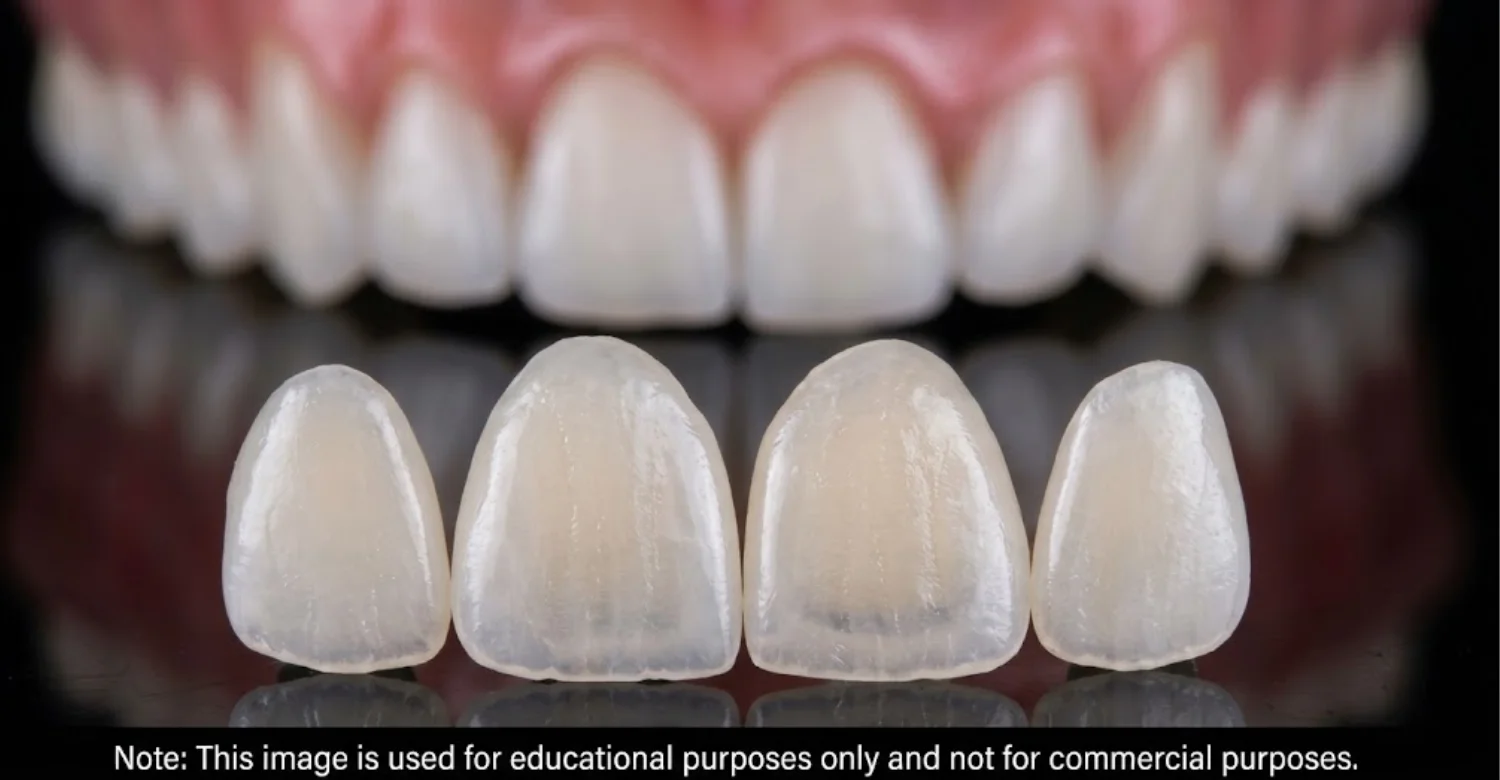
No Prep Veneers are ultra-thin dental shells bonded to the front surfaces of teeth with little or no tooth reduction. They can improve selected concerns, including small teeth, gaps, and minor shape irregularities. However, they are not suitable for every smile. Tooth position, existing restorations, bite alignment, and enamel condition influence suitability. Although this approach preserves more natural tooth structure, adding material can make teeth look bulky. Understanding the advantages, disadvantages, costs, and long-term limitations helps patients make informed decisions.
Key Takeaways About No Prep Veneers
Thickness: Some ultra-thin veneers measure approximately 0.2–0.5 mm, depending on their design and material.
Appointments: Treatment commonly requires multiple visits for assessment, design, fabrication.
Anesthesia: Local anesthesia may be unnecessary when no preparation is performed, but individual circumstances vary.
Reversibility: can involve permanent changes to enamel, so removal may not restore the original tooth.
Suitable cases: Multiple gaps, undersized teeth, and selected worn teeth may benefit from added material.
Main limitation: Naturally prominent teeth can look excessively thick after treatment.
Ready to transform your smile?
Talk to our team and get a personal FREE treatment plan.
What Are No Prep Veneers?
No Prep Veneers are thin coverings bonded to tooth surfaces without conventional drilling or with very limited adjustment. Their purpose is to improve the appearance of selected teeth while conserving natural tooth structure.
The technique works best when adding material creates the desired shape without making teeth protrude. Porcelain veneers require careful planning because even a thin shell adds thickness. Material selection, conditions, and the existing tooth shape influence the final result.
Not every veneer advertised as preparation-free can be placed without adjustment. Some cases require minimal enamel reshaping to achieve acceptable contours and margins. The proposed technique should reflect the patient's anatomy rather than marketing terminology.
No-Prep vs Minimal-Prep: Why Most Dentists Prefer Minimal
Minimal preparation allows limited enamel removal where necessary to improve fit, shape, and appearance. It can prevent excessive facial thickness when teeth already occupy their intended positions.
A preparation-free approach may preserve more tissue, but preservation alone does not guarantee a better cosmetic result. Minimal preparation can sometimes produce more natural contours and cleaner margins.
The choice depends on the planned restoration, tooth position, enamel availability, and bite. Removing enamel is irreversible, so unnecessary reduction should be avoided. Equally, avoiding all preparation should not compromise the restoration's shape or function.
Materials: Feldspathic, E.max and Branded Systems
Feldspathic porcelain can provide excellent translucency and detailed color characterization. Its suitability depends on the required thickness, design, and conditions.
Lithium disilicate ceramics, including E.max products, offer different strength and optical properties. They are not automatically suitable for every preparation-free case. Material selection must account for available space, shade requirements, and the restoration's intended function.
Lumineers is a branded veneer system associated with ultra-thin restorations. The brand name does not guarantee that every case requires zero preparation.
Material availability, laboratory capabilities, and individual anatomy affect the final recommendation. The selected material should support a natural contour and reliable rather than thickness alone.

.jpg)
Are No Prep Veneers Right for You?
Suitability depends on whether a veneer can improve the smile without creating excessive thickness or compromising oral health. A clinical assessment should examine tooth position, enamel, existing restorations, gums, and bite.
Potentially suitable | Potentially unsuitable |
Small or narrow teeth | Prominent teeth |
Multiple gaps | Significant crowding |
Mild tooth wear | Dark internal discoloration |
Teeth positioned slightly inward | Large existing restorations |
Selected mild discoloration | Untreated grinding or gum disease |
Why Gaps Make the Best No-Prep Cases
Multiple spaces between teeth can create room for carefully designed additions. Closing these gaps may improve proportions without removing healthy enamel.
The restoration must distribute added width across the teeth naturally. Poor planning can create wide-looking teeth or awkward spaces near the gums. A diagnostic mock-up helps assess the proposed proportions before permanent .
Small, isolated gaps may need a different approach. Depending on their size and location, orthodontic treatment could be more appropriate. The decision should consider tooth proportions, bite, gum health, and the patient's expectations.
When No Prep Veneers Look Bulky
Bulkiness occurs when added restorative material makes teeth appear too thick, prominent, or square. This risk increases when teeth already project forward or have limited space.
Excessively thick contours may also create difficult-to-clean areas near the gums. Poorly finished margins can retain plaque and contribute to gum irritation.
A mock-up is useful because it allows the proposed shape to be evaluated . Photographs and digital planning can support this process, but they cannot replace clinical judgment.
If the mock-up looks unnatural, the design should be reconsidered. Minimal preparation or another treatment may produce a more suitable contour.
Can No Prep Veneers Cover Dark Stains?
Coverage depends on the depth and intensity of the discoloration, the ceramic's properties, and the available thickness. Very thin, translucent materials may allow dark underlying shades to show through.
Increasing opacity can improve masking but may reduce the natural appearance of the restoration. Adding thickness to conceal severe discoloration can also create an undesirable contour.
The cause of discoloration should be assessed before choosing cosmetic treatment. Internal staining, old restorations, and changes following dental trauma may require different approaches. Patients with pronounced discoloration may need another veneer design or alternative treatment.
No Prep vs Traditional Veneers
The main difference is the amount of tooth preparation and the space available for the restoration. Conventional veneers often involve controlled enamel reduction to accommodate their design.
Feature | No-prep approach | Traditional veneers |
Tooth reduction | None or minimal | Usually required |
Added thickness | Can be noticeable | Better controlled through preparation |
Anesthesia | Sometimes unnecessary | Depends on preparation |
Reversibility | Not guaranteed | Generally irreversible |
Design flexibility | More limited | Often greater |
Best candidates | Teeth that benefit from added volume | A wider range of selected cases |
No Prep Veneers vs Lumineers
Lumineers is a commercial brand associated with thin ceramic veneers. The term does not mean that every treatment using this system avoids tooth preparation.
Both approaches depend on the available space, tooth position, and desired final contour. Some patients can receive very thin veneers without preparation, while others require limited adjustment.
Brand recognition should not replace an assessment of the actual treatment plan. Patients should ask about the planned material, preparation requirements, thickness, and removal implications.
No Prep Veneers vs Crowns
Veneers cover mainly the visible front surfaces of teeth. Crowns cover most or all of a tooth's visible structure and usually require more extensive preparation.
A veneer may suit a tooth that is structurally sound and needs a cosmetic change. A crown may be considered when substantial tooth structure is damaged, depending on the clinical findings.
Neither treatment should be selected solely for appearance. Existing restorations, cracks, remaining tooth structure, and bite forces influence the decision.
Are Snap-On Veneers No Prep ?
Snap-on veneers are removable appliances that fit over existing teeth. They are not the same as bonded ceramic veneers.
They may temporarily change the visible appearance of a smile, but they do not repair tooth decay or restore damaged teeth. Their bulk can affect speech, comfort, and bite.
Patients should not confuse removable cosmetic covers with permanent restorations. The safest option depends on the underlying dental condition and the patient's treatment goals.
Are No Prep Veneers Reversible?
No-preparation treatment is not necessarily reversible because procedures can alter the tooth surface. Enamel conditioning and adhesive placement may change the surface even when no drilling occurs.
Removing bonded veneers can be difficult and may remove some natural enamel. The process may require additional time and expense, depending on the material and technique.
Patients should understand these limitations before treatment begins. A temporary mock-up can help assess shape and appearance, but it does not guarantee the final result.
The term no-prep describes the preparation approach, not a promise that the teeth will remain completely unchanged.
The No Prep Veneer Procedure, Step by Step
Treatment begins with an assessment of oral health, tooth position, enamel, and bite. The following stages may vary according to the case and material.
Consultation and photographs: Records document the starting appearance and treatment concerns.
Digital smile design: Planning tools help evaluate proportions and proposed changes.
Trial mock-up: Temporary material helps assess shape, thickness, and appearance.
Scanning: Digital scans or impressions record the tooth surfaces.
Laboratory fabrication: A dental laboratory creates restorations to the agreed design.
Etching : The surfaces are conditioned as indicated, and the veneers are bonded.
Finishing and bite check: Margins, contacts, and bite are evaluated before completion.
How Long Does Treatment Take?
The timeline depends on the number of teeth, material, laboratory process, and clinical findings. Many porcelain cases require more than one appointment.
Stage | Typical timing |
Assessment and planning | Initial appointment |
Mock-up and records | Same or separate visit |
Laboratory fabrication | Several days or longer |
final checks | Subsequent appointment |
Do No Prep Veneers Hurt? Do You Need Anesthesia?
Many patients experience little discomfort when no tooth reduction is needed. Local anesthesia may not be necessary, although individual needs differ.
Sensitivity or gum irritation can still occur . Minimal preparation, existing tooth sensitivity, and the condition of the teeth can affect comfort.
Patients should discuss concerns before treatment rather than assume anesthesia will never be needed. Any unexpected or persistent pain after placement requires clinical assessment.
Ready to transform your smile?
Talk to our team and get a personal FREE treatment plan.
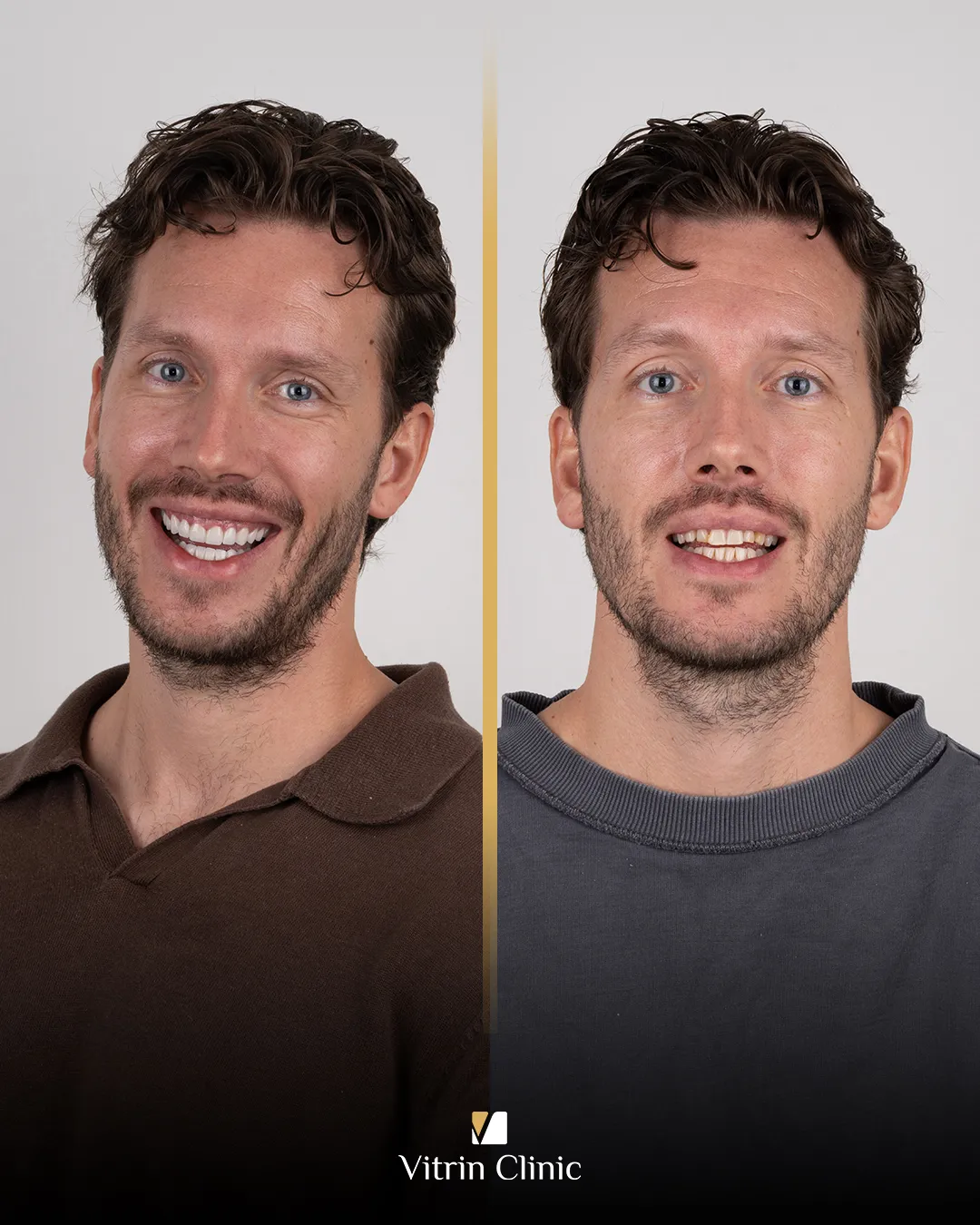
No Prep Veneers Before and After
Before-and-after photographs can show how changes in tooth shape, spacing, and proportions affect a smile. Results depend on the starting tooth anatomy and the planned restoration.
For accurate comparison, look for natural contours, balanced tooth proportions, and healthy-looking gum margins. Photographs alone cannot confirm the condition of the teeth or the long-term success of treatment.
.jpg)
.jpg)
.jpg)
Advantages and Disadvantages of No Prep Veneers
The main advantage is the potential to preserve natural tooth structure. However, the technique has important limitations and requires careful case selection.
Advantages
Little or no tooth reduction may be required.
Healthy enamel may be preserved more extensively.
Anesthesia may be unnecessary in suitable cases.
Added material can close selected gaps.
Treatment may improve tooth shape and proportions.
Disadvantages
Added thickness can make teeth look bulky.
Dark discoloration may remain visible.
Suitability is limited by tooth position and available space.
Poor contours may complicate cleaning near the gums.
Bonded restorations are not reliably reversible.
Chipping may require repair or replacement.
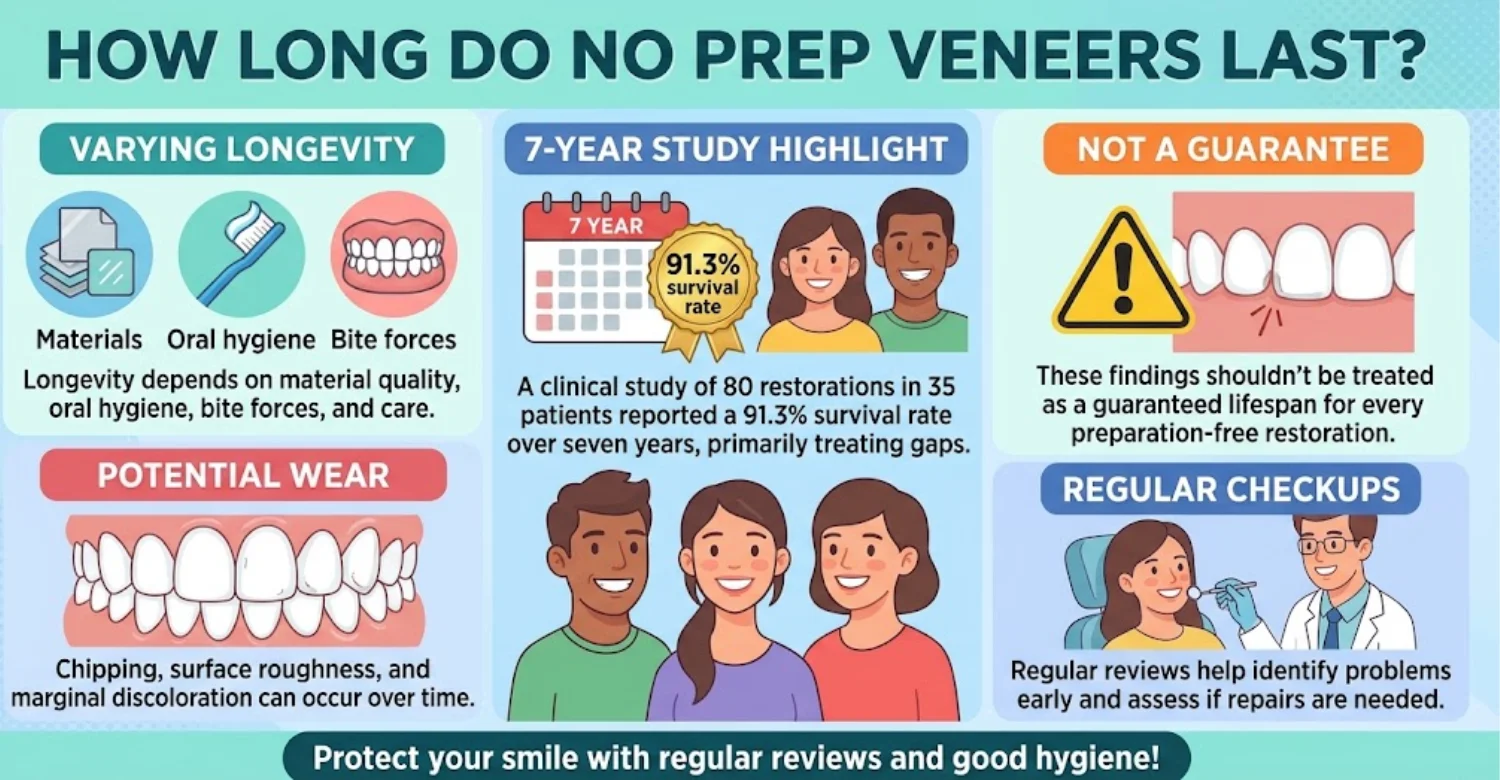
What Affects Their Lifespan?
Restoration longevity depends on several interacting factors:
conditions: Reliable adhesion depends on the material and surface preparation.
Bite forces: Heavy loading can increase the risk of chipping .
Oral hygiene: Plaque control helps protect the surrounding gums and teeth.
Restoration design: Poor contours can complicate cleaning and affect appearance.
Maintenance: Regular reviews can identify damage or marginal changes.
Habits: Biting hard objects may increase mechanical stress.
No single factor guarantees long-term success. Individual risks should be discussed before treatment.
Caring for No Prep Veneers
Daily cleaning and regular professional reviews help maintain the restorations and surrounding teeth.
Brush twice daily with a soft-bristled toothbrush.
Clean between the teeth every day.
Avoid biting hard objects with the restored teeth.
Follow individualized advice if you grind your teeth.
Attend recommended reviews and hygiene appointments.
Seek assessment if a veneer feels loose, rough, or damaged.
Do not attempt to glue a detached veneer back into place yourself. Keep it safe and contact the treating clinic for advice.
How Much Do No Prep Veneers Cost?
The cost of No Prep Veneers varies by country, veneer material, laboratory fees, and case complexity. The following figures are indicative private-treatment estimates for 2026, not guaranteed quotes.
United Kingdom
From $700
Estimated cost per tooth
Average cost per tooth: $700–$1,500
6 veneers: $4,200–$9,000
8 veneers: $5,600–$12,000
10 veneers: $7,000–$15,000
Turkey
From $250
Estimated cost per tooth
Average cost per tooth: $250–$500
6 veneers: $1,500–$3,000
8 veneers: $2,000–$4,000
10 veneers: $2,500–$5,000
United States
From $1,000
Estimated cost per tooth
Average cost per tooth: $1,000–$2,500
6 veneers: $6,000–$15,000
8 veneers: $8,000–$20,000
10 veneers: $10,000–$25,000
What Affects the Price?
The final cost depends on:
Number of veneers: Treating more teeth increases the overall cost.
Veneer material: Porcelain types and laboratory specifications influence pricing.
Laboratory design: Custom shade matching and detailed aesthetic work may affect fees.
Clinical suitability: Existing decay, gum disease, or bite problems may require treatment before veneers.
Additional services: Consultations, imaging, mock-ups, and follow-up visits may incur separate charges.
Request an itemised written estimate that distinguishes included services from optional extras.
No Prep Veneers in Turkey
Turkey offers no-prep and minimally prepared veneer treatments at different price points. When comparing clinics, consider the material, clinician's experience, laboratory standards, and arrangements for follow-up care.
No-prep veneers are not suitable for everyone. Tooth position, enamel condition, bite alignment, and the desired cosmetic changes determine whether veneers can be placed without removing enamel. In some cases, minimal preparation may produce a more natural result. For international patients, the total budget should also account for flights, accommodation, transfers, and any additional visits. Before travelling, obtain a written treatment plan and clarify the costs of adjustments or repairs.
Ready to transform your smile?
Talk to our team and get a personal FREE treatment plan.
What We Notice Clinically
At Vitrin Clinic, we assess whether the proposed restoration can achieve a natural contour without unnecessary tooth reduction. Gaps and undersized teeth may offer useful space for adding material. Prominent teeth or limited space can increase the risk of excessive thickness.
Dr. Rifat Alsaman, Head of the Medical Team, emphasizes evaluating tooth position, enamel condition, gum health, and bite before selecting a veneer technique. A diagnostic mock-up can help reveal contour problems before permanent .
The treatment decision should prioritize the patient's oral health and realistic expectations. When a preparation-free design would look bulky, a minimally prepared approach or another treatment may be more appropriate.
How Does Vitrin Clinic Plan Your Veneer Treatment?
At Vitrin Clinic, treatment planning begins with an individualized review of the teeth, gums, bite, and cosmetic concerns. Clinical examination and digital dental imaging may be recommended when appropriate.
We use the findings to assess whether preparation-free veneers, minimal preparation, or another option better suits the case. Digital planning and trial mock-ups may help evaluate proposed tooth proportions before finalizing the design.
International patients should receive a written estimate that explains the planned treatment, included services, and possible additional costs. We also discuss appointment timing and follow-up needs before travel arrangements are finalized.
No cosmetic procedure can guarantee a specific result. Our priority is to select a suitable approach based on clinical findings, patient preferences, and informed consent.
Conclusion: Are No Prep Veneers the Right Choice for You?
No Prep Veneers can improve selected cosmetic concerns while preserving more natural tooth structure. They may work particularly well for small teeth and multiple gaps. However, prominent teeth, severe discoloration, and limited space can increase the risk of bulky results.
At Vitrin Clinic, we assess tooth position, enamel condition, gum health, and bite before recommending treatment. A personalized evaluation helps determine whether no-preparation veneers, minimal-preparation veneers, or another option best suits your needs. The priority is a natural-looking result that respects your oral health and long-term dental function.
Ready to transform your smile?
Talk to our team and get a personal FREE treatment plan.
Medical Disclaimer
This article is intended for general educational and informational purposes only and does not replace professional dental advice, diagnosis, or treatment. Treatment suitability, risks, recovery time, and expected results vary depending on each patient's dental condition and individual needs. A clinical examination by a qualified dental professional is necessary to determine the most appropriate treatment. Always consult your dentist before making decisions about your dental health.
References
FAQs
No Prep Veneers are thin coverings bonded to the front of teeth with little or no tooth reduction. They can improve selected concerns, including gaps, small teeth, and minor shape irregularities. Their suitability depends on tooth position, enamel condition, and the space available for added material.
Dr. Rifat Alsaman has more than 5 years of clinical experience in dentistry and currently serves as the Head of the Medical Team at Vitrin Clinic. He is dedicated to providing exceptional patient care, overseeing treatment planning, and ensuring the highest clinical standards across the team. His expertise, attention to detail, and commitment to continuous professional development have helped countless patients achieve healthier, more confident smiles.


