Is It Possible to Get Dental Implants If I Smoke?
Dental implants for smokers are possible in many cases. Yes, you can usually get dental implants if you smoke. Smoking does not automatically rule you out of treatment.

Dental implants for smokers are possible in many cases. Yes, you can usually get dental implants if you smoke. Smoking does not automatically rule you out of treatment. However, it is one of the most important risk factors your dentist will weigh before surgery.
Tobacco slows healing and can weaken the bond between the implant and your jawbone. As a result, smokers face a higher chance of complications and implant failure than non-smokers. The good news is that much of this extra risk can be reduced with the right planning.
This patient guide to dental implants for smokers explains how smoking affects healing, what the research shows, and how dentists decide who is suitable. It also covers when to stop smoking and what to expect if you travel to Istanbul for treatment at Vitrin Clinic. Most importantly, every decision should start with an individual assessment, not your smoking status alone.
Key Takeaways
Smokers can often receive dental implants, but their risk of complications may be higher.
Smoking can interfere with osseointegration and increase the risk of implant failure.
Quitting before and after surgery can improve the conditions needed for successful healing.
Individual assessment is essential to determine implant eligibility and the most appropriate treatment plan.
Careful planning, including travel timing, helps dental implants for smokers achieve long-term implant success.
A single dental implant in Turkey costs approximately $500 - $1,800, including the implant and crown. The price depends on the implant brand and any additional procedures required.
.jpg)
.jpg)
.jpg)
Ready to transform your smile?
Talk to our team and get a FREE treatment plan.
How Does Smoking Affect Dental Implant Healing?
To understand dental implants for smokers, it helps to know what happens after surgery. A dental implant is a small titanium post placed in the jawbone to replace the root of a missing tooth. Over the following months, the bone grows around it and holds it firmly. Tobacco can interfere with almost every stage of this healing process.
Reduced Blood Circulation
Nicotine makes blood vessels narrow, which doctors call vasoconstriction. Narrower vessels carry less blood to the surgical site. At the same time, carbon monoxide from cigarette smoke attaches to red blood cells and lowers the amount of oxygen they can carry. Healing tissue needs a steady supply of oxygen and nutrients to repair itself. When that supply drops, the gums and bone around the implant recover more slowly. This one effect explains much of the implant healing risk seen in smokers.
Impaired Osseointegration
Osseointegration is the process in which your jawbone grows onto the implant surface and locks it in place. It usually takes around three to six months. Smoking can disrupt the bone-building cells that drive this process. If the bond is weak or incomplete, the implant may feel loose or fail to integrate at all. This is why tobacco and dental implants are a difficult combination, especially during the early healing months. A stable bond is the foundation of long-term implant success.
Weakened Immune Response
Your immune system protects the surgical wound from bacteria. Tobacco exposure can reduce the ability of white blood cells to reach the area and fight infection. Smoking also changes the balance of bacteria living in the mouth. Together, these effects may make infection around the implant more likely. Smokers may also show fewer warning signs, such as bleeding gums, because reduced blood flow can hide inflammation. As a result, problems are sometimes noticed later than they would be in non-smokers.
Delayed Soft Tissue Healing
The gum tissue around an implant forms a tight seal that protects the bone underneath. In smokers, this tissue often heals more slowly. Heat from smoke and the chemicals in tobacco can irritate the wound directly. Reduced blood flow also slows the cells that rebuild gum tissue. A slow seal gives bacteria more time to reach the bone, which increases the risk of complications.
What Does the Research Say About Dental Implants for Smokers?
Research on dental implants for smokers consistently shows a link between smoking and implant failure. A large 2020 review that combined many studies found that smokers had more than twice the risk of implant failure compared with non-smokers.
Much of this extra risk appears early. Early failure means the implant does not bond with the bone during the first months, often before the final tooth is fitted. Smoking is also linked to greater bone loss around implants over the years.
The connection between smoking and peri-implantitis is still debated. Peri-implantitis is an infection that damages the gum and bone around an implant. Some studies show a clear link, while others do not. However, smoking can add to stronger risk factors, such as a history of gum disease and poor plaque control.
Risk also seems to rise with the amount smoked. Heavy smokers, often described in studies as those smoking more than 10 to 20 cigarettes a day, tend to face more complications than light smokers.
What Is the Number One Cause of Dental Implant Failure?
There is no single cause for every case. Implants can fail for different reasons at different stages. Early failure usually happens when the bone does not bond with the implant. Common reasons include infection, poor initial stability, and smoking. Later failure is most commonly linked to peri-implantitis, a gum and bone infection around the implant. Its strongest risk factors are a history of gum disease and poor plaque control. Smoking can add to both types of risk.
Smokers vs. Non-Smokers (Implant Outcomes)
Outcome | Non-Smokers | Smokers |
Overall implant survival | Very high; often reported above 95% in long-term studies | Lower; large reviews suggest failure risk is roughly doubled |
Early failure (first months) | Uncommon | More frequent |
Bone loss around the implant | Usually minimal and stable | Often greater over time |
Post-operative infection | Lower risk | Higher risk reported |
Gum healing after surgery | Usually predictable | Often slower |
Peri-implantitis | Mainly linked to gum disease history and hygiene | Possible added risk; evidence is mixed |
Please note that these figures on dental implants for smokers are study-dependent estimates. There are no fixed success or failure rates for every patient. Your personal risk depends on your health, your habits, and the condition of your mouth.

Ready to transform your smile?
Talk to our team and get a FREE treatment plan.
Are You Eligible for Dental Implants If You Smoke?
Implant eligibility is never decided by one factor. For dental implants for smokers, your dentist looks at the full picture of your oral and general health. The main factors include:
Number of cigarettes smoked per day: Light smokers usually face lower risk than heavy smokers.
Duration and history of tobacco use: When it comes to tobacco and dental implants, long-term use can leave lasting effects on the gums and bone.
Gum health and presence of periodontal disease: Periodontal disease is an infection of the gums and supporting bone. It must be controlled first.
Jawbone density and available bone volume: The implant needs enough healthy bone to hold it securely.
Existing infections and oral hygiene: Decay, abscesses, and plaque build-up raise the risk of infection after surgery.
General health conditions and medications that may affect healing: Examples include diabetes, some osteoporosis medicines, and past radiation therapy to the head or neck.
Can Dentists Tell If You're a Smoker?
Often, yes. Dentists may notice brown stains on the teeth, darker patches on the gums, or gum recession. Changes on the roof of the mouth can also be a sign. Smoking can also make gums bleed less, even when gum disease is present. However, these signs do not show how much you smoke or which products you use. That is why your dentist will ask directly. Honest answers about dental implants for smokers help your team plan safer treatment and healing.
When Should Dental Implant Treatment Be Postponed?
With dental implants for smokers, sometimes the safest choice is to wait. A delay is not a refusal; it is a way to improve your chances of success. Your dentist may postpone treatment in these situations:
Untreated gum disease or active periodontal infection: Bacteria from infected gums can spread to the new implant.
Severe gum inflammation: Swollen, bleeding gums need treatment before they can heal well around an implant.
Insufficient bone volume requiring additional treatment: A bone graft or sinus lift may be needed first. Smoking can also slow the healing of these procedures.
Poorly controlled medical conditions that may compromise healing: For example, uncontrolled blood sugar in diabetes can slow recovery and increase infection risk.
Does the Type of Smoking Matter? Cigarettes vs. Vaping vs. Other Nicotine Products
Many patients considering dental implants for smokers ask whether switching products protects their implants. The table below summarises the main differences.
Product | Main Exposure | What We Know About Implants |
Cigarettes, cigars, pipes, and shisha | Nicotine, carbon monoxide, heat, and many tobacco chemicals | Strongest evidence of higher failure and bone loss |
Vaping and e-cigarettes | Nicotine (in most e-liquids), heat, and flavouring chemicals | Early studies suggest more gum inflammation; evidence is limited |
Nicotine pouches and chewing tobacco | Nicotine absorbed through the gums | Little implant-specific research; nicotine effects still apply |
Traditional Cigarettes and Tobacco
Cigarettes deliver nicotine, carbon monoxide, and thousands of other chemicals with every puff. Cigars, pipes, and shisha (waterpipe) expose your mouth to similar smoke and heat. As explained earlier, these exposures reduce blood flow and oxygen to healing tissue. They can also slow bone repair around the implant. Traditional tobacco has the most research behind it, and that research consistently shows higher risk. For this reason, it is the main focus of advice on smoking before implant surgery.
Vaping and E-Cigarettes
Vaping does not burn tobacco, so it produces far less carbon monoxide and tar. However, most e-liquids still contain nicotine, which narrows blood vessels. Some small studies found that people who vape had more gum inflammation and bone loss around implants than non-smokers. Even so, current evidence on vaping and implant failure remains limited. Because of this, vaping should not be considered a safe option for dental implants for smokers, especially during healing.
Nicotine Pouches and Other Nicotine Products
Nicotine pouches, snus, and chewing tobacco produce no smoke, but they still deliver nicotine into your bloodstream. Nicotine and implants are a concern because nicotine itself reduces blood flow. Products held against the gums may also irritate the tissue near the implant site. Nicotine replacement products, such as patches, can help some people quit smoking. If you use any of these, discuss them with your doctor. Always tell your implant dentist about every nicotine product you use.
Approximate Dental Implant Prices at Vitrin Clinic
Dental implant prices at Vitrin Clinic depend on the number of implants required, the implant brand, the type of restoration, and whether additional procedures such as bone grafting or sinus lifting are needed. Below are approximate prices for common dental implant treatments in Istanbul, Turkey.
Price at Vitrin Clinic
Single dental implant (including abutment and crown) = $500–$700
Implant-supported crown = $700–$900
All-on-4 dental implants (per arch) = $3,500–$7,500
All-on-6 dental implants (per arch) = $4,000–$9,000
Full-mouth dental implant rehabilitation = $7,000–$15,000
Note: Vitrin Clinic offers dental treatments at approximately 60–70% less than the average costs in the USA and UK, while maintaining high standards of dental care.
Note on Dental Sedation Costs
Conscious sedation or general anesthesia can be arranged for severe dental anxiety. These options and costs are discussed openly and itemized separately, so you know the fee before giving consent. A medical history review confirms that sedation is safe for you.
How Long Should You Stop Smoking Before and After Dental Implant Surgery?
Timing makes a real difference for dental implants for smokers. There is no single rule for every patient, so your surgeon will set your personal plan. The timeline below explains when stopping matters most.
Before Implant Surgery
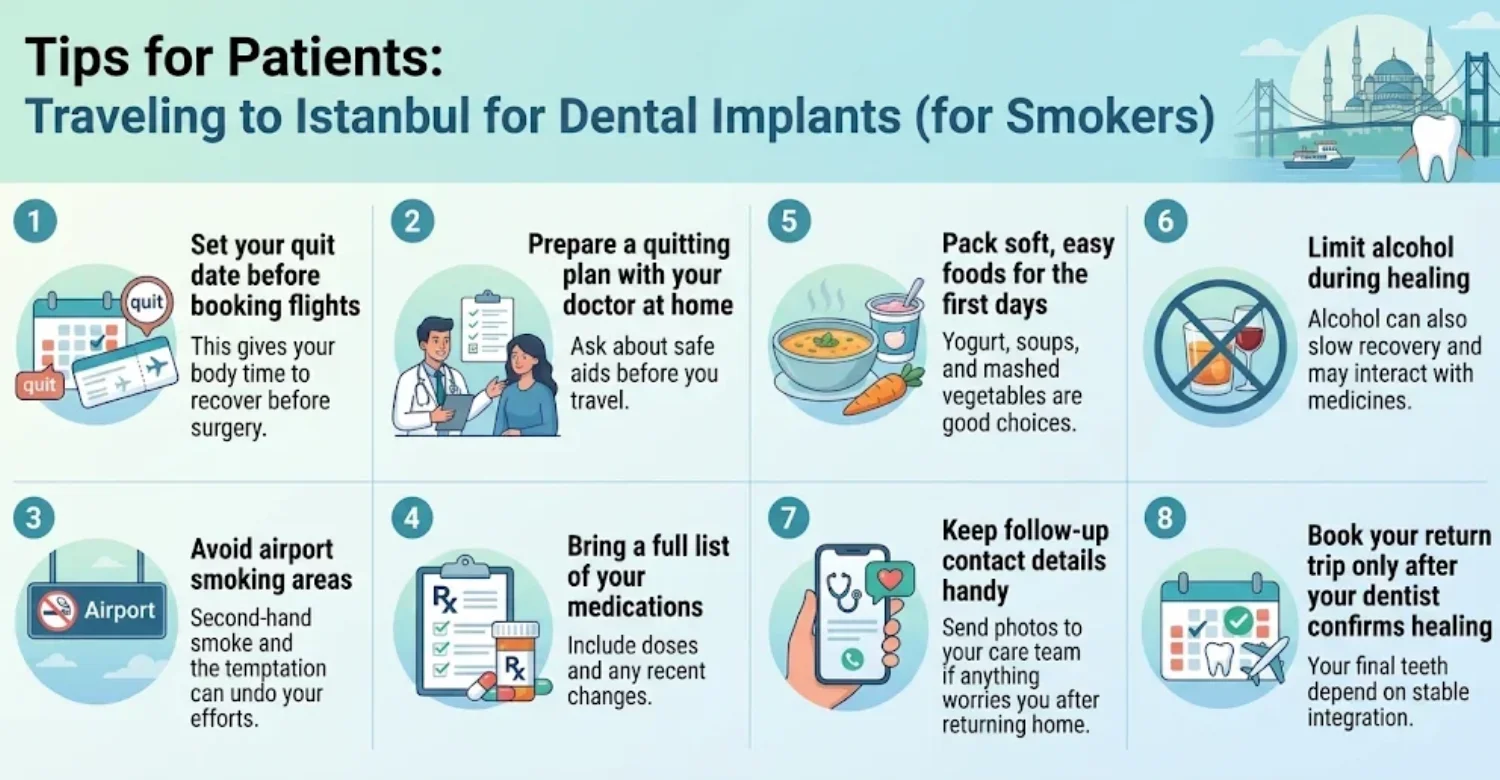
Stopping smoking before implant surgery gives your body time to recover. Carbon monoxide levels in the blood drop within a day or two of quitting. Over the following weeks, blood flow and immune function begin to improve. Research in general surgery suggests that longer periods without smoking bring greater benefits for wound healing. Plan your quit date with your treating dentist. If you are travelling for treatment, set your quit date well before your flight so your body is ready on surgery day.
During the First 72 Hours After Surgery
The first three days are the most delicate. A blood clot forms over the surgical site and acts as a natural bandage. The suction created when inhaling can disturb this clot and pull on the stitches. Heat and chemicals in smoke also irritate the fresh wound. Smoking at this stage may lead to more pain, infection, delayed healing, or the wound opening. Avoid all smoking and vaping during this period to protect the surgical site.
During the Osseointegration Period
The first few months after surgery are when the bone bonds to the implant. This is the stage that decides whether the implant becomes stable. Continued smoking during this time may reduce blood supply to the bone and slow integration. In some cases, this can lead to an implant that never becomes firmly fixed. Staying smoke-free for as long as possible during these months gives dental implants for smokers the best possible start.
After Complete Implant Healing
Once your implant has healed, the risk does not disappear completely. Long-term smoking is linked to more bone loss around implants and may add to the risk of peri-implantitis. These problems often develop slowly and without pain at first. That is why ongoing maintenance is essential for dental implants for smokers. Regular dental examinations, professional cleaning, and X-rays when needed allow your dentist to spot changes early. Early treatment is much simpler than repairing advanced bone loss.

Ready to transform your smile?
Talk to our team and get a FREE treatment plan.
How Can Smokers Improve Their Chances of Dental Implant Success?
With dental implants for smokers, you have more control over your results than you might think. These practical steps help reduce implant healing risk:
Stop smoking or reduce tobacco exposure under professional guidance: Even cutting down helps, but stopping completely offers the most benefit.
Treat existing gum disease before implant placement: Healthy gums create a cleaner environment for healing.
Maintain excellent oral hygiene: Brush gently twice a day and clean between teeth as your dentist shows you.
Follow post-operative instructions carefully: Take prescribed medicines as directed and avoid chewing on the implant side.
Attend regular implant maintenance appointments: Professional cleaning removes bacteria that brushing can miss.
Monitor gum health and bone levels around implants: Regular checks catch early changes before they become serious.
Discuss smoking cessation support with a healthcare professional: Counselling and approved quitting aids can improve your chances of quitting successfully.
What If You Cannot Quit Smoking Before Getting Dental Implants?
Quitting is hard, and many people need several attempts. The good news is that smoking is not necessarily an absolute contraindication, which means it does not automatically make treatment unsafe. Many dental implants for smokers are placed successfully when risks are well managed.
What matters is that you understand the additional risks of dental implants for smokers before you agree to treatment. Your dentist should explain how your habit may affect healing and long-term results. Reducing how much you smoke, especially around surgery, still helps.
In some cases, delaying implant surgery may be more appropriate. This is often true for heavy smokers who also have gum disease or significant bone loss. If implants are not suitable right now, other options can restore your smile:
Option | How It Works | Points to Consider |
Dental bridge | A false tooth supported by crowns on the neighbouring teeth | No surgery; the neighbouring teeth need to be reshaped |
Removable denture | A removable plate holding one or more false teeth | No surgery; may feel less stable, and the jawbone may continue to shrink |
Delayed implants | Implant surgery after gum treatment and a quitting period | Gives healing the best conditions; requires patience |
Has Anyone Smoked After a Dental Implant?
Yes, many people have smoked after implant surgery, and some of their implants still heal well. However, this does not mean smoking is safe. Studies show that people who keep smoking face a higher risk of slow healing, infection, and bone loss. Results vary from person to person, so another patient's experience cannot predict yours. If you return to smoking, tell your dentist so they can monitor your implant more closely.
When to Seek Immediate Dental Care
Most recoveries after dental implants for smokers go smoothly when instructions are followed. However, contact your dental team or seek medical care quickly if you notice any of the following:
Bleeding that does not slow down after firm pressure with gauze.
Swelling that keeps increasing after the third day.
Fever, chills, or feeling generally unwell.
Pus, a bad taste, or an unpleasant smell from the implant site.
Severe pain that is not relieved by your prescribed pain relief.
Numbness in the lip, chin, or tongue that continues after the anaesthetic wears off.
An implant that feels loose or moves.
Difficulty breathing or swallowing; this needs emergency care straight away.
.jpg)
.jpg)
.jpg)
.jpg)
What We Notice Clinically
At Vitrin Clinic, we regularly plan dental implants for smokers who travel from abroad. One pattern stands out: patients who plan their quit date around their travel dates usually find it easier to stay smoke-free. The trip gives them a clear start point and a strong reason to stop.
We also notice that many patients underestimate their nicotine use. Some forget to mention vaping, shisha, or nicotine pouches, because they do not think of them as smoking. A complete and honest history helps us plan safely.
Smokers often show hidden gum problems on examination, even when their gums look healthy and do not bleed. This is why we assess gum health and bone carefully before planning dental implants for smokers. Finally, the desire for a new smile is often a powerful motivation. Many patients tell us it finally helped them quit for good.
Your Dental Implant Journey at Vitrin Clinic
Vitrin Clinic in Istanbul welcomes patients from around the world. For many people, dental tourism makes implant treatment more accessible while still offering careful, personalized care. For dental implants for smokers, our approach focuses on honest risk assessment, clear planning, and close follow-up. Implant treatment usually involves two visits: one for surgery and one for the final teeth after healing.
1. Initial Consultation and Smoking History
Your journey can begin online before you travel. You can share photos, existing X-rays, and your medical history with our team. During your consultation, we discuss your smoking habits, daily cigarette consumption, and any other nicotine use. We also review your medical history and current medications. This also gives you time to start a quitting plan before your trip to Istanbul.
2. Comprehensive Oral and Bone Assessment
When you arrive, we carry out a full examination of your mouth. We check your gum health, look for any existing infections, and assess your bite. We also measure the bone available for implants. Digital X-rays and 3D CBCT scans are used when clinically indicated. A CBCT scan is a three-dimensional X-ray that shows bone height, width, and nearby structures such as nerves and sinuses.
3. Personalised Implant Treatment Plan
Based on your results, we confirm whether implants are suitable for you now. If you need gum treatment or bone grafting first, we explain why and how it fits your travel plans. We discuss the specific risks of dental implants for smokers, expected healing time, and a recommended quitting period for your case. You also receive a clear cost breakdown after your assessment. Costs depend on the number of implants, the materials chosen, and any additional treatments needed before surgery.
4. Implant Placement and Healing Monitoring
Implant placement is usually performed under local anaesthesia, so the area is numb and you should not feel pain during surgery. Afterwards, you receive personalised post-operative instructions, including clear advice on avoiding smoking. Most patients stay in Istanbul for a few days for an early check. Once you return home, our team can monitor your gum healing and osseointegration through scheduled follow-ups.
5. Final Restoration and Long-Term Aftercare
Your final crown, bridge, or full-arch restoration is fitted once healing and implant stability have been confirmed. This usually happens on your second visit to Istanbul, after the bone has had time to bond with the implant. We then guide you on caring for your implants for the long term. This includes cleaning techniques, the long-term value of quitting for dental implants for smokers, and regular check-ups with a dentist near your home.
Clinical Note
Dr. Rifat Alsaman, Head of the Medical Team at Vitrin Clinic, shares his view on dental implants for smokers. He explains that smoking is an important factor, but it is never assessed on its own. "We look at smoking history alongside bone quality, periodontal health, medical history, and daily oral hygiene. A light smoker with healthy gums and good bone may be a better candidate than a non-smoker with untreated gum disease."
Dr. Rifat Alsaman, Head of the Medical Team at Vitrin Clinic, also stresses that every case is different. Implant eligibility and treatment timing must be decided individually rather than based on smoking status alone. "Our goal is to give each patient the safest path to a stable result, even if that means preparing the mouth before surgery."
Why Choose Vitrin Clinic for Dental Implants?
At Vitrin Clinic in Istanbul, we provide dental implants treatment for patients with different dental needs, including those who smoke. We understand that smoking can make dental implant treatment more challenging. That is why every patient receives an individual assessment before treatment begins. Our medical team, headed by Dr. Rifat Alsaman, evaluates gum health, jawbone condition, smoking habits, and medical history to determine whether implants are suitable and when surgery should take place.
We focus on reducing avoidable risks through careful planning and personalised care. Your treatment journey includes:
Comprehensive assessment: We evaluate your gums, bone volume, existing infections, and oral health before recommending implant treatment.
Personalised treatment planning: We consider your smoking habits, nicotine exposure, and medical history when deciding on the most appropriate treatment approach.
Transparent treatment costs: You receive a personalised treatment plan and cost breakdown based on the number of implants and any additional procedures required.
Guidance throughout healing: Our team provides post-operative instructions, including recommendations on avoiding smoking during recovery.
Long-term follow-up: We guide you through implant maintenance and encourage regular check-ups to monitor gum health and bone stability.
Whether you are a light or heavy smoker, smoking alone does not determine your eligibility for dental implants. Our priority is to assess your individual circumstances and recommend a treatment plan that supports safe healing and long-term implant stability.






Book your FREE treatment plan with Vitrin Clinic and get a personalized treatment plan from our dental team.
Ready to transform your smile?
Talk to our team and get a FREE treatment plan.
References:

Medically reviewed by
Dr. Rifat AlsamanDr. Rifat Alsaman has more than 5 years of clinical experience in dentistry and currently serves as the Head of the Medical Team at Vitrin Clinic. He is dedicated to providing exceptional patient care, overseeing treatment planning, and ensuring the highest clinical standards across the team. His expertise, attention to detail, and commitment to continuous professional development have helped countless patients achieve healthier, more confident smiles.
More in Dental Treatments
View all 18 min readCan I Get Dental Implants in Turkey If I Have Gum Disease?Dental implants with gum disease are possible for many patients, but timing matters. Many people with a history of gum disease can get implants, provided the condition is treated and stabilized first.
 47 min readWhat Makes You Eligible for Immediate Dental Implants?Immediate dental implant eligibility depends on bone availability, gum health, infection control, and initial implant stability.
 22 min readWill I Need a Bone Graft Before Getting Dental Implants, or Can I Avoid It?Do I need bone graft for dental implant treatment? Many patients ask this when planning to replace a missing tooth. The honest answer is: not always. Some people have enough healthy jawbone for direct implant placement.
 19 min readCan I Get a Dental Implant If I Have Been Missing the Tooth for Many Years?A dental implant after years of missing tooth is possible for most patients. Time alone rarely rules you out. What matters is how much jawbone remains, how healthy your gums are, and whether your bite has shifted.
Still have a question?
Our patient coordinators answer every day of the week: before, during and long after your treatment.