Dental Bridge
November 8, 2026
Porcelain Dental Bridge in Turkey: Which Material Is Right for Your Missing Tooth?
 Dr. Rifat Alsaman

A missing tooth rarely stays a small problem. You start chewing on the other side. The teeth next to the gap begin to tilt. And every time you smile in a photo, you notice the space before anyone else does.
A porcelain dental bridge is one of the quickest ways to close that gap with a fixed, natural-looking tooth, and Istanbul is one of the most popular places to have it done. But "porcelain bridge" is a loose term. Clinics use it for very different materials, and the choice between them affects how the bridge looks, how strong it is and how long it lasts.
This guide explains what a porcelain bridge really is, which material suits which part of your mouth, what it costs in Turkey compared with the UK and US, and the questions worth asking before you book a flight.
Key Takeaways
A bridge replaces one or more missing teeth by anchoring a false tooth to crowns on the teeth either side of the gap.
"Porcelain bridge" can mean porcelain fused to metal, porcelain layered over zirconia, solid zirconia or lithium disilicate (E-max). Each has different strengths.
Traditional bridges require reshaping the neighbouring teeth, so they are the best choice when those teeth already need crowns, and a weaker choice when they are perfectly healthy.
Large reviews report that around 89% of conventional tooth-supported bridges are still in place after 10 years.
A standard bridge can usually be completed in one trip of about 5–7 days in Istanbul.
At Vitrin Clinic, a conventional bridge starts from $350 per unit, against roughly £2,100–£3,600 for a three-unit bridge privately in the UK.
The best bridge is the one planned around your bite, your gums and the health of the supporting teeth, not the one with the lowest price.
Prices from £200 per tooth
Full mouth restoration from
£1,600
Timescale
5 to 7 days
Hotel + transfers available
Airport-Hotel-Clinic
coordination included
Porcelain Dental Bridge Cost: Turkey vs. the UK and US
A conventional bridge at Vitrin Clinic starts from $350 per unit, so a standard three-unit bridge replacing one missing tooth starts from about $1,050. Across Turkey, invoice-based data from Bookimed puts dental bridges at roughly $350–$640.
UK
From: $2,800–$4,800
Conventional bridge (3 units, one missing tooth), private.
Cantilever bridge: varies by practice
Resin-bonded (Maryland) bridge: varies by practice
Implant-supported bridge: several times the Turkish price
Turkey
From: $1,050
Conventional bridge (3 units, one missing tooth), from $350 per unit.
Cantilever bridge: from $300 per unit
Resin-bonded (Maryland) bridge: from $200 per unit
Implant-supported bridge: from $1,000 per unit
USA
From: $2,800
Conventional bridge (3 units, one missing tooth).
Cantilever bridge: varies by practice
Resin-bonded (Maryland) bridge: varies by practice
Implant-supported bridge: several times the Turkish price
Vitrin prices are from the clinic's published price list, 2026. The UK private range is a clinic-published figure for a three-unit zirconia bridge; the US figure is Bookimed's invoice-based estimate, updated November 2026. On the NHS in England, bridges fall under the Band 3 charge of £332.10 (April 2026), but material choice and availability are more limited.
What affects the final price:
The number of units, since each supporting crown and each false tooth is priced as one unit.
The material: porcelain fused to metal usually costs least; zirconia and E-max cost more.
Whether the supporting teeth need fillings, root canal treatment or gum treatment first.
Whether the bridge is held by natural teeth or by implants.
What is usually included at Vitrin Clinic: consultation, digital scans and X-rays where needed, treatment planning, tooth preparation, a temporary bridge, laboratory fabrication, the final fitting and a follow-up check.
Costs to plan for besides treatment: flights, about a week of accommodation, travel insurance and meals.
What Is a Porcelain Dental Bridge?
A bridge is a single piece made of connected crowns. The crowns on each end, called abutments, are cemented onto the teeth beside the gap. The false tooth in the middle, called a poetic, sits on the gum where the missing tooth used to be. Because it is cemented in place, you do not take it out at night.
The word porcelain describes the tooth-coloured ceramic you see. What sits underneath it, and how much of the bridge is porcelain at all, varies a great deal.
What are Types of Dental Bridge Materials? Comparing Your 4 Main Options
Porcelain fused to metal (PFM): Porcelain is baked onto a metal framework. It has the longest track record and handles strong biting forces well. The trade-offs are that it looks less translucent, and a thin dark line can show at the gumline if the gum recedes. Usually the most affordable option.
Porcelain layered over zirconia: A tooth-coloured zirconia framework replaces the metal, with porcelain layered on top for a lifelike finish. It is metal-free and looks very natural, but the outer porcelain layer can chip, especially in people who grind their teeth.
Solid (monolithic) zirconia: The whole bridge is milled from one block of zirconia, with little or no layered porcelain. It is very strong and rarely chips, which makes it a good choice for back teeth, though it can look slightly more opaque than layered ceramic.
Lithium disilicate (E-max): A glass-ceramic known for its translucency and natural light reflection. It looks excellent on front teeth, but it is generally used for shorter bridges and lower-stress areas.
A 2015 systematic review in Dental Materials compared multi-unit bridges by material over five years. Metal-ceramic bridges had an estimated 94.4% survival, zirconia bridges 90.4% and reinforced glass-ceramic bridges 89.1%. Zirconia bridges also showed more fractures of the veneering ceramic than the other types.
In practice, that means no single material is "best". A metal-ceramic or solid zirconia bridge often makes sense for back teeth that take heavy chewing forces. Layered zirconia or E-max often makes sense where appearance matters most. A good clinic will explain why it has chosen a material for your specific gap
Bridge Designs in Brief
Most porcelain bridges are traditional bridges, held by a crown on each side of the gap. A cantilever bridge is held on one side only and suits limited, low-stress areas. A resin-bonded (Maryland) bridge uses small wings bonded to the back of the neighbouring teeth and needs little or no drilling, but it is best for front teeth with a light bite. An implant-supported bridge is anchored to implants instead of natural teeth.
How Does a Dental Bridge Actually Impact the Adjacent Teeth?
A traditional bridge needs a crown on each tooth beside the gap, and a crown needs room. A laboratory study in the Journal of Prosthetic Dentistry found that preparing a tooth for a full crown removes roughly 63–72% of the visible tooth structure.
That changes how you should think about a bridge:
If the neighbouring teeth already have large fillings, cracks or old crowns, a bridge can be an excellent choice. Those teeth would benefit from crowns anyway, and the bridge protects them while replacing the gap.
If the neighbouring teeth are healthy and untouched, cutting them down is a real cost. An implant or a resin-bonded bridge may preserve more of your natural teeth.
Ask your dentist directly: "Would these supporting teeth need crowns even without the bridge?" The answer often makes the decision clearer.
Porcelain Bridge vs. Dental Implant: Which Fits Your Situation?
Factor | Porcelain Dental Bridge | Dental Implant |
Neighbouring Teeth | Best if adjacent teeth already have damage and need crowns | Best if adjacent teeth are completely healthy and you want to leave them untouched |
Treatment Time & Trips | Completed in one single trip of about a week | Requires two separate trips a few months apart to allow bone integration |
Surgical Requirement | Completely non-surgical; ideal if you have medical reasons to avoid surgery | Requires a surgical procedure to place the implant post into the jaw |
Bone Volume & Grafting | Suitable if bone is thin and you prefer to avoid bone grafting | Requires sufficient bone volume, or a willingness to undergo bone grafting |
Long-Term Bone Health | Does not stimulate bone growth beneath the false tooth | Preserves bone structure long-term by actively stimulating the jawbone |
Your Decision in 3 Questions
1. Are the teeth beside the gap already heavily filled, cracked or crowned? Yes → a bridge is often a strong choice, because those teeth benefit from crowns anyway. No → consider an implant or a resin-bonded bridge to keep them untouched.
2. Do you have enough healthy bone where the tooth was lost? Yes → an implant is possible. No → a bridge avoids bone grafting, or you can plan grafting before an implant.
3. Can you make two trips a few months apart? Yes → an implant fits your schedule. No → a tooth-supported bridge can usually be finished in one trip of about a week.
Mostly bridge answers? A porcelain bridge is likely to suit you. Mostly implant answers? Ask about an implant at your consultation.
Porcelain Dental Bridge in Turkey: Before and After Realities
These are illustrative examples to show how the decision works, not real patient cases.
The patient with worn-out neighbours: A man in his fifties lost a lower molar. The teeth on both sides already had large, ageing fillings. A three-unit solid zirconia bridge replaced the gap and protected both weakened teeth in one trip.
The patient with perfect neighbours: A woman in her thirties lost a premolar after an injury. The teeth beside the gap were completely healthy. Cutting them down for a bridge made little sense, so an implant over two trips kept them untouched.
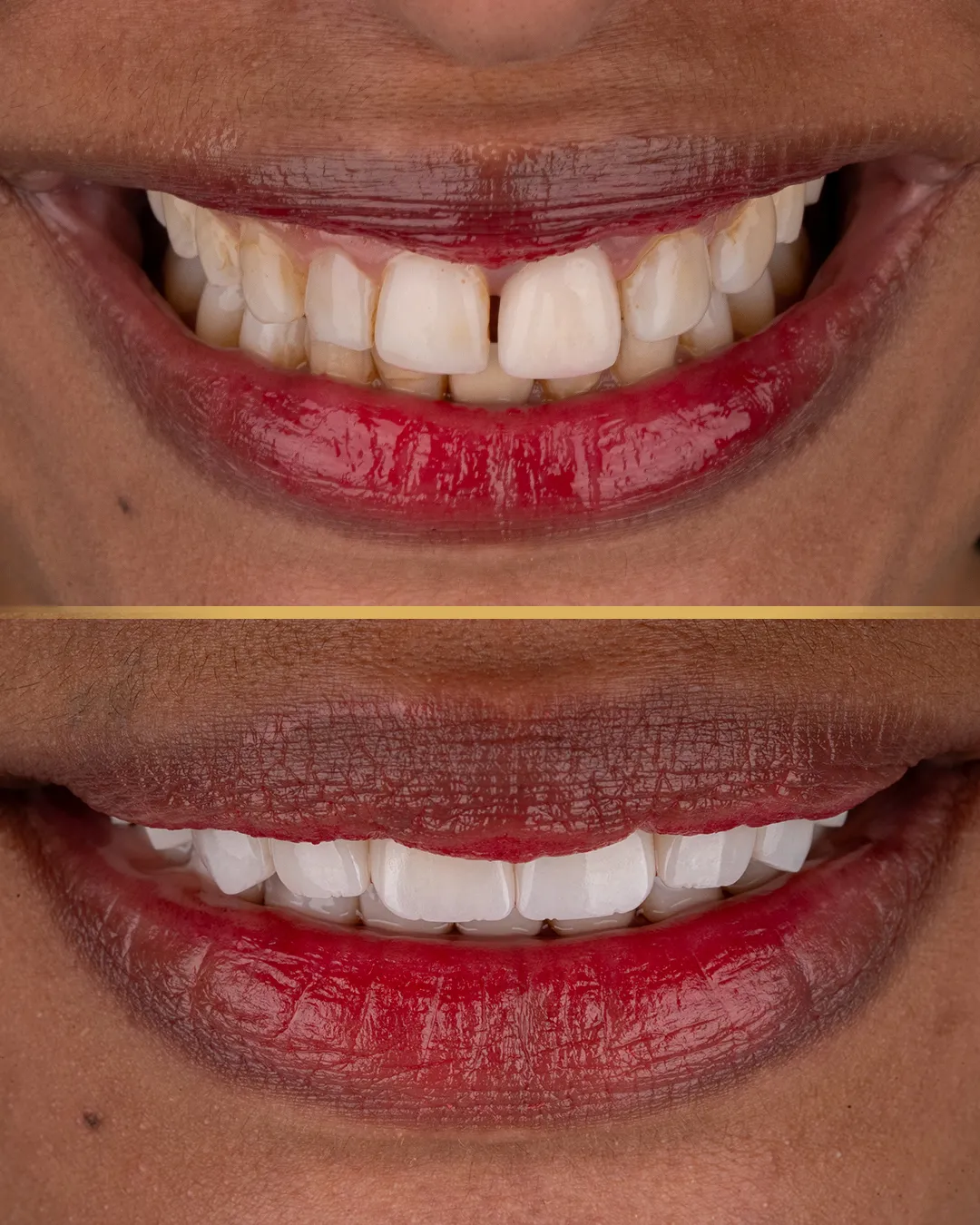
Before and After a Porcelain Bridge: What Changes?
Before treatment
A visible gap, often noticeable when you smile or speak.
Chewing shifted to one side of the mouth.
Neighbouring teeth starting to tilt into the space, and the opposite tooth drifting towards it.
Food trapping around the gap.
After Treatment: When It Goes as Planned
A fixed, tooth-coloured replacement that blends with the teeth around it.
More even chewing on both sides.
The gap closed, so neighbouring teeth can no longer drift into it.
Supporting teeth protected by their new crowns.
What a bridge cannot change: It does not rebuild lost bone under the false tooth, and it cannot match the colour of untreated teeth that are stained. If you want a brighter shade, whitening is usually done before the bridge so the lab can match it.
The Journey: Initial Presentation to Final Result


Are You a Good Candidate for a Porcelain Bridge?
You are likely to be a good candidate if:
You are missing one tooth, or two to three teeth in a row.
The supporting teeth are strong, with healthy roots and gums.
Your gum disease, if any, is treated and stable.
You can clean carefully under the bridge every day.
A bridge needs more careful planning if you grind or clench your teeth heavily, if the supporting teeth are loose or have had extensive root canal treatment, or if the gap is long. In these cases your dentist may suggest a stronger material, a night guard, implants or a different design.
Your Porcelain Bridge Trip to Istanbul: What Happens Each Day
A traditional bridge usually needs two clinical stages, preparation and fitting, with laboratory work in between. Most patients plan a stay of about 5–7 days.
Before you travel:
You send photos, any recent X-rays and your dental history. The team gives you a provisional plan and an estimate, so you know what to expect.
Day 1: assessment and planning.
A full examination, digital X-rays and scans, and a check of the supporting teeth and gums. Any fillings or gum treatment needed first are planned here, and the material and shade are agreed with you.
Day 2: preparation and temporary bridge.
Under local anaesthetic, the supporting teeth are shaped and digitally scanned. You leave the same day with a temporary bridge, so you are never without a tooth.
Days 3–4: laboratory work.
Technicians design and make your bridge to the agreed shape and shade. This is free time to rest or see the city.
Days 5–6: try-in and fitting.
The bridge is tried in, and the fit, bite and colour are checked and adjusted before it is permanently cemented.
Day 7: final check.
A short review of your bite and comfort, plus cleaning instructions, before you fly home.
If the supporting teeth need root canal treatment, or if the bridge is held by implants, the timeline is longer. An implant-supported bridge usually needs a second trip after the implants have healed.
Does It Hurt?
The preparation is done under local anaesthetic, so most people feel pressure rather than pain. Mild tenderness of the gums and some temperature sensitivity for a few days afterwards are common and usually settle on their own.
How Long Does a Porcelain Bridge Last?
A review in the Journal of Oral Rehabilitation reported 10-year survival of about 89% for conventional tooth-supported bridges and about 80% for cantilever bridges. Many bridges last longer, but the result depends far more on the health of the supporting teeth than on the bridge itself. The most common reasons a bridge fails are decay at the edge of a supporting crown, gum disease and fractures from heavy grinding.
Caring for Your Bridge
Clean underneath the false tooth every day. Use floss threaders, super floss or small interdental brushes, because a toothbrush cannot reach the space between the poetic and the gum.
Brush twice a day with fluoride toothpaste, paying attention to the gumline of the supporting teeth.
Wear a night guard if you grind or clench your teeth.
Avoid biting hard objects such as ice, nut shells or pens with the bridge.
See a dentist regularly for check-ups and professional cleaning, either at home or in Istanbul.
Porcelain Bridge Myths vs. Facts
Myth: All porcelain bridges are the same. Fact: "Porcelain" can mean porcelain over metal, porcelain over zirconia, solid zirconia or E-max. Each behaves differently in strength, appearance and risk of chipping.
Myth: A bridge lasts forever. Fact: Around 89% of conventional bridges are still in place after 10 years. How long yours lasts depends mostly on the health of the supporting teeth and your daily cleaning.
Myth: The strongest material is always the best. Fact: Solid zirconia suits back teeth that chew hard, but more translucent ceramics often look better at the front. The right material depends on the position of the gap.
Myth: A bridge doesn't affect your other teeth. Fact: A traditional bridge needs crowns on the neighbouring teeth, which means removing a large part of their structure. That is worth it only when those teeth need crowns anyway, or when the alternatives don't suit you.
Myth: Once it's fitted, a bridge needs no special care. Fact: Food and plaque collect under the false tooth. Cleaning there every day with floss threaders or interdental brushes protects the supporting teeth and gums.
How to Choose a Clinic for a Porcelain Bridge in Turkey?
Before you book, make sure you know:
Which material you are getting, and why it suits the position of your gap.
What happens to the supporting teeth, and whether they are healthy enough to carry a bridge.
Who designs and makes the bridge, and whether you will have a try-in before it is cemented.
What the quote includes, from scans and temporaries to the follow-up visit.
What happens if something goes wrong after you are home.
Red flags in a quote:
A price per unit with no explanation of the material.
No X-rays or examination of the supporting teeth before the plan is confirmed.
A bridge recommended without any mention of implants or other alternatives.
A fitting squeezed into one or two days with no time for adjustments.
Why International Patients Choose Vitrin Clinic
A bridge is only as strong as the teeth that hold it. That is why, at Vitrin Clinic in Istanbul, we start with the foundation rather than the porcelain: we look at the supporting teeth, the gums and your bite first, and then recommend the bridge, or the alternative, that will last.
The right specialists for every part of a bridge. A bridge can involve more than one discipline. Our team includes prosthodontists Dr. Faisal Kayali and Dr. Uğur Sazlıkoğlu, who specialise in crowns and bridges, endodontist Dr. Melih Kaya for supporting teeth that need root canal treatment, and oral and maxillofacial surgeons for cases where implants are the better choice, with Dr. Rifat Alsaman leading the medical team. Everything is planned and carried out in one clinic, so you are not sent elsewhere halfway through.
An honest comparison before any drilling. If the teeth beside your gap are healthy and an implant or a resin-bonded bridge would protect them better, we will tell you. If a traditional bridge is the stronger choice, we will explain why, including which material we recommend for your bite and the position of the gap.
Comprehensive Treatment Planning & Patient Experience
A plan you can see before you fly. It starts with a free, no-obligation online consultation. You send photos, your dental history and any X-rays you have, and our team reviews them. You then receive a personalised treatment plan with the recommended bridge type and material, the expected timeline and a transparent quotation, so there are no surprises in Istanbul.
A fitting you approve. Your bridge is tried before it is cemented. Fit, bite and colour are checked and adjusted while you are still in the clinic, and the final cementation happens only when you are happy with the result.
Care that fits around your trip. Our patient team helps arrange your hotel and your airport, hotel and clinic transfers, offers multilingual support during your stay, and stays in touch after you return home with aftercare advice and planning for any future visit.
Recognised standards. Vitrin Clinic is licensed by the Turkish Ministry of Health, is part of the HealthTürkiye and Turkey Destination Health programmes for international patients, and holds ISO certification for its quality management.
Conclusion: A Bridge Built Around Your Teeth
A porcelain dental bridge is a reliable, fixed way to replace a missing tooth, and in Istanbul it can be completed in about a week for a fraction of UK and US prices. The decisions that matter most are the material, chosen for where the gap is, and the condition of the teeth that will hold the bridge for years to come.
If you are unsure whether a bridge, an implant or another option suits your gap, start with a free online consultation at Vitrin Clinic. Send us your photos and X-rays, and our team will give you a clear recommendation and a transparent plan before you travel.
Medical Disclaimer
This article is for general information and does not replace a personal assessment by a qualified dentist. Prices are approximate 2026 averages, with UK and Turkey figures converted to US dollars, and may vary by clinic and case.
Book your free consultation with Vitrin Clinic and get a personalized assessment and treatment plan from our dental team.
References
All-ceramic or metal-ceramic tooth-supported fixed dental prostheses (FDPs)? Part I: Single crowns.
Tooth structure removal associated with various preparation designs for anterior teeth.
FAQs
At Vitrin Clinic, a conventional bridge starts from $350 per unit, so a three-unit bridge for one missing tooth starts from about $1,050. The final price depends on the material, the number of units and any treatment the supporting teeth need first.
Dr. Rifat Alsaman has more than 5 years of clinical experience in dentistry and currently serves as the Head of the Medical Team at Vitrin Clinic. He is dedicated to providing exceptional patient care, overseeing treatment planning, and ensuring the highest clinical standards across the team. His expertise, attention to detail, and commitment to continuous professional development have helped countless patients achieve healthier, more confident smiles.


