Dental Implant
October 14, 2026
What Is Coupling Element Design in Custom Subperiosteal Implants, and Why Does It Matter?
 Dr. Rifat Alsaman
Coupling element design is the planning of the parts that join a custom titanium subperiosteal framework to the teeth you see and chew with. It decides where your abutments sit, how the bridge attaches, and how easily you can clean around it. A framework can fit the bone perfectly and still feel wrong if this connection is poorly planned. That is why coupling element design in custom subperiosteal implants deserves as much attention as the framework.
Who it concerns: adults with severe jawbone loss who cannot receive conventional implants without major grafting.
What it affects: bite comfort, screw stability, gum health, cleaning access and long-term repair options.
Typical treatment time: roughly 3 to 6 weeks from scan to framework placement, depending on design and manufacturing.
Starting price at Vitrin Clinic: from approximately $6,000 per full arch in Turkey.
Book a free consultation to have your scans reviewed by our implant team, or get a personalised quote through WhatsApp.
.jpg)
.jpg)
.jpg)
.jpg)
.jpg)
.jpg)
Ready to transform your smile?
Talk to our team and get a personal FREE treatment plan.
What Is Coupling Element Design in Custom Subperiosteal Implants?
Coupling element design in custom subperiosteal implants is the engineering link between the titanium framework and fixed teeth. It covers abutment number, position, height, angle and screw connection. Each choice influences how forces travel, how the gums heal and how the bridge is serviced. Good coupling element design in custom subperiosteal implants therefore starts from the planned teeth, not the bone.
What Is a Coupling Element in a Custom Subperiosteal Implant?
A coupling element is the part of the implant that rises from the framework through the gum. It gives the prosthesis a stable, defined place to attach. In most modern designs, it appears as a post or abutment with a screw-receiving connection. The framework rests on the bone surface, while these posts emerge into the mouth. Without them, the titanium framework would have no way to carry teeth.
How Does the Coupling Element Connect the Titanium Framework to the Dental Prosthesis?
The framework is fixed to the jawbone with small osteosynthesis screws. Posts extend from its arms through the mucosa at planned points. The prosthesis then sits onto these posts, usually through multi-unit style components and prosthetic screws. When the bridge is tightened, it becomes one rigid unit with the framework. Bite forces then pass from the teeth, through the posts, into the framework and finally into the bone.
What Is the Difference Between a Coupling Element, a Prosthetic Abutment, and a Transmucosal Component?
These terms overlap, but each describes a different role. The coupling element is the overall connection region between framework and prosthesis. The transmucosal component is the portion that passes through the gum tissue. The prosthetic abutment is the top interface that receives the bridge and its screw. In some systems these are one milled piece, while in others they are separate parts. Knowing which design you have matters for future repairs.
Why Is Connection Design Important for Prosthetic Stability, Comfort, and Function?
Coupling element design in custom subperiosteal implants controls whether the bridge seats passively and stays tight. A misaligned post can strain screws and create uneven contacts with the opposing teeth. A post emerging in the wrong place can irritate the cheek or tongue. Poor clearance can also trap food and make cleaning difficult. Reviews report partial framework exposure in roughly 25% of cases, which shows why soft-tissue planning matters.
What Determines an Effective Coupling Element Design?
Effective coupling element design in custom subperiosteal implants balances four goals at the same time. It must match the planned tooth positions and bite. It must spread load across well-supported framework regions. It must emerge through healthy, cleanable gum tissue. It must also allow the prosthesis to be removed and repaired when needed. No single measurement achieves this, so each patient's design is built from their own scans and records.
How Is Coupling Element Design Planned for Custom Subperiosteal Implants?
Planning coupling element design in custom subperiosteal implants begins with the final teeth and works backwards. The team first decides where the teeth should sit for function and appearance. Only then are the posts placed to support those teeth. This "prosthetically driven" approach is now the accepted standard in implant dentistry. It reduces the risk of a framework that fits well but supports teeth badly.
What Information Is Needed Before Designing the Prosthetic Connection?
Three groups of information are essential before coupling element design in custom subperiosteal implants starts. The team needs a precise 3D picture of the bone, a digital record of the mouth and bite, and an assessment of the gums. Missing any one of these can lead to compromises later. Most clinics also review medical history and previous dental work at this stage.
Cone Beam Computed Tomography (CBCT) and Three-Dimensional Bone Assessment
A CBCT scan produces a three-dimensional image of the jaw at low radiation dose. It shows bone height, width, contours, nerve canals and sinus position. Designers use it to decide where the framework can rest and where screws can anchor safely. Scan quality matters greatly, because movement or metal artefacts can distort the bone surface. A small error here can affect fit across the entire framework.
Intraoral Scanning, Occlusal Records, and Digital Prosthetic Planning
An intraoral scan records the gums, remaining teeth and soft-tissue contours in high detail. Bite records capture how the jaws meet and the vertical space available. These files are merged with the CBCT to create one virtual patient. The planned teeth are then set up digitally on this model. The posts are positioned to sit within the outline of these future teeth.
Gum Thickness, Soft-Tissue Anatomy, and Available Prosthetic Space
Gum thickness affects how high each transmucosal post should be. Thin tissue may need a different emergence shape than thick, firm tissue. Muscle attachments and the floor of the mouth also limit where posts can emerge. The vertical distance between the jaws decides how much room exists for the bridge material. Too little space can force thin, fragile teeth or awkward post heights.
How Does Patient-Specific Subperiosteal Implant CAD/CAM Design Work?
CAD/CAM stands for computer-aided design and computer-aided manufacturing. The framework is designed virtually, then produced by titanium 3D printing or milling. Most modern frameworks are made by selective laser melting of medical-grade titanium alloy. The process allows shapes that match each jaw closely. Reviews report satisfactory surgical fit in about 87.7% of assessed implants.
Importing and Segmenting CBCT Data
The CBCT file is loaded into specialised planning software. The bone is separated from soft tissue and teeth in a step called segmentation. This creates a 3D model of the exact bone surface. Engineers then clean artefacts and check the model against the scan slices. Accurate segmentation is the foundation of a passive, stable fit.
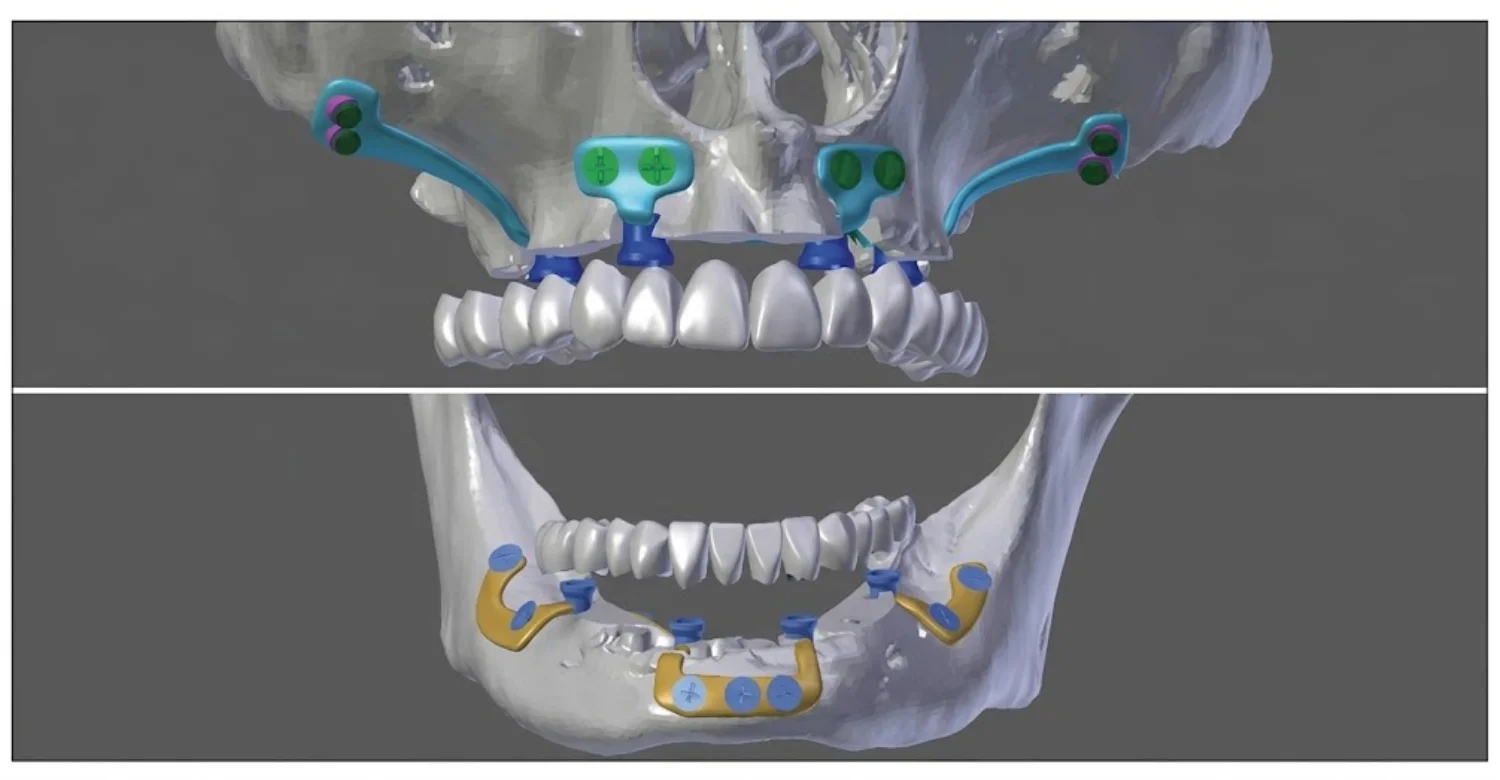
Designing the Titanium Framework and Prosthetic Connection
The designer draws framework arms along the strongest bone regions, such as the buttresses in the upper jaw. Screw holes are placed where bone is thick enough for fixation. The posts are then added at positions dictated by the tooth set-up. Arm thickness is balanced against tissue coverage. A bulky framework may be strong but harder for the gum to cover.
Aligning Abutment Positions With the Planned Dental Restoration
Each post should emerge beneath a tooth, ideally under the central fossa of a back tooth. Screw access channels should exit on the tongue or chewing side, not the visible front. Posts are aligned so the bridge can slide along one shared path. The designer checks that no post sits under a gap or a visible area. This alignment strongly influences comfort and appearance.
Reviewing the Digital Design Before Manufacturing
The surgeon, prosthodontist and engineer review coupling element design in custom subperiosteal implants before production. They check fit, screw positions, post angles and the predicted soft-tissue relationship. Changes at this stage are inexpensive compared with changes after surgery. Many teams print a resin model of the jaw and framework for physical checking. Approval is typically documented before manufacturing begins.
How Are Abutment Position, Height, Angulation, and Number Determined?
Position follows the planned teeth and the available bone support beneath the framework. Height depends on gum thickness and the space needed for the prosthesis. Angulation is set so all posts share a common insertion path. Number depends on arch length, bone quality and expected bite force. Many full-arch designs use four posts, though some cases need more. Coupling element design in custom subperiosteal implants is individual and should be explained to the patient.
How Are Framework Fit and Connection Compatibility Verified Before Surgery?
Teams verify fit on a printed bone model that reproduces the patient's jaw. The framework should seat without rocking or forcing. Prosthetic components are test-fitted to confirm that screws engage fully and parts are compatible. A provisional bridge is often made in advance from the same digital plan. These checks help reduce surprises during surgery and the first loading appointment.
What Are the Most Important Elements of Custom Subperiosteal Implant Prosthetic Connection Design?
Four elements carry most of the weight in coupling element design in custom subperiosteal implants. They are post spacing, transmucosal shape, screw connection type and the framework-to-post transition. Each one affects mechanics, hygiene and maintenance. A weakness in any single element can undermine an otherwise excellent framework.
How Is Coupling Element Spacing in Subperiosteal Implants Determined?
Coupling element spacing is the distance between posts along the arch. It is set by tooth positions, bridge length and where the framework has good bone support. Wider spacing can improve stability against rocking forces. However, posts placed too far back may sit over thin bone or near nerves. The final spacing is always a compromise between these factors.
Relationship Between Abutment Spacing and Prosthesis Span
The span is the length of the bridge between two neighbouring posts. Longer spans bend more under chewing load, which stresses screws and bridge material. Shorter spans reduce bending but may crowd posts and limit cleaning access. Designers aim for a span that the chosen bridge material can carry safely. Stronger materials, such as metal-reinforced bridges, tolerate longer spans better.
Anatomical Limitations and Available Bone-Surface Support
In the upper jaw, the strongest support is often near the canine pillars and cheekbone buttresses. In the lower jaw, the mental nerve limits post placement near the premolars. Severe resorption can leave very thin bone in some regions. Posts are best placed above framework areas that rest on solid bone. Anatomy therefore often decides spacing more than ideal geometry does.
Why Spacing Must Be Individualized Rather Than Based on a Universal Measurement
No published study defines one ideal distance between subperiosteal posts. Jaw size, arch shape, bite force and bone quality vary widely between patients. A spacing that works for a small, narrow arch could fail in a large, square one. Using a fixed template ignores these differences. Individual coupling element design in custom subperiosteal implants gives more predictable results than templates.
How Does Transmucosal Abutment Design Affect Prosthetic Function?
The transmucosal part is where titanium meets living gum tissue. Its height, width and surface finish shape how the tissue seals around it. A well-designed post supports a stable soft-tissue cuff. A poorly designed one may cause chronic irritation or recession. This region is where coupling element design in custom subperiosteal implants most affects plaque control.
Abutment Height and Emergence Profile
The emergence profile is the shape of the post as it leaves the gum. A smooth, gently flared profile supports healthy tissue and easy cleaning. A post that is too short may leave the bridge margin buried in the gum. A post that is too tall may become visible or crowd the bridge. Height is chosen from the measured soft-tissue thickness.
Angulation, Parallelism, and Prosthetic Insertion Path
All posts must allow the bridge to seat along one direction. If one post diverges too much, the bridge may bind or need forcing. Angled multi-unit components can correct moderate divergence. Large corrections, however, can complicate screw access and add parts. Planning parallel posts early keeps coupling element design in custom subperiosteal implants simpler.
Clearance for Soft Tissue and Oral Hygiene
The bridge should not press on the gum around each post. A small, cleanable gap allows floss, interdental brushes or water flossers to pass. Ridge-lap designs that trap food should be avoided where possible. Clearance must still be small enough for speech and appearance. This balance is among the most practical decisions in coupling element design in custom subperiosteal implants.
Which Screw-Retained Prosthetic Connections Can Be Used in Subperiosteal Implants?
Most contemporary designs use screw-retained connections rather than cement. Common options include multi-unit abutment interfaces and custom milled connections. Screw retention lets the dentist remove the bridge for cleaning or repair. It also avoids residual cement, a known cause of soft-tissue inflammation around implants. The choice depends on the framework system and the prosthetic team's workflow.
Screw-Access Position and Prosthetic Retrievability
Screw holes should exit through the chewing or tongue side of the teeth. Front-facing access holes can spoil appearance and weaken thin porcelain. Retrievability means the bridge can come off without cutting or breaking it. This is valuable when gum problems or fractures occur. Patients should ask whether their final bridge is designed to be retrievable.
Connection Geometry, Seating Accuracy, and Component Compatibility
The post, screw and bridge base must match exactly. Mixing incompatible brands can leave tiny gaps or uneven screw tension. Precise geometry allows the bridge to seat fully and passively. A non-passive fit places continuous stress on screws and framework. Teams should use components verified for the specific connection design.
Screw Loosening, Fracture Risk, and Maintenance Considerations
Screw loosening is among the most common mechanical problems in implant bridges generally. Conventional implant studies report rates of roughly 5% over five years. Causes include misfit, heavy bite forces, long cantilevers and incorrect tightening. Screws are maintenance parts and may need periodic replacement. Regular reviews let small problems be fixed before a fracture occurs.
Why Does Framework-to-Abutment Transition Design Matter?
In coupling element design in custom subperiosteal implants, the arm-to-post junction is a mechanical hotspot. Bite forces converge here before spreading into the framework. A sharp or thin junction can concentrate stress. A smooth, adequately thick transition spreads that stress more evenly. Its shape also affects how gum tissue drapes over the framework.
Transition Geometry and Potential Stress Concentration
Sharp internal corners act like notches where cracks can begin. Rounded transitions, called fillets, reduce this concentration. Engineers often use simulation to identify peak stress at this junction. Modest design changes can lower peak stress considerably. These details are invisible to patients but matter for long-term durability.
Framework Thickness, Material Properties, and Manufacturing Constraints
Titanium alloy Ti-6Al-4V offers high strength with good biocompatibility. Printed titanium can contain microscopic porosity if processing is not controlled. Minimum printable thickness limits how slim arms and junctions can be. Post-processing, such as heat treatment and polishing, improves mechanical properties and surface finish. Thickness must balance strength with tissue coverage.
Inspection of Connection Surfaces and Potential Manufacturing Defects
Connection surfaces should be inspected under magnification before delivery. Burrs, rough spots or distorted threads can prevent proper seating. Many manufacturers measure critical dimensions against the digital design. Some also use scanning to compare the printed part with the plan. A defective connection is far easier to correct before surgery than after.
How Does Biomechanical Design Affect Custom Subperiosteal Implant Connections?
Biomechanics describes how chewing forces move through the bridge, posts, framework and bone. Unlike conventional implants, a subperiosteal framework spreads load across a wide bone surface. The posts are the entry points for every bite. Coupling element design in custom subperiosteal implants decides whether that load spreads evenly or concentrates.
How Is Prosthetic Load Distributed Across a Subperiosteal Implant Framework?
When you bite, force enters the bridge and passes into the posts beneath. The framework arms then carry it to the fixation screws and bone surface. A rigid, well-connected bridge shares load across all posts. If one post carries most of the force, its screws and junction work harder. Even distribution is a central goal of coupling element design in custom subperiosteal implants.
What Factors Influence Stress Distribution Around Subperiosteal Implant Abutments?
Several factors combine to shape stress around each post. The most important are bite force, contact pattern, framework stiffness, post geometry and cantilever length. Patient habits, such as clenching or grinding, add further load. Each factor can be partly controlled through design and bite adjustment.
Bite Force, Occlusal Contacts, and the Direction of Applied Loads
Maximum biting force in adults commonly ranges from about 300 to 700 newtons in the back teeth. Denture wearers often have lower values, which may rise after fixed teeth. Vertical forces along the post axis are tolerated best. Sideways forces create bending, which raises stress at screws and junctions. Balanced, evenly spread contacts help keep forces more vertical.
Framework Rigidity, Abutment Geometry, and Support Distribution
A stiffer framework distributes force more widely across the bone. A flexible framework may let posts move slightly under load, straining the bridge. Post diameter and height also matter, because taller posts act as longer levers. Posts over well-supported framework zones transfer load more safely. Designers aim for stiffness without excessive bulk.
Cantilever Length and Uneven Occlusal Loading
A cantilever is a part of the bridge that extends beyond the last post. Long cantilevers multiply the force acting on the nearest post and screw. Implant literature generally advises keeping distal cantilevers short. Uneven contacts, such as heavy biting on one side, add similar strain. Careful post placement can reduce the need for long extensions.
How Can Digital Simulation Help Evaluate Connection Design?
Digital simulation tests a design under virtual load before it is made. It helps engineers compare alternative post positions and framework shapes. Weak points can be reinforced at the design stage. This adds an extra safety check to clinical judgement. It is most useful for unusual anatomy or heavy-bite patients.
Finite Element Analysis and Stress Concentration Assessment
Finite element analysis divides the framework into thousands of small elements. Software then calculates stress and strain under applied forces. Results are shown as colour maps highlighting high-stress regions. Designers often find peak stress near post junctions and screw holes. Smoothing or thickening those areas can lower predicted peaks.
What Digital Simulation Can and Cannot Predict Clinically
Simulations rely on assumptions about bone properties, loads and boundary conditions. Real bone varies in density and remodels over time. Gum health, hygiene and habits are not captured in the model. Simulation therefore indicates relative risk, not guaranteed clinical outcomes. Its findings should support, not replace, clinical experience.
How Can Poor Connection Design Contribute to Mechanical Complications?
Poorly placed posts can create misfit, uneven loading and long cantilevers. These conditions increase the chance of screw loosening and bridge fracture. Reviews report provisional bridge fracture in about 5.2% of patients who received one. Repeated loosening can also wear the connection threads. Over time, unresolved strain may affect the framework's stability on bone.
Are There Universal Design Rules for Stress Distribution and Coupling Element Spacing?
There are principles, but no universal numeric rules for subperiosteal designs. Engineers follow general guidance from conventional implants and structural mechanics. Examples include short cantilevers, even contacts and smooth transitions. Evidence specific to coupling element design in custom subperiosteal implants remains limited. Each design must therefore be judged on its own anatomy and prosthetic plan.



How Do Coupling Elements Affect Soft-Tissue Health and Oral Hygiene?
Soft-tissue problems are the most frequently reported complication of custom subperiosteal implants. A 2024 systematic review of 227 implants found partial exposure in 25.6% of cases. A 2025 review of 246 implants reported partial exposure in 37%. Many exposures are small and manageable, but they show how important the gum interface is. Coupling element design in custom subperiosteal implants is one factor the team can directly control.
How Should Soft-Tissue Considerations Influence Coupling Element Design?
The posts should emerge through stable, attached gum wherever possible. Mobile tissue near the cheek or floor of the mouth moves constantly around a post. That movement can pull the seal open and allow bacteria in. Designers also limit framework bulk near the posts so the tissue can close without tension. Soft-tissue planning should be part of coupling element design in custom subperiosteal implants, not an afterthought.
Why Are Emergence Profile and Transmucosal Clearance Important?
A smooth emergence profile helps the gum form a tight, healthy cuff. Polished titanium in the transmucosal zone collects less plaque than rough surfaces. Clearance under the bridge lets patients clean the area each day. Without it, food and plaque build up against the tissue. This can lead to inflammation, bleeding and eventually tissue breakdown.
How Can Abutment Position Affect Plaque Accumulation and Cleaning Access?
Posts placed too close together leave little room for brushes between them. Posts set far toward the cheek or tongue can be hard to reach. A post under a thick, flat bridge base creates a hidden plaque trap. Ideal positions allow a straight path for an interdental brush on both sides. Patients should be able to see and reach every post with simple tools.
Which Patients May Have Greater Risk of Soft-Tissue Complications?
Some patients face higher risk because of tissue type, habits or general health. Identifying these factors early allows the team to adjust design and aftercare. It also helps set realistic expectations before surgery. Higher risk does not always rule treatment out, but it calls for extra care.
Thin Mucosal Tissue and Limited Soft-Tissue Coverage
Thin gum tissue offers less protection over the titanium framework. It tears more easily during closure and may thin further with time. Research on maxillary frameworks has linked recession to soft-tissue factors and framework position. Designers may lower the framework profile or move posts toward thicker tissue. Some patients may benefit from soft-tissue grafting as part of the plan.
Smoking, Poor Plaque Control, and Pre-Existing Oral Inflammation
Smoking reduces blood flow and slows soft-tissue healing. Studies in conventional implants associate smoking with more peri-implant inflammation and bone loss. Poor plaque control increases bacterial load around every post. Untreated gum disease in remaining teeth can spread bacteria to the surgical area. These issues are best addressed before surgery begins.
Wound Closure, Tissue Irritation, and Framework Exposure
The gum must close over the framework without stretching. Tension along the incision can cause the wound to reopen, called dehiscence. A reopened wound may expose part of the titanium framework. Pressure from a provisional bridge can add irritation during healing. Careful surgical technique and a well-relieved provisional help reduce these risks.
How Can Design, Surgical Planning, and Hygiene Instructions Help Reduce Complications?
Design reduces risk through slim frameworks, polished collars and cleanable clearance. Surgery reduces risk through tension-free closure and careful flap handling. Hygiene instructions reduce risk by keeping plaque low from the first days. Reviews report soft-tissue or persistent infection in about 5.3% of patients. Combining all three approaches gives the best chance of keeping that rate low.
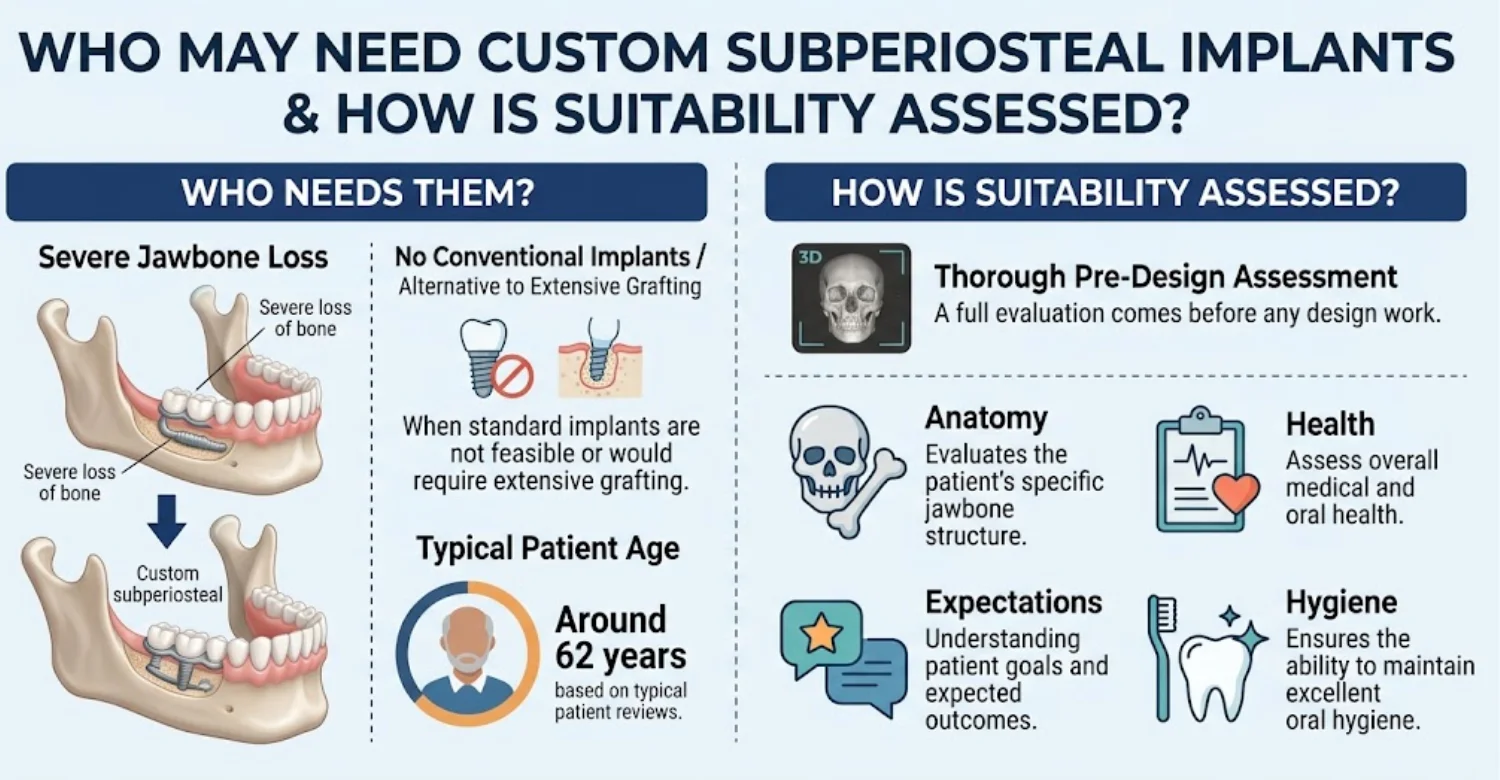
What Is the Role of Coupling Element Design in Patients With Severe Jawbone Loss?
Severe bone loss changes the relationship between the jaw and the planned teeth. The remaining ridge often sits far from where natural teeth once stood. Posts must bridge that gap while still emerging through healthy gum. Here, coupling element design in custom subperiosteal implants compensates for missing bone height and width. It allows fixed teeth in places where a standard implant could not anchor.
Which Clinical Factors Determine Whether a Custom Subperiosteal Implant Is Appropriate?
The main factors are bone anatomy, dental history, gum health, general health and prosthetic goals. Each factor can strengthen or weaken the case for treatment. The team weighs them together rather than relying on one test. Patients should receive a clear explanation of how each factor applies to them.
Residual Bone Anatomy and Previous Dental Treatment
The CBCT shows how much bone remains and where it is strongest. Previous failed implants, grafts or long-term denture wear may have altered the anatomy. Old screws, graft material or infection sites must be identified. Some patients have had several failed treatments before seeking this option. Their history strongly guides framework and post planning.
Gum Health, Oral Hygiene, Medical History, and Healing Capacity
Healthy gums and good daily cleaning support long-term success. Conditions such as uncontrolled diabetes can slow healing and raise infection risk. Certain medications, including some bone-modifying drugs, require careful review. A history of head and neck radiotherapy also needs specialist assessment. Medical clearance from the patient's doctor may be requested.
Prosthetic Requirements, Chewing Function, and Aesthetic Goals
Patients differ in how much they chew, how they smile and what they expect. A high smile line may reveal the bridge base and post area. Heavy chewers or grinders need stronger materials and careful load planning. Some patients prioritise appearance, while others mainly want to eat comfortably. These goals shape tooth set-up and post positions.
How Is the Patient Evaluated Before Implant Treatment?
Evaluation combines examination, imaging and discussion of alternatives. It usually takes one or two visits, or can begin remotely with shared records. The aim is to confirm suitability and identify risks early. A good evaluation ends with a written plan the patient understands.
Clinical Examination of Teeth, Gums, and Oral Tissues
The dentist examines remaining teeth, gums, tongue, cheeks and existing prostheses. Signs of infection, ulcers or suspicious lesions are noted and addressed. Mouth opening, jaw joints and muscle activity are also checked. Gum thickness and attached tissue are assessed at likely post sites. Any active disease is treated before implant surgery.
CBCT Imaging and Digital Prosthetic Assessment
A CBCT scan is taken, often with a radiographic guide or current denture. Intraoral scans and bite records are captured for the digital plan. The team reviews the bone, nerve positions and sinus anatomy in 3D. A virtual tooth set-up shows where the posts would need to emerge. This assessment reveals whether a framework can support the planned teeth.
Review of Conventional Implants, Bone Grafting, and Other Alternatives
Subperiosteal implants are one option among several. Alternatives include conventional implants with grafting, zygomatic implants, pterygoid implants and removable dentures. Each has different risks, timelines and costs. One review reported 5-year survival of 97.1% for subperiosteal and 96.3% for zygomatic implants. Patients should hear about all realistic options before deciding.
When Should a Patient Receive a Second Opinion Before Surgery?
A second opinion is reasonable for any complex, costly or irreversible procedure. It is especially wise after previous failed treatment or when explanations feel unclear. Patients may also seek one if only a single option was offered. Sharing CBCT files and the design proposal makes a second review straightforward. A confident clinical team should welcome this step.
Ready to transform your smile?
Talk to our team and get a personal FREE treatment plan.
What We Notice Clinically
In day-to-day practice, connection problems rarely announce themselves at surgery. They tend to appear weeks or months later, when the bridge is in daily use. Patients describe a sore spot, a loose feeling or food trapping under the teeth. Tracing these complaints back often leads to the posts. These observations shape how our team reviews coupling element design in custom subperiosteal implants.
Why a Precisely Fitting Framework Does Not Automatically Guarantee a Successful Prosthesis
A framework can sit perfectly on bone yet support the teeth poorly. Fit to bone and fit to the prosthesis are two separate questions. Reviews rate surgical fit as satisfactory in most cases, around 87.7%. However, good bone fit says nothing about post angle, clearance or bite balance. Success needs both a good framework and sound coupling element design in custom subperiosteal implants.
Common Design and Clinical Issues That May Be Overlooked
Some issues are easy to miss on a screen but obvious in the mouth. Three patterns appear repeatedly in referrals and reviews. They are poorly angled posts, poor clearance and connection misfit. Each can usually be prevented by reviewing coupling element design in custom subperiosteal implants carefully.
Abutments That Are Angled or Positioned Inappropriately for the Prosthesis
A post that follows the bone rather than the teeth may emerge at an awkward angle. The screw hole may then exit through a visible tooth surface. The technician may need angled components or thin areas to compensate. These compromises can weaken the bridge or spoil appearance. Prosthetically driven planning largely avoids this problem.
Insufficient Transmucosal Clearance or Difficult Cleaning Access
Some bridges sit tight against the gum to look natural. This often leaves no room to clean around the posts. Patients then notice bleeding, bad taste or persistent swelling. Over time, inflammation can contribute to tissue recession and exposure. A small, cleanable gap is usually a better long-term choice.
Connection Misfit, Uneven Loading, and Prosthetic Seating Difficulties
A bridge that needs force to seat is not fitting passively. Screws may tighten, yet hidden stress remains in the connection. Uneven contacts on one side add further strain. Patients may feel pressure, clicking or recurring screw loosening. Verification steps and bite checks help detect misfit early.
What Is the Difference Between Mechanical Discomfort and Soft-Tissue Irritation?
Mechanical discomfort usually relates to biting, chewing or pressure on specific teeth. It may come with clicking, looseness or a changed bite. Soft-tissue irritation tends to cause tenderness, redness or bleeding at the gum. It often worsens with poor cleaning and may produce a bad taste. Telling these apart helps the dentist choose the right treatment.
Clinical Note: Dr. Rifat Alsaman, Head of the Medical Team at Vitrin Clinic and Cosmetic Dentist
"In my experience, patients judge their new teeth by comfort and confidence, not by framework fit. A perfect scan match means little if the bite feels heavy or the gum stays sore. We review each connection with the final smile and bite already planned. That habit prevents many problems before they start."
Why Prosthetic Fit, Occlusal Balance, and Soft-Tissue Health Must Be Considered Together
"These three factors influence each other constantly. A misfit can create uneven contacts, and uneven contacts can stress the gum around a post. Inflamed tissue can then make the bridge feel loose or tender. Treating one factor alone often brings the problem back. We assess all three at every review."
Why Individual Clinical Findings Should Guide Design Decisions Rather Than a Standardized Template
"Every jaw tells its own story through bone shape, gum thickness and bite habits. A template might save design time, but it ignores those details. I prefer designs that respond to the patient's actual findings. That approach takes longer, yet it gives more predictable comfort and function."
What Are the Potential Side Effects and Complications of Custom Subperiosteal Implant Connections?
Like any surgery, custom subperiosteal treatment carries side effects and possible complications. Most early symptoms are temporary and settle within days. Reviews report short-term survival of around 97.6% to 97.8%. Complications are still common, and one six-year follow-up found only 25% of cases fully complication-free. Knowing what to expect helps patients respond early and calmly.
What Are the Possible Early Postoperative Side Effects?
Early side effects reflect normal healing after surgery on the jaw and gums. A 2025 review reported pain in 25% and swelling in 24% of patients early on. Another review found postoperative discomfort, bleeding or swelling in about 7.5% of patients. The difference partly reflects how studies define and record symptoms. Either way, most early symptoms improve steadily with time.
Temporary Pain, Swelling, Bruising, and Gum Tenderness
Swelling usually peaks around the second or third day after surgery. Bruising on the cheeks or neck can appear and fade over one to two weeks. The gums around the posts may feel tender while the tissue seals. Mild discomfort is often controlled with prescribed pain relief. Symptoms should improve gradually rather than worsen.
Differences Between Expected Healing Symptoms and Concerning Changes
Expected symptoms peak early and then ease day by day. Concerning changes include pain that increases after the third day. Spreading swelling, pus, fever or a foul taste also need attention. Visible metal through the gum is another sign to report. When unsure, contacting the clinic is always the safer choice.
What Mechanical Complications Can Affect the Prosthetic Connection?
Mechanical complications involve screws, posts, the bridge or how they fit together. They often relate to misfit, bite forces or coupling element design in custom subperiosteal implants. Some are minor and quickly fixed in the chair. Others need parts replaced or the bridge remade. Early reporting usually makes repairs simpler.
Screw Loosening, Component Fracture, and Prosthesis Damage
A loose screw may cause clicking, slight movement or a changed bite. If ignored, it can lead to screw fracture or thread damage. Bridge materials can chip or crack, especially in grinders. Provisional bridges fractured in about 5.2% of patients in one review. Prompt tightening or replacement prevents larger damage.
Poor Prosthetic Fit, Mobility, and Occlusal Discomfort
A bridge that rocks or feels mobile needs urgent assessment. Mobility can come from loose screws, misfit or, rarely, framework movement. Occlusal discomfort may appear as one tooth hitting first or a sore jaw. These signs suggest uneven loading through the connection. A bite check and fit assessment usually identify the cause.
What Biological Complications Can Occur Around the Framework and Abutments?
Biological complications affect the gum and bone around the implant. They include inflammation, wound reopening, exposure and infection. Reviews report partial exposure in roughly 25% to 37% of implants. Infection was recorded in about 5% of patients across studies. Many cases are managed without removing the implant.
Mucosal Inflammation, Wound Dehiscence, and Framework Exposure
Inflamed gum appears red, puffy and bleeds easily when cleaned. Dehiscence means the wound edges have separated. When this happens, part of the framework may become visible. Small exposures can often be kept clean and monitored. Larger or growing exposures may need surgical treatment.
Infection, Persistent Irritation, and Difficulty Maintaining Oral Hygiene
Infection may cause swelling, pus, pain or a bad taste. Persistent irritation often links to plaque, poor clearance or pressure from the bridge. If cleaning is difficult, the cycle of inflammation can continue. Reviews recorded five late failures needing removal among 246 implants. Early care improves the chance of saving the implant.
Which Warning Signs Require Prompt Professional Assessment?
Some symptoms should never be managed at home alone. They suggest infection, mechanical failure or a serious reaction. Contact your clinic promptly if any of these signs appear. In emergencies, seek local medical care without delay.
Increasing Pain, Swelling, Pus, Fever, or Persistent Bleeding
Pain that worsens instead of easing may signal infection. Pus, fever or swelling spreading toward the eye or neck need same-day care. Bleeding that continues despite firm gauze pressure also needs assessment. These signs can progress quickly without treatment. Early antibiotics or drainage may be required.
A Loose Prosthesis, Visible Framework, or Sudden Bite Changes
A loose bridge can strain the remaining screws and posts. Visible titanium through the gum suggests exposure that needs review. A sudden change in how your teeth meet may mean a fractured or shifted component. Avoid chewing on that side until checked. Book an appointment as soon as possible.
Difficulty Swallowing or Breathing as a Medical Emergency
Difficulty swallowing or breathing is a medical emergency. It may indicate severe swelling spreading into the neck or floor of the mouth. Call emergency services or go to the nearest emergency department immediately. Do not wait for a dental appointment. Inform your dental team once you are safe.
Note : All images used are for editorial and illustrative purposes only and may not originate from the original news provider or associated company.
What Relief Measures and Medical Tips Are Appropriate After Subperiosteal Implant Treatment?
Good aftercare protects both your comfort and the new connection. Most relief measures are simple and follow your dentist's written instructions. The goal is to reduce swelling, control pain and keep the area clean. Equally important is avoiding pressure that could disturb healing tissue. Always follow your own clinician's advice over general guidance.
How Can Patients Manage Mild Postoperative Discomfort Safely?
Mild discomfort is expected in the first few days. Rest, prescribed medication and gentle care usually keep it manageable. Keeping your head slightly raised when resting may reduce swelling. Staying hydrated and eating nourishing soft foods supports healing. If discomfort grows rather than fades, contact the clinic.
Following the Dentist's Instructions for Prescribed Pain Relief
Take pain relief exactly as prescribed, with the dose and timing given. Do not combine medicines without checking with your dentist or pharmacist. Antibiotics, if prescribed, should be finished as directed. Tell the team about allergies, stomach problems or other medications you take. Never increase doses on your own.
Using Cold Compresses When Recommended
Cold compresses can reduce swelling during the first 24 to 48 hours. Wrap ice or a cold pack in a cloth to protect the skin. Apply it to the cheek in short intervals, such as 15 to 20 minutes. Avoid applying ice directly to skin or inside the mouth. After the first two days, your dentist may suggest different care.
Choosing Soft Foods and Avoiding Excessive Pressure on the Surgical Area
Soft foods reduce load on the posts and provisional bridge. Good choices include yoghurt, soups, mashed vegetables, eggs and soft fish. Avoid hard, sticky or crunchy foods such as nuts, toffee and crusty bread. Cut food into small pieces and chew gently. Your dentist will tell you when normal foods can return.
Which Medical Tips Help Protect the Prosthetic Connection During Healing?
The first weeks are when the gum seals around each post. Protecting this seal reduces the risk of exposure and infection. Simple habits make a meaningful difference. Your daily routine supports the work done during design and surgery.
Maintaining Gentle, Clinician-Directed Oral Hygiene
Use a soft toothbrush and the rinses your dentist recommends. Clean gently around the posts without scrubbing the wound line. Interdental brushes or water flossers may be introduced once healing allows. Ask the hygienist to demonstrate the correct technique. Consistent cleaning keeps plaque away from the healing tissue.
Avoiding Smoking and Excessive Pressure on the Temporary Prosthesis
Smoking slows healing and raises the risk of wound breakdown. Stopping before surgery and staying smoke-free afterwards gives the best chance of success. Avoid biting hard objects, opening packets with your teeth or chewing ice. If you grind at night, ask about a protective guard. Provisional bridges are not as strong as final ones.
Attending Scheduled Reviews and Following Cleaning Instructions
Review visits allow the team to check healing, screws and bite. Problems found early are usually simpler and cheaper to correct. Your team may adjust the provisional bridge as swelling settles. Professional cleaning may be scheduled every three to six months. Keep every appointment, even when everything feels fine.
Which Home Remedies and Self-Adjustments Should Patients Avoid?
Never try to tighten, file or adjust the bridge yourself. Avoid placing aspirin or other tablets directly on the gum, as this can burn tissue. Do not use strong home-made rinses, such as undiluted alcohol or hydrogen peroxide. Avoid poking at exposed areas with sharp objects. These actions can damage the connection or worsen inflammation.
When Is Professional Treatment Necessary Instead of Home Relief?
Home care supports healing but cannot fix mechanical or infectious problems. See your dentist if pain worsens, swelling spreads or pus appears. Professional care is also needed for looseness, visible framework or bite changes. Persistent bleeding or bad taste should be checked. Seek emergency help for any breathing or swallowing difficulty.
How Is Treatment Managed When a Coupling Element or Prosthetic Connection Has a Problem?
Treatment begins with finding the true cause, not just easing symptoms. A loose bridge, sore gum or changed bite can each have several causes. The dentist examines the connection, bite and soft tissue together. Many problems linked to coupling element design in custom subperiosteal implants are solved with simple maintenance. More complex cases may need component replacement or surgical care.
How Does a Dentist Diagnose a Suspected Connection Problem?
Diagnosis combines your description, a clinical examination and, sometimes, imaging. The dentist asks when symptoms began and what makes them worse. Each post and screw is then assessed in turn. The aim is to separate mechanical, biological and bite-related causes. A clear diagnosis guides the most conservative effective treatment.
Clinical Examination and Assessment of Prosthetic Stability
The dentist checks whether the bridge moves under gentle pressure. Gum tissue around each post is examined for redness, swelling or exposure. Gentle probing may show bleeding or pus. Any visible framework is measured and photographed for comparison. These findings show whether the problem is mainly mechanical or biological.
Checking Occlusion, Screw Stability, and Prosthetic Seating
Articulating paper marks show where teeth meet during biting and sliding movements. Heavy or early contacts point to uneven loading through the connection. Screws are checked for looseness using calibrated tools. If needed, the bridge is removed to inspect seating surfaces. Fit is then confirmed when the bridge is replaced.
Using Radiographic Imaging When Clinically Indicated
X-rays or a CBCT may be taken when exams leave questions unanswered. Imaging can show bone changes around fixation screws or framework arms. It may reveal fractured components or gaps at the connection. Radiation is kept as low as reasonably achievable. Imaging is used when it changes management, not routinely.
What Treatment Options May Be Considered for Connection-Related Complications?
Options range from small adjustments to significant revisions. The choice depends on the cause, severity and how long the problem has existed. Simple treatments are tried first where safe. More involved options are discussed openly, with costs and expected results.
Occlusal Adjustment and Prosthetic Maintenance
Adjusting high spots on the bridge can rebalance bite forces quickly. The dentist may also polish rough areas that irritate the tongue or cheek. Professional cleaning removes plaque and calculus around the posts. Sometimes the bridge base is reshaped to improve cleaning access. These steps are often done in a single visit.
Screw Replacement, Component Repair, or Prosthesis Remaking
Loose or worn screws are usually replaced rather than retightened repeatedly. Damaged components may be swapped for new matching parts. Chipped teeth on the bridge can often be repaired. A bridge with persistent misfit may need to be remade from new records. This is why retrievable screw-retained designs are so valuable.
Soft-Tissue Treatment or Framework Revision When Necessary
Inflamed tissue may be treated with deep cleaning, antiseptic rinses or antibiotics. Small exposures can sometimes be smoothed and kept clean. Larger exposures may need soft-tissue grafting or flap surgery. In rare cases, part of the framework is trimmed or the implant is removed. Reviews report removal in a small minority of implants.
How Is the Treatment Plan Individualized According to the Cause of the Problem?
A bite problem needs bite correction, not antibiotics. An infection needs infection control, not just screw tightening. Many cases involve a mix of mechanical and biological factors. The plan addresses each contributing factor in a logical order. Patients should receive a written summary of what is planned and why.
How Can Routine Follow-Up Help Identify Problems Before They Progress?
Regular reviews catch loose screws, early inflammation and small exposures. These are far easier to manage than advanced complications. Most teams suggest reviews at one week, one month, three months and then regularly. Professional cleaning and bite checks are part of each visit. International patients can combine remote check-ins with local dental reviews.
Ready to transform your smile?
Talk to our team and get a personal FREE treatment plan.
What Does Current Clinical Evidence Say About Custom Subperiosteal Implant Design?
Coupling element design in custom subperiosteal implants is a relatively new field of research. Most published studies date from 2017 onwards, after titanium 3D printing became practical. Short-term results are encouraging, but follow-up periods remain limited. Evidence quality is still rated low or very low by formal grading. Patients should view current numbers as promising rather than definitive.
Country | Medical device regulator | Approx. full-arch cost (USD) | Reported survival | Reported partial exposure |
United States | FDA | 25,000–50,000 | 94.1%–100% | 25.6%–37% |
United Kingdom | MHRA | 25,400–57,150 | 94.1%–100% | 25.6%–37% |
Turkey | TITCK | From ~$6,000 (Vitrin Clinic) | 94.1%–100% | 25.6%–37% |
Survival and exposure figures come from international reviews and are not country-specific. Clinical outcomes depend on planning, surgical skill and aftercare, not location.
What Have Recent Clinical Reviews Reported About Survival and Complications?
A 2024 systematic review pooled 13 studies with 227 patients and implants. It found 97.8% of implants in function after a weighted mean of 21.4 months. Partial exposure affected 25.6% of implants, and infection affected 5.3% of patients. A 2025 review of 246 implants reported survival between 94.1% and 100%. Both reviews highlighted soft-tissue complications as the main ongoing challenge.
What Is Known About CAD/CAM Framework Accuracy and Patient-Specific Design?
Digital design and printing allow frameworks to match the bone surface closely. Across four studies, surgical fit was rated satisfactory in 87.7% of implants. Fit accuracy depends on scan quality, segmentation and manufacturing precision. Soft-tissue thickness over the bone can also affect how frameworks seat. Accuracy has improved greatly compared with older, impression-based subperiosteal implants.
What Evidence Supports Careful Evaluation of Abutment Position and Prosthetic Fit?
Direct studies on subperiosteal post position remain scarce. However, decades of conventional implant research support passive fit and balanced occlusion. Misfit and heavy loads are linked to screw loosening and bridge fractures. Research on maxillary frameworks also links soft-tissue recession to framework and tissue factors. These findings justify careful review of every post before manufacturing.
What Are the Current Evidence Gaps in Coupling Element Spacing and Connection Geometry?
No controlled trials compare different post spacings or connection geometries. Most studies report survival and exposure, not detailed prosthetic outcomes. Follow-up rarely exceeds five years, so long-term behaviour is uncertain. Reporting methods vary, making studies hard to compare or combine. Future research on coupling element design in custom subperiosteal implants should track mechanical and soft-tissue outcomes.
Which Authoritative Sources Should Support the Medical Content?
Reliable information comes from peer-reviewed research and recognised health institutions. Marketing claims and single-clinic testimonials are not enough. Patients can ask their clinic which studies support its approach. Good clinics are comfortable sharing that evidence.
PubMed and Peer-Reviewed Oral and Maxillofacial Surgery Research
PubMed indexes research from journals in implant dentistry and maxillofacial surgery. Searching "custom subperiosteal implant" returns systematic reviews and case series. Articles in the International Journal of Implant Dentistry and the International Journal of Oral and Maxillofacial Surgery are especially relevant. Abstracts are free, and many full texts are open access. Look for reviews and cohort studies rather than single case reports.
National Institute of Dental and Craniofacial Research (NIDCR) and NIH Resources
The NIDCR is part of the US National Institutes of Health. It publishes patient information on oral health, gum disease and dental implants. Its materials are independent and evidence based. They help patients understand general risks such as smoking and diabetes. They do not endorse specific clinics or implant systems.
Relevant Clinical Studies, Systematic Reviews, and Long-Term Follow-Up Reports
Systematic reviews combine several studies and give the broadest view. Long-term follow-up reports show how implants behave over many years. A 2023 consensus report and literature review also summarised expert recommendations. Patients should check the study size, follow-up length and complication reporting. Larger, longer studies carry more weight than small short-term series.
How Much Do Custom Subperiosteal Implants Cost in the US, UK, and Turkey?
The cost of custom subperiosteal implants varies by country, clinic, framework complexity, surgical requirements, and prosthetic materials. The following table compares estimated full-arch treatment costs in US dollars. These figures are approximate planning estimates, not guaranteed prices or personalized quotes.
Turkey may offer substantially lower starting prices than the US and UK. However, the final cost depends on the patient's anatomy, the custom framework, the fixed bridge, and the services included in the treatment package.
Average Cost of Custom Subperiosteal Implants by Country
Note: The US and UK midpoints are calculated from the stated price ranges; they are not verified national averages. Turkey's figure is a starting price, so a midpoint cannot be calculated. Confirm current pricing directly with the clinic.
What Is the Estimated Full-Arch Cost of Custom Subperiosteal Implants?
Full-arch custom subperiosteal implant treatment generally involves a patient-specific framework, surgical placement, connection components, and a fixed prosthetic bridge. Depending on the clinic, the package may also include imaging, digital planning, temporary teeth, and follow-up care.
The tables below explain the estimated regional costs and the main factors that influence the final price.
United States: Approximately 25,000–50,000 per Full Arch
In the United States, the estimated cost of custom subperiosteal implants ranges from $25,000 to $50,000 per full arch, with a calculated midpoint of $37,500. Actual fees may be higher in major cities or specialist surgical centres. Insurance coverage varies, and patients may need to pay a substantial portion of treatment costs themselves.
Cost measure | Estimated amount (USD) |
Lower end of the price range | $25,000 |
Upper end of the price range | $50,000 |
Calculated midpoint | $37,500 |
Financing may be available through a clinic or third-party provider. Before accepting a plan, patients should check interest rates, repayment terms, and whether the quotation includes both the custom framework and the definitive bridge.
United Kingdom: Approximately 25,400–57,150 per Full Arch
In the United Kingdom, estimated private treatment costs convert to approximately 25,400–57,150 per full arch, with a calculated midpoint of $41,275. Availability may be limited because custom subperiosteal implant procedures require specialized planning and manufacturing. Patients should confirm whether the quoted price covers surgical treatment, prosthetic components, and long-term maintenance.
Cost measure | Estimated amount (USD) |
Lower end of the price range | $25,400 |
Upper end of the price range | $57,150 |
Calculated midpoint | $41,275 |
Currency conversion can change the equivalent cost in US dollars. NHS funding should not be assumed; eligibility depends on individual circumstances and applicable specialist service arrangements.
Turkey: From Approximately $6,000 per Full Arch at Vitrin Clinic
At Vitrin Clinic in Turkey, custom subperiosteal implant treatment starts from approximately $6,000 per full arch, subject to confirmation of current pricing and the clinical scope of treatment. This starting figure is lower than the calculated US and UK range midpoints, but the actual saving depends on the personalized quote and what each package includes.
Cost measure | Estimated amount (USD) |
Starting price per full arch | $6,000 |
Final treatment cost | Based on individual assessment |
Average or midpoint | Not available |
Travel and accommodation | Confirm separately |
The final price may depend on framework design, the number and type of coupling components, bridge material, surgical complexity, and any additional procedures. International patients should also budget for flights, accommodation, transport, and any follow-up visits required after returning home.
How Much Could Patients Save by Choosing Turkey?
The following comparison illustrates the difference between the stated Turkish starting price and the calculated US and UK midpoints.
Comparison | Reference price (USD) | Turkish starting price (USD) | Illustrative difference | Difference as a percentage |
United States vs. Turkey | $37,500 | $6,000 | $31,500 | 84.0% |
United Kingdom vs. Turkey | $41,275 | $6,000 | $35,275 | Approximately 85.5% |
These percentages compare the Turkish starting price with the US and UK range midpoints. They are illustrative comparisons, not guaranteed patient savings. Travel, accommodation, additional treatment, and differences in package inclusions may reduce the actual saving.
Why Do Custom Subperiosteal Implant Costs Vary Between Countries and Clinics?
Custom subperiosteal implant costs depend on the work required to design, manufacture, place, and restore the framework. Labour costs, laboratory charges, clinical facilities, material selection, and aftercare arrangements can all affect the total.
A low advertised price may exclude important components, while a higher quotation may include a more comprehensive treatment package. Comparing itemized quotations helps patients understand the actual cost of treatment.
Framework Complexity, Number of Abutments, and Manufacturing Method
Custom subperiosteal frameworks are designed to fit the patient's underlying bone anatomy. The complexity of the design, the amount of titanium required, the manufacturing process, and the quality-control procedures can influence the final fee.
Additional posts, abutments, or customized connections may also increase laboratory costs. Treatment involving both jaws generally costs more than treatment for one arch. Design revisions or manufacturing changes may add costs, depending on the clinic's policy and the stage of production.
Surgical Fees, Prosthetic Materials, Temporary Teeth, and Final Restoration
The surgical component may include the clinician's fee, operating facilities, and anaesthesia where applicable. The final prosthesis is another major factor because different bridge materials and fabrication methods have different costs.
Treatment component | Potential cost influence |
Surgical procedure | Complexity, clinician fees, facilities, and anaesthesia |
Titanium framework | Design, material, manufacturing, and quality control |
Coupling elements and abutments | Number, design, and type of connections |
Temporary bridge | Whether provisional teeth are required and included |
Final prosthesis | Material selection, laboratory work, and fabrication |
Additional procedures | Extractions or other clinically necessary treatment |
A provisional bridge may be provided during treatment, followed by a definitive restoration when clinically appropriate. The timing and design depend on initial stability, tissue healing, and the treatment plan. Patients should confirm whether both restorations are included in the quoted price.
Whether CBCT Imaging, Digital Design, Follow-Up, and Aftercare Are Included
CBCT imaging and digital planning help clinicians evaluate anatomy and plan a custom framework. However, clinics differ in how they charge for scans, digital modelling, surgical guides, and related services.
Service | What patients should confirm |
CBCT imaging | Whether imaging and interpretation are included |
Digital planning | Whether framework design and planning fees are included |
Surgical procedure | Whether all surgical and facility fees are covered |
Follow-up appointments | Number of included visits and the follow-up period |
Medication and adjustments | Whether prescriptions and prosthesis adjustments cost extra |
Repairs and maintenance | Whether screw replacements, repairs, or complications are covered |
A detailed written quotation should identify any excluded services. This is particularly important for international patients who may need to arrange additional appointments after returning home.
Is Coupling Element Design Usually Priced Separately From the Implant Treatment?
In many custom subperiosteal implant treatment packages, coupling element design is included in the overall framework or laboratory fee rather than billed as a separate service. However, pricing practices vary between clinics and manufacturers.
Custom-milled connections, angled abutments, additional posts, or specialized prosthetic components may incur separate charges. Their cost depends on the design, materials, manufacturing process, and number of components required.
Coupling element cost consideration | What to check |
Standard connections | Whether they are included in the framework fee |
Custom-milled connections | Whether additional design or manufacturing fees apply |
Angled abutments | Whether these are necessary and separately priced |
Additional posts or components | Whether the quoted amount covers all required parts |
Replacement components | Whether future replacements and repairs are covered |
Patients should ask the clinic to explain how coupling elements are itemized and whether the quoted price covers all components needed to connect the custom framework to the definitive bridge.
What Should Patients Compare Before Accepting a Treatment Quote?
The lowest price does not automatically represent the best value. Patients should compare treatment inclusions, clinician expertise, prosthetic materials, aftercare, and the arrangements for managing complications. A clear written quotation makes it easier to compare clinics on equivalent terms.
Written Treatment Scope and Itemized Pricing
Request a written treatment plan that identifies the main stages and associated costs. The quotation should distinguish between the custom framework, surgery, temporary bridge, final restoration, and any other procedures.
Item to review | Questions to ask |
Custom framework | Is design and manufacturing included? |
Surgery | Are surgical and facility fees included? |
Coupling elements | Are all required connections included? |
Temporary bridge | Is a provisional restoration included? |
Final bridge | Which materials and laboratory services are covered? |
Imaging and planning | Are CBCT scans and digital planning included? |
Aftercare | Which follow-up visits and adjustments are included? |
An itemized quotation can help identify unexpected charges and clarify how costs may change if the treatment plan needs to be modified.
Included Prosthetic Components, Follow-Up Visits, and Possible Additional Procedures
Before accepting a quote, confirm which screws, abutments, coupling elements, and other prosthetic parts are included. Ask how many postoperative reviews are covered and whether maintenance is available after treatment.
Some patients may require extractions or other preparatory procedures. These can increase the cost and treatment duration, so they should be discussed before treatment begins whenever possible.
The Difference Between a Starting Price and a Personalized Treatment Quote
A starting price represents an advertised entry point, not necessarily the amount every patient will pay. A personalized quotation should reflect the patient's scans, bone anatomy, planned framework, prosthetic materials, and any additional clinical needs.
Price type | What it means |
Starting price | The advertised cost for an eligible or straightforward case |
Estimated range | An approximate budget based on a set of treatment assumptions |
Calculated midpoint | The middle of a stated range, not necessarily the actual average paid |
Personalized treatment quote | The proposed cost based on the patient's assessment and planned treatment |
Final treatment cost | The amount charged after accounting for agreed services and any authorized changes |
Patients should use a personalized, itemized quotation to make their final decision rather than relying exclusively on the lowest advertised price.
Key Takeaways: Average Custom Subperiosteal Implant Costs
Country | Estimated full-arch price | Calculated midpoint or average |
United States | 25,000–50,000 | $37,500 midpoint |
United Kingdom | 25,400–57,150 | $41,275 midpoint |
Turkey (Vitrin Clinic) | From approximately $6,000 | Not available |
Custom subperiosteal implant costs vary according to framework complexity, coupling elements, surgery, prosthetic materials, and aftercare. Turkey's stated starting price is considerably lower than the US and UK range midpoints, but the fairest comparison is between complete treatment packages that include equivalent services.
Before making a decision, request a personalized treatment plan, verify what is covered, and account for travel and follow-up expenses where applicable.
At Vitrin Clinic Treatment Pricing
Subperiosteal implants are a specialist solution for patients with advanced bone loss who are not suitable candidates for conventional endosseous implants. As a custom-fabricated, digitally designed treatment, costs reflect the complexity of the CBCT imaging, CAD framework design, and surgical placement involved. The following table provides a transparent comparison of average costs across the United Kingdom, United States, and Vitrin Clinic in Istanbul allowing patients to evaluate this treatment option with accurate financial context before their consultation.
Treatment | 🇬🇧 UK | 🇺🇸 USA | 🇹🇷 Turkey |
|---|---|---|---|
Single subperiosteal implant Custom framework, per implant unit | $3,175 – $5,715 | $4,000 – $6,000 | From $1,000 |
Partial arch framework 2–4 posterior teeth, one segment | $7,620 – $15,240 | $10,000 – $20,000 | From $3,000 |
Full arch framework Complete fixed restoration, per arch | $25,400 – $57,150 | $25,000 – $50,000 | From $6,000 |
CBCT scan & CAD framework design 3D imaging + digital planning | Charged separately | Charged separately | Included |
Consultation | Charged separately | Charged separately | Free & included |
Estimated saving | — | — | Up to 70% less |
* Prices are averages for reference only and may vary based on framework complexity, number of abutments, prosthetic material selection, and individual case requirements. A personalised quote is provided following your free consultation.







Tips for Patients Considering Custom Subperiosteal Implants
Informed patients make better decisions and often experience fewer surprises. Preparing questions, records and expectations before your consultation saves time. It also helps the clinical team design around your real needs. These tips apply whether you are treated locally or abroad.
What Questions Should Patients Ask About Coupling Element Design?
Ask how many posts are planned and why that number was chosen. Ask whether post positions were planned from the final teeth. Find out whether the bridge is screw-retained and removable by the dentist. Ask how you will clean around each post at home. Finally, ask who reviews coupling element design in custom subperiosteal implants before manufacturing.
What Should Patients Know About the Implant Framework and Final Prosthesis?
The framework stays in place long term, while the bridge can be serviced or replaced. Provisional teeth are usually worn during healing before the final bridge. Final bridges may be acrylic, composite or zirconia, each with different durability. Screws and some components are maintenance parts. Understanding this helps you plan for future care and costs.
How Can Patients Prepare for a Consultation and Share Relevant Dental Records?
Gather any recent CBCT scans, X-rays and dental reports. Include details of previous implants, grafts or failed treatments. Prepare a list of medications, allergies and medical conditions. Photos of your smile and current dentures can also help. Sharing records in advance allows a more accurate first assessment.
What Should International Patients Consider When Planning Treatment and Follow-Up?
Treatment usually involves at least two visits, separated by a healing period. Plan for enough time to rest after surgery before flying. Ask how follow-up will work once you return home. Identify a local dentist willing to perform routine checks if needed. Confirm how the clinic handles complications that arise after you travel.
At Vitrin Clinic: How Is Coupling Element Design Integrated Into Personalized Implant Planning?
At Vitrin Clinic, connection planning is part of every custom framework case. Our team designs from the planned smile and bite first. The framework and posts are then shaped to support that result. Surgeons, prosthetic dentists and technicians review each plan together. This shared review aims to catch problems before manufacturing.
How Does CBCT Imaging Support Patient-Specific Framework Design?
Each case begins with a CBCT scan of the affected jaw. We use it to map bone contours, nerve paths and sinus anatomy. Strong support zones are identified for the framework arms and fixation screws. Scan data is merged with intraoral scans for a complete digital model. This model becomes the foundation for every later design decision.
How Are Abutment Positions Reviewed Against the Planned Prosthetic Outcome?
We create a digital tooth set-up before placing any post. Each post is checked against tooth position, screw access and bite. Posts that would emerge under a visible surface or a gap are moved. The team confirms a shared insertion path for the bridge. Only then is coupling element design in custom subperiosteal implants approved for manufacturing.
How Are Fit, Bite Function, Soft-Tissue Clearance, and Hygiene Access Considered?
Fit is verified on printed models before surgery whenever possible. The bite is planned for even contacts and short cantilevers. Post height is chosen from measured gum thickness at each site. The bridge base is shaped to leave cleanable clearance around every post. Patients receive hands-on cleaning instructions before they leave.
How Does the Clinical Team Discuss Treatment Alternatives, Risks, and Expected Costs?
We explain all realistic options, including conventional, zygomatic and removable alternatives. Risks such as exposure, infection and screw loosening are discussed openly. Patients receive a written plan with itemised pricing. We also explain what follow-up is included and how complications are handled. Questions are welcome at every stage.
When Can a Personalized Consultation Help Determine Whether Subperiosteal Implants Are Suitable?
A consultation is helpful if you have been told you lack bone for implants. It also helps after failed implants or grafts. Patients unhappy with loose dentures often benefit from an assessment. Sharing your scans allows a preliminary opinion before you travel. Book a free treatment to find out whether this treatment suits you.
How Vitrin Clinic Supports Your Treatment Journey
Our support begins before your first visit and continues after you return home. A dedicated coordinator helps with records, scheduling and travel arrangements. Clinical decisions remain with your treating dentists and surgeons. The aim is a clear, well-organised journey from first contact to final teeth.
Initial Consultation and Review of Medical and Dental Records
You can begin by sending scans, X-rays and medical history online. Our team reviews these records and may request additional information. A video or in-person consultation then discusses your goals and concerns. We explain whether further imaging is needed. You receive a preliminary opinion on suitable options.
Personalized Diagnostic Assessment and Digital Treatment Planning
At the clinic, we carry out a full examination and fresh CBCT scan if needed. Intraoral scans and bite records are taken for digital planning. The team builds your virtual tooth set-up and framework design. You are shown the plan and invited to ask questions. Approval is confirmed before manufacturing begins.
Treatment Coordination From Framework Planning to Final Prosthetic Restoration
We coordinate design, manufacturing, surgery and bridge fabrication on one timeline. Your provisional bridge is planned alongside the framework. Healing visits and final bridge appointments are scheduled in advance. Our coordinators help arrange accommodation and transfers if you travel. You always know the next step.
Postoperative Review, Maintenance Guidance, and Follow-Up Planning
After surgery, we review healing, screws and bites before you travel home. You receive written aftercare and cleaning instructions. Remote check-ins can be arranged using photos and video calls. We can share records with your local dentist for routine maintenance. Long-term reviews help protect your investment and your oral health.
Ready to transform your smile?
Talk to our team and get a personal FREE treatment plan.
Key Takeaways
Custom subperiosteal implants can restore fixed teeth when bone loss rules out simpler options. The connection between framework and bridge is central to that success. The points below summarise what patients should remember. Use them as a checklist when discussing treatment with any clinic.
Coupling Element Design Must Balance Prosthetic Fit, Load Distribution, and Soft-Tissue Health
A good connection supports the teeth, spreads bite forces and respects the gums. Neglecting any one of these goals can cause problems later. Framework fit to bone is necessary but not sufficient. The posts must also suit the bridge and the soft tissue. Balance, not one measurement, defines good coupling element design in custom subperiosteal implants.
Patient-Specific Imaging and Digital Planning Help Guide Connection Design
CBCT scans, intraoral scans and bite records create a complete virtual patient. Planning starts with the final teeth and works back to the bone. Digital review allows changes before anything is manufactured. Surgical fit was satisfactory in about 87.7% of assessed implants in recent reviews. Careful digital work underpins that accuracy.
Spacing, Angulation, and Emergence Profiles Must Be Determined Individually
No universal spacing rule exists for subperiosteal posts. Anatomy, bite force and bridge material all influence the right layout. Posts should share a common insertion path where possible. Emergence profiles should support healthy, cleanable gum tissue. Every jaw needs its own solution.
Pain, Swelling, Framework Exposure, and Prosthetic Looseness May Require Professional Assessment
Early pain and swelling are common and usually settle within days. Worsening pain, pus, fever or visible framework need prompt review. Partial exposure has been reported in roughly 25% to 37% of implants. A loose bridge or sudden bite change also needs attention. Breathing or swallowing difficulty is a medical emergency.
Treatment Costs Depend on the Framework, Prosthesis, Surgical Complexity, and Included Services
Full-arch costs average around $37,500 in the US and $41,275 in the UK. At Vitrin Clinic in Turkey, treatment starts from about $6,000 per arch. Quotes differ in what they include, such as scans and follow-up. Always compare itemised written plans. A personal quote matters more than a starting price.
A Personalized Clinical Evaluation Is Essential Before Choosing a Custom Subperiosteal Implant Treatment
Only a full assessment can confirm whether this treatment suits you. Alternatives such as zygomatic implants or grafting should also be considered. A second opinion is reasonable for complex cases. Share your records and ask clear questions. Good decisions start with good information.
At Vitrin Clinic
At Vitrin Clinic, custom subperiosteal implant treatment combines CBCT imaging and digital planning to address complex bone-loss cases. Careful coupling element design helps connect the custom framework to the final bridge while supporting function and hygiene. Treatment starts from approximately $6,000 per full arch, depending on individual needs. Book your FREE consultation or send your scans via WhatsApp for a personalized assessment.
Reference
FAQs
Dr. Rifat Alsaman has more than 5 years of clinical experience in dentistry and currently serves as the Head of the Medical Team at Vitrin Clinic. He is dedicated to providing exceptional patient care, overseeing treatment planning, and ensuring the highest clinical standards across the team. His expertise, attention to detail, and commitment to continuous professional development have helped countless patients achieve healthier, more confident smiles.


