Dental Implant
September 27, 2026
What Is the Difference Between Immediate Dental Implants vs Delayed Implants?
 Dr. Rifat Alsaman
Dental implants are one of the most reliable ways to replace missing teeth. Teeth may be lost to decay, injury, gum disease, or extraction. Each implant is a titanium post that fuses with the jawbone and supports a natural-looking crown. When comparing immediate dental implants vs delayed implants, the key difference is timing. The implant can be placed on the day of extraction or after the site heals. The right timing depends on bone condition, infection, gum health, and overall suitability.
What Are Immediate and Delayed Dental Implants?
Both approaches use the same type of implant and aim for the same result. That result is a stable, functional, and natural-looking tooth. What separates them is the point at which the implant is placed. Each approach also requires different clinical conditions to succeed.
What Are Immediate Dental Implants?
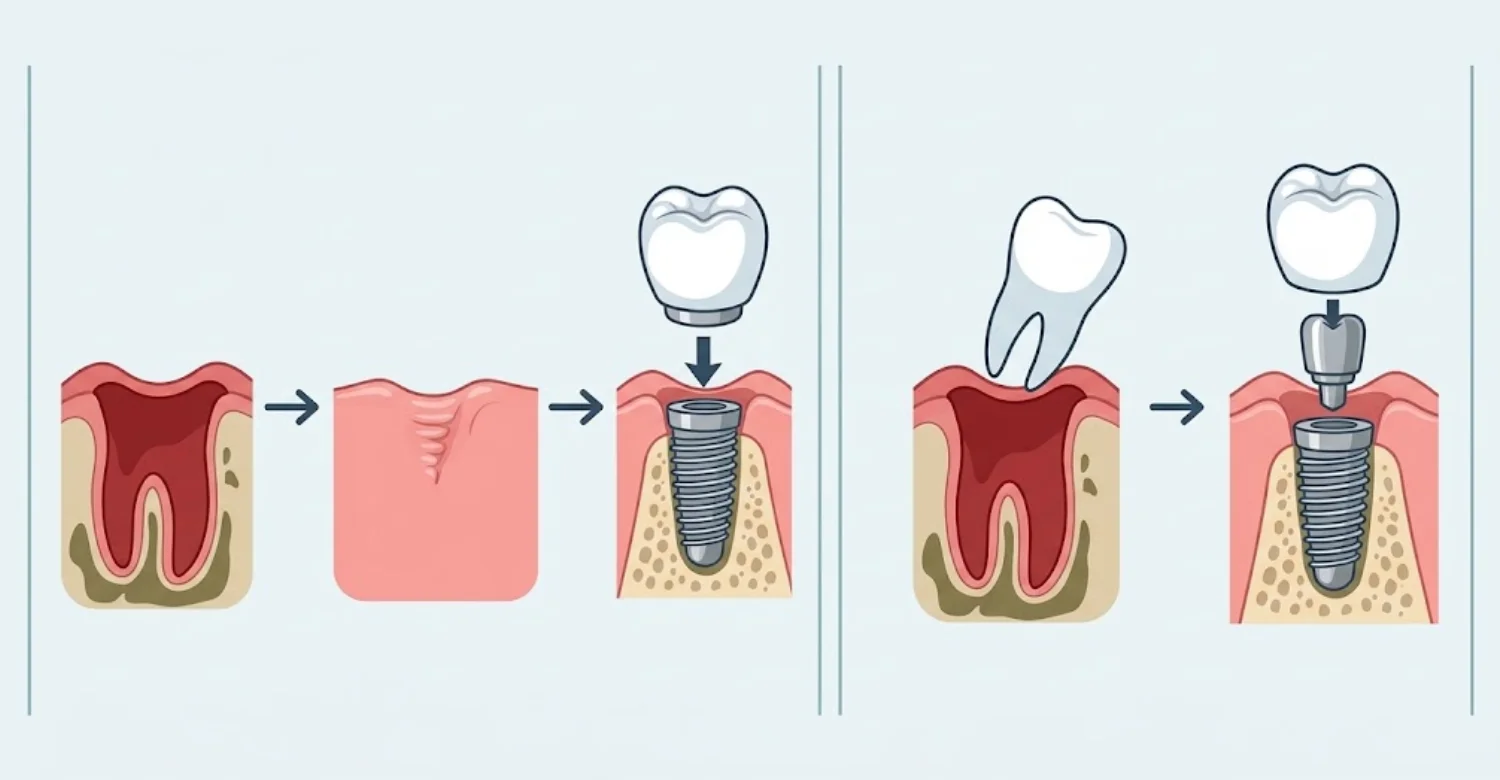
Immediate placement means the implant goes into the tooth socket on the same day as the extraction. This option requires enough surrounding bone to anchor the implant firmly from the start. Healthy soft tissue is also needed to protect it during healing. Without these conditions, the implant may not integrate successfully with the jawbone.
What Are Delayed Dental Implants?
Delayed placement means the implant is inserted after the extraction site has healed. This usually takes several weeks to a few months. The wait may be needed to resolve an infection or allow new bone to fill the socket. It can also allow time to complete a bone graft. This healing phase creates a more stable and predictable foundation for the implant.
Immediate Dental Implants vs Delayed Implants: The Main Difference
The core distinction is when the implant enters the jaw relative to the extraction. The two approaches also differ in healing needs, tissue requirements, planning, and duration. Each one suits different clinical situations. The factors below explain how they compare in everyday practice.
Timing of Implant Placement
Immediate implants are placed on the same day as the extraction. Delayed implants are placed only after the socket has healed. This difference shapes the number of appointments and the order of procedures. It also affects when a temporary or permanent tooth can be attached.
Healing Requirements
With immediate placement, the implant bonds with the bone while the socket heals around it. Delayed placement separates these two stages. The bone and soft tissue recover fully before the implant is introduced. This can make healing more predictable when the site was damaged or infected.
Bone and Gum Condition
Immediate placement requires strong bone walls and healthy gums at the moment of extraction. Delayed placement can go ahead even when these tissues are initially weak. Healing time or grafting improves them first. For this reason, tissue quality is often the deciding factor.
Treatment Planning
Immediate cases need precise planning before the tooth is removed. Dentists often use 3D imaging to measure the bone and choose the implant position. Delayed cases allow the dentist to reassess the site after healing. The final plan can then reflect how the bone and gums actually recovered.
Potential Treatment Duration
Immediate placement removes the waiting period between extraction and implant surgery. This can shorten the early stage of treatment. Delayed placement adds a healing interval before the implant is placed. However, grafting or infection management can lengthen either pathway. The total duration always depends on the individual case.
Patient-Specific Suitability
No single approach suits every patient or every tooth. The decision between immediate dental implants vs delayed implants rests on several factors. These include bone volume, gum health, infection status, and general medical condition. A thorough evaluation is the only reliable way to choose the right timing.
Read more about Dentinogenesis Imperfecta and Tooth Loss
Causes of the Condition
It helps to understand why extraction becomes necessary in the first place. The reason a tooth is lost often affects the surrounding bone and gums. This, in turn, influences whether the implant can be placed right away or after healing.
Why Might a Tooth Need to Be Extracted Before an Implant?
A tooth may need removal when it can no longer be restored. Common causes include severe decay, advanced gum disease, or a fracture below the gumline. Failed root canals or crowns, severe infection, and dental trauma can also lead to extraction. Each situation affects which implant timing is most suitable.
Why Might Implant Placement Need to Be Delayed?
Placement may be postponed when bone volume is too low or significant bone loss has occurred. An active infection at the site can also require waiting. Other reasons include poor soft-tissue condition, the need for bone grafting, or gum treatment. Patient-specific factors, such as slower healing, may also affect timing.
Note : All images used are for editorial and illustrative purposes only. They may not originate from the original news provider or associated company.
Learn more about Tooth Autotransplantation in Young Patients
Problems Caused by the Condition
Tooth loss affects much more than appearance. The changes that follow directly influence implant planning. Knowing what happens to the bone, gums, and nearby teeth explains why timing matters.
What Can Happen After Tooth Loss?
After a tooth is lost, the jawbone gradually shrinks because it no longer receives stimulation from the root. Gum contours may flatten, and neighboring teeth can drift into the gap. Chewing efficiency may also decline. Over time, facial appearance can change. Reduced bone volume may also make future implant placement more complex.
What Are the Risks of Delaying Implant Placement?
Bone continues to remodel after extraction. A long delay may reduce the volume available to support the implant. This can create a need for bone augmentation and extend the timeline. A temporary tooth may also be needed to maintain appearance, speech, and chewing.
What Are the Potential Concerns With Immediate Implant Placement?
Immediate placement is not suitable for every extraction site. Infection, thin bone walls, or poor bone support can affect candidacy. These issues can also reduce implant stability. For this reason, careful evaluation is required before choosing this approach.
Immediate Implant Placement vs Delayed Implant Placement
The procedural steps show how the two approaches differ in practice. Both share the same goal, but the order of stages and the time between them differ. Knowing each pathway helps patients prepare for their appointments.
How Does Immediate Implant Placement Work?
The tooth is removed gently to preserve as much bone as possible. The socket is then checked for infection and wall integrity. If conditions are adequate, the implant is placed immediately. Bone grafting may fill any remaining gaps when needed. A temporary tooth may be attached if implant stability and bite conditions allow.
How Does Delayed Implant Placement Work?
The tooth is extracted first. A healing period follows, often lasting several weeks to a few months. The bone and soft tissues are then re-evaluated, and grafting is done if required. Once the site has healed, the implant is placed into a stable foundation. The final restoration is planned after integration.
Immediate vs Delayed Implants: Which Takes Longer?
Treatment duration varies from patient to patient. Immediate placement usually shortens the time between extraction and implant surgery. Delayed placement adds a healing interval first. However, grafting, infection control, or soft-tissue procedures can extend either pathway. The total timeline depends on the individual case.
Understand the details of Folate Deficiency and Oral Health
Immediate vs Delayed Implants: Advantages and Limitations
When comparing immediate dental implants vs delayed implants, each option has its own benefits and trade-offs. Neither approach is ideal in every situation. The advantages of one often reflect the limitations of the other. Reviewing both sides helps patients set realistic expectations.
Potential Advantages of Immediate Implant Placement
The implant is placed at the time of extraction. This may reduce the number of surgical stages in suitable cases. It can shorten the time a patient spends without a tooth. It may also allow a temporary tooth to be attached sooner. Overall, it keeps treatment efficient when bone and gum conditions are favorable.
Potential Limitations of Immediate Implant Placement
Immediate placement is not suitable for every patient. It requires good primary stability, meaning the implant must be firmly anchored at insertion. Bone and soft-tissue conditions must also be favorable. Active infection or major bone defects may make waiting the safer choice.
Potential Advantages of Delayed Implant Placement
Delayed placement allows the extraction site to heal fully. It provides time to resolve infection or correct bone deficiencies. Additional bone or soft-tissue procedures can also be completed when necessary. This makes it the better choice for complex or compromised extraction sites.
Potential Limitations of Delayed Implant Placement
The overall treatment timeline is longer. Patients may need a temporary tooth during the healing phase. Bone can also shrink while the socket heals, reducing the available support. In some cases, bone grafting becomes necessary before or during implant surgery.
.jpg)
.jpg)
.jpg)
Immediate Dental Implants vs Delayed Implants: What Determines the Choice?
Several clinical factors guide this decision. The dentist examines the bone, gums, infection status, and overall oral health together. Each factor can support immediate placement or point toward healing first. The final recommendation reflects how all of them combine in each patient.
Bone Condition
Adequate bone volume and density are essential for anchoring an implant securely. The dentist checks for defects, such as missing or thin socket walls. These defects could weaken stability after placement. When bone is deficient, grafting may be needed. This often shifts treatment toward delayed placement.
Gum and Soft-Tissue Condition
Healthy gums protect the implant and support a natural-looking appearance. Esthetics matter most for the front teeth. Here, thin tissue may recede after placement and expose the implant edge. If soft tissue is inadequate, delaying placement allows grafting or healing first. This can improve long-term esthetic results.
Infection
The presence and severity of infection strongly influence implant timing. Localized infection may sometimes be managed during the extraction. Extensive or uncontrolled infection usually requires healing first. Whether the infection can be controlled often decides between same-day and later placement.
Overall Oral Health
Gum health, daily oral hygiene, and the condition of nearby teeth all affect implant success. Untreated gum disease or active decay may need attention before treatment begins. A healthy mouth supports predictable healing and long-term stability. This applies whichever timing approach is recommended.
Explore the facts on Tirzepatide Dental Side Effects
Delayed vs Immediate Implant Cost
Cost is a common question when comparing immediate dental implants vs delayed implants. The price depends less on timing and more on the procedures each patient needs. Prices also vary widely between countries. The table below shows approximate ranges in US dollars for Turkey, the United Kingdom, and the United States.
Treatment Component | Turkey (USD) | United Kingdom (USD) | United States (USD) |
Single implant with abutment and crown | $500 – $1,500 | $2,300 – $4,500 | $3,000 – $6,000 |
Bone grafting (per site, if needed) | $150 – $650 | $600 – $1,500 | $600 – $3,000 |
Temporary restoration | $50 – $200 | $300 – $800 | $300 – $1,000 |
Sinus lift (upper jaw, if needed) | $250 – $2,100 | $3,800 – $5,000 | $1,500 – $5,000 |
These figures are approximate private, self-pay ranges for general comparison only. In most cases, the base implant price is similar for both approaches. The real cost difference comes from added procedures such as grafting, temporary teeth, and extra visits. A personal evaluation at Vitrin Clinic is needed to confirm the exact cost.
What Affects Immediate Implant Cost?
Immediate implant cost usually includes the extraction and the implant system used. Bone grafting to fill the socket may also be added. A temporary restoration and the final crown contribute to the total. Guided surgery or soft-tissue management can raise the cost further.
What Affects Delayed Implant Cost?
Delayed implant cost usually covers the extraction, healing, and follow-up visits. Bone grafting may be added if needed. Implant placement and the final restoration follow once the site has healed. Soft-tissue grafts or temporary teeth during healing can increase the total.
Delayed vs Immediate Implant Cost: Why Can Prices Differ?
Neither approach has a universal price. Cost depends on the patient's clinical condition and the number of procedures required. Grafting, temporary restorations, and visits vary widely between cases. A complete treatment plan is needed before prices can be compared fairly.
Patient's Perspective
Knowing what to expect helps patients approach treatment with confidence and less anxiety. Both pathways involve some healing and temporary discomfort. However, they differ in the number of visits and the waiting time between them.
What Does Immediate Implant Placement Feel Like?
Extraction and implant placement happen in one visit under local anesthesia. The procedure itself is usually comfortable. Afterward, mild pain and swelling are common for a few days. These are usually manageable with prescribed care. The implant then bonds with the bone gradually over the following months.
What Does Delayed Implant Treatment Feel Like?
Patients first recover from the extraction, which may cause short-term tenderness and mild swelling. A waiting period follows while the site heals. A temporary tooth may be worn during this time. Implant surgery is then performed, and recovery is generally manageable with proper aftercare.
Common Patient Concerns
Patients often ask about pain, treatment duration, and their appearance during healing. Some worry about eating and speaking with temporary teeth. Others are concerned about cost, the number of procedures, and long-term stability. Discussing these concerns openly with the dentist helps set clear expectations.
Check out the connection between X-linked Hypophosphatemia and Dental Damage
Doctor's Perspective
From a clinical view, choosing between immediate dental implants vs delayed implants requires a step-by-step evaluation. The dentist reviews the patient's health and examines the tooth and surrounding tissues. Imaging is used when needed. This ensures the timing is based on clinical evidence, not preference.
How Is a Patient Evaluated for Immediate Implant Placement?
Evaluation begins with the medical and dental history. A clinical exam of the tooth and extraction site follows. Bone volume, gum health, and tissue thickness are assessed, often with CBCT imaging. Infection and nearby structures, such as nerves and sinuses, are also checked carefully.
When Is Delayed Implant Placement Preferred?
Delayed placement is preferred when bone support is insufficient or major bone defects exist. It is also chosen when an infection is active or uncontrolled. Bone or soft-tissue augmentation may be needed before placement. Delayed placement is the safer route when primary stability cannot be predicted.
How Does a Dentist Plan the Implant Timeline?
The dentist first determines extraction needs and assesses healing requirements. The bone and soft tissues are then evaluated. Next, implant placement is scheduled, with a temporary tooth if required. Finally, the permanent crown is designed. Each stage is aligned with the patient's healing progress.
When Is It Serious and Requires a Checkup?
Whichever implant timing you choose, certain symptoms need prompt attention. Most patients heal without problems. Recognizing warning signs early allows complications to be treated quickly. Knowing normal healing from a problem helps patients act at the right time.
Warning Signs After Extraction or Implant Placement
Contact your dentist if pain persists or gets worse. Significant swelling, fever, or pus from the site also need attention. Other warning signs include ongoing bleeding and severe gum inflammation. Difficulty opening the mouth, a loose implant, or lasting numbness should also be checked.
When Is Urgent Dental Care Needed?
Seek urgent care for rapidly increasing facial swelling. Difficulty breathing or swallowing also needs immediate help. The same applies to heavy bleeding that does not stop with firm pressure. Fever with worsening swelling may signal a spreading infection. Do not wait for a scheduled appointment in these cases.
Discover how Peri-Implant Bone Loss is Detected
When the Patient Should Rest
Rest is an important part of recovery with both immediate dental implants vs delayed implants. It reduces bleeding, swelling, and the risk of complications. The amount of rest needed depends on the procedure performed. Always follow the specific instructions provided by your dentist.
After Tooth Extraction
Rest during the first day or two after the procedure. Avoid strenuous activity when advised, as it can increase bleeding and swelling. Follow your post-extraction instructions carefully. Protecting the blood clot is essential for proper socket healing.
After Immediate Implant Placement
Let the surgical area heal undisturbed. Avoid strenuous activity during the recommended recovery period. Eat soft foods and chew away from the implant side. Keep the area clean with gentle oral hygiene as directed.
During Delayed Implant Treatment
Rest after both the extraction and the later implant surgery. Each procedure has its own recovery period. If bone grafting was done, follow its specific instructions closely. Allowing enough healing between stages builds a stronger foundation for the implant.
Rest Tips
Good habits support healing regardless of the implant timing chosen. Here are simple steps patients can follow at home:
Follow post-surgery instructions: Stick closely to the care plan your dentist gives you after the procedure.
Rest for the first days: Avoid strenuous activity and heavy exercise for at least 48 to 72 hours.
Use cold compresses: Apply them to the cheek during the first 24 to 48 hours to reduce swelling.
Eat soft foods: Choose soups, yogurt, and mashed foods, and avoid chewing on the implant side.
Clean gently: Brush carefully around the area with a soft toothbrush. Use rinses only as recommended.
Avoid smoking and alcohol: Both slow healing and can affect the long-term success of the implant.
Take medications as prescribed: Complete any antibiotics or pain relief exactly as directed.
Attend follow-up visits: Regular check-ups let your dentist monitor healing and catch any issues early.
How Can Patients Support Recovery?
Follow all post-operative instructions and avoid strenuous activity when advised. Avoid smoking and eat the foods your dentist recommends. Keep the surgical area clean with careful oral hygiene. Do not put unnecessary pressure on the implant site. Attend every follow-up and report unusual pain, swelling, bleeding, or implant movement.
About Vitrin Clinic
At Vitrin Clinic, every decision about immediate dental implants vs delayed implants follows a thorough clinical assessment. The team evaluates each patient's bone, gums, infection status, and oral health. Only then is an implant timeline recommended. This individual approach aims for a stable, functional, and natural-looking result.
What We Notice Clinically
Dr. Rifat Alsaman is Head of the Medical Team at Vitrin Clinic and a Cosmetic Dentist. Dr. Alsaman notes that immediate placement is not automatically right for every extraction site. Bone, gums, infection, and primary stability must be evaluated before deciding on timing. Delayed placement can give valuable time for healing or extra preparation when needed.
Clinical Note
Implant timing should be based on clinical conditions, not simply on speed. Both immediate and delayed placement can be appropriate depending on the case. Careful bone and soft-tissue assessment is key. It ensures the chosen approach supports lasting, predictable results.
Tips for the Patients
Ask whether immediate placement is clinically suitable for you. Discuss your bone and gum condition before choosing implant timing. Follow pre- and post-operative instructions and keep good oral hygiene. Avoid smoking during the healing period. Attend all follow-ups and ask for a full treatment plan before comparing costs.
Find out the link in Peripheral Artery Disease and Periodontitis
Resource:
https://pubmed.ncbi.nlm.nih.gov/35044012/
FAQs
Dr. Rifat Alsaman has more than 5 years of clinical experience in dentistry and currently serves as the Head of the Medical Team at Vitrin Clinic. He is dedicated to providing exceptional patient care, overseeing treatment planning, and ensuring the highest clinical standards across the team. His expertise, attention to detail, and commitment to continuous professional development have helped countless patients achieve healthier, more confident smiles.


