Invisalign
November 3, 2026
Is Invisalign for Overbite Turkey the Right Choice? Cost, Results & Duration
 Dr. Sami Assani

Choosing Invisalign in Turkey involves more than comparing aligner prices. Patients should understand clinical suitability, treatment stages, follow-up arrangements, and what happens after returning home. Invisalign for overbite Turkey may be an option for selected dental overbites, but the right approach depends on tooth positions, jaw relationships, and supporting tissue health.
This guide focuses on treatment planning in Istanbul, expected costs, international patient arrangements, and questions to ask before committing.
Key Takeaways
Check suitability: Invisalign can correct selected dental overbites, but significant skeletal problems may need another approach.
Understand treatment duration: Treatment may take around 6–24 months or longer, depending on complexity.
Compare costs: Indicative Turkish prices range from $2,350–$5,200.
Wear aligners consistently: Most patients need to wear them for 20–22 hours daily.
Expect monitoring: Some cases require attachments, elastics, refinement aligners, or additional appointments.
Compare aligners and braces: Braces may offer better control for certain complex tooth movements.
Plan international follow-up: Confirm remote monitoring, refinement arrangements, and possible return visits before travelling.
Remember retention: Retainers help maintain tooth positions after active treatment.
Ready to transform your smile?
Talk to our team and get a personal FREE treatment plan.
Is Invisalign Suitable for Your Type of Overbite?
An overbite describes the vertical overlap of the upper front teeth over the lower front teeth. A deep overbite occurs when this overlap is excessive and may contribute to tooth wear or contact with the gum tissue.
For patients researching Invisalign for overbite Turkey, the cause matters more than the appearance alone. Some cases are mainly dental, involving tooth position or eruption. Others have a skeletal component involving the relationship between the upper and lower jaws. Invisalign for overbite Turkey can address selected dental problems, but aligners cannot independently correct significant jaw discrepancies in adults.
An overbite is different from an overjet. Overbite describes vertical overlap; overjet describes how far the upper front teeth sit horizontally ahead of the lower teeth. Both may occur together, but they are assessed separately.
Can Invisalign Correct a Mild or Moderate Overbite?
Selected mild and moderate dental overbites may respond to planned aligner movements. Depending on the diagnosis, treatment may involve intruding certain front teeth, allowing selected back teeth to erupt, and coordinating the dental arches.
Attachments can help aligners control particular movements. Elastics may also be prescribed to support the relationship between the upper and lower teeth. Not every patient needs these features.
What If You Have a Deep or Severe Overbite?
Some dental deep bites can be treated with clear aligners, but correction is not equally predictable in every case. A 2025 systematic review reported variable deep-bite correction accuracy, with low-certainty overall evidence. The findings should not be interpreted as a guaranteed result for an individual patient.
When an overbite is linked to a significant skeletal discrepancy, aligners alone may not achieve the required correction. Fixed braces, additional anchorage, or combined orthodontic and surgical planning may be considered. Surgery is not automatically required because an overbite is described as severe.
.jpg)
.jpg)
.jpg)
Who May Be a Suitable Candidate?
Invisalign for overbite Turkey may suit adults with healthy teeth and gums whose bite problem can be managed through planned tooth movement. The assessment considers periodontal health, tooth positions, available space, existing restorations, jaw relationships, and willingness to wear aligners consistently.
Treatment may need to be delayed or modified when a patient has:
Active gum disease or untreated tooth decay.
Significant tooth mobility or compromised supporting tissues.
Complex restorations or missing teeth affecting treatment mechanics.
A pronounced skeletal discrepancy.
Difficulty maintaining oral hygiene or wearing aligners as prescribed.
Adults considering Invisalign for overbite Turkey can receive orthodontic treatment, but aligners primarily move teeth once jaw growth is complete. They do not independently reposition adult jaws. Fixed braces may offer better control for some complex movements, while significant jaw discrepancies may need specialist assessment.
How Is Overbite Suitability Assessed Before Treatment?
A reliable Invisalign for overbite Turkey plan starts with an in-person orthodontic examination. The clinician evaluates the vertical overlap, tooth contacts, dental arches, facial proportions, gum health, and signs of wear or tissue trauma.
Diagnostic records are selected according to clinical need. These may include:
Digital scans to record tooth positions and create a three-dimensional dental model.
Clinical photographs and bite records.
Panoramic or lateral cephalometric X-rays when indicated.
Targeted dental imaging to investigate specific concerns.
CBCT is not routinely necessary for every overbite. It should be used only when the clinical findings justify three-dimensional imaging.
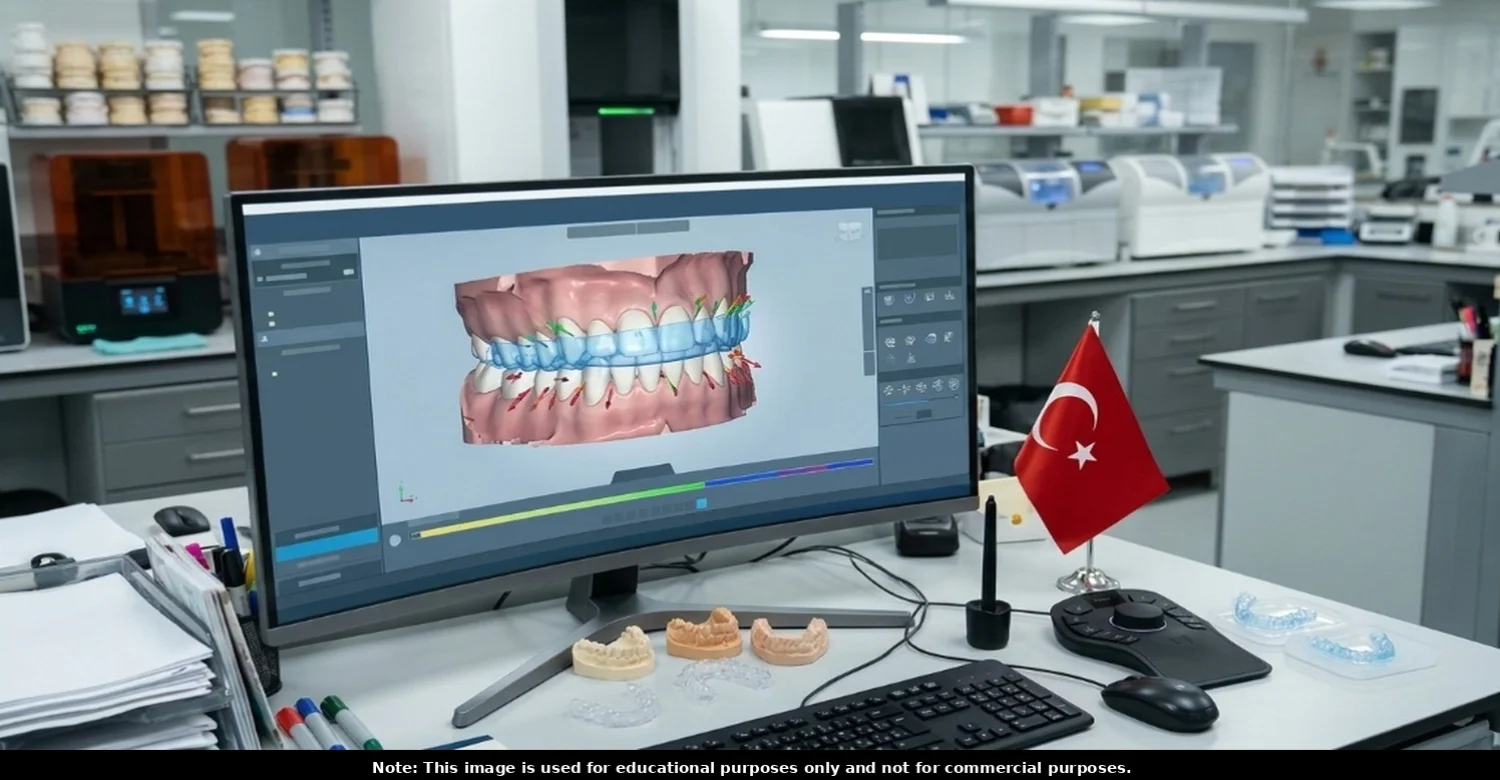
Invisalign for overbite Turkey planning should distinguish dental movement from skeletal correction. ClinCheck simulations can help the orthodontist plan proposed movements and show an estimated sequence. They are planning tools, not a promise of the final clinical result.
What Happens During Treatment in Istanbul?
The Invisalign for overbite Turkey pathway usually includes assessment, digital planning, aligner delivery, monitoring, refinements when needed, and retention.
1. Examination and Treatment Planning
The orthodontist reviews dental history, examines the bite, and checks the health of the teeth and supporting tissues. Any untreated dental or periodontal conditions may need attention first.
2. Digital Scanning and ClinCheck Review
Digital scans record the teeth and dental arches. The orthodontist reviews the proposed ClinCheck movements, attachments, and any use of elastics before approving the plan. The simulation supports clinical planning; actual tooth movement can differ.
3. Wearing Custom Aligners
Each aligner applies controlled pressure to selected teeth. Most treatment plans require aligners to be worn for approximately 20–22 hours daily, removing them for meals, drinks other than plain water, and oral hygiene.
Following the prescribed sequence is important. Patients should not move ahead to another aligner or change the schedule without professional advice.
4. Monitoring and Refinements
Review appointments allow the orthodontist to check fit, tooth movement, and bite changes. Some patients need refinement aligners if certain teeth do not track as expected.
Before starting Invisalign for overbite Turkey, ask how reviews will be arranged, whether refinements are included, and whether additional visits or scans could be necessary.
5. Retainers After Active Treatment
Retainers help maintain the corrected tooth positions after active aligner treatment. The orthodontist should explain the recommended wear schedule and long-term review arrangements. Retention is an essential part of treatment, not an optional finishing step.
How Long Does Treatment Usually Take?
For Invisalign for overbite Turkey, treatment duration depends on the starting bite, the movements required, aligner wear, biological response, and whether refinements are needed. Broad planning estimates may be:
Mild cases: around 6–12 months.
Moderate cases: around 12–18 months.
More complex cases: around 18–24 months or longer.
These ranges are not guaranteed. A case involving skeletal jaw relationships may need a different approach rather than simply a longer aligner course.
Most patients are instructed to wear aligners for 20–22 hours per day. Inconsistent wear can affect tracking and extend treatment. The orthodontist can provide a more useful estimate after reviewing clinical records and the proposed movements.
.webp)
What Results Can You Realistically Expect?
For suitable cases, treatment may reduce excessive vertical overlap, improve tooth alignment, and coordinate the dental arches. The amount of correction depends on the diagnosis and the movements that can be achieved safely.
Before-and-after photographs can illustrate visible changes, but they cannot prove that the bite has been fully corrected. Clinical examination and bite records are needed to assess function and tooth contacts. Individual results cannot be guaranteed.
Patients considering Invisalign for overbite Turkey should ask to see relevant, consented clinical examples where available. They should also ask what the photographs show, how long treatment took, and whether refinements or retainers were part of the case.
Invisalign or Braces: Which Option May Be More Appropriate?
Both clear aligners and fixed braces can treat selected dental overbites in patients comparing Invisalign for overbite Turkey with other options. The choice depends on the required movements, complexity, oral health, and the patient's ability to follow the treatment instructions.
Consideration | Clear aligners | Fixed braces |
Appearance | Clear and less noticeable | More visible |
Removability | Removed for meals and cleaning | Remain fixed |
Oral hygiene | Easier appliance removal | Requires careful cleaning around brackets |
Daily responsibility | Requires consistent wear | Less dependent on patient wear time |
Complex movements | Suitable for selected cases | May offer greater control for some movements |
Ready to transform your smile?
Talk to our team and get a personal FREE treatment plan.
How Much Does Invisalign for an Overbite Cost in Turkey?
The price of Invisalign for overbite Turkey depends on treatment complexity, the aligner package, provider fees, monitoring, and what is included in the quotation.
Indicative market estimates sometimes place comprehensive treatment within these broad ranges:
United Kingdom
Indicative Cost: 2,900–5,500
Indicative cost
Indicative cost: $2,900–$5,500
Private UK clinic standard rate
Domestic specialist treatment plan
Turkey
Indicative Cost: 2,350–5,200
Indicative cost
Indicative cost: 2,350–5,200
High savings vs. international rates
Comprehensive full-service clinic care
United States
Indicative Cost: 3,500–8,000
Indicative cost
Indicative cost: 3,500–8,000
US private clinic standard rate
Domestic treatment standard
What Can Change the Final Price?
The total may depend on:
The complexity of the bite and required tooth movements.
The number of aligners and treatment duration.
Attachments, elastics, and additional diagnostic records.
Monitoring appointments and refinement aligners.
Retainers and post-treatment reviews.
A lower starting price may not include every stage. Ask for a written, itemised estimate rather than relying on an advertised headline price.
What Should a Treatment Package Include?
Before booking, check whether the quotation covers the examination, scans, indicated X-rays, aligners, attachments, progress reviews, refinements, and retainers. Also clarify the cost of extra appointments, replacement aligners, or additional scans.
Invisalign for overbite Turkey should be compared on the full treatment scope and clinical supervision, not price alone.
What Should International Patients Arrange Before Travelling?
Choosing Invisalign for overbite Turkey as an international patient requires planning beyond the first appointment. Before travelling to Istanbul, share available dental records for a preliminary review and ask what further assessment will be required in person. A remote review cannot confirm final suitability or replace a clinical examination.
Before committing, clarify:
Whether the clinic has reviewed your available records.
How many in-person appointments may be needed during the visit.
The expected treatment stages and estimated duration.
Which costs are included and which may arise separately.
How progress will be monitored after you return home.
How urgent concerns, poor-fitting aligners, or lost aligners will be handled.
Allow enough time for the required clinical appointments. Do not book flights around an assumed same-day treatment start before the clinic confirms the necessary steps.
Ready to transform your smile?
Talk to our team and get a personal FREE treatment plan.
How Does Follow-up Work After You Return Home?
Aligner treatment usually continues for months after the initial visit. Patients and the clinic should agree on communication and review arrangements before travel.
After returning home, patients follow the prescribed aligner schedule and report concerns such as poor fit, unexpected discomfort, or changes in the bite. Remote communication can support coordination, but it cannot replace an examination when one is clinically necessary.
What If You Need Refinements?
Some patients need additional aligners because teeth do not follow the original plan exactly. Ask whether new scans are required, how refinement aligners will be supplied, and whether another visit to Istanbul may be necessary.
The written treatment agreement should explain who reviews the case, what refinement stages are included, and whether extra costs may apply. This is particularly important for patients who live abroad.
What Are the Possible Side Effects?
Temporary pressure or tenderness is common when starting treatment or changing to a new aligner. Some patients notice mild gum, cheek, or tongue irritation, or a temporary speech change.
The way the teeth meet may also feel different during active movement. The orthodontist should monitor bite changes and check that treatment is progressing as intended.
Contact the treatment team if you experience persistent or severe pain, significant swelling or bleeding, a cracked aligner, poor fit, or worsening difficulty chewing. Severe facial swelling or difficulty breathing or swallowing requires urgent medical attention.
How Can You Care for Your Aligners?
Remove aligners before eating and before drinking anything other than plain water. Hot drinks can distort the plastic, while coloured drinks may stain it. Clean your teeth before putting aligners back in to reduce the risk of trapping food and plaque.
Clean aligners according to the manufacturer's instructions and avoid hot water. Store them in their protective case whenever they are not being worn.
If an aligner breaks or stops fitting, do not force it or independently skip several stages. Contact the orthodontist for instructions about the next step.
What Matters Clinically When Correcting an Overbite?
Two patients with a similar-looking overbite may need different treatment. One may have excessive eruption or positioning of the front teeth; another may have a jaw relationship that limits dental correction.
The orthodontist therefore considers tooth position, jaw relationships, gum health, supporting bone, and bite function together. Straightening teeth does not necessarily correct an underlying skeletal discrepancy.
Clinical Perspective: Dr Sami Assani
Dr Sami Assani's clinical review should focus on identifying the cause of the overbite, assessing whether the planned movements are achievable, and explaining realistic treatment limits. The decision should be based on examination findings rather than appearance alone.
Editorial note: This clinical perspective must be reviewed and approved by Dr Sami Assani before publication. It is not a direct quotation.
Precision You Can See: Award Winning Invisalign at Vitrin Clinic
With Invisalign, small details make a big difference. Each aligner moves your teeth a fraction of a millimeter, so the accuracy of every planned step shapes your final smile. At Vitrin Clinic, that precision comes from one of the region’s most recognized Invisalign doctors.
Dr. Sami Assani has received the Invisalign Apex Award 2026–2027. The award honors the top 1% of Invisalign providers across Europe, the Middle East, and Africa. Here’s what supports that level of precision:
500+ Invisalign cases: experience that helps anticipate how teeth will respond and plan each movement with care.
Blue Diamond Provider status: Invisalign’s highest tier, held by only 75 doctors in EMEA and just 32 in Türkiye.
The Invisalign Apex Award: recognition among the top 1% of providers in the EMEA region.
For you, precision means a treatment plan you can trust and progress that stays on course. Most of all, it means a final result that matches the smile you were promised.
.jpg)
How Vitrin Clinic Plans Invisalign Treatment in Istanbul
At Vitrin Clinic, Invisalign for overbite Turkey planning follows a structured, step-by-step process:
Step 1: Initial Clinical Examination
The dental team examines tooth alignment, bite relationships, jaw position, and gum health. This helps determine whether Invisalign is suitable for the patient's condition.
Step 2: Digital Scanning and Imaging
Digital scans and dental X-rays are taken when clinically indicated. These records help assess tooth positions and supporting structures.
Step 3: Personalised Treatment Planning
The orthodontist reviews the clinical records and proposed tooth movements. ClinCheck is used as a planning aid to visualise the proposed stages of Invisalign treatment.
Step 4: Treatment Explanation and Cost Estimate
Patients receive an explanation of the proposed treatment stages, expected monitoring, possible limitations, and estimated costs. The written estimate should clarify refinements, retainers, included services, and potential additional charges.
Step 5: International Patient Coordination
For international patients, appointment scheduling, travel arrangements, and follow-up plans are discussed before arrival. The team also explains how monitoring can continue after patients return home.
Step 6: Suitability and Alternative Options
If Invisalign cannot adequately address the diagnosed bite problem, alternative orthodontic treatments may be discussed.
Choosing Invisalign for overbite Turkey should involve an accurate diagnosis, realistic expectations, transparent costs, and a practical follow-up plan.
Conclusion: Is Invisalign for Overbite Turkey Right for You?
Clear aligners may be suitable for selected dental overbites, but they cannot correct every bite problem. The decision depends on the cause of the overlap, the required tooth movements, and whether the jaw relationship allows predictable orthodontic correction.
Compare the full treatment cost, monitoring arrangements, refinements, and retention plan before making travel decisions. At Vitrin Clinic, an individual assessment helps establish which options may be appropriate.
Request your FREE Digital Treatment Plan to discuss your records and the next steps for an in-person evaluation.
Ready to transform your smile?
Talk to our team and get a personal FREE treatment plan.
Reference
FAQs
It can correct selected dental deep bites in adults. Suitability depends on the amount of overlap, tooth positions, gum health, and jaw relationships. Significant skeletal discrepancies may require another orthodontic approach.
Dr. Sami Assani leads clear aligner treatment at Vitrin Clinic. He is an Invisalign Apex Award recipient (top 1% of providers in EMEA) and a Blue Diamond provider with 500+ completed Invisalign cases. He is known for precise digital planning and long-term, stable results.


