Can Bone Grafting Be Done at the Same Time as Dental Implant Placement?
Yes, a bone graft and dental implant at the same time is often possible. It works when there's enough bone to hold the implant firmly in the right position, and the missing bone around it is small and well contained. When the bone loss is larger, the graft is placed first and the implant follows once it has healed.

Yes, a bone graft and dental implant at the same time is often possible. It works when there's enough bone to hold the implant firmly in the right position, and the missing bone around it is small and well contained. When the bone loss is larger, the graft is placed first and the implant follows once it has healed.
At Vitrin Clinic, the online consultation is free and no-obligation, with a written plan and fixed price before you travel.
This guide explains when grafting can be combined with an implant, when it should come first, which techniques are used, what recovery looks like and how many trips to Istanbul you may need.
Key Takeaways
A graft and an implant can often be placed in one surgery when the implant is stable and the bone defect is small.
Large width loss, most height loss and active infection usually mean grafting first.
A 3D (CBCT) scan shows the shape of the defect, which largely decides one stage or two.
The implant usually needs several months to heal before the final crown, even with one surgery.
Short or narrow implants and tilted implants can sometimes avoid a graft.
At Vitrin Clinic, you can start with a free online review and receive a written plan with a fixed, all-inclusive price before you book flights.
Prices from $150 per crown
Six E.max front crowns from
$1,080
Timescale
5 to 7 days
Hotel + transfers available
Airport-Hotel-Clinic
coordination included
Ready to transform your smile?
Talk to our team and get your Free Treatment plan.
What Decides a Bone Graft and Dental Implant at the Same Time?
The size and shape of the bone defect decide it. Small gaps, thin walls or exposed implant threads can usually be grafted during the implant surgery. Larger defects, height loss or infection often mean grafting first. The implant must also sit firmly in your own bone on the day, which a 3D scan helps confirm.
What Does a Simultaneous Bone Graft Implant Procedure Mean?
It means one surgical appointment. The implant is placed, and graft material is added around it to rebuild missing bone, usually covered by a protective membrane. It doesn't mean same-day teeth: the implant and graft still need months to heal before the crown.
What Is the Difference Between Simultaneous and Staged Bone Grafting?
Simultaneous (one-stage): the graft and the implant go in during the same surgery.
Staged (two-stage): the bone is grafted first. The implant is placed in a second surgery once the graft has turned into bone.
Why Do Some Implants Need Bone Augmentation During Surgery?
An implant needs bone all around it to stay healthy and stable. If part of the implant would sit outside the bone, or the bone wall is very thin, extra bone is added to cover and protect it.
What Happens to the Jawbone After Tooth Loss?
Once a tooth is removed, the bone that held it starts to shrink, because it's no longer stimulated by the tooth root. Most of this shrinkage happens in the first months, and the ridge usually loses width faster than height.
Why Does Bone Width vs Bone Height Matter?
Width loss leaves a ridge that's too narrow, while height loss leaves it too short. Width defects are often easier to rebuild during implant surgery. Height defects are harder to rebuild and are more often grafted in a separate step.
What Are Dehiscence and Fenestration Defects?
A dehiscence is when part of the implant surface is exposed along the top edge of the ridge. A fenestration is a small window where the implant shows through the side wall, with bone still above it. Both are common reasons for grafting during implant surgery.
When Is a Bone Graft During Implant Surgery Possible?
It's usually possible when five conditions are met. At Vitrin Clinic, each one is checked at your exam and 3D scan in Istanbul before treatment starts.
Your dream smile, expertly crafted at Vetern Clinic.:
.jpg)
Is There Enough Bone to Hold the Implant Firmly?
The implant must be stable in your own bone on the day it's placed. The graft only fills the gaps around it and can't hold the implant in place by itself.
How Do the Size and Shape of the Bone Defect Matter?
Small defects with bone walls around them, like a shallow gap or a few exposed threads, heal well with a graft placed at the same time. Wide, open or deep defects are harder to rebuild in one step.
Can the Implant Be Placed in the Right Position for the Bite?
The implant has to be placed where the final crown needs it, not just where the bone happens to be. If that ideal position would leave too much of the implant outside the bone, grafting first is often the better choice.
Do Gum Thickness and Soft Tissue Health Affect the Plan?
Yes. The gum must cover and protect the graft while it heals. Thin or inflamed gums raise the risk of the graft becoming exposed, so gum problems are usually treated first.
Which Health Factors Affect Bone Healing?
smoking
uncontrolled diabetes
some bone-strengthening or cancer medicines
past radiation treatment to the jaw
active gum disease or poor oral hygiene
Medical note: These factors don't always rule out grafting, but they can slow healing and raise the risk of graft or implant failure. Share your full medical history and medicine list before surgery.
When Should Jawbone Grafting Be Done Before the Implant?
Grafting first is usually the safer choice when the bone can't hold the implant firmly or needs time to heal. In these cases, the jawbone is rebuilt in one surgery, left to heal for several months, and the implant is placed once the new bone is solid. It adds a step and some time, but it gives the implant a stronger foundation. The three most common situations are severe width loss, height loss and active infection.
What If You Have Severe Horizontal Bone Loss?
When the ridge is too narrow to hold an implant firmly, the bone is widened first. The implant is placed months later, once the new bone is solid.
Can Vertical Bone Loss Be Grafted at the Same Time?
Sometimes, but usually not. Rebuilding lost height is one of the most demanding grafting procedures, so it's more often done as a separate step.
Can You Graft and Place an Implant With an Active Infection?
No. An active infection, such as an abscess, swelling or pus around a tooth or implant site, is treated first. Graft material and a new implant need a clean, healthy site to bond to the bone, and infection can cause both to fail. The tooth is usually removed, the area cleaned and sometimes antibiotics prescribed, and the site is left to heal for several weeks before grafting and implant placement go ahead.
How Do Dentists Decide Between One and Two Stages?
The decision is based on 3D measurements, digital planning and, sometimes, what the surgeon sees during surgery.
What Does a CBCT Scan Show About Your Bone?
A CBCT scan is a 3D X-ray that shows the height, width and shape of the bone at each implant site, plus nearby nerves and sinuses. A regular 2D X-ray can't show bone width.
How Does Digital and Guided Implant Planning Help?
The scan can be used to plan the implant's exact position on a computer, around the future crown. In some cases, a printed surgical guide then helps place the implant where it was planned.
Why Is the Final Decision Sometimes Made During Surgery?
The scan shows the bone shape, but not exactly how firm the bone feels. If the implant isn't stable enough when it's placed, the surgeon may graft the site only and return for the implant later.
Medical note: Ask before surgery what will happen if the plan changes during the operation, so you know both possibilities in advance.
Which Bone Augmentation Techniques Can Be Done With the Implant?
Four techniques are commonly combined with implant placement. The choice depends on where bone is missing and how much.
What Is Guided Bone Regeneration (GBR)?
GBR is the most common way to graft during implant surgery. Graft material is packed over the thin or exposed area, then covered with a membrane that keeps the gum out while new bone grows. It's well suited to dehiscence and fenestration defects.
Can a Socket Be Grafted When an Implant Is Placed Right After Extraction?
Yes. When an implant goes into a fresh extraction socket, there's often a gap between the implant and the socket walls. That gap can be filled with graft material in the same surgery to support the bone and gum.
What Is Ridge Splitting and Expansion?
If the ridge is tall enough but too narrow, the bone can be gently split and widened along its length. The implant is placed in the widened space, and graft material fills the gaps. This works best where the bone is soft enough to expand.
Can a Sinus Lift Be Done With Implant Placement?
Yes, for upper back teeth. When height is missing under the sinus, the sinus floor can be raised and the implant placed in the same surgery if it's stable. This is covered in detail in our guide to sinus lifts with implants.
How Do the Techniques Compare for Same-Surgery Grafting?
Technique | Best for | Main limitation |
Guided bone regeneration | Small width defects, exposed threads | Needs a stable implant; membrane exposure risk |
Socket grafting with immediate implant | Gaps around an implant in a fresh socket | Needs healthy, infection-free socket walls |
Ridge splitting and expansion | Narrow ridges with good height | Not suitable for very hard or very thin bone |
Sinus lift with implant | Missing height under the upper sinus | Needs enough bone to hold the implant |
What Happens During Implant Surgery With a Bone Graft?
The combined surgery is usually done under local anaesthesia in one appointment, so you're awake but the area is fully numb. The implant is placed first, then graft material is added wherever bone is thin or missing and covered to protect it while it heals. For a single implant, the appointment often takes about one to two hours, depending on how much grafting is needed. Here's what happens before, during and right after surgery.
How Do You Prepare Before Surgery?
An exam and CBCT scan to plan the implant and graft
A review of your medicines, especially blood thinners and bone medicines
Treatment of any gum disease or infection first
Stopping or cutting down smoking before and after surgery
Any antibiotics or mouth rinses your dentist prescribes
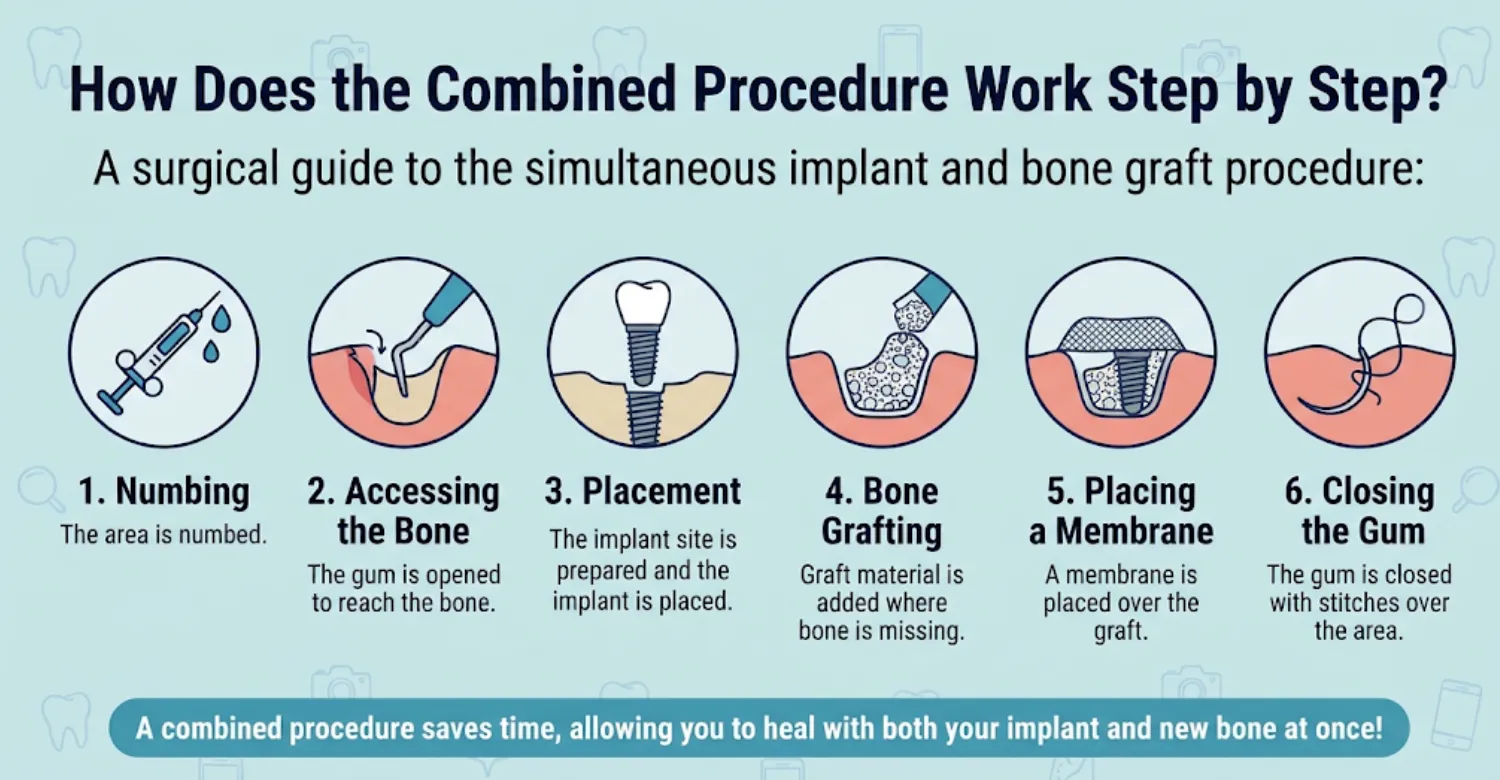
How Does the Combined Procedure Work Step by Step?
Combining a bone graft with dental implant placement streamlines your treatment into a single visit. Here is a simple, step-by-step look at what happens during the procedure so you know exactly what to expect:
What Types of Bone Grafts Are Used With Dental Implants?
There are three main types of bone graft used with implants. Your dentist chooses based on the size of the defect, where it is and your medical history.
Autograft (your own bone): Bone taken from another area of your mouth, often the back of the jaw or the chin. It contains your own living bone cells, so it heals well, but it adds a second small surgical site.
Allograft (donor bone): Human bone from a tissue bank that has been cleaned, processed and sterilized. It avoids a second surgical site in your mouth.
Alloplast (synthetic bone): Lab-made bone substitutes, such as calcium phosphate materials. They give your body a framework for new bone to grow into.
Over several months, the graft is gradually replaced by your own bone.
Which Membranes Are Used Over a Bone Graft?
A membrane covers the graft and keeps the gum out while new bone grows. Resorbable membranes dissolve on their own, while non-resorbable membranes need to be removed later. Your dentist chooses the type based on the size and shape of the defect.
Is a Bone Graft With an Implant Painful?
You should feel pressure rather than pain during surgery. Afterwards, soreness and swelling for a few days are common and usually controlled with pain relief. Using your own bone adds a second small surgical site, which can mean a little more discomfort.
How Long Does Healing Take After an Implant With a Bone Graft?
Most people feel back to normal within one to two weeks. The implant and graft then need several months, often around 4 to 6, before the final crown, and larger grafts can take longer.
At Vitrin Clinic, you leave with aftercare instructions, and our team continues follow-ups with you from home during these months.
What Happens in the First Two Weeks?
Swelling, bruising and mild pain are common for a few days. Stitches are usually removed after one to two weeks.
Eat soft foods and avoid chewing on the surgery side.
Don't press on the area with your tongue or a denture.
Avoid smoking and strenuous exercise.
Keep the area clean exactly as instructed.
How Long After a Bone Graft Can You Get an Implant?
In a staged plan, the implant is usually placed once the graft has turned into solid bone, often after several months. Larger grafts, especially height grafts, usually need longer. A new scan confirms the bone is ready.
When Can the Final Crown Be Placed?
The crown is fitted once your dentist confirms that the implant is firmly bonded to the bone, checked with an exam and an X-ray. A digital scan or impression is then taken and your crown is made.
Which Signs Need a Dentist's Attention?
Contact your dentist promptly if you notice:
swelling or pain that gets worse after the third day
fever or pus
graft granules coming out in large amounts, or a membrane showing through the gum
an implant that feels loose
How Many Trips to Turkey Do You Need for an Implant With a Bone Graft?
A one-stage treatment usually needs two trips, and a staged treatment usually needs three:
One-stage: trip 1 for the exam, scan, implant and graft; trip 2 for the final crown after healing.
Two-stage: trip 1 for the bone graft; trip 2 for the implant; trip 3 for the final crown.
With Vitrin Clinic, your expected trips are set out in your written plan with a fixed, all-inclusive price. For each visit, our team books your hotel and arranges your airport, hotel and clinic transfers.
What Are the Benefits and Limitations of Grafting at the Same Time?
Having a bone graft and dental implant at the same time saves a surgery and months of treatment time. However, it only works when the defect is small enough.
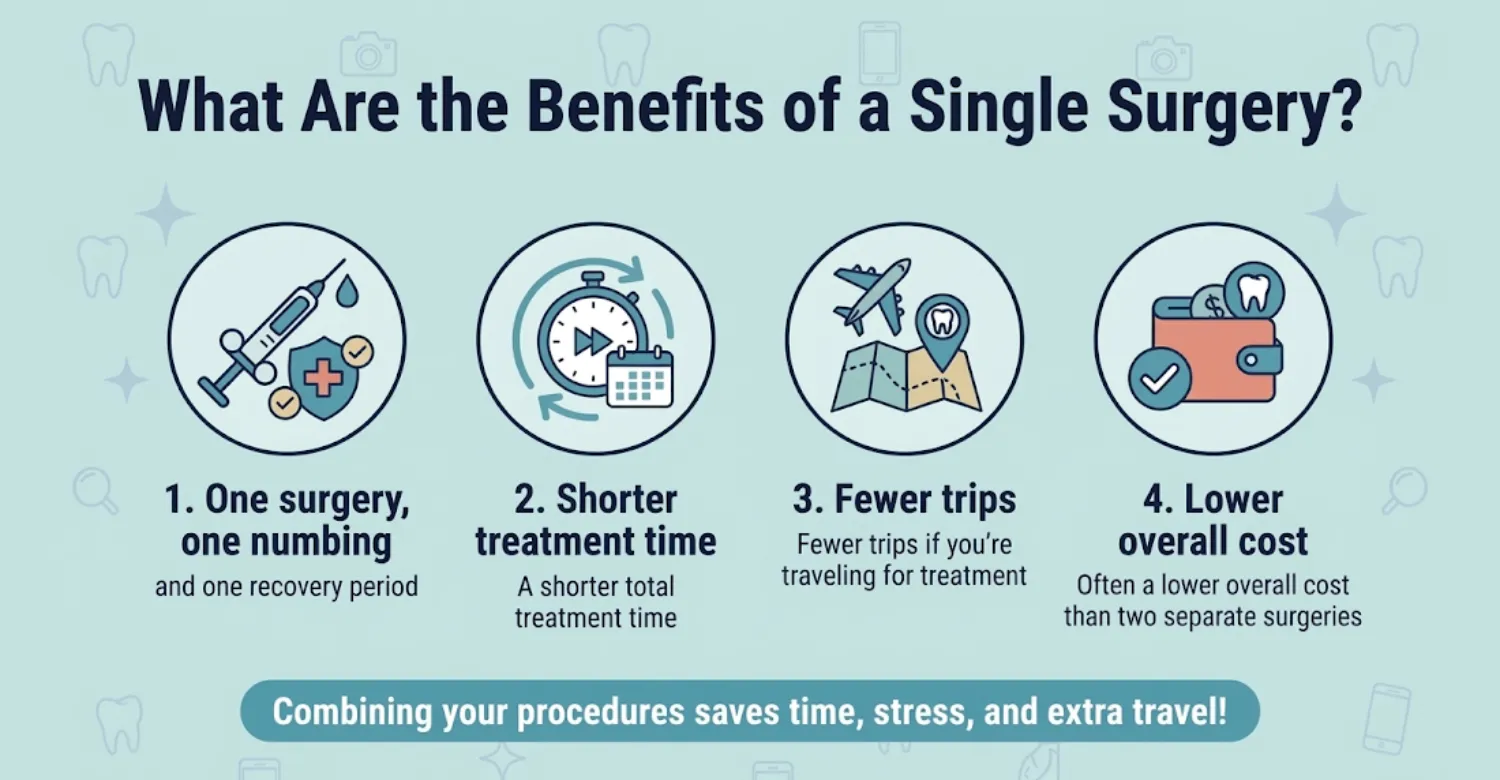
What Are the Benefits of a Single Surgery?
Choosing a single combined procedure instead of two separate surgeries makes your treatment journey smoother and more efficient. Take a look at the key benefits below:
What Are the Limitations and Possible Complications?
It only works when the implant is stable and the defect is limited.
The plan may change during surgery if the bone is weaker than expected.
Possible complications include membrane or graft exposure, infection, partial graft loss and implant failure.
Are There Alternatives That Avoid a Bone Graft?
Sometimes. Implant design or angle can make use of the bone you already have.
At Vitrin Clinic, subperiosteal implants are another option for patients with low bone volume, with no grafting needed. Which option suits you is discussed after your 3D scan.
Can Short or Narrow Implants Avoid a Graft?
In some cases, yes. Shorter implants can fit where height is limited, and narrower implants where width is limited. They suit certain sites and bite forces, and aren't right for every tooth.
Can Tilted Implants or a Full Arch on Four Implants Avoid a Graft?
For patients missing all teeth in a jaw, implants can be angled to reach denser bone and avoid weak areas. A full arch of teeth on four implants uses this idea and can often avoid major grafting.
What Does the Research Say About Simultaneous Bone Grafting?
Systematic reviews report that implants placed with lateral bone grafting, such as guided bone regeneration, have high survival rates, similar to implants placed in bone that didn't need grafting. Guided bone regeneration is considered a predictable way to treat dehiscence and fenestration defects at the time of implant placement.
Reviews of clinical trials also found that rebuilding bone height is more demanding and has more complications than rebuilding width. For comparison, standard dental implants show a 10-year survival of about 96% in a large systematic review.
Medical note: Pooled research can't predict one person's result. Your outcome depends on the defect, your health, smoking and how well you follow your aftercare.
How Much Does a Bone Graft With a Dental Implant Cost?
The cost depends on the type and size of the graft, the graft material and membrane, one-stage or two-stage treatment, the number of implants and any extractions or gum treatment needed first.
At Vitrin Clinic, you receive a written plan with a fixed, all-inclusive price before you travel, so you know the total before booking flights.
What Do Patients Often Ask Before Booking?
Will my body reject the bone graft?
Bone grafts aren't rejected the way organ transplants can be. A graft can still fail if it becomes infected, exposed or moves before it heals, which is why aftercare matters so much.
One dentist says I need a graft and another says I don't. Who's right?
Both may be partly right, because the answer depends on the exact implant size and position each one plans. Ask to see your 3D scan measurements and the planned implant position. A plan based on a CBCT scan is more reliable than one based on a 2D X-ray.
Can I wear my denture after a bone graft?
Often not straight away. A denture pressing on a fresh graft can disturb healing, so it may need adjusting or leaving out for a while. Ask your dentist before you travel.
Can my local dentist check my healing once I'm home?
Yes, a local dentist can check your gums and stitches. At Vitrin Clinic, our team also continues aftercare and follow-ups with you from home.
Do You Need One Surgery or Two for Your Implant and Graft?
Is your implant stable and the bone defect small? Then a bone graft and dental implant at the same time is often possible. If the bone loss is wide, vertical or infected, grafting first is usually safer, even though it adds time and a trip. Your 3D scan is what decides.
At Vitrin Clinic, you can start with a free online review and receive a written plan with a fixed, all-inclusive price before you travel.
What Else Do Patients Ask About Bone Grafts and Implants?
Beyond eligibility, healing and trips, patients often have a few quick questions about how a bone graft fits into daily life and their health. Here are short answers to the questions that come up most, from scars and eating afterward to how to start your free online review with Vitrin Clinic.
Can a failed bone graft be redone?
Yes, in most cases. A failed graft usually shows up as infection, exposed graft material or bone that didn't form as planned. The area is cleaned and left to heal for a few months, then a new scan shows how much bone remains. The graft can then be repeated, sometimes with a different technique or material, or an option such as a shorter implant may be considered.
Does a bone graft leave a scar?
No, not on your face. The surgery is done inside the mouth, and the gum is stitched closed over the graft. It usually heals within a couple of weeks, leaving at most a faint line on the gum. If your own bone is taken from another area in the mouth, that site also heals under the gum, while donor, animal-derived or synthetic grafts avoid a second site altogether.
Can I get a bone graft if I have osteoporosis?
Often, yes. Osteoporosis alone doesn't usually rule out a bone graft or implant. What matters more is your medication, because some bone-strengthening drugs, especially when given as injections or taken for many years, can affect how the jaw heals. Tell your dentist which medicines you take, in what form and for how long, so your plan can take them into account.
Do front teeth implants need bone grafts more often?
Often, yes. The bone over the roots of the front teeth is naturally thin, and it tends to shrink quickly after a tooth is lost. Even a small loss can show as a dip in the gum or a tooth that looks longer than its neighbours. Grafting rebuilds that contour, so the gum around the implant looks natural when you smile.
When can I eat normally after an implant with a bone graft?
Most people return to a normal diet gradually over one to two weeks. For the first few days, stick to soft, lukewarm foods such as soups, eggs and yogurt, and chew on the other side. Avoid crunchy, hard or sticky foods on the treated side until your dentist confirms the gum has healed, because pressure can disturb the graft.
Will I need antibiotics after a bone graft?
Antibiotics are often prescribed around grafting surgery to lower the risk of infection, because graft material needs a clean site to heal. An antiseptic mouth rinse may also be recommended for the first days. Take every dose exactly as instructed, and tell your dentist about any allergies or medicines you already take before surgery.
How do I start a free online review with Vitrin Clinic?
Send Vitrin Clinic your photos, dental history and any X-rays or 3D scans you already have. Our dentists review your case free of charge and with no obligation, and tell you whether a graft is likely to be needed. You then receive a written plan with the treatments, the timeline and a fixed, all-inclusive price, so you can decide before booking anything.
Does This Article Replace a Dental Exam?
No. This article is for general education only and doesn't replace a personal assessment by a qualified dentist. Every jaw, bone defect and medical history is different. Whether a graft and implant can be combined, and your timeline and cost, can only be confirmed after a clinical exam and a 3D scan. If you have pain, swelling or signs of infection, see a dentist promptly.
Which Treatments Does Vitrin Clinic Provide?
At Vitrin Clinic, your implant plan depends on how many teeth you're missing and how much bone is left to support them. Our implant options include:
Single tooth implants
Multiple implants and implant-supported bridges
All-on-4 and All-on-6 full-arch implants
Same-day (immediate) implants
Implants combined with a bone graft or sinus lift
Zygomatic implants for severe upper jaw bone loss
Subperiosteal implants for low bone volume, with no grafting needed
What to send: a panoramic X-ray or CBCT scan, photos of your smile and which teeth are missing.
Learn more about dental implants at Vitrin Clinic.
Why Choose Vitrin Clinic for an Implant With a Bone Graft?
At Vitrin Clinic, the online consultation is free and no-obligation. You send photos, your dental history and any X-rays or 3D scans, and our dentists review your case. A personalized treatment plan is sent in less than 24 hours.
Your written plan includes the treatments, the timeline and a fixed, all-inclusive price before you travel. Our team books your hotel and arranges your transfers, and aftercare continues once you're home. Vitrin Clinic has been treating patients in Istanbul since 2007.
What Is the Patient Journey at Vitrin Clinic?
Step 1: How Does the Online Review of Your X-Rays and Photos Work?
You send your photos, dental history and any X-rays, and our dentists review your case.
Step 2: What Happens at the CBCT Scan and Bone Assessment in Istanbul?
After a transfer from your hotel, you have an exam and a 3D scan of your bone at our clinic.
Step 3: How Is One-Stage or Two-Stage Treatment Chosen?
The scan results confirm whether your graft and implant can be combined, as described in your plan.
Step 4: What Happens at Implant Placement With Bone Augmentation?
Treatment follows your confirmed plan, and you leave with aftercare instructions.
Step 5: How Do Healing and Follow-Up From Home Work?
Our team stays in touch for follow-ups while your implant and graft heal.
Step 6: When Is the Final Crown Placed?
Once the implant has healed, you return for your final crown, as set out in your plan.






Sources

Medically reviewed by
Dr. Rifat AlsamanDr. Rifat Alsaman has more than 5 years of clinical experience in dentistry and currently serves as the Head of the Medical Team at Vitrin Clinic. He is dedicated to providing exceptional patient care, overseeing treatment planning, and ensuring the highest clinical standards across the team. His expertise, attention to detail, and commitment to continuous professional development have helped countless patients achieve healthier, more confident smiles.
More in Dental Treatments
View all 33 min readCBCT Scan for Dental Implants in Turkey: How Does Vitrin Clinic Use 3D Imaging?A CBCT scan for dental implants provides detailed three-dimensional images of the jawbone and surrounding anatomical structures. It helps dentists examine bone dimensions, locate important nerves, and evaluate the maxillary sinuses.
 19 min readIs It Possible to Get Dental Implants If I Smoke?Dental implants for smokers are possible in many cases. Yes, you can usually get dental implants if you smoke. Smoking does not automatically rule you out of treatment.
 18 min readCan I Get Dental Implants in Turkey If I Have Gum Disease?Dental implants with gum disease are possible for many patients, but timing matters. Many people with a history of gum disease can get implants, provided the condition is treated and stabilized first.
 47 min readWhat Makes You Eligible for Immediate Dental Implants?Immediate dental implant eligibility depends on bone availability, gum health, infection control, and initial implant stability.
Still have a question?
Our patient coordinators answer every day of the week: before, during and long after your treatment.