Is Replacing Failed Dental Implant Treatment Possible?
Yes, replacing failed dental implant treatment is possible in most cases. The failed implant is removed, the bone is allowed to heal or is rebuilt, and a new implant is placed once the site is ready. Studies show that most replacement implants survive well when the cause of the first failure is found and treated.

Yes, replacing failed dental implant treatment is possible in most cases. The failed implant is removed, the bone is allowed to heal or is rebuilt, and a new implant is placed once the site is ready. Studies show that most replacement implants survive well when the cause of the first failure is found and treated.
At Vitrin Clinic, a free 3D scan checks your bone and the cause of failure before any replacement implant is planned.
Key Takeaways
Most failed implants can be removed and replaced with a new one.
Finding the cause of failure is the most important step before a second implant.
The bone may need healing time or grafting before the new implant goes in.
Replacement implants have high survival rates, though slightly lower than first implants.
Good planning, healthy gums and regular check-up's lower the risk of another failure.
Prices from $150 per crown
Six E.max front crowns from
$1,080
Timescale
5 to 7 days
Hotel + transfers available
Airport-Hotel-Clinic
coordination included
Ready to transform your smile?
Talk to our team and get your Free Treatment plan.
When Can a Failed Implant Be Replaced?
A failed implant can be replaced once the cause of failure is treated and there is enough healthy bone to hold a new one. Replacing failed dental implant treatment usually follows five steps:
Finding the cause of the failure.
Removing the failed implant gently.
Healing or rebuilding the bone.
Placing the new implant in a planned position.
Fitting the final crown once the bone has healed.
The 5 steps of replacing a failed dental implant: find the cause, remove the failed implant, heal or rebuild the bone, place the new implant and fit the final crown.
Can a Dental Implant Be Redone If It Fails?
Yes, a dental implant can usually be redone if it fails. Research shows that around 86% to 89% of implants placed in a site with one previous failure survive. Success is best when the reason for the first failure is understood and corrected.
If a Dental Implant Fails, Can It Be Replaced Right Away?
Sometimes, but not always. If the bone is healthy and there is no infection, a new implant may be placed soon after removal. If there is infection or bone loss, the site usually needs a few months to heal, or a bone graft first.
Can Dental Implants Be Removed and Replaced Years Later?
Yes, dental implants can be removed and replaced years later, for example after gum infection, bone loss or a broken implant. The new implant may need a different size, angle or position than the original. Your dentist will also check whether the old crown design played a part in the failure.
What Is Implant Revision?
Implant revision means correcting a problem with an existing implant or replacing it. It can include treating gum infection, changing the crown or removing the implant and placing a new one. The goal is a stable, healthy implant that lasts.
Why Do Dental Implants Fail?
Dental implants fail when the bone does not bond to the implant, or when that bond breaks down later. Understanding why the first implant failed is the key to replacing failed dental implant treatment successfully.
How Common Is a Failed Dental Implant?
A failed dental implant is uncommon. Large studies report overall failure rates of around 2% to 4%. Early failures are much more common than late ones, and most implants last for many years.
Ready to see our latest Vitrin Clinic before & after success story?
.jpg)
.jpg)
.jpg)
What Are the Main Implant Failure Causes?
The main implant failure causes are different for early and late failures:
Early failure: the bone does not bond to the implant, often due to infection, poor bone quality, smoking or too much pressure during healing.
Late failure: the bond breaks down after the implant is in use, most often due to gum infection around the implant.
Mechanical causes: heavy grinding, a poorly fitting crown or a fractured implant.
Planning causes: an implant placed in the wrong position or angle.
How Do Early and Late Implant Failures Compare?
Early and late implant failures differ in timing, cause and how much bone is lost, which changes how the implant is replaced.
Factor | Early Implant Failure | Late Implant Failure |
|---|---|---|
When it happens | In the first months, before the final crown is fitted | After the crown is in use, sometimes years later |
Main cause | The bone does not bond to the implant | Gum infection around the implant, fracture or heavy bite forces |
Bone condition | Usually a small defect that heals well | Often more bone loss around the implant |
Removal | The implant is often loose and easy to remove | May need special tools if still partly bonded |
New implant timing | Often after a short healing period | Usually after bone grafting and longer healing |
Why Do Dental Implants Fail After 10 Years?
Dental implants that fail after 10 years usually fail because of slow bone loss from gum infection around the implant, called peri-implantitis. Grinding, worn crowns and changes in general health can also play a role. Regular check-up's help catch these problems early.
What's the Average Lifespan of a Dental Implant?
The implant itself can last for decades, and many last a lifetime with good care. The crown on top usually needs replacing sooner because it wears with chewing. How long an implant lasts depends on your gums, bite, habits and check-up's.
What Happens When a Dentist Removes a Failed Implant?
When a dentist removes a failed implant, they numb the area, take the implant out gently and clean the site. The goal is to protect as much bone as possible for a future implant.
What Does a Dentist Do If an Implant Fails?
If an implant fails, the dentist first checks why with an exam and X-rays or a 3D scan. These steps usually follow:
Treating any infection around the implant.
Removing the implant if it is loose or cannot be saved.
Cleaning the site and grafting bone if needed.
Planning the timing and position of a new implant.
Can a Dentist Remove a Failed Implant?
Yes, a dentist or oral surgeon can remove a failed implant, usually in a short appointment. It is best done by someone experienced in implant surgery, because careful removal saves bone for a future implant.
How Is Dental Implant Removal Done?
Dental implant removal is done under local anesthesia in most cases. The crown is taken off, then the implant is unscrewed or gently freed from the bone. The site is cleaned, and a bone graft may be placed in the same visit to prepare for a new implant.
Does Removing a Failed Implant Hurt?
Removing a failed implant should not hurt during the procedure because the area is numbed. Afterward, mild soreness and swelling for a few days are common. Over-the-counter pain relief recommended by your dentist is usually enough.
How Is the Bone Prepared for a Second Dental Implant?
The bone is prepared for a second dental implant by letting the site heal and, if needed, rebuilding lost bone. A strong, healthy base gives the new implant the best chance to last.
What Is the Bone Condition After Implant Failure?
The bone condition after implant failure is checked on a 3D scan, which measures the height, width and density of the remaining bone. The shape of the defect matters too, as a defect with bone walls on all sides heals better. Any infection must be fully cleared before replacing failed dental implant treatment.
When Is Bone Grafting Needed Before Failed Implant Replacement?
Bone grafting is needed before failed implant replacement when there is not enough bone height or width to hold a new implant securely. It is common after infection or when the failed implant was in place for many years. The graft may be placed during removal or later.
How Long Should You Wait Before a Second Dental Implant?
The wait before a second dental implant usually follows the healing of each step. The gum heals over the site within a few weeks. If bone grafting is needed, healing usually takes a few months before the new implant goes in.
What Is Involved in a Replacement Implant Assessment?
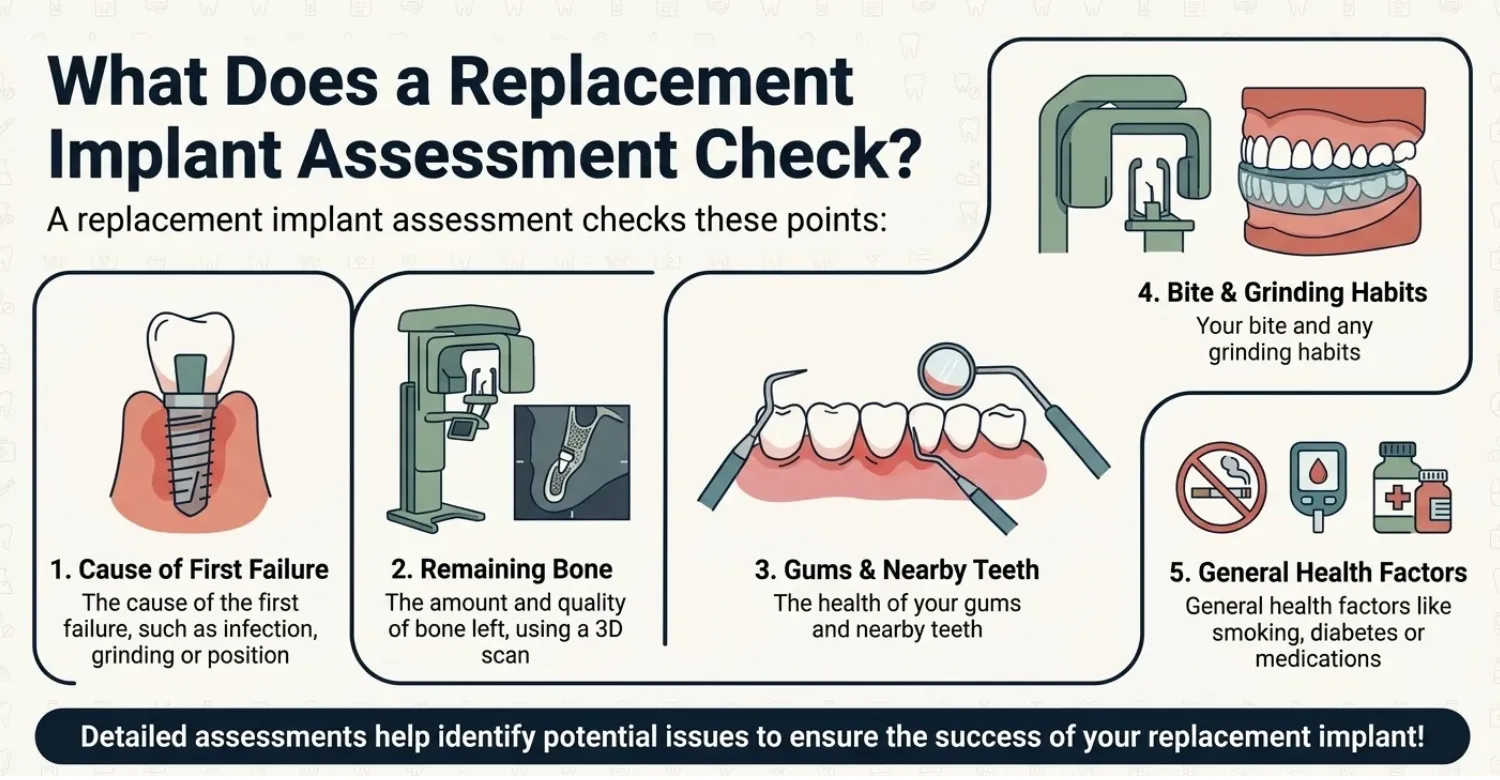
A replacement implant assessment checks why the first implant failed and whether the site is ready for a new one. It is the most important step in replacing failed dental implant treatment, because it stops the same problem from happening again.
What Does a Replacement Implant Assessment Check?
Replacing a failed dental implant starts with understanding why it happened. A thorough clinical assessment evaluates everything from remaining bone volume via 3D scans to bite forces, gum health, and overall medical factors-ensuring your second implant is built on a stronger, lasting foundation. Here is what your dentist checks before replacing an implant:
Is a Second Dental Implant as Successful as the First?
A second dental implant is usually successful, but its survival rate is slightly lower than a first implant. The chance drops further after two failures in the same spot. This is why the cause must be fixed first, and why a different size, position or timing is often chosen.
How Can You Lower the Risk of Another Implant Failure?
You can lower the risk of another implant failure with these habits:
Stop smoking, especially before and after surgery.
Clean around the implant every day and keep your gums healthy.
Wear a night guard if you grind or clench your teeth.
Keep health conditions like diabetes under control.
Attend regular check-up's so problems are caught early.
What Do Patients Ask Before Replacing Failed Dental Implant Treatment?
Before replacing an implant, patients usually want to know about pain, age limits and what affects the overall cost. Here are clear answers to the most common questions.
How Painful Is Getting One Dental Implant?
Getting one dental implant is usually much less painful than people expect, and many patients say it feels easier than a tooth extraction. Discomfort tends to peak in the first two to three days and then fades. Most patients return to normal activities the next day.
Is It Worth Getting Dental Implants at 70 Years Old?
Yes, age alone does not rule out dental implants. Many people in their 70s and older get implants successfully. What matters most is your general health, bone quality and ability to keep the area clean.
What Affects the Cost of Replacing a Failed Implant?
The cost of replacing a failed implant depends on several factors:
How easily the failed implant can be removed.
Whether bone grafting or a sinus lift is needed.
The number of visits and the healing time.
The type of crown or bridge placed on the new implant.
How Can You Make Implant Treatment More Affordable?
You can make implant treatment more affordable by planning it carefully. Ask for a written, itemized plan before you start, so there are no surprise costs. Many patients also choose treatment abroad, where a fixed, all-inclusive price can cover the treatment, hotel and transfers.
How Long Does Implant Replacement Take at Vitrin Clinic?
Implant replacement at Vitrin Clinic usually takes two trips to Istanbul. On the first trip, the failed implant is removed, the site is prepared and, where possible, the new implant is placed. After the bone heals at home, the final crown is fitted on the second trip.
Which Dental Implant Treatments Does Vitrin Clinic Provide?
For patients replacing failed dental implant treatment from another clinic or country, Vitrin Clinic offers these implant options and supporting treatments:
Single dental implants
Multiple dental implants
Implant-supported bridges
Immediate implants placed on the day of extraction
All-on-4, All-on-6 and All-on-8 full-arch implants
Zygomatic implants
Bone grafts and sinus lifts
What to send: clear photos of the failed implant area, any recent X-rays or scans, and a short note about when and why the implant was placed.
To learn more about each option and plan your visit, explore our dental implants at Vitrin Clinic.
How Does Vitrin Clinic Check Your Bone Before Replacing an Implant?
Before any replacement implant is placed, the bone and the cause of the first failure are checked carefully.
A free 3D scan shows the bone height, width and density around the failed implant.
The dentist reviews your history to find the likely cause of failure.
The new implant position, angle and size are planned digitally.
Bone grafting is planned in advance if the site needs rebuilding.
How Does Vitrin Clinic Plan Your Replacement Implant Before You Travel?
At Vitrin Clinic, the online consultation is free and no-obligation. You send photos, your dental history and any X-rays, and our dentists review your case. A personalized treatment plan is sent in less than 24 hours.
Your written plan includes the treatments, the timeline and a fixed, all-inclusive price before you travel. Our team books your hotel and arranges your transfers, and aftercare continues once you're home. Vitrin Clinic has been treating patients in Istanbul since 2007.
What Is Your Patient Journey With Vitrin Clinic?
Your journey with Vitrin Clinic moves through three stages, with the cause of the first failure checked before anything is replaced.
Before you travel:
You send photos of the failed implant area, any recent X-rays and a short dental history, and our dentists give a first opinion on whether replacement looks possible.
Within 24 hours, you receive a written plan with your treatments, the timeline, the expected days in Istanbul and a fixed, all-inclusive price.
Once you choose your dates, our team books your hotel and arranges your transfers between the airport, hotel and clinic.
During your stay in Istanbul:
A 3D scan and an exam show the bone around the failed implant and the likely cause of failure.
The dentist confirms whether removal, grafting and a new implant can be done in one visit or in stages.
The failed implant is removed under local anesthesia, the new implant is placed when the bone allows, and its position is checked before you receive clear aftercare instructions.
After you return home:
While the bone heals, our team stays in touch and answers your questions.
When healing is complete, you return to Istanbul for your final crown.
How Can You Get a Lasting Result After a Failed Implant?
A lasting result after a failed implant starts with finding the cause, then rebuilding the site and placing the new implant with careful planning. Replacing failed dental implant treatment is successful for most patients when these steps are followed.
To give your new implant the best chance, keep these points in mind:
Ask your dentist to explain why the first implant failed.
Make sure the bone is checked with a 3D scan before replacement.
Allow enough healing time, especially after bone grafting.
Keep your gums healthy and attend regular check-ups.
If your implant has failed, send your photos and X-rays to Vitrin Clinic for a free online review, and find out whether a new implant is right for you.






References

Medically reviewed by
Dr. Rifat AlsamanDr. Rifat Alsaman has more than 5 years of clinical experience in dentistry and currently serves as the Head of the Medical Team at Vitrin Clinic. He is dedicated to providing exceptional patient care, overseeing treatment planning, and ensuring the highest clinical standards across the team. His expertise, attention to detail, and commitment to continuous professional development have helped countless patients achieve healthier, more confident smiles.
More in Dental Treatments
View all 17 min readWill I Be Awake During Dental Implant Surgery and What Anesthesia Is Used?Dental implant anesthesia is what keeps implant surgery comfortable, and for most patients it means staying awake while the treatment area is completely numb.
 22 min readCan People With Diabetes Have Dental Implants Safely?Dental implants with diabetes are possible and often successful when blood sugar is well managed. Diabetes changes how your gums, bone, and immune system respond to surgery.
 13 min readWhat Happens If There Is Not Enough Space for Dental Implant Placement?If there is not enough space for dental implant placement, your dentist will usually create or adjust the space first, choose a narrower implant or suggest another way to replace the tooth. A cramped gap does not always mean an implant is impossible. It means the space, roots and bone need careful planning before surgery.
 34 min readWhat are the dental crown procedure steps at Vitrin Clinic in Turkey?Understanding the dental crown procedure steps helps you prepare for treatment, know what happens during each appointment, and make informed decisions.
Still have a question?
Our patient coordinators answer every day of the week: before, during and long after your treatment.