What Happens If There Is Not Enough Space for Dental Implant Placement?
If there is not enough space for dental implant placement, your dentist will usually create or adjust the space first, choose a narrower implant or suggest another way to replace the tooth. A cramped gap does not always mean an implant is impossible. It means the space, roots and bone need careful planning before surgery.

If there is not enough space for dental implant placement, your dentist will usually create or adjust the space first, choose a narrower implant or suggest another way to replace the tooth. A cramped gap does not always mean an implant is impossible. It means the space, roots and bone need careful planning before surgery.
At Vitrin Clinic, a free 3D scan shows the space, roots and bone around your missing tooth before any implant is planned.
Key Takeaways
A single standard implant usually needs about 7 mm of space between the neighboring teeth.
The visible gap can look wide enough while the roots underneath are too close.
Dentists measure crown space, root clearance and bone with 3D scans.
Orthodontics, narrow implants or a bridge can solve most space problems.
A missing tooth space often shrinks over time, so early planning helps.
Prices from $150 per crown
Six E.max front crowns from
$1,080
Prices from $150 per crown
Six E.max front crowns from
$1,080
Hotel + transfers available
Airport-Hotel-Clinic
coordination included
Ready to transform your smile?
Talk to our team and get your Free Treatment plan.
How Much Space Do You Need for a Dental Implant?
A standard single implant usually needs about 7 mm of space between the neighboring teeth. This leaves room for the implant itself and a safe gap of about 1.5 mm on each side, so the implant does not touch the roots next to it.
How Much Space Between Teeth for Implants?
The space needed between teeth for implants depends on which tooth is missing. Front teeth like lower incisors can often take narrow implants in smaller gaps, while molars need wider implants and more room. If two implants sit side by side, they usually need about 3 mm of bone between them.
What Determines Whether There Is Enough Room?
Whether there is enough room for an implant depends on several measurements:
The width of the gap between the crowns of the neighboring teeth.
The distance between the roots of those teeth below the gum.
The height of the space between your upper and lower teeth when you bite.
The width and height of the jawbone where the implant will go.
Why Doesn't the Visible Gap Tell the Whole Story?
The visible gap only shows the space between the crowns of your teeth. Underneath the gum, the roots of the neighboring teeth may lean toward the gap and leave less room. A gap that looks wide enough can still mean not enough space for dental implant placement at root level, which is why X-rays and 3D scans are needed.
Why Do Adjacent Tooth Roots Matter for Implant Spacing?
Adjacent tooth roots matter because an implant placed too close can damage them or the bone between them. This can lead to bone loss, sensitivity or problems with the neighboring tooth. Keeping a safe distance protects both the implant and your natural teeth.
How Do Dentists Check If There Is Enough Space for an Implant?
Dentists check the space for an implant with a clinical exam, X-rays and a 3D scan of the jaw. Together, these show the gap between the teeth, the position of the roots and the amount of bone available.
How Do Dentists Measure Crown Space and Root Clearance?
Dentists measure crown space and root clearance in three steps:
Crown space: the width of the gap at the biting surface and the height between your upper and lower teeth.
Root clearance: the distance between neighboring roots, measured on X-rays or a 3D scan.
Digital planning: a virtual implant is placed on the scan to check the distances before surgery.
What Happens During a Dental Implant Assessment?
During a dental implant assessment, the dentist checks your teeth, gums, bite and general health. A 3D scan shows the bone, nerves, sinuses and nearby roots. The dentist then explains whether the space is ready or needs preparing first.
What Disqualifies You From Getting Dental Implants?
Implants may be delayed or not advised if you have:
Not enough space between the teeth or roots that cannot be corrected.
Not enough bone, unless bone grafting is possible.
Untreated gum disease or tooth decay.
Uncontrolled health conditions that affect healing.
Heavy smoking, which raises the risk of implant failure.
Want to see pure joy captured in a Vitrin Clinic before & after?
.jpg)
.jpg)
.jpg)
What Are Your Options If There Is Not Enough Space for Dental Implant Treatment?
If there is not enough space for dental implant treatment, there are five proven ways to solve it. The right option depends on whether the problem is the crown space, the roots or the bone:
Orthodontics to move the neighboring teeth and roots apart.
A narrow implant for a smaller gap.
Bone grafting or a sinus lift to rebuild the bone.
Reshaping the sides of neighboring teeth in small cases.
A dental bridge or another non-implant option.
How Can Dentists Restore Space Before an Implant?
Dentists can restore space before an implant in these ways:
Moving the neighboring teeth with braces or clear aligners.
Uprighting tilted teeth that have drifted into the gap.
Gently reshaping the sides of neighboring teeth in small cases.
Separating roots that sit too close to the implant site.
How Does Orthodontics Before Implant Treatment Help?
Orthodontics before implant treatment moves the neighboring teeth and their roots apart to create a safe space. It is common when teeth have drifted, leaving not enough space for dental implant surgery, or when a tooth has been missing since childhood. Treatment time depends on how far the teeth need to move, and the implant is placed once the space is stable.
Can a Narrow Implant Fit a Narrow Space?
Yes, a narrow space for implant placement can often take a narrow implant, especially for front teeth like lower incisors and upper lateral incisors. They still need a safe distance from the neighboring roots. Narrow implants are not suitable for back teeth that take heavy chewing forces.
What Are the Options If I Don't Have Enough Bone for Dental Implants?
If you do not have enough bone, the most common options are:
Bone grafting: adds bone to rebuild the width or height of the jaw.
Sinus lift: adds bone under the sinus for upper back teeth.
Narrow or short implants: fit smaller amounts of bone in suitable cases.
Zygomatic implants: anchor in the cheekbone when upper jaw bone is very limited.
What Can I Do Instead of a Dental Implant?
If an implant is not possible, a missing tooth can be replaced in other ways:
Dental bridge: a fixed false tooth supported by the teeth on each side.
Bonded bridge: a lighter bridge bonded to the back of nearby teeth, often for front teeth.
Removable partial denture: a removable plate with one or more false teeth.
Should You Leave the Missing Tooth Space Empty?
Leaving a missing tooth space empty is usually not a good long-term choice. Over time, nearby teeth can drift into the gap and the bone can shrink, which can leave not enough space for dental implant treatment later.
Is Getting a Dental Implant Necessary? Can It Be Avoided by Leaving a Gap?
An implant is not always necessary, but leaving a gap has risks. Neighboring teeth may tilt, the opposite tooth may grow into the space and the bone may shrink. If you choose not to have an implant, ask your dentist about a bridge or a space maintainer.
Why Does a Missing Tooth Space Get Smaller Over Time?
A missing tooth space gets smaller because teeth naturally move toward gaps. The teeth on each side can tip inward, and the tooth above or below can drift into space. The jawbone also shrinks without a tooth root to support it, which makes later implant placement harder.
Is It Better to Pull a Tooth or Get an Implant?
It is usually better to keep a natural tooth if it can be saved with a filling, root canal or crown. If the tooth cannot be saved, removing it and replacing it with an implant is often the best long-term option. Your dentist will compare both options after checking the tooth and the space.
Can You Get a Tooth Pulled and an Implant Put In the Same Day?
Yes, in some cases. An immediate implant can be placed right after the extraction if there is no infection and the bone and space are suitable. If not, the implant is placed after the area heals, which also gives time to check the space properly.
How Can You Replace a Missing Tooth While Waiting for an Implant?
You can replace a missing tooth while waiting for an implant with a temporary option that also helps hold the space. This stops neighboring teeth from drifting into the gap during healing.
How Can I Cover My Missing Teeth While Waiting for the Implant?
These temporary options can cover the gap while you wait:
Flipper: a light removable plate with a false tooth.
Clear retainer with a tooth: a removable tray with a false tooth attached.
Temporary bridge: a fixed false tooth bonded to nearby teeth.
Temporary crown on the implant: possible in some immediate implant cases.
Can You Wear a Flipper While Waiting for an Implant?
Yes, a flipper is a common temporary option while waiting for an implant. It fills the gap, helps you smile and speak normally and helps hold the space. It should not press hard on the implant area while it heals, so your dentist may adjust it.
Can I Sleep With My Flipper In?
Most dentists advise removing your flipper at night. This lets your gums rest, reduces the risk of irritation and allows you to clean the flipper well. Follow your own dentist's advice, as some cases need different care.
What Should You Know Before Getting a Dental Implant?
Before getting a dental implant, it helps to know that planning takes time and that space, bone and gum health all affect the result.
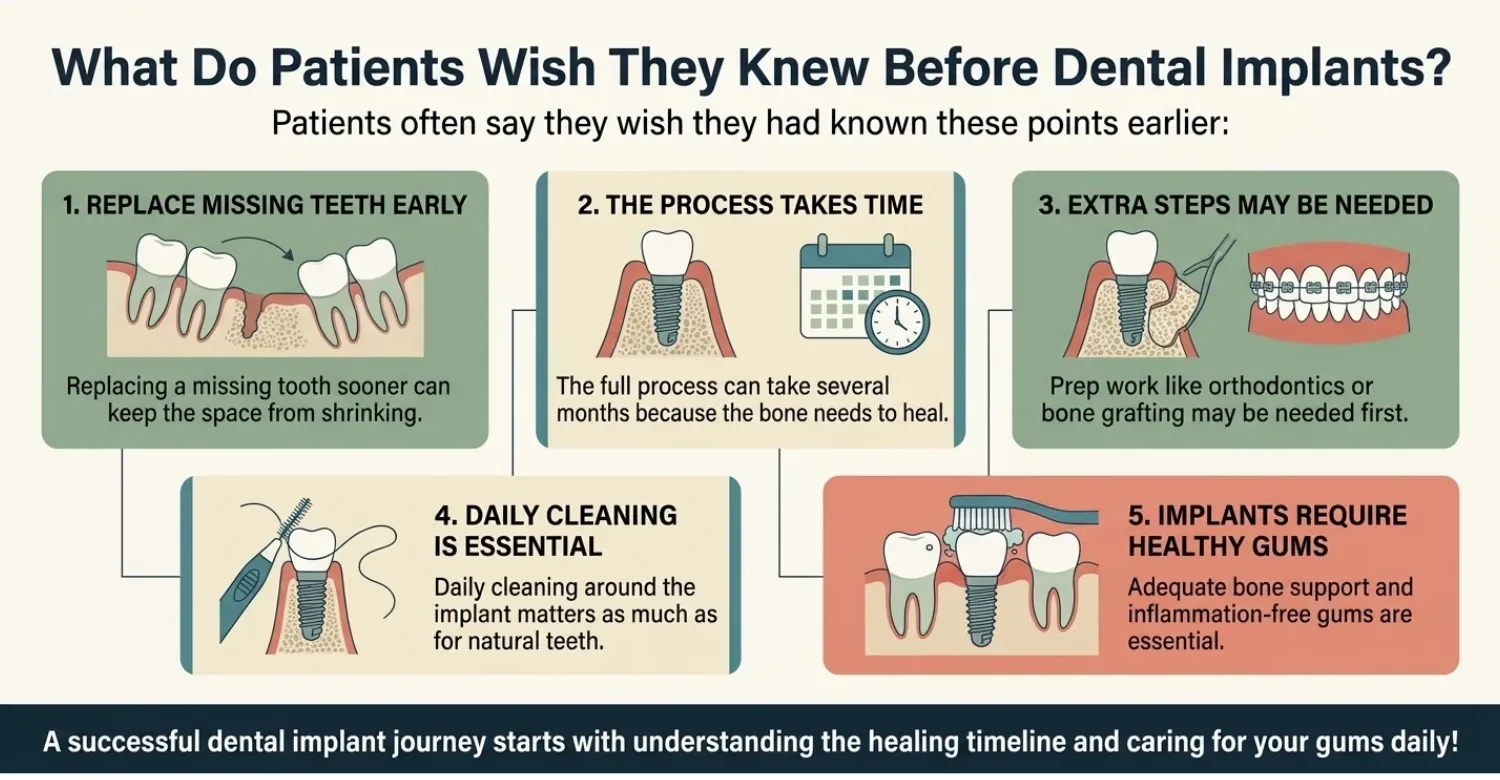
What Do Patients Wish They Knew Before Dental Implants?
Getting dental implants is a life-changing journey, but knowing what to expect makes all the difference. Patients often share that they wish they’d known key facts early on- like why prompt replacement matters, why healing takes time, and the essential role of daily care. Understanding these five insights helps you plan confidently for a healthy, permanent smile. Here is what patients wish they knew beforehand:
What Is the Biggest Complaint About Dental Implants?
The biggest complaint about dental implants is the length of the treatment, as healing can take several months. Some patients also notice food getting caught around the implant crown. Good planning of the implant position and crown shape helps reduce these problems.
What Can You Not Do With a Dental Implant?
With a dental implant, you should avoid habits that put extra stress on it:
Biting very hard objects like ice, pens or hard candy.
Opening packages with your teeth.
Smoking, which slows healing and raises the risk of failure.
Skipping daily cleaning around the implant.
Why Does Correct Implant Positioning Matter Long Term?
Correct implant positioning protects the neighboring roots, the bone and the gums around the implant. An implant placed too close to a tooth or at the wrong angle can lead to bone loss, gum recession or a crown that traps food. Careful planning helps the implant last for many years.
How Long Does Dental Implant Treatment Take at Vitrin Clinic?
Dental implant treatment at Vitrin Clinic usually takes two trips to Istanbul. On the first trip, the implant is placed and a temporary tooth is fitted, then the bone heals at home for about 3 to 6 months. On the second trip, the final crown or bridge is fitted.
Which Dental Implant Treatments Does Vitrin Clinic Provide?
To plan around cases with not enough space for dental implant placement, Vitrin Clinic offers several implant options and supporting treatments:
Single dental implants
Multiple dental implants
Implant-supported bridges
Immediate implants placed on the day of extraction
All-on-4, All-on-6 and All-on-8 full-arch implants
Zygomatic implants
Bone grafts and sinus lifts
What to send: clear photos of your smile and the gap, any recent X-rays or scans, and a short note about how long the tooth has been missing.
To learn more about each option and plan your visit, explore our dental implants at Vitrin Clinic.
How Does Vitrin Clinic Check the Space for Your Implant?
Every implant at Vitrin Clinic is planned digitally before surgery, so the space, roots and bone are checked first.
A free 3D scan shows the bone, nerves, sinuses and neighboring roots.
The implant position, angle and size are planned on the scan.
If the space is too tight, the dentist explains the options before treatment.
Bone grafting or extraction can be done in the same visit when needed.
How Does Vitrin Clinic Plan Your Implant Before You Travel?
At Vitrin Clinic, the online consultation is free and no-obligation. You send photos, your dental history and any X-rays, and our dentists review your case. A personalized treatment plan is sent in less than 24 hours.
Your written plan includes the treatments, the timeline and a fixed, all-inclusive price before you travel. Our team books your hotel and arranges your transfers, and aftercare continues once you're home. Vitrin Clinic has been treating patients in Istanbul since 2007.
What Is Your Patient Journey With Vitrin Clinic?
From your first message to your final crown, here is what you can expect at each stage with Vitrin Clinic:
You share your case: send photos of the gap, any recent X-rays and a short dental history. Our dentists give a first opinion on whether the space looks suitable for an implant.
You receive your plan: within 24 hours, you get a written plan with your treatments, the timeline, the expected days in Istanbul and a fixed, all-inclusive price.
You arrive in Istanbul: our team books your hotel and arranges your transfers between the airport, hotel and clinic, so you can focus on your treatment.
You see your space measured: a 3D scan measures the gap, the distance between the roots and the bone. If there is not enough space for dental implant placement, the dentist explains the steps needed to prepare it.
You receive your implant: the implant is placed under local anesthesia and its position is checked. A temporary tooth is fitted where suitable, and you get clear aftercare instructions before you fly home.
You heal at home and return for your final tooth: our team stays in touch while the bone heals. When healing is complete, you return to Istanbul for your final crown or bridge.
How Can You Find Out If Your Missing Tooth Space Is Ready for an Implant?
The only way to know if your missing tooth space is ready is a proper assessment with X-rays and a 3D scan. Not enough space for dental implant placement is often solvable with orthodontics, a narrower implant or bone grafting.
To find out where you stand, keep these points in mind:
Do not judge the space by the visible gap alone.
Ask for a 3D scan that shows the roots and bone.
Replace a missing tooth early to stop the space from shrinking.
Use a temporary tooth to hold the space while you wait.
If you are planning implants abroad, send your photos and X-rays to Vitrin Clinic for a free online review, and find out whether your space is ready before you travel.






References

Medically reviewed by
Dr. Rifat AlsamanDr. Rifat Alsaman has more than 5 years of clinical experience in dentistry and currently serves as the Head of the Medical Team at Vitrin Clinic. He is dedicated to providing exceptional patient care, overseeing treatment planning, and ensuring the highest clinical standards across the team. His expertise, attention to detail, and commitment to continuous professional development have helped countless patients achieve healthier, more confident smiles.
More in Dental Treatments
View all 17 min readWill I Be Awake During Dental Implant Surgery and What Anesthesia Is Used?Dental implant anesthesia is what keeps implant surgery comfortable, and for most patients it means staying awake while the treatment area is completely numb.
 13 min readIs Replacing Failed Dental Implant Treatment Possible?Yes, replacing failed dental implant treatment is possible in most cases. The failed implant is removed, the bone is allowed to heal or is rebuilt, and a new implant is placed once the site is ready. Studies show that most replacement implants survive well when the cause of the first failure is found and treated.
 22 min readCan People With Diabetes Have Dental Implants Safely?Dental implants with diabetes are possible and often successful when blood sugar is well managed. Diabetes changes how your gums, bone, and immune system respond to surgery.
 34 min readWhat are the dental crown procedure steps at Vitrin Clinic in Turkey?Understanding the dental crown procedure steps helps you prepare for treatment, know what happens during each appointment, and make informed decisions.
Still have a question?
Our patient coordinators answer every day of the week: before, during and long after your treatment.