Orthodontics
April 26, 2026
Adult Braces Options: Which Orthodontic Treatment Is Best for Adults?
 Dr. Rifat Alsaman

Adults have five main adult braces options: metal braces, ceramic braces, lingual braces, self-ligating braces and clear aligners. The best choice depends on how simple or complex your case is. It also depends on your gum and bone health, any crowns or implants you already have, and how much it matters that nobody notices your treatment.
Key Takeaways
What Are Adult Braces and What Are They Used For? At Vitrin Clinic, adult orthodontic treatment helps straighten teeth, correct bite problems, close gaps, and improve dental alignment through an individualized treatment plan.
What Are the Types of Braces for Adults? Vitrin Clinic offers different orthodontic options, including metal braces, ceramic braces, lingual braces, self-ligating braces, and clear aligners. The right option depends on your dental needs, oral health, and lifestyle.
What Is the Recovery Like After Getting Adult Braces? Mild soreness and pressure are common for a few days after fitting or adjustments. Most adults adapt within about two weeks. Vitrin Clinic’s treatment process includes regular check-ups and guidance on oral hygiene to support treatment progress.
How Much Do Adult Braces Cost at Vitrin Clinic? The cost depends on the type of orthodontic treatment, case complexity, and treatment duration. Vitrin Clinic’s prices range by individual needs, so a personalized assessment is required to determine the cost of your treatment.
.jpg)
.jpg)
.jpg)
.jpg)
Ready to transform your smile?
Talk to our team and get a FREE treatment plan.
Adult Braces Options Compared
No single appliance wins every category. Metal braces lead to control and durability. Aligners lead on discretion and removability. Ceramic, lingual and self-ligating braces sit in between, each with its own trade-off. The table below compares all five adult braces options on the points adults ask about most. Use it to narrow your list before your consultation, not to make the final decision on your own.
Metal | Ceramic | Lingual | Self-ligating | Clear aligners | |
Visibility | Most visible | Tooth-colored, subtle | Hidden behind teeth | Metal or clear versions | Nearly invisible |
Suitable cases | Mild to complex | Mild to complex | Many cases, technique-dependent | Mild to complex | Mild to moderate, selected complex |
Typical duration | 18–36 months | 18–36 months | 18–36 months | 18–36 months | 6–24 months |
Relative cost | Lowest | Higher than metal | Highest | Higher than metal | Similar to ceramic, case-dependent |
Comfort | Adjustment period | Adjustment period | Tongue contact at first | Fewer ties, similar feel | Pressure with each new tray |
Speech | Little effect | Little effect | Often a temporary lisp | Little effect | Mild lisp for a few days |
Cleaning | Harder | Harder, bands can stain | Hardest | Harder | Easiest (trays come out) |
Visits | Every 4–10 weeks | Every 4–10 weeks | Every 4–10 weeks | Often less frequent | About every 6 weeks |
Compliance needed | Low | Low | Low | Low | High |
Fixed or removable | Fixed | Fixed | Fixed | Fixed | Removable |
Durability | Highest | Brackets can chip | High | High | Trays replaced often |
Finishing predictability | Strong | Strong | Depends on technique | Strong | Less predictable for some complex movements |
Match your priority to an option:
Your priority | Best fit |
I need complex bite correction | Metal or ceramic braces |
Nobody should see my treatment | Lingual braces |
I want to eat and brush normally | Clear aligners |
I want the lowest cost | Metal braces |
I travel a lot or lose small things | Any fixed braces |
I want subtle but fixed treatment | Ceramic braces |
Which Braces Are Best for Adults?
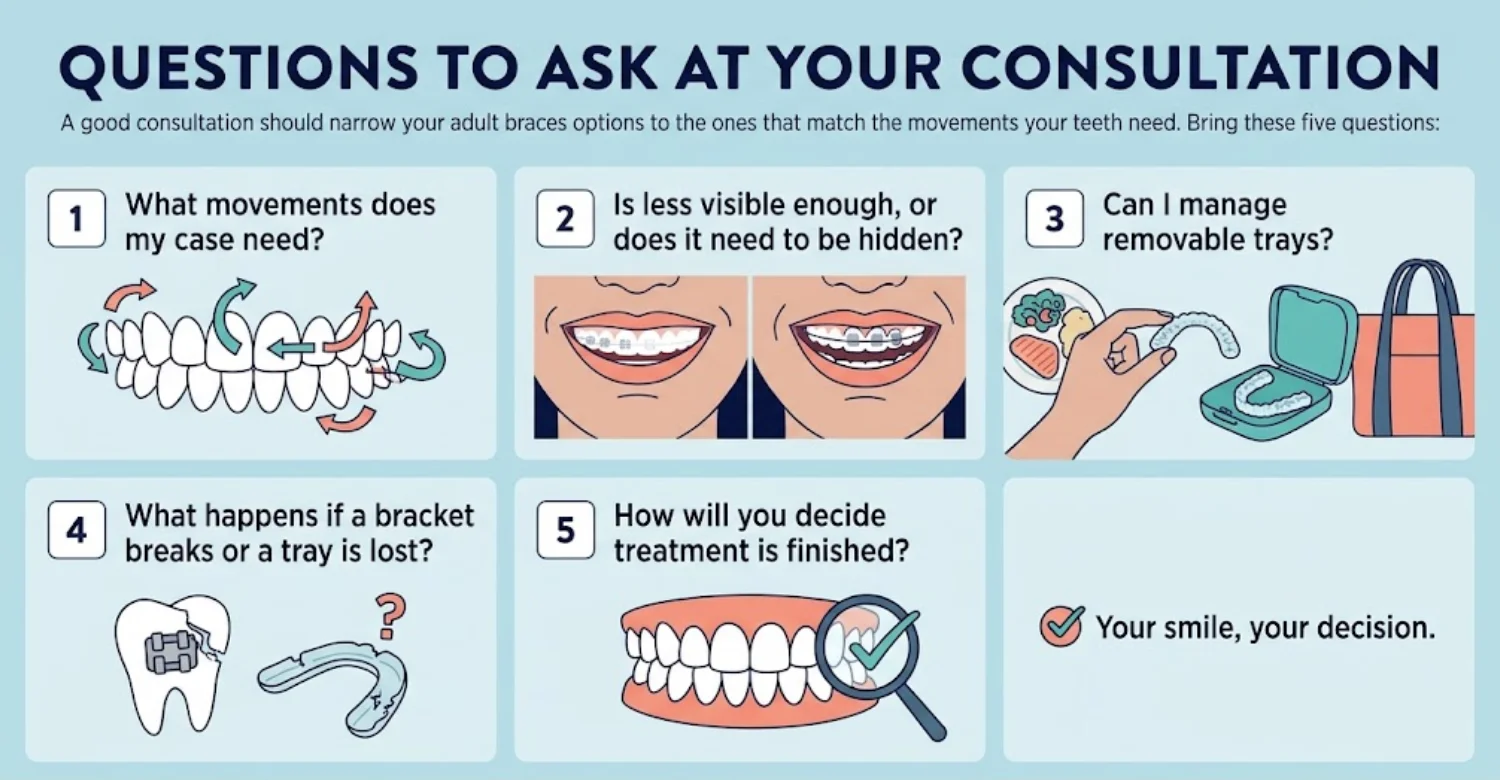
The best braces for adults are the ones that can complete the tooth movements your case needs while fitting your real routine. The least visible appliance is not always the most predictable one. So start with the complexity of your case, then think about lifestyle. A frequent traveler who forgets small items may do better with fixed braces. A disciplined professional with mild crowding may do very well with aligners.
Sometimes adult braces options are not the only answer. If only two or three front teeth are slightly crooked, porcelain veneers can change how they look. Veneers do not fix your bite, though, and they usually need some enamel removal. For bite problems, crowding or teeth that are healthy and unworn, orthodontics is the more conservative choice.
Dr. Sami’s Invisalign Excellence: Top 1% Recognition and 500+ Successful Cases
Dr. Sami received the prestigious Invisalign Apex Award, recognizing his position among the top 1% of Invisalign providers across Europe, the Middle East, and Africa (EMEA), alongside achieving Blue Diamond status and completing over 500 Invisalign cases.
Ready to transform your smile?
Talk to our team and get a FREE treatment plan.
Types of Braces for Adults
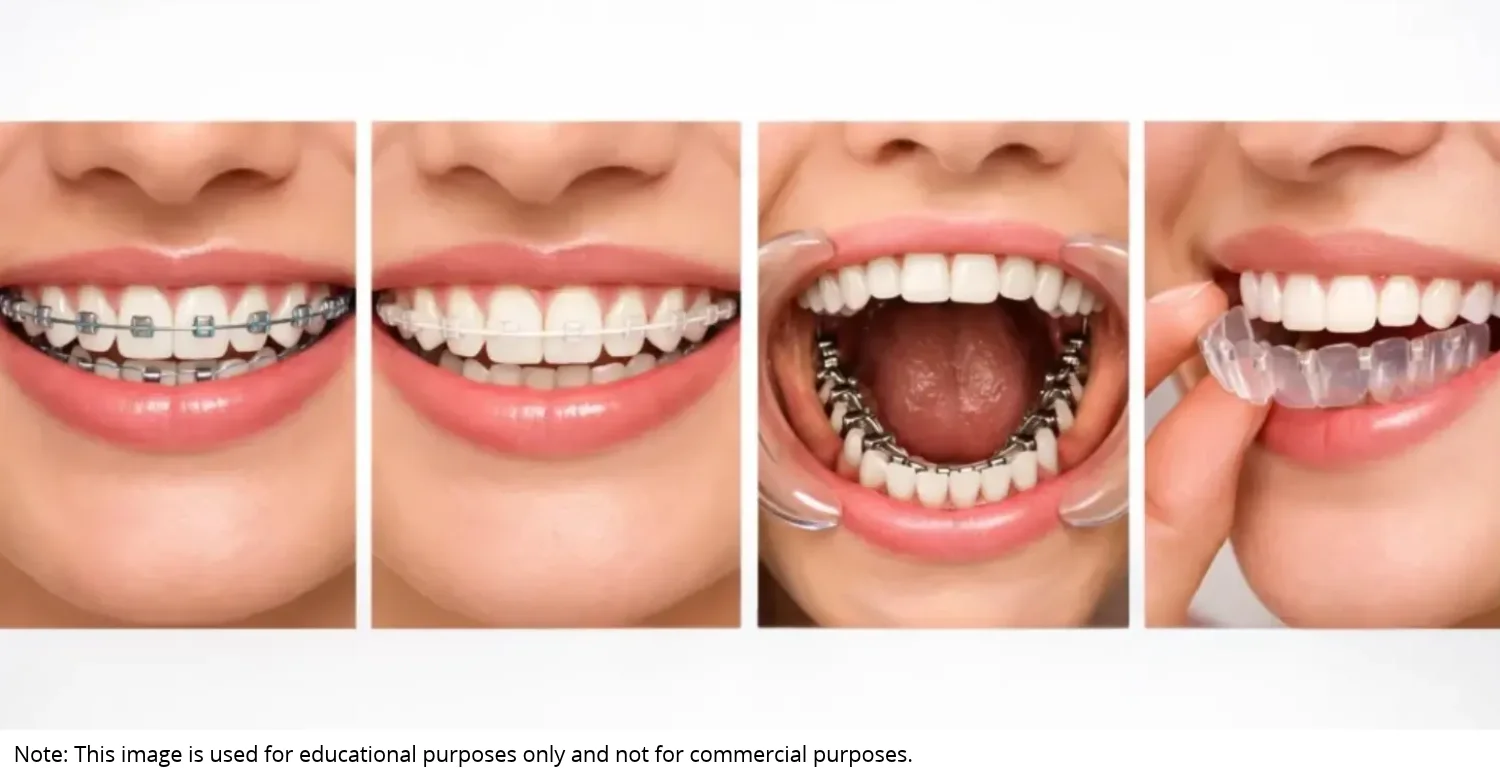
Each of the adult braces options below can straighten teeth. The difference is how they do it, how they look and what they ask of you every day. Fixed appliances stay on your teeth for the whole treatment. Aligners come out for meals and cleaning. Here is what you need to know about each one.
Traditional Metal Braces
Metal braces use small stainless steel brackets and an archwire to move teeth step by step. They give your orthodontist continuous control over every tooth. That makes them a strong fit for severe crowding, complex bite problems and difficult rotations. Modern brackets are smaller and more comfortable than the ones many adults remember. Some patients even pick colored bands. They also suit adults who do not want to think about where their trays are or whether they are wearing them. The trade-off is that, of all adult braces options, metal is the most visible. It also brings some food limits and more careful brushing.
Ceramic (Clear) Braces
Ceramic braces work exactly like metal braces, but the brackets are tooth-colored or translucent. They are not limited to mild cases, a common myth about tooth-colored adult braces options. Ceramic braces can treat the same complex problems as metal braces, including major crowding and bite correction. The trade-offs are practical. Ceramic brackets can chip more easily than metal, and some create more friction with certain wires, so your orthodontist plans for this. The clear bands can also stain from coffee, tea or curry, so good daily cleaning matters.
Lingual Braces
Lingual braces are bonded to the back surfaces of your teeth, so nobody sees them in normal conversation. They are usually custom-made for your teeth. Of all fixed adult braces options, they are the least visible, which suits adults in client-facing roles. They are also highly technique-sensitive. Not every bite or tooth shape suits them, so your orthodontist decides case by case. Expect a short adjustment period. Your tongue touches the brackets, so speech and comfort can feel different for the first few weeks. Lingual braces of this kind sit under the wider umbrella of invisible braces.
Self-Ligating Braces
Self-ligating braces use a built-in clip or door to hold the wire instead of elastic ties. They come in metal and clear versions. Fewer ties can mean easier cleaning around the brackets and, in some cases, fewer or shorter appointments. You may read that they straighten teeth faster. Current research does not show a consistent reduction in total treatment time compared with conventional braces. Treat them as one of several adult braces options chosen for comfort and convenience, not for a promised shortcut.
Clear Aligners
Clear aligners are a series of custom plastic trays. Each tray moves your teeth a small step. You switch to a new set every one to two weeks. They come out for eating, drinking anything except water, and brushing. Their biggest advantage over other adult braces options is discretion. The biggest risk is inconsistent wear: you need to wear them at least 20–22 hours a day, and a tray in its case moves nothing. Aligners suit mild to moderate crowding, spacing and selected bite problems. Not sure if you qualify?
Limited / Short-Term Cosmetic Orthodontics
Some adults only want to fix the teeth that show when they smile. Limited orthodontics is one of the shortest adult braces options. It targets the front teeth, usually with clear aligners or a short course of ceramic braces. It does not aim to correct the full bite. Treatment is often a few months to under a year. It can work well for mild crowding, small gaps or minor relapse after earlier braces. Your orthodontist will tell you honestly if your bite needs full treatment instead.
How Adult Orthodontics Is Different
Teeth move the same way at 45 as they do at 15. What changes is everything around them. Adults often have fillings, crowns, implants, missing teeth or gum recession. Some take medications that affect bone. Many have habits like clenching. A good adult treatment plan accounts for all of this before the first bracket goes on. These factors shape your adult braces options more than your age does.
Adult vs Child Orthodontics: What Changes When the Jaw Stops Growing
Most children start orthodontic treatment between 10 and 14. At that age, the jaw is still growing. Orthodontists can use headgear, palatal expanders and space maintainers to guide that growth. Adults cannot benefit from these devices because the jaw is fully developed. So adults have fewer options for skeletal problems. A narrow upper jaw or a large jaw mismatch may need surgery alongside braces. Tooth movement can also take a little longer in adult bone. This is not a barrier. It just means planning matters more.
Gum Health and Bone Loss: Why They Come First
Gum disease comes in two stages. Gingivitis is mild and reversible. Periodontitis is more serious and destroys the bone that holds your teeth. If you have either, a periodontist should treat it before any braces go on. Moving teeth through inflamed gums can do more than fail. It can speed up bone loss and loosen teeth. Once the gums are stable, many adults with past bone loss can still choose from most adult braces options. Their orthodontist uses lighter forces and checks the gums closely throughout treatment.
Braces With Crowns, Bridges or Implants
Existing dental work changes the plan, but it rarely rules out adult braces options. Dental implants are fused to the bone, so they do not move at all. Your orthodontist plans around them, and sometimes uses them as a fixed anchor to move other teeth. Bridges join teeth together, so they may need to be sectioned first. Brackets also bond differently to porcelain or zirconia crowns than to natural enamel. The crown surface needs special preparation, and removal at the end must be gentle to avoid chipping it.
Missing Teeth: Closing or Holding Space for an Implant
Missing teeth leave gaps that neighboring teeth slowly drift into. Braces can close a gap completely, or open and hold the space for a future single tooth implant. The choice depends on your bite, your smile and the bone in that area. Worn teeth also matter. Teeth that have worn down from grinding or age may need their final shape restored after orthodontics. Planning both steps together, before you choose between adult braces options, gives a better result than treating them separately.
Braces Before Veneers or Crowns (Pre-Restorative Orthodontics)
Many adults come to us for veneers or crowns, and orthodontics improves the result. When teeth are crooked, a dentist must remove more enamel to make veneers line up. Straightening the teeth first means less drilling and a more natural look. This is called pre-restorative orthodontics. A few months of aligners before your porcelain veneers can protect tooth structure for life. It is one of the most common reasons adults combine orthodontic and cosmetic care.
Medications, Health Conditions and Habits That Slow Tooth Movement
Some medications slow tooth movement. Bisphosphonates, used for osteoporosis, are the best known. Long-term use of certain anti-inflammatory drugs may also affect bone turnover. Uncontrolled diabetes raises the risk of gum problems during treatment. Habits matter too. Smoking reduces blood flow to the gums and raises the risk of gum disease while you wear braces. Teeth grinding (bruxism) can break brackets and wear out aligners early. Tell your orthodontist about every medication and habit at your first visit, because they can narrow your adult braces options.
Is There an Age Limit for Braces?
There is no upper age limit. If your teeth and gums are healthy, you can start orthodontic treatment at 30, 50 or 70. Adult treatment is now common. The American Association of Orthodontists (AAO) reported about 1.91 million adults in active treatment with its US members in 2024, up from 1.64 million in 2022. What decides your adult braces options is not your age but your periodontal health, bone support and goals.
When Braces Aren't Enough: Jaw Surgery and Sleep Apnea
Braces move teeth, not jaws. When the upper and lower jaws are badly mismatched, adult braces options alone may not give a stable result. In these cases, orthodontics is combined with orthognathic (jaw) surgery. Braces line up the teeth before surgery. The surgeon then repositions one or both jaws, and braces finish the bite afterward. Common reasons include a severe underbite, a recessed maxilla or a long face with an open bite. For some adults with obstructive sleep apnea, moving the jaws forward also opens the airway.
Speeding Up Adult Treatment
Adults often ask if any adult braces options can make treatment go faster. Several methods claim to help. Micro-osteoperforation makes tiny openings in the bone to trigger a local healing response. Vibration and light devices are used at home. Some studies show modest gains, but the evidence is mixed and the results vary a lot between patients. None of these replaces good planning, regular visits and, with aligners, full-time wear. Ask your orthodontist whether any method fits your case before paying for it.
Elastics, Archwires and Auxiliaries
Small extras do a lot of the work in adult treatment. Elastics (rubber bands) connect the upper and lower teeth to correct the bite. Your orthodontist changes archwires during treatment, moving from flexible wires to stiffer ones. Springs, power chains and small attachments add precise forces where needed. Wearing your elastics exactly as told is one of the simplest ways to stay on schedule.
How Long Do Braces Take for Adults?
Most adults wear braces for 18 months to three years. Children and teens usually finish in 16 to 24 months, because their jaws are still growing. The NHS says treatment usually lasts 6 to 30 months, and the British Orthodontic Society says comprehensive treatment often takes 1 to 2 years. A systematic review found overall duration was not very different between aligners and fixed braces.
Treatment type | Typical adult duration |
Metal braces | 18–36 months |
Ceramic braces | 18–36 months |
Lingual braces | 18–36 months |
Self-ligating braces | 18–36 months |
Clear aligners | 6–24 months |
Limited cosmetic orthodontics | A few months to under a year |
Across all adult braces options, your timeline depends on how complex your case is, how closely you follow instructions, whether you keep your appointments and your oral health at the start. Fixed braces need a visit every 4 to 10 weeks. Aligner patients are usually seen about every 6 weeks.
Ready to transform your smile?
Talk to our team and get a FREE treatment plan.
Clear Aligners vs Braces for Adults
Both can produce excellent results. The right one depends on your case and your habits.
Clear aligners | Fixed braces | |
Visibility | Nearly invisible | Visible (metal), subtle (ceramic), hidden (lingual) |
Removable | Yes | No |
Eating | No restrictions | Avoid hard and sticky foods |
Compliance | 20–22 hours a day | Built in |
Complex movements | Less predictable | More predictable |
Finishing Quality: What the Research Shows
A systematic review in the European Journal of Orthodontics compared aligners with fixed braces. Total treatment time was not very different. But fixed braces scored better on the American Board of Orthodontics grading system for the final result. Aligners also produced more unacceptable outcomes on finishing measures. This does not mean aligners don't work. It means the appliance must match the movement. If you need precise torque, exact bite contacts or complex movements, fixed braces deserve a serious discussion.
Professional vs Mail-Order Aligners for Adults
Mail-order aligners promise lower prices without office visits. The risk is that nobody examines your gums, bone or bite in person before your teeth start moving. Untreated gum disease, hidden decay or a bite problem can get worse. The American Dental Association considers aligners an orthodontic option only under the direct supervision of a dentist or orthodontist. An AAO study in 2025 found that orthodontists treated 64% of adult orthodontic patients. Among adult braces options, aligners are only as safe as the supervision behind them.
Life With Braces as an Adult
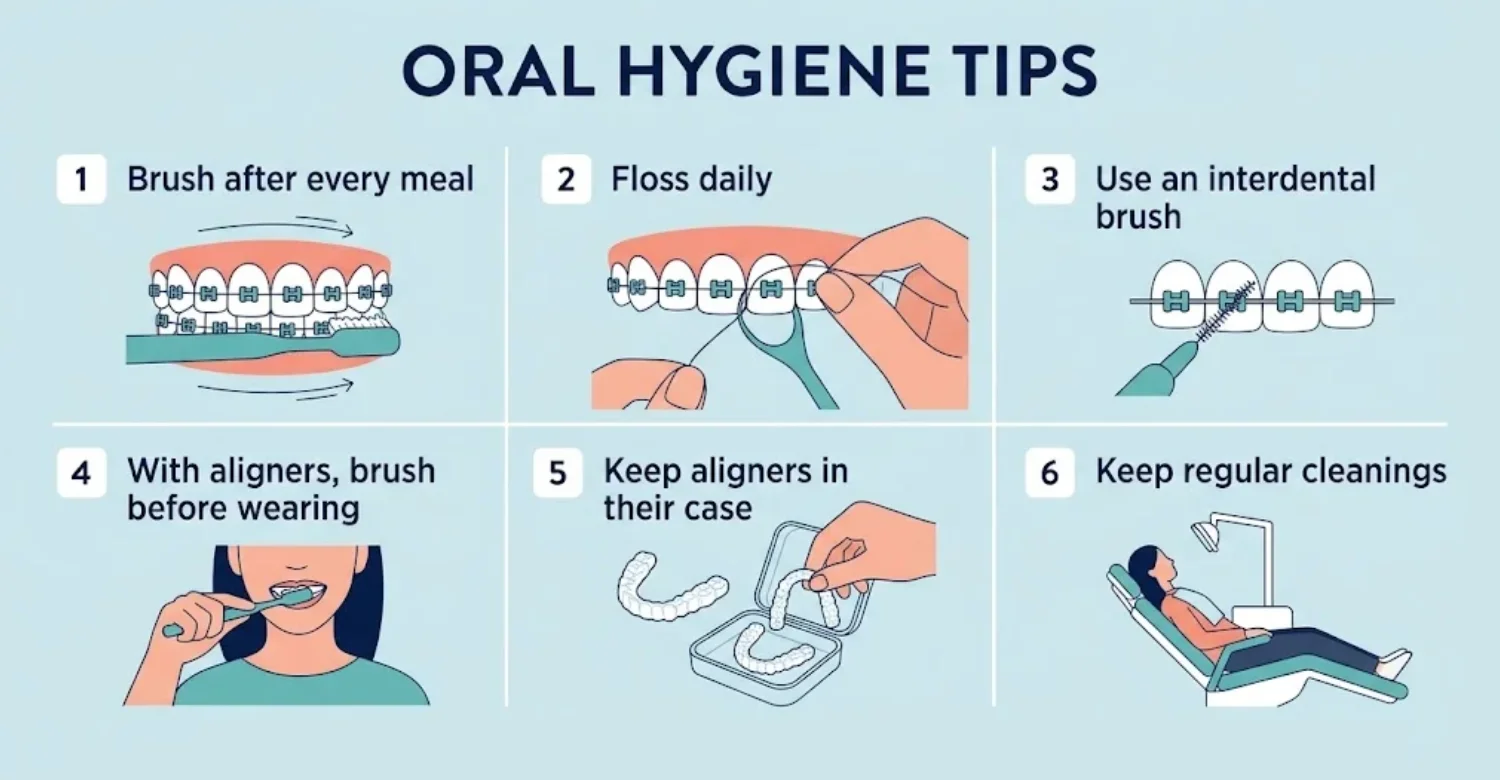
Most adults adapt within two weeks. At work, the most discreet adult braces options (ceramic braces, lingual braces or aligners) keep treatment low-key. If you wear aligners, plan where you will keep the case during meetings and meals. Fewer people notice braces than you expect, and adult treatment is now common. Speech may change for a few days, especially with lingual braces or new trays. Expect some soreness for a few days after fitting and after each adjustment. Soft foods, cool water and a pain reliever your dentist approves usually help. With fixed braces, cut food into small pieces and avoid hard or sticky foods.
Keeping Your Results: Retainers for Adults
Whichever of the adult braces options you choose, retention is the part adults forget most. Teeth tend to drift back after braces, and adults have more reasons for this, from gum changes to natural ageing. That is why most orthodontists now recommend long-term retainer wear, often for life, usually at night. You can choose a bonded wire behind the teeth, a removable retainer, or both. Compare them in our guide to fixed vs removable retainers. Habits like tongue thrusting can also push teeth out of line.
How Vitrin Clinic Personalizes Patient Care
Located in Istanbul, Türkiye, Vitrin Clinic follows a personalized, diagnosis-led approach to Invisalign and clear aligner treatment. Before developing a treatment plan, the dental team evaluates tooth alignment, bite function, gum condition, existing restorations, and the patient’s orthodontic and aesthetic expectations. This assessment helps establish whether clear aligners are an appropriate option and identify realistic treatment goals.
Clear Aligner Treatment at Vitrin Clinic
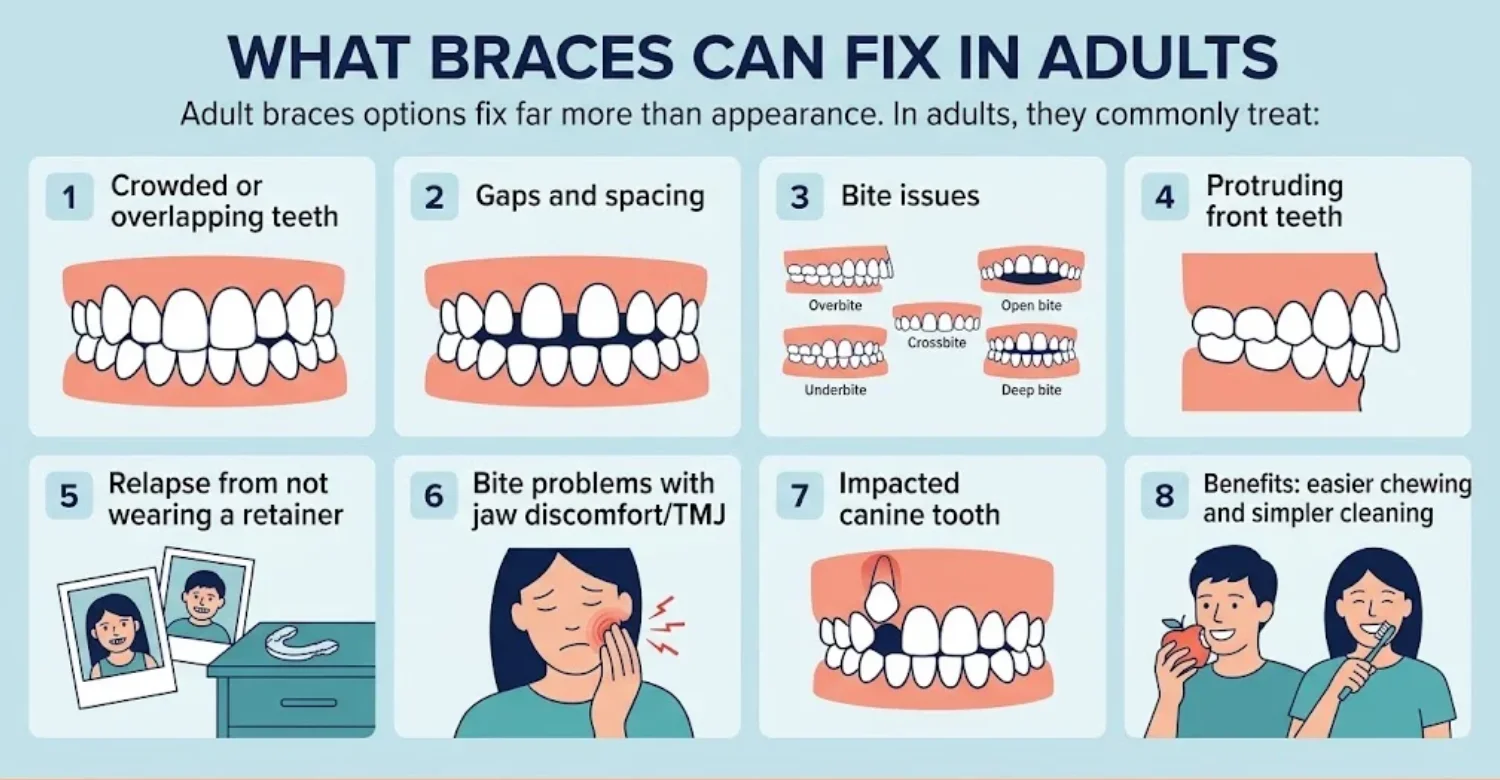
Vitrin Clinic provides Invisalign and clear aligner treatment for a range of suitable orthodontic concerns, including:
Mild to Moderate Crowding – Clear aligners can gradually reposition crowded teeth to achieve better alignment when clinically appropriate.
Gaps Between Teeth (Diastema) – A planned series of aligners can help reduce spaces between teeth through gradual, controlled movement.
Certain Bite Irregularities – Depending on the individual assessment, clear aligners may address selected overbites, underbites, crossbites, and open bites.
Crooked or Misaligned Teeth – Custom-fitted aligners can progressively improve tooth positioning without the need for conventional metal brackets.
Relapse Following Previous Orthodontic Treatment – For patients whose teeth have shifted after braces or earlier orthodontic care, clear aligners may help restore alignment, depending on the movements required.
Customized Clear Aligner Treatment Planning
At Vitrin Clinic, Invisalign and clear aligner plans are tailored to each patient’s alignment needs, bite condition, and oral health. Digital scans and orthodontic planning tools help map the intended tooth movements, while the overall treatment time varies according to case complexity and consistent aligner wear. A consultation allows the dental team to assess suitability and develop a treatment plan specific to your needs.






This article is for general information and does not replace a personal assessment by a qualified dentist. Prices are approximate 2026 averages, with UK and Turkey figures converted to US dollars, and may vary by clinic and case.
Book your FREE treatment plan with Vitrin Clinic and get a personalized assessment and treatment plan from our dental team.
Ready to transform your smile?
Talk to our team and get a FREE treatment plan.
Patients Reviews
Medical Disclaimer:
This article is for general information and does not replace a personal assessment by a qualified dentist. Prices are approximate 2026 averages, with UK and Turkey figures converted to US dollars, and may vary by clinic and case.
References
FAQs
Dr. Rifat Alsaman has more than 5 years of clinical experience in dentistry and currently serves as the Head of the Medical Team at Vitrin Clinic. He is dedicated to providing exceptional patient care, overseeing treatment planning, and ensuring the highest clinical standards across the team. His expertise, attention to detail, and commitment to continuous professional development have helped countless patients achieve healthier, more confident smiles.


