Cosmetic Dentistry
June 19, 2025
Porcelain Crown: A Dentist's Guide to Types, Lifespan and Care
 Dr. Rifat Alsaman
The porcelain crown is a tooth-colored ceramic cap that covers the whole visible part of a damaged tooth. Dentists use it when a filling is no longer enough to hold the tooth together. It restores strength, shape and color in one step. With good care, most crowns last 5 to 15 years, and many last longer.
This guide explains the main ceramic types, how the treatment works, and how to keep your crown in good condition. It also compares porcelain with zirconia, metal and gold, so you can discuss the right option with your dentist.
Key Facts
Question | Short answer |
Number of visits | Usually two (one for same-day CAD/CAM crowns) |
Average lifespan | 5–15 years, often longer with good care |
Best location | Front teeth and visible premolars |
Does it stain? | Glazed porcelain resists stains well |
Stronger alternative | Monolithic zirconia for heavy biting forces |
What Is a Porcelain Crown?
A crown is a custom cap that fits over a tooth like a snug hat. A porcelain version is made entirely or mostly from dental ceramic. It is shaded to match the teeth around it.
To make room for the cap, the dentist removes a thin layer of enamel. The lab then builds a crown that matches your bite and smile. Once bonded, it protects what is left of the natural tooth. It also brings back normal chewing. Patients often choose ceramic over metal because it looks like real enamel, not like dental work.
Porcelain Crown vs Cap: Same Thing?
Yes. "Cap" and "crown" are two names for the same restoration. People say "cap" because the restoration caps the tooth from every side. Dentists usually say "crown" in clinical notes and treatment plans.
The material is a separate question. A cap can be made from porcelain, zirconia, metal, resin or a combination. So "porcelain cap" and "porcelain crown" mean exactly the same thing.
How a Porcelain Crown Mimics Natural Enamel
Natural teeth are not one flat color. The edge is slightly see-through. The middle is brighter. Near the gum, the shade is warmer.
A skilled ceramist copies this with layers. A denser, more opaque layer sits inside and hides the prepared tooth. Lighter, translucent layers go on top. Light passes into the ceramic, scatters, and reflects back much like it does in enamel. A final glaze adds natural shine. This layered build is why a well-made ceramic restoration can blend in at conversation distance.
Pictures of Porcelain Crowns
Photos help you judge results better than any description. Look for close-up shots, side angles and pictures taken in natural light.
When you review photos from any clinic, check the gumline. A good restoration sits close to the gum with no dark edge. The shade should match the neighboring teeth in more than one light.
.jpg)
.jpg)
.jpg)
Ready to transform your smile?
Talk to our team and get a FREE treatment plan.
When Do You Need a Porcelain Crown?
A crown is not the first choice for every damaged tooth. Dentists usually recommend one when:
A large filling has weakened the tooth.
The tooth is cracked or broken.
A root canal has left the tooth brittle.
A bridge needs anchor teeth on each side.
A dental implant needs a visible tooth on top.
Severe wear or discoloration cannot be fixed with simpler options.
If a filling or bonding can do the job, that is usually better, because it keeps more natural tooth. For a full overview of all crown types and uses, see our dental crowns guide.
Weak, Cracked, or Broken Teeth
A cracked tooth flexes every time you bite. Over time, the crack can spread toward the root. A crown wraps the tooth and holds the pieces together, so bite force spreads more evenly.
Large old fillings create the same problem. When a filling takes up most of the tooth, the remaining walls become thin. They can snap off during normal chewing. Covering the tooth early is often cheaper and simpler than treating a split tooth later.
After a Root Canal
A root canal removes infected pulp from inside the tooth. The tooth stays alive in the jaw, but it loses part of its inner structure and moisture. It becomes more brittle.
Back teeth carry heavy chewing loads, so dentists usually cover them after root canal treatment. Front teeth sometimes need only a filling, depending on how much structure remains. Your dentist will check the walls left after treatment before deciding.
Holding a Dental Bridge in Place
A bridge replaces a missing tooth by joining a false tooth to crowns on the teeth either side. These anchor crowns are called retainers. They carry the bite force of the missing tooth.
Ceramic retainers keep the whole bridge tooth-colored. For longer spans or back teeth, dentists may prefer zirconia or metal-ceramic frameworks for extra strength. The choice depends on the gap, the bite and how visible the area is.
Porcelain vs Ceramic Crowns: What's the Difference?
Porcelain is one type of ceramic. All porcelain is ceramic, but not all ceramic is porcelain. In everyday speech, people use "porcelain" for almost any tooth-colored crown. In the lab, the terms are more specific.
Material | What it is | Strength | Look | Typical use |
Feldspathic porcelain | Classic glass-rich porcelain | Lowest | Most lifelike | Veneers, layering over cores |
Lithium disilicate (E.max) | Glass-ceramic, pressed or milled | Moderate–high | Very natural | Front teeth, premolars |
Zirconia (monolithic) | Solid zirconium dioxide | Highest | Good, more opaque | Molars, heavy biters |
Layered zirconia (PFZ) | Zirconia core with porcelain layers | High core, porcelain surface can chip | Very natural | Front and back teeth |
So when a clinic quotes a "ceramic" crown, ask which material they mean. The answer affects strength, appearance and the right place in your mouth.
Types of Porcelain Crowns
Ceramic crowns differ in two ways: what they are made of and how they are made. Some are fully ceramic. Others have a strong inner core with porcelain on the outside. Some are milled from a block. Others are pressed or built by hand in layers.
Each method has trade-offs between strength, beauty and cost. Your dentist picks based on the tooth's position, your bite and how much tooth is left.
All-Porcelain (Feldspathic) Crowns
Feldspathic porcelain is the traditional material used in cosmetic dentistry. It gives the most lifelike translucency and color depth. A ceramist builds it by hand in thin layers.
The downside is strength. Feldspathic porcelain is more brittle than modern ceramics. Today it is used mostly for veneers and as a surface layer over stronger cores. A full crown made only of feldspathic porcelain is less common on teeth that take heavy bite forces.
Pressed Ceramic Crowns
Pressed crowns start as a wax model of the tooth. The lab heats a ceramic ingot until it flows, then presses it into a mold made from that wax model.
Lithium disilicate (often known by the brand E.max) is the most popular pressed material. It is stronger than feldspathic porcelain and still looks very natural. A pressed core can also be layered with extra porcelain for more detail. Dentists use pressed ceramics on front teeth and premolars.
Milled (CAD/CAM) Crowns
Milled crowns are designed on a computer from a digital scan. A milling machine then carves the crown from a solid ceramic block.
The process is precise and fast. Some clinics mill in the office, which makes same-day treatment possible. Common milled materials include lithium disilicate and zirconia. Single-shade blocks can look slightly flatter than hand-layered work. A ceramist can improve this with surface stains and glaze.
Layered Crowns
A layered crown has a strong core, usually zirconia or lithium disilicate. The ceramist then adds porcelain by hand on top. This gives the strength of the core and the beauty of porcelain.
The weak point is the bond between layers. Under heavy force, the outer porcelain can chip away from the core. This is called chipping or delamination. Careful design, a correct bite and a night guard for grinders reduce this risk.
Porcelain-Fused-to-Metal (PFM) Crowns
A PFM crown has a metal shell underneath and porcelain baked on top. It was the standard tooth-colored option for decades. It is still a reliable choice for some back teeth and bridges.
The metal can show as a gray line at the gumline, and it blocks light. For this reason, all-ceramic options are now preferred on visible teeth. We cover PFM in more detail in its own section below.
.jpg)
.jpg)
.jpg)
.jpg)
.jpg)
.jpg)
Ready to transform your smile?
Talk to our team and get a FREE treatment plan.
Porcelain vs Zirconia Crowns
This is the most common question patients ask. Both are tooth-colored. Both are strong enough for daily use. The difference is the balance between beauty and toughness.
Feature | Porcelain / glass-ceramic | Zirconia (monolithic) |
Strength | Good | Highest of all ceramics |
Appearance | Most natural, very translucent | Good, slightly more opaque |
Translucency | High | Lower (newer grades improved) |
Wear on opposing teeth | Low when well glazed | Low when well polished |
Risk of chipping | Higher, especially layered work | Very low |
Best location | Front teeth, premolars | Molars, grinders, bridges |
Survival evidence is reassuring for both. A critically appraised topic from McGill University found no statistically or clinically significant difference in five-year survival between zirconia and PFM crowns. So the choice usually depends on where the tooth is and how hard you bite.
Which Is Better for Front Teeth vs Molars?
For front teeth, appearance comes first. Glass-ceramics and layered zirconia give the translucency and color depth that front teeth need. Bite forces at the front are also lower.
For molars, strength comes first. Back teeth take the heaviest chewing forces, and few people see them. Monolithic zirconia is often the safer pick there, especially for people who grind.
Porcelain-Fused-to-Metal (PFM) Crowns
PFM crowns combine a metal base with a porcelain surface. The metal gives strength. The porcelain gives a tooth-colored look. They have a long clinical track record.
They still make sense for some back teeth, long bridges and cases where budget matters. They also suit patients with a heavy bite who want a tooth-colored surface.
There are two main drawbacks. First, the metal can show as a dark line where the crown meets the gum, especially if the gum recedes. Second, metal blocks light, so PFM looks less lifelike than all-ceramic options. The porcelain layer can also chip and expose the metal underneath.
Porcelain vs Metal and Gold Crowns
Metal crowns are the toughest option. They rarely chip or break and need the least tooth removal. Their color is the obvious drawback.
Feature | Porcelain / ceramic | Gold / metal |
Strength | Good to very good | Excellent |
Appearance | Natural tooth color | Clearly metallic |
Wear on opposing teeth | Low when glazed | Very gentle |
Tooth removal needed | More | Least |
Metal sensitivity | None | Rare allergy possible |
Gold still makes sense in some cases. It suits back molars that do not show, patients with severe grinding, and teeth with very short walls. Some people also like how it looks. For any visible tooth, ceramic is almost always the better choice.
Porcelain Crowns for Front Teeth
Front teeth are the first thing people see when you smile. Here, small color differences are easy to spot. That is why all-ceramic materials are the standard choice for the smile zone.
Good front crowns need three things. The first is translucency at the edge. The second is an exact shade match with the teeth beside them. The third is characterization: tiny details such as soft white spots or subtle edge effects that make a tooth look real.
All-ceramic crowns also avoid the gray gumline seen with PFM. If you need a single front tooth crowned, matching one tooth to its neighbors is the hardest job in cosmetic dentistry.
.jpg)
Ready to transform your smile?
Talk to our team and get a FREE treatment plan.
The Porcelain Crown Procedure Step by Step
Most crowns need two visits about one to three weeks apart. Same-day crowns are an exception. The main steps are:
Digital scan and examination
Tooth preparation
Temporary crown
Lab fabrication
Final bonding
Stage | When | What happens |
Visit 1 | Day 1 | X-ray, numbing, shaping, scan, temporary crown |
Lab work | 1–3 weeks | Crown designed, made and shaded |
Visit 2 | After lab work | Temporary removed, fit checked, crown bonded |
Each step is explained below, so you know what to expect in the chair.
Same-Day Porcelain Crowns vs Lab-Made
Same-day crowns are designed and milled in the clinic during one visit. You leave with your final crown and skip the temporary.
Lab-made crowns take longer but allow more hand finishing. A ceramist can layer porcelain, add fine color details and adjust translucency. This matters most for front teeth.
Feature | Same-day (CAD/CAM) | Lab-made |
Visits | One | Two |
Temporary crown | Not needed | Needed |
Customization | Good | Excellent |
Best for | Back teeth, simple cases | Front teeth, complex smiles |
First Visit: Exam, Tooth Preparation and Impressions
The first visit lays the foundation. The dentist checks the tooth, shapes it and records its exact form. This visit usually takes one to two hours. It is the longest part of the treatment.
Everything done here affects the final fit. A clean, well-shaped preparation gives the crown a strong grip and a tight seal at the gumline. A precise scan lets the lab build a crown that needs little adjustment later.
X-Ray and Examination
Before any shaping, the dentist takes an X-ray. This shows the root, the bone around it and any hidden decay or infection.
If the nerve is inflamed or infected, a root canal may be needed first. Crowning a tooth with an untreated infection can lead to pain later. The dentist also checks your bite and gum health. Healthy gums give a cleaner margin and a better final result.
Reshaping and Building Up the Tooth
After numbing the area, the dentist removes a thin layer from the top and sides of the tooth. This makes room for the crown so it sits flush with your other teeth.
All-ceramic crowns need enough thickness to stay strong, so careful reduction matters. If decay or old fillings have destroyed part of the tooth, the dentist rebuilds it with a core filling first. This gives the crown a solid base to grip.
Digital Scan vs Physical Impressions
Next, the dentist records the shape of the prepared tooth and its neighbors. There are two ways to do this.
A digital scan uses a small handheld camera to build a 3D model. It is quick, accurate and avoids the gagging some people feel with putty. Physical impressions use a soft paste in a tray that sets in a few minutes. Both methods work well. Digital scans also make same-day milling possible.
Temporary Crown Placement
While the lab makes your crown, the dentist fits a temporary one. It is usually made of acrylic or resin.
The temporary protects the shaped tooth, keeps it from shifting and lets you smile normally. It is held with weaker cement so it can be removed later. Chew on the other side when you can. Avoid sticky and very hard foods. If it comes off, keep it and call the clinic.
Lab Fabrication: How Long Does It Take?
Most labs need one to three weeks. Time depends on the material and how much hand finishing the crown needs.
Milled zirconia or lithium disilicate can be ready quickly. Layered crowns take longer because the ceramist builds and fires several porcelain layers. Front teeth may also need a shade visit or photos, so the color matches perfectly. Clinics with an in-house lab can often shorten this wait.
Second Visit: Fitting and Bonding the Final Crown
At the second visit, the dentist removes the temporary and cleans the tooth. Then they check the new crown for fit, shape, shade and bite before bonding.
You will see it in a mirror before it is fixed. This is the right moment to speak up about color or shape. Once everyone is happy, the dentist bonds it with dental cement or adhesive resin. Finally, they adjust the bite so the crown does not hit first when you close.
Does Getting a Porcelain Crown Hurt?
The treatment should not be painful. The dentist numbs the area with local anesthetic before shaping the tooth. Most people feel only pressure and vibration.
If you feel pain during treatment, tell your dentist. They can add more anesthetic. After the numbness fades, mild soreness in the gum and some sensitivity are normal for a few days. Over-the-counter pain relief usually helps. Strong or throbbing pain is not normal and should be checked.
Recovery After Getting a Porcelain Crown
Recovery is short for most people. You can usually return to work or school the same day. The numbness wears off within a few hours. Wait until it does before eating, so you do not bite your cheek or tongue.
Your new crown may feel slightly different at first. Your tongue will notice the new shape. This usually settles within a few days as you adapt.
Normal Sensitivity and Gum Soreness
Some sensitivity to hot and cold is common for a few days to a couple of weeks. The gum around the tooth may also feel tender after the shaping and cleaning.
These effects should get better each day. A sensitivity toothpaste can help. So can avoiding very hot or very cold drinks for the first days. If sensitivity gets worse instead of better, or the bite feels high, call your dentist. A small bite adjustment often fixes it.
Foods to Avoid With a New Crown
Whether your crown is temporary or permanent, some foods carry more risk. Avoid:
Ice cubes
Very hard nuts and hard candy
Popcorn kernels
Sticky sweets like toffee and caramel
Hard foods can chip ceramic. Sticky foods can pull at the crown, especially a temporary. Cut tough foods into smaller pieces and chew evenly on both sides.
Pros and Cons of Porcelain Crowns
Like every treatment, ceramic crowns have clear strengths and some limits. Knowing both helps you choose with confidence and set realistic expectations.
The main strength is appearance. No other crown blends in so well with natural teeth. The main limit is strength. Ceramics are tough but more brittle than metal or solid zirconia. The best results come from matching the material to the tooth's position and your bite.
Benefits of Porcelain Crowns
Natural appearance: they match the color, shine and translucency of nearby teeth.
No metal: suitable for patients with metal allergies, with no gray line at the gum.
Protection: they hold weak or cracked teeth together.
Better chewing: they restore normal shape and bite.
Stain resistance: glazed ceramic resists coffee and tea stains well.
Gentle on gums: smooth, polished ceramic is well tolerated by gum tissue.
Drawbacks and Possible Risks
Tooth removal: some healthy enamel must be removed.
Chipping: porcelain, especially layered porcelain, can chip under heavy force.
Sensitivity: common for a short time after treatment.
Wear on opposing teeth: rough or unglazed ceramic can wear the teeth it bites against.
Decay at the edge: a poor fit or poor hygiene can let bacteria in.
Cannot be whitened: the shade is fixed once made.
Patient Reviews
Ready to transform your smile?
Talk to our team and get a FREE treatment plan.
How Long Do Porcelain Crowns Last?
Cleveland Clinic reports an average lifespan of five to 15 years for dental crowns with proper care. Many last much longer.
Lifespan depends on the material, the tooth's position, your bite and your daily habits. Solid zirconia and metal resist breakage best. Glass-ceramics do very well on front teeth and premolars. Layered crowns can last many years, but their outer porcelain is the most likely part to chip. As noted above, five-year survival is similar for zirconia and PFM crowns. Regular checkups let your dentist spot small problems early.
What Shortens a Porcelain Crown's Life
Most failures are linked to habits, not the material. Common causes include:
Grinding or clenching, especially at night
Biting ice, pens, nails or bottle caps
Opening packages with your teeth
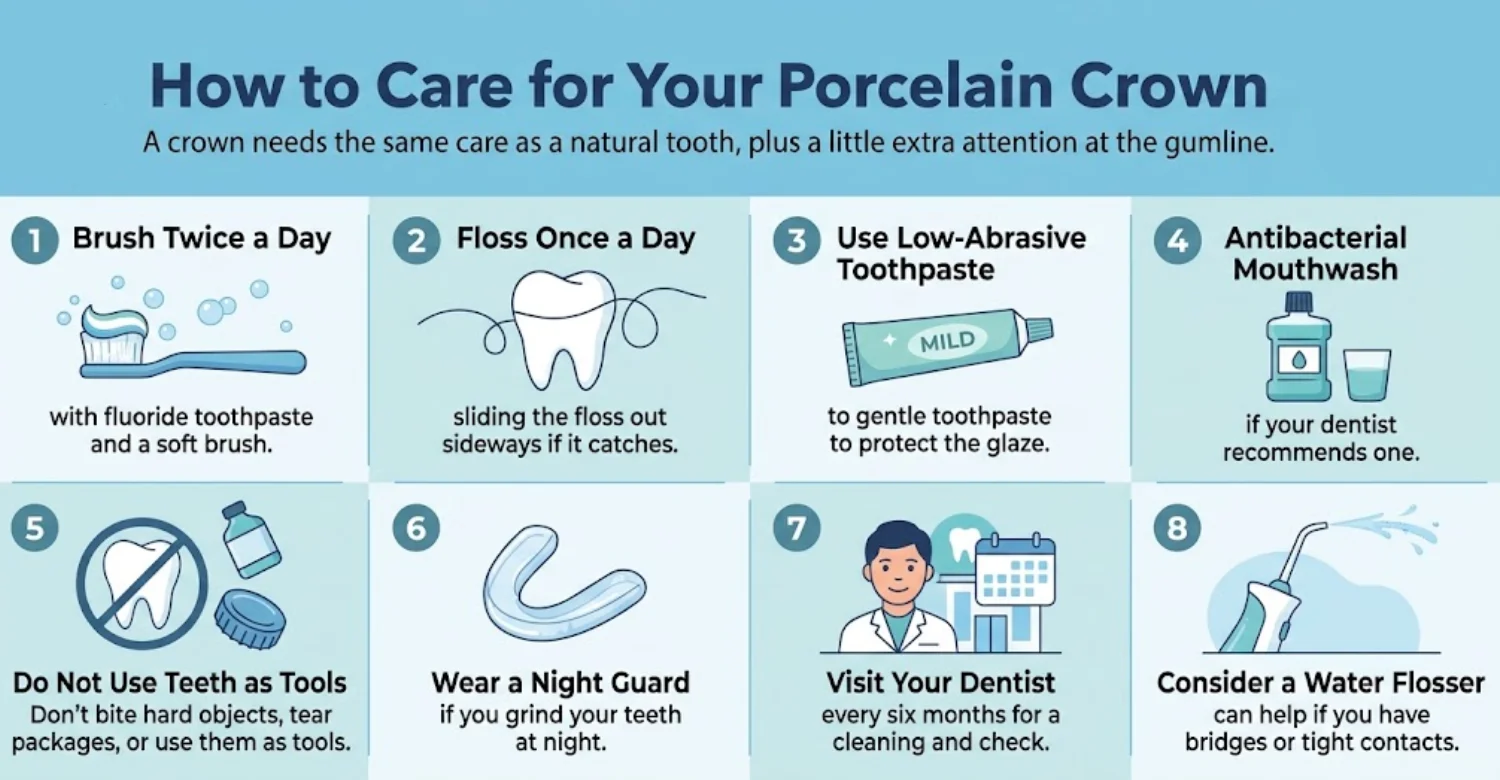
Poor brushing and flossing at the gumline
Skipping checkups and cleanings
Contact sports without a mouth guard
Decay at the crown edge is a major cause of replacement. The crown cannot decay, but the natural tooth under it can. Clean the gumline carefully every day.
Night Guards and Bruxism
Bruxism means grinding or clenching your teeth, often during sleep. Many people do not know they do it. Signs include jaw ache in the morning, headaches and flat, worn teeth.
Grinding puts very high forces on ceramic and can cause chips or cracks. A custom night guard spreads the force and protects both crowns and natural teeth. If you grind, ask your dentist about a guard before or right after your crown is placed. It is a small step that protects a long-term investment.
Signs Your Porcelain Crown Needs Replacement
Crowns do not last forever. Watch for these signs:
A visible chip or crack
A dark line or gap at the gumline
Pain when biting
New sensitivity to hot or cold
A loose feeling or movement
Bad taste or bad breath around the tooth
Gum swelling around the crown
Small chips can sometimes be polished or repaired. Larger damage or decay under the edge usually means replacement. See your dentist early. Waiting can turn a simple fix into a root canal.
Do Porcelain Crowns Stain? Can You Whiten Them?
Glazed porcelain is smooth and non-porous, so it resists staining far better than natural enamel. Coffee, tea and red wine are less likely to change its color.
However, ceramic does not respond to whitening gels. The shade is fixed when the crown is made. If you whiten your natural teeth after getting a crown, the crown will stay the same and may look darker than its neighbors.
How to Clean Surface Stains From a Porcelain Crown
Most marks on ceramic are surface stains or plaque, not color change inside the material. A professional cleaning and polish usually removes them.
At home, brush gently with a low-abrasive toothpaste. Avoid whitening pastes with harsh particles. Avoid baking soda scrubs too. They can scratch the glaze, and scratched ceramic stains more easily. If the color looks wrong all over, or a dark line appears at the gum, the issue is not a surface stain. Ask your dentist to check it.
Porcelain Crowns vs. Alternatives
Treatment | What It Covers | Best For | Advantages | Limitations |
|---|---|---|---|---|
Porcelain Crown vs. Veneer | A crown covers the entire tooth, while a veneer covers only the front surface. | Veneers: healthy teeth with chips, gaps, mild misalignment, or discoloration. Crowns: weak, heavily filled, cracked, or root canal-treated teeth. | Veneers preserve more natural tooth structure. Crowns provide greater coverage and protection for compromised teeth. | Veneers are unsuitable for severely weakened teeth. Crowns usually require more tooth reduction. |
Porcelain Crown vs. Bonding and Whitening | Bonding applies composite resin to the tooth. Whitening lightens the color of natural teeth. | Bonding: small chips and gaps. Whitening: discoloration. Crowns: significantly damaged or weakened teeth. | Bonding and whitening are generally faster, less invasive, and less expensive than crowns. | Bonding can stain or wear over time. Whitening does not repair damage, and neither option strengthens a weakened tooth. |
Porcelain Crown vs. Inlay/Onlay | A crown covers the entire tooth, while an inlay or onlay restores only the damaged portion. | Inlays/onlays: moderately damaged teeth with sufficient healthy tooth structure remaining. Crowns: teeth requiring more extensive coverage and protection. | Inlays and onlays preserve more healthy tooth structure and can provide natural-looking results. | They are unsuitable when too little sound tooth structure remains to support the restoration reliably. |
Porcelain Crown vs. Extraction and Dental Implant | A crown restores a natural tooth. A dental implant replaces a missing tooth root and supports a replacement crown. | Crowns: teeth that can be predictably restored. Extraction and implants: teeth that are non-restorable due to severe decay, deep fractures, or other extensive damage. | Saving a natural tooth is generally preferred when a predictable outcome is possible. Implants can replace teeth that cannot be saved. | Implants require surgery, healing time, and sufficient bone or additional procedures when needed. They are not automatically better than saving a natural tooth. |
Cosmetic Problems a Porcelain Crown Can Correct
Crowns are mostly restorative, but they can also fix cosmetic problems that simpler treatments cannot. When a tooth needs strengthening and a better look, one crown can do both.
Common cases include deep stains, broken or oddly shaped teeth, and small gaps. These fixes can transform how a person feels about smiling. The key is choosing the least invasive option that still gives a stable, lasting result.
Tetracycline Staining
Tetracycline antibiotics taken in childhood can cause gray, brown or banded stains inside the teeth. Because the stain is deep in the tooth, whitening often gives poor or uneven results.
All-ceramic crowns can cover these stains completely when veneers cannot. The ceramist uses a more opaque inner layer to block the dark color, then builds a natural shade on top. For milder cases, opaque veneers may be enough.
Chipped or Misshapen Teeth
Large chips or badly shaped teeth can be rebuilt with a crown. This includes peg-shaped teeth, worn edges and teeth broken in an accident.
For small chips, bonding or a veneer is often enough. A crown is the better choice when much of the tooth is missing or the tooth is also weak. The dentist can redesign the shape and length so the tooth fits the rest of your smile.
Gaps Between Teeth
Small gaps can be closed by making crowns slightly wider than the original teeth. This works best when the teeth also need crowns for other reasons.
Problems After a Porcelain Crown
Most crowns settle in without trouble. A few problems can still happen, especially in the first weeks:
Sensitivity: mild and short-lived in most cases. Lasting or worsening sensitivity needs a check.
High bite: if the crown hits first, the tooth can ache. A quick adjustment fixes it.
Dislodgement: a crown can loosen if the cement fails or the tooth underneath decays.
Chipping: usually from hard foods or grinding.
Hairline Crack in a Porcelain Crown: What to Do
Thin lines on ceramic can be harmless craze lines in the surface glaze. They can also be real cracks through the crown.
Craze lines do not usually need treatment. Learn more in our guide to craze lines. A true crack may cause pain on biting, sensitivity or a rough edge. Do not wait. Avoid chewing on that side and see your dentist. Small damage can sometimes be polished or repaired. A crack that runs through the crown usually means replacement.
Dark Line at the Gumline
A dark line at the gum edge is most common with PFM crowns. The metal underneath shows when the gum recedes or the porcelain is thin at the edge.
It can also come from a darkened root under the crown, or decay at the margin. A dentist should examine it to find the cause. If it is cosmetic only, replacing the PFM with an all-ceramic crown usually solves it. If it is decay, it needs treatment soon.
What to Do If Your Crown Becomes Loose or Falls Off
Call your dentist as soon as possible. Keep the crown clean and safe in a small container.
Until your visit, avoid chewing on that side. Brush the area gently. Some pharmacies sell temporary dental cement that can hold the crown for a short time. Never use household glue. A loose crown can let bacteria in and lead to decay under it. Your dentist will check the tooth and, if it is healthy, re-bond the crown.
When to Call Your Dentist
Contact your dentist if you notice:
A loose or moving crown
Cracks or chips
Pain when biting
Swelling or bleeding gums around the crown
Bad taste or bad breath that does not go away
Sharp edges that hurt your tongue or cheek
Sensitivity that gets worse after the first two weeks
Porcelain Crowns on Dental Implants
An implant replaces a missing root. A crown on top replaces the visible tooth. Ceramic is a popular choice because it looks natural, especially on front implants.
Implant crowns attach through a connector called an abutment. They can be fixed in two ways. Screw-retained crowns are held by a small screw and are easy to remove for maintenance. Cement-retained crowns are bonded to the abutment and can look more seamless, but excess cement must be carefully cleaned away. To understand the parts, read our article on abutment vs crown.
Myths vs Facts About Porcelain Crowns
Myth: A crown always looks fake.
Fact: Modern ceramics and good shade matching make crowns hard to spot at normal speaking distance.
Myth: Crowned teeth cannot get cavities.
Fact: The ceramic cannot decay, but the tooth beneath it can, especially at the gumline.
Myth: Crowns last forever.
Fact: Most last many years, but they wear and may eventually need replacement.
Myth: Ceramic is too weak for daily life.
Fact: With the right material for each tooth, ceramic handles normal chewing well.
Myth: Getting a crown is very painful.
Fact: Local anesthesia keeps treatment comfortable.
How Vitrin Clinic Plans Porcelain Crowns
At Vitrin Clinic, every dental crown treatment begins with a comprehensive dental examination to assess tooth structure, gum health, bite alignment, and existing restorations. X-rays are taken when clinically indicated, and digital intraoral scans help capture precise details for treatment planning. When appropriate, Digital Smile Design allows the team to plan the proposed shape, proportions, and shade before tooth preparation begins.






This article is for general information and does not replace a personal assessment by a qualified dentist. Prices are approximate 2026 averages, with UK and Turkey figures converted to US dollars, and may vary by clinic and case.
Not sure whether Veneers or Hollywood Smile is right for you?
Book your FREE treatment plan with Vitrin Clinic and get a personalized assessment and treatment plan from our dental team.
Ready to transform your smile?
Talk to our team and get a FREE treatment plan.
References:
Cleveland Clinic – Dental Crowns: Types, Procedure & Care
https://my.clevelandclinic.org/health/treatments/10923-dental-crownsAcibadem – Porcelain Crowns
https://acibademinternational.com/treatments/porcelain-crowns/Acibadem – Zirconia vs Porcelain Crowns
https://acibademinternational.com/best-zirconia-crown-clinics-in-turkey/McGill University – Survival Rate Comparison between Zirconia and PFM Crowns (CAT Summary, 2023)
https://www.mcgill.ca/dentistry/files/dentistry/survival_rate_of_zirconia_vs_pfm_crowns_2023.pdfAmerican Dental Association – Code on Dental Procedures and Nomenclature (CDT)
https://www.ada.org/en/cdt
FAQs
Dr. Rifat Alsaman has more than 5 years of clinical experience in dentistry and currently serves as the Head of the Medical Team at Vitrin Clinic. He is dedicated to providing exceptional patient care, overseeing treatment planning, and ensuring the highest clinical standards across the team. His expertise, attention to detail, and commitment to continuous professional development have helped countless patients achieve healthier, more confident smiles.


