General Dentistry
October 1, 2026
Acetaminophen Gummies or Soft Chews: Are They Safe and Effective?
 Dr. Rifat Alsaman
Acetaminophen gummies or soft chews offer a convenient way to take a familiar pain reliever and fever reducer. Their candy-like look does not change the active ingredient or its safety profile. The key details are the milligram amount, serving size, age guidance, and other medicines in use. Acetaminophen can ease headaches, muscle aches, fever, sore throat discomfort, and some toothache symptoms. However, it does not remove the dental or medical cause of persistent pain. Taking too much can cause severe liver injury, sometimes before obvious symptoms appear. The FDA sets a limit of 4,000 mg daily from all medicines for adults and people aged 12 or older.
What Are Acetaminophen Gummies or Soft Chews?
Acetaminophen gummies or soft chews contain acetaminophen in a chewable, soft, or gummy-style dosage form. This format can help people who dislike swallowing tablets. However, formulations differ considerably between manufacturers and markets. Some products marketed as chewables are actually chewable tablets rather than confectionery-style gummies. What matters clinically is the active ingredient and the amount in each unit. Check whether the package lists acetaminophen, paracetamol, or another active ingredient. The label should also state the intended age group, serving size, and directions.
How acetaminophen gummies and soft chews work for pain and fever relief
Acetaminophen is an analgesic and antipyretic medicine. It reduces pain perception and helps lower raised body temperature. Its exact mechanism is not fully understood. Central prostaglandin-related pathways appear to contribute to its effects. Unlike NSAIDs, it does not mainly work by reducing inflammation in painful tissue. This difference can matter when choosing treatment for dental or musculoskeletal pain. A soft chew releases the same active medicine according to its formulation. Acetaminophen gummies or soft chews can offer temporary relief while the cause is assessed.
Acetaminophen gummies vs. chewable tablets, caplets, and liquid medicine
Gummies, soft chews, chewable tablets, caplets, and liquids mainly differ in formulation and administration. Their clinical effect depends on active ingredient, strength, dose, and product design. Tablets and caplets are usually swallowed whole with water. Chewable products are designed to be chewed before swallowing. Acetaminophen gummies or soft chews suit people who prefer chewing over swallowing. Liquids require careful volume measurement because concentrations can vary. U.S. pediatric liquid acetaminophen follows standardized concentration guidance to reduce dosing confusion. A gummy-style product may look simpler, but counting pieces can mislead when strengths differ.
What is the difference between acetaminophen and paracetamol?
Acetaminophen and paracetamol are two names for the same active medicine. Acetaminophen is the common name in the United States, Canada, and several other regions. Paracetamol is widely used in the United Kingdom, Turkey, Europe, Australia, and many other countries. Under either name, the medicine treats pain and fever. Brand names also differ, which can confuse patients who travel. A traveler might buy paracetamol abroad after using acetaminophen at home. Because the ingredient is the same, the total daily amount still matters. Taking both products together counts as a double dose.
How much acetaminophen is in each gummy or soft chew?
The amount varies widely between products, so there is no universal gummy dose. Some pediatric chewables contain 160 mg per unit. Adult formulations commonly use higher strengths. The label should state the active ingredient per piece and the recommended serving. Calculate total milligrams rather than simply counting gummies. Two units of one product may equal one unit of another. Always review unfamiliar acetaminophen gummies or soft chews before the first dose.
Why the milligram amount matters more than the number of gummies
The number of pieces does not reveal the actual medicine dose. One product may contain 80 mg per piece, while another contains 160 mg. Counting pieces without checking strength can therefore cause an unintended overdose. The same risk appears when switching between pediatric and adult products. Total daily exposure must include every acetaminophen-containing medicine. The FDA advises consumers to know the milligrams in all medicines they use. Record both the product name and the amount whenever several doses are taken.
How product strength and serving size can differ between brands
Manufacturers use different strengths, unit counts, and serving instructions. A package may list the amount per gummy, per two gummies, or per serving. These differences make comparisons difficult without reading the Drug Facts panel. Children’s products may also use different age ranges between brands. Two similar fruit-flavored chews can therefore contain different amounts of medicine. Compare milligrams, serving size, maximum daily use, and intended age group. Never copy dosing instructions from another brand.
Who Can Take Acetaminophen Gummies or Soft Chews?
Eligibility depends on age, weight, formulation, medical history, and the specific product label. Adults may use suitable strengths when acetaminophen is appropriate for them. Children need closer attention, because pediatric doses are often weight-based or age-specific. Toddlers may not suit every chewable product, since chewing ability and choking risk vary. A child’s medical history can also change whether a product is suitable. Liver disease, repeated dosing, multiple medicines, and nutritional concerns can increase risk. Pregnant patients should discuss any repeated medicine use with a clinician.
Acetaminophen gummies for adults
Adults can generally use a suitable acetaminophen product when the label permits adult use. The main safety issue is total exposure, not the dosage form. The FDA sets 4,000 mg in 24 hours as the maximum from all medicines. This limit applies to adults and people aged 12 or older. Many labels recommend lower maximums, and personal circumstances may require less. People with liver disease should seek professional advice before use. The same applies to heavy alcohol use or prolonged self-treatment.
Acetaminophen gummies for kids
Children can use pediatric acetaminophen products when the label supports their age and weight. The product should match the child, not the caregiver’s preferred format. The American Academy of Pediatrics recommends weight-based dosing whenever possible. It also advises against giving adult products to children. Caregivers should never guess a dose from the number of gummies. Verify the strength per unit before every administration. Younger children may need liquids instead of chewables, because chewing and swallowing abilities differ.
Children’s acetaminophen gummies and age-specific labeling
Pediatric medicines are often grouped by age because strengths and directions differ. A product suitable for an older child may not suit a toddler. Packaging may list minimum ages, dosing intervals, and maximum daily doses. Follow the current label rather than an older product stored at home. Manufacturers can change packaging, formulations, or directions over time. U.S. pediatric guidance also aims to reduce errors caused by confusing concentrations.
Gummy acetaminophen for kids: what parents should check
Parents should check the active ingredient, strength per unit, serving size, and age range. They should also confirm dosing frequency and the maximum daily amount. Review every other active ingredient listed on the package. Combination products may add acetaminophen to cough, cold, or allergy ingredients. Using two such products can unintentionally raise total exposure. Expiration dates and storage instructions also deserve attention. The American Academy of Pediatrics recommends using the child’s weight to determine the dose.
Acetaminophen gummies for toddlers: are they appropriate?
Toddler suitability depends on the exact product, not the word gummy. Some formulations are not designed for very young children. Chewing ability, choking risk, strength, and labeled age range all matter. A toddler may need a liquid, which permits more precise measurement. Do not cut, crush, or modify medicated products unless instructions allow it. Never give adult-strength products to toddlers. The American Academy of Pediatrics emphasizes correct product choice and weight-based dosing.
Why age, weight, formulation, and swallowing ability matter
Age and weight help determine whether a pediatric product is suitable and how much is needed. Formulation matters because liquids allow measured volumes, while chewables require adequate chewing ability. Swallowing ability also affects choking risk and practical administration. These factors become especially important during fever, when children may be tired or irritable. Never assume a larger child can simply take an adult product. Check the label for every medicine strength.
When parents should ask a pediatrician before giving acetaminophen
Seek professional advice when a child is very young, has liver disease, or takes other medicines. Advice is also wise for repeated fever or pain. Ask for help whenever you cannot calculate the dose confidently. A pharmacist can verify the product, strength, and schedule. A pediatrician is better placed to assess persistent or unusual symptoms. Parents should also seek advice after any possible dosing error.
Teen gummies and acetaminophen dosing considerations
The FDA adult maximum of 4,000 mg daily includes teenagers aged 12 and older. Product labels may still set lower limits for this age group. Teen dosing requires attention to product strength and individual circumstances. Adolescents sometimes self-medicate without recognizing overlapping ingredients. They may combine cold remedies, sports supplements, or prescription pain medicines. Parents and teens should therefore learn to spot acetaminophen on labels. The American Academy of Pediatrics warns against exceeding labeled doses.
How Should Acetaminophen Gummies or Soft Chews Be Taken?
Safe use starts with the exact product directions. Never apply instructions from a different medicine. Verify the active ingredient and amount before each dose. Follow the labeled interval between doses and the maximum within 24 hours. Calculate total exposure from every medicine used that day, including cold products and prescriptions. Adults and older adolescents should not exceed the FDA maximum of 4,000 mg daily. Many products recommend less than this limit. Children should follow their specific age and weight guidance.
How to read the acetaminophen dose on the package
Start with the active ingredients section of the label. Look for acetaminophen or, in some markets, paracetamol. Then identify the amount per unit, such as one chewable or one gummy. Next, check whether a serving contains one unit or several. Review the age range and dosing directions separately. Finally, identify the maximum daily amount allowed. The FDA advises checking all medicines for this ingredient and its milligram amount. This applies equally to acetaminophen gummies or soft chews and tablets.
How often can acetaminophen be taken?
The interval depends on the product, strength, age group, and label. Some adult formulations are taken every four to six hours. Pediatric products follow their own directions. The NHS advises at least four hours between adult paracetamol doses. It also limits adults to eight standard 500 mg tablets within 24 hours. U.S. products may use different directions, so local labeling matters. Never shorten the interval because pain remains severe.
How to calculate total acetaminophen from all medicines
Add the milligrams from every acetaminophen-containing product taken within the same 24 hours. Include single-ingredient products and combination medicines. Prescription products may list the ingredient as APAP or another abbreviation. Add each individual dose rather than counting packages. A pain reliever and a cold medicine may both contain the same ingredient. This duplication can happen even when brand names look unrelated. The FDA advises knowing the amount in every medicine you use.
Why you should not combine multiple acetaminophen-containing products
Combining products can unexpectedly increase the total amount taken. One medicine may target pain, while another targets cold or flu symptoms. Both may still contain acetaminophen. Prescription pain medicines can include the same ingredient too. This creates duplication risk rather than any therapeutic advantage. The FDA advises against taking more than one OTC product containing acetaminophen. It also recommends checking with a professional before mixing prescription and OTC products.
Cold and flu medicines that may also contain acetaminophen
Many cold and flu medicines combine acetaminophen with ingredients for congestion, cough, or allergy symptoms. Because these products target several symptoms, consumers may miss the pain reliever inside. Adding a single-ingredient medicine can then raise total exposure. The FDA and MedlinePlus identify cold and flu products as common sources of duplicate use. Read the active ingredient panel before adding another medicine. Acetaminophen gummies or soft chews should not be added without checking these labels.
Prescription pain medicines that contain acetaminophen
Some prescription pain relievers combine acetaminophen with another analgesic. Hydrocodone-acetaminophen is one well-known example. The prescription label may display both the opioid amount and the acetaminophen amount. Patients sometimes focus on the opioid number and overlook the second ingredient. This becomes dangerous if they add an OTC product containing acetaminophen. FDA labeling for hydrocodone-acetaminophen clearly identifies the acetaminophen content. Treat this component as part of your daily total.
What to do if you forget a dose
Acetaminophen is often taken only as needed, so a missed dose may not need replacing. Some clinicians, however, recommend regular dosing for a set period. In that case, MedlinePlus advises taking the missed dose when remembered. If the next dose is nearly due, skip the missed one. Then continue the usual schedule. Never take a double dose to catch up. Doubling raises total exposure without improving pain control safely.
Can acetaminophen gummies be taken with food?
Acetaminophen can generally be taken with or without food. MedlinePlus states that a normal diet can continue unless a clinician advises otherwise. Food is therefore not usually needed for the medicine to work safely. Individual products may have different directions, so check the package. People with stomach discomfort may prefer taking medicine after eating. Eating first does not reduce overdose risk, however.
What Pain and Fever Can Acetaminophen Gummies Relieve?
Acetaminophen can temporarily reduce mild to moderate pain and fever. Common uses include headache, sore throat discomfort, muscle aches, and minor cold symptoms. Some people also use it for toothache pain. The medicine relieves symptoms rather than eliminating their cause. That distinction matters when symptoms continue. The ADA describes nonopioid medicines as part of temporary care until definitive treatment is available. Acetaminophen gummies or soft chews ease discomfort, but they cannot repair a damaged tooth.
Headache, body aches, and fever relief
Acetaminophen is commonly used for temporary relief of headache, muscle aches, and raised temperature. Its main role is symptom reduction. It does not treat viruses, bacterial infections, dehydration, or many other underlying causes. Follow the product directions and avoid other acetaminophen-containing medicines. Rest and fluids often support recovery alongside medication. Fever that persists, becomes severe, or occurs with concerning symptoms needs medical assessment. Recurrent headaches also deserve evaluation when they are unusual or persistent.
Can acetaminophen gummies help with toothache?
Acetaminophen can provide temporary toothache relief for some patients. The ADA includes it among medicines used for acute dental pain. However, relief does not mean the painful tooth has been treated. Toothache may result from reversible or irreversible pulp inflammation, decay, trauma, or infection. Each condition progresses differently without care. Acetaminophen gummies or soft chews may suit patients who struggle with tablets during dental pain.
When acetaminophen may provide temporary dental pain relief
Temporary pain relief can help while you arrange dental care. It may reduce discomfort enough to support sleep, eating, or travel to an appointment. The ADA describes analgesics as a bridge to definitive care, not a replacement. The right medicine depends on age, health conditions, contraindications, and pain characteristics. Some patients benefit from NSAID alone, when medically appropriate. Others may benefit from an NSAID combined with acetaminophen.
Why pain relief does not treat the underlying dental problem
Pain is a symptom, not a diagnosis. A medicine can reduce pain signals while the disease process continues. Decay can progress, and pulp inflammation can worsen without treatment. An untreated infection can spread into surrounding tissues. The ADA stresses that analgesics for toothache only bridge access to definitive dental care. Delaying treatment because symptoms improve can let the problem advance.
Tooth decay and dental infection
Tooth decay can progress from surface damage to deeper pulp involvement. As the pulp becomes inflamed or infected, pain may become persistent or spontaneous. Dental infection can also cause swelling, tenderness, fever, or drainage. Pain medicine may reduce symptoms temporarily. However, it cannot remove infected tissue or restore damaged tooth structure. The ADA recommends dental treatment rather than antibiotics alone for most pulpal and periapical pain.
Gum inflammation and other oral causes of pain
Gingivitis, periodontitis, traumatic ulcers, impacted teeth, and cracked teeth can all cause discomfort. Oral soft-tissue conditions may also produce pain. The location and character of pain offer clues, but diagnosis requires examination. Analgesics reduce the symptom without identifying its source. Persistent gum pain may require periodontal evaluation. A cracked tooth may require restorative assessment. Oral lesions that do not heal as expected also deserve professional review.
When persistent dental pain needs professional evaluation
Pain that continues, returns, or worsens deserves dental assessment. Swelling, fever, drainage, or difficulty opening the mouth increase urgency. Facial swelling or trouble swallowing may require emergency care. The ADA identifies definitive options such as pulpectomy, root canal treatment, drainage, or extraction. Pain medicine should not be used indefinitely while delaying evaluation.
What Are the Side Effects of Acetaminophen Gummies or Soft Chews?
When taken correctly, acetaminophen generally causes few side effects. However, no medicine is completely risk-free. Serious reactions can include severe skin reactions, allergic reactions, and liver injury. The greatest danger is excessive total exposure. Overdose can progress to major liver damage, liver failure, or death. Symptoms can be delayed after a dosing error. Feeling well immediately afterward therefore does not guarantee safety. People with liver disease and other risk factors need extra caution.
Common or expected side effects
Acetaminophen gummies or soft chews are usually well tolerated when taken correctly. Some people experience nausea, stomach discomfort, or other nonspecific symptoms. Significant adverse effects are uncommon. Do not continue a medicine automatically when unusual symptoms develop. Consider whether another ingredient in a combination product could be responsible. Severe, persistent, or unusual symptoms deserve review by a clinician or pharmacist.
Less common but serious side effects
Serious reactions are uncommon but can include severe skin reactions, allergic reactions, and liver injury. MedlinePlus lists red, peeling, or blistering skin as emergency warning signs. Facial swelling and breathing problems also require immediate care. Yellow skin, dark urine, pale stools, or upper abdominal pain may suggest liver injury. These symptoms need urgent medical attention.
Signs of a severe allergic reaction
A severe allergic reaction can cause swelling of the face, lips, tongue, or throat. Difficulty breathing or swallowing is an emergency sign. Widespread hives, wheezing, or rapidly worsening symptoms also need urgent attention. Severe skin reactions can occur as well. Anyone with suspected anaphylaxis should seek emergency care immediately. This reaction differs from liver toxicity and needs different urgent treatment.
Symptoms that may indicate liver injury
Warning signs include nausea, vomiting, upper abdominal discomfort, and yellowing of the skin or eyes. Dark urine and pale stools may also appear. Loss of appetite and unusual sweating can occur too. Importantly, symptoms may not appear soon after excessive ingestion. Liver injury can develop after a period with few symptoms.
Why acetaminophen overdose can be dangerous even when symptoms are initially mild
Acetaminophen toxicity can begin without dramatic symptoms. MedlinePlus notes symptoms may not occur until 12 hours or more after ingestion. Other sources note symptoms can appear within several hours or later. This delay can create false reassurance. Liver injury may progress before the person realizes how serious the exposure was. Seek prompt guidance after exceeding the labeled amount.
Can You Take Acetaminophen Gummies With THC, CBD, or Other Gummies?
The word gummy does not describe a single type of substance. THC, CBD, vitamins, fiber, creatine, botanical extracts, and other supplements all appear in gummy form. Their ingredients and pharmacology differ significantly. Evidence for many combinations remains limited, especially for variable commercial supplements. CBD has documented potential to affect drug metabolism. THC products can also vary widely in dose and composition. Acetaminophen gummies or soft chews should be reviewed alongside every supplement you use.
Acetaminophen and weed gummies: what is known about the combination?
Limited clinical evidence describes a clear interaction between acetaminophen and recreational cannabis products. Cannabis products vary widely in THC, CBD, other cannabinoids, and possible contaminants. Research findings therefore cannot always apply to every commercial gummy. Consider impairment, sedation from other medicines, and underlying liver concerns. A lack of strong evidence does not prove complete safety.
Acetaminophen and THC gummies: possible safety considerations
THC products can alter attention, coordination, perception, and reaction time. These effects are separate from the pain-relieving action of acetaminophen. The main concern is the full pharmacological picture, not the gummy format. Other medicines, alcohol, liver disease, and product strength can all change the situation. Do not treat THC products as ordinary supplements without drug-like effects.
Could acetaminophen interact with THC gummies?
A clinically important interaction has not been firmly established for every THC formulation. However, the evidence base remains incomplete. THC products contain varying concentrations and combinations of cannabinoids. Other medicines taken at the same time may add further interactions. Patients should therefore avoid a blanket rule that the combination is always safe.
Can you take CBD gummies with Tylenol or acetaminophen?
CBD can affect how other medicines are metabolized. The FDA has specifically warned about drug interactions involving cannabidiol. The degree of interaction depends on the CBD product, dose, formulation, and other medicines. Evidence from pharmaceutical CBD cannot automatically apply to every OTC gummy. Acetaminophen gummies or soft chews and CBD products should never be combined without checking labels.
CBD gummies and acetaminophen: what the evidence currently shows
Current evidence shows CBD can influence drug metabolism. It may change exposure to some medicines. The FDA notes that studies of approved CBD products show potential interactions. However, commercial CBD products vary in dose and composition. Interaction studies do not cover every possible combination. Evidence should therefore be treated as product- and dose-dependent.
Why CBD interaction evidence remains limited
Commercial CBD products are not standardized like prescription medicines. They differ in concentration, purity, cannabinoid profile, and formulation. Research often uses pharmaceutical-grade cannabidiol rather than retail supplements. Study populations can be small or focused on specific medicines. The FDA highlights limited research involving CBD with herbs and plant-based supplements.
Why the exact CBD product, dose, and other medicines matter
Interaction risk depends on CBD quantity, processing method, and other medicines in use. A low-dose product may behave differently from a concentrated extract. Another medicine may compete for the same metabolic pathways. Liver function adds another layer of complexity. Share the product name, ingredient panel, estimated dose, and frequency with a professional. This information allows a more accurate risk assessment.
Acetaminophen with creatine gummies
Creatine gummies are dietary supplements, not pain medicines. No universal interaction rule exists for every creatine formulation and acetaminophen product. The supplement may also contain extra ingredients beyond creatine. Read the complete label rather than assuming creatine is the only component. People with kidney or liver concerns should discuss regular supplement use with a clinician.
Acetaminophen with fiber gummies
Fiber gummies usually provide dietary fiber rather than an analgesic ingredient. They work very differently from acetaminophen. However, fiber supplements can have gastrointestinal effects. Depending on product and timing, they may affect how some medicines are absorbed. People taking several medicines should review timing with a pharmacist.
Acetaminophen with multivitamin gummies
Multivitamin gummies may contain vitamins, minerals, sweeteners, and other additives. Most are not pain medicines, but formulations vary widely. Do not assume one manufacturer’s product equals another. High-dose supplements can raise separate concerns unrelated to acetaminophen. Reviewing the full label helps identify ingredients relevant to liver health or medicines.
What about shilajit gummies and acetaminophen?
Shilajit is a botanical substance used in some dietary supplements. Evidence about its interactions with medicines is limited. Commercial formulations also vary considerably. Some products contain additional herbs or minerals. A broad statement about combining it with acetaminophen would therefore be unreliable. Show the exact product label to a healthcare professional before regular combined use.
Is acetaminophen, Tylenol, or shilajit the same type of product?
No, these are different types of products. Acetaminophen is an active pharmaceutical ingredient. Tylenol is a brand name for products containing acetaminophen. Shilajit is a botanical substance sold in dietary supplements. Their regulatory categories, ingredients, evidence, and purposes all differ. A shared gummy format does not make these substances equivalent.
Are “trip gummies” safe to combine with acetaminophen?
Trip gummies is an informal label covering very different products. Some contain cannabinoids, botanical compounds, nootropics, or psychedelic substances. Without an exact ingredient list, the interaction profile cannot be determined. Actual contents may also differ from marketing claims. Combining an unidentified psychoactive product with medicine is difficult to assess reliably. Disclose any such product to a healthcare professional.
Why the full ingredient list matters before combining products
A label may contain more than the main ingredient promoted on the front. Additional cannabinoids, stimulants, sedating compounds, herbs, vitamins, or proprietary blends can affect safety. Supplement labels may also vary between batches or manufacturers. The FDA urges caution with CBD and plant-based supplements because interaction research remains limited.
What About Hydrocodone-Acetaminophen 5-325 and Gummy Products?
Hydrocodone-acetaminophen is a prescription combination of an opioid and acetaminophen. The 5-325 label refers to the amount of each component per tablet. It is fundamentally different from an OTC single-ingredient product. Patients must count the prescription’s acetaminophen in their daily total. Adding acetaminophen gummies or soft chews can raise exposure and potentially cause liver toxicity. Hydrocodone also carries opioid-specific risks. These include sedation, respiratory depression, and dependence.
What does hydrocodone-acetaminophen 5-325 mean?
The label indicates 5 mg of hydrocodone and 325 mg of acetaminophen per unit. Hydrocodone is an opioid analgesic. Acetaminophen is a non-opioid pain reliever. The two ingredients work differently and are combined for added pain relief. Because each unit contains acetaminophen, count those 325 mg in your daily total. Follow the prescription label at all times.
Why hydrocodone-acetaminophen is different from over-the-counter acetaminophen gummies
The prescription combines acetaminophen with hydrocodone. A single-ingredient chewable contains acetaminophen without any opioid. Hydrocodone can affect the central nervous system and breathing. It also involves additional prescribing restrictions and safety considerations. Never substitute one product for the other based on milligram numbers alone.
Can prescription hydrocodone-acetaminophen be taken with another acetaminophen product?
Do not add another acetaminophen product unless a healthcare professional specifically advises it. The prescription already contributes acetaminophen to your daily total. The FDA warns against combining prescription and OTC acetaminophen products without professional advice. This is a common pathway to accidental excess exposure.
Why patients should check for duplicate acetaminophen ingredients
Duplicate exposure happens when patients recognize only a brand name or primary ingredient. Prescription labels may say APAP, while OTC products use the full name. Cold medicines can contain acetaminophen without being marketed for pain. Checking every label prevents this hidden duplication. A pharmacist can review all your medicines in one visit.
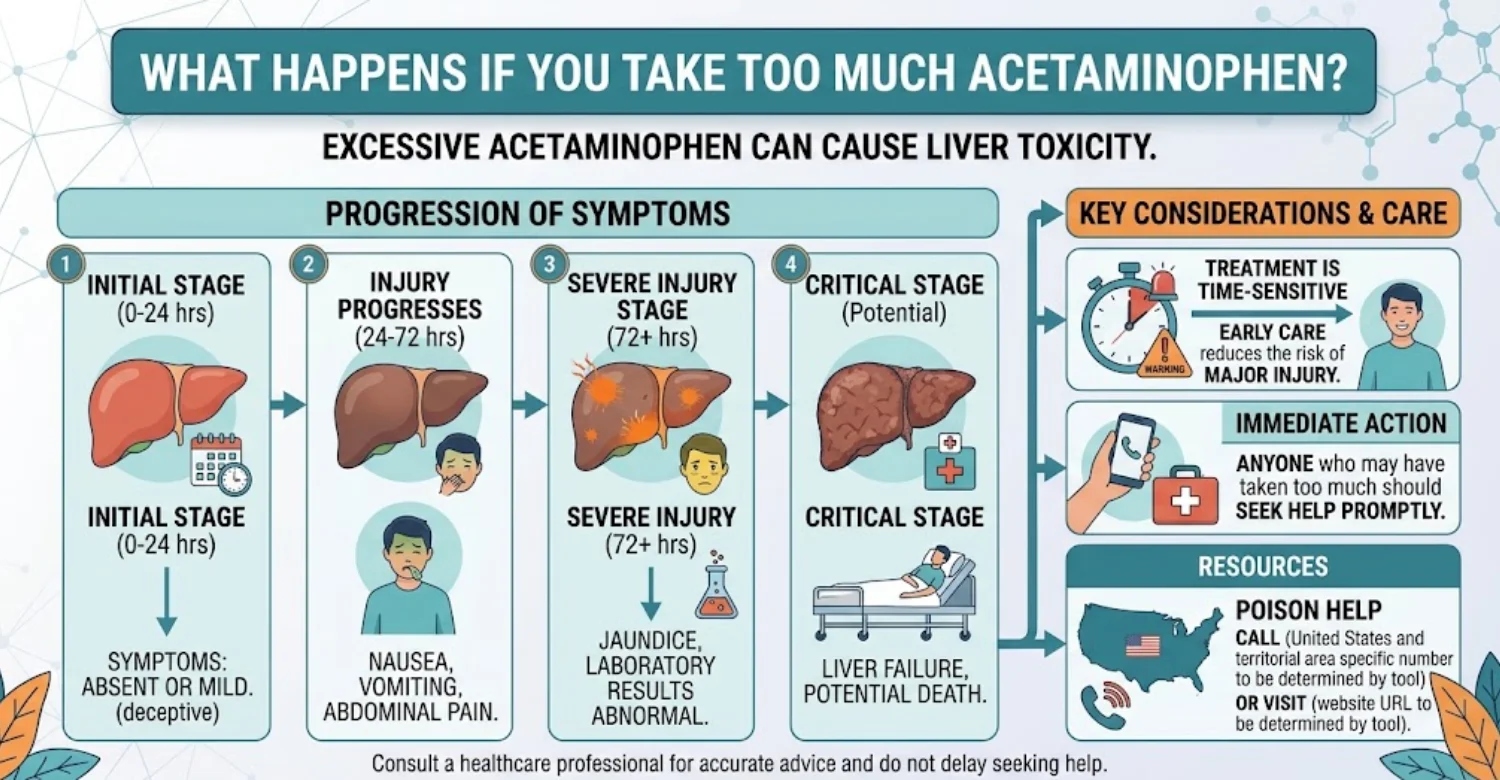
Early symptoms of acetaminophen overdose
Early symptoms may include nausea, vomiting, sweating, abdominal discomfort, loss of appetite, or general malaise. However, some patients have few symptoms at first. Symptoms alone therefore cannot show whether an overdose is dangerous. A person may look well while liver injury develops.
Why acetaminophen toxicity may cause few symptoms at first
Toxic effects develop through metabolic pathways that may not cause immediate symptoms. This creates an early period when the person can feel relatively normal. The delayed presentation explains why clinicians do not rely on symptoms alone. They use ingestion timing, blood levels, and laboratory tests instead.
What symptoms can develop as liver injury progresses?
Progressive toxicity may cause worsening abdominal pain, persistent vomiting, jaundice, confusion, and severe weakness. Liver function tests may become markedly abnormal. Severe cases can progress to liver failure, bleeding problems, kidney injury, coma, or death. Not every person develops every symptom.
When an accidental overdose requires urgent medical attention
Urgent assessment is appropriate after taking more than the package recommends. It is also needed after using overlapping products or ingesting an unknown amount. The NHS advises seeking medical help after taking more paracetamol than the packet states. U.S. guidance also advises immediate help after suspected excess exposure.
What information to bring to a doctor, emergency department, or poison center
Bring the product container, package insert, or a clear photo of the label. Note the estimated amount taken and the time of ingestion. Provide the person’s age, body weight, and other medicines or supplements. Include combination cold products and prescription medicines. If doses occurred over several days, describe the timing and amounts accurately.
How Is Acetaminophen Overdose Diagnosed?
Clinicians combine the exposure history with blood testing and liver evaluation. Ingestion timing is especially important, since acetaminophen levels are interpreted against it. A blood acetaminophen concentration may be measured after a suspected acute overdose. Liver function tests show whether injury has already developed. A poison center or emergency clinician can guide testing.
What information does a clinician need?
Clinicians generally need the product name, strength, amount taken, and timing. They also need the patient’s age, body weight, other medicines, and medical history. They may ask about repeated dosing over several days. Accurate packaging information prevents errors caused by assumptions about strength.
When is a blood acetaminophen level measured?
A blood level may be measured after a suspected acute overdose. The test shows exposure and can guide treatment when timing is known. It may be repeated in certain situations to monitor progress. Results are interpreted alongside ingestion time and clinical context.
How liver function tests help evaluate toxicity
Liver tests help clinicians see whether liver cell injury is developing. They can show abnormalities even when symptoms remain limited. Other laboratory markers help assess clotting and overall liver function. Because toxicity can progress, clinicians may repeat blood tests over time.
What other blood tests may be needed?
Additional tests can assess kidney function, electrolytes, glucose, clotting status, and acid-base balance. The exact panel depends on the patient and the suspected severity. Severe cases may need more intensive monitoring. These tests reveal complications that symptoms alone may not show.
How the timing of ingestion affects overdose assessment
Timing helps clinicians interpret the blood level and decide whether treatment is needed. A patient who cannot state the ingestion time may need more cautious evaluation. Repeated excessive dosing creates a different challenge than a single acute ingestion. Accurate timing information is therefore clinically valuable.
How Is Acetaminophen Poisoning Treated?
Treatment depends on the amount taken, timing, laboratory results, symptoms, and overall health. A major therapy is N-acetylcysteine, commonly called NAC. It helps replenish glutathione and supports detoxification of the toxic metabolite. Treatment may begin before severe liver injury develops. Waiting for major symptoms reduces the opportunity to prevent complications. Significant poisoning or liver injury may require hospital care.
Why treatment should not wait for severe symptoms
Serious liver injury can develop while early symptoms remain mild or absent. Waiting for jaundice or severe abdominal symptoms allows toxicity to progress. Medical treatment is most useful when started promptly after significant exposure. Early care often means shorter treatment and better outcomes.
N-acetylcysteine and acetaminophen toxicity
N-acetylcysteine is the established antidote for significant acetaminophen poisoning. It works best when given early. It may still provide benefits later in the course of poisoning. Clinicians decide the need and duration from laboratory results and clinical response.
Monitoring liver and kidney function after an overdose
Doctors may repeat liver enzymes, bilirubin, coagulation tests, kidney studies, and other markers. Monitoring shows whether injury is resolving or progressing. Patients with substantial toxicity may need prolonged hospital observation. Specialist input may also be required in severe cases.
When hospital or emergency care may be necessary
Emergency care may be needed after significant ingestion or an uncertain quantity. Repeated excessive dosing, abnormal blood tests, or severe symptoms also warrant hospital assessment. Suspected liver injury always requires urgent evaluation. Patients should not drive themselves when severely unwell.
What Factors Increase the Risk of Acetaminophen-Related Problems?
The most common preventable risk is taking more than intended. This can result from duplicate medicines, incorrect dosing, or repeated use over several days. Liver disease, heavy alcohol use, low body weight, and poor nutrition can also increase concern. Frailty and complex medication schedules add further risk. Acetaminophen gummies or soft chews follow the same risk principles as tablets.
Taking more than one acetaminophen-containing medicine
Using multiple products with the same active ingredient can cause accidental cumulative exposure. Cold remedies and prescription analgesics are common examples. Read the active ingredient section on each product before combining them. Keep all current medicines together so you can compare labels.
Liver disease and other medical conditions
People with liver disease should discuss acetaminophen use with a healthcare professional. Other medical conditions can also affect medication choices, especially with multiple drugs. MedlinePlus recommends discussing use with a clinician when liver or kidney disease is present. A lower daily limit may be advised in some cases.
Heavy alcohol use
Heavy or binge alcohol use can increase concern about liver toxicity. NHS guidance advises seeking professional advice before using paracetamol in these situations. The same applies to people with liver or kidney conditions or alcohol dependence. Be honest with clinicians about drinking habits.
Low body weight, frailty, or nutritional concerns
Lower body weight and poor nutrition can affect how clinicians assess medication exposure. Older or frail adults often have several medicines and chronic conditions. A personalized assessment can therefore be safer than relying on a standard maximum. Recent illness or reduced eating may also matter.
Repeated dosing over several days
Toxicity can follow repeated excessive dosing rather than one dramatic ingestion. Taking slightly more than recommended across several days can still be dangerous. Medication records are useful when pain or fever persists. A recurring need for medicine also suggests the cause needs assessment.
Medication and supplement combinations
Supplement products can have complex ingredient lists and limited interaction research. CBD is one example where the FDA has identified possible interactions with medicines. Disclose all supplements rather than assuming they are irrelevant. Include herbal teas, powders, and sports products in your list.
What Can Help With Pain Relief Besides Acetaminophen Gummies?
Pain management should match the underlying cause. Options may include NSAIDs, local measures, dental procedures, physical strategies, or clinician-directed treatments. ADA guidance supports nonopioid analgesics as first-line options for many patients with acute dental pain. Some adults and adolescents benefit from NSAIDs alone or combined with acetaminophen. However, NSAIDs are not suitable for everyone. Acetaminophen gummies or soft chews are one option among several, not a universal answer.
Choosing an appropriate pain-relief option for the cause of pain
The cause of pain matters more than the product format. Headache, muscle pain, tooth decay, gum inflammation, and post-procedure pain may need different approaches. Medication history, age, health conditions, and contraindications also influence the choice. A pharmacist or clinician can help when self-treatment is uncertain.
Medical tips for using over-the-counter pain medicine safely
Use the lowest effective amount recommended on the label. Never exceed the stated maximum. Check every active ingredient before adding another product. Avoid taking several products containing the same medicine. Keep products in their original containers. Record doses when frequent treatment is required.
Non-drug approaches that may provide temporary relief
Depending on the cause, rest, hydration, and soft foods may reduce discomfort temporarily. Avoiding known triggers can also help. For dental symptoms, gentle oral hygiene keeps the area clean. Avoid very hot or cold foods while awaiting evaluation.
When another pain-management approach may be more appropriate
Repeated severe pain may signal that medication alone is inadequate. For dental problems, treatment can address the underlying cause directly. Options include restoration, root canal therapy, extraction, periodontal care, or drainage. For other pain conditions, a clinician may suggest a different medicine.

Note : All images used are for editorial and illustrative purposes only and may not originate from the original news provider or associated company.
How Can Acetaminophen Gummy Errors Be Prevented?
Many medication errors are preventable with simple routines. Keep products in their original packaging. Read the active ingredient every time you take a dose. Use the exact strength intended for the patient. Record doses when several caregivers are involved. Never describe a medicated gummy as candy to a child. Children should not have unsupervised access, because accidental ingestion can cause serious poisoning. Store acetaminophen gummies or soft chews with other medicines, never with snacks.
Keep gummies and medicines away from children
Store medicines securely, ideally in a location children cannot reach or open. Child-resistant packaging reduces risk but does not eliminate it. Attractive flavors and shapes make medicated products especially appealing. Acetaminophen gummies or soft chews need the same secure storage as any medicine. Return medicines to secure storage immediately after each use.
Check the active ingredients before every dose
Check the ingredient panel, strength, and serving size before taking another medicine. This step is essential when switching brands or adding a cold remedy. Familiar packaging should never replace label checking.
Use the correct product and strength for the patient
The correct medicine depends on age, weight, health conditions, and formulation. Adult products should not automatically be used for children. Pediatric guidance emphasizes matching the product to the child.
Keep a record when several caregivers give medicine
A written record can show the product, time, dose, and caregiver. This prevents two adults from independently giving the same medicine. A simple phone note works well. Shared family apps can also help.
Do not treat medicated gummies like ordinary candy
Medicine should always be recognized as medicine, whatever it looks like. Gummies can contain clinically significant drug doses. Acetaminophen gummies or soft chews are medicines, even when they taste like sweets. Teach children to take medicine only from an approved adult.
How Much Do Acetaminophen Gummies or Soft Chews Cost?
Prices depend on dosage form, strength, package size, brand, retailer, country, and local regulation. Current U.S. listings show children’s chewable tablets around $3.69 for 24 generic units at Target. Branded 24-count chewables appear around $7.99 at Target. Walmart lists branded 24-count chewables around $7.98. These examples are chewable tablets, not proof of a universal gummy price. In the UK, Boots lists a 16-tablet generic pack at $0.49. In Turkey, an August 2026 price list shows PAROL 500 mg 30 tablets at 105.16 $.
Country | Product Example | Package Size | Indicative Price |
United States | Generic children’s chewable tablets | 24 units | ~$3.69 |
United States | Branded children’s chewable tablets | 24 units | ~$7.99 |
United States | Branded children’s chewable tablets | 24 units | ~$7.98 |
United Kingdom | Generic paracetamol 500 mg tablets | 16 tablets | ~$0.49 |
United Kingdom | Panadol 500 mg capsules | 16 capsules | ~$4.99 |
Turkey | PAROL 500 mg tablets | 30 tablets | ~105.16 $ |
Turkey | PAROL 500 mg tablets | 20 tablets | ~79.10 $ |
These are product-specific retail examples rather than universal national averages. Gummy and soft-chew prices may differ because these formulations are not equally available in every market.
Average Cost of Acetaminophen Gummies or Soft Chews in the United States
No single reliable national average exists for gummy-style products in the United States. Availability of true gummy formats varies by retailer and region. Current children’s chewable listings show generic examples around $3.69 per 24-count pack. Branded examples cost around $7.99. Larger or specialty products may cost more.
U.S. Product Type | Package Size | Indicative Cost |
Generic children’s chewables | 24 units | ~$3.69 |
Branded children’s chewables | 24 units | ~$7.99 |
Branded children’s chewables | 24 units | ~$7.98 |
Gummy or soft-chew formulations | Varies | No reliable national average |
Average Cost of Acetaminophen or Paracetamol Products in the UK
Current UK prices for standard paracetamol tablets can be very low. Boots lists generic 500 mg paracetamol at $0.49 for 16 tablets. Panadol branded 500 mg capsules are listed at about $4.99 for 16. This shows how brand, formulation, and retailer change the final price.
UK Product | Strength | Package Size | Indicative Cost |
Generic paracetamol tablets | 500 mg | 16 tablets | ~$0.49 |
Panadol capsules | 500 mg | 16 capsules | ~$4.99 |
Gummy or soft-chew formulations | Varies | Varies | Availability and pricing vary |
Average Cost of Acetaminophen or Paracetamol Products in Turkey
A current 2026 listing shows PAROL 500 mg, 30 tablets, at 105.16 $. A 20-tablet package is listed at 79.10 $. These figures reflect listed retail prices. They can change with updated national price lists. They describe conventional tablets rather than gummy-style formulations.
Turkey Product | Strength | Package Size | Indicative Cost |
PAROL tablets | 500 mg | 30 tablets | ~105.16 $ |
PAROL tablets | 500 mg | 20 tablets | ~79.10 $ |
Gummy or soft-chew formulations | Varies | Varies | Availability and pricing vary |
Average Cost Comparison by Country
Country | Typical Example | Package Size | Approximate Cost |
United States | Generic children’s chewables | 24 units | ~$3.69 |
United States | Branded children’s chewables | 24 units | ~7.98–7.99 |
United Kingdom | Generic paracetamol 500 mg | 16 tablets | ~$0.49 |
United Kingdom | Panadol 500 mg | 16 capsules | ~$4.99 |
Turkey | PAROL 500 mg | 20 tablets | ~79.10 $ |
Turkey | PAROL 500 mg | 30 tablets | ~105.16 $ |
Why prices differ by formulation, strength, package size, and brand
Branded products often cost more than generic equivalents. Specialty flavors, sugar-free formulas, larger packages, and unusual dosage forms may also cost more. Distribution, retailer margins, taxes, and pharmacy rules add variation. Local market availability plays a role as well.
Price Factor | How It Can Affect Cost |
Brand | Branded products often have higher retail prices |
Formulation | Gummies, soft chews, liquids, and tablets may have different prices |
Strength | Higher or different strengths can change the package price |
Package size | Larger packs generally have a different total and per-unit cost |
Retailer | Pharmacies, supermarkets, and online retailers may charge different prices |
Local regulations and taxes | Can affect retail pricing between countries |
How to compare gummy prices with liquid, chewable, or tablet formulations
Compare the active-ingredient amount per unit and the number of doses supplied. Then compare the package price. A larger package is not better value if the patient needs a different strength. Acetaminophen gummies or soft chews may cost more per dose than plain tablets. Liquids may require dosing devices and use different concentrations.
Formulation | What to Compare |
Gummies or soft chews | Active ingredient per unit, package size, and price per dose |
Chewable tablets | Strength per tablet and number of tablets |
Liquid | Concentration, bottle size, measuring device, and doses supplied |
Standard tablets | Strength, package size, and price per tablet |
Where Can You Buy Acetaminophen Gummies or Soft Chews?
Availability varies substantially by country and retailer. In the United States, chewable acetaminophen is widely listed by Target, Walmart, CVS, and other pharmacies. True gummy-style products may be stocked less consistently than chewable tablets. In the UK, paracetamol is widely available, but specific dosage forms vary. In Turkey, paracetamol is commonly sold through pharmacies. Gummy-style formulations are not routinely available there.
Are acetaminophen gummies available at Walmart and major retailers?
Major U.S. retailers list pediatric acetaminophen chewable tablets, including Walmart, Target, and CVS. Current Walmart listings show branded 160 mg chewables and generic alternatives. These examples show strong availability for chewable formulations. However, not every listing is a true gummy or soft chew.
What to verify when buying acetaminophen gummies online
Verify the seller, active ingredient, strength, age range, and serving size. Check expiration information and the full product label. Avoid products with unclear or missing ingredient details. Compare current packaging with the manufacturer’s official product information when possible.
How to confirm the active ingredient, strength, age range, and serving size
Read the Drug Facts panel or official label rather than the product title. Confirm the amount per unit, not only per serving. Check the minimum age, dosing instructions, and daily maximum. Pediatric products deserve extra care, because weight and age affect selection.
Why product availability may differ between the United States, UK, and Turkey
Medicine naming, licensing, consumer preferences, pharmacy rules, and national formularies differ across countries. The same ingredient may be called acetaminophen in one country and paracetamol in another. Dosage forms also vary between markets.
.jpg)
.jpg)
.jpg)
.jpg)
.jpg)
What We Notice Clinically
Medication questions often arise during dental treatment, because patients want quick symptom relief. Our clinical priority is identifying the cause of pain and confirming safe medicine use. A recurring pattern is confusion between product names and active ingredients. Patients may know a brand without realizing a prescription or cold medicine contains the same analgesic. Gummies can also look like ordinary supplements or sweets. For children, this creates accidental ingestion risks.
Why patients often confuse gummies with dietary supplements
Gummies are strongly associated with vitamins, minerals, and wellness supplements. A pain-relief gummy can therefore feel different from conventional medicine. The pharmacological effect still comes from the active drug ingredient.
The most common medication-safety mistake: duplicate acetaminophen exposure
Duplicate exposure occurs when several products contain the same active ingredient. A patient may take one product for pain and another for cold symptoms. Both may contain acetaminophen without the patient realizing it. The FDA identifies this as a major avoidable safety issue.
Why children’s gummy products require especially careful label reading
Children are more vulnerable to dosing errors. The correct amount depends on age, weight, and formulation. Attractive flavors can also encourage children to seek extra pieces. Caregivers should store medicated products securely and calculate doses carefully.
Why dental pain should be evaluated when it persists despite temporary relief
Pain relief can hide symptoms without correcting decay, pulp disease, infection, trauma, or periodontal problems. Continued symptoms suggest the underlying issue remains active. The ADA recommends definitive dental care when appropriate.
How clinicians distinguish routine pain management from possible medication toxicity
Clinicians review the amount taken, timing, formulation, other medicines, symptoms, and risk factors. Suspected overdose may require blood acetaminophen testing and liver-function monitoring. Waiting for severe symptoms is not necessary or advisable.
Clinical Note
A useful clinical question is whether the patient is treating a short-lived symptom. The alternative is repeatedly suppressing unresolved pain. Repeated analgesic use can delay recognition of a condition needing diagnosis. Medication safety depends on total exposure, not product appearance. Acetaminophen gummies or soft chews carry the same overdose risk as tablets. When a dosing error is suspected, clinical assessment comes before another dose. For dental patients, persistent pain warrants professional evaluation.
Dr. Rifat Alsaman: using pain relief safely around dental treatment
Pain relief can be useful as temporary support, but it should not replace diagnosis. Patients should tell the dental team about every medicine and supplement they use. This matters most with prescription pain medicine, cold remedies, CBD products, or other supplements. Around dental treatment, the goal is to find the source of discomfort. Appropriate care can then be selected with confidence.
Dental Pain Assessment at Vitrin Clinic
Assessment starts with when the pain began, where it occurs, and what triggers it. Clinicians also ask whether pain is spontaneous or continuous. The examination covers the teeth, gums, bite, restorations, and oral tissues. Digital imaging is used when clinically appropriate. X-rays help identify decay, bone changes, and periapical findings. CBCT provides three-dimensional information when conventional imaging is insufficient. Patients taking acetaminophen gummies or soft chews should mention them at this stage.
How dental pain is assessed before recommending treatment
Assessment considers pain location, duration, triggers, severity, and associated symptoms. Clinicians examine the teeth and surrounding tissues. Percussion, palpation, thermal testing, or other diagnostic methods may be used.
Clinical examination of the teeth, gums, and oral tissues
A comprehensive examination can identify cavities, fractured teeth, gum inflammation, and periodontal problems. It also reviews existing restorations, bite issues, and visible soft-tissue changes. The dentist combines history with examination findings to find the likely cause.
When digital X-rays or CBCT may be appropriate
Digital X-rays can reveal hidden decay, bone changes, and root-related findings. CBCT provides three-dimensional imaging for selected complex cases. It is not automatically required for every toothache. Imaging should answer a specific clinical question.
How the underlying dental cause guides treatment rather than relying only on pain relief
A damaged pulp may require endodontic treatment. Decay may require restoration. Periodontal inflammation needs a different approach. An abscess may require drainage or another definitive procedure.
Relevant Vitrin Clinic treatment options for tooth pain and its underlying cause
Depending on diagnosis, treatment may include restorative dentistry or Pulpectomy and Endodontic treatment. Periodontal care addresses gum and supporting-tissue disease. Dental implants may suit selected cases of tooth loss. Cosmetic treatments are considered after oral disease is properly addressed.
How Vitrin Clinic Supports Your Treatment Journey
International dental patients often need medical coordination as well as treatment planning. Vitrin Clinic structures the process around assessment, diagnostics, treatment sequencing, and follow-up. Patients should share current medication information before treatment begins. This lets clinicians consider interactions and duplication. Medicine names may differ between countries for international travelers. Patients using acetaminophen gummies or soft chews should list them with other medicines.
Initial consultation and individualized dental assessment
The first consultation reviews symptoms, dental history, previous treatment, and current medicines. The clinician then performs an oral examination. Additional diagnostics are chosen only when appropriate.
Digital diagnostics and treatment planning when clinically appropriate
Digital X-rays, CBCT, and 3D scanning support diagnosis and planning when clinically indicated. These technologies help clinicians visualize structures and assess restorative needs. They also help plan selected procedures accurately.
Coordinating treatment for international patients with dental pain
International patients may arrive already using temporary pain relief. Coordinators help organize appointments and communication with the clinical team. Bring medication packaging or clear label photographs. This helps when products come from different countries.
Personalized treatment sequencing and follow-up care
Treatment sequencing depends on urgency, diagnosis, healing, and overall dental needs. Pain control may be addressed first while definitive procedures are scheduled. Follow-up visits assess recovery.
Internal-link opportunities to relevant Vitrin Clinic treatment pages and dental-pain articles
Relevant internal links can guide readers to dental implants, Pulpectomy and Endodontics, and Periodontics pages. Restorative dentistry, emergency dental care, and general treatment pages are also useful. Anchor text should describe each destination accurately.
When Should You See a Doctor, Dentist, or Pharmacist?
Seek professional advice when symptoms do not improve as expected. The same applies when pain returns repeatedly or dosing is uncertain. Pharmacists help with medicine identification, duplication, and many interaction questions. Dentists should assess persistent tooth pain and other oral symptoms. Urgent help is needed for severe allergic reactions or significant poisoning.
When pain or fever does not improve as expected
Persistent fever or pain can mean the underlying condition needs further assessment. Increasing the dose without checking the label creates additional risk.
When dental pain keeps returning after temporary relief
Recurrent pain often means the cause remains unresolved. Decay, pulp disease, cracked teeth, periodontal disease, and infection continue despite temporary relief. A dental examination is appropriate.
When a child may have received the wrong dose
Seek prompt professional advice when a child receives an incorrect amount. The same applies when the product is uncertain. Provide the package, strength, amount taken, and timing. Poison centers can advise quickly.
When you may have taken too much acetaminophen
Treat any amount above the labeled maximum seriously. The FDA recommends seeking medical help immediately after suspected excessive intake. This applies to acetaminophen gummies or soft chews as much as tablets. Do this even if you feel well.
Warning signs that require urgent medical attention
Emergency signs include difficulty breathing and severe facial or throat swelling. Severe skin reactions and jaundice also need urgent care. Confusion, major weakness, and persistent vomiting are warning signs too.
Tips for Patients
Safe medicine use begins with reading the actual label. Do not rely on appearance or memory. Track how much acetaminophen you take each day. Review supplements and prescriptions with a pharmacist when unsure. Pediatric dosing needs particular attention to weight, age, and formulation. Store medicated gummies securely and separately from ordinary sweets. After a dosing error, keep the package for clinicians or poison experts.
Check the acetaminophen amount before taking another medicine
Read every active-ingredient panel before adding another pain, fever, cold, or prescription medicine. Confirm you are not duplicating the same ingredient. Remember that acetaminophen gummies or soft chews add to every other source. When unsure, ask before taking the next dose.
Keep a simple daily dose record
Record the product name, amount, and time of each dose. This helps calculate the daily total. It also reduces double dosing during busy or stressful periods. Include acetaminophen gummies or soft chews alongside tablets and liquids in this record.
Ask a pharmacist about CBD, THC, supplements, and prescription medicines
Interaction evidence is limited for many supplements. CBD has documented potential to alter drug effects. A pharmacist can review your exact products rather than relying on assumptions.
Follow the age and weight guidance on pediatric products
Use the labeled age and weight information. Do not transfer dosing instructions from an adult product or another brand. Careful label review prevents most pediatric dosing errors.
Keep medicated gummies stored securely and separate from candy
Treat acetaminophen gummies or soft chews as medicines from the moment they enter your home. Secure storage reduces accidental ingestion, especially among young children.
Bring the product packaging when seeking medical advice after a dosing error
The exact label reveals the active ingredient, strength, serving size, and other components. This information speeds up clinical assessment. It also reduces uncertainty during an urgent situation.
Ready to transform your smile?
Talk to our team and get a personal FREE treatment plan.
Key Takeaways
The safety of a medicated chew depends on its active ingredient, strength, dose, and patient factors. A gummy appearance does not make a medicine equivalent to a supplement. The total amount from all products matters more than the number of pieces. Combining products with the same analgesic can cause accidental excess exposure. CBD and THC products need separate consideration, since evidence and formulations vary. Shilajit, creatine, fiber, and multivitamin gummies also have different ingredient profiles.
Acetaminophen gummies or soft chews provide an alternative way to take an acetaminophen pain reliever or fever reducer
This dosage form can make medicine easier to take for some patients. The active ingredient remains a regulated medicine with the same safety considerations. Acetaminophen gummies or soft chews still require careful label reading.
The active-ingredient amount matters more than whether the medicine looks like a gummy
Milligrams determine exposure. Piece count alone is not a reliable dosing method. Different products contain different strengths per unit. Acetaminophen gummies or soft chews from different brands are rarely interchangeable.
Avoid duplicate acetaminophen products and check every label carefully
Cold medicines, prescription pain medicines, and OTC analgesics may share the same ingredient. Always review the complete active-ingredient list. Acetaminophen gummies or soft chews count toward the same daily limit. Ask a pharmacist when in doubt.
CBD, THC, shilajit, creatine, fiber, and other gummies should be considered separately based on their ingredients and evidence
These products are not interchangeable. Interaction evidence varies, and commercial formulations differ. A pharmacist can review the specific products involved.
Overdose can require urgent medical assessment even before serious symptoms appear
Early toxicity can be subtle or delayed. Seek help promptly after a significant dosing error. Do not wait for jaundice or severe symptoms.
Persistent tooth pain needs evaluation of the underlying dental cause rather than relying only on pain relief
Temporary pain relief can bridge access to dental care. It does not remove decay, pulp disease, infection, or other causes. A dental examination identifies and treats the source.
Reference
FAQs
Dr. Rifat Alsaman has more than 5 years of clinical experience in dentistry and currently serves as the Head of the Medical Team at Vitrin Clinic. He is dedicated to providing exceptional patient care, overseeing treatment planning, and ensuring the highest clinical standards across the team. His expertise, attention to detail, and commitment to continuous professional development have helped countless patients achieve healthier, more confident smiles.


