General Dentistry
September 1, 2026
Fissure of Tooth: What are The Causes, Anatomy, Symptoms, Treatment and Prevention?
 Dr. Rifat Alsaman
Fissure of tooth structures are the natural grooves and clefts that form on the chewing surfaces of teeth, especially molars. Every fissure of tooth anatomy is unique, shaped during development as the tooth's cusps and ridges come together. Some fissures stay shallow and easy to clean. Others run deep, trapping plaque and food debris. A fissure of tooth surface is often harmless but when bacteria settle in and enamel weakens, decay can follow.
Fissure of Tooth: What Does It Mean?
A fissure of tooth is a narrow groove that occurs naturally where the cusps of a molar or premolar meet during formation. It is part of normal tooth anatomy, not automatically a sign of disease. The difference lies in depth and cleanliness. A fissure linked to caries, wear, or structural damage looks and behaves differently from a healthy one. Fissures are more prominent on posterior teeth because these teeth have broader chewing surfaces. Food particles and bacterial plaque can settle into these narrow spaces easily.
Tooth Fissures vs Normal Tooth Grooves
Not every groove on a molar signals disease. Most tooth fissures are simply part of normal tooth anatomy and cause no harm at all. The concern arises when a fissure appears unusually deep, stained dark, structurally weakened, or shows signs of active caries. These features aren't always visible to the patient. A clinical examination is the only reliable way to tell a harmless groove apart from one that needs treatment.
Why Are Molar Fissures More Susceptible to Decay?
Molar fissures sit on the widest, most irregular chewing surfaces in the mouth. Their narrow shape makes brushing access difficult, letting plaque cling to the base of the groove. Diet plays a role too: frequent sugar exposure feeds the bacteria that thrive in these tight spaces. Saliva flow, fluoride exposure, and an individual's personal caries risk all influence how vulnerable a molar fissure becomes over time. Beverages to avoid: Worst Drinks For Your Teeth
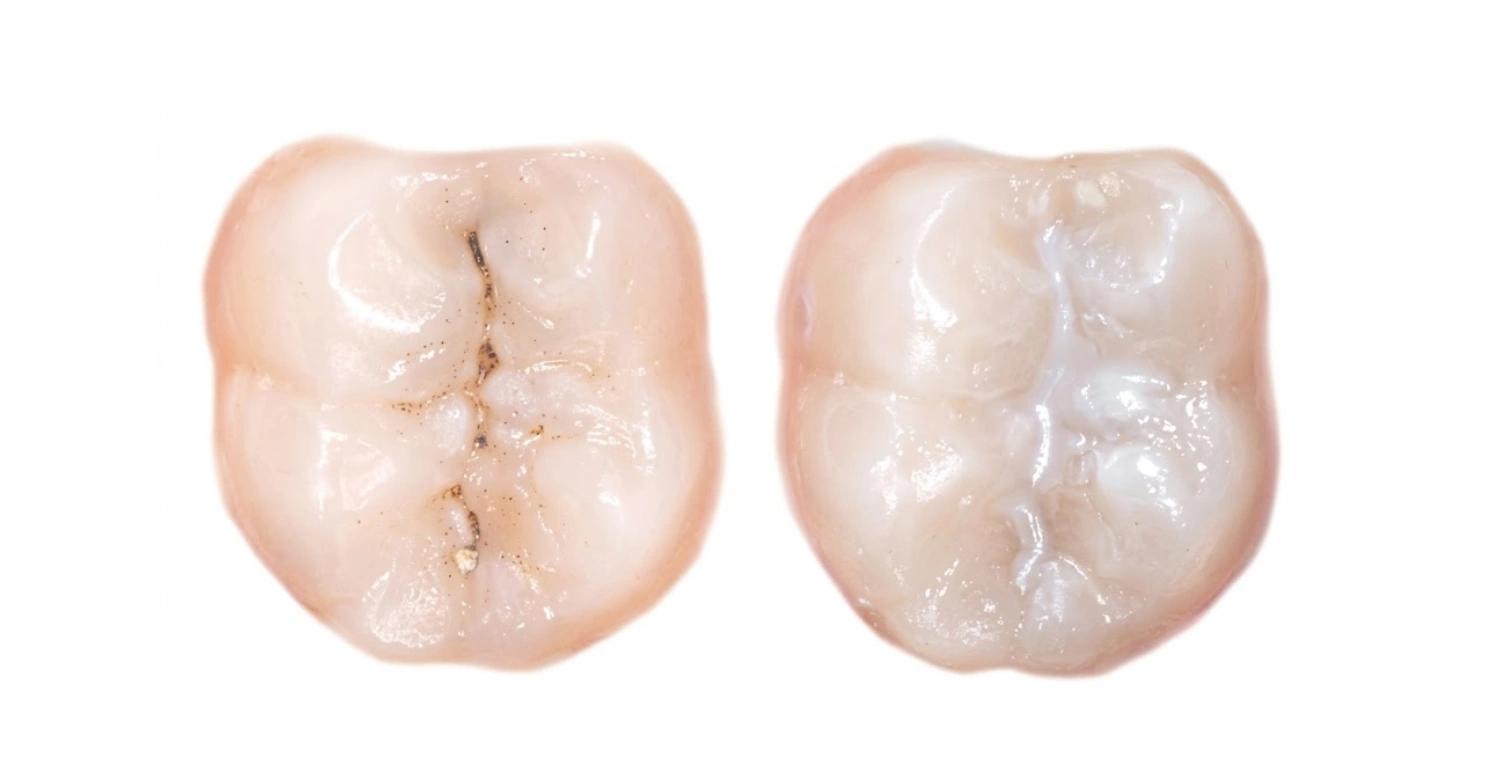
Dental Fissure Anatomy and How Tooth Fissures Develop
Understanding dental fissure anatomy helps explain why some teeth are more prone to a fissure of tooth problem than others. Premolars and molars develop with cusps, pits, and grooves that meet at specific points during formation. Where these ridges join, a natural fissure forms. The depth and shape of this fissure of tooth anatomy vary significantly between patients, and even between different teeth in the same mouth.
Occlusal Fissures and Pits
Occlusal fissures are the grooves and pits found on the biting surfaces of molars and premolars. They form naturally as the tooth develops and are considered a standard part of tooth anatomy. Clinically, their significance depends on depth and accessibility. Narrow occlusal fissures can be difficult to clean mechanically, even with careful brushing, because toothbrush bristles are often too wide to reach the base of the groove.
Deep Tooth Grooves and Plaque Retention
Deep tooth grooves create spaces where toothbrush bristles may not fully reach, allowing plaque to build up undisturbed. Over time, this retained plaque can contribute to enamel demineralization, the earliest stage of tooth decay. It's important to note that groove depth alone doesn't automatically mean a tooth needs treatment. Many deep grooves remain healthy for years with good oral hygiene and regular monitoring.
Tips for Patients
Brush twice daily with fluoride toothpaste
Pay particular attention to the chewing surfaces of molars
Clean between teeth daily
Limit frequent sugary snacks and drinks
Attend regular dental examinations
Report persistent sensitivity or biting pain
Do not attempt to remove or scratch a dark line from a fissure
Ask about whether fissure sealants suit your high-risk molars
Maintain fluoride exposure as professionally advised
Do not assume every dark fissure is a cavity
What Causes a Fissure of Tooth to Become a Dental Problem?
A fissure of tooth becomes problematic when bacteria, plaque, or food debris remain trapped inside it over time. Several factors raise this risk: poor plaque control, frequent sugar intake, reduced fluoride exposure, and fissures that are unusually deep or narrow. Existing enamel defects, previous caries, cracks, or structural damage also increase vulnerability. Patients with a high individual caries risk due to diet, saliva flow, or genetics are more likely to see a harmless fissure of tooth structure progress toward decay.
Can Tooth Fissures Turn Into Cavities?
Yes, tooth fissures can turn into cavities, but the process takes time. It begins with plaque accumulation, which gradually causes enamel demineralization. Left unaddressed, this progresses into active decay. However, a dark line inside a fissure doesn't automatically mean there's a cavity. Fissure staining often from food pigments or minor surface changes looks similar to early decay but behaves very differently. Enamel erosion: How Sugar Damages Tooth Enamel
Signs and Symptoms of a Problematic Tooth Fissure
Many fissure-related problems are initially symptom-free, which makes routine checkups essential. When symptoms do appear, they can include sensitivity to cold or sweet foods, pain when biting down, and food becoming repeatedly trapped in the same spot. Some patients notice localized discomfort, visible darkening or staining, or a rough or slightly chipped area on the tooth surface. If decay progresses without treatment, a persistent toothache can eventually develop.
When Should You See a Dentist?
Professional evaluation is recommended whenever a fissure looks unusual, feels rough, or is associated with any discomfort. Importantly, pain is not required for a fissure-related problem to exist; many issues are caught only through examination. Routine dental visits allow early detection before decay has a chance to spread. Waiting for pain often means the problem has already advanced.
Clinical Note
A clinically important distinction exists between a fissure, a crack, and dental caries. An anatomical fissure is not necessarily a structural crack; the two involve different tissue changes and different risks. A fissure affected by caries may require a different treatment approach entirely compared to a tooth with a true fracture. Treatment decisions should always be based on clinical findings and individual risk factors, not appearance alone. Preserving healthy enamel is generally preferable to unnecessary removal of tooth structure, so conservative assessment always comes first. Beverage comparison: Sugar Free Vs Regular Soda Which Is Worse For Teeth
How Is a Fissure of Tooth Diagnosed?
Diagnosing a fissure of tooth issue begins with a thorough visual inspection during a dental examination. The dentist assesses fissure morphology, checks for plaque and food retention, and evaluates any visible enamel changes. A clinical examination for caries follows, sometimes supported by radiographs when clinically indicated. Assessing the patient's overall caries risk is part of this process too, since two similar-looking fissures can carry very different levels of concern depending on the individual.
Can a Dentist Tell If a Tooth Fissure Is Carious?
Distinguishing staining from active caries takes more than a glance. Dentists use a combination of visual examination, gentle probing where appropriate, and sometimes radiographs to confirm findings. Colour alone is not enough to establish a diagnosis: a dark fissure can be entirely stable, while a lighter one may hide early decay beneath the surface. Damage prevention: Sticky And Hard Foods
Treatment Options for Tooth Fissures
Treatment for tooth fissures depends entirely on whether the fissure is healthy, at risk, carious, or structurally compromised. A healthy fissure may need nothing beyond good hygiene and monitoring. An at-risk fissure might benefit from a preventive sealant. A carious fissure requires restorative treatment matched to the depth of decay. Structurally compromised teeth, such as those with cracks, need a separate management approach altogether.
Fissure Sealants
Fissure sealants are thin protective coatings applied to the grooves of molars and premolars. The material covers susceptible fissures, reducing the space where plaque and food particles can accumulate. Patients who may benefit most include children and teenagers with newly erupted molars, as well as adults with deep or high-risk grooves. Sealants work as a preventive measure, not a treatment for established deep decay.
Preventive Resin Restoration
A minimally invasive restoration may be considered when a fissure shows early, localized changes that don't yet require a full filling. This approach focuses on preserving as much sound tooth structure as possible while still addressing the affected area. It combines conservative removal of compromised tissue with a small, precisely placed restoration.
Dental Filling for Fissure-Related Decay
When decay within a fissure has progressed beyond the superficial layer, restorative treatment becomes necessary. This involves removing the infected or compromised tissue and restoring the tooth with an appropriate filling material. The extent of treatment depends directly on how deep and widespread the decay has become.
Root Canal Treatment
Fissure-related decay can, in some cases, progress deep enough to reach the dental pulp. Symptoms suggesting pulpal involvement may include lingering pain, sensitivity that doesn't resolve quickly, or spontaneous discomfort. When this occurs, root canal treatment may become necessary to save the tooth.
Treatment for a Cracked or Fractured Tooth
A true structural crack is managed very differently from an anatomical fissure, even though the two can sometimes look similar to an untrained eye. Treatment depends on several factors: the crack's location, its depth, whether the tooth remains restorable, and whether the pulp is involved. Some cracks can be managed conservatively, while others require more extensive intervention. This distinction is one reason a professional clinical evaluation is essential before assuming a fissure and a crack call for the same treatment approach. Dietary choices: Natural Sugar Vs Added Sugar Dental Impact
What We Notice Clinically
Dr. Rifat Alsaman, Head of the Medical Team at Vitrin Clinic and a cosmetic dentist, notes that assessing a suspicious fissure of tooth structure requires more than a quick look. Clinicians evaluate fissure depth, enamel integrity, staining patterns, plaque retention, and any signs of active caries together. Visual appearance alone cannot always determine whether treatment is needed. Dr. Rifat Alsaman emphasizes assessing the patient's overall caries risk rather than treating every fissure automatically. Magnification, good lighting, careful clinical probing where appropriate, and radiographs when indicated all support this assessment, guiding a decision based on evidence rather than assumption.
Clinical Assessment of Molar Fissures
During examination, the dentist looks closely for differences between healthy fissures, stained fissures, early carious fissures, and structurally compromised fissures. Each category is managed differently. A healthy fissure needs monitoring alone. A stained fissure may need closer observation over time. An early carious fissure could benefit from a conservative restoration or sealant, while a structurally compromised fissure may require more involved treatment.
Fissure Sealants vs Dental Fillings: What Is the Difference?
Fissure sealants and dental fillings serve different purposes. A sealant is preventive, applied to a fissure before decay has established itself, requiring minimal to no tooth preparation. A filling is restorative, used once decay has already caused damage that must be removed and repaired. The expected outcome differs too: a sealant protects a vulnerable but otherwise healthy fissure of tooth surface, while a filling restores function and structure to a tooth already affected by cavitation.
When Is a Fissure Sealant More Appropriate?
Healthy but vulnerable fissures
High-risk molars
Deep grooves without established cavitation
Cases suited to preventive management rather than restoration
A sealant works best before any decay has taken hold, making early identification of at-risk fissures particularly valuable for long-term outcomes.
When Is a Filling More Appropriate?
Confirmed cavitated caries
Noticeable loss of tooth structure
Decay extending beyond the superficial fissure
Once a cavity has formed, a sealant alone cannot resolve the problem. Restorative treatment becomes necessary to remove the affected tissue and restore the tooth's shape, strength, and function properly. Staining comparison: Coffee And Tea And Red Wine
Benefits of Treating High-Risk Tooth Fissures
Addressing a high-risk fissure of tooth early carries several preventive benefits. It reduces plaque retention in hard-to-clean grooves and lowers the risk of fissure-related caries developing over time. Treating vulnerable fissures also helps preserve natural tooth structure, since early intervention is generally far less invasive than treating advanced decay. It makes oral hygiene easier for the patient going forward and reduces the likelihood of needing extensive restorative treatment later. Ultimately, this approach protects vulnerable molars during the years they're most exposed to decay risk.
What Should Patients Expect Before and After Treatment?
Before treatment, the dentist conducts a full examination to determine the fissure's condition and the most appropriate approach. After a sealant or restoration, the tooth should feel smooth and comfortable, without rough edges or sensitivity. Regular monitoring may still be required to check the treated area over time. It's important to understand that preventive treatment does not replace daily brushing, fluoride use, or professional examinations; it works alongside these habits, not instead of them. Natural remedies: Certain Foods Whiten Teeth Naturally
Can You Prevent Problems in Tooth Fissures?
Preventing complications in tooth fissures starts with an honest risk assessment. Fluoride use, consistent oral hygiene, sensible dietary habits, and regular professional examinations all reduce the chances of a fissure of tooth issue developing. Fissure sealants add another layer of protection for particularly vulnerable grooves. Children and adolescents may benefit especially from preventive assessment of newly erupted permanent molars, since these teeth are at their highest risk in the years right after eruption. Monitoring sealed teeth over time also matters, as sealants can wear and may occasionally need reapplication.
The Role of Regular Dental Check-Ups
Early lesions in a fissure often produce no symptoms at all, which is exactly why routine checkups matter so much. Professional monitoring allows the dentist to track existing fissures and any previously placed sealants over time. Early intervention, when needed, tends to be simpler and less invasive than treatment delayed until symptoms appear. Skipping regular visits increases the chance that a manageable early-stage issue develops into something requiring more extensive treatment. Effects of alcohol: Does Alcohol Affect Your Teeth And Gums
Advanced Dental Technology for Fissure Assessment and Treatment
Modern dentistry supports accurate diagnosis and conservative treatment planning through several technologies. Digital dental imaging and digital radiography allow closer inspection of areas not visible to the naked eye. Magnification tools help the dentist examine fissure morphology in detail, while intraoral photography documents findings for monitoring over time. Digital treatment documentation also supports consistent follow-up care. It's worth emphasizing that this technology supports clinical judgement rather than replacing professional examination; the dentist's assessment remains central to every decision made. Joint and gum health: Rheumatoid Arthritis And Gum Disease
Why Choose Vitrin Clinic for Tooth Fissure Assessment and Treatment?
Vitrin Clinic takes a patient-focused approach to every fissure of tooth assessment, built around comprehensive examination before any treatment is recommended. The clinic favours a conservative philosophy, focused on preserving healthy tooth structure wherever clinically appropriate, supported by experienced clinical assessment and modern dental technology. Dr. Rifat Alsaman, Head of the Medical Team at Vitrin Clinic and a cosmetic dentist, brings this expertise to every case reviewed. Treatment planning at Vitrin Clinic is personalized to each patient's specific dental condition, never applied as a one-size-fits-all solution. Clear communication about diagnosis, treatment options, expected outcomes, and costs is a core part of the process from the very first visit.
Your Next Step
If you're experiencing sensitivity, biting discomfort, visible changes in a fissure, or concerns about deep molar grooves, arranging a professional examination is the right next step. The focus should always be diagnosed first, followed by an individualized treatment plan tailored to your specific needs. Early assessment can help preserve your natural tooth structure and prevent complications that are otherwise avoidable. Vitrin Clinic offers a free treatment plan to help you understand your options clearly before deciding on any next steps. Autoimmune impact: Lupus And Teeth Pain
References:
FAQs
Dr. Rifat Alsaman has more than 5 years of clinical experience in dentistry and currently serves as the Head of the Medical Team at Vitrin Clinic. He is dedicated to providing exceptional patient care, overseeing treatment planning, and ensuring the highest clinical standards across the team. His expertise, attention to detail, and commitment to continuous professional development have helped countless patients achieve healthier, more confident smiles.

.webp&w=3840&q=75)


