Dental Tourism in Turkey
November 12, 2026
Can You Get Dental Implants Without a Bone Graft in Turkey?
 Dr. Rifat Alsaman

Losing jawbone volume does not automatically rule out dental implants. Dental Implants Without Bone Graft Turkey may be an option when enough healthy bone remains to support stable implant placement.
Modern implant techniques can sometimes use existing bone more strategically. Options include short implants, angled placement, and selected full-arch solutions. However, severe bone loss may still require augmentation or specialised procedures.
The right approach depends on bone dimensions, gum health, anatomical structures, bite forces, and medical history. A detailed clinical examination helps determine whether grafting can safely be avoided.
Key Takeaways
Dental Implants Without Bone Graft Turkey may be possible when the existing jawbone provides sufficient support.
Short, angled, and strategically positioned implants can help selected patients avoid additional bone augmentation.
CBCT imaging may help evaluate bone dimensions and anatomical restrictions when three-dimensional information is needed.
All-on-4 and All-on-6 do not guarantee graft-free treatment.
Severe bone loss may require bone augmentation or specialist implant techniques.
Treatment costs depend on implant numbers, surgical complexity, and the final restoration.
Prices from £200 per tooth
Full mouth restoration from
£1,600
Timescale
5 to 7 days
Hotel + transfers available
Airport-Hotel-Clinic
coordination included
Ready to transform your smile?
Talk to our team and get a personal FREE treatment plan.
Can You Get Dental Implants in Turkey Without Bone Grafting?
Yes. Some patients can receive implants without additional bone grafting because their existing jawbone provides enough support.
The key is identifying suitable implant positions without compromising surgical safety or the final teeth. Dental Implants Without Bone Graft Turkey may involve conventional, short, or angled implants, depending on the patient's anatomy.
How Can Implants Work When Jawbone Volume Is Reduced?
Dental implants need contact with surrounding bone to achieve initial stability. They then undergo osseointegration, the process through which bone connects with the implant surface.
When bone volume is limited, the dental team may consider alternative implant dimensions or positioning. However, avoiding grafting is not the only treatment objective.
The implant must support a functional restoration, tolerate chewing forces, and allow effective daily cleaning.
Which Implant Options Can Make Better Use of Existing Bones?
Implant approach | How it works | When it may be considered |
Conventional implants | Use standard implant dimensions in suitable bone | Adequate bone height and width |
Short implants | Use a shorter implant design | Selected cases with reduced vertical bone |
Angled implants | Use planned positioning to access available bone | When anatomical structures restrict conventional placement |
Full-arch solutions | Distribute support across selected implant positions | Suitable patients missing most or all teeth |
Specialised implants | Use alternative anchorage in specific anatomical areas | Selected cases with severe bone loss |
When Is Bone Grafting Still the Better Option?
Bone grafting may be necessary when the remaining jawbone cannot provide adequate implant support. This may involve severe loss of bone height or width.
Alternative techniques cannot solve every type of bone deficiency. If graft-free placement compromises implant stability or restoration design, augmentation may be the more appropriate choice.
The objective of Dental Implants Without Bone Graft Turkey should be a suitable, maintainable result not avoiding an additional procedure at any cost.
Why Does Jawbone Loss Make Implant Placement More Difficult?
Jawbone loss reduces the available foundation for dental implants. It can affect implant dimensions, positioning, and initial stability.
What Causes the Jawbone to Shrink?
Natural tooth roots stimulate the surrounding jawbone during everyday chewing. After tooth loss, this stimulation decreases, and the bone may gradually resorb.
Other possible causes include:
Advanced gum disease and previous dental infections.
Long-term gaps left by missing teeth.
Traumatic extractions or jaw injuries.
Previous implant complications or surgery.
Individual anatomical and healing differences.
The amount of bone loss varies between patients. Some retain enough bone for conventional implants, while others need additional procedures.
Does Bone Height, Width or Density Matter Most?
All three characteristics influence implant planning.
Bone characteristic | What it describes | Why it matters |
Height | Available vertical bone | Influences implant length and positioning |
Width | Thickness of the jawbone | Determines whether sufficient bone can surround the implant |
Density | Internal bone structure and quality | Influences initial stability and healing |
The upper and lower jaws also have different anatomical restrictions. The maxillary sinuses sit above the back teeth in the upper jaw. The inferior alveolar nerve runs through the lower jaw.
Safe implant positioning must account for these structures. This is particularly important when planning Dental Implants Without Bone Graft Turkey.
Who May Qualify for Implants Without Bone Augmentation?
Having missing teeth does not automatically mean a patient needs a bone graft. Suitability depends on the amount and distribution of remaining bone, gum health, medical history, and restoration design.
How Does Your Bone Condition Affect Treatment Options?
The available dental implant options depend largely on the amount, density, and location of the remaining jawbone.
Adequate bone: Conventional implants may be suitable when the jawbone can support the required implant dimensions and positioning.
Moderate bone loss: Short or angled implants may be considered in selected cases, provided the remaining bone offers sufficient support.
Significant bone loss: More complex surgical techniques or bone augmentation may be necessary to create suitable conditions for implant placement.
Severe upper-jaw bone loss: Zygomatic or pterygoid implants may be considered for selected patients. These techniques require specialist surgical expertise and detailed planning.
The final approach depends on clinical examination and imaging. Bone volume alone does not determine suitability; bone quality, anatomical structures, and the planned restoration also matter.
Which Health Factors Can Influence Eligibility?
Even with sufficient bone, certain conditions and habits may affect healing or implant maintenance.
Uncontrolled diabetes: May interfere with healing and increase complication risks.
Active gum disease: Usually needs treatment before implant placement.
Smoking and nicotine: Can impair healing and increase implant-related risks.
Certain medications: May require review with the treating physician.
Previous implant failure: The original cause should be investigated.
Poor oral hygiene: Can increase inflammation around implants.
Conditions affecting healing: Previous radiotherapy and some medical conditions may require specialist input.
Age or missing teeth alone do not determine eligibility. A clinical examination and medical history review are essential before recommending Dental Implants Without Bone Graft Turkey.

.jpg)
How Do Dentists Decide Whether You Need a Bone Graft?
The decision involves more than measuring bone height. Dentists evaluate bone dimensions, gum health, nearby anatomical structures, bite forces, and the position of the proposed replacement teeth.
What Happens During the Examination and Imaging Review?
The clinical examination may include:
Reviewing bone height, width, and quality.
Checking gum health and soft-tissue condition.
Reviewing previous extractions, infections, and implant procedures.
Identifying possible implant positions.
Evaluating bite forces and signs of teeth grinding.
CBCT imaging may be recommended when detailed three-dimensional information is necessary. It helps examine the jawbone and locate structures such as the maxillary sinuses and lower-jaw nerves.
Why Must Implant Planning Consider the Final Teeth?
Implants should not be positioned according to available bone alone. Their locations must also support the planned restoration.
The dental team considers chewing forces, bite relationships, speech, and access for cleaning. A technically possible implant position may still be unsuitable if it compromises the final teeth.
This is why planning Dental Implants Without Bone Graft Turkey must consider both surgical and restorative requirements.
Ready to transform your smile?
Talk to our team and get a personal FREE treatment plan.
Which Implant Techniques Can Help Avoid Bone Grafting?
Several techniques may reduce the need for augmentation in selected cases. Each has specific indications and limitations.
Short Implants: An Option for Reduced Bone Height
Short implants use a shorter design to fit within available vertical bone. They may help selected patients avoid procedures intended to increase bone height.
However, they are not suitable for every case. Bone width, quality, implant position, and chewing forces must also be considered.
Angled Implants and All-on-4: Making Strategic Use of Bone
Angled implants are positioned at a planned inclination to access suitable bone. In selected upper-jaw cases, this may help avoid certain anatomical restrictions, including the maxillary sinus.
All-on-4 uses four implants to support a fixed full-arch restoration. The posterior implants are often tilted to make better use of available bone.
This approach may reduce the need for sinus augmentation in suitable patients. However, it cannot compensate for every degree of bone loss.
Zygomatic and Pterygoid Implants: Specialist Options for Severe Bone Loss
When conventional upper-jaw placement is difficult, specialist techniques may be considered.
Zygomatic implants: Gain anchorage in the cheekbone rather than relying entirely on the upper jaw.
Pterygoid implants: Use bone in the posterior upper-jaw region for additional support.
Both require detailed anatomical planning and advanced surgical expertise. They are not routine alternatives for every patient with reduced bone volume.
Can Conventional Implants Still Work Without a Graft?
Yes. Conventional implants may remain suitable when the existing bone provides enough support for the planned implant dimensions and positions.
The decision also depends on the final restoration, bite forces, and long-term maintenance. Dental Implants Without Bone Graft Turkey can involve conventional implants when the clinical findings support this approach.
Can You Get Upper-Jaw Implants Without a Sinus Lift?
Yes. Some patients can receive implants in the back of the upper jaw without sinus lift surgery.
The maxillary sinus is an air-filled cavity above the upper back teeth. After tooth loss, bone resorption may reduce the vertical space available for implant placement.
Which Techniques May Reduce the Need for a Sinus Lift?
Technique | How it may help | Main limitation |
Short implants | Fit within the available vertical bone | Require suitable bone quality and loading conditions |
Angled implants | Access bone outside restricted sinus areas | Need accurate surgical and restorative planning |
Alternative implant positions | Use other areas with suitable bone support | Depend on anatomy and final tooth design |
When Might Sinus Lift Surgery Still Be Needed?
A sinus lift may be recommended when the remaining bone cannot provide adequate support for predictable implant placement.
The decision depends on bone dimensions, sinus anatomy, implant stability, and the planned restoration. A sinus lift is a specific procedure for the upper jaw; it is not another name for every type of bone graft.
Can You Replace a Full Arch of Teeth Without Bone Grafting?
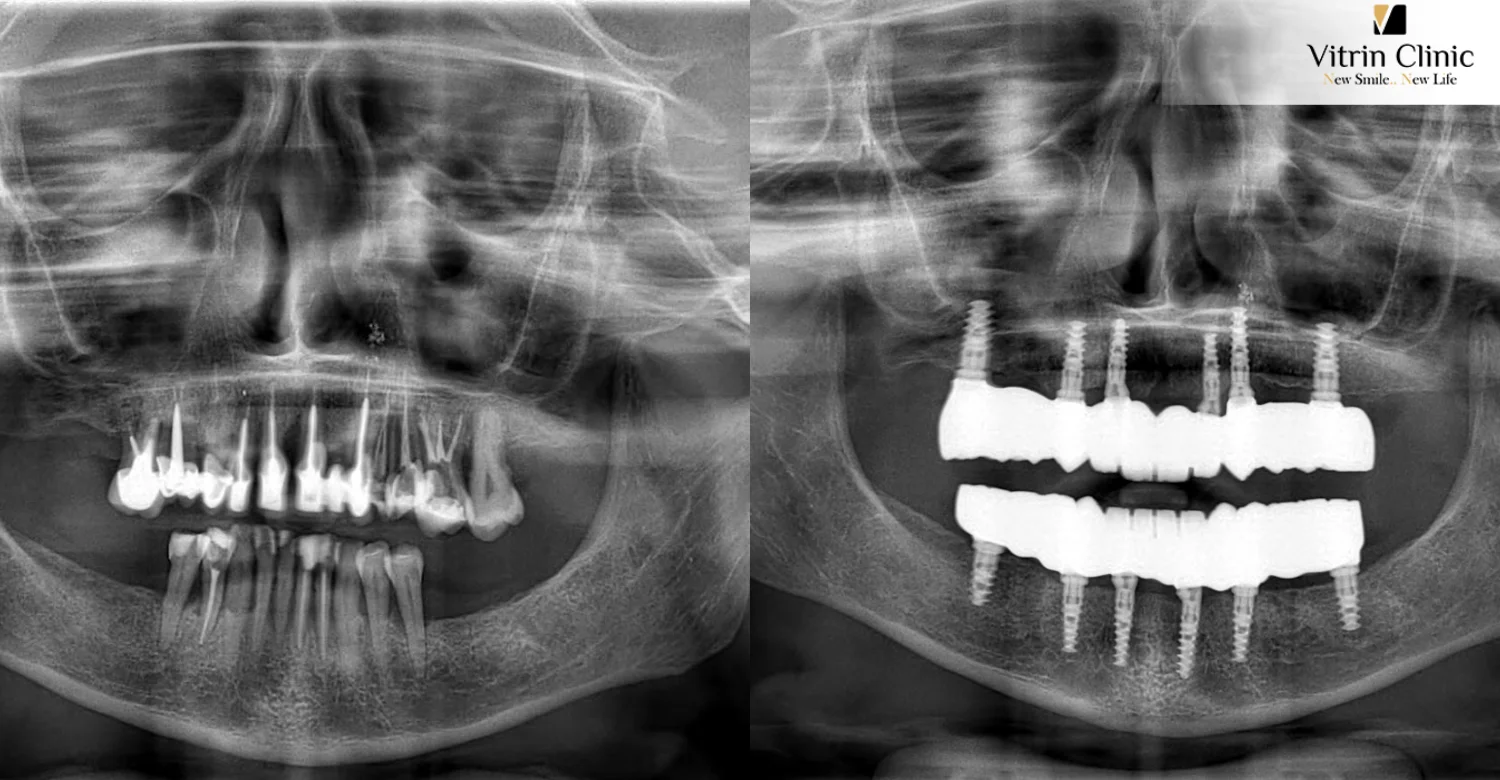
Yes. Selected patients can receive a fixed full-arch restoration using existing jawbone. The approach depends on bone volume, implant positioning, and the forces expected on the final bridge.
All-on-4 vs All-on-6: Which Is More Suitable?
Feature | All-on-4 | All-on-6 |
Implants per arch | 4 | 6 |
Main purpose | Support a full-arch restoration | Support a full-arch restoration |
Positioning | Often includes tilted posterior implants | Depends on available bone and restoration design |
Support points | Four implants | Six implants |
Main consideration | Whether four suitable positions can be achieved | Whether six suitable positions can be achieved |
Can You Receive Temporary Fixed Teeth Immediately?
Some patients may receive a temporary fixed bridge shortly after surgery. This depends on primary implant stability and other clinical conditions that allow immediate loading.
If these conditions are not met, a removable temporary restoration or a healing period may be necessary.
Temporary teeth are not the final bridge. Their materials, design, and chewing restrictions may differ from the permanent restoration.
When Is Full-Arch Treatment Better Performed in Stages?
Treatment may need to be divided into stages when patients have:
Active gum disease or dental infection.
Insufficient initial implant stability.
Significant bone deficiencies.
Medical or healing factors that affect surgical timing.
The treatment schedule should follow clinical requirements rather than a fixed promise of immediate teeth.
What Happens During Graft-Free Dental Implant Treatment?
The process usually moves from examination and planning to implant placement, healing, and final restoration. The exact sequence depends on the patient's clinical needs.
1. Clinical Examination and Digital Planning
The dental team reviews medical history, previous treatment, and available dental images. CBCT may be recommended when three-dimensional information is needed.
Planning considers bone dimensions, anatomical structures, replacement tooth positions, bite relationships, and cleaning access.
2. Implant Placement and Stability Checks
Implants are generally placed under local anaesthesia. Sedation may be considered when appropriate.
After placement, the dental team checks primary stability. This describes how firmly the implant is secured in the bone immediately after surgery.
3. Temporary Teeth and Osseointegration
A temporary fixed bridge may be possible when implant stability and other clinical conditions allow immediate loading.
Otherwise, the patient may need a removable provisional restoration or a healing period. During healing, osseointegration allows the surrounding bone to connect with the implant surface.
4. Final Restoration and Follow-Up
Once healing is sufficient, the planned final bridge or restoration can be fitted.
The dentist checks its fit, bite contacts, chewing forces, and cleaning access. Follow-up appointments help monitor the implants, gums, and restoration.
What Are the Benefits and Limitations of Avoiding Bone Grafting?
For suitable patients, Dental Implants Without Bone Graft Turkey may reduce the number of surgical procedures. However, graft-free treatment still has limitations and risks.
Potential Benefits
Fewer procedures: Some patients avoid a separate bone augmentation operation.
Potentially shorter treatment: Removing a grafting stage may simplify the overall timeline.
No separate donor site: Patients may avoid collecting bone from another area.
Less additional surgery: Selected cases may require fewer surgical interventions.
Important Limitations
Restricted positioning: Reduced bone may limit implant length, width, and placement.
Not suitable for everyone: Severe bone loss may still require augmentation.
More complex planning: Angled and specialised implants need careful surgical and restorative planning.
Restoration restrictions: Bone availability may influence the design of replacement teeth.
Ongoing bone changes: Inflammation and natural bone changes can affect implant support over time.
Avoiding grafting is beneficial only when the remaining bone can support a functional and maintainable restoration.
What Risks and Complications Should You Know About?
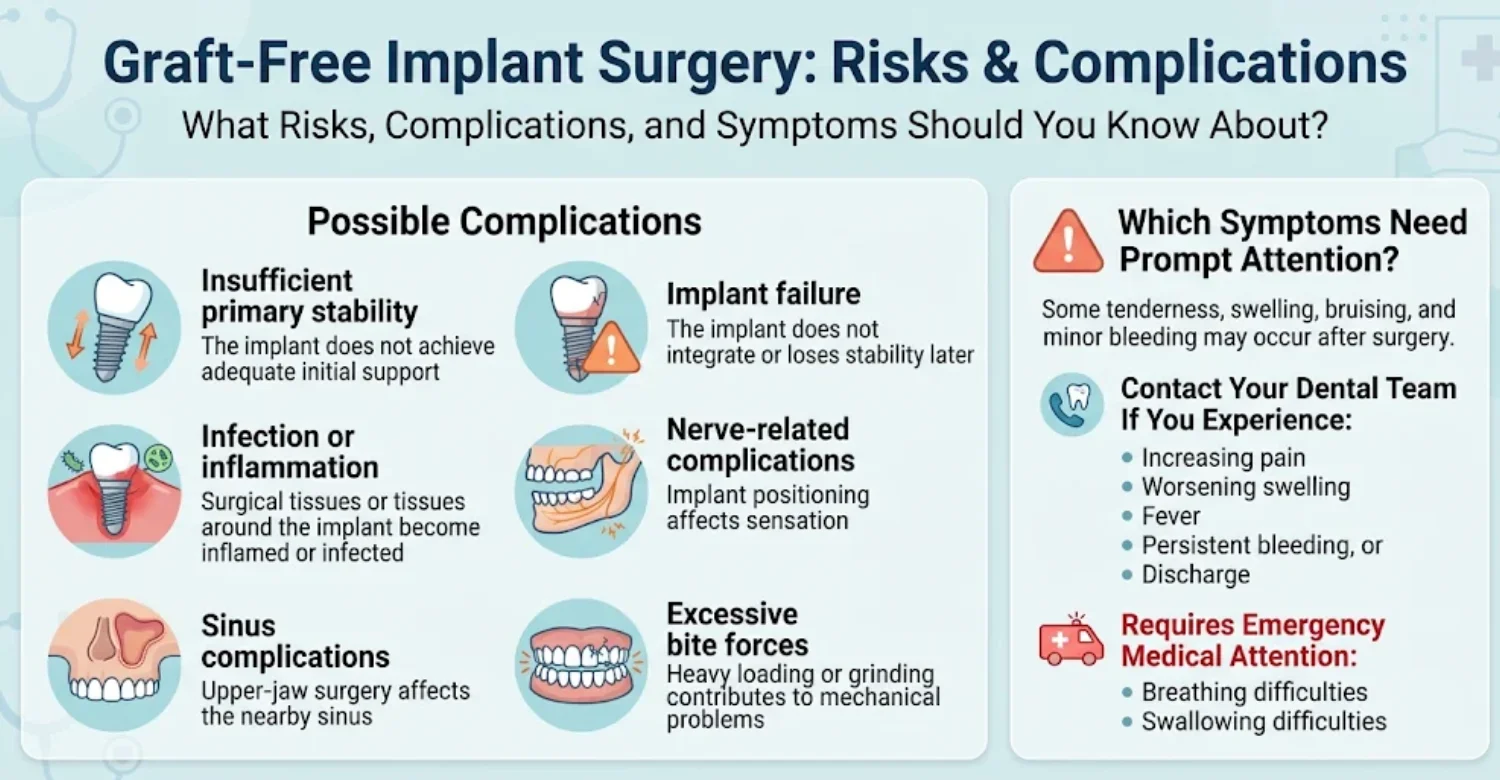
Graft-free implant surgery still involves surgical risks and a healing process. Not having a bone graft does not remove the possibility of implant-related complications.
Possible complication | What it means |
Insufficient primary stability | The implant does not achieve adequate initial support |
Implant failure | The implant does not integrate or loses stability later |
Infection or inflammation | Surgical tissues or tissues around the implant become inflamed or infected |
Nerve-related complications | Implant positioning affects sensation |
Sinus complications | Upper-jaw surgery affects the nearby sinus |
Prosthetic problems | Screws loosen or the bridge chips or fractures |
Excessive bite forces | Heavy loading or grinding contributes to mechanical problems |
Which Symptoms Need Prompt Attention?
Some tenderness, swelling, bruising, and minor bleeding may occur after surgery.
Contact your dental team if you experience increasing pain, worsening swelling, fever, persistent bleeding, or discharge. Breathing or swallowing difficulties require emergency medical attention.
Ready to transform your smile?
Talk to our team and get a personal FREE treatment plan.
How Long Does Recovery Take?
Recovery varies with implant numbers, surgical complexity, and individual healing. Avoiding bone grafting may remove an additional healing stage, but the implants still need time to integrate with the jawbone.
What Can You Expect During Healing?
Recovery stage | What you may experience | General care |
First 24–48 hours | Tenderness, swelling, minor bleeding, or bruising | Follow postoperative instructions; use cold compresses if advised |
First week | Discomfort and swelling should gradually improve | Choose soft foods and avoid disturbing the surgical area |
Following weeks | Soft tissues continue healing | Maintain gentle oral hygiene and attend reviews |
Following months | Osseointegration develops | Follow loading restrictions until the dentist approves the next stage |
Eating, Cleaning and Returning to Daily Activities
During early healing, choose soft foods and avoid hard or chewy items that place pressure on the implants. Follow instructions about brushing near the surgical area.
Light activities may resume within several days, depending on the procedure. Avoid strenuous exercise until your dental team confirms it is appropriate.
For a smoother recovery:
Take prescribed medication as directed.
Use cold compresses if recommended.
Avoid smoking and nicotine during healing.
Keep your mouth clean according to instructions.
Do not disturb stitches or healing tissues.
Avoid applying home remedies directly to surgical wounds.
How Is Implant Healing Monitored?
Follow-up appointments allow the dental team to examine the gums and review healing. Implant stability may also be evaluated when appropriate.
The final restoration is fitted when the clinical conditions are suitable. Dental Implants Without Bone Graft Turkey still require professional monitoring throughout healing and after restoration.
How Can You Maintain Your Implants Long Term?
Brush twice daily with a suitable toothbrush.
Clean around and underneath the restoration with recommended tools.
Use a water flosser if advised.
Attend regular professional maintenance appointments.
Report bleeding, swelling, unpleasant taste, or implant movement promptly.
Review intervals should reflect gum health, implant condition, and individual risk factors.
.jpg)
.jpg)
.jpg)
Clinical Insight: Why Is Personalised Implant Planning Essential?
The amount of remaining jawbone is only one part of implant planning. Bone quality, gum health, sinus and nerve positions, bite forces, and final tooth design also matter.
Patients with similar bone loss may need different treatment approaches. Their anatomy, healing factors, and restoration requirements can change the recommended technique.
Dr. Rifat Alsaman, Head of the Medical Team at Vitrin Clinic, can review the importance of individual anatomy and long-term restorative needs as part of the clinical planning process. Any attributed clinical statement should be reviewed and approved by him before publication.
The priority is not simply avoiding a bone graft. It is achieving suitable implant positioning, functional replacement teeth, and a restoration that patients can maintain over time.
How Much Do Dental Implants Without Bone Grafting Cost in Turkey?
The cost of Dental Implants Without Bone Graft Turkey depends on implant numbers, the implant system, surgical complexity, and final restoration materials.
Avoiding bone augmentation may reduce some treatment expenses. However, graft-free procedures do not all have the same price.
What Are the Indicative Implant Prices in Turkey?
Single Implant
Indicative Price: $700 – $1,500
Indicative price in Turkey
Single dental implant with restoration: 700–1,500
Includes implant fixture, abutment & crown
Globally recognized titanium implant brands
Full-Arch (All-on-4 / All-on-6)
From $3,900
Indicative price per jaw in Turkey
All-on-4, per jaw: 4,000–12,000
All-on-6, per jaw: $3,900–$10,400
Fixed full-arch bridge restoration
Specialized Cases
Pricing: Custom Quotation
Indicative price in Turkey
Short dental implants: Depends on implant system and restoration
Zygomatic implants: Individual quotation
Pterygoid implants: Individual quotation
How Do Implant Prices Compare in Turkey, the UK and the USA?
Dental implant prices can vary considerably between Turkey, the UK, and the USA. Turkey generally offers lower treatment costs, while prices in the UK and USA are often higher. However, the final amount depends on the implant system, restoration type, bone condition, and clinical complexity. The comparison below shows indicative costs for single implants and full-arch treatments in each country.
UK
From $1,800
Implant treatment comparison
Single implant with restoration: $1,800–$3,500
All-on-4, per jaw: $10,000–$18,000
All-on-6, per jaw: $12,000–$20,000
Turkey
From $700
Implant treatment comparison
Single implant with restoration: 700–1,500
All-on-4, per jaw: 4,000–12,000
All-on-6, per jaw: $3,900–$10,400
Save up to ~60–75% vs. UK & USA
USA
From 3,000
Implant treatment comparison
Single implant with restoration: 3,000–6,000
All-on-4, per jaw: 18,000–30,000
All-on-6, per jaw: 24,000–38,000
Highest domestic private expense
Does Choosing Turkey Always Mean Lower Overall Costs?
Turkey may offer lower treatment prices than the UK and USA. However, a meaningful comparison must include the same implant brand, number of implants, restoration material, and surgical procedures.
Patients should also budget for travel, accommodation, additional appointments, and possible changes to the treatment plan.
All-on-4 vs All-on-6: Which Offers Better Value?
Comparison | All-on-4 | All-on-6 |
Implants per jaw | 4 | 6 |
Treatment purpose | Replace a complete arch | Replace a complete arch |
Implant requirements | Four suitable positions | Six suitable positions |
Relative cost | Generally lower | Generally higher |
Main consideration | Whether four implants provide suitable support | Whether six implants can be positioned appropriately |
What Can Change Your Final Implant Quotation?
Several factors influence the total price:
Implant system: Brand, model, and number of implants.
Bone condition: Whether conventional or specialised techniques are suitable.
Surgical complexity: Additional procedures and specialist expertise.
Final restoration: Material, framework, design, and laboratory work.
Temporary teeth: Whether provisional restorations are included.
Imaging and follow-up: Diagnostic scans, reviews, and maintenance arrangements.
Short implants are generally used for individual missing-tooth sites, while All-on-4 replaces a complete arch. Their prices are not directly comparable.
Zygomatic and pterygoid implants require specialist planning, so their costs are usually quoted individually.
What Should an Itemised Implant Quotation Include?
Before accepting a treatment package, confirm the following in writing:
Implant number, manufacturer, brand, and model.
Surgical fees, anaesthesia, and sedation if applicable.
Imaging and diagnostic procedures.
Extractions, grafting, or sinus procedures if required.
Abutments and other implant components.
Temporary teeth and final restoration materials.
Laboratory fees and necessary adjustments.
Medication and postoperative reviews.
Accommodation and transportation, if included.
Follow-up arrangements and any exclusions.
Ready to transform your smile?
Talk to our team and get a personal FREE treatment plan.
How Does Vitrin Clinic Plan Dental Implant Treatment for International Patients?
At Vitrin Clinic, planning Dental Implants Without Bone Graft Turkey starts with understanding each patient's jawbone anatomy and restorative needs. The team considers clinical requirements alongside appointment schedules and practical arrangements for international patients.
1. Share Your Dental Records Before Travelling
Patients can send recent dental X-rays, available CBCT scans, and details of previous dental treatment for preliminary review. The clinical team reviews the available information to identify possible treatment approaches. However, remote review cannot confirm final suitability. An in-person examination or additional imaging may still be necessary.
2. Receive an Individualised Plan and Written Quotation
The proposed plan should explain:
Recommended implant technique and number.
Whether existing bone may support graft-free placement.
Whether extractions or additional procedures may be needed.
Temporary and final restoration options.
Expected treatment stages and estimated costs.
Final recommendations are confirmed after the necessary clinical examination and imaging.
3. Confirm Your Treatment Schedule Before Booking Flights
Treatment duration depends on the surgical approach, implant stability, and healing requirements. Some patients may qualify for temporary fixed teeth soon after surgery. Others need a different restoration schedule. Confirm expected appointment dates, possible additional visits, and the time needed before receiving the final bridge.
4. Clarify Accommodation, Transfers and Package Inclusions
International patients should confirm accommodation, airport transportation, appointment arrangements, and who to contact if postoperative concerns arise. Build flexibility into travel plans in case additional reviews or adjustments become necessary. Hotel stays and transfers should be confirmed according to the actual package rather than assumed to be included.
5. Arrange Maintenance After Returning Home
Before departure, request copies of relevant implant records and restoration specifications. These should include the implant manufacturer and model, available clinical records, and details of the final prosthesis. Arrange follow-up with an appropriately qualified dental professional after returning home. Regular maintenance helps monitor the implants, surrounding gums, and restoration. At Vitrin Clinic, the aim is to recommend Dental Implants Without Bone Graft Turkey only when clinical findings support that approach. The treatment plan should prioritise appropriate implant positioning and long-term function not avoiding grafting when it is necessary.
Conclusion: Is Dental Implants Without Bone Graft Turkey Treatment the Right Choice?
Dental Implants Without Bone Graft Turkey may suit patients who retain enough healthy jawbone for stable implant placement. However, graft-free treatment is not appropriate for every case of bone loss.
Conventional, short, angled, and full-arch techniques may offer alternatives in selected situations. The right option depends on bone dimensions, anatomical structures, gum health, bite forces, and the planned restoration.
A thorough clinical examination, appropriate imaging, and individualised planning should guide the decision. Avoiding a graft is beneficial only when it does not compromise treatment safety or the final result.
At Vitrin Clinic, our team reviews each patient's dental needs before recommending a suitable approach. Contact us to discuss your options and get your FREE Treatment Plan.
Reference
FAQs
Yes. Some patients can receive implants without additional bone grafting if enough suitable jawbone remains. Conventional, short, or angled implants may be considered, depending on the location and extent of bone loss. Severe deficiencies may still require augmentation or specialist techniques.
Dr. Rifat Alsaman has more than 5 years of clinical experience in dentistry and currently serves as the Head of the Medical Team at Vitrin Clinic. He is dedicated to providing exceptional patient care, overseeing treatment planning, and ensuring the highest clinical standards across the team. His expertise, attention to detail, and commitment to continuous professional development have helped countless patients achieve healthier, more confident smiles.


