Dental Implant
October 11, 2026
AI in Dental Implant Planning: How AI Supports Safer, More Precise Treatment?
 Dr. Rifat Alsaman
.webp&w=3840&q=75)
AI in Dental Implant Planning is changing how dental professionals assess bone anatomy, evaluate digital images, and plan implant positions. If you are considering an implant, you may have questions about accuracy, safety, discomfort, cost, and treatment time. These concerns are reasonable. Artificial intelligence can organize complex imaging data and highlight important structures. However, it supports clinical decision-making only. It does not replace a qualified dentist's examination, experience, or responsibility for your treatment. This guide explains what the technology can and cannot do.
AI in Dental Implant Planning: What Is It and How Does It Work?
AI in Dental Implant Planning refers to software that helps the dental team analyze scans and prepare a virtual treatment plan. These systems can analyze digital images, identify anatomical structures, and suggest measurements. It is important to separate two ideas. Computer-assisted planning lets the dentist design the plan manually on screen. AI-driven systems go further and offer predictive or automated recommendations. Capabilities and reliability vary between products. Every output still needs review by a qualified clinician before it guides treatment.
What Does Artificial Intelligence in Dental Implantology Actually Do?
Artificial intelligence in dental implantology performs several supporting tasks. It can analyze images and outline structures such as teeth, jawbone, nerve canals, and sinuses. This outlining is called anatomical segmentation. The software may also take measurements, such as bone height and width at a planned site. Digital simulations then show how an implant might sit in the jaw. Decision-support functions flag areas that deserve closer attention. Together, these tools help the dental team assess implant positioning and the requirements of the final tooth.
How Is AI Different From Traditional Dental Implant Planning?
In conventional planning, the clinician studies the images, measures the bone, and positions the implant manually. In AI-assisted workflows, software completes some of these steps automatically and proposes results for review. Both approaches depend on a clinical examination, appropriate imaging, and professional judgment. AI in Dental Implant Planning may support consistency and save time on repetitive tasks. However, it does not automatically make every treatment plan more accurate. A careful clinician-led plan remains a valid, established standard. The tools differ, but the responsibility does not.
What Can AI Help Dentists Identify Before Dental Implant Surgery?
Before surgery, the dental team needs a clear picture of your jaw. AI in Dental Implant Planning may support this stage by organizing and analyzing diagnostic information. It can highlight bone contours, nearby nerves, sinus boundaries, and neighboring tooth roots on suitable scans. These findings are only one part of the assessment. Your dentist must interpret them alongside your medical history, oral examination, bone quality, and restorative needs. Software shows what an image contains. It cannot judge your overall suitability for treatment alone.
AI in Dental Implant Diagnosis and Bone Assessment
AI in dental implant diagnosis focuses on what suitable images reveal about the jaw. Tools may help evaluate bone height, bone width, and anatomical boundaries at a planned implant site. Some systems also estimate bone density from scan data. These estimates have limitations. Grey values on dental 3D scans are not standardized, so density readings can vary between machines. Image-based measurements may also be affected by patient movement or metal restorations. For this reason, results often require additional clinical interpretation by the dentist.
3D Imaging and AI in Dental Implants
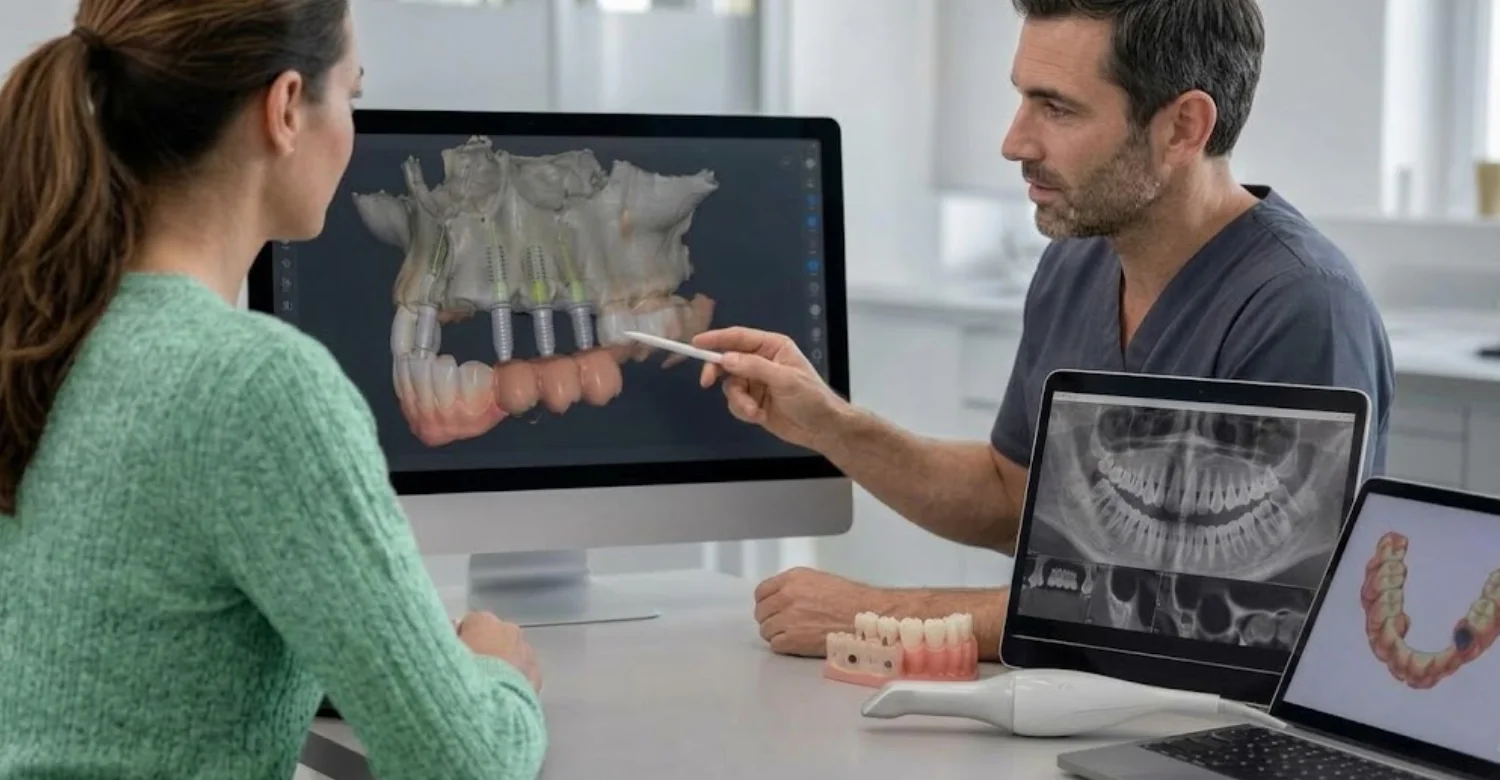
Cone-beam computed tomography, or CBCT, produces three-dimensional images of the jaw. 3D imaging and AI in dental implants are often combined, because AI software can process CBCT data quickly. Digital scans of the teeth and gums may be merged with CBCT images. Together, they help the team assess available bone, nearby nerves, the maxillary sinus, and the proposed implant position. CBCT involves radiation exposure. It is therefore used when clinically justified, rather than automatically for every patient.
Machine Learning in Dental Implant Planning
Machine learning is a form of AI that identifies patterns in data. Instead of following fixed rules, the system learns from many examples. Machine learning in dental implant planning has potential applications in image interpretation and anatomical measurements. It is also used in research into implant outcomes. Performance depends on the data used to develop the system. That data must be high quality, representative of different patients, and properly validated. A model trained on limited data may perform poorly in unfamiliar cases.
Note: All images used are for editorial and illustrative purposes only and may not originate from the original news provider or associated company.
How AI-Guided Dental Implant Surgery Works
AI-guided dental implant surgery is best understood as a sequence of steps, from assessment to surgical execution. AI in Dental Implant Planning may contribute to this digital workflow by speeding up analysis and simulation. However, the software does not perform the operation. The actual procedure still depends on the clinician, the chosen technique, and your anatomy. Each step includes human checks. The sections below explain how records are collected, how the plan is created, and how it is transferred into surgery.
Step 1: Collecting Clinical Records and Digital Images
Planning begins with information, not software. Your dentist reviews your medical history, medications, and habits such as smoking. An oral examination assesses the gums, remaining teeth, and bite. Appropriate radiographs or CBCT are then taken if they are needed. Digital impressions, made with an intraoral scanner, may be added when indicated. The team combines these records to build an individualized treatment plan. Accurate, complete records matter greatly. Any digital plan is only as reliable as the information entered into it.
Step 2: Creating an AI-Based Dental Implant Treatment Plan
AI-based dental implant treatment planning takes place in compatible software. The program may help map anatomical structures, such as nerve canals and sinus boundaries. It can then simulate implant positions and assess the space available for the future crown. These proposals are a starting point. The dentist reviews each suggestion, checks the measurements, and modifies the plan where necessary. Nothing proceeds until the clinician approves it. This review step keeps AI in Dental Implant Planning under professional control.
Step 3: Translating the Digital Plan Into Surgery
Once the plan is finalized, it must be transferred into the mouth. The digital plan may be used with a surgical guide or with a navigation system. Three related technologies are often confused here. AI planning concerns how the plan is analyzed and designed. Guided surgery concerns how a physical guide directs the drills. Dynamic navigation tracks instruments in real time. These are distinct tools. A clinic may use one, several, or none, depending on the case.
Static Surgical Guides vs. Dynamic Navigation
Static guides are custom-made templates that fit over the teeth, gums, or bone. They contain sleeves that help direct the drill along the planned path. Dynamic navigation is different. It uses cameras and tracking markers to follow the instruments during surgery and display their position on a screen. Either method may be used without AI. The appropriate choice depends on clinical requirements, available equipment, and professional judgment. Neither method removes the need for a skilled surgeon. Small deviations can still occur.
Can AI Improve Dental Implant Placement Accuracy?
Digital planning may support careful assessment of implant position, angulation, and depth. Claims about AI dental implant placement accuracy should be read with care, though. Accuracy depends on a chain of factors. These include imaging quality, correct alignment of digital records, software performance, and surgical technique. The plan must also be transferred precisely into the patient's mouth. A weakness at any stage can affect the result. AI in Dental Implant Planning is therefore a support tool, not a guarantee of ideal placement or long-term success.
Benefits of Artificial Intelligence in Dental Implantology
The potential benefits of artificial intelligence in dental implantology include:
More structured analysis of complex imaging data.
Support for identifying relevant anatomical landmarks.
Improved visualization of proposed implant positions.
More efficient communication within the treatment team.
Assistance with planning complex or multidisciplinary cases.
These benefits are not automatic. They depend on the specific system, the complexity of the case, and how the clinician uses the technology. A well-validated tool in experienced hands offers more value than advanced software used without careful review.
What AI Can and Cannot Predict About Implant Success
AI may support research and risk assessment by finding patterns in large sets of patient data. However, it cannot reliably guarantee osseointegration. This is the process by which bone bonds with the implant surface. Many factors influence that process and the years that follow. They include healing capacity, bone quality, smoking, systemic health, oral hygiene, and regular maintenance. Some of these change over time. For this reason, any prediction is an estimate of risk, not a promise about your individual result.
Tips for Patients
Bring a current medication list and disclose relevant medical conditions before treatment.
Ask for a clear explanation of why each scan or digital tool is needed.
Request a review of the proposed implant position and its relationship to the final crown.
Compare the complete treatment plan, including restorations, follow-up, and possible additional procedures.
Ask how the dental team verifies AI-generated measurements and recommendations.
AI in Dental Implant Surgery Complications: Can It Reduce Risks?
Discussion of AI in dental implant surgery complications needs careful wording. AI in Dental Implant Planning may help the dental team visualize anatomical constraints and identify potential concerns before surgery. That is a meaningful advantage. However, better planning accuracy does not automatically prove fewer complications or better long-term outcomes. Those results depend on surgery, healing, and aftercare as well. Research in this field is still developing. Patients should view AI as one safety layer among several, not as protection against every risk.
Identifying Anatomical Risks Before Surgery
Several structures require particular attention. In the lower jaw, the inferior alveolar nerve supplies feeling to the lower lip and chin. In the upper jaw, the maxillary sinus sits above the back teeth. Neighboring tooth roots and limited bone volume also restrict where an implant can go. Appropriate imaging shows the position of these structures. AI tools may outline them on the scan. The clinician then reviews the result and plans the implant at a safe distance from each structure.
Recognizing Patient-Specific Risk Factors
Risk is not only anatomical. Your medical history, gum health, smoking status, medications, and previous surgery all affect treatment planning. For example, poorly controlled diabetes and a history of gum disease can influence healing and long-term implant health. Certain medications that affect bone metabolism also need careful consideration. AI software analyzes the data it receives. It cannot independently establish a complete diagnosis or replace a medical assessment. Your dentist must gather this information directly and may consult your physician when necessary.
What Happens When an AI System Makes an Error?
AI systems can make mistakes. Possible causes include poor image quality, inaccurate segmentation, and training data that does not represent all patient groups. Software incompatibility between devices may also introduce errors. Sometimes the output is correct, but it is interpreted incorrectly. An unnoticed error could affect the implant position. This is why AI in Dental Implant Planning always requires verification against the scan and the clinical findings. The dentist, not the software, retains responsibility for the final treatment decision.
What We Notice Clinically
Dr. Rifat Alsaman, Head of the Medical Team and cosmetic dentist at Vitrin Clinic, emphasizes assessment before technology. Oral health, bone anatomy, bite, and restorative goals should be evaluated first. Only then can the team select a suitable digital planning method. This order matters. Software can produce a neat plan from a scan, yet miss problems seen only during examination. Active gum disease is one example. AI is useful only when its recommendations fit the patient's actual clinical needs.
Why Implant Position Must Match the Final Restoration
An implant supports a crown, so its position shapes the final result. Placement affects where the crown sits, how bite forces are distributed, and how easily you can clean around it. It also influences the appearance of the restoration. Dr. Rifat Alsaman, Head of the Medical Team and cosmetic dentist at Vitrin Clinic, considers restorative requirements an essential part of implant planning. They are not a separate concern addressed only after surgery. Planning backward from the intended tooth helps avoid compromises later.
When AI Assistance May Be Particularly Useful
AI assistance may be particularly useful in selected cases. These include complex anatomy, multiple implants, and multidisciplinary rehabilitation involving several specialists. In such situations, structured analysis of the imaging can support planning and communication. Dr. Rifat Alsaman, Head of the Medical Team and cosmetic dentist at Vitrin Clinic, would first assess the clinical indication, imaging requirements, and available technology. He would then decide whether AI-assisted planning adds meaningful value. For a simple case, established clinician-led planning may be entirely sufficient.
.webp)
What Should You Expect Before, During, and After AI-Assisted Implant Treatment?
The patient journey has three stages: assessment, surgery, and follow-up. AI in Dental Implant Planning may change how your treatment plan is developed behind the scenes. Your experience in the chair is often similar to conventional implant care. Realistic expectations are important. AI does not necessarily reduce discomfort, eliminate appointments, or shorten healing. Bone still needs time to bond with the implant. The sections below describe each stage in realistic terms, so you know what to expect.
Before Treatment: Assessment and Planning
Treatment starts with a consultation. Your dentist discusses your goals and reviews your medical history. An oral examination follows, and imaging is arranged when indicated. The clinician evaluates bone availability, gum health, your bite, and the planned restoration. Existing problems, such as gum inflammation or decay, are usually treated first. Only after this assessment can your suitability be confirmed. If AI in Dental Implant Planning is used, your dentist can show you the proposed implant position on screen and explain the reasoning.
During Treatment: What You May Experience
Your experience during surgery depends on several factors. These include the number and location of implants, the surgical technique, and the type of anesthesia. Additional procedures, such as bone grafting, can lengthen the appointment. Local anesthesia numbs the area, so you should not feel sharp pain. Pressure and vibration are common. AI-assisted planning does not automatically mean surgery is painless or incision-free. Some guided cases allow a smaller opening in the gum, but this depends on your anatomy and the clinician's judgment.
After Treatment: Healing and Follow-Up
Temporary tenderness and swelling are common in the first days after surgery. Your dental team will give hygiene instructions and advice on eating and pain relief. Follow-up visits allow the clinician to monitor healing and check the site. Osseointegration may take several months. During this time, the bone gradually bonds with the implant. The timing of the final restoration depends on the individual case. Contact your clinic promptly if you notice increasing pain, persistent bleeding, fever, or lasting numbness.
What Are the Costs and Limitations of AI in Dental Implant Planning?
The costs of AI in Dental Implant Planning may reflect imaging, planning software, guided-surgery equipment, and laboratory work. The complexity of treatment and the implant restoration also matter. AI may be included in the treatment fee or priced as part of a broader digital workflow. No universal price exists, and figures vary by country and clinic. The limitations are equally important. Systems differ in quality and evidence. They rely on good images and careful human review. Technology adds to clinical skill but cannot substitute for it.
Which Factors May Affect the Total Cost?
Several factors influence the total cost. The number of implants is the most obvious. Bone grafting, if required, adds further stages and materials. Additional diagnostic procedures, surgical guides, and temporary teeth may also be included. The final restorations and follow-up care complete the picture. For this reason, a single quoted fee can be misleading. One price may cover only the implant, while another includes the crown and aftercare. Compare the full treatment plan and ask what each fee includes.
Is More Advanced Technology Always Better?
Not necessarily. Technology is valuable when it addresses a specific clinical need. A simpler workflow may be entirely appropriate for a single implant with generous bone. Complex anatomy, limited bone, or several implants may justify additional digital tools. More equipment does not guarantee a better result. Clinical expertise and appropriate case selection remain central. When considering AI in Dental Implant Planning, ask what the technology adds in your case. A clear, specific answer is a good sign.
Clinical Note
A promising technology is not the same as a clinically validated outcome. AI systems differ in their regulatory status, intended use, training data, and supporting clinical evidence. Some tools are intended for specific tasks only, such as outlining structures on a scan. Marketing language can blur these differences. As a patient, you are entitled to a clear explanation of how your plan was made. An individualized diagnosis and informed consent remain essential, whichever tools are used in AI in Dental Implant Planning.
Does AI Replace the Implant Dentist?
No. AI provides decision support, not independent clinical care. A qualified dental professional must evaluate the findings and decide what they mean for you. The dentist explains the alternatives, approves the plan, and performs or supervises the treatment. If a complication occurs, the dentist manages it. Software cannot examine your mouth, discuss your preferences, or take responsibility for an outcome. AI in Dental Implant Planning therefore works as an assistant. The clinical relationship between you and your dentist stays central.
Does Every Dental Implant Case Need AI or CBCT?
No. Neither AI nor CBCT is mandatory for every case. Imaging should be selected according to the clinical question, the expected diagnostic benefit, and radiation considerations. In some straightforward situations, two-dimensional radiographs and a careful examination may provide enough information. In others, three-dimensional detail is clearly needed. The same reasoning applies to software. Digital planning tools should be used when they add value to the individual treatment plan. Your dentist should be able to explain why each one is recommended.
How Can You Prepare for AI-Assisted Dental Implant Treatment?
Preparation begins with a clear medical history. Tell your dentist about your conditions, medications, allergies, and smoking. Realistic expectations also help. Implant treatment usually involves several stages and a healing period. Make sure you understand the proposed treatment, including why each scan or diagnostic procedure is recommended. Discuss the alternatives as well, such as bridges or removable dentures. Good preparation makes AI in Dental Implant Planning more meaningful, because the plan is built on accurate and complete information about you.
Questions to Ask During Your Consultation
Consider asking the following questions:
What clinical problem will AI help address in my case?
Will I need CBCT, and why?
Will a surgical guide or dynamic navigation be used?
How will the proposed implant position be checked?
What are my alternatives if AI-assisted planning is not suitable?
Which risks, follow-up appointments, and additional costs should I expect?
Write down the answers. Clear, direct responses suggest a well-reasoned plan.
Prevention and Long-Term Care After Dental Implant Placement
Technology cannot replace daily hygiene or ongoing professional monitoring. Implants do not decay, but the surrounding gums and bone can become inflamed. Brush twice daily with a suitable toothbrush. Clean between your teeth and around implant-supported restorations with interdental brushes or floss, as advised. Avoid tobacco, which is linked to a higher risk of implant problems. Attend maintenance visits at intervals your dentist recommends. These habits protect your implant long after AI in Dental Implant Planning has done its part.
Protecting the Health of Your Gums and Implants
Two conditions deserve attention. Peri-implant mucositis is inflammation of the soft tissues around an implant. It is generally reversible with professional care and improved cleaning. Peri-implantitis is more serious. It involves inflammation together with progressive loss of the supporting bone. Early assessment makes a real difference. Contact your dentist if you notice bleeding, swelling, discomfort, pus, or any change in implant stability. Regular examinations allow the team to detect early changes before they become harder to treat.
How Vitrin Clinic Approaches Digital Dental Implant Planning
At Vitrin Clinic, we provide advanced Dental Implant treatment using modern techniques and technologies, with an individualized approach to every patient. Implant planning begins with a thorough clinical assessment, considering imaging, gum health, bone anatomy, bite, and the intended restoration. CBCT imaging, digital scans, and advanced planning software may be used when clinically appropriate to support precise treatment planning. Not every patient requires the same tools or approach.
Our treatment team will discuss the recommended procedure, available options, anticipated timeline, and potential costs based on your individual needs. You are welcome to request a consultation and receive a personalized treatment plan tailored to your oral health and restorative goals. All recommendations are based on your clinical examination, with realistic expectations and no guaranteed outcomes.
Is AI in Dental Implant Planning Right for You?
AI in Dental Implant Planning may support image analysis, digital planning, and implant positioning. Its value depends on clinical evidence, appropriate technology, and professional oversight. It does not replace examination, judgment, or aftercare. For some patients, it adds useful detail. For others, established planning methods are sufficient. Focus on the rationale behind your treatment plan, not on technology alone. Ask why each step is recommended and how it benefits you. A dentist who explains this clearly is your most important safeguard.
Ready to transform your smile?
Talk to our team and get a FREE treatment plan.
References:
FAQs
Dr. Rifat Alsaman has more than 5 years of clinical experience in dentistry and currently serves as the Head of the Medical Team at Vitrin Clinic. He is dedicated to providing exceptional patient care, overseeing treatment planning, and ensuring the highest clinical standards across the team. His expertise, attention to detail, and commitment to continuous professional development have helped countless patients achieve healthier, more confident smiles.


