Dental Bridge
November 8, 2026
Dental Bridge for Back Teeth Turkey: Costs, Types & Options
 Dr. Rifat Alsaman

A dental bridge for back teeth Turkey patients choose can restore chewing after molar or premolar loss. Missing back teeth may allow neighbouring teeth to drift and change the bite over time. A bridge is one fixed option, alongside implants. This guide explains suitability, materials, costs in Turkey, and clinic selection. It also shows how Vitrin Clinic builds individualised treatment plans. This helps you compare options before you travel.
Key Takeaways
A dental bridge replaces missing molars or premolars. It restores chewing, keeps the bite stable, and stops neighbouring teeth from drifting.
Options include traditional, cantilever, Maryland, and implant-supported bridges. Zirconia and porcelain-fused-to-metal are common material choices for posterior restorations.
Most conventional bridge patients eat normally once the final bridge is fitted and the bite is adjusted. Temporary sensitivity may occur. Implant-supported bridges require additional healing time.
Dental bridge cost in Turkey depends on the number of units, material, and additional procedures. At Vitrin Clinic, a three-unit conventional or zirconia bridge is estimated at $500–$1,800. Implant-supported options may cost $1,500–$3,100, depending on the plan.
Prices from £200 per tooth
Full mouth restoration from £1,600
Timescale
5 to 7 days
Hotel + transfers available
Airport-Hotel-Clinic coordination included
Ready to transform your smile?
Talk to our team and get a FREE treatment plan.
Why Consider a Dental Bridge for Back Teeth in Turkey?
Dental bridge for back teeth Turkey searches often start with a simple problem: chewing becomes harder after molar loss. Restoring posterior teeth helps rebuild bite function. A gap can let neighboring teeth tilt and opposing teeth over-erupt, which may affect bite stability. Many patients consider Turkey for fixed restorations because of treatment access and cost differences. However, price should not be the only factor. Clinical assessment, material choice, follow-up arrangements, and clear communication matter just as much.
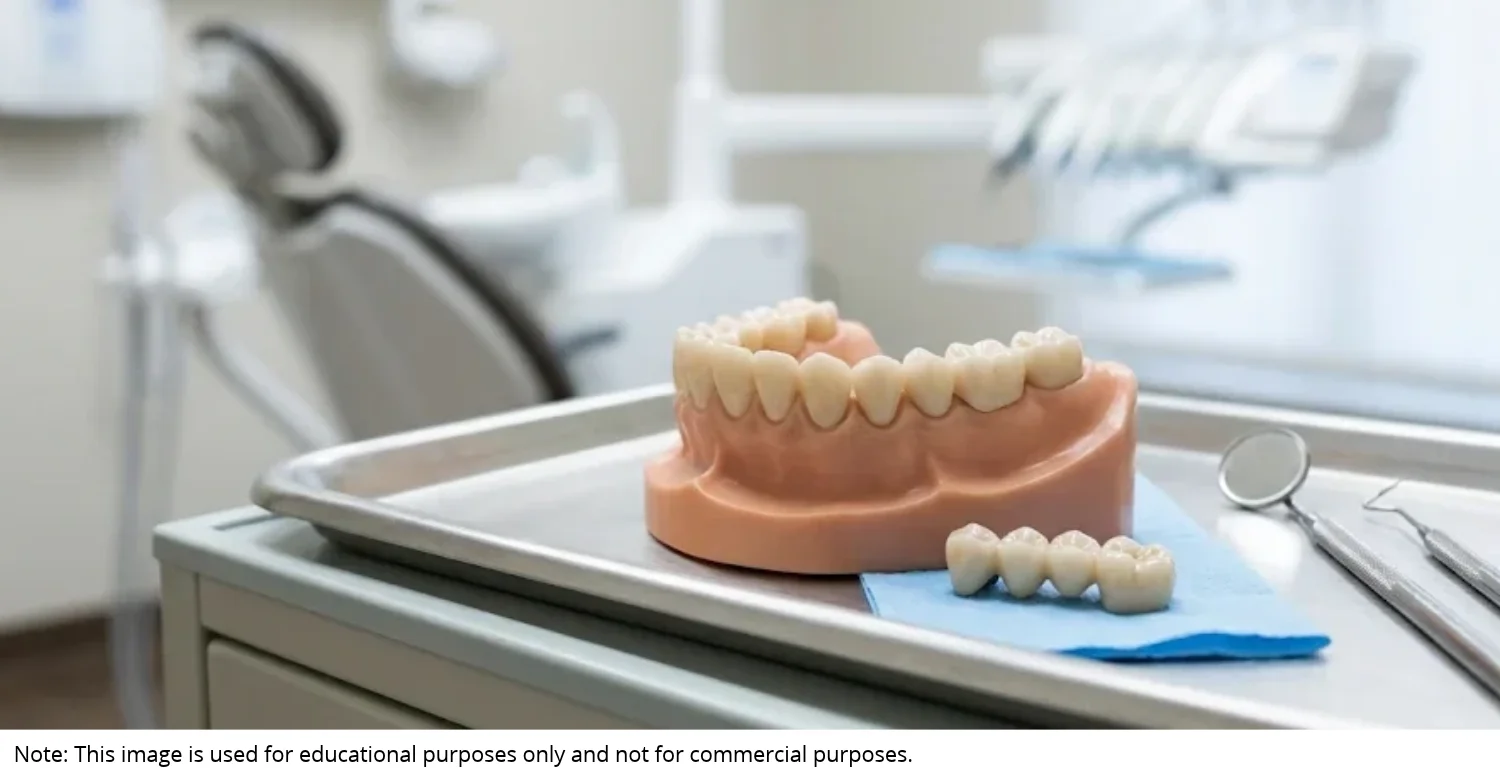
Dental Bridges for Back Teeth: Options and Clinical Suitability in Turkey
Restoring missing back teeth (molars and premolars) needs durability, proper support, and the strength to withstand heavy chewing pressure. In Turkey, dental clinics offer several bridge configurations. Each suits specific oral conditions, bite mechanics, and periodontal health.
Before recommending a bridge, a dentist evaluates the gap size, remaining tooth structure, gum health, and bite forces. There are four main types:
1. Traditional Dental Bridges
A conventional bridge uses artificial teeth (pontics) anchored to crowns on the natural teeth beside the gap.
Best For:
Replacing one or two posterior teeth when neighboring teeth already require crowns or possess large fillings.
Clinical Considerations:
Because back teeth bear heavy occlusal loads, abutment teeth must have healthy roots, adequate bone support, and strong natural structure. Preparing these teeth means removing some natural enamel. This is irreversible, so long-term tooth vitality needs thorough evaluation.
2. Cantilever Dental Bridges
A cantilever bridge attaches the replacement tooth to an anchor tooth on only one side of the gap.
Posterior Limitations:
Chewing forces on back teeth are substantially higher than in the front. Supporting a molar bridge from one side creates an uneven lever effect. Over time, this can loosen the bridge, cause crown failure, or fracture the anchor tooth.
Clinical Considerations:
Rarely recommended as a first-line option for molars. It is reserved for select cases where support is unavailable on both sides. Bite forces must be light, and the single abutment must have exceptional root stability.
3. Maryland (Resin-Bonded) Bridges
Maryland bridges use metal or ceramic "wings" bonded to the back of adjacent teeth. These hold the replacement tooth in place without full-coverage crowns.
Preservation Advantage:
This option requires minimal to no enamel preparation, preserving natural tooth structure.
Posterior Limitations:
The resin-bonded connection is prone to debonding under heavy masticatory forces typical of the molar region.
Clinical Considerations:
Maryland bridges are common for front teeth but generally unsuitable for molars. They are occasionally used as temporary restorations or in controlled, low-force premolar areas.
4. Implant-Supported Dental Bridges
Rather than modifying healthy natural teeth, an implant bridge anchors directly into the jawbone using titanium or zirconia dental implants.
Ideal Application:
Multiple consecutive missing molars or premolars, where natural tooth support is inadequate or absent.
Efficiency:
A multi-unit bridge often needs only two or three implants to span a long gap. This avoids one implant per missing tooth.
Treatment Process:
Planning begins with high-resolution 3D CBCT scans. These assess bone density and proximity to landmarks such as the maxillary sinus or mandibular nerve. If bone volume is insufficient, preliminary treatments like bone grafting or sinus lifts may precede placement. After insertion, a healing period (osseointegration) lets the implants fuse with the bone. The permanent bridge is attached afterwards.
Ready to transform your smile?
Talk to our team and get a FREE treatment plan.
Dental Bridge vs Dental Implant for Molars: Which Should You Choose?
Dental bridge vs dental implant for molars is a common question. The right answer depends on your teeth, bone, and general health. A bridge relies on neighbouring teeth, while an implant replaces the missing root. Neither option is universally better. The table below summarises the main differences. Discuss them with your dentist before choosing a dental bridge for back teeth Turkey clinics offer.
Feature | Dental Bridge | Dental Implant |
Treatment type | Fixed bridge supported by teeth | Implant with a crown |
Supporting structure | Neighbouring teeth (abutments) | Implant placed in the jawbone |
Effect on neighbouring teeth | Abutments are usually prepared and crowned | Neighbouring teeth are generally not prepared |
Surgical requirements | Usually no surgery | Minor surgery required |
Treatment duration | Usually shorter | Usually longer because of healing |
Bone requirements | Not directly dependent on bone volume | Needs adequate bone, or grafting |
Maintenance considerations | Clean under the pontic; abutment teeth can still decay | Careful cleaning; gum health around the implant needs monitoring |
Suitability | When abutments need crowns or surgery is unsuitable | When neighbouring teeth are healthy and bone is adequate |
When a Dental Bridge May Be More Suitable
A dental bridge may be more suitable when adjacent teeth already need crowns, because preparation then serves two purposes. It may also help when implant surgery is unsuitable, for example because of limited bone or certain medical conditions. Some patients simply prefer to avoid surgery. In every case, clinical conditions must support a conventional bridge, including healthy gums and abutments with enough remaining structure. Your dentist should explain how long the bridge is expected to last and what maintenance it needs.
When a Dental Implant May Be a Better Option
An implant may be better when neighbouring teeth are healthy. It avoids cutting them. It also requires adequate bone and suitable surgical conditions, including controlled gum disease and stable general health. Individual preference and long-term planning matter too. An implant still needs careful hygiene and regular review. Your dentist should discuss risks, healing time, and alternatives before you decide.
Clinical Note
Dr. Rifat Alsaman emphasises that restoring posterior teeth should begin with careful evaluation of the abutment teeth. Chewing forces must be distributed sensibly across the restoration. Periodontal health and bite stability also influence the outcome. Not every missing molar should automatically be replaced with a conventional bridge. In some cases, an implant, a different design, or monitoring the space may be more appropriate. This approach guides each dental bridge for back teeth Turkey plan at Vitrin Clinic.
Who Is a Suitable Candidate for a Dental Bridge for Missing Back Teeth?
Suitability depends on several factors. These include the number and position of missing teeth, the condition of neighbouring teeth, and gum health. Bite forces and signs of bruxism matter, as do available bone and the opposing teeth. Existing restorations and oral hygiene are also reviewed. A dental bridge for missing back teeth works best when supporting teeth are strong and gums are stable. Only a clinical examination and imaging can confirm suitability for a dental bridge for back teeth Turkey patients consider.
When a Dental Bridge May Not Be Recommended
A bridge may not be recommended when supporting teeth are weak or heavily compromised. Active periodontal disease is another concern, because it must be controlled first. Excessive bite forces, such as severe bruxism, may overload the restoration if the design is unsuitable. A bridge is also inappropriate when support is insufficient. For example, several teeth may be missing with too few abutments. In these situations, dentists often discuss implants or other alternatives.
Some of Our Patients
.jpg)
.jpg)
.jpg)
.jpg)
Ready to transform your smile?
Talk to our team and get a FREE treatment plan.
Back Teeth Dental Bridge Cost in (Vitrin Clinic) Turkey
Back teeth dental bridge cost Turkey patients see quoted varies between clinics. Price depends on the number of units, material, preparation needs, and additional procedures. Because each mouth is different, a reliable figure requires examination and imaging. Compare itemised quotations rather than headline prices, and check what is included. This section explains how pricing works, what influences cost, and what a package may include. Use it to ask informed questions about a dental bridge for back teeth in Turkey.
UK
Traditional dental bridge (3 units) = $1,900–$4,400
Zirconia dental bridge (3 units) = $2,700–$4,800
Implant-supported bridge (2 implants + 3-unit bridge) = $5,000–$10,000
Turkey (Vitrin Clinic)
Traditional dental bridge (3 units) = ≈$500–$1,200
Zirconia dental bridge (3 units) = ≈$600–$1,800
Implant-supported bridge (2 implants + 3-unit bridge) = ≈$1,500–$3,100
USA
Traditional dental bridge (3 units) = $2,000–$5,000
Zirconia dental bridge (3 units) = $2,500–$6,000
Implant-supported bridge (2 implants + 3-unit bridge) = $6,000–$15,000
Factors Determining the Cost of a Molar Dental Bridge
Total Unit Count:
Bridges are priced by total units. This combines the replacement teeth (pontics) and the supporting crowned teeth (abutments). A molar gap requiring a 3-unit bridge costs less than an extended 4- or 5-unit restoration.
Material Composition
Zirconia (Monolithic): Preferred for molars due to high fracture resistance against intense chewing forces; moderately high cost.
Porcelain-Fused-to-Metal (PFM): Combines structural strength with lower cost, but carries cosmetic compromises like dark metal margins at the gumline.
Preparatory and Restorative Treatments:
Root Canal Therapy: Necessary if decay or prior trauma has compromised the nerve of an abutment tooth.
Core Build-Up and Posts: Required when extensive natural tooth structure is missing, rebuilding the core so the crown can grip securely.
Extractions and Bone Preservation: If a failing molar must be removed before bridging, extraction and socket-preservation costs apply.
Periodontal (Gum) Health:
Active gingivitis or periodontitis must be treated prior to placement. Scaling, root planing, or minor gum contouring around the margins adds to the clinical bill.
Laboratory Fabrication & Technology:
High-precision CAD/CAM digital milling, custom staining, and intraoral 3D scanning ensure tighter margins and longer durability, influencing final lab fees.
What Is Included in a Dental Bridge Treatment Package
Dental packages for international patients typically bundle standard clinical stages and logistics into a single cost.
Clinical & Diagnostic Essentials:
Initial in-person consultation and bite evaluation.
Diagnostic imaging, including 2D panoramic X-rays (and 3D CBCT scans where indicated).
Local anesthesia and tooth preparation (shaping abutment teeth).
Provisional & Lab Procedures:
Fitting of temporary (acrylic) restorations to protect exposed dentin between visits.
Digital intraoral scans or high-detail physical impressions.
Custom milling and glazing of the permanent bridge in an accredited dental lab.
Delivery & Final Integration:
Chairside fitting, margin inspection, and bite adjustments.
Permanent cementation using durable dental adhesive resins.
Final post-fitting checkup before discharge.
Travel & Support Services (Medical Tourism Packages):
Dedicated clinic transfers between airport, hotel, and appointments.
Multilingual patient hosts or translators throughout appointments.
Material warranty cards (often covering material defects for 2–5 years).
Ready to transform your smile?
Talk to our team and get a FREE treatment plan.
Dental Bridge for Back Teeth Turkey: How your Journey look like at Vitrin Clinic
1. Start with an Online Consultation
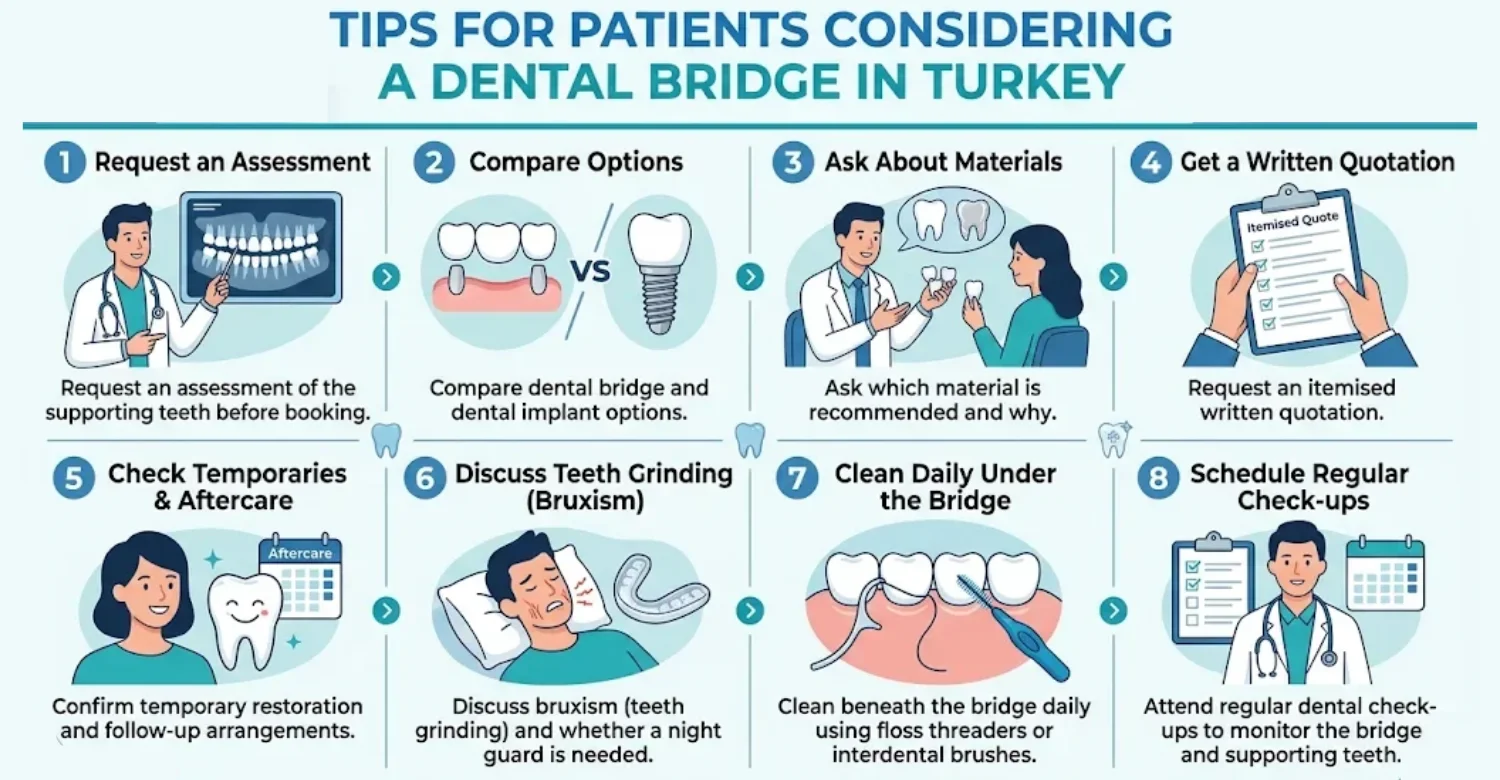
Your journey begins before you arrive in Istanbul. Share recent dental X-rays, photographs, and information about your missing teeth or existing restorations. The clinical team reviews your information to understand your needs and discuss options. Then they arrange the next steps. This preliminary assessment helps you prepare for your visit, although a definitive diagnosis requires an in-person examination.
2. Explore Your Dental Bridge Options
Every missing-tooth case has different clinical requirements. The team considers the number and location of missing teeth, the condition of neighbouring teeth, and available bone support. Options include a traditional, cantilever, Maryland, or implant-supported bridge.
3. Receive Your Personalized Treatment Plan
Following your clinical examination and any necessary diagnostic imaging, the treatment plan is tailored to your oral condition. The assessment covers supporting teeth, gum health, bite forces, and available space. If implants are considered, bone condition is assessed too.
If additional procedures, such as root canal treatment or periodontal therapy, are required, these are discussed before restorative treatment begins. You also receive a clear explanation of the recommended approach, treatment timeline, and an itemised quotation.
4. Prepare and Design Your Custom Dental Bridge
For a conventional tooth-supported bridge, the supporting teeth are prepared according to the selected design. Digital scans or conventional impressions are then taken to guide laboratory fabrication. A temporary bridge may protect the prepared teeth and maintain appearance and function. It stays in place while the final restoration is made.
Implant-supported bridges follow a different process. This involves implant placement, healing, and assessment of integration before the final restoration is fitted.
5. Fit and Adjust Your Final Dental Bridge
Once your bridge is ready, the dentist checks its fit, stability, appearance, and contact with neighbouring and opposing teeth. The bite is assessed to identify excessive contact or pressure, and any necessary adjustments are made.
Once the restoration meets clinical requirements, it is permanently cemented or secured to the implants, depending on design. You receive instructions on what to expect during the initial adjustment period.
6. Enjoy Ongoing Aftercare and Long-Term Maintenance
Your dental bridge journey continues beyond the fitting appointment. Proper maintenance is essential for protecting the restoration and the teeth or implants supporting it.
The dental team explains how to clean beneath and around the bridge. Tools include floss threaders and interdental brushes. Regular dental check-ups help monitor the restoration, supporting teeth, and surrounding gum tissues. If you have bruxism (teeth grinding), a protective night guard may also be recommended.
Why Choose Vitrin Clinic for a Dental Bridge in Turkey?
Choosing a clinic involves more than price. Vitrin Clinic provides dental bridge treatment with individualized treatment planning and a medical team led by Dr. Rifat Alsaman. The team assesses supporting teeth, gums, and bite before recommending a suitable bridge design and material. Digital dental technology and laboratory capabilities are used where indicated and applicable. Quotations are transparent, and online consultations and international patient coordination are available. Aftercare and follow-up are also discussed from the start. These factors help patients make informed decisions when considering dental bridge treatment for back teeth in Turkey.
What We Notice Clinically
Dr. Rifat Alsaman is Head of the Medical Team at Vitrin Clinic. He emphasizes that successful bridge treatment means looking beyond the missing tooth. His approach considers these factors:
Supporting teeth: Evaluating the condition of neighbouring teeth before deciding whether they can support a bridge.
Chewing forces: Considering the higher functional demands placed on bridges in the posterior region.
Tooth preservation: Avoiding unnecessary preparation of healthy supporting teeth whenever a more conservative option is appropriate.
Bruxism: Assessing teeth grinding and clenching because they can affect bridge design, durability and maintenance.
Gum health: Checking periodontal conditions to ensure the supporting teeth have a healthy foundation.
Long-term maintenance: Emphasising daily cleaning, appropriate interdental hygiene and regular dental check-ups.






Book your FREE treatment plan with Vitrin Clinic and get a personalized treatment plan from our dental team.
Ready to transform your smile?
Talk to our team and get a FREE treatment plan.
Medical Disclaimer
This article is for general information and does not replace a personal assessment by a qualified dentist. Prices are approximate 2026 averages. UK and Turkey figures are converted to US dollars. Prices may vary by clinic and case.
References:
FAQs
Yes, zirconia is widely used for molar bridges because it is strong, tooth-coloured, and biocompatible. Dental bridge materials for molars also include porcelain-fused-to-metal. Modern zirconia is suitable for posterior areas, but design matters, as connector thickness and span length affect strength. Your dentist should choose based on bite forces, bruxism, available space, and aesthetics. A zirconia dental bridge Turkey clinics provide should be well fitted and checked for bite.
Dr. Rifat Alsaman has more than 5 years of clinical experience in dentistry and currently serves as the Head of the Medical Team at Vitrin Clinic. He is dedicated to providing exceptional patient care, overseeing treatment planning, and ensuring the highest clinical standards across the team. His expertise, attention to detail, and commitment to continuous professional development have helped countless patients achieve healthier, more confident smiles.


