Dental Bridge
September 29, 2026
Implant Supported Bridge vs Traditional Bridge: Which Option Fits Your Smile?
 Dr. Rifat Alsaman
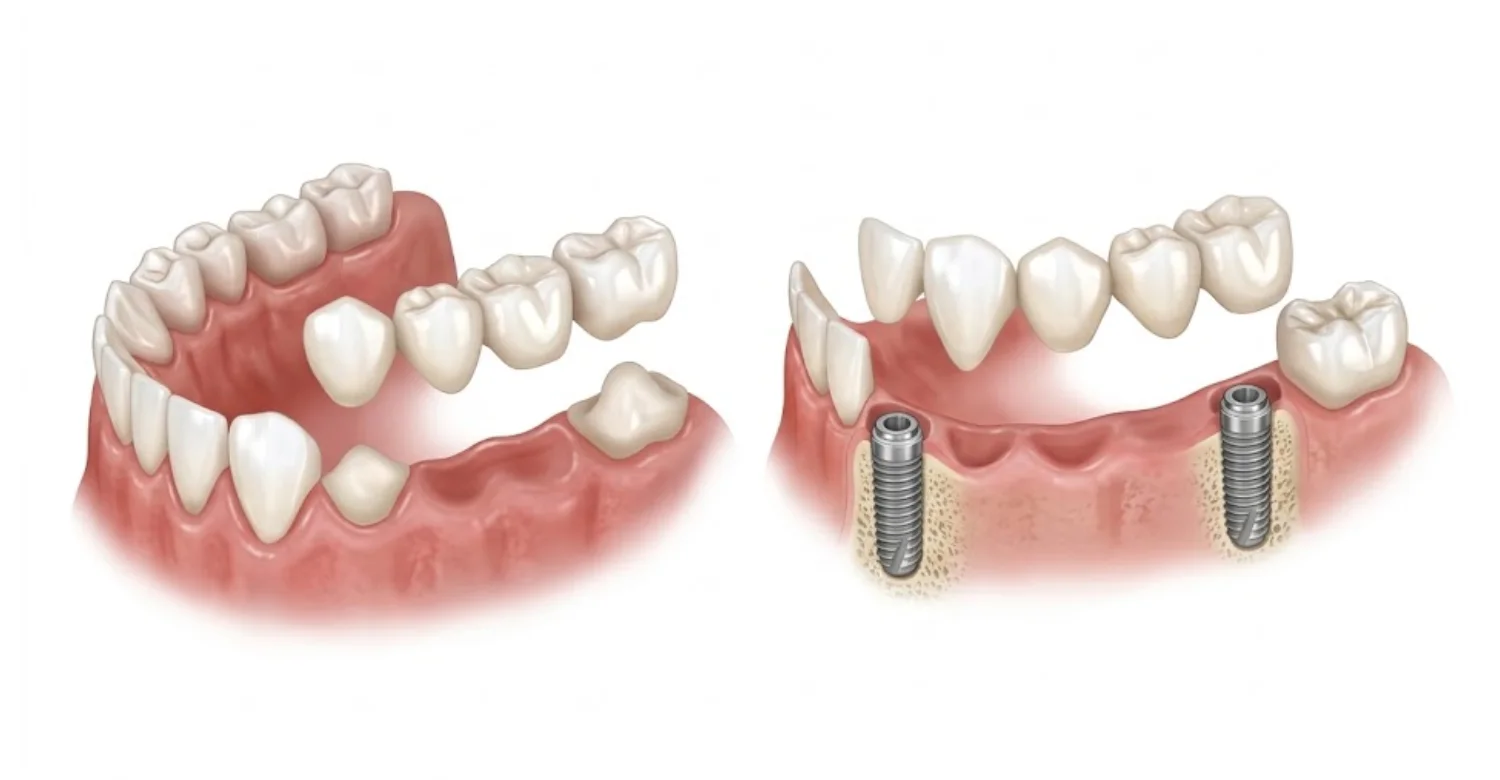
Implant Supported bridge vs traditional bridge is one of the most common comparisons for people replacing missing teeth. Both options can replace missing teeth with a fixed restoration. However, they rely on different forms of support. A traditional bridge uses prepared natural teeth as anchors. An Implant Supported bridge is anchored to dental implants placed in the jawbone. Implants replace missing tooth roots and may avoid preparing neighboring teeth. No single option suits everyone. The right choice should follow an examination of your gap, surrounding teeth, gums, bone, bite, and treatment goals.
Implant Supported Bridge vs Traditional Bridge: What Is the Difference?
Implant Supported bridge vs. traditional bridge comes down to one key question: what holds the new teeth in place? A traditional bridge borrows support from the natural teeth beside the gap. Those teeth are shaped and crowned. An Implant Supported bridge takes its support from implants set into the bone. Both close the space with fixed artificial teeth. Both can restore chewing and appearance. The real difference lies in the foundation, the treatment steps, and how each design behaves over time.
What Is a Traditional Dental Bridge?
A traditional dental bridge replaces one or more missing teeth with a fixed prosthesis. It is supported by crowns placed on the natural teeth on each side of the gap. These supporting teeth are called abutments. The replacement tooth, called a pontic, is joined to the crowns. The whole unit is cemented in place. It cannot be removed at home. Dentists have used this design for decades. In the Implant Supported bridge vs. traditional bridge discussion, it is the long-established, non-surgical option.
How Does a Conventional Bridge Stay in Place?
A conventional bridge stays in place through cemented crowns. First, the dentist reshapes the abutment teeth. This creates room for the crown material. Next, the teeth are scanned, or impressions are taken. A dental laboratory then fabricates the crowns and the connected pontic as one piece. At the fitting visit, the bridge is checked for fit and bite. It is then cemented or bonded onto the prepared teeth. The artificial tooth rests gently over the gum, filling the gap.
What Happens to the Teeth Supporting the Bridge?
The supporting teeth must be reduced to hold crowns. When these teeth are healthy and unrestored, this means removing sound enamel. Tooth preparation also carries biological considerations. The pulp inside the tooth may become irritated. In some cases, it may later need root canal treatment. The existing condition of these teeth matters greatly. Teeth with large fillings or old crowns may benefit from new crowns anyway. This is a central point when weighing Implant Supported bridge vs. traditional bridge options.
What Is an Implant Supported Bridge?
An Implant Supported bridge is a fixed row of artificial teeth attached to dental implants. The implants act as replacement roots. They are placed in the jawbone where teeth are missing. The bridge connects to these implants rather than relying mainly on natural neighboring teeth. This design is often used when several teeth in a row are missing. It can also help when adjacent teeth are healthy and worth protecting. The implant bridge vs conventional bridge choice often starts with this distinction.
How Do Dental Implants Support the Bridge?
First, implants are surgically placed in the jawbone. Over the following months, the bone bonds to the implant surface. This process is called osseointegration. Once integration is confirmed, abutments are attached. Abutments are connectors that link the implants to the bridge. The final bridge is then screwed or cemented onto them. Not every patient needs the same number of implants. Two implants may support a three-unit bridge. Longer spans may need more. Planning depends on bone, bite forces, and span length.
Implant Bridge vs Conventional Bridge at a Glance
The table below summarizes the main implant bridge vs conventional bridge differences. Neither option is automatically superior. Research shows that both tooth-supported and Implant Supported fixed restorations can achieve substantial long-term survival. However, their complication profiles differ. Tooth-supported bridges are more affected by decay and loss of tooth vitality. Implant bridges are more affected by technical issues and inflammation around implants. Use this overview as a starting point for your Implant Supported bridge vs traditional bridge discussion with your dentist.
Factor | Traditional Bridge | Implant Supported Bridge |
Main support | Crowned natural teeth | Dental implants in the jawbone |
Treatment invasiveness | Tooth preparation, no surgery | Surgical implant placement |
Effect on neighboring teeth | Adjacent teeth are reshaped | Neighboring teeth usually untouched |
Bone considerations | No bone needed in the gap | Adequate bone needed; grafting sometimes |
Treatment timeline | Usually 1–3 weeks | Usually 3–6 months or more |
Maintenance | Cleaning under pontic, abutment care | Cleaning around implants, component checks |
Potential complications | Decay, loss of vitality, debonding | Peri-implantitis, screw loosening, chipping |
Initial cost | Usually lower | Usually higher |
Long-term considerations | Depends on abutment health | Depends on bone, gums, and components |
Suitability | Stable, suitable abutment teeth | Suitable bone, healthy teeth to protect |
Why Are You Considering a Bridge in the First Place?
Most people consider a bridge because a gap is affecting daily life. Some notice chewing difficulties. Others dislike how their smile looks. Some worry about neighboring teeth drifting. Understanding your main concern helps frame the Implant Supported bridge vs traditional bridge decision. If protecting healthy teeth matters most, the discussion may lean one way. If avoiding surgery matters most, it may lean the other. Your priorities count, though clinical findings always come first. Below are the most common reasons patients start this conversation.
You May Be Missing One or More Teeth
A missing tooth affects more than appearance. Chewing may shift to one side of the mouth. Neighboring teeth can tilt into the space over time. Opposing teeth may over-erupt toward the gap. These changes can alter tooth contacts and the bite. Forces may then concentrate on fewer teeth. Food can also become trapped in newly formed spaces. Replacing the missing tooth helps restore balance. Both bridge types can achieve this when they are properly planned and maintained.
You May Be Worried About Preparing Healthy Teeth
Many patients hesitate when they learn that a conventional bridge requires crowns on adjacent teeth. This concern is valid. Preparing an untouched, healthy tooth removes enamel permanently. That tooth then depends on its crown for protection. If you share this worry, raise it early. Your dentist can explain how much reduction is needed. They can also show whether those teeth already need restoration. In the Implant Supported bridge vs traditional bridge comparison, this factor often carries significant weight.
You May Be Worried About Dental Implant Surgery
Implant placement is a surgical procedure. It is usually performed under local anesthesia. Most patients report manageable discomfort afterward. Still, surgery involves healing time, follow-up visits, and a small risk of complications. Some patients also need bone grafting first. This makes the implant pathway longer and more staged. If surgery worries you, discuss sedation options and recovery expectations. Understanding each step often reduces anxiety. Your general health will also be reviewed before any surgery is planned.
You May Mainly Be Comparing Cost and Treatment Time
Cost and time are practical concerns. A conventional bridge is often quicker and may cost less at first. An implant bridge usually involves more stages and components. However, the initial price is only part of the picture. Consider what may happen to the supporting teeth over the years. Consider possible future repairs or replacements too. The cheaper option today is not automatically the less expensive long-term choice. Compare full treatment pathways when reviewing Implant Supported bridge vs traditional bridge quotes.
Compare options in Single Dental Implant vs Multiple Implants
What Determines Whether an Implant Bridge or Conventional Bridge Is Suitable?
Suitability depends on clinical assessment, not preference alone. A dentist examines the teeth beside the gap, the bone beneath it, and the surrounding gums. They also study your bite and the available space. X-rays or 3D scans may be needed. Your medical history matters as well. Some conditions and habits, such as heavy smoking, can affect healing. Only after gathering this information can a clear Implant Supported bridge vs traditional bridge recommendation be made. The key factors are explained below.
Condition of the Neighboring Teeth
The neighboring teeth strongly influence the plan. Your dentist checks for:
Existing crowns or large restorations
Tooth decay
Cracks
Root canal treatment
Tooth mobility
Periodontal support
Strong, stable teeth with large existing fillings may make a conventional bridge reasonable. They would benefit from crowns anyway. Weak, cracked, or mobile teeth are different. They may not handle the extra load. In that case, the treatment plan may change. Healthy, untouched teeth may also shift the balance toward implants.
Bone Volume and Quality
Implants need enough healthy bone to anchor securely. After tooth loss, the jawbone can gradually shrink. The longer a gap remains, the more bone may be lost. A 3D CBCT scan measures bone height, width, and density. If bone is limited, grafting or other procedures may be recommended. Not every implant patient needs grafting. Many already have adequate bone. Traditional bridges do not depend on bone volume in the gap. This difference often shapes the Implant Supported bridge vs traditional bridge decision.
Gum and Periodontal Health
Healthy gums are essential for any bridge. Active gum disease can loosen natural teeth and damage bone around implants. It should be assessed and managed before definitive restorative treatment. This may involve deep cleaning, periodontal therapy, and improved home care. Gum stability also affects aesthetics. Receding or inflamed gums can make a bridge look less natural. Once gum health is stable, planning can continue safely. Both bridge types depend on long-term periodontal care to succeed.
Your Bite and Available Space
Your bite determines how much force the bridge will carry. The dentist examines occlusion, meaning how upper and lower teeth meet. They check the opposing teeth and the inter-arch space, which is the vertical room available. Limited space can restrict bridge or implant component design. Heavy bite forces or grinding increase stress on the restoration. In such cases, design changes or a protective night guard may be advised. Bite analysis applies to both sides of the Implant Supported bridge vs traditional bridge choice.
Number and Location of Missing Teeth
Replacing one tooth differs from replacing several in a row. A single gap between healthy teeth may suit a single implant crown instead. A short gap between suitable teeth may suit a conventional bridge. Longer spans place more stress on natural abutments. Here, implant support can distribute the load more safely. Location matters too. Front teeth raise aesthetic demands. Back teeth face higher chewing forces. Each factor shapes the implant bridge vs conventional bridge recommendation.
Spot the early signs of Tongue Cancer
Tips for Patients
Ask whether your neighboring teeth are healthy enough to support a conventional bridge.
Ask whether your bone volume is adequate for implant placement.
Request an explanation of the full treatment timeline, not only the surgical appointment.
Compare the complete treatment cost rather than the bridge price alone.
Ask how you will clean underneath and around your specific bridge design.
Implant Supported Bridge vs Dental Bridge: What Are the Main Benefits and Limitations?
Factor | Implant Supported Bridge | Conventional Dental Bridge |
|---|---|---|
How it is supported | Supported by dental implants placed in the jawbone. | Supported by neighboring natural teeth. |
Preparation of natural teeth | Usually does not require routine preparation of healthy neighboring teeth. | Neighboring teeth usually need to be prepared to support the bridge. |
Surgery | Requires surgical implant placement. | Does not require implant surgery. |
Healing time | May require several months for implant healing before the final restoration. | Generally does not require a bone-healing period. |
Treatment timeline | Often takes longer because of implant placement and healing. | Usually has a shorter overall treatment timeline. |
Bone preservation | Implants can help maintain bone in the treated area by providing root-like stimulation. | Does not provide the same stimulation to the underlying bone. |
Support distribution | Support comes primarily from the implants. | Support depends on the neighboring abutment teeth. |
Suitability for multiple missing teeth | Can be useful when several adjacent teeth are missing, depending on bone and implant conditions. | Can also replace multiple missing teeth when suitable supporting teeth are available. |
Condition of neighboring teeth | Healthy neighboring teeth generally do not need to be used as bridge supports. | Requires suitable neighboring teeth that can support the restoration. |
Maintenance | Requires regular professional reviews and careful daily hygiene. | Requires regular professional reviews and careful cleaning around and underneath the bridge. |
Potential biological complications | May include inflammation around implants, including peri-implantitis. | May include decay or periodontal problems affecting supporting teeth. |
Potential technical complications | May include screw loosening, restoration problems, or ceramic chipping. | May include restoration damage or problems affecting the supporting teeth. |
If a supporting structure fails | An implant or the bridge restoration may require further treatment. | Failure of an important abutment tooth may affect the entire bridge. |
Best suited when | Implant placement is clinically appropriate and surrounding conditions support implant treatment. | Suitable neighboring teeth are available and implant surgery is not preferred or indicated. |
Main benefit | Fixed tooth replacement without relying primarily on neighboring natural teeth. | Fixed tooth replacement without the need for implant surgery. |
Main limitation | More invasive treatment with surgery, healing, and implant-related risks. | Requires preparation and long-term reliance on neighboring supporting teeth. |
If one abutment tooth fails, the whole bridge may need replacing. Cleaning under the pontic also requires extra effort. Research shows that both conventional and Implant Supported options can achieve high survival. However, their biological and technical complications differ. This balance is central to Implant Supported bridge vs traditional bridge planning.
Find out when Subperiosteal Implants for Maxillary Reconstruction are used
Fixed Implant Bridge vs Conventional Bridge: How Does the Treatment Process Differ?
The fixed implant bridge vs conventional bridge treatment pathways differ mainly in timing and surgery. A conventional bridge can often be completed within a few weeks. An Implant Supported bridge typically takes several months. This is because implants must integrate with the bone before loading. Both begin with a thorough examination. Both end with careful bite adjustment. Understanding each sequence helps you plan travel, work, and daily life. It also clarifies the Implant Supported bridge vs traditional bridge timeline difference.
Conventional Bridge Treatment Process
A typical conventional bridge follows this sequence:
Examination and treatment planning
Assessment of supporting teeth
Tooth preparation when required
Impressions or digital scanning
Temporary restoration when indicated
Fabrication of the definitive bridge
Try-in and occlusal assessment
Final placement
Most patients need two or three main visits. The gap between preparation and fitting is usually one to two weeks while the laboratory works. A temporary bridge protects the prepared teeth during this time.
Implant Supported Bridge Treatment Process
An Implant Supported bridge usually follows these stages:
Clinical examination
Imaging and implant planning
Implant placement
Healing and integration
Abutment/restorative stage
Digital impression or scanning
Bridge fabrication
Final fitting and bite adjustment
Bone augmentation may be added before or during implant placement when needed. Healing and integration commonly take around three to six months. A temporary restoration may be worn meanwhile. Some cases allow faster loading, depending on bone quality and implant stability.
Clinical Note
Clinical Note: Dr. Rifat Alsaman, Head of the Medical Team and cosmetic dentist at Vitrin Clinic, explains that bridge selection is ultimately a restorative planning decision. An Implant Supported bridge may reduce the need to prepare neighboring teeth. However, it introduces implant surgery and implant-specific maintenance. A conventional bridge may be appropriate when the supporting teeth are already suitable for crowns or need restoration for other reasons. The evidence does not support treating one design as universally appropriate for every patient. Each plan should reflect individual findings.
Explore the link between Long-Distance Endurance Exercise and Tooth Erosion
Implant Bridge vs Traditional Bridge Cost: What Should You Actually Compare?
Implant bridge vs traditional bridge cost comparisons can be misleading if you only look at one number. An Implant Supported bridge usually costs more initially. It can involve surgery, implants, 3D imaging, healing time, and restorative components. A conventional bridge often has a lower upfront price. However, the true cost includes preliminary treatment, maintenance, and possible future work. When reviewing Implant Supported bridge vs traditional bridge prices, ask what each quote includes and excludes.
What Can Affect the Cost of a Conventional Bridge?
Several factors shape the price of a conventional bridge:
Number of units
Materials, such as zirconia or porcelain fused to metal
Condition of supporting teeth
Existing restorations
Need for preliminary treatment, such as root canal or gum therapy
Laboratory and digital workflow
A three-unit bridge costs less than a longer span. Premium materials usually cost more. If abutment teeth need treatment first, the total rises accordingly. Ask for an itemized quote so you can see each part clearly.
What Can Affect the Cost of an Implant Supported Bridge?
Implant bridge pricing depends on:
Number of implants
Implant system
Bone availability
Need for grafting
Abutments
Bridge material
Imaging and planning
Temporary restorations
Follow-up requirements
Grafting can add both cost and time. Established implant systems may cost more but offer long-term component availability. Always confirm whether imaging, temporary teeth, and follow-up reviews are included in your quote.
Whythe Lowest Initial Price May Not Tell the Whole Story
A lower quote can look attractive, but it may not reflect the full picture. One plan may exclude imaging or temporary teeth. Another may not account for treating weak abutment teeth. Future costs also matter. A conventional bridge may need replacement if a supporting tooth fails. An implant bridge may need component repairs over time. Compare complete treatment plans side by side. This gives a fairer implant bridge vs traditional bridge cost comparison than comparing two single figures.
How Long Does an Implant Supported Bridge or Traditional Bridge Last?
No dentist can promise a fixed lifespan for any bridge. Longevity depends on many factors. These include oral hygiene, gum health, bite forces, materials, and regular reviews. Both designs can last many years with good care. Both can also fail earlier if problems develop unnoticed. In the Implant Supported bridge vs traditional bridge comparison, the question is less about which lasts longer. It is more about which risks apply to your mouth and how well they can be managed.
How Long Can a Conventional Bridge Remain Functional?
A conventional bridge can remain functional for many years. Longevity varies according to abutment quality, oral hygiene, periodontal health, bite, bridge design, and maintenance. Long-term studies show meaningful survival rates. However, failures and complications do occur. Common problems include decay under the crowns and loss of retention. Some supporting teeth need root canal treatment later. Regular checkups help detect these issues early. Careful cleaning under the pontic also helps protect the abutment teeth.
How Long Can an Implant Supported Bridge Last?
Implant Supported restorations can show strong long-term survival. Implants themselves often remain stable for many years. However, implant survival is not the same as complication-free function. Technical complications can still occur. These include ceramic fracture, screw loosening, and wear of components. Biological problems such as peri-implantitis may also develop. Most issues are repairable when found early. This is why follow-up care matters. In Implant Supported bridge vs traditional bridge terms, both require long-term commitment.
Understand the risks of Acidic Sugar-Free Candy and Tooth Erosion
What Can You Expect Before and After a Bridge Treatment?
Knowing what to expect helps you prepare mentally and practically. Before treatment, the gap may affect eating, speaking, or confidence. After treatment, most patients notice improved function and appearance. However, results vary. They depend on your starting condition, bridge design, oral health, and healing response. Realistic expectations lead to greater satisfaction. Whichever path you choose in the Implant Supported bridge vs traditional bridge decision, clear communication with your dentist is essential. It also helps you plan time around each appointment.
Before Treatment
Before treatment, you may have:
A visible gap
Difficulty chewing certain foods
Food trapping
Concerns about appearance
Concerns about neighboring teeth
Questions about treatment time or surgery
These are normal concerns. Write them down before your consultation. This helps your dentist address each one clearly. It also ensures your priorities shape the treatment plan. Share any medical conditions or medications too, as they can affect planning.
After Treatment
After treatment, realistic expectations include:
Improved ability to chew
A more complete dental arch
Improved appearance when aesthetics are a treatment goal
A fixed restoration rather than a removable replacement
The result depends on the starting condition, bridge design, oral health, and individual healing. Some adjustment is normal in the first days. The bite may feel slightly different at first. Speech usually adapts quickly. Report any persistent discomfort to your dentist promptly.
What You Should Not Expect
Neither treatment guarantees a permanent restoration. No bridge eliminates the need for maintenance. Natural abutment teeth can still decay. Gums around implants can still become inflamed. Porcelain can chip. Screws can loosen. A bridge also does not stop gum disease elsewhere in the mouth. Expecting a lifetime result without care leads to disappointment. Instead, view your bridge as a long-term investment. It needs daily cleaning and regular professional reviews to perform well.
Learn about causes and prevention for Throat Ulcers
What We Notice Clinically
Dr. Rifat Alsaman, Head of the Medical Team and cosmetic dentist at Vitrin Clinic, considers several factors before discussing bridge design. These include the neighboring teeth, bone, gums, bite, number of missing teeth, and the patient's priorities. In his view, an Implant Supported bridge should not be selected simply because it is an implant treatment. Likewise, a conventional bridge should not be selected solely because it may involve fewer surgical steps. The right answer depends on clinical findings. Each case deserves its own reasoning.
How Can You Maintain Your Bridge and Protect Your Oral Health?
Maintenance is what keeps any bridge functional. Daily home care removes plaque from the restoration, the gums, and the supporting structures. Professional reviews catch problems early. Without both, even a well-made bridge can fail. The cleaning technique differs slightly between designs. A conventional bridge requires cleaning under the pontic and around the crowned teeth. An implant bridge requires careful cleaning around the implant connections. Your dentist or hygienist should demonstrate the right tools for your specific design.
Cleaning Around a Conventional Bridge
Brush twice daily with fluoride toothpaste. Pay close attention to the gumline around the crowned teeth. Normal floss cannot pass between joined units. Instead, use a floss threader, super floss, or a water flosser. These reach beneath the artificial tooth, where plaque collects. Interdental brushes help clean the spaces beside the abutments. Fluoride protects the natural tooth structure at the crown margins. Consistent cleaning reduces the risk of decay under the crowns. It also keeps the gums healthy.
Cleaning Around an Implant Supported Bridge
Plaque control around implants is essential. Implants cannot decay, but the surrounding gums and bone can become inflamed. Brush carefully around each implant connection. Use interdental brushes sized for your spaces. A water flosser can clean under the bridge effectively. Some designs need special brushes or implant floss. Avoid metal-tipped tools that may scratch components. Your hygienist can recommend aids suited to your specific bridge design. Daily consistency matters more than any single product.
Why Regular Dental Reviews Matter
Routine reviews help identify problems before they become harder to manage. During a checkup, the dentist examines the restoration, supporting teeth, gums, and implants. X-rays may reveal hidden decay or bone changes. Professional cleaning removes hardened deposits you cannot reach at home. Screw stability and bite contacts can also be checked. Many patients benefit from reviews every six months. Some need more frequent visits, especially with a history of gum disease. Early care is simpler, whichever side of the Implant Supported bridge vs traditional bridge decision you chose.
Find out what means a Black Spot Inside Your Cheek
Prevention: How Can You Protect Your Remaining Teeth and Bridge?
Prevention protects both your bridge and your natural teeth. Key habits include:
Daily plaque control
Interdental cleaning
Regular professional examinations
Managing gum disease
Limiting frequent sugar exposure
Addressing bruxism (teeth grinding) when clinically relevant
Wearing a protective appliance when prescribed
Avoiding using the bridge to bite excessively hard objects
These steps apply to either design. Small daily habits often decide how long a restoration lasts. They also protect the teeth you still have.
Implant Bridge vs Conventional Bridge: Which One May Be Appropriate for You?
The implant bridge vs conventional bridge decision is not about finding a winner. It is about matching the treatment to your situation. Each option works well in the right case. Each carries risks in the wrong case. Your teeth, bone, gums, bite, goals, and timeframe all matter. The following sections describe when each may be considered. Use them as a guide, not a self-diagnosis. A professional examination should confirm the Implant Supported bridge vs traditional bridge choice.
A Conventional Bridge May Be Considered When...
A conventional bridge may be considered when the teeth beside the gap are strong and well supported. It suits cases where those teeth already have large fillings or crowns. They would benefit from new crowns anyway. It may also suit patients who prefer to avoid surgery. Some medical conditions make implant surgery less advisable. Limited time can also favor this option. Finally, it may be considered when bone in the gap is insufficient and grafting is not preferred.
An Implant Supported Bridge May Be Considered When...
An Implant Supported bridge may be considered when several teeth are missing and bone conditions are suitable. It is often preferred when neighboring teeth are healthy and unrestored. Protecting them avoids unnecessary enamel removal. It can also help when there are no suitable natural teeth to support a bridge. Patients willing to accept surgery and a longer timeline may benefit. Good general health and commitment to hygiene also support this choice in Implant Supported bridge vs traditional bridge planning.
Why Individual Assessment Matters
Two patients with identical gaps may need different treatments. One may have strong abutment teeth and limited bone. Another may have healthy, untouched teeth and excellent bone. Terminology alone cannot decide the right option. Only a clinical examination, imaging, and bite analysis can. Online comparisons offer useful background. However, they cannot see your mouth. Individual assessment turns general information into a safe, personalized plan. That is the foundation of any sound Implant Supported bridge vs traditional bridge decision.
Understand the causes and treatment for Anodontia
Vitrin Clinic: Individualized Bridge and Implant Planning
Vitrin Clinic approaches bridge and implant planning through individualized assessment. Where clinically indicated, the evaluation may include a dental examination, periodontal assessment, digital scans, CBCT/3D imaging, and bite assessment. Dr. Rifat Alsaman, Head of the Medical Team and cosmetic dentist at Vitrin Clinic, oversees individualized treatment planning. He can coordinate restorative, cosmetic, periodontal, and implant considerations when more than one area of care is involved. This helps each Implant Supported bridge vs traditional bridge recommendation reflect your full oral health picture.
What Can Be Discussed During Your Consultation?
During your consultation, you can discuss:
Which bridge type may be suitable
Condition of supporting teeth
Implant suitability
Bone and gum assessment
Expected treatment stages
Estimated treatment duration
Maintenance requirements
Complete treatment costs
If you are missing one or more teeth, you can arrange an assessment at Vitrin Clinic. You may also request a personalized treatment plan. Your options will be explained based on your own clinical findings.

.jpg)
.jpg)
Takeaway: Choosing Between an Implant Supported and Traditional Bridge
Both restoration types can provide fixed tooth replacement. However, they solve the problem in different ways. A conventional bridge relies on natural teeth. An Implant Supported bridge relies on implants placed in the jawbone. Neither is right for everyone. Before choosing, have the missing-tooth area examined properly. Avoid deciding based only on price, treatment speed, or online comparisons. The best Implant Supported bridge vs traditional bridge choice reflects your anatomy, oral health, restorative needs, and priorities.
Ready to transform your smile?
Talk to our team and get a FREE treatment plan.
References:
FAQs
Dr. Rifat Alsaman has more than 5 years of clinical experience in dentistry and currently serves as the Head of the Medical Team at Vitrin Clinic. He is dedicated to providing exceptional patient care, overseeing treatment planning, and ensuring the highest clinical standards across the team. His expertise, attention to detail, and commitment to continuous professional development have helped countless patients achieve healthier, more confident smiles.


