
The best medicine for toothache depends on the cause of the pain, your health, and the medicines you already take. Over-the-counter active ingredients can ease discomfort temporarily, but they do not fix the dental problem. This guide explains your options, their risks, and when to see a dentist.
What Is the Best Medicine for Toothache?
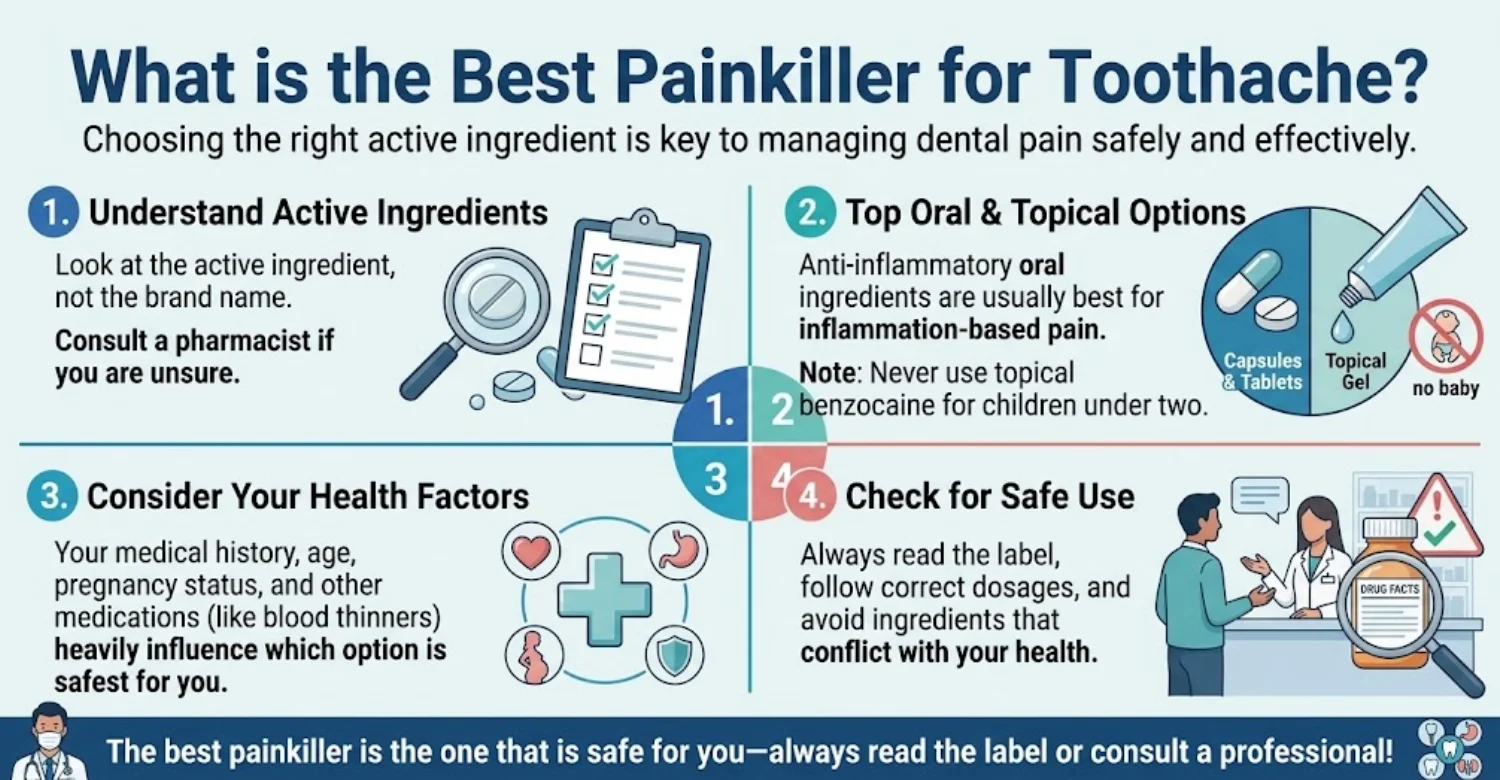
There is no single best medicine for toothache for everyone. For many adults, anti-inflammatory active ingredients such as ibuprofen are a common first choice for dental pain, while acetaminophen suits those who cannot take anti-inflammatories. The right option depends on your medical history and the cause of the pain.
How Does Toothache Medicine Help Relieve Dental Pain?
Toothache pain medicine works by reducing the body's pain signals and, with some active ingredients, by lowering inflammation around the tooth. Because much dental pain comes from an inflamed pulp or gums, anti-inflammatory ingredients can help. Still, any pain reliever only controls symptoms temporarily, not the underlying cause.
What Is the Difference Between Tooth Pain Medication and Toothache Pain Medicine?
The terms tooth pain medication and toothache pain medicine are generally used interchangeably. Both describe medicines taken to relieve dental discomfort, usually containing active ingredients such as ibuprofen, naproxen, or acetaminophen. What matters most is the active ingredient, whether it suits you, and using it correctly according to label directions.
What Is the Best Painkiller for Toothache?
The best painkiller for toothache is usually an anti-inflammatory active ingredient such as ibuprofen or naproxen, since dental pain often involves inflammation. Professional dental guidance supports anti-inflammatories, alone or combined with acetaminophen, as first-line options for many adults. The right choice still depends on your individual health.
Which Over-the-Counter Painkillers Can Help Relieve Toothache?
Common over-the-counter active ingredients for toothache include ibuprofen, naproxen, acetaminophen, and aspirin taken by mouth. Topical gels containing benzocaine can numb the area briefly but should never be used for children under two. Always read the label, follow the directions, and check that each product suits your health.
How Should Patients Choose the Best Tablet for Tooth Pain?
To choose the best tablet for tooth pain, look at the active ingredient rather than the product name. Consider your age, medical conditions, other medicines, and any allergies, and ask a pharmacist if unsure. The best medicine for toothache is the one that is effective, safe for you, and used correctly.
What Factors Affect the Choice of Tooth Pain Medication?
Factors that affect the choice of tooth pain medication include stomach, kidney, liver, or heart conditions, pregnancy, asthma, age, alcohol use, and other medicines you take, especially blood thinners. These factors can make some active ingredients unsuitable, so the most suitable option differs from one patient to another.
What Is the Strongest Medicine for Toothache?
Many people search for the strongest medicine for toothache, but stronger does not always mean better. Dental guidance shows that combining ibuprofen with acetaminophen, when appropriate and taken as directed, can relieve dental pain effectively. The best medicine for toothache balances effectiveness with safety, and prescription options require a professional decision.
When Might Stronger Pain Relief Be Necessary?
Stronger pain relief may be considered when severe pain does not respond to standard over-the-counter options taken correctly. In these cases, a dentist or doctor decides whether a different approach is needed. Prescription pain relievers are generally reserved for limited situations and short periods, after carefully evaluating the patient's needs.
Why Should Patients Avoid Taking More Than the Recommended Dose?
Taking more than the recommended dose does not reliably improve pain relief but does increase the risk of harm. Excess acetaminophen can cause serious liver damage, while too much ibuprofen or naproxen can irritate the stomach and affect the kidneys. Any pain reliever must stay within label limits.
What Are the Risks of Using Strong Painkillers Without Dental Advice?
Using strong painkillers without dental advice can hide worsening problems such as a spreading infection, delaying needed treatment. Some prescription pain relievers also carry risks of drowsiness, dependence, and interactions with other medicines. Relying on painkillers alone allows the cause to progress, making later dental treatment more complex.
What Is the Best Medicine for Severe Toothache?
The best medicine for severe tooth pain is often an anti-inflammatory active ingredient, sometimes combined with acetaminophen when appropriate, but severe pain usually signals a problem needing dental care. Medicine for severe toothache provides temporary relief, yet in severe cases the best medicine for toothache is prompt professional treatment.
What Should Patients Do When Severe Tooth Pain Does Not Improve?
If severe tooth pain does not improve with correctly used tooth pain medication, contact a dentist promptly. Do not keep increasing doses or adding extra products. Persistent severe pain often indicates deep decay, nerve inflammation, or infection, which require diagnosis and treatment that medicine alone cannot provide.
Can Medicine for Severe Toothache Treat the Underlying Cause?
No. Painkillers reduce pain and inflammation, but they do not remove decay, repair a cracked tooth, or clear an infection. Even effective pain relief only buys time until a dentist can provide definitive treatment, such as a filling or root canal treatment, that addresses the actual problem.
When Does Severe Tooth Pain Require Urgent Dental Care?
Severe tooth pain requires urgent dental care if it comes with facial or gum swelling, fever, a bad taste or pus, or pain spreading to the jaw, ear, or neck. Difficulty swallowing or breathing is an emergency, so seek emergency medical care immediately if this happens.
Note : All images used are for editorial and illustrative purposes only and may not originate from the original news provider or associated company.
What Causes Toothache and When Is Medication Necessary?
Toothache can result from decay, infection, cracked teeth, damaged fillings or crowns, gum inflammation, or sensitivity. Medication may help manage pain while you wait for an appointment, but it cannot replace treating the cause. Understanding the source helps decide whether medicine alone is reasonable.
Tooth Decay and Dental Infections
Tooth decay damages enamel and can reach the inner pulp, causing sensitivity and pain. If bacteria infect the pulp, an abscess may form, causing throbbing pain and swelling. Pain relievers can ease this discomfort temporarily, but decay and infection need a filling, root canal treatment, or other care.
Cracked Teeth and Damaged Dental Restorations
Cracked teeth and damaged fillings or crowns can expose sensitive inner layers, causing sharp pain when biting or with hot and cold. Tooth pain medication may ease discomfort, but the crack or damaged restoration needs repair. Delaying treatment can allow cracks to spread and bacteria to reach the nerve.
Gum Inflammation and Tooth Sensitivity
Gum inflammation can cause soreness, bleeding, and discomfort around the teeth, while exposed roots or worn enamel can cause sensitivity to temperature and sweets. Good oral hygiene and a desensitizing toothpaste may help. Pain relievers can ease flare-ups, but the real solution here is addressing the gum or enamel problem.
Clinical Note
Persistent or recurring toothache is a sign that something needs professional evaluation, even if painkillers seem to work. The dental team at Vitrin Clinic notes that dental infections may need definitive treatment, such as drainage, root canal treatment, or extraction, rather than relying on painkillers alone.
How Can You Relieve Toothache at Home Until Your Dental Appointment?
Simple home measures can make toothache more bearable while you wait for a dental appointment. Combined with a pain reliever suited to your health, these steps can reduce swelling and avoid triggering pain. They are temporary measures only and do not replace professional assessment and treatment.
Apply a Cold Compress to the Outside of the Cheek
Apply a cold compress wrapped in a cloth to the outside of the cheek for about 15–20 minutes at a time. Cold can help reduce swelling and numb discomfort. Never place ice directly on the skin or the painful tooth, and contact a dentist if swelling increases.
Avoid Foods and Drinks That Trigger Tooth Pain
Avoid foods and drinks that trigger pain, such as very hot or cold items, sugary snacks, acidic drinks, and hard or chewy foods. Chew on the opposite side of your mouth. Rinsing gently with warm salt water may help keep the area clean while you wait for dental care.
Tips for the Patients
Keep these safety points in mind when using the best medicine for toothache at home:
Follow medication labels and avoid exceeding recommended doses.
Do not place aspirin directly on the tooth or gums.
Avoid taking multiple medicines containing the same active ingredient.
Seek urgent care for facial swelling, fever, or difficulty swallowing or breathing.
What Are the Risks of Taking Toothache Pain Medicine?
Every toothache pain medicine carries potential risks, especially with incorrect use, long-term use, or existing health conditions. Understanding these risks helps you use pain relievers safely. Reading labels, avoiding duplicate active ingredients, and asking a pharmacist or doctor when unsure all reduce the chance of side effects.
Can Painkillers Cause Stomach Problems or Other Side Effects?
Yes. Anti-inflammatory active ingredients such as ibuprofen, naproxen, and aspirin can irritate the stomach and, in some people, cause ulcers or bleeding. They may also affect the kidneys and blood pressure. Acetaminophen is gentler on the stomach, but exceeding the recommended dose can cause serious liver damage.
Which Patients Should Consult a Healthcare Professional Before Taking Painkillers?
Consult a healthcare professional before taking any painkiller if you are pregnant or breastfeeding, have stomach ulcers, kidney, liver, or heart disease, asthma, or high blood pressure, take blood thinners, or are treating a child. Aspirin should not be given to children or teenagers.
Why Should Antibiotics Not Be Used Without a Prescription?
Antibiotics do not relieve most toothaches and should never be used without a prescription. Most dental pain, including many infections, is best treated by removing the cause. Unnecessary antibiotic use can cause side effects and contribute to antibiotic resistance. A dentist decides whether antibiotics are needed, usually alongside dental treatment.
Ready to transform your smile?
Talk to our team and get a personal FREE treatment plan.
When Should You See a Dentist Instead of Taking More Tooth Pain Medication?
If you keep needing more tooth pain medication, it is time to see a dentist. Relying on painkillers for several days can mask a worsening problem. Pain medication is meant for short-term relief, while lasting comfort comes from diagnosing and treating the cause of the pain.
Warning Signs of a Dental Infection
Warning signs of a dental infection include throbbing pain, swelling of the gums or face, a pimple or pus near the tooth, a bad taste or bad breath, fever, and tender lymph nodes under the jaw. These signs need prompt dental care; painkillers cannot clear an infection.
When Toothache Requires Emergency Treatment
Toothache requires emergency treatment if you have facial swelling with fever, difficulty swallowing or breathing, swelling spreading toward the eye, jaw, or neck, or you feel very unwell. These may signal a spreading infection. If you cannot reach a dentist quickly, go to an emergency department immediately.
Why Treating the Cause of Tooth Pain Is More Important Than Masking Symptoms
Painkillers only mask symptoms, while the problem causing them may continue to worsen. Untreated decay can reach the nerve, and infections can spread. Treating the cause relieves pain more reliably and protects your tooth. In most cases, the best medicine for toothache is effective dental treatment, not more tablets.
How Can Vitrin Clinic Help Patients With Toothache?
Vitrin Clinic is a dental care provider focused on evaluating patients' dental concerns and discussing appropriate treatment options. Rather than relying on pain medication alone, the clinic aims to identify the source of pain and recommend treatment based on clinical findings and each patient's individual needs.
.jpg)
.jpg)
.jpg)
.webp)
How Does Vitrin Clinic Approach Dental Pain Evaluation?
At Vitrin Clinic, dental pain evaluation begins with listening to your symptoms, including when the pain started and what triggers it. The dentist examines the teeth and gums and may use X-rays or other tests when needed. This approach helps locate the problem accurately rather than masking it.
Why Is Identifying the Cause of Toothache Important Before Treatment?
Different causes of toothache need different treatments, so identifying the cause comes first. A cracked tooth, deep decay, and gum inflammation can feel similar but are managed differently. Accurate diagnosis prevents unnecessary procedures and ensures that pain relief supports rather than replaces treatment.
How Can Vitrin Clinic Help Patients Understand Their Dental Treatment Options?
Dr. Rifat Alsaman, Head of the Medical Team at Vitrin Clinic and a Cosmetic Dentist, highlights the importance of professional assessment and patient-centered dental care. Vitrin Clinic explains treatment options clearly, based on the underlying cause, clinical findings, and individual needs. Pain medication may offer temporary relief but does not replace treating decay, damaged teeth, or infections.
Clinical Note
Clinically, many patients delay care because pain relievers temporarily control their symptoms. By the time they seek help, decay or infection may have progressed. Using painkillers for short-term comfort is reasonable, but recurring pain is a signal to book a dental assessment rather than continue self-medicating.
Tips for the Patients
To use the best medicine for toothache safely until your visit:
Use pain relievers only as directed on the label.
Note when the pain occurs and what triggers it.
Keep up gentle brushing and flossing.
Seek urgent care for swelling, fever, or difficulty swallowing.
Contact Vitrin Clinic if toothache persists or keeps returning.
Resource:
https://pubmed.ncbi.nlm.nih.gov/36631957/
https://pmc.ncbi.nlm.nih.gov/articles/PMC10911578/
https://pubmed.ncbi.nlm.nih.gov/37634915/
FAQs

Dr. Rifat Alsaman has more than 5 years of clinical experience in dentistry and currently serves as the Head of the Medical Team at Vitrin Clinic. He is dedicated to providing exceptional patient care, overseeing treatment planning, and ensuring the highest clinical standards across the team. His expertise, attention to detail, and commitment to continuous professional development have helped countless patients achieve healthier, more confident smiles.


