Dental Veneers in Turkey
October 21, 2026
Ceramic Veneers: Types, Pros & Cons, Lifespan and Cost
 Dr. Rifat Alsaman

Ceramic veneers are one of the most reliable ways to get a natural, bright smile that lasts. Yet choosing them can feel confusing. Porcelain, E-max, zirconia and composite all sound similar, and many patients are unsure which one suits them.
Here is the short answer. These are thin, custom-made shells of dental ceramic that are bonded to the front of your teeth to improve their color, shape and size. "Porcelain veneers" are one type of ceramic veneer, so the two terms are often used to mean the same thing.
At Vitrin Dental Clinic in Istanbul, we design every smile digitally and protect as much natural tooth as possible. This guide explains the types, pros and cons, lifespan and cost, so you can choose with confidence.
.jpg)
.jpg)
.jpg)
.jpg)
.jpg)
.jpg)
.jpg)
.jpg)
Ready to transform your smile?
Talk to our team and get a FREE treatment plan.
What Are Ceramic Veneers?
Ceramic veneers are thin shells of tooth-colored dental ceramic, usually about 0.3 to 0.7 mm thick, that are permanently bonded to the front surface of teeth. Each one is custom-made to change a tooth's color, shape, size or length. Because ceramic reflects light much like natural enamel, the result looks lifelike. Unlike crowns, veneers cover only the visible surface, so they usually preserve more healthy tooth structure. They are a cosmetic treatment, not a fix for decay or gum disease.
How ceramic veneers work
A veneer works through adhesive bonding. First, the dentist lightly reshapes the enamel, often by only a fraction of a millimeter, to make room for the shell. Next, the inside of the ceramic is etched and coated with a bonding agent. A resin cement then locks it to the enamel, creating a strong, sealed bond. Once in place, the veneer can mask discoloration, cover chips, close small gaps and rebuild worn or uneven edges. Bonding to enamel gives the most predictable results.
Ceramic veneers for front teeth
Patients asking about ceramic veneers front teeth treatment usually mean the "smile zone." This is the group of teeth people see when you talk and smile. Most makeovers cover the upper six to ten front teeth, depending on how wide your smile is. Front teeth face lighter chewing forces than molars, which suits thin bonded ceramic. Back teeth take heavier loads and are rarely visible. For damaged back teeth, onlays or crowns are usually a better choice.
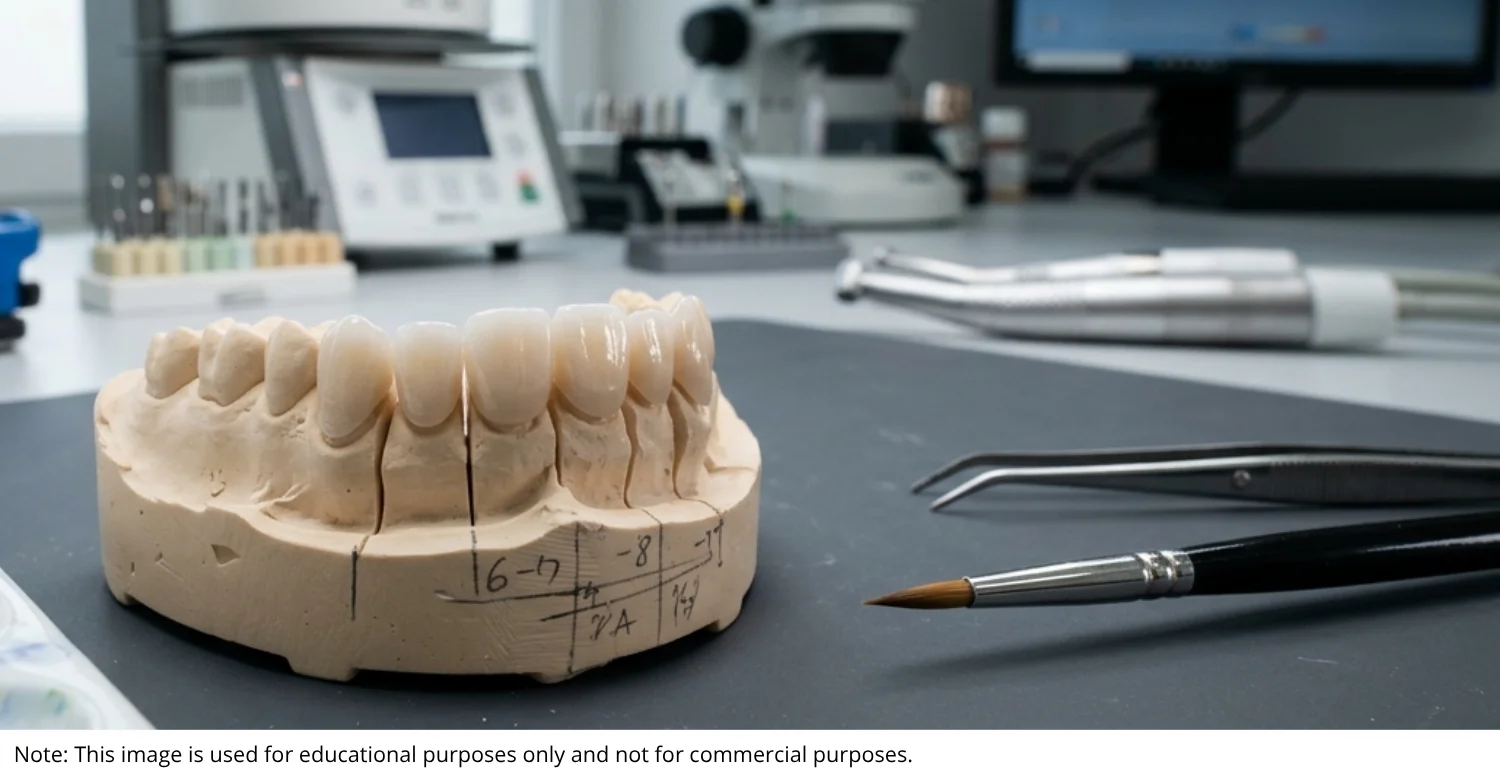
Porcelain vs. Ceramic Veneers: What's the Difference?
Porcelain is a type of ceramic. So every porcelain veneer is a ceramic veneer, but not every ceramic veneer is traditional porcelain. Today, the word "ceramic" often refers to stronger materials such as lithium disilicate (E-max) or zirconia. "Porcelain" traditionally means feldspathic porcelain, the classic hand-layered material. That is why the porcelain vs ceramic veneers debate is mostly about wording. The real choice is between specific materials. Each one offers its own balance of beauty, strength and cost.
Are ceramic and porcelain veneers the same?
Yes and no. They belong to the same material family, so many dentists use the terms interchangeably. However, they are not always the same material. Feldspathic porcelain is a glass-rich ceramic with very high translucency. Lithium disilicate is a reinforced glass-ceramic that is much stronger. Zirconia is a dense, crystalline ceramic with very high strength but lower translucency. So when a clinic quotes "porcelain" or "ceramic," ask which exact material and brand it uses. This affects appearance, durability and price.
Which is better, porcelain or ceramic veneers?
It depends on your goal. For most patients, E-max offers the best balance of beauty and strength. It is thin, natural-looking and resistant to chipping. Feldspathic porcelain gives maximum translucency, which suits very thin veneers on teeth that need only small changes. However, it is more fragile and needs a highly skilled ceramist. Zirconia is the toughest option, but its opacity makes it better for crowns or very dark teeth. Your bite, tooth color and enamel guide the final choice.
Feature | Feldspathic porcelain | E-max (lithium disilicate) | Zirconia |
Appearance | Most translucent, very lifelike | Natural, highly translucent | More opaque; newer types are more translucent |
Strength | Lowest | High | Highest |
Thickness | Can be extremely thin | Thin | Usually thicker |
Tooth prep | Minimal | Minimal to moderate | Moderate |
Lifespan | Long, if well bonded to enamel | Long, with strong clinical data | Long, but bonding is less predictable |
Price level | Higher (handcrafted) | Mid to high | Mid to high |
Types of Ceramic Veneers
Veneer ceramics fall into three main groups: feldspathic porcelain, glass-ceramics such as lithium disilicate (E-max), and zirconia. Each is made differently. Feldspathic porcelain is layered by hand and fired in a furnace. E-max is pressed or milled from a solid block. Zirconia is milled and then sintered at very high temperature. The right material depends on how much color change you need, how strong your bite is and how much enamel you have. Using one material across visible teeth keeps color consistent.
Feldspathic porcelain veneers
Feldspathic porcelain is the original veneer material. A ceramist builds it up layer by layer from powder and liquid, then fires it in a furnace. This hand-layering creates subtle color shifts and translucent edges that mimic natural enamel beautifully. Feldspathic veneers can be made extremely thin, so they often need very little tooth reduction. The trade-off is lower strength. They rely heavily on a strong bond to enamel and are less suitable for people who grind their teeth.
E-max (lithium disilicate) veneers
E-max is the brand name for a lithium disilicate ceramic made by Ivoclar. It is one of the most widely used veneer materials today. It is several times stronger than feldspathic porcelain, yet it stays translucent and natural-looking. E-max can be pressed or digitally milled to thin dimensions, so preparation stays conservative. Its glassy surface can also be etched, which allows a very reliable bond to enamel. For a deeper look, read our full guide to E-max veneers.
Zirconia veneers
Zirconia is the strongest dental ceramic and resists fracture very well. Traditional zirconia is fairly opaque, although newer translucent versions look more natural. This opacity can help mask very dark or heavily stained teeth. However, zirconia has drawbacks as a veneer. It usually needs more thickness. It also cannot be etched like glass-ceramics, so bonding relies on sandblasting and special primers. For these reasons, zirconia is used far more often for crowns than for thin veneers.
All-ceramic vs. metal-backed restorations
Older crowns were often made of porcelain fused to a metal base. Metal adds strength, but it blocks light and can show as a gray line near the gums. Veneers, by contrast, are always fully metal-free. All-ceramic restorations let light pass through naturally, which gives teeth a lifelike glow. They also avoid any concern about metal sensitivity. Today, even crowns are increasingly made from all-ceramic materials such as E-max and zirconia, mainly because they look far more natural.
What Are the Three Types of Veneers?
The three main types are porcelain or ceramic, composite resin, and no-prep or ultra-thin veneers (often sold under brand names like Lumineers). Porcelain and ceramic options are made in a lab and last the longest. Composite veneers are sculpted directly onto the tooth with resin, usually in one visit. No-prep veneers are extremely thin shells placed with little or no enamel removal. They suit only certain cases, such as small, worn or slightly spaced teeth.
Type | Material | Best for | Learn more |
Porcelain / ceramic | Feldspathic, E-max, zirconia | Long-lasting, natural results | See the materials section above |
Composite | Tooth-colored resin | Small fixes, lower budget | See the comparison below |
No-prep / ultra-thin | Very thin ceramic | Small or worn teeth, minimal change | See Vitrin's minimal-preparation approach |
Ready to transform your smile?
Talk to our team and get a FREE treatment plan.
Ceramic vs. Composite Veneers: Which Should You Choose?
When comparing ceramic veneers vs composite veneers, the short answer is simple. Ceramic lasts longer, resists stains and looks more natural. Composite costs less, can often be done in one visit and is easier to repair, but it stains and wears faster. Composite is a good choice for small fixes or a tighter budget. Ceramic is usually the better long-term investment for a full smile makeover. Some patients start with composite and switch to ceramic later. [Internal link: composite veneers]
Feature | Ceramic | Composite |
Material | Lab-made dental ceramic | Tooth-colored resin |
Appearance | Highly natural, keeps its gloss | Good at first, can dull over time |
Durability and lifespan | Often 10–15+ years | Often around 5–7 years |
Stain resistance | Excellent | Moderate; can stain |
Visits | Usually several appointments | Often one visit |
Repairability | Chips usually need replacement | Easy to repair in the chair |
Price in Turkey | ≈ $180–$280 per tooth | ≈ $80–$120 per tooth |
Ceramic veneers vs. "lenses"
Many patients from Turkey, the Gulf and the Middle East ask about "dental lenses" or "teeth lenses." This is not a separate treatment. In most cases, "lenses" simply means ultra-thin ceramic shells, sometimes called laminate veneers. The name comes from their contact-lens-like thinness. Some providers also use the word loosely for regular veneers or even crowns. Before booking, always confirm the exact material, thickness and amount of tooth preparation. A true "lens" should need only minimal enamel removal.
Ceramic Veneers vs. Ceramic Crowns
Feature | Ceramic Veneers | Ceramic Crowns |
Coverage | Covers only the front surface of the tooth | Covers the entire tooth (360-degree coverage) |
Tooth Preparation | Minimal preparation required | Requires more extensive tooth preparation |
Ideal Tooth Condition | Healthy teeth (e.g., minor discoloration, chips) | Broken, heavily filled, root-canal treated, or badly worn teeth |
Vitrin's Clinical Approach | Chosen for healthy front teeth needing aesthetic improvement | Chosen for weakened teeth (e.g., with large old fillings) needing structural support |
Material Matching | Both can be crafted from the same ceramic material for a seamless, matching appearance | Both can be crafted from the same ceramic material for a seamless, matching appearance |
Ceramic Veneers Pros and Cons
Understanding the advantages and disadvantages of ceramic veneers helps you decide with realistic expectations. Their biggest strengths are natural beauty, stain resistance, and a long lifespan. Their main drawbacks are cost and the fact that treatment is usually irreversible. Neither list is a deal-breaker on its own. The right decision depends on your teeth, your habits, and your goals.
Pros:
Most natural appearance: Mimics the translucency and shine of real tooth enamel.
Excellent stain resistance: High resistance to discoloration from coffee, tea, and tobacco.
Long lifespan: Durable and long-lasting when properly maintained.
Gum-friendly: Well-tolerated by gum tissues, minimizing irritation.
Strong when bonded: Forms a powerful and stable bond with healthy enamel.
Fixes color and shape together: Simultaneously resolves aesthetic concerns regarding shade, alignment, and contour.
Cons:
Usually irreversible: Requires the removal of a thin layer of enamel, making the process permanent.
Higher cost than composite: A larger upfront financial investment.
Can chip with grinding or hard biting: Susceptible to damage under heavy force or teeth grinding (bruxism).
Cannot be whitened later: The shade is permanently set; teeth-whitening treatments do not affect ceramics.
Possible temporary sensitivity: Some mild, temporary sensitivity to hot or cold temperatures immediately after placement.
Ready to transform your smile?
Talk to our team and get a FREE treatment plan.
Why Do Some Dentists Discourage Veneers?
Some dentists discourage veneers because the treatment is usually permanent. Most veneers require removing some enamel, and enamel can never be replaced. Veneers are also unsuitable for people with untreated gum disease, active decay or severe, unmanaged grinding. Another reason is the "Turkey teeth" problem. In those cases, healthy teeth were heavily cut down for crowns that were marketed as veneers. This caution is healthy. Veneers should be planned conservatively and used only when they are truly the right solution.
What We Notice Clinically: Many patients arrive worried about "Turkey teeth" and expecting their teeth to be filed down. Once they see a mock-up and a preparation plan, they understand how little enamel a well-designed veneer needs. Some also learn that whitening or aligners can do part of the job first, which lowers the number of veneers required.
Vitrin's minimal-preparation approach
At Vitrin, we treat enamel as something worth protecting. Every case starts with a digital smile design, so you see the planned result first. We then place a mock-up in your mouth, letting you test the new shape before any tooth is touched. During preparation, we use guides made from that mock-up and remove only the enamel the design truly needs. If whitening, bonding or aligners can reach your goal more conservatively, we recommend those instead.
Who is a good candidate for ceramic veneers?
A good candidate has healthy teeth and gums and wants a cosmetic change that whitening or bonding cannot achieve. Check whether these points apply to you:
Healthy gums with no active gum disease
No untreated cavities
Enough enamel on the front teeth
Discoloration that whitening cannot fix
Chips, small gaps, or worn or uneven edges
No severe grinding, or willingness to wear a night guard
Good oral hygiene and realistic expectations
If you have gum disease or decay, we treat that first.
The Ceramic Veneers Procedure at Vitrin, Step by Step
Here is how treatment works with us, from your first photo to your final smile. We keep every step transparent, so you always know what comes next.
Free online smile assessment: send photos and get an initial opinion.
Exam, digital scan and shade selection in Istanbul, including X-rays.
Digital smile design and mock-up try-on.
Minimal preparation and temporary veneers.
Lab fabrication of your custom veneers.
Try-in and bonding with adhesive cement.
Bite check, night guard and aftercare instructions.
How many days do you need in Istanbul?
Most patients need around 5 to 7 days in Istanbul for a full set of veneers. The first days cover the exam, scans, smile design, mock-up and preparation. While you wear temporaries, the lab crafts your final veneers. The last appointments are for try-in, bonding and a bite check. Cases that first need gum treatment, fillings or root canals may take longer. We confirm your exact timeline after reviewing your photos and X-rays, before you book flights.
How Long Do Ceramic Veneers Last?
With good care, they commonly last 10 to 15 years, and many last 20 years or more. Long-term clinical research on porcelain veneers reports survival rates above 90% at 10 years. The same research found roughly 83% were still in place after 20 years. Composite veneers typically last around 5 to 7 years before needing major repair or replacement. Lifespan depends on bonding to enamel, your bite, grinding habits and oral hygiene.
Ceramic | Composite | |
Typical lifespan | 10–15+ years | 5–7 years |
Color stability | Excellent | Can stain and dull |
Common problems | Chipping, debonding | Staining, wear, chipping |
How to make your veneers last longer
A few simple habits protect your investment for many years:
Brush and floss daily: healthy gums keep veneer edges sealed and natural-looking.
Wear a night guard: it protects against grinding and clenching.
Avoid biting hard objects: no ice, pens, nails or bottle caps.
Cut hard fruit first: slice apples and similar foods instead of biting into them.
Attend regular check-ups: your dentist can spot small problems early.
Small daily choices make a big difference to how long ceramic lasts.
Ceramic Veneers Before and After
Before and after photos show what treatment can really achieve. Typical changes include brightening discolored teeth, closing small gaps, rebuilding chipped edges and creating a balanced full smile makeover. For each case, we list the veneer material, number of teeth, shade and days spent in Istanbul, so you can compare fairly. Video testimonials and reviews add further proof. Be wary of very white, bulky results. Natural proportions and translucency matter more than extreme brightness.
Our Patients
Case 1: Discoloration:
-
Case 2: Gaps:
-
Case 3: Chipped Teeth:
-
Case 4: Full Smile Makeover:
How Much Do Ceramic Veneers Cost in Turkey?
In Turkey, ceramic veneers cost considerably less than in the UK, US or Western Europe. The final price depends on the material, the number of teeth, any treatment needed first and what the package includes. Feldspathic porcelain is often priced higher because it is handcrafted. E-max usually sits in the mid-to-high range. Composite is the lowest-cost option. Always compare like with like, including the material brand, warranty and aftercare, rather than looking at the price alone.
Package prices for 8, 10, 16, and 20 veneers
Most smile makeovers treat between 8 and 20 teeth. Eight veneers usually cover the upper teeth visible in a natural smile. Ten suit patients with a wider smile. Sixteen typically cover the visible upper and lower teeth. Twenty suit very broad smiles on both arches. The right number depends on how many teeth show when you smile, not on a fixed package. Our packages give a lower combined price than booking each tooth individually.
10 veneers (upper smile)
GBP
≈ £1,750–£2,250
Flexible Veneer Packages
Transparent Estimated Pricing
Personalized Smile Design
EUR
≈ €2,000–€2,600
Flexible Veneer Packages
Transparent Estimated Pricing
Personalized Smile Design
USD
≈ $2,000–$2,850
Flexible Veneer Packages
Transparent Estimated Pricing
Personalized Smile Design
16 veneers (8 upper + 8 lower)
GBP
≈ $3,000–$5,000
Flexible Veneer Packages
Transparent Estimated Pricing
Personalized Smile Design
EUR
≈ €3,200–€4,800
Flexible Veneer Packages
Transparent Estimated Pricing
Personalized Smile Design
USD
≈ $3,000–$5,000
Flexible Veneer Packages
Transparent Estimated Pricing
Personalized Smile Design
20 veneers (full upper + lower)
GBP
≈ £3,500–£5,000
Flexible Veneer Packages
Transparent Estimated Pricing
Personalized Smile Design
EUR
≈ €4,000–€8,000
Flexible Veneer Packages
Transparent Estimated Pricing
Personalized Smile Design
USD
≈ $3,500–$6,000
Flexible Veneer Packages
Transparent Estimated Pricing
Personalized Smile Design
Your coordinator will confirm which package matches your smile design.
Ready to transform your smile?
Talk to our team and get a FREE treatment plan.
Turkey vs. UK / US / EU ceramic veneer prices
Veneer prices in Turkey are lower mainly because of lower operating, lab and staff costs, along with favorable exchange rates. A lower price does not have to mean lower-quality materials. Many Turkish clinics use the same branded ceramics found in London, New York or Berlin. The key is checking which brand and material you are actually getting. Even after adding flights and a hotel, many patients still pay noticeably less than they would at home.
What's included
Our veneer packages are designed so you know the full cost before you travel. Each package includes:
Free online consultation and smile assessment
Digital smile design
Mock-up try-in before preparation
Temporary veneers while your final set is made
Hotel accommodation during treatment
VIP airport and clinic transfers
A written warranty
Final inclusions are confirmed in your personal treatment plan, so you can compare offers clearly and plan your trip with confidence.
Why Choose Vitrin Dental Clinic in Istanbul for Ceramic Veneers
Choosing the right clinic matters as much as choosing the right material. Here is what you can expect from us:
Cosmetic dentist credentials: treatment is led by Dr. Rifat Alsaman, Head of the Medical Team and Cosmetic Dentist at Vitrin Clinic.
Minimal-prep philosophy: we protect healthy enamel.
Genuine branded ceramics: with material certificates.
In-house lab: precise color and fit.
Digital smile design: see your result first.
Written warranty: clear, documented cover.
All-inclusive packages: no hidden costs.
Multilingual coordinators: support in your language.
Vitrin Clinic in Istanbul, Türkiye, takes an individualized, diagnosis-first approach to veneer treatment. Before recommending veneers, the team assesses tooth structure, enamel condition, gum health, bite alignment, existing restorations, and each patient’s aesthetic goals. This helps determine whether veneers are a suitable option and supports treatment planning that considers oral health, function, aesthetics, and long-term maintenance.
Veneer Treatments at Vitrin Clinic
Veneers - Thin restorations designed to improve the appearance of teeth affected by discoloration, chips, minor shape irregularities, or other aesthetic concerns. The choice of veneer material and preparation approach depends on the condition of the teeth and the patient's individual needs.
Personalized Treatment Planning
The aim is to provide practical, realistic recommendations tailored to each patient's oral health, needs, and aesthetic goals. To discuss suitable veneer options and receive a personalized treatment plan, request a consultation.
Conclusion
Ceramic is the most natural-looking and long-lasting way to change the color and shape of your teeth. Porcelain and ceramic belong to the same family, and E-max offers the best balance of beauty and strength for most patients. The best result comes from careful planning, minimal preparation and an honest assessment of whether veneers suit you at all. Appointment dates fill up during busy travel months, so plan early to secure your preferred dates.

This article is for general information and does not replace a personal assessment by a qualified dentist. Prices are approximate 2026 averages, with UK and Turkey figures converted to US dollars, and may vary by clinic and case.
Not sure whether Veneers or Hollywood Smile is right for you?
Book your FREE treatment plan with Vitrin Clinic and get a personalized assessment and treatment plan from our dental team.
Ready to transform your smile?
Talk to our team and get a FREE treatment plan.
References:
FAQs
Dr. Rifat Alsaman has more than 5 years of clinical experience in dentistry and currently serves as the Head of the Medical Team at Vitrin Clinic. He is dedicated to providing exceptional patient care, overseeing treatment planning, and ensuring the highest clinical standards across the team. His expertise, attention to detail, and commitment to continuous professional development have helped countless patients achieve healthier, more confident smiles.


