Dental Implant
October 22, 2026
What Causes Dental Implant Displacement in Weak Jawbone, and How Is It Treated?
 Dr. Rifat Alsaman

Dental Implant Displacement in Weak Jawbone happens when an implant loses the bone support it needs to stay fixed. Large reviews report implant survival of roughly 95% to 97% after ten years. That still leaves a small group of patients facing movement, pain, or failure. Low bone volume and poor bone density are among the most common contributors. This guide covers causes, symptoms, diagnosis, treatment, and costs in the US, UK, and Turkey.
Long-term survival: Around 95% to 97% of implants survive ten years in large reviews.
Early failure: Studies commonly place early failure between 1% and 4% of implants.
Key distinction: A loose crown is often repairable, while a mobile fixture usually needs removal.
Cost difference: Turkish treatment prices can be roughly 50% to 70% lower than US ranges.
Ready to transform your smile?
Talk to our team and get a personal FREE treatment plan.
What Is Dental Implant Displacement in Weak Jawbone?
Dental Implant Displacement in Weak Jawbone describes unwanted implant movement caused by inadequate bone support. It ranges from slight mobility to full migration into nearby spaces, such as the maxillary sinus. Understanding the type of movement is the first step toward the right treatment.
What Does Dental Implant Displacement Mean?
Dental implant displacement means the implant fixture has shifted from its planned position in the jaw. A healthy implant fuses with bone through a process called osseointegration. Once integrated, it should show no clinically detectable movement. Displacement indicates that this bond has failed or never formed properly. In some cases, the implant tilts, sinks, or rotates within the bone. In rare cases, it migrates into the sinus or surrounding soft tissues. Each pattern points to a different cause and treatment.
Can a Dental Implant Move in Weak Jawbone?
Yes, a dental implant can move when the surrounding bone is too thin, soft, or short. Weak bone provides less mechanical grip during placement. It may also integrate more slowly during healing. Research using the Lekholm and Zarb bone classification links soft Type IV bone with higher failure rates. One older study reported failure rates near 35% in Type IV bone using machined implants. Modern rough-surface implants have improved these outcomes considerably. Even so, weak bone remains the central mechanism behind Dental Implant Displacement in Weak Jawbone.
Is Dental Implant Movement After Surgery Normal?
No, a properly placed implant should not move after surgery. Mild soreness, swelling, and bruising are normal for several days. Movement of the implant itself is not part of normal healing. Early mobility often suggests poor primary stability or failing integration. Studies commonly place early implant failure between 1% and 4% of placed implants. Most early failures appear within the first three to six months. Any movement should be reported to your dentist promptly.
What Is the Difference Between a Loose Dental Implant and a Loose Crown?
Patients often feel movement and assume the implant has failed. In many cases, the crown or abutment is loose instead. These are very different problems with very different treatments and costs.
Implant fixture mobility versus abutment or crown mobility
The fixture is the titanium post inside the bone. The abutment connects the fixture to the crown above the gum. A loose abutment screw or failed cement can make the crown wobble. The fixture underneath may remain fully integrated and healthy. Systematic reviews report abutment or screw loosening in roughly 5% to 9% of single implant crowns over five years. Fixture mobility, by contrast, usually means the bone bond has been lost.
Why identifying the moving component changes the treatment plan
A loose crown or abutment can often be retightened or recemented in one visit. A mobile fixture usually needs removal and later replacement. Misreading the problem can lead to unnecessary surgery or delayed care. Dentists use clinical tests and X-rays to locate the moving part. This distinction protects healthy bone and helps control treatment costs.
How Does Low Bone Density Affect Dental Implant Stability?
Low bone density reduces how firmly the implant engages the bone during placement. Soft trabecular bone offers less resistance and less mechanical locking. Many clinicians aim for insertion torque around 30 to 35 Ncm before conventional loading. Low-density bone often produces lower torque and lower stability readings. The back of the upper jaw commonly has the softest bone in the mouth. Surgeons may adapt drilling techniques, implant design, or healing time to compensate. These adjustments reduce the risk of Dental Implant Displacement in Weak Jawbone.
What Is the Difference Between Early and Late Dental Implant Displacement?
Early displacement occurs before or shortly after the implant receives its crown. It usually reflects poor primary stability, surgical trauma, infection, or failed osseointegration. Late displacement develops months or years after successful integration. It is often linked to peri-implantitis, overload, or progressive bone loss. Early failures are generally more common in weak jawbone. Late failures depend more on hygiene, bite forces, and regular maintenance. Knowing the timing helps the dentist narrow down the cause.
.jpg)
.jpg)
.jpg)
.jpg)
What Causes Dental Implant Displacement in Weak Jawbone?
Several factors usually combine rather than one single cause. Dental Implant Displacement in Weak Jawbone often reflects both biological and mechanical stress on limited bone. Identifying each factor helps prevent a repeat failure.
How Does Insufficient Jawbone Affect Dental Implant Placement?
Insufficient jawbone limits the implant length and diameter a surgeon can safely use. Shorter or narrower implants offer less surface area for integration. Thin bony walls may crack or resorb after placement. Bone loss after tooth extraction is rapid in many patients. Research shows the ridge can lose up to 50% of its width within 12 months. Around two-thirds of this change happens within the first three months. Delaying implant treatment can therefore reduce the bone available for support.
Can Poor Bone Quality Cause Dental Implant Failure?
Yes, poor bone quality is a recognized risk factor for implant failure. Low-density bone has fewer mineralized trabeculae to support the implant surface. It may also remodel more aggressively under chewing loads. Poor quality does not make implants impossible, but it changes the plan. Surgeons may use undersized drilling, tapered implants, or longer healing periods. These steps help achieve stability where bone is naturally soft. They directly lower the risk of Dental Implant Displacement in Weak Jawbone.
What Are the Main Dental Implant Displacement Causes?
Most cases involve one or more of the following causes. They often overlap, especially in patients with limited bone.
Inadequate primary stability during implant placement
Primary stability is the mechanical grip the implant achieves on the day of surgery. Without it, micromovement disrupts early bone healing. Research suggests micromotion above roughly 50 to 150 micrometers may encourage fibrous tissue instead of bone. Fibrous tissue cannot hold the implant firmly under load. This is one of the leading causes of early Dental Implant Displacement in Weak Jawbone.
Insufficient bone volume or low bone density
Limited bone height or width leaves thin walls around the implant. Low density reduces the quality of the bone that remains. Together, they reduce support during healing and chewing. Dental Implant Displacement in Weak Jawbone is most common when both problems occur together.
Failure of osseointegration during healing
Osseointegration usually takes about three to six months. During this time, bone cells grow directly onto the implant surface. Infection, smoking, bone overheating, or movement can interrupt this process. When integration fails, the implant may feel loose despite looking normal. Failed integration usually requires removal of the implant.
Excessive biting forces or premature loading
Maximum biting forces in the back of the mouth can reach several hundred newtons. Loading an implant too early in soft bone may overwhelm its stability. Heavy biting, clenching, or uneven contacts concentrate stress at the bone crest. Immediate loading can work well, but only with sufficient primary stability. Careful case selection is essential.
Peri-implant infection and progressive bone loss
Peri-implantitis is an inflammatory disease that destroys bone around implants. A 2015 meta-analysis estimated its prevalence at about 22% of patients. Peri-implant mucositis, the earlier gum stage, affected about 43% of patients. In a weak jawbone, even modest bone loss can compromise stability. Untreated infection may eventually cause implant mobility and loss.
Anatomical limitations in the upper jaw near the maxillary sinus
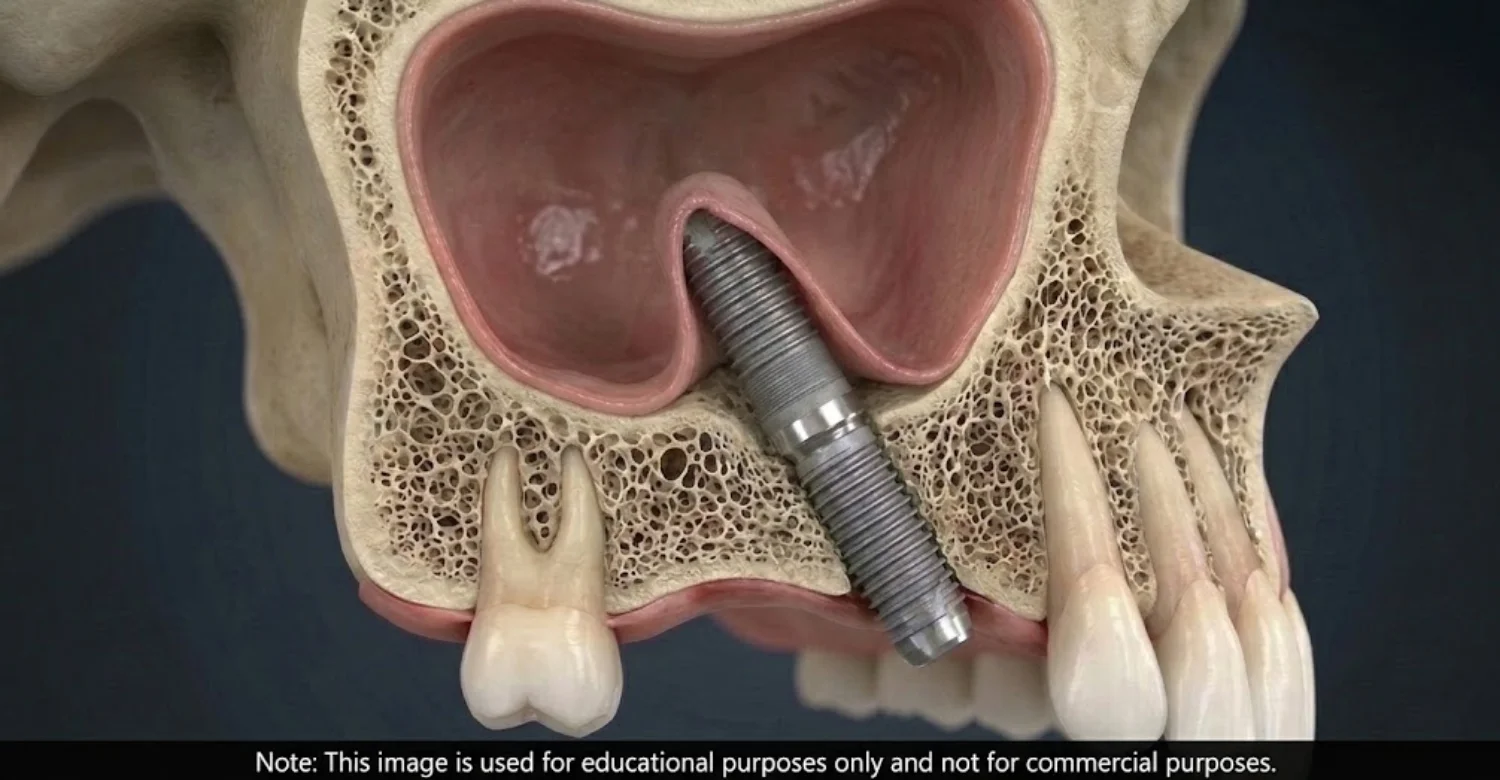
The upper back jaw often has a thin bone beneath the maxillary sinus. After tooth loss, the sinus can expand downward into the ridge. This process is called sinus pneumatization. The remaining bone height may be only a few millimeters. Implants placed into this thin bone carry a small risk of sinus migration.
Can Dental Implant Displacement Occur After Bone Grafting or Sinus Lifting?
Yes, displacement can still occur after grafting, although these procedures improve support. Grafted bone needs time to mature and integrate. Early loading or graft resorption may reduce stability. One systematic review reported about 90% three-year survival for implants after lateral sinus lifting. Survival reached about 98% with modern rough-surface implants. Careful timing and surgical technique remain important. Dental Implant Displacement in Weak Jawbone can still happen after augmentation if healing is incomplete.
Can Teeth Grinding Increase the Risk of Implant Movement?
Yes, bruxism can increase mechanical stress on implants and their components. Implants lack the shock-absorbing ligament that natural teeth have. Repeated grinding may loosen screws, fracture crowns, or overload thin bone. Several systematic reviews associate bruxism with higher implant failure rates. Grinding is also linked to more prosthetic complications. A custom night guard is often recommended for patients who grind their teeth.
What Are the Symptoms of Dental Implant Displacement?
Symptoms vary depending on whether the implant, abutment, or crown is moving. Some patients notice clear signs, while others feel very little. Recognizing the early warning signs of Dental Implant Displacement in Weak Jawbone supports faster treatment.
What Are the Most Common Dental Implant Displacement Symptoms?
The most common signs involve movement, discomfort, and changes in the surrounding gum. They may appear alone or together.
Noticeable movement of the implant or attached restoration
You may feel the tooth wobble when chewing or touching it with your tongue. A clicking sensation can suggest a loose abutment screw. Movement of the entire unit may indicate fixture failure. Any movement deserves professional assessment.
Persistent or worsening pain and tenderness
Mild discomfort after surgery usually fades within one to two weeks. Pain that persists or worsens may signal infection or failed integration. Tenderness when biting is another warning sign. Do not ignore discomfort that returns after initial healing.
Swelling, redness, bleeding, or discharge around the implant
Inflamed gum tissue may look red, swollen, or shiny. Bleeding on brushing suggests peri-implant inflammation. Pus or a bad taste may indicate active infection. These signs often appear before the implant becomes loose.
Changes in the bite or difficulty chewing
A displaced implant may change how your teeth meet. The crown may feel high, low, or out of line. Chewing may feel uncomfortable on that side. Bite changes can also overload the implant further.
Gum recession or visible changes around the implant
The gum may pull back and expose metal or the abutment edge. A grayish shadow can appear through thin gum tissue. Recession often reflects underlying bone loss. It should be checked with clinical probing and X-rays.
How Can You Tell If a Dental Implant Is Loose or Failing?
You cannot reliably tell at home which component is moving. A loose crown often moves alone while the gum stays healthy. A failing implant may show bone loss, pain, and gum inflammation together. Dentists check mobility, probing depths, and radiographs. Some clinics measure the Implant Stability Quotient, known as ISQ. ISQ values above about 70 generally suggest high stability. Values below about 60 suggest low stability and closer monitoring.
Can a Dental Implant Move Without Causing Pain?
Yes, an implant can loosen without much pain. Fibrous tissue around a failed implant may not cause sharp discomfort. Bone loss from peri-implantitis is often painless in its early stages. This is why routine reviews and X-rays matter. Pain-free movement still requires prompt evaluation by your dentist.
Which Symptoms May Suggest Dental Implant Migration Into the Sinus?
Sinus migration is rare, but its symptoms differ from typical implant problems. It mainly affects implants in the upper back jaw.
One-sided nasal congestion or purulent nasal discharge
Congestion limited to one side may suggest sinus involvement. Thick yellow or green discharge can indicate infection. Symptoms usually appear on the same side as the implant.
Facial pressure, sinus pain, or persistent unpleasant odor
Pressure under the eye or across the cheek is common with sinusitis. Patients may notice a foul smell or taste. Pain may worsen when bending forward.
Symptoms that require dental and potentially ENT assessment
If the implant disappears from view, imaging is needed urgently. Sinus symptoms after upper implant surgery also need review. An ear, nose, and throat specialist may join the care team. Combined assessment helps plan safe retrieval.
When Is Dental Implant Movement a Dental Emergency?
Most implant movement is urgent but not life-threatening. Some signs, however, need same-day care.
Severe or rapidly increasing swelling, uncontrolled bleeding, or fever with worsening infection symptoms
Rapid swelling may indicate a spreading infection. Fever suggests the body is responding to a significant infection. Bleeding that does not stop with firm pressure needs urgent attention. Contact your dentist or an emergency service immediately.
Difficulty breathing or swallowing, which requires immediate emergency medical care
Difficulty breathing or swallowing can signal a serious spreading infection. Go to an emergency department or call emergency services immediately. Do not wait for a routine dental appointment.
How Does Jawbone Loss After Tooth Extraction Affect Implant Stability?
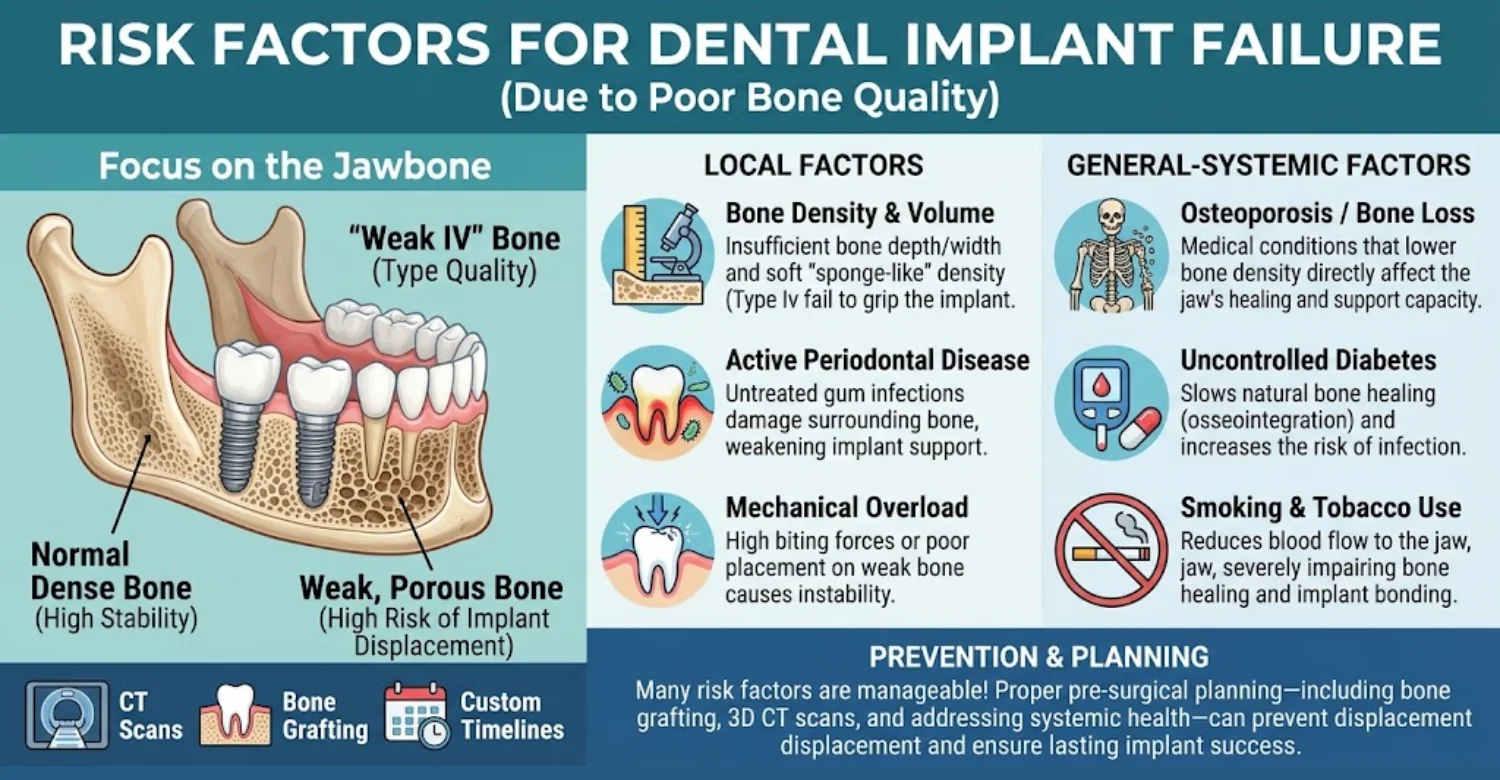
After extraction, the bone that once held the tooth begins to resorb. A systematic review found horizontal loss of about 29% to 63% within six months. Vertical loss ranged from about 11% to 22% in the same period. The longer a gap remains, the more bone may be lost. Denture pressure can accelerate this process in some patients. Reduced bone limits options for stable implant placement.
Does Osteoporosis Affect Dental Implant Stability in Low Bone Density?
Osteoporosis reduces bone mass throughout the skeleton. Worldwide, about one in three women and one in five men over 50 will experience osteoporotic fractures. Jawbone density does not always mirror hip or spine density. Reviews suggest implant survival is broadly similar in patients with osteoporosis. Some studies report slightly more marginal bone loss around their implants. Certain bone medications, such as bisphosphonates, require careful review before surgery.
Can Periodontal Disease Increase the Risk of Implant Failure?
Yes, a history of periodontitis increases the risk of peri-implant disease. The same bacteria that damage gums can colonize implant surfaces. Patients with past periodontitis show higher rates of bone loss around implants. Treating active gum disease before implant surgery is essential. Ongoing professional maintenance reduces the risk of recurrence.
How Can Smoking Affect Bone Healing and Implant Integration?
Smoking reduces blood flow and impairs bone healing. Nicotine and heat also damage gum tissues. A meta-analysis found smokers had roughly twice the implant failure risk of non-smokers. Smoking also increases marginal bone loss over time. Heavy smokers face the highest risk. Stopping before surgery and during healing improves outcomes.
Can Diabetes or Other Medical Conditions Affect Implant Healing?
Diabetes can slow healing and increase infection risk. Well-controlled diabetes generally shows implant outcomes similar to those of non-diabetic patients. Poor control, often reflected by higher HbA1c values, increases complication risk. Other relevant conditions include immune disorders and previous radiation therapy to the jaw. Your dentist may coordinate care with your physician before treatment.
How Do Implant Position, Length, Diameter, and Surgical Planning Influence Stability?
Implant position determines how forces travel into the bone. An implant placed at a poor angle may overload one side of the ridge. Length and diameter affect the surface area available for integration. Short implants of about 6 to 8 millimeters can perform well in selected cases. Wider implants may improve stability where bone width allows. Digital planning with CBCT helps match the implant to the available bone.
Does Older Age Automatically Mean There Is Insufficient Jawbone for Dental Implants?
No, age alone does not determine bone suitability. Many older adults have adequate bone for implants. Studies show implant survival in older patients is broadly comparable to younger adults. Bone volume depends more on tooth loss history, gum disease, and denture wear. General health and medications also matter. A personalized assessment is more important than age.
What Happens When a Dental Implant Moves Into the Sinus?
Implant migration into the maxillary sinus is uncommon but clinically important. It usually occurs in the upper back jaw, where bone is thin and soft. This form of Dental Implant Displacement in Weak Jawbone needs careful, coordinated management.
Why Can Dental Implants Migrate Into the Maxillary Sinus?
Migration usually happens when residual bone height is very limited. Poor primary stability allows the implant to move upward under pressure. Tears in the sinus membrane during surgery may also contribute. Pressure changes from nose blowing or sneezing may play a role. Bone resorption after placement can further reduce support. Most published reports describe this as a rare complication.
Is Dental Implant Migration Into the Sinus Dangerous?
It is not usually life-threatening, but it should not be left untreated. A foreign body in the sinus can trigger chronic inflammation. Infection may spread to other sinuses in some cases. Most clinical guidance recommends removing a displaced implant. Timely retrieval reduces the risk of long-term sinus problems.
What Complications Can Develop After Implant Migration?
Complications range from mild inflammation to infection involving nearby structures. Their severity depends on implant position and how long it remains.
Maxillary sinusitis and persistent inflammation
The implant can block normal sinus drainage. Mucus may build up and become infected. Chronic sinusitis can cause long-lasting congestion and facial pressure.
Oroantral communication between the mouth and sinus
An opening may form between the mouth and the sinus. Fluids may pass into the nose when drinking. Small openings may close naturally, while larger ones usually need surgical repair.
Infection involving adjacent tissues or sinus structures
Untreated infection may spread to the ethmoid or frontal sinuses. Very rarely, it may affect the eye socket or deeper tissues. Early treatment helps prevent these complications.
How Do Dentists Diagnose a Dental Implant Displaced Into the Sinus?
Diagnosis starts with a clinical examination and medical history. A panoramic X-ray may show the implant above the ridge. CBCT imaging gives a precise three-dimensional location. It also shows sinus inflammation and the remaining bone height. An ENT assessment may include nasal endoscopy.
Can a Displaced Sinus Implant Be Removed Without Major Surgery?
Often, yes, depending on implant position and sinus health. Some implants can be retrieved through the original implant site. Others are removed through a small window on the side of the sinus wall. This is known as a lateral window or Caldwell-Luc approach. Endoscopic techniques through the nose may also be minimally invasive.
When Is Endoscopic Sinus Surgery or Oral Surgery Needed?
Endoscopic sinus surgery is often preferred when infection affects sinus drainage. It allows an ENT surgeon to remove the implant through the nose. Oral surgery suits implants located near the sinus floor. Some cases combine both approaches in one procedure. The choice depends on imaging, infection, and surgical expertise.
Can the Missing Tooth Be Replaced After Sinus Implant Displacement?
Yes, replacement is often possible after healing. The sinus must be healthy and free of infection first. A sinus lift may be needed to rebuild bone height. Healing commonly takes about six to nine months before new implant placement. Alternatives include bridges, short implants, or zygomatic implants in selected cases.
Ready to transform your smile?
Talk to our team and get a personal FREE treatment plan.
How Is Dental Implant Displacement Diagnosed?
Accurate diagnosis identifies which component is moving and why. It combines examination, imaging, and a careful history review. A clear diagnosis of Dental Implant Displacement in Weak Jawbone guides every later decision.
What Happens During a Clinical Examination of a Loose Dental Implant?
The dentist checks the implant and crown for movement. Gum tissue is examined for redness, swelling, and discharge. Probing depths around the implant are measured gently. The bite is checked for high spots or uneven contacts. The dentist may remove the crown to test the fixture directly.
Which Dental X-Rays Are Used to Assess Implant Stability?
Periapical X-rays show bone levels around a single implant in detail. Panoramic X-rays give an overview of both jaws. Comparing new images with earlier ones reveals bone loss over time. A dark line around the implant may suggest failed integration. Bitewing X-rays can also help assess crestal bone levels.
When Is CBCT Imaging Needed to Assess Jawbone Quality and Implant Position?
CBCT is useful when standard X-rays cannot answer the clinical question. It shows bone width, height, and implant position in three dimensions. It is especially valuable near the sinus or the nerve canal. It also helps plan grafting and replacement surgery. Radiation doses are higher than standard dental X-rays but generally lower than medical CT.
How Do Dentists Assess Osseointegration and Bone Loss Around an Implant?
Dentists assess integration through mobility testing, sound, and imaging. A firmly integrated implant often gives a clear, solid sound when tapped. Resonance frequency analysis provides an ISQ value on a scale from 1 to 100. Radiographs measure bone levels from the implant shoulder. Bone loss beyond expected remodeling may suggest peri-implantitis.
How Can Dentists Distinguish Mechanical Loosening From Biological Implant Failure?
Mechanical loosening affects screws, abutments, or crowns. Biological failure affects the bone and soft tissues. Removing the crown allows direct testing of the fixture. Healthy bone on X-ray with a mobile crown suggests a mechanical problem. Bone loss, inflammation, and fixture mobility suggest biological failure.
Which Medical History and Risk Factors Should Be Reviewed Before Treatment?
A full history guides safe and effective treatment. It also helps explain why the first implant moved.
Previous bone grafting or sinus augmentation
Earlier grafts affect the bone quality available for repair. Graft type and healing time should be documented. Records from the original clinic are very helpful.
Smoking, diabetes, periodontal history, and medications relevant to bone health
These factors influence healing and long-term success. Medications such as bisphosphonates or steroids need careful review. Your dentist may request information from your physician.
Bite forces, bruxism, and the timing of implant loading
Grinding habits and heavy bites increase mechanical stress. The time between surgery and loading is also relevant. Early loading in soft bone may explain some failures.
What Are the Treatment Options for Dental Implant Displacement?
Treatment depends on the cause, the moving component, and the remaining bone. Options range from simple repairs to staged surgery. The aim is to resolve Dental Implant Displacement in Weak Jawbone while protecting future options.
Can a Displaced Dental Implant Be Saved?
Sometimes, but only if the fixture remains integrated with bone. A loose crown or abutment can usually be repaired. Early peri-implantitis may respond to cleaning and surgical treatment. A truly mobile fixture usually cannot be saved. Fixture mobility typically means the implant must be removed.
When Can a Loose Dental Crown or Abutment Be Repaired Without Removing the Implant?
Repair is possible when the fixture is stable and the bone is healthy. The dentist may retighten the abutment screw to the correct torque. A worn or damaged screw can be replaced. A cemented crown can be cleaned and recemented. Correcting the bite helps prevent the problem from returning.
When Does a Mobile Implant Fixture Need to Be Removed?
A mobile fixture usually indicates that osseointegration has failed. It cannot regain a solid bone bond once it becomes mobile. Leaving it in place may cause further bone loss and infection. Removal protects the remaining bone for future treatment. The procedure is often simpler than patients expect. Removal is a common step when managing Dental Implant Displacement in Weak Jawbone.
How Is Dental Implant Displacement Treatment Selected?
Treatment is selected only after the cause is clearly established. The options below are matched to specific findings.
Monitoring and conservative management in carefully selected cases
Minor bone changes without mobility may be monitored closely. Improved hygiene and bite adjustments may be enough. Regular X-rays track any progression.
Correcting a loose prosthetic component
Screws are retightened or replaced. Crowns may be recemented or remade. The bite is adjusted to reduce overload.
Treating peri-implant infection when present
Treatment may include mechanical cleaning and antiseptic irrigation. Antibiotics may be used in selected cases. Surgical cleaning or regeneration may be needed for deeper defects.
Removing a failed or displaced implant
Removal is performed under local anesthesia in most cases. Specialized tools gently unscrew or free the implant. The site is cleaned and sometimes grafted immediately.
Planning implant replacement after healing and reassessment
New imaging is taken after healing. Bone grafting may be planned if needed. A new implant is placed once bone support is adequate.
Can Bone Grafting Restore the Jawbone After Implant Displacement?
Bone grafting can rebuild many defects left by failed implants. Graft material acts as a scaffold for new bone growth. Results depend on defect size, shape, and patient health. Healing typically takes about four to nine months. Grafting improves support but does not guarantee future stability.
Can a New Dental Implant Be Placed Immediately After a Failed Implant Is Removed?
Sometimes, if the site is free of infection and enough bone remains. A wider or longer implant may achieve the needed stability. In weak jawbone, immediate replacement is often less predictable. Reported survival for replacement implants often ranges from about 70% to 90%. This is generally lower than survival for first-time implants. Many surgeons prefer a staged approach for safety.
How Long Does Recovery Take After Dental Implant Removal and Replacement?
Soft tissue usually heals within two to four weeks after removal. Bone healing commonly takes three to six months. Grafted sites may need four to nine months. The new implant then needs about three to six months to integrate. Total treatment may take six to eighteen months. Treating Dental Implant Displacement in Weak Jawbone often requires patience for a durable outcome.
Can Bone Grafting Prevent Dental Implant Displacement?
Bone grafting can reduce risk by improving bone volume around the implant. It works best with careful planning and adequate healing time. For many patients, it lowers the risk of Dental Implant Displacement in Weak Jawbone.
How Does Bone Grafting Improve Support for Dental Implants?
Grafting adds volume where the jaw is too thin or short. This allows a longer or wider implant to be placed. More bone then surrounds the implant surface. Thicker bony walls resist resorption under chewing forces. Grafting also helps place the implant in the correct position.
What Types of Bone Grafting Are Used for Insufficient Jawbone?
The technique depends on the defect type and its location. Your surgeon chooses the approach after reviewing CBCT imaging.
Guided bone regeneration for localized bone defects
Graft material is placed and covered with a protective membrane. The membrane stops gum tissue from growing into the defect. It is common for small to moderate defects.
Ridge augmentation for inadequate jawbone width or height
This approach rebuilds narrow or short ridges. Block grafts or particulate grafts may be used. Healing usually takes several months.
Sinus lift procedures for selected upper-jaw implant cases
A sinus lift raises the sinus membrane and adds bone beneath it. It increases bone height in the upper back jaw. Lateral window and crestal approaches are both used.
Is Bone Grafting Always Necessary Before Dental Implant Replacement?
No, grafting depends on how much bone remains. Some sites keep enough bone for direct replacement. Short or narrow implants may avoid grafting in selected cases. Larger defects usually need augmentation first. CBCT imaging helps guide this decision.
How Long Should Patients Wait Between Bone Grafting and Implant Placement?
Waiting times vary with graft type and defect size. Small grafts may allow implant placement after about four months. Larger ridge augmentation may need six to nine months. Sinus lifts commonly require six to nine months before placement. In some cases, implants are placed during the grafting procedure.
What Are the Limitations of Bone Grafting for Dental Implant Stability?
Grafts can partly resorb during healing. Infection or membrane exposure can reduce results. Smoking and poor general health may limit graft success. Grafted bone still needs good hygiene and balanced bite forces. Grafting improves conditions but cannot remove all risk.

What Can You Do Safely While Waiting for a Dental Appointment?
Simple steps can reduce discomfort and prevent extra strain on the implant.
Choose soft foods and avoid chewing on the affected side
Eat soft foods such as yogurt, soups, and eggs. Avoid hard, sticky, or chewy foods. Chew on the opposite side where possible.
Keep the area clean with gentle oral hygiene
Brush gently around the area with a soft toothbrush. Avoid aggressive flossing near the moving implant. Keeping plaque low helps reduce inflammation.
Use a cold compress externally for short periods if swelling is present
Apply a wrapped cold pack to your cheek for about 10 to 15 minutes. Repeat with breaks during the first day of swelling. Never place ice directly on the skin.
Follow dentist-approved pain relief instructions and medication precautions
Use only pain relief your dentist or pharmacist approves. Follow label instructions and dosing carefully. Tell your dentist about any other medicines you take.
Which Home Remedies Should Patients Avoid?
Avoid placing aspirin or chemicals directly on the gum. Do not apply heat to facial swelling. Avoid using glue or adhesives to fix a loose crown. Do not take leftover antibiotics without professional advice. These measures may delay diagnosis or worsen infection.
Can Saltwater Rinses or Mouthwash Treat a Displaced Dental Implant?
No, rinses cannot fix a displaced implant. Warm saltwater may soothe irritated gums temporarily. An antiseptic mouthwash may reduce surface bacteria. Neither restores lost bone or integration. Use them only as supportive care.
Should You Stop Wearing a Temporary Crown or Dental Prosthesis?
Ask your dentist before removing anything. A denture pressing on the implant site may increase movement. Your dentist may advise leaving it out or adjusting it. Do not force a fixed temporary crown off by yourself.
Why Should Patients Never Push, Twist, or Attempt to Tighten a Moving Implant?
Pushing may drive an upper implant toward the sinus. Twisting can damage surrounding bone and soft tissue. Household tools can scratch the implant or introduce bacteria. Correct tightening requires specific instruments and torque values. Always leave adjustments to your dentist.
When Is Pain Relief Not Enough and Professional Treatment Is Necessary?
Pain relief only masks symptoms. Seek care if pain lasts more than a few days. Swelling, pus, or fever require prompt assessment. Any movement of the implant needs professional diagnosis. Early treatment often preserves more bone.
.jpg)
.jpg)
.jpg)
.jpg)
What Are the Possible Side Effects of Dental Implant Displacement Treatment?
All dental procedures carry some risk. Most side effects are temporary and manageable with good aftercare.
What Side Effects Can Occur After Dental Implant Removal?
Common effects include soreness, swelling, and mild bleeding. These usually settle within a few days. Some bones may be lost during removal. Rarely, nearby structures may be affected. Your dentist will explain the specific risks for your case.
What Are the Potential Side Effects of Bone Grafting?
Bone grafting is generally safe, but side effects can occur. Most are mild and short-lived.
Temporary pain, swelling, bruising, and bleeding
These effects are common in the first few days. Swelling usually peaks around 48 to 72 hours. Bruising may take one to two weeks to fade.
Infection, wound-healing problems, or graft complications
Infection can reduce graft success. Membrane exposure may occur in some cases. Partial graft loss may need additional treatment.
Risks associated with graft donor sites when applicable
Grafts taken from the chin or jaw can cause local discomfort. Temporary numbness may occur in rare cases. Many clinics now use donor or synthetic materials instead.
What Are the Risks of Sinus Surgery for a Displaced Implant?
Risks include bleeding, swelling, and temporary nasal congestion. The sinus membrane may tear during retrieval. Infection or persistent sinusitis is possible. Temporary numbness of the cheek or teeth occurs rarely. Experienced surgeons and careful imaging reduce these risks.
Can a Replacement Dental Implant Fail Again?
Yes, a replacement implant can fail, especially if the original cause remains. Studies report lower survival for second implants than for first implants. Identifying and correcting the cause improves the odds. Grafting, longer healing, and bite control may help. Dental Implant Displacement in Weak Jawbone can recur without a tailored plan.
How Can Patients Reduce Complications During Recovery?
Follow all post-operative instructions carefully. Avoid smoking during healing. Keep the area clean and attend every follow-up appointment. Avoid chewing on the treated area until your dentist approves. Report fever, increasing swelling, or discharge promptly.
Ready to transform your smile?
Talk to our team and get a personal FREE treatment plan.
What We Notice Clinically
In practice, implant movement often has more than one explanation. These observations reflect patterns commonly seen during clinical assessment.
Why Not Every Moving Dental Restoration Indicates Implant Failure
Many patients arrive worried that their implant has failed. In many cases, the crown or abutment screw is simply loose. The fixture beneath remains stable and healthy. A simple repair may solve the problem in one visit. Careful diagnosis prevents unnecessary removal.
Why Initial Implant Stability and Long-Term Bone Integration Are Different
Primary stability is mechanical and present on the day of surgery. Secondary stability is biological and develops as new bone forms. Overall stability often dips around weeks two to four after placement. This stage carries the highest risk in weak bones. Good primary stability does not guarantee successful integration.
Why Weak Jawbone Requires Individualized Planning Rather Than a One-Size-Fits-All Implant
Bone density, volume, and anatomy vary greatly between patients. A plan suited to dense lower-jaw bone may fail in soft upper-jaw bone. Implant design, drilling technique, and loading time should be tailored. Individual planning makes Dental Implant Displacement in Weak Jawbone less likely.
Why Upper-Jaw Implant Displacement Requires Particular Attention to Sinus Anatomy
The upper back jaw combines soft bone with close sinus proximity. Remaining bone height may be very limited. Small errors can push an implant into the sinus. CBCT planning helps measure bone height precisely. A sinus lift may be safer than forcing a short implant.
Common Patient Misconceptions About Dental Implant Movement
Several common beliefs can delay appropriate treatment.
Assuming that every loose crown requires implant removal
Many loose crowns need only a screw adjustment. Removal is needed only when the fixture itself has failed.
Assuming that pain-free implant movement is harmless
Painless movement can still mean failed integration. It should always be checked promptly.
Assuming that bone grafting guarantees implant stability
Grafting improves support but does not remove all risk. Healing, hygiene, and bite forces still matter.
Assuming that an implant can always be replaced immediately
Infection and bone loss may require staged treatment. Immediate replacement suits only selected cases.
Clinical Note: Dr. Rifat Alsaman on Assessing Dental Implant Stability
Dr. Rifat Alsaman reviews implant movement cases using a structured diagnostic approach.
Dr. Rifat Alsaman, Head of the Medical Team at Vitrin Clinic , on distinguishing mechanical complications from biological failure
Dr. Rifat Alsaman stresses that the first question is what is actually moving. A loose screw and a failed fixture can feel identical to patients. Clinical testing and imaging separate these problems. This step prevents both overtreatment and delayed care.
Why the diagnosis should establish the cause of movement before selecting a corrective procedure
Treating movement without knowing its cause risks repeat failure. Infection, overload, and poor bone each need different solutions. Dental Implant Displacement in Weak Jawbone therefore requires a cause-based plan.
Why the condition of the surrounding bone and soft tissues matters when planning replacement
Healthy gums and adequate bone support long-term implant success. Thin tissues may need grafting before replacement. Planning around tissue quality improves predictability.
How Can Patients Reduce the Risk of Dental Implant Displacement?
Prevention starts before surgery and continues for life. Good planning and maintenance address most known risk factors.
Why Preoperative Bone Assessment Matters
Bone assessment shows whether the jaw can support an implant. CBCT measures bone height, width, and nearby anatomy. Density estimates help guide drilling and implant choice. Skipping assessment increases the risk of poor stability. Thorough planning is the most effective protection against Dental Implant Displacement in Weak Jawbone.
How Can Appropriate Implant Positioning and Surgical Planning Improve Stability?
Correct positioning keeps the implant within a healthy bone. Guided surgery can improve accuracy in complex cases. Proper angulation directs chewing forces along the implant axis. Avoiding thin bony walls reduces resorption risk. Planning also protects the sinus and nearby nerves.
When Should Bone Augmentation Be Considered Before Implant Placement?
Augmentation is considered when bone is too thin or too short. It is common in the upper back jaw. Sites with long-standing tooth loss often need grafting. Your surgeon will compare grafting with alternatives such as short implants. Dental Implant Displacement in Weak Jawbone is less likely when deficient bone is rebuilt first.
Why Should Implant Loading Follow a Clinically Appropriate Healing Plan?
Loading too soon can disrupt integration in soft bone. Immediate loading requires high primary stability. Conventional loading usually waits about three to six months. Your dentist decides timing based on stability measurements. Following this plan protects the implant during healing.
How Can Regular Dental Reviews Help Identify Early Implant Complications?
Reviews can detect bone loss before symptoms appear. Probing and X-rays track tissue health over time. Screws and bites can be checked and adjusted. Many clinicians recommend reviews every three to twelve months. Early detection usually allows simpler treatment.
What Daily Habits Support Long-Term Implant Health?
Daily care protects the bone and gums around your implants.
Maintain effective brushing and interdental cleaning
Brush twice daily with a soft toothbrush. Use interdental brushes or water flossers around implants. Clean carefully under bridges and fixed prostheses.
Avoid smoking and follow individualized medical advice
Avoid smoking to protect bone and gum health. Manage diabetes and other conditions with your doctor. Tell your dentist about any new medications.
Address teeth grinding and excessive bite forces when indicated
Wear a night guard if you grind your teeth. Avoid chewing ice, pens, or other hard objects. Report bite changes promptly.
Attend professional maintenance appointments
Professional cleaning removes deposits you cannot reach at home. Regular checks track implant stability over time. Consistent maintenance lowers the risk of peri-implant disease.
What Are the Average Costs of Dental Implant Displacement Treatment in the US, UK, and Turkey?
Costs vary widely with treatment complexity and location. The figures below are planning estimates, not fixed quotes. Treating Dental Implant Displacement in Weak Jawbone may involve one procedure or several.
What Determines the Total Cost of Dental Implant Displacement Treatment?
Several components contribute to the final cost. Each is usually priced separately.
Diagnostic examination and dental imaging
Examinations, X-rays, and CBCT scans are often the first costs. CBCT is usually priced separately from routine X-rays.
Implant removal or correction of a loose prosthetic component
Retightening a screw costs far less than removing a fixture. Removal fees vary with difficulty.
Prosthetic screw tightening or correction
$250
Average estimated cost
Average $250
Estimated range $100–$400
Implant removal
$450
Average estimated cost
Average $450
Estimated range $100–$800
Bone grafting or sinus augmentation
Graft size and material affect the price. Sinus lifts usually cost more than small grafts.
Bone grafting
$1,350
Average estimated cost
Average $1,350
Estimated range $200–$2,500
Sinus lift
$2,250
Average estimated cost
Average $2,250
Estimated range $500–$4,000
Replacement implant, abutment, and final crown
The implant brand and crown material influence the price. Zirconia and porcelain crowns vary in cost.
United Kingdom
$2,750
Replacement implant and crown
Average $2,750
Estimated range $2,000–$3,500
Turkey
$1,400
Replacement implant and crown
Average $1,400
Estimated range $800–$2,000
United States
$4,500
Replacement implant and crown
Average $4,500
Estimated range $3,000–$6,000
Sinus surgery or specialist treatment when required
ENT involvement or hospital-based surgery adds significant cost. These fees are often quoted separately.
Specialist or ENT assessment
$325
Average estimated cost
Average $325
Estimated range $150–$500
Hospital-based or complex sinus surgery
$3,250
Average estimated cost
Average $3,250
Estimated range $1,500–$5,000
What Is the Average Cost of Dental Implant Displacement Treatment in the US?
US prices are generally the highest of the three countries. Implant removal often ranges from $300 to $800. A replacement implant and crown typically costs $3,000 to $6,000. Bone grafting adds about $500 to $2,500. A sinus lift may add $1,500 to $4,000. Complex cases can exceed $10,000 in total. Insurance coverage varies widely between plans.
Combined illustrative total
$9,300
Average estimated cost for all four components
Estimated range $5,300–$13,300
Replacement implant and crown
$4,500
Average estimated cost
Range $3,000–$6,00
What Is the Average Cost of Dental Implant Displacement Treatment in the UK?
UK private prices are usually lower than US prices. Implant removal commonly ranges from about $150 to $500. Bone grafting may cost about $300 to $1,500. A sinus lift ranges from about $1,000 to $3,000. A replacement implant and crown may cost $2,000 to $3,500. NHS coverage for implants is limited to specific clinical cases.
Combined illustrative total
$5,975
Average estimated cost for all four components
Estimated range $3,450–$8,500
Replacement implant and crown
$2,750
Average estimated cost
Range $2,000–$3,500
What Is the Average Cost of Dental Implant Displacement Treatment in Turkey?
Turkey offers lower prices, mainly due to lower operating costs. Implant removal often ranges from $100 to $400. Bone grafting usually ranges from $200 to $1,000. A sinus lift may cost $500 to $2,000. A replacement implant and crown may cost $800 to $2,000. Patients should also budget for travel and accommodation. Quality depends on the clinic, not the country alone.
Combined illustrative total
$3,500
Average estimated cost for all four components
Estimated range $1,600–$5,400
How Do Dental Implant Removal, Bone Grafting, and Replacement Costs Compare Across Countries?
The table below compares typical ranges for each procedure. All figures are shown in US dollars for easy comparison.
United States
$9,300
Combined illustrative total
Implant removal $550
Bone grafting $1,500
Sinus lift $2,750
Replacement implant and crown $4,500
Total $9,300
Turkey
$3,500
Combined illustrative total
Implant removal $250
Bone grafting $600
Sinus lift $1,250
Replacement implant and crown $1,400
Total $3,500
United Kingdom
$5,975
Combined illustrative total
Implant removal $325
Bone grafting $900
Sinus lift $2,000
Replacement implant and crown $2,750
Total $5,975
Important notes: These are illustrative planning estimates calculated from the price ranges provided, not verified national averages or guaranteed treatment quotes. Combined totals assume all four procedures are required, which is not always the case. A displaced implant may require a different treatment approach depending on its location, stability, bone condition, and proximity to anatomical structures. Diagnostic imaging and specialist assessment are necessary to determine the appropriate plan.
Illustrative planning ranges for individual procedures
United States
$5,300–$13,300
Average planning range
Implant removal $300–$800
Bone grafting $500–$2,500
Sinus lift $1,500–$4,000
Replacement implant and crown $3,000–$6,000
Total $5,300–$13,300
Turkey
$1,600–$5,400
Average planning range
Implant removal $100–$400
Bone grafting $200–$1,000
Sinus lift $500–$2,000
Replacement implant and crown $800–$2,000
Total $1,600–$5,400
United Kingdom
$3,450–$8,500
Average planning range
Implant removal $150–$500
Bone grafting $300–$1,500
Sinus lift $1,000–$3,000
Replacement implant and crown $2,000–$3,500
Total $3,450–$8,500
How to interpret these cost estimates
These ranges are averages for planning purposes only. Your final cost depends on your diagnosis and treatment needs. Not every patient needs every procedure. Turkish ranges are roughly 50% to 70% lower than US ranges in this table. Always request an itemized quote before treatment.
Is Dental Implant Displacement Treatment Cheaper Than Replacing the Entire Implant?
It depends on the underlying problem. Fixing a loose crown or screw is much cheaper than replacement. Removing and replacing a failed fixture costs significantly more. Grafting or sinus surgery increases the total further. Early diagnosis often keeps costs lower.
What Should Patients Check Before Accepting a Dental Implant Treatment Quote?
Check whether imaging, grafting, and the final crown are included. Ask which implant brand and crown material will be used. Confirm follow-up visits and warranty terms. Ask what happens if the implant fails again. Compare itemized quotes rather than headline prices.
Tips for Patients With Dental Implants in Weak Jawbone
Preparation helps you get clearer answers and safer care. These tips help you discuss Dental Implant Displacement in Weak Jawbone with confidence.
What Information Should You Prepare Before Your Dental Consultation?
Bring previous X-rays, CBCT scans, and treatment records. Note the implant brand and placement date if known. List your medications and medical conditions. Describe when symptoms started and how they changed. This information speeds up diagnosis.
Which Questions Should You Ask About Bone Density and Implant Stability?
Ask how much bone is available at the implant site. Ask how bone density affects your treatment plan. Ask whether grafting or a sinus lift is needed. Ask how stability will be measured before loading. Ask which risks apply to your specific case.
How Can You Compare Treatment Plans From Different Implant Specialists?
Compare the diagnosis each specialist gives, not just the price. Check whether CBCT imaging supports their plan. Compare healing timelines and treatment stages. Review implant brands, materials, and warranties. Choose the plan with the clearest clinical reasoning.
What Should International Patients Ask About Aftercare and Follow-Up?
Ask how many visits are required and how long each stage takes. Confirm who handles complications after you return home. Request digital copies of all records and X-rays. Ask whether remote follow-up consultations are available. Plan your travel around the healing periods.
How Can Patients Recognize Warning Signs During Implant Healing?
Watch for pain that worsens after the first week. Look for swelling, pus, or bleeding around the implant. Notice any movement when chewing or touching the area. Report sinus symptoms after upper-jaw surgery. Contact your clinic early rather than waiting.
At Vitrin Clinic: How Is Dental Implant Displacement in Weak Jawbone Assessed?
At Vitrin Clinic, assessment focuses on finding the cause before recommending treatment. Dental Implant Displacement in Weak Jawbone is evaluated using clinical and imaging findings together.
How Does Vitrin Clinic Evaluate the Cause of Implant Movement?
The team first identifies which component is moving. They review your symptoms, history, and previous records. Gum health and bite forces are checked carefully. This approach separates mechanical problems from biological failure.
How Are Clinical Examination and Digital Imaging Used When Appropriate?
Clinical examination checks mobility, gum health, and the bite. Digital X-rays show bone levels around the implant. CBCT is used when three-dimensional information is needed. Imaging is selected according to the clinical question.
How Is a Personalized Dental Implant Treatment Plan Developed?
The plan reflects your bone volume, density, and general health. It considers whether repair, removal, or grafting is needed. Timing is set according to healing requirements. You receive a clear explanation of each stage.
When May Bone Grafting or Implant Replacement Be Considered?
Grafting may be considered when bone loss limits safe replacement. Replacement is planned only after infection is controlled. A sinus lift may be advised for the upper back jaw. Each option is discussed with its benefits and limitations.
How Are Treatment Options, Risks, and Itemized Costs Explained to Patients?
Patients receive an itemized quote for each recommended procedure. Risks and alternatives are explained clearly. Timelines and follow-up needs are outlined in advance. You can ask questions before agreeing to any treatment.






How Vitrin Clinic Supports Your Treatment Journey
Support continues from the first consultation to long-term maintenance. Each stage is planned around your clinical needs and travel schedule.
Initial Consultation and Review of Previous Dental Records
The team reviews your records, X-rays, and implant details. Remote review may be possible before you travel. This helps prepare an initial treatment plan.
Assessment of Bone Support, Implant Position, and Oral Health
Bone support and implant position are assessed in detail. Gum health and neighboring teeth are also reviewed. These findings guide the treatment choices.
Coordination of Specialist Evaluation for Complex Implant or Sinus Cases
Complex cases may need specialist input. Sinus cases may involve an ENT evaluation. Coordination helps keep your care consistent.
Personalized Treatment Scheduling for International Patients
Appointments are scheduled around healing stages and travel plans. You receive a clear timeline for each visit. This helps reduce unnecessary trips.
Communication About Recovery, Follow-Up, and Long-Term Implant Maintenance
You receive written aftercare instructions. Follow-up plans are explained before you leave. Maintenance advice supports long-term implant health.
Access to Treatment Records and Aftercare Guidance After Returning Home
You receive copies of your records and imaging. These help your local dentist provide follow-up care. Guidance remains available after you return home.
Ready to transform your smile?
Talk to our team and get a personal FREE treatment plan.
Key Takeaways
These points summarize the most important information in this guide.
Dental Implant Displacement Can Result From Poor Bone Support, Inadequate Stability, or Other Complications
Weak bone, poor primary stability, infection, and overload are common causes. Dental Implant Displacement in Weak Jawbone often involves several factors together.
A Loose Crown and a Mobile Implant Require Different Assessments
A loose crown may need only a simple repair. A mobile fixture usually needs removal and staged replacement.
Prompt Evaluation Helps Identify the Cause and Guide Appropriate Treatment
Early assessment preserves bone and treatment options. Delays may allow infection and bone loss to progress.
Bone Grafting May Improve Bone Support but Cannot Guarantee Implant Stability
Grafting adds volume and improves healing conditions. Hygiene, bite control, and healing time still matter.
Sinus Migration, Worsening Swelling, and Signs of Infection Require Timely Professional Assessment
These signs need prompt professional care. Difficulty breathing or swallowing requires emergency treatment.
Treatment Costs Depend on the Procedures Needed, the Complexity of the Case, and the Country
Costs range from simple repairs to staged reconstruction. Itemized quotes allow a fair comparison between clinics.
.jpg)
.jpg)
.jpg)
.jpg)
At Vitrin Clinic: How Does Our Dental Implant Treatment for Weak Jawbone Work?
Dental Implant Treatment at Vitrin Clinic begins with an individual assessment to identify the cause of implant displacement in a weak jawbone. Our team evaluates bone support, implant stability, and gum health using X-rays or CBCT when needed. Treatment may involve repairing components, managing infection, bone grafting, or implant replacement. Each plan is tailored to the patient's needs, with personalised aftercare and follow-up.
Book your consultation with Vitrin Clinic and receive a personalized, itemized treatment plan.
Reference
FAQs
Dr. Rifat Alsaman has more than 5 years of clinical experience in dentistry and currently serves as the Head of the Medical Team at Vitrin Clinic. He is dedicated to providing exceptional patient care, overseeing treatment planning, and ensuring the highest clinical standards across the team. His expertise, attention to detail, and commitment to continuous professional development have helped countless patients achieve healthier, more confident smiles.


