Invisalign
October 19, 2026
What Is Dental Occlusion? Types, Bite Problems, Assessment, and Treatment
 Dr. Rifat Alsaman

Dental occlusion describes how your upper and lower teeth meet when you bite, chew, and rest your jaw. A comfortable bite supports chewing, clear speech, and the long-term health of teeth and restorations. A global systematic review found that about three in four people have a Class I molar relationship. However, many of those people still show crowding, deep bite, or other minor bite traits. Not every imperfect bite causes symptoms or needs treatment.
Ready to transform your smile?
Talk to our team and get a personal FREE treatment plan.
What Is Dental Occlusion?
Occlusion is the dental term for the contact relationship between the upper and lower teeth. It covers how teeth touch at rest and how they slide during jaw movement.
Dental Occlusion Definition and Meaning
In dentistry, dental occlusion means the way the biting surfaces of opposing teeth come together. The word comes from the Latin “occludere,” which means “to close up.” Dentists describe occlusion in two ways: static and dynamic. Static occlusion is how the teeth meet when the jaw closes and stays still. Dynamic occlusion describes tooth contacts while the jaw moves forward, backward, or from side to side.
How Dental Occlusion and Bite Alignment Work Together
Bite alignment describes where each tooth sits within its own arch. Occlusion describes how the two arches meet each other. A person can have neatly aligned teeth yet still have an uneven bite. For example, jaw size differences or tooth wear can change contacts even when teeth look straight. Alignment, jaw position, and muscle control together decide how evenly bite forces are shared.
Why Occlusion Matters for Chewing, Speaking, and Tooth Function
A stable bite lets the teeth break down food efficiently with less strain. Healthy adults can generate several hundred newtons of force between their back molars. Even distribution of that force protects enamel, fillings, and the bone supporting each tooth. Good dental occlusion also gives crowns, veneers, and implants a more predictable working environment.
What Is Considered an Ideal Dental Occlusion in Dentistry?
Dentists often use Angle’s classification, first published in 1899, as a starting reference. In the ideal pattern, the upper first molar’s front cusp rests in the lower first molar’s groove. Upper front teeth slightly overlap the lower front teeth, both vertically and horizontally. Textbook values are roughly 2 to 3 millimetres for both overbite and overjet.
How the upper and lower teeth contact when the mouth closes
When you close gently, back teeth should meet evenly on both sides at about the same moment. Front teeth usually touch lightly or sit just apart in this position. This balanced contact spreads bite force across many teeth rather than a few.
How tooth alignment, jaw position, and muscle function contribute to a functional bite
Tooth alignment sets the shape and angle of each contact surface. Jaw position decides where the lower arch sits beneath the upper arch. Chewing muscles control how hard and how often the teeth come together. The temporomandibular joints guide the jaw’s path during opening and side movements. A functional bite emerges when these parts work together without pain or damage.
Does Everyone Need a Perfectly Straight or Symmetrical Bite?
No, a perfectly symmetrical bite is uncommon and rarely necessary for good oral health. Large population studies show that most people have minor deviations from the textbook ideal. Many of these people chew comfortably and never develop bite-related problems. Dentists generally focus on function, comfort, stability, and the patient’s own goals.
.jpg)
.jpg)
.jpg)
.jpg)
What Are the Main Types of Dental Occlusion?
Dentists classify bites by molar relationship, front-tooth overlap, and how the arches line up sideways. The table below shows how common the main patterns are worldwide.
Bite pattern | Approximate global prevalence (permanent teeth) |
Class I molar relationship | 74.7% |
Class II molar relationship | 19.6% |
Increased overjet | 20.1% |
Deep bite (increased overbite) | 22.0% |
Posterior crossbite | 9.4% |
Class III molar relationship | 5.9% |
Anterior open bite | 4.9% |
Source: Alhammadi et al., Dental Press Journal of Orthodontics, 2018. Some traits overlap, so percentages do not add up to 100%.
Normal or Functional Occlusion
A functional bite allows comfortable chewing, stable teeth, and pain-free jaw movement. It does not need to match the textbook ideal in every detail. Teeth meet evenly enough that no single tooth takes excessive load. Many dentists consider a bite “normal” when it is healthy, stable, and symptom-free.
Class I Occlusion
Class I describes a normal front-to-back relationship between the upper and lower first molars. It is the most common pattern, seen in roughly 75% of people worldwide. However, Class I does not guarantee straight teeth. People in this group may still have crowding, spacing, rotations, or a deep bite.
Class II Malocclusion
In Class II, the lower first molar sits further back than the upper first molar. This often makes the upper front teeth appear prominent, sometimes called an “overbite” in everyday speech. About one in five people worldwide show this pattern in their permanent teeth.
Division 1 and Division 2 bite patterns
Class II Division 1 features upper front teeth that tilt forward, creating a large overjet. Lips may struggle to close comfortably over these teeth at rest. Prominent upper incisors are also more vulnerable to trauma during falls or sports. Class II Division 2 features upper central incisors that tilt backward.
Class III Malocclusion
In Class III, the lower first molar sits further forward than the upper first molar. The lower front teeth often rest in front of the upper front teeth. This is sometimes called an “underbite” and affects roughly 6% of people worldwide. Prevalence is noticeably higher in some East Asian populations.
Anterior Open Bite
An anterior open bite means the front teeth do not meet when the back teeth close. A visible gap remains between the upper and lower incisors. It affects about 5% of people, according to global estimates. Biting into sandwiches or slicing food with the front teeth may be difficult.
Deep Bite
A deep bite occurs when the upper front teeth cover too much of the lower front teeth. Global data suggest that around 22% of people have an increased overbite. Mild deep bites are common and often cause no problems. Severe cases may lead to gum irritation behind the upper teeth.
Crossbite and Scissor Bite
A crossbite means one or more upper teeth sit inside the lower teeth when the jaw closes. It can affect front teeth, back teeth, one side, or both sides. Posterior crossbite affects about 9% of people, based on global estimates. One-sided crossbite may cause the jaw to shift on closing. A scissor bite is the opposite problem.
Edge-to-Edge Bite
In an edge-to-edge bite, the upper and lower front teeth meet tip to tip. There is little or no overlap in either direction. This pattern may sit between normal occlusion and a mild Class III relationship. Because the incisal edges collide directly, they may chip or wear faster.
Overbite, Overjet, and Crowding
These three terms describe different bite features, and people often confuse them. Overbite is vertical overlap, while overjet is horizontal distance. Crowding describes a lack of space within the arch itself.
How these bite characteristics differ from one another
Feature | What it measures | Typical normal range | Common concern when excessive |
Overbite | Vertical overlap of upper over lower front teeth | About 2–3 mm | Gum irritation, front-tooth wear |
Overjet | Horizontal gap between upper and lower front teeth | About 2–3 mm | Trauma risk, lip closure difficulty |
Crowding | Space shortage within one dental arch | Little to none | Cleaning difficulty, uneven contacts |
About 20% of people show an increased overjet, according to global estimates. Crowding is often the main reason adults seek orthodontic care.
What Causes Malocclusion and Bite Problems?
Most bite problems develop from a mix of inherited traits, growth patterns, habits, and dental history. Identifying the likely cause helps dentists choose treatment that addresses the problem rather than only its symptoms.
Genetic and Developmental Factors
Jaw size, tooth size, and facial growth patterns are strongly influenced by genetics. Class III patterns, for example, often run in families. A mismatch between tooth size and jaw size can cause crowding or spacing. Developmental conditions such as cleft lip and palate also affect bite development. Studies suggest that hypodontia affects roughly 4% to 7% of people, excluding wisdom teeth.
Childhood Habits That Can Affect Bite Alignment
Children’s jaws and teeth respond readily to repeated pressure because bone is still growing. Habits that place regular force on the teeth or palate can gradually shift them. The duration, frequency, and intensity of a habit matter more than the habit itself.
Thumb sucking, prolonged pacifier use, and tongue thrusting
Thumb sucking and pacifier use are normal in infancy and rarely cause lasting harm early on. Dental associations generally advise stopping these habits by around age three or four. Beyond that age, they can contribute to open bite, crossbite, and protruding upper teeth. Tongue thrusting pushes the tongue forward between the front teeth during swallowing.
Missing, Impacted, or Extra Teeth
When a tooth is lost, neighbouring teeth often drift or tilt into the gap. The opposing tooth may also over-erupt because it no longer meets anything. These movements can change how the whole arch contacts the opposite arch. Impacted teeth, such as canines trapped in bone, can block normal eruption and alignment.
Tooth Wear, Grinding, and Clenching
Grinding and clenching can flatten tooth surfaces and alter how teeth fit together. A 2024 meta-analysis estimated global bruxism prevalence at about 22%. In the same review, sleep bruxism affected about 21% and awake bruxism about 23% of people. Not everyone with bruxism develops significant wear or pain.
Dental Restorations That Do Not Fit the Existing Bite
A restoration that is slightly too tall or poorly shaped can change how the teeth meet. Even a difference of a fraction of a millimetre may be noticeable to the patient.
High fillings, crowns, bridges, and implant-supported restorations
A “high” filling or crown hits before the other teeth when you close. This can cause tenderness, sensitivity, or a bruised feeling around the tooth. Bridges spread force across several teeth, so an uneven contact affects more than one site. Implants lack the cushioning ligament that natural teeth have.
Jaw Growth Differences, Tooth Movement, and Previous Dental Treatment
The upper and lower jaws can grow at different rates during childhood and adolescence. Late lower-jaw growth may change a bite that once looked normal. Teeth also continue to move slightly throughout adult life. Lower front teeth commonly become more crowded with age.
Can Stress Contribute to Clenching and Jaw Muscle Symptoms?
Yes, stress and anxiety are among the factors most strongly linked to awake clenching. Many people clench without noticing while concentrating, driving, or working at a screen. Sustained clenching tires the chewing muscles and may cause morning jaw stiffness. Sleep quality, caffeine, alcohol, smoking, and some medications may also play a role.
What Are the Signs and Symptoms of Dental Occlusion Problems?
Bite problems may show up in the teeth, gums, jaw muscles, or joints. Some signs are obvious, while others develop gradually over months or years.
Common Symptoms of Bite Misalignment
The most common complaints involve how the teeth feel when they meet. Patients often describe their bite as “off,” “uneven,” or “different from before.” Some notice changes only while eating, while others feel them constantly.
Teeth meeting unevenly or feeling too high when biting
You may feel one tooth touching before the others when you close. This often happens after a new filling, crown, or onlay. A tooth that hits first may become tender, especially when chewing firm food. Some patients also notice the jaw sliding sideways to find a comfortable position.
Difficulty chewing or biting through food
Uneven contacts can make it harder to grind food efficiently on one or both sides. People with an open bite often struggle to bite through lettuce, noodles, or sandwiches. Some patients chew only on one side to avoid discomfort.
Chipped teeth, flattened enamel, or unexplained tooth sensitivity
Heavy or uneven contacts may contribute to chips, fractures, and flattened tooth surfaces. Small notches near the gumline, called abfraction lesions, are sometimes linked to bite stress. However, their causes remain debated and likely include brushing and acid wear. Teeth under heavy load may become sensitive to cold or biting pressure.
Jaw Discomfort, Facial Muscle Fatigue, and Headaches
Overworked chewing muscles may ache, especially in the morning or after long meals. Pain often appears in the cheeks, temples, or in front of the ears. Tension-type headaches near the temples are common in people who clench heavily. Muscle fatigue may also make wide openings, such as yawning, uncomfortable.
Tooth Mobility, Gum Recession, and Localized Discomfort
A tooth that takes repeated heavy load may become slightly loose over time. This is called occlusal trauma, and it usually affects a single tooth or small group. Healthy bones can often recover once the excess force is reduced. In people with gum disease, heavy forces may speed up existing bone loss.
Clicking or Popping in the Temporomandibular Joint
Clicking happens when the joint’s cartilage disc moves slightly out of position during opening. Studies suggest that joint sounds are very common in the general population. Many people with clicking never develop pain or restricted movement. Painless clicking usually needs monitoring rather than active treatment.
Can Dental Occlusion Problems Cause Ear Pain or Facial Pain?
The jaw joint sits just in front of the ear canal, so joint pain can feel like earaching. People with jaw muscle problems sometimes report ear fullness, ringing, or ear discomfort. Facial pain may also spread across the cheeks, temples, or neck. However, these symptoms have many possible causes beyond the bite.
When Symptoms May Have Another Dental or Medical Cause
Tooth sensitivity may come from decay, cracks, gum recession, or recent whitening. Jaw or facial pain may be caused by sinusitis, nerve pain, or dental infection. Rarely, jaw pain on the left side may signal a heart problem, especially with chest symptoms. Headaches have many causes unrelated to the teeth, including migraine and tension.
Ready to transform your smile?
Talk to our team and get a personal FREE treatment plan.
What We Notice Clinically
In daily practice, bite complaints follow some recognizable patterns. These observations reflect general clinical experience and do not replace an individual examination.
Common Patient Patterns During Bite Assessment
Many patients first notice bite problems a few days after a new filling or crown. Others arrive with worn front teeth they noticed in photographs. People who clench during the day often report jaw tiredness by the late afternoon. Patients preparing for veneers or crowns frequently ask whether their bite needs correcting first.
Why a Bite That Feels Uneven Does Not Always Require Adjustment
The sense of an “uneven bite” can change with muscle tension, stress, and attention. After dental work, temporary inflammation around a tooth may make normal contacts feel heavy. Many of these sensations settle within days as tissues recover. Adjusting healthy enamel too early can create a new problem rather than solving the first.
Distinguishing a High Dental Restoration From a Long-Standing Bite Pattern
A high restoration usually causes symptoms soon after placement, often within hours or days. The discomfort tends to focus on that single tooth. Marks from articulating paper typically show a heavy contact on the new surface. In contrast, a long-standing bite pattern has usually been present for years.
Occlusal Contact and Tooth Function: What Clinicians Evaluate
Clinicians look at where teeth touch, how heavily they touch, and when they touch. They check contacts with the jaw closed and during forward and sideways movements. Wear facets, fractures, and restoration damage provide clues about past forces. Tooth mobility, gum condition, and bone levels are also recorded.
Why Tooth Wear Alone Does Not Prove That Occlusion Is Abnormal
Some tooth wear is a normal part of aging and lifelong chewing. Wear can also result from acid erosion, abrasive toothpaste, or certain diets. Grinding may cause significant wear even when the bite itself is well balanced. Conversely, some people with irregular bites show surprisingly little wear.
Clinical Note
Bite complaints are rarely explained by a single finding. A structured, step-by-step assessment usually reveals the true source of discomfort.
Dr. Rifat Alsaman : on identifying the source of bite-related complaints
Dr. Rifat Alsaman explains that the first step is listening carefully to when symptoms start. “A bite that changed after new dental work tells a very different story from long-standing jaw pain,” he notes. He emphasizes checking teeth, restorations, gums, and muscles before considering any adjustment. He also stresses that a healthy dental occlusion does not need to look perfect.
Why clinical history, tooth condition, muscle function, and jaw movement should be considered together
Each source of information covers gaps left by the others. History reveals timing, habits, previous treatment, and medical conditions. Tooth examination shows wear, cracks, and restoration problems. Muscle and joint checks reveal tenderness, clicking, or restricted movement.
Understanding the Temporomandibular Joint and Chewing Muscles
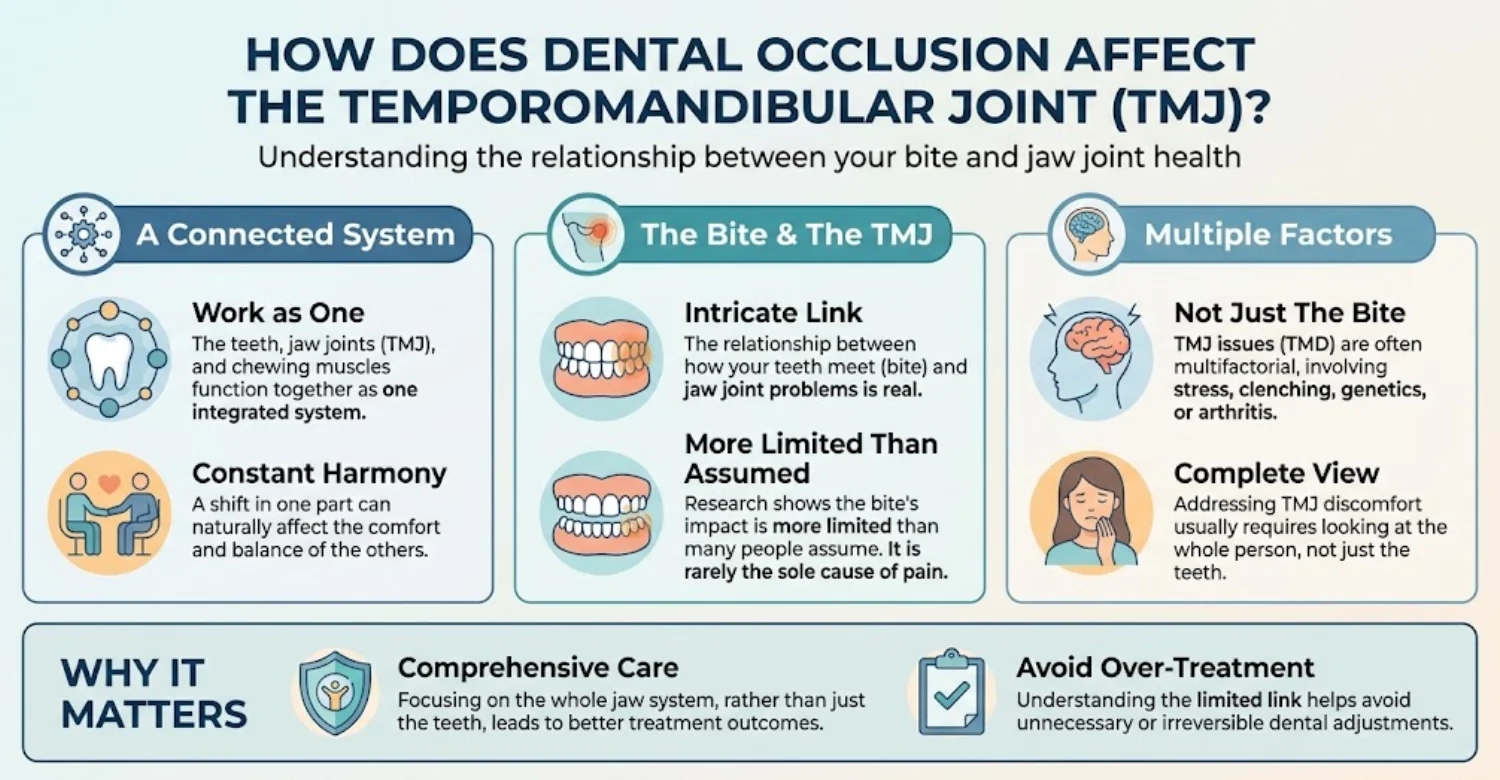
The temporomandibular joint (TMJ) connects the lower jaw to the skull, just in front of each ear. It is one of the most complex joints in the body, allowing both hinge and sliding movements. A small cartilage disc cushions the joint and guides smooth motion. Four main pairs of chewing muscles move the jaw, including the masseter and temporalis.
Dental Occlusion and Temporomandibular Joint Disorders
Temporomandibular disorders (TMD) are a group of conditions affecting the jaw joints, muscles, or both. The US National Institute of Dental and Craniofacial Research estimates TMD affects about 5% to 12% of people. Women are affected roughly twice as often as men. Most cases involve muscle pain rather than structural joint damage.
Can a Misaligned Bite Cause TMD or Make Symptoms Worse?
Current evidence suggests that most bite variations do not cause TMD on their own. Large reviews have found only weak links between specific bite traits and jaw disorders. Still, a Cochrane review found no evidence that grinding the bite prevents or treats TMD. For this reason, modern guidance recommends reversible care before any change to dental occlusion.
The Difference Between Joint Clicking, Muscle Pain, and Restricted Jaw Movement
These three problems often occur together, yet they have different causes and management. Clicking usually reflects disc movement and is often painless and harmless. Muscle pain feels like a dull ache in the cheeks or temples and often worsens with chewing. Restricted movement means the mouth cannot open fully or the jaw catches.
Why TMD Cannot Be Diagnosed From Bite Alignment Alone
Many people with irregular bites have no jaw symptoms at all. Equally, many people with TMD have bites that appear normal. Diagnosis therefore relies on symptoms, palpation of muscles, and assessment of joint movement. Clinicians often use standardized criteria known as the DC/TMD protocol.
When Jaw Symptoms Need Dental or Medical Evaluation
Mild jaw ache that improves within two weeks often settles with simple self-care. You should book an evaluation if pain lasts longer or keeps returning. Jaw locking, difficulty opening, or pain that disturbs sleep also needs assessment. Seek prompt care for swelling, fever, numbness, or pain after an injury. Jaw pain with chest pain or breathlessness needs emergency medical attention.
How Is Dental Occlusion Assessed?
Bite assessment combines conversation, examination, and, when helpful, recorded or digital data. The aim is to understand both how the teeth meet and whether that pattern causes harm.
What Happens During a Dental Occlusion Assessment?
A typical assessment takes about 30 to 60 minutes, depending on complexity. The dentist first discusses your symptoms, history, and treatment goals. Next, they examine the teeth, gums, muscles, and jaw joints. Bite contacts are checked with articulating paper, and jaw movements are observed.
Medical and Dental History, Symptoms, and Previous Restorations
The dentist asks when symptoms started and what makes them better or worse. Recent fillings, crowns, extractions, or orthodontic treatment are especially important clues. Questions cover grinding, clenching, sleep quality, stress, and headaches. Medical conditions such as arthritis or reflux may affect the teeth and joints.
Clinical Examination of Teeth, Gums, and Oral Tissues
The dentist checks each tooth for wear, cracks, decay, and mobility. Existing restorations are examined for chips, leaks, or uneven surfaces. Gums are assessed for inflammation, recession, and pocket depth. The tongue and cheeks may show scalloping or ridges linked to clenching.
Checking Static and Dynamic Occlusal Contacts
Static checks show how teeth meet with the jaw closed. Dynamic checks show contacts while the jaw slides forward and sideways.
How articulating paper identifies contact locations
Articulating paper is a thin, coloured strip placed between the teeth. When you bite or slide, it marks the points where teeth touch. Larger or darker marks may suggest heavier contact, though this is not always reliable. Dentists often use two colours to separate closed contacts from movement contacts.
How dentists assess jaw movement and contact interference
The dentist guides or observes the jaw as it moves forward and to each side. They watch for back teeth that collide when front teeth should guide the movement. Such unwanted contacts are called interferences. The dentist also checks for any slide between the first contact and full closure.
Digital Occlusal Analysis in Dentistry
Digital tools record bite contacts as measurable data rather than coloured marks. They can show which teeth touch first and how force spreads across the arch.
How electronic bite-analysis systems assess contact timing and force distribution
Systems such as T-Scan use a thin sensor that the patient bites on. The sensor records contact timing in milliseconds and relative force at each point. Results appear as a moving colour map on a screen. Dentists can see if one side touches before the other.
When digital analysis may provide additional information
Digital analysis can help when standard checks leave questions unanswered. It is useful for complex restorations, implant cases, and full-mouth rehabilitation planning. It may help verify results after adjustment or new crowns are placed. However, digital dental occlusion data still needs clinical interpretation.
Digital Scans, Bite Registration, and Dental Models
Intraoral scanners create accurate 3D images of the teeth in minutes. Many scanners record surfaces with accuracy measured in tens of microns. A bite registration records how the upper and lower teeth fit together. Scans and models allow the dentist to study the bite from every angle.
When Dental X-Rays or CBCT Imaging May Be Appropriate
Dental X-rays help check for decay, infection, bone loss, and root fractures. They are not routinely needed for every bite complaint. Panoramic X-rays may reveal impacted teeth, jaw cysts, or joint changes. Cone-beam CT (CBCT) produces 3D images of bone and joints.
How Dentists Distinguish Occlusal Problems From Tooth, Gum, or Joint Conditions
Dentists compare symptoms with what they find on examination. A cracked tooth often causes sharp pain on release, unlike a high filling. Gum infection usually shows swelling, bleeding, or deep pockets. Joint problems typically produce pain on movement and tenderness near the ear.
How Is Dental Occlusion Treated?
Treatment ranges from simple monitoring to orthodontics, restorations, or combined care. The right option depends on the cause, severity, symptoms, and your personal goals.
Does Every Bite Problem Need Treatment?
No, many bite variations are stable and harmless and only need monitoring. Treatment is generally considered when there is pain, damage, function loss, or aesthetic concern. Dentists also weigh whether the problem is likely to worsen over time. A mild deep bite without symptoms, for example, may simply be observed.
Treatment Based on the Cause and Severity of the Problem
A high filling may need only a few seconds of careful adjustment. Crowding or an open bite may need months of orthodontic treatment. Worn or missing teeth may require crowns, bridges, or implants. Skeletal jaw differences in adults sometimes need surgery combined with orthodontics.
Orthodontic Treatment for Bite Alignment
Orthodontics moves teeth gradually to improve both alignment and how the arches meet. It can correct crowding, spacing, crossbites, open bites, and many deep bites. Treatment usually lasts between 6 and 24 months, depending on complexity.
Braces and clear aligners for selected malocclusions
Fixed braces use brackets and wires and suit a wide range of complex movements. Clear aligners, such as Invisalign, use a series of removable plastic trays. Aligners are usually worn for 20 to 22 hours each day. They work well for many mild to moderate crowding, spacing, and bite issues.
Restorative Dentistry for Damaged or Missing Teeth
Restorations rebuild worn, broken, or missing teeth to restore function and appearance. They can also re-establish stable contacts between the upper and lower teeth.
Dental crowns, bridges, and other restorations
Crowns cover and protect a damaged tooth while restoring its shape and contacts. Bridges replace one or more missing teeth by anchoring to neighbouring teeth. Onlays restore part of a tooth while preserving more natural structure. Composite bonding can rebuild worn edges with minimal tooth preparation.
Dental implants and bite planning
Implants replace missing roots with titanium or zirconia posts placed in the jawbone. Long-term studies commonly report implant survival rates above 95% after ten years. Unlike natural teeth, implants lack a cushioning ligament around them. This makes careful bite planning essential to avoid overloading the implant.
Occlusal Adjustment for Bite Correction
Occlusal adjustment means selectively reshaping small areas of tooth or restoration surfaces. The goal is to remove specific interferences and balance bite contacts.
When selective adjustment may be appropriate
Adjustment is most useful when a new filling or crown is clearly too high. It can also help when a single contact causes tooth tenderness or mobility. Dentists may smooth sharp or rough edges that irritate the tongue or cheeks. Some restorative cases need minor adjustment to fit new crowns into the bite. It is not recommended as a general treatment for jaw pain or TMD.
Why enamel removal must be conservative and carefully planned
Enamel does not grow back once it has been removed. Excessive adjustment can cause sensitivity, weaken teeth, or create new uneven contacts. Each change can shift how the remaining teeth meet. Careful dentists remove only small amounts and check contacts after every step.
Occlusal Splints and Night Guards for Selected Patients
An occlusal splint is a custom-made removable appliance, usually worn at night. Hard acrylic splints protect teeth from grinding damage and spread bite forces. They may also reduce muscle strain in some people with clenching habits. Evidence for splints in treating TMD pain is mixed but supports their use in selected patients.
Management of Clenching, Grinding, and Jaw Muscle Symptoms
Awareness is often the first step in reducing daytime clenching. Patients learn to keep the lips together and teeth slightly apart at rest. Stress management, relaxation techniques, and better sleep habits may help. Physiotherapy and gentle jaw exercises can ease muscle tension.
When Multidisciplinary Care May Be Necessary
Some bite problems involve several areas of dentistry at once. A combined plan may involve a general dentist, orthodontist, prosthodontist, and periodontist. Severe skeletal problems may need an oral and maxillofacial surgeon. Persistent jaw pain may benefit from a physiotherapist or pain specialist.
Note : All images used are for editorial and illustrative purposes only and may not originate from the original news provider or associated company.
Dental Occlusion in Restorative Dentistry
Every crown, veneer, bridge, and implant becomes part of your bite. Planning how these restorations meet the opposing teeth is as important as their colour and shape.
Why Bite Planning Matters Before Crowns, Veneers, and Bridges
Restorations must work with your existing dental occlusion, not against it. Veneers on front teeth, for example, change how the jaw is guided during movement. If guidance is ignored, porcelain may chip or the restoration may be broken. Studies of ceramic restorations commonly list fracture and chipping among the main complications.
Occlusal Contact and Tooth Function in Restorative Treatment
Each restored tooth should share bite force fairly with its neighbours. Back teeth should meet evenly when the jaw closes. Front teeth and canines usually guide sideways and forward movements. This guidance helps protect back teeth from damaging sideways forces.
Dental Implant Restoration and Occlusal Load Distribution
Natural teeth move slightly under pressure, while implants are fixed rigidly in bone. This difference means implants feel and absorb force differently. Dentists therefore design implant crowns with lighter contacts than neighbouring natural teeth. Narrower chewing surfaces and flatter cusps may reduce sideways loads.
How Digital Scanning and Bite Registration Support Restoration Planning
Digital scans capture tooth shape and bite relationships with high accuracy. This data allows technicians to design restorations that fit the bite precisely. Digital smile design can preview changes before any tooth is prepared. Temporary restorations can test the new bite and appearance in real life.
Why Restorations Must Be Evaluated in Both Static and Dynamic Occlusion
A crown may feel perfect when you close but collide during chewing movements. Testing only the closed bite misses these sliding interferences. Dentists therefore check restorations during forward and side-to-side movements. Contacts are refined until movement feels smooth and even.
How Follow-Up Visits Help Identify Bite Discomfort After Treatment
Some bite issues only appear after the anaesthetic wears off and normal chewing resumes. A review visit within one to two weeks allows early fine-tuning. Patients can describe how the bite feels while eating and at rest. The dentist checks contacts again and makes small corrections if needed.
How Can You Find Relief From Bite-Related Discomfort?
Simple self-care can ease many bite and jaw symptoms while you await assessment. These measures are temporary and should not replace a professional examination.
Safe Measures for Temporary Relief While Awaiting Assessment
Resting the jaw and reducing strain help sore muscles and teeth recover. Most measures are simple, low-cost, and easy to use at home.
Choosing softer foods if chewing is uncomfortable
Soft foods reduce the work your teeth and muscles must do. Options include yogurt, soups, eggs, fish, pasta, and steamed vegetables. Cutting food into small pieces reduces wide opening and heavy chewing. Chewing on both sides, when comfortable, avoids overloading one area.
Avoiding gum, hard foods, and deliberate jaw clenching
Chewing gum keeps the jaw muscles working for long periods. Hard foods, such as nuts, ice, and crusty bread, place extra force on sensitive teeth. Avoid biting nails, pens, or other objects. Try to keep your teeth apart and lips gently closed when resting.
Using a warm or cold compress when appropriate for muscle discomfort
A warm compress may relax tight jaw muscles and improve comfort. Apply it to the cheeks or temples for about 10 to 15 minutes. A cold pack may help after an injury or when swelling is present. Always wrap ice in a cloth to protect the skin. Do not use heat if you suspect a dental infection or facial swelling.
Medical Tips for Managing Jaw Tension and Tooth Sensitivity
Desensitizing toothpaste containing potassium nitrate or stannous fluoride may ease sensitivity. It usually needs two to four weeks of regular use to work well. Brush gently with a soft brush to protect worn or sensitive areas. Gentle jaw stretches recommended by a clinician may relieve muscle tightness.
Can Over-the-Counter Pain Relief Help?
Over-the-counter pain relievers may ease short-term tooth or jaw discomfort. Anti-inflammatory medicines such as ibuprofen can help with muscle and joint pain. Paracetamol, also called acetaminophen, is another commonly used option. These medicines relieve symptoms but do not correct the underlying cause.
Important precautions, contraindications, and medication interactions
Always follow the dose on the label and do not exceed the daily maximum. Ibuprofen may not be suitable for people with stomach ulcers, kidney disease, or some heart conditions. It may also interact with blood thinners and certain blood pressure medicines. People with asthma should check whether anti-inflammatories are safe for them. Taking too much paracetamol can cause serious liver damage. Ask a pharmacist or doctor if you are pregnant or take other medicines.
Why You Should Not File, Grind, or Adjust Your Teeth at Home
Filing or grinding your own teeth can cause permanent damage. Enamel removed at home cannot be replaced naturally. DIY adjustment may expose sensitive dentine or crack the tooth. It may also create new uneven contacts and worsen your bite. Home tools are not sterile and may injure the gums.
Why Irreversible Bite Changes Should Not Be Used as a Self-Treatment for Jaw Pain
Jaw pain often has causes that bite changes cannot fix. Stress, muscle overuse, and joint conditions frequently play a larger role. Research has not shown that reshaping the bite reliably relieves TMD. Irreversible changes may leave you with sensitive teeth and an unfamiliar bite.
Possible Side Effects of Occlusal Adjustment
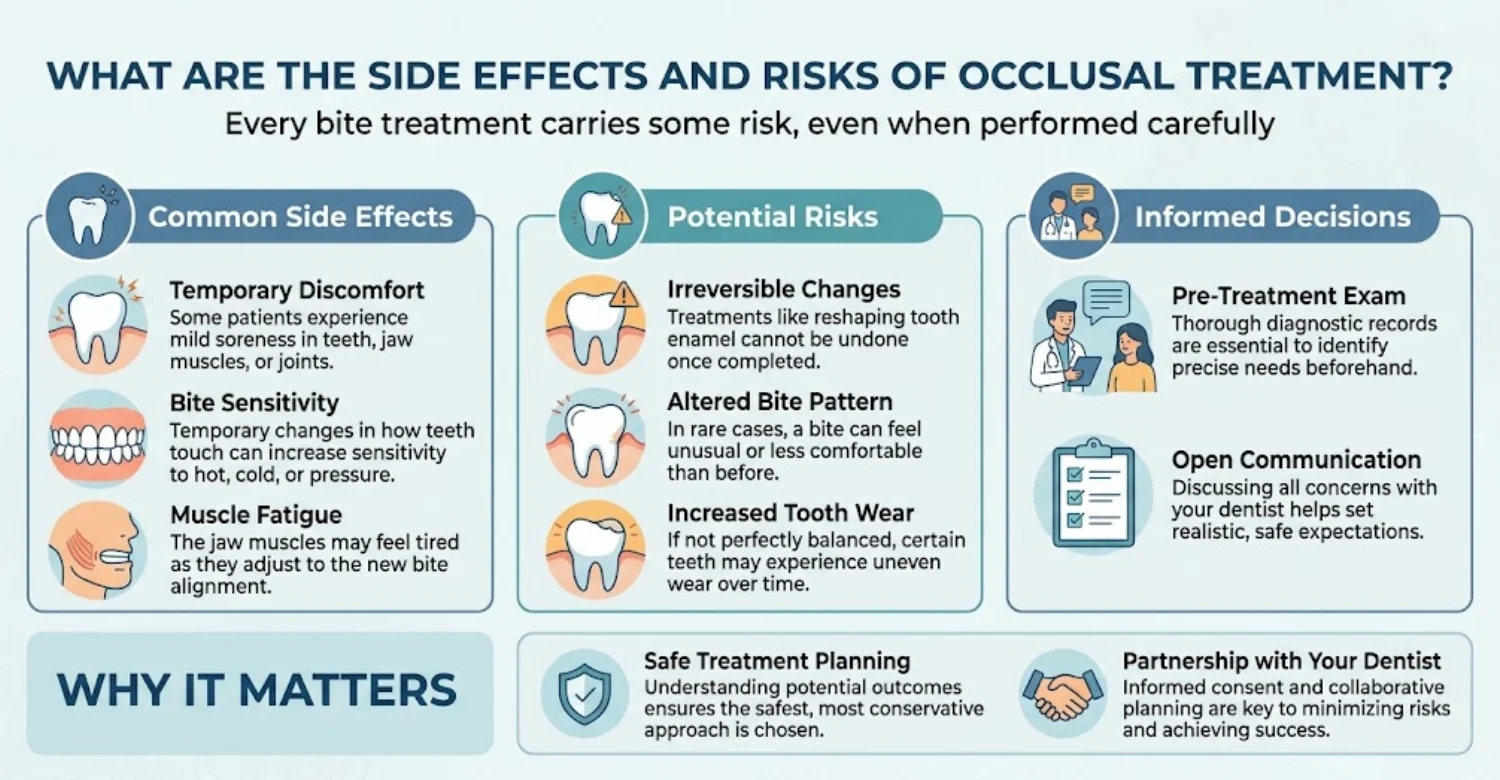
Most minor adjustments cause few or no lasting side effects. Problems are more likely when large amounts of enamel are removed.
Temporary sensitivity or discomfort
Adjusted teeth may feel sensitive to cold for a few days. The bite may also feel unfamiliar while the muscles adapt. This sensation usually settles within one to two weeks. Desensitizing toothpaste can help during this period.
The risk of excessive enamel removal and altered tooth contacts
Removing too much enamel can expose dentine and cause lasting sensitivity. It can also weaken teeth and increase the risk of fracture. Adjusting one area may create new heavy contacts elsewhere. Repeated adjustments can gradually change the overall bite in unintended ways.
Risks and Limitations of Orthodontic and Restorative Bite Correction
Orthodontic treatment may cause temporary soreness, gum irritation, and mild root shortening. Teeth can relapse if retainers are not worn as advised. Restorations may chip, debond, or need replacement over time. Crowns and veneers usually require removing some natural tooth structure.
Possible Discomfort and Adaptation With Occlusal Splints
New splints may cause temporary tooth pressure, extra saliva, or mild jaw stiffness. Most people adapt within one to two weeks. Poorly fitting splints can cause discomfort or unwanted tooth movement. Partial-coverage appliances worn long term may change the bite.
Why Unnecessary or Irreversible Treatment Should Be Avoided
Treating a harmless bite variation adds cost and risk without clear benefit. Irreversible procedures permanently change tooth structure or position. If they do not help, returning to the original state is often impossible. Evidence-based care starts with the simplest, most reversible options.
How Follow-Up and Monitoring Help Manage Treatment Risks
Follow-up visits allow early detection of high contacts, wear, or discomfort. Small issues found early are usually easy to correct. Photos and scans help track changes over months and years. Monitoring also confirms whether treatment achieved its goals.
Ready to transform your smile?
Talk to our team and get a personal FREE treatment plan.
When Should You See a Dentist for Dental Occlusion Problems?
Some bite changes need only a routine visit, while others need prompt or urgent care. Knowing the difference helps you act at the right time.
Signs That Warrant a Routine Dental Appointment
Book a routine visit if you notice gradual tooth wear or small chips. Mild jaw stiffness that comes and goes also deserves a check. Partner reports of night-time grinding are worth mentioning to your dentist. Most adults benefit from a dental check every 6 to 12 months.
When to Seek Prompt Dental Care
Some symptoms should be checked within days rather than weeks. Prompt care often makes treatment simpler and prevents further damage.
A sudden change in the way your teeth meet
A bite that changes suddenly is not normal and deserves prompt attention. Possible causes include a broken tooth, lost filling, or swelling near a tooth. Joint changes or recent injury can also alter how teeth meet.
A newly high crown or filling that makes biting uncomfortable
A restoration that feels high usually needs only a quick adjustment. Leaving it may cause tooth tenderness, sensitivity, or jaw muscle strain. Contact your dentist within a few days of noticing the problem.
Persistent tooth pain, sensitivity, or difficulty chewing
Pain lasting more than a few days may signal decay, a crack, or inflammation. Sensitivity that lingers after cold drinks may suggest nerve irritation. Pain on biting or releasing may point to a cracked tooth.
Warning Signs That May Require Urgent Medical Assessment
Some symptoms suggest serious infection, injury, or other medical problems. These need same-day dental care or emergency medical services.
Significant facial swelling, fever, or suspected dental infection
Swelling of the face, jaw, or neck may indicate a spreading infection. Fever, a bad taste, or pus suggests an abscess. Dental infections can spread to deeper spaces of the head and neck. Seek urgent dental or medical care the same day. Go to an emergency department if swelling affects your eye or neck.
Jaw locking, inability to open the mouth normally, or severe pain
A jaw that locks open or closed needs urgent assessment. Severe pain that stops you eating or sleeping also needs prompt care. Sudden inability to open the mouth may reflect joint, muscle, or infection problems. Do not force the jaw open or closed.
Facial trauma, suspected jaw fracture, or difficulty swallowing or breathing
A blow to the face may fracture the jaw or loosen teeth. Signs include a changed bite, numbness, bleeding, or severe pain on movement. Difficulty swallowing or breathing is a medical emergency. Call emergency services immediately in these situations.
Which Professional Should You Consult for Bite Problems?
Your general dentist is usually the best first point of contact. They can assess the problem and refer you to a specialist when needed.
General dentist, orthodontist, restorative dentist, or oral and maxillofacial specialist
Professional | When to consider them |
General dentist | First assessment, high fillings, sensitivity, basic adjustments, night guards |
Orthodontist | Crowding, crossbite, open bite, deep bite, Class II or III patterns |
Restorative dentist or prosthodontist | Worn teeth, multiple crowns, implants, full-mouth rehabilitation |
Oral and maxillofacial surgeon | Jaw fractures, severe skeletal problems, complex joint disorders |
Many complex cases benefit from several of these professionals working together.
.jpg)
.jpg)
.jpg)
How Can Dental Occlusion Problems Be Prevented or Managed Long Term?
Not every bite problem can be prevented, but many complications can be limited. Regular care and early action make the biggest difference.
Maintaining Regular Dental Examinations
Routine check-ups allow dentists to spot wear, cracks, and bite changes early. Photographs and scans can compare your teeth over time. Children benefit from an orthodontic check by around age seven, as many guidelines suggest. Early checks can identify crossbites and habits while the jaws are still growing.
Protecting Teeth From Grinding and Clenching
A custom night guard can protect teeth from sleep grinding. Daytime awareness helps reduce clenching during work or concentration. Stress management and good sleep habits may lower muscle activity. Sports mouthguards protect teeth during contact sports.
Monitoring Changes After Crowns, Veneers, Bridges, or Dental Implants
Restorations need regular checks to ensure they still fit the bite. Teeth and restorations both wear slowly over time. Implant crowns may need small adjustments as natural teeth shift. Chips or rough areas should be repaired before they worsen.
Supporting Healthy Oral Hygiene and Gum Health
Healthy gums and bone give teeth stable support against bite forces. Gum disease can loosen teeth and allow them to drift. Brush twice daily with fluoride toothpaste and clean between teeth daily. Regular professional cleaning removes hardened tartar.
Recognizing Early Changes in Chewing Comfort and Tooth Contact
Pay attention if chewing starts to feel different or uncomfortable. Notice new food traps, gaps, or teeth that seem to touch first. Morning jaw tiredness may suggest night-time clenching. New sensitivity or small chips are worth reporting.
Why Preventive Care Does Not Guarantee That Malocclusion Can Be Avoided
Many bite patterns are shaped by genetics and jaw growth. These factors cannot be fully controlled with hygiene or habits. Some people develop bite changes despite excellent care. Preventive care aims to limit damage, not guarantee a perfect bite.
Ready to transform your smile?
Talk to our team and get a personal FREE treatment plan.
How Much Does Dental Occlusion Assessment and Bite Correction Cost in the US, UK, and Turkey?
Costs vary widely by country, clinic, and the complexity of your bite problem. The figures below are approximate private-sector estimates and should be confirmed with a written quote.
Average Cost of Dental Occlusion Assessment by Country
Assessment fees depend on how many records are taken and whether digital analysis is used. A basic clinical check costs less than a full digital workup with scans and imaging.
United States: estimated assessment and digital bite-analysis fees
A comprehensive exam with bite evaluation typically costs around $200 to $600. Digital bite analysis with systems such as T-Scan may add to this fee. Clinics in major cities often charge toward the upper end of the range. X-rays, scans, and models are sometimes billed separately.
United Kingdom: estimated private assessment and digital bite-analysis fees
Private occlusal assessments in the UK generally cost around $100 to $500. Digital bite analysis is mostly offered privately rather than through the NHS. NHS patients pay banded charges, with Band 1 examinations costing $27.40 in England from April 2025.
Turkey: estimated assessment and digital bite-analysis fees
Private clinics in Turkey typically charge around $80 to $250 for an occlusal assessment. Many clinics include digital scanning within their consultation packages. Lower operating costs help explain the price difference compared with the US and UK.
Average Cost of Occlusal Adjustment and Bite Correction
Adjustment costs depend on how many teeth need treatment and how many visits are required. Broader correction may include orthodontics, restorations, or splints.
United States: estimated costs for selective adjustment and more extensive correction
A limited occlusal adjustment usually costs around $50 to $300. A complete adjustment across both arches may cost more. Broader bite correction often ranges from $500 to over $3,000.
United Kingdom: estimated private treatment costs
Private selective adjustment in the UK generally costs around $50 to $250. Broader bite correction often starts around $400 and may exceed $2,000. In England, Band 3 treatment costs $326.70 from April 2025, covering items like crowns.
Turkey: estimated treatment costs and potential additional expenses
Selective adjustment in Turkey typically costs around $25 to $150. Broader bite correction often ranges from $200 to over $1,500. International patients should also budget for flights, accommodation, and local transport. Follow-up visits may require a second trip or coordination with a local dentist.
Dental Occlusion Cost Comparison: US vs UK vs Turkey
Service | United States | United Kingdom | Turkey |
Occlusion assessment / digital analysis | Around 200–600 | Around $100–$500 | Around $80–$250 |
Selective occlusal adjustment | Around 50–300 | Around $50–$250 | Around $25–$150 |
Broader bite correction | Around 500–3,000+ | Around $400–$2,000+ | Around $200–$1,500+ |
Prices are approximate private-sector estimates as of 2026 and vary by clinic and case complexity. Turkey often costs 50% to 70% less than comparable private UK care.
What Factors Affect the Total Cost of Bite Correction?
The final cost reflects diagnosis, treatment scope, materials, and aftercare. Understanding each factor helps you compare quotes fairly.
Clinical examination, diagnostic records, and digital analysis
Comprehensive records cost more than a quick visual check. Scans, photographs, X-rays, and digital bite analysis each add to the fee. CBCT imaging is usually the most expensive diagnostic step.
The number of teeth involved and the complexity of the bite problem
Adjusting one high filling costs far less than balancing an entire bite. Complex cases need more chair time and more follow-up visits. Skeletal problems may require specialist input or surgery.
Orthodontics, restorative treatment, splints, or additional procedures
Orthodontic treatment, crowns, veneers, and implants carry their own separate fees. A custom splint adds laboratory and fitting costs. Gum treatment or extractions may be needed before bite correction.
Follow-up appointments, laboratory fees, and travel expenses
Review visits may or may not be included in the original quote. Laboratory fees for crowns and splints vary by material and lab quality. International patients must add travel, accommodation, and time off work.
Does Dental Insurance Cover Occlusal Assessment or Bite Correction?
Coverage depends on your plan, your country, and whether treatment is medically necessary. In the US, many plans cover exams but limit occlusal adjustment and night guards. Orthodontic coverage for adults is often limited or excluded. In the UK, the NHS covers clinically necessary care under banded charges.
How to Compare Dental Treatment Quotes Across Countries
Compare what each quote includes, not only the headline price. Check whether diagnostics, temporary restorations, and follow-up visits are included. Ask about materials, laboratory brands, and dentist qualifications. Confirm warranty terms and how complications are handled.
Why an Individualized Treatment Plan Is More Reliable Than a Starting Price
Advertised starting prices usually describe the simplest possible case. Your actual cost depends on your teeth, bite, and treatment goals. A personalized plan lists each procedure, its purpose, and its cost. It also explains alternatives, including monitoring without treatment.






Personalized Dental Occlusion Assessment and Bite Correction at Vitrin Clinic
At Vitrin Clinic, bite assessment is part of planning any cosmetic or restorative treatment. Our team focuses on function, comfort, and long-term protection of your teeth.
Assessing Bite Alignment Before Cosmetic or Restorative Dental Treatment
Before veneers, crowns, or implants, we examine how your teeth meet and move. This helps us design restorations that fit your bite naturally. We look for wear, interference, and signs of grinding. Identifying these issues early reduces the risk of chips or failures later.
Evaluating Tooth Contacts, Existing Restorations, and Chewing Function
We check contacts with articulating paper and observe jaw movements carefully. Existing fillings and crowns are assessed for fit, wear, and damage. We ask how chewing feels on each side of the mouth. Muscle tenderness and joint sounds are also recorded.
When Digital Scanning and Additional Imaging May Be Appropriate
Digital scans record your teeth and bite in precise 3D detail. They support restoration design and allow comparison over time. X-rays are taken when needed to check roots, bone, and hidden problems.
Personalized Treatment Planning for Crowns, Veneers, and Dental Implants
Every plan is built around your diagnosis, goals, and budget. We consider how each restoration will affect your overall dental occlusion. Temporary restorations may be used to test the new bite and appearance. Implant crowns are designed to manage load carefully.
Understanding Which Findings Require Treatment and Which Can Be Monitored
Not every finding needs immediate treatment. We explain which issues pose real risks and which are stable variations. Minor wear or small asymmetries may only need monitoring. Problems causing pain, damage, or failing restorations usually need attention.
Relevant Vitrin Clinic Treatment Pages
If your assessment shows that treatment may help, these services are often part of bite-focused care. Each treatment is planned with careful attention to how your teeth meet.
Dental crowns and zirconia crowns
Crowns restore damaged or heavily worn teeth and rebuild stable bite contacts. Zirconia crowns combine strength with a natural appearance.
Dental veneers
Veneers improve the shape, colour, and alignment of front teeth. Careful bite planning protects them from chipping during jaw movements.
Dental implants and full-mouth rehabilitation
Implants replace missing teeth and help prevent neighbouring teeth from drifting. Full-mouth rehabilitation rebuilds the entire bite when many teeth are worn or missing.
Invisalign and orthodontic treatment
Clear aligners can correct crowding, spacing, and many bite problems discreetly. Orthodontic treatment may be recommended before cosmetic restorations.
How Vitrin Clinic Supports Your Treatment Journey
From your first message to your final review, our team guides each step. We aim to make care clear, coordinated, and comfortable.
Initial Consultation and Review of the Patient’s Main Concerns
We start by listening to your symptoms, goals, and previous dental experiences. You can share photos or X-rays before your visit. This helps us understand your situation and prepare relevant questions.
Individualized Clinical Assessment and Diagnostic Planning
Your examination covers teeth, gums, restorations, muscles, and jaw movement. We take scans, photos, or X-rays when they add useful information. Findings are reviewed together with you in clear language.
Explaining Suitable Options, Benefits, Limitations, and Expected Costs
We explain each suitable option, including monitoring without treatment. You learn the benefits, limitations, risks, and expected outcomes of each choice. A written cost estimate is provided before treatment begins.
Coordinating Treatment for International Patients
Our team helps international patients plan appointments around travel dates. We can advise on visit length and the number of trips needed. Coordination support may include transfers and accommodation guidance.
Providing Follow-Up Guidance and Recommendations for Ongoing Dental Care
After treatment, we explain how to care for your teeth and restorations. You receive guidance on night guards, hygiene, and warning signs. We remain available for questions after you return home.
Ready to transform your smile?
Talk to our team and get a personal FREE treatment plan.
Key Takeaways
These points summarize what you need to know about your bite, its problems, and its care.
Understanding Dental Occlusion and Functional Bite Alignment
Dental occlusion describes how your upper and lower teeth meet during rest and movement. A functional bite matters more than a perfect-looking one. About three in four people have a Class I molar relationship.
Recognizing Common Bite Problems and Their Possible Causes
Common problems include crowding, deep bite, open bite, and crossbite. Causes include genetics, habits, missing teeth, grinding, and ill-fitting restorations. Bruxism affects roughly one in five people worldwide.
Knowing When Assessment or Treatment May Be Appropriate
Seek assessment for persistent pain, a sudden bite change, or a newly high restoration. Many bite variations need only monitoring.
Choosing Evidence-Based Treatment and Safe Relief Measures
Start with reversible options such as self-care and splints when the cause is unclear. Never file or adjust your teeth at home.
Understanding Treatment Risks, Side Effects, and Cost Differences
Adjustment can cause sensitivity and permanent enamel loss if overdone. Costs vary widely between the US, UK, and Turkey.
Seeking Professional Care for Persistent Symptoms or Urgent Warning Signs
Swelling, fever, jaw locking, or facial trauma need urgent care. Difficulty swallowing or breathing is an emergency.
Correct Your Bite with Personalized Invisalign Treatment at Vitrin Clinic
If crowding, spacing, or an uneven bite affects your comfort or confidence, Invisalign may help. Clear aligners gradually move teeth into better positions with minimal disruption to daily life. At Vitrin Clinic, every aligner plan begins with a careful bite assessment. Contact Vitrin Clinic today to book your consultation and start planning a healthier, more balanced bite.
Sources
FAQs
Dr. Rifat Alsaman has more than 5 years of clinical experience in dentistry and currently serves as the Head of the Medical Team at Vitrin Clinic. He is dedicated to providing exceptional patient care, overseeing treatment planning, and ensuring the highest clinical standards across the team. His expertise, attention to detail, and commitment to continuous professional development have helped countless patients achieve healthier, more confident smiles.


