Dental Crowns
October 19, 2026
Full Mouth Dental Crowns in Turkey: Cost, Materials, Process & Results
 Dr. Rifat Alsaman

Full mouth dental crowns can turn worn, chipped, discolored, or mismatched teeth into one strong, natural-looking smile. Many people live for years with teeth damaged by grinding, acid erosion, old fillings, or tired crowns. Eating becomes careful. Smiling becomes guarded.
Full mouth dental crowns cover most or all of your visible teeth, and sometimes every tooth, with custom-made caps. They restore strength, bite, and appearance in one coordinated treatment, usually with zirconia or E-max crowns.
This guide explains materials, costs, the step-by-step process, honest downsides, and who should not have this treatment at all.
.jpg)
.jpg)
.jpg)
.jpg)
.jpg)
.jpg)
Ready to transform your smile?
Talk to our team and get a FREE treatment plan.
What Are Full Mouth Dental Crowns?
Full mouth dental crowns are custom-made caps placed over many or all teeth in both jaws. Each crown covers the whole visible part of a tooth above the gum line. Together, they rebuild tooth shape, strength, color, and bite in one planned treatment. Dentists usually use zirconia, E-max, or porcelain-fused-to-metal crowns. The aim is not just whiter teeth. The aim is a healthy, stable bite that functions well and looks natural for many years.
Full mouth crowns vs. full mouth reconstruction
Full mouth crowns mainly restore appearance and bite on teeth that can still be saved. Dental crowns full mouth reconstruction is a wider plan. It may also include root canal treatment, gum therapy, extractions, implants, bridges, or bite correction. Many patients start by asking about crowns only. After a full exam, some need only crowns. Others need a staged reconstruction first. A careful diagnosis decides which path fits your mouth, not the other way around.
How many crowns is a "full mouth"?
There is no fixed number. Most adults have 28 teeth, not counting wisdom teeth. A smile makeover often involves about 16 to 20 crowns, covering the teeth that show when you smile in both jaws. A complete reconstruction may include up to 28 crowns. Your final number depends on which teeth are damaged, how wide your smile is, and whether healthy teeth can be left untouched. Healthy back teeth often need no crown at all.
Can You Have a Full Mouth of Crowns?
Yes. A full mouth of crowns is a common treatment when many teeth are worn, damaged, or heavily restored. Healthy teeth with only cosmetic issues may be better treated with veneers, bonding, or whitening. Dental crowns full mouth treatment works best when there is a real structural reason behind it. Before any decision, your gums, roots, bone, and bite should be checked with an exam and X-rays. Good candidates are chosen by diagnosis, not by desire alone.
Who is a good candidate?
You may be a good candidate if your teeth have lost a lot of structure. Common reasons include:
Severe tooth wear from grinding or acid erosion
Multiple large fillings or old crowns
Many cracked or broken teeth
Bite problems
Discoloration that whitening can't fix, combined with structural damage
In these cases, a full set of crowns protects weak teeth and rebuilds lost height. Your gums and roots must also be healthy enough to support the new crowns.
Who should NOT get full mouth crowns?
Full mouth dental crowns are not right for everyone. If your teeth are healthy and you only want a brighter color, whitening or veneers are usually kinder options. People with untreated gum disease should treat it first, because crowns on unstable gums can fail. Heavy grinders also need a protective night guard after treatment. Without one, even strong crowns can chip or crack. A responsible dentist will tell you when crowns are not the answer.
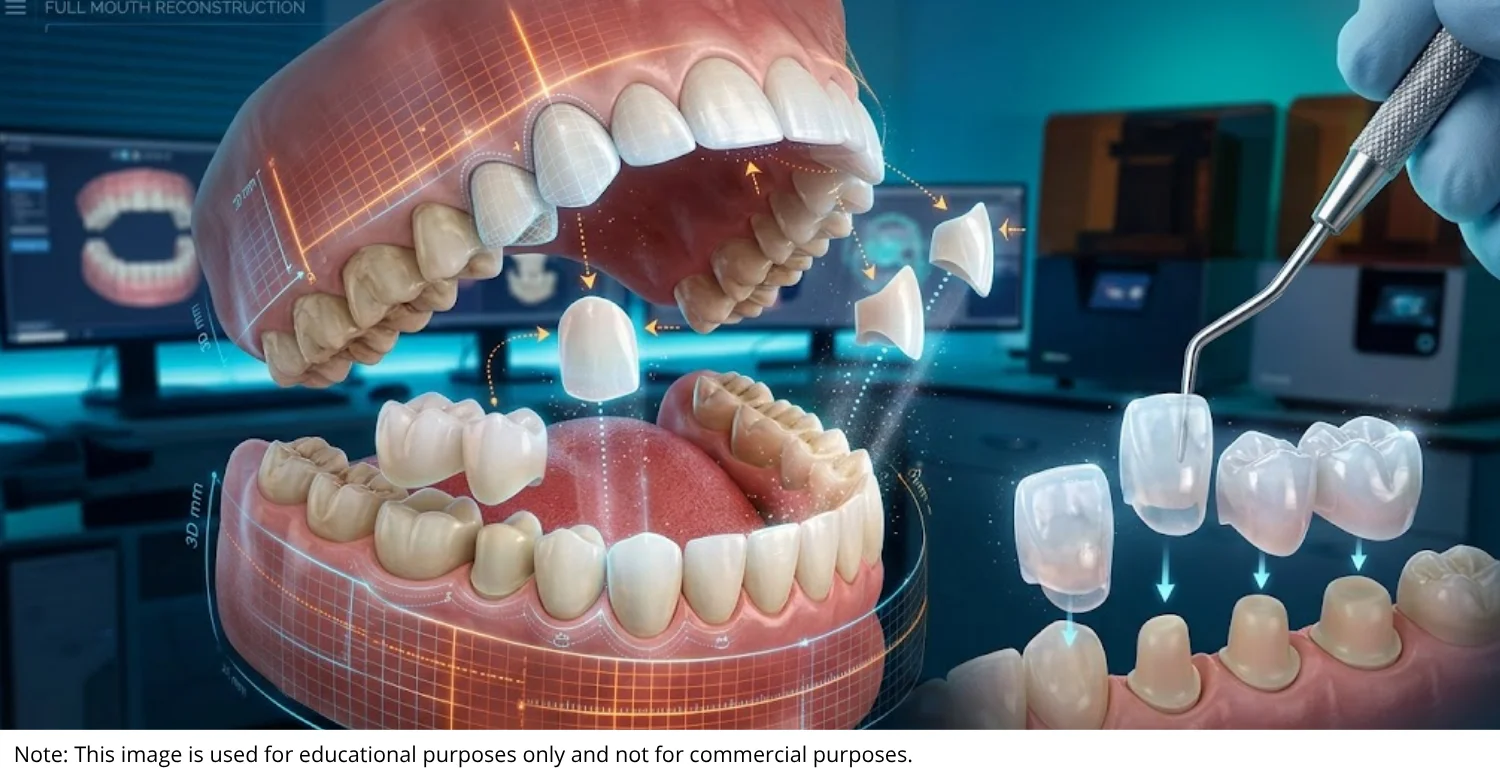
Note: All images used are for editorial and illustrative purposes only and may not originate from the original news provider or associated company.
Why Do Dentists Recommend Crowns, and When Are They Really Needed?
Dentists recommend crowns when a tooth is too weak for a filling alone. This happens after a large cavity, a crack, or a root canal on a back tooth. A crown holds the tooth together and spreads biting forces evenly.
At Vitrin Clinic, we follow a conservative-first philosophy. Healthy teeth are not prepared unnecessarily. Removing enamel is permanent, so we only cut what treatment truly requires. This protects your teeth and keeps future options open.
The term "Turkey teeth" describes healthy teeth ground down for cosmetic crowns. This is the outcome we work hard to avoid. If you received a plan elsewhere, you can ask for a second opinion. We will tell you honestly whether crowns are needed.
Types of Dental Crowns for a Full Mouth
The three main types are all-ceramic (zirconia and E-max), porcelain-fused-to-metal (PFM), and metal or gold crowns. For dental crowns full mouth cases, all-ceramic options are now the most popular. They look natural and contain no metal. PFM and gold crowns are still used in specific situations. The right choice depends on where the tooth sits, how hard you bite, and how important appearance is for that tooth.
Type | Appearance | Strength | Best for | Lifespan | Price range at Vitrin Clinic |
Zirconia | Natural, slightly more opaque | Very high | Back teeth, grinders, long spans | 15+ years | ≈$140 – $200 per tooth |
E-max | Most lifelike, translucent | High | Front teeth, smile zone | 10–15 years | ≈$180 – $350 per tooth |
PFM | Good, may show a gray gum line | High | Budget-conscious cases | 10–15+ years | ≈$85 – $160 per tooth |
Metal or gold | Not tooth-colored | Very high | Hidden back molars | 15–20+ years | ≈$200 – $350 per tooth (up to $900+ for gold depending on market rate) |
Zirconia crowns
Zirconia is a very strong, tooth-colored ceramic. It resists fracture well, even on back teeth that take heavy chewing forces. Solid (monolithic) zirconia is the toughest form. Layered zirconia has a porcelain outer layer for better looks, but that layer can chip. Modern multilayer zirconia looks far more natural than older versions. For many full mouth dental crowns plans, zirconia is the main material for molars and premolars.
E-max crowns
E-max is a lithium disilicate glass-ceramic made by Ivoclar. Its translucency lets light pass through like natural enamel. This makes it ideal for front teeth, where appearance matters most. E-max is strong enough for most front teeth and many premolars. It is less strong than zirconia, so it is a weaker choice for heavy grinders' back teeth. In full mouth dental crowns plans, E-max is often reserved for the smile zone. You can read more in our dedicated E-max crowns guide.
Porcelain-fused-to-metal (PFM)
PFM crowns have a metal core covered by porcelain. They were the standard for decades and have a long track record. They are strong and usually cost less than all-ceramic crowns. Their main drawbacks are cosmetic. A dark line may appear at the gum edge if gums recede. The metal also blocks light, so they look less lifelike. The porcelain layer can sometimes chip. Some patients choose PFM to lower their full mouth dental crowns cost. Today, zirconia offers similar strength without metal.
Metal or gold crowns
Metal and gold crowns are extremely durable. They rarely break, and gold is gentle on opposing teeth. They also need less tooth reduction than most ceramics. Their obvious downside is color. Most patients today avoid them in visible areas. They may still suit a hidden back molar in a heavy grinder. In modern full mouth dental crowns treatment, they are used far less often than ceramic options.
Mixing materials
You do not have to use one material for every tooth. A common approach is E-max for the front teeth and zirconia for the back teeth. E-max gives the smile zone natural translucency. Zirconia gives the back teeth the strength they need for chewing. A skilled lab can match the shades closely so the smile looks uniform. Your dentist will plan the mix around your bite, habits, and goals. This mix is now standard in many full mouth dental crowns cases.
What Type of Crown Is the Strongest?
Monolithic (solid) zirconia and metal or gold crowns are the strongest. Zirconia is the most popular strong option because it is also tooth-colored.
Strength matters more in full mouth dental crowns than in single crowns. Back teeth absorb the highest biting forces. People who grind or clench put even more stress on every tooth. A crown that is too weak may chip or crack. That is why the strongest materials are usually chosen for molars, especially in patients with a history of tooth wear.
Full Mouth Crowns vs. Veneers: Which Is Better?
Crowns are better when teeth are damaged, worn, or heavily filled. Veneers are better when teeth are healthy and the goal is mainly cosmetic, because less tooth is removed. Veneers cover only the front surface of a tooth. Crowns cover the entire tooth. Many smile plans combine both. Strong, healthy front teeth may receive veneers, while broken or heavily filled teeth receive crowns. The best choice protects the most natural tooth structure possible.
Factor | Crowns | Veneers |
Tooth reduction | More, usually around the whole tooth | Less, mainly the front surface |
Protection | Strengthens weak teeth | Little structural protection |
Best for | Damaged, worn, or heavily filled teeth | Healthy teeth with cosmetic issues |
Lifespan | Commonly 10–15+ years | Commonly 10–15+ years for porcelain |
Cost | Usually higher per tooth | Usually lower per tooth |
Reversibility | Not reversible | Usually not reversible |
Do celebrities get veneers or crowns?
Many celebrity smile makeovers use veneers, because their teeth are often healthy and the goal is mostly cosmetic. Crowns are usually used where teeth needed structural repair, such as after damage or heavy wear. You often cannot tell the difference just by looking. Both can look natural when well made. The right option for you depends on your own teeth, not on a famous smile. Explore our veneers and Hollywood smile pages to compare.
The Full Mouth Crowns Procedure at Vitrin, Step by Step
At Vitrin Clinic, full mouth dental crowns follow a careful, planned sequence. Every step is designed so you understand your treatment before any tooth is touched. Planning begins before you travel and continues after you return home. Here is how the process usually works:
Free online assessment from photos or X-ray. We review your images and give an initial opinion.
In-clinic exam, 3D CBCT, digital scan, and bite analysis. We check teeth, roots, bone, and jaw function.
Digital smile design with a mock-up. You preview your new smile before any work begins.
Preparatory treatment, if needed. This may include fillings, root canals, or gum care.
Tooth preparation and temporary crowns. Teeth are shaped, and temporaries protect them.
Crown fabrication in the lab. Technicians make each crown from your digital scan.
Try-in, bite adjustment, and final cementation. We check fit, shade, and bite before bonding.
Night guard and aftercare plan. You leave with protection and clear care instructions.
How many days do you need in Istanbul?
Most full mouth dental crowns cases need around 7 to 10 days in Istanbul. This covers the exam, preparation, temporaries, lab work, try-in, and final fitting. Your exact stay depends on the number of crowns and any treatment needed first. Root canals or gum treatment may add a few days. If implants are needed, two trips are usually required, because implants need several months to heal before final crowns are fitted.
Full Mouth Crowns Before and After
Real results show what full mouth dental crowns can achieve. Typical cases include badly worn teeth rebuilt to their natural height, complete smile makeovers, and old PFM crowns replaced with natural-looking ceramics. Each case below lists the number of crowns, the material, and the days spent in Istanbul.
Case : smile makeover
Number of crown : full mouth
Material :zircon
3 days in Istanbul
.jpg)
.jpg)

How Much Do Full Mouth Dental Crowns Cost in Turkey?
Full mouth dental crowns cost in Turkey is usually much lower than in the UK, US, or much of Europe. The final price depends on the material, the number of crowns, and any treatment needed first. Many patients search for dental crowns full mouth cost and find very different numbers. Always compare what each price includes. A low headline price may leave out X-rays, temporaries, or root canals. A clear written quote protects you from surprises.
Vitrin's full mouth crown prices
Vitrin Clinic offers transparent package prices by material and by number of crowns. Prices are shown in GBP, EUR, and USD. Your final quote is confirmed after your exam and X-rays.
Package | Zirconia | E-max | PFM |
16 crowns | £2,125 / €2,500 / $2,720 | £3,310 / €3,900 / $4,240 | ≈ £1,375 / €1,620 / $1,760 |
20 crowns | £2,655 / €3,125 / $3,400 | £4,140 / €4,875 / $5,300 | ≈ £1,720 / €2,025 / $2,200 |
24 crowns | £3,185 / €3,750 / $4,080 | £4,970 / €5,850 / $6,360 | ≈ £2,060 / €2,430 / $2,640 |
28 crowns | £3,720 / €4,375 / $4,760 | £5,800 / €6,825 / $7,420 | ≈ £2,405 / €2,835 / $3,080 |
Full mouth zirconia crowns cost
Zirconia is the most requested material for full mouth cases, because it combines strength and a natural color. The full mouth dental restoration zirconia crowns cost depends mainly on how many teeth are treated. It also depends on whether monolithic or layered zirconia is used. Layered zirconia often costs more because it needs extra lab work. At Vitrin Clinic, zirconia is often used for back teeth and combined with E-max at the front.
What affects the total cost
Several factors shape your final full mouth dental crowns cost:
Number of teeth: more crowns mean a higher total.
Material: zirconia, E-max, and PFM are priced differently.
Root canals: needed when nerves are infected or badly inflamed.
Implants: needed to replace missing teeth.
Gum work: treatment for gum disease before crowns.
Night guard: protection for grinders after treatment.
A full exam is the only way to know exactly which items apply to you.
Dental Crown Cost: vitrin Clinic vs. UK vs. USA
The cost of a dental crown varies depending on the material selected, the clinical complexity of the case, and the country of treatment.
The following table provides a transparent comparison of average costs by crown type across the United Kingdom, United States, and Vitrin Clinic in Istanbul allowing patients to assess their options accurately before their consultation.
Crown type | 🇬🇧 UK | 🇺🇸 USA | 🇹🇷 Turkey |
|---|---|---|---|
Zirconia crown Monolithic, high strength per unit | $890 – $1,525 | $1,000 – $2,500 | From $150 / unit |
E.max crown Lithium disilicate, premium aesthetics per unit | $1,270 – $2,030 | $1,200 – $2,500 | From $180 / unit |
PFM crown Porcelain-fused-to-metal per unit | $570 – $1,015 | $800 – $1,500 | From $100 / unit |
CEREC same-day crown CAD/CAM milled, single visit per unit | $1,015 – $1,780 | $1,000 – $2,000 | From $200 / unit |
Consultation & scans | Charged separately | Charged separately | Free & included |
Estimated saving | — | — | Up to 70% less |
* Prices are averages for reference only and may vary based on individual case requirements, tooth location, material selection, and treatment complexity. A personalised quote is provided following your free consultation.
What's included
Vitrin Clinic packages are designed to be all-inclusive, so you know your costs in advance. A typical package includes:
Consultation and examination
X-rays and 3D scans
Digital smile design
Temporary crowns
Hotel accommodation
Airport and clinic transfers
A written warranty
Your coordinator will confirm exactly what your package covers before you book. When you compare quotes for full mouth dental crowns, check that each item is listed in writing. Hidden extras can change the total quickly.
Ready to transform your smile?
Talk to our team and get a FREE treatment plan.
Is It Cheaper to Pull a Tooth or Get a Crown?
Pulling a tooth is cheaper upfront, but it is rarely cheaper in the long run. A missing tooth usually needs replacing with an implant or a bridge, and that often costs more than a crown. Gaps also cause problems. Neighboring teeth can drift, the opposing tooth can over-erupt, and the jawbone shrinks over time. Saving your natural tooth with a crown is usually the better long-term value. Learn more on our dental implants page.
When Is It Too Late to Put a Crown on a Tooth?
It may be too late when there is not enough healthy tooth left to hold a crown. Other warning signs include a cracked root, decay that goes deep below the gum or bone, severe infection, or major bone loss that makes the tooth loose. In some cases, gum reshaping or a post can still save the tooth. When it cannot, extraction and an implant may be the better option. The earlier you act, the more options you have.
What Are the Downsides of Dental Crowns?
Full mouth dental crowns are a reliable treatment, but they have real downsides you should know about:
Tooth structure is removed permanently.
Possible temporary sensitivity.
Crowns can chip, especially with grinding.
They may need replacement after many years.
Higher cost than fillings or veneers.
Vitrin Clinic works to reduce each risk. We use conservative preparation and remove only what is necessary. We use quality ceramic materials. Grinders receive a night guard. Every case is covered by a written warranty.
How Long Do Full Mouth Crowns Last, and How to Care for Them
Well-made full mouth dental crowns commonly last 10 to 15 years, and many last longer. Zirconia and gold tend to be the most durable. E-max and PFM also perform well with good care. To protect your crowns:
Brush twice daily with fluoride toothpaste.
Clean between teeth with floss or a water flosser.
Wear your night guard if you grind.
Attend check-ups and cleanings regularly.
Avoid chewing ice, hard candy, nut shells, or pens.
The tooth under a crown can still decay, so cleaning the gum line matters.
Patient Reviews
What We Notice Clinically
Our clinical team at Vitrin Clinic sees a clear pattern. Many patients asking for full mouth dental crowns do not need crowns on every tooth. Some need crowns only on damaged teeth and veneers or whitening elsewhere. Others come to replace crowns that were placed on healthy teeth abroad. We also see bite collapse from years of grinding, where teeth have lost real height. In those cases, crowns restore function, not just looks. Diagnosis always comes before design.
Conclusion
Full mouth dental crowns can restore strength, bite, and confidence when teeth are worn, damaged, or heavily restored. The best results come from honest diagnosis, the right material for each tooth, and a conservative approach. Clear pricing and careful planning make treatment in Istanbul simple and predictable.
Damaged teeth tend to get worse over time. Cracks spread, decay deepens, and treatment options narrow. Acting early usually means saving more of your natural teeth.
Why Choose Vitrin for Full Mouth Crowns in Istanbul
Choosing a clinic for full mouth crowns Istanbul treatment is a big decision. At Vitrin Clinic, we provide dental crown treatment with a plan built around your oral health first and your smile goals second. We explain every suitable option and its cost before treatment begins. Patients choose us for:
Prosthodontist-led planning
A conservative approach
An in-house lab and digital smile design
Genuine Ivoclar and zirconia brands
A written warranty
All-inclusive packages
Multilingual coordinators
These are the foundations of safe, personalized full mouth crowns Turkey treatment.






Ready to transform your smile?
Talk to our team and get a FREE treatment plan.
References:
FAQs
Dr. Rifat Alsaman has more than 5 years of clinical experience in dentistry and currently serves as the Head of the Medical Team at Vitrin Clinic. He is dedicated to providing exceptional patient care, overseeing treatment planning, and ensuring the highest clinical standards across the team. His expertise, attention to detail, and commitment to continuous professional development have helped countless patients achieve healthier, more confident smiles.


