General Dentistry
August 20, 2026
AI Dental Charting: How AI Is Transforming Dental Documentation
 Dr. Rifat Alsaman
Modern dentistry depends on accurate records, efficient workflows, and clear clinical communication. Instead of manually entering every detail, dentists can use intelligent systems to capture spoken information during an appointment. This approach can reduce repetitive administrative work without removing professional responsibility from the clinician. The American Dental Association increasingly emphasizes validation, safety, transparency, fairness, and reliable datasets for dental AI systems.
What Is AI Dental Charting?
AI Dental Charting refers to technology that uses artificial intelligence to assist dentists with clinical documentation. Depending on the system, information may be captured through voice, typed input, templates, or connected digital systems. However, generated documentation should not automatically become the final clinical record. This distinction is essential because AI Dental Charting supports clinical work.
How AI-Powered Dental Charting Works
AI Dental Charting generally begins by receiving information from a clinical encounter. Natural language processing can identify relevant words and relationships within that information. Some platforms generate a draft note using predefined templates that mirror a practice's existing documentation style. The dentist remains responsible for reviewing the generated content in every case.
AI Dental Charting vs. Traditional Dental Charting
Traditional documentation usually requires clinicians or staff to enter information manually, field by field, note by note. AI Dental Charting changes the workflow by helping transform information into a preliminary structured record automatically. Intelligent templates can encourage more standardized language across a practice by nudging documentation toward a shared structure. However, AI Dental Charting introduces its own risks.
What Information Can AI Capture in a Dental Chart?
Depending on the software, AI Dental Charting can organize several categories of clinical information gathered throughout an appointment. These categories may include patient complaints, relevant history, examination findings, diagnoses, procedures, treatment recommendations, and follow-up instructions, each placed into its expected section of the note. However, capabilities vary considerably between software platforms. Other systems may connect documentation with practice-management software to reduce duplicate entry. The ADA emphasizes independent evaluation and validation when assessing AI systems used within dentistry, and that principle applies just as much to smaller documentation tools as it does to diagnostic software.
Patient History and Chief Complaints
Patient history provides important context for clinical decision-making throughout a course of treatment. For example, a patient's description of sensitivity could be recorded alongside its location and reported triggers. The system should preserve clinically important details without changing their meaning in the process of summarizing them. The goal is not simply shorter documentation. When records involve missing teeth, the clinical history may also include the causes and consequences of tooth loss, as explained in our guide to tooth loss and its treatment options.
Clinical Findings and Diagnoses
Clinical findings describe what the dental professional observes during examination. However, recognizing a clinical statement is different from independently establishing a diagnosis. This distinction protects against excessive reliance on automated suggestions. Reliable documentation therefore depends on both technology and professional interpretation working together rather than either one operating alone. AI can organize information efficiently, while clinical expertise determines its meaning and its implications for treatment.
Treatment Plans and Procedures
AI Dental Charting can help distinguish between proposed treatment and completed procedures. It can also help organize discussions about treatment alternatives, expected outcomes, and follow-up requirements so that informed-consent conversations are properly documented. Errors in these fields can create serious documentation problems. AI Dental Charting should therefore support structured verification rather than unrestricted automatic publishing of generated content. For example, documentation of implant treatment may include whether a patient is considering traditional or immediate dental implants.
Follow-Up and Progress Notes
Follow-up documentation helps clinicians understand how treatment progresses over time. AI Dental Charting can summarize previous encounters and organize new observations into progress notes. The dentist should also verify whether the generated summary accurately reflects changes since the previous appointment. This is particularly useful when patients receive multi-stage treatment that unfolds across several months or longer. Clear records may also support continuity when another qualified clinician becomes involved in treatment.
How AI Dental Charting Improves Clinical Documentation
Clinical documentation must be accurate, understandable, complete, and available when needed. A standardized documentation process may help practices identify missing information before finalizing a record. However, technology cannot guarantee accuracy by itself. The most effective approach treats AI as a documentation assistant rather than an independent authority over the record. Dentists remain responsible for determining whether the final record accurately reflects the clinical encounter that actually took place.
Standardizing Dental Clinical Notes
Standardized templates can create greater consistency across clinical notes. This can make records easier for dentists, hygienists, assistants, and authorized administrative staff to understand. However, templates should remain flexible enough for specialty-specific requirements that vary from one type of appointment to another. A periodontal examination may require different information from an endodontic consultation, while a patient's treatment history may include procedures such as root canal treatment.
Reducing Documentation Errors and Omissions
Manual documentation can sometimes result in incomplete fields or forgotten details. Automated prompts may help identify potentially missing information before a note is finalized. However, AI-generated text can introduce different types of errors. Dentist review remains essential in every case, regardless of how polished a generated draft may appear. Therefore, AI Dental Charting should reduce documentation burden without eliminating verification as a required step in the workflow.
Improving the Accuracy and Completeness of Patient Records
Well-organized records provide clinicians with a clearer picture of a patient's dental history across multiple providers and visits. A complete record may include history, examination findings, assessment, treatment, instructions, and follow-up, all captured in a predictable format. The technology can assist with organization, but accuracy still depends on human review at the point of approval. This includes tooth numbers, diagnoses, procedures, medications, measurements, and treatment recommendations. The objective is not maximum automation.
Supporting Consistent Clinical Documentation
Multiple clinicians may contribute to the same patient's records over time. Automated templates can support consistent headings, terminology, and formatting. However, consistency should not become rigid documentation that fails to reflect a patient's individual circumstances. The best systems provide a consistent framework while allowing professional customization when a case calls for it.
Clinical Note
It should distinguish patient-reported information from clinician-observed findings. Automated generation can help produce an initial draft that captures most of this structure automatically. This review is particularly important when the system interprets conversational language that may be ambiguous or context-dependent. The final record should represent the dentist's clinical judgment rather than an unchecked machine-generated summary of the appointment.
Faster Patient Records With AI Dental Charting
AI Dental Charting can reduce repetitive typing and help clinicians produce structured records more efficiently, freeing up time for other tasks. The technology can capture information during or shortly after an appointment. Recent healthcare research on ambient AI found statistically significant reductions in note-related documentation time after adoption across a range of clinical settings. That evidence comes from healthcare broadly, rather than dentistry specifically, so it should be treated as a promising signal rather than a guarantee.
How Automated Dental Charting Saves Time
Time savings can occur when software handles repetitive documentation tasks that would otherwise require manual entry. A dentist may speak naturally during an encounter rather than typing every observation afterward. This can reduce the number of manual steps required to create a note. The actual benefit depends on documentation complexity, system accuracy, integration, and review requirements specific to a given practice. Practices should therefore measure documentation time before and after implementation rather than relying on assumptions.
AI-Assisted Clinical Note Generation
Clinical note generation uses language-processing technology to create structured documentation from available information gathered during an encounter. The generated note remains a draft until the dentist reviews it. Customization can help practices maintain their preferred terminology and documentation structure across different providers and appointment types. However, clinicians should avoid accepting generated content without review. A polished sentence can still contain clinically incorrect information.
Reducing Administrative Work for Dental Teams
AI Dental Charting can reduce repetitive transcription and data-entry tasks across all of these roles. This may allow staff to redirect time toward patient communication and operational responsibilities that require more direct attention. However, implementation should consider the entire workflow rather than a single point in the documentation process. If staff must repeatedly transfer information between incompatible systems, efficiency may decline rather than improve.
Improving Documentation During Busy Clinical Sessions
Busy schedules can make documentation particularly challenging, especially during high-volume clinical days. Clinicians may move quickly between examinations, procedures, consultations, and follow-up discussions with little time to write detailed notes in between. This may reduce the need to reconstruct details later, when memory of the specific conversation has faded. However, busy environments also increase the importance of verification. Dental teams should therefore establish clear procedures for reviewing generated records before approval, even on the busiest days.
Dr. Rifat Alsaman's Opinion
Dr. Rifat Alsaman can view documentation technology as a clinical support tool rather than an autonomous decision-maker in patient care. AI Dental Charting can help reduce repetitive documentation tasks when dentists maintain control over final records at every step. Technology should never replace professional interpretation or patient communication, both of which depend on human judgment and presence. This approach also encourages responsible adoption because errors can be identified before documentation becomes final and part of the permanent record. For Vitrin Clinic, modern technology is most valuable when it supports dentist-led care rather than attempting to substitute for it.
Benefits of Automated Dental Charting
AI Dental Charting can provide several operational advantages for modern dental practices willing to invest in proper implementation. Its value extends beyond faster note creation, touching nearly every part of a practice's daily operations. The benefits depend on implementation quality and clinical oversight rather than AI Dental Charting alone. Practices should assess whether AI Dental Charting solves a genuine documentation problem specific to their workflow.
Faster Dental Documentation
Automated drafting can reduce the amount of manual writing required after appointments. Dentists can review generated content instead of starting every note from a blank page. However, actual savings vary between clinicians and documentation types, so results should be measured rather than assumed.
More Consistent Patient Records
Standardized templates can make documentation more consistent across providers and appointment types. Consistent formatting may also support internal auditing and quality processes that rely on predictable record structure. However, templates must remain adaptable to individual clinical circumstances that fall outside a standard pattern.
Improved Workflow Efficiency
Efficient records can support communication between clinical and administrative teams working from the same patient file. They can also make information easier to retrieve during future appointments, reducing time spent searching for relevant history.
Better Access to Organized Dental Information
Organized records can help clinicians find relevant information more efficiently during time-limited appointments. Automated summaries may highlight important historical details without requiring a full manual review of past notes. Clinicians need the ability to review original documentation when necessary.
Supporting Dentist-Patient Communication
Clear records can help dentists explain previous findings and treatment decisions in terms patients can understand. Patients can benefit when clinicians can quickly review relevant information rather than searching through disorganized notes. Technology should therefore support communication rather than distract from it during the appointment itself.
Reducing Repetitive Administrative Tasks
AI Dental Charting can assist with transcription, formatting, summarization, and structured note creation across multiple roles. Reducing repetitive work may allow teams to focus more on patient-facing activities that require a human touch.
AI Dental Record Management and Patient Data Organization
Dental practices generate substantial amounts of information during routine care, accumulating over years of ongoing treatment. This information may include clinical notes, treatment histories, radiographs, periodontal measurements, photographs, and administrative records. Dental record management supported by AI can potentially identify relationships between information collected at different appointments, surfacing patterns that might otherwise be missed. It may also help clinicians locate relevant historical information more quickly when reviewing a long-running case. The WHO states that health data governance is essential for trustworthy digital health systems and responsible AI more broadly.
How AI Organizes Dental Patient Records
AI systems can classify information according to predefined categories that mirror a practice's documentation structure. The system can also recognize recurring concepts across multiple encounters, linking related information even when it was recorded at different visits. This organization can make records easier to search. Practices should validate workflows before relying on automated organization for anything clinically significant.
Connecting Clinical Notes With Patient History
Connecting current documentation with historical information can provide useful clinical context during an appointment. This can reduce the time required to manually review long records that have accumulated over years of care. However, summaries must accurately preserve important clinical details rather than glossing over information that matters. This is particularly relevant when records contain imaging data such as CBCT-guided implant planning and digital implant design.
Automated Dental Patient Records and Record Retrieval
Automated retrieval can help authorized users locate information more efficiently across a large patient database. Search systems may identify relevant records using clinical terminology rather than requiring exact keyword matches. Access controls should remain in place throughout the retrieval process. Convenience should never override privacy protections, even when a faster workflow seems appealing.
Using AI to Identify Missing or Inconsistent Documentation
They can potentially flag missing fields or inconsistent information before a record is finalized. For example, conflicting dates or incomplete treatment descriptions could trigger a review prompt for staff. Human review remains necessary before correcting clinical records.
Artificial Intelligence in Dental Documentation
Artificial intelligence can support documentation through several distinct technologies working together. Generative models can produce structured text from approved inputs, drafting language that a dentist can then review and adjust. These technologies can work together inside documentation platforms, each handling a different part of the overall workflow. Dental practices should understand what the system actually does before purchasing it. Marketing language alone does not demonstrate clinical reliability, and practices should ask vendors for evidence rather than assurances.
AI Dental Charting Tools for Modern Practices
Modern AI Dental Charting tools may provide transcription, summarization, note generation, templates, and workflow automation in a single platform. Some platforms focus on ambient listening that captures conversation passively during the appointment. Some tools integrate directly with practice-management systems, reducing the need to move information manually between programs. The right choice depends on the practice's needs, existing software, and clinical workflow preferences.
Natural Language Processing in Dental Records
Natural language processing allows software to interpret written or spoken language in a clinical context. It can identify clinical terminology within ordinary conversations. NLP can also help organize information into structured note sections automatically as conversation unfolds. However, dental language can be highly specialized, with terminology and abbreviations that general-purpose language models may not handle well.
Machine Learning for Dental Records
Machine learning enables systems to identify patterns within data collected across many appointments and practices. In documentation, machine learning can support classification, extraction, and prediction tasks that would be tedious to perform manually. Poorly representative data can produce unreliable results, particularly for specialties or populations underrepresented in training data. The WHO emphasizes the importance of representative, high-quality data for trustworthy healthcare AI across all applications.
AI-Assisted Data Extraction and Classification
Classification places that information into predefined categories that match a practice's documentation structure. For example, a system could identify whether a statement relates to history, examination, treatment, or follow-up based on its content and context. Nevertheless, extracted information should be checked for accuracy before becoming part of the permanent record.
Smart Dental Charting Systems: What Can They Do?
Smart charting systems can combine multiple documentation functions within one workflow, reducing the need for separate tools. Some systems can also support templates and practice-specific terminology. The technology is evolving rapidly, with new capabilities appearing regularly as underlying language models improve. However, predicted capabilities should not be confused with proven clinical performance in an actual dental practice. Practices should assess real-world functionality before implementation, ideally through a trial period with representative encounters.
Automated Clinical Note Creation
The system may organize the information according to a selected template that matches the practice's preferred format. This reduces the need to manually construct every section of a note from scratch after each appointment.
Voice-to-Text Dental Documentation
Voice technology can convert spoken information into written text during or after a clinical encounter. This can be useful when dentists prefer speaking rather than typing. Users should test the system with realistic pronunciation and clinical vocabulary before relying on it for daily documentation.
Dental Procedure and Treatment Documentation
Procedure documentation can include treatment performed, materials used, and relevant observations made during the visit. Critical procedural information should always be reviewed carefully. This may include restorative treatment such as E.max and zirconia crowns, where material selection and tooth location are clinically important.
Patient History Summarization
Summarization can help condense long records into useful overviews that a dentist can review quickly before an appointment. Clinicians should still review source records when decisions depend on specific details that a summary might simplify away.
AI Dental Charting Workflows
Workflow automation can connect documentation with other practice processes beyond the clinical note itself. Automation of this kind can reduce unnecessary manual steps across the broader administrative process. However, practices should carefully control permissions and automated actions to avoid unintended consequences.
AI Dental Charting Software for Dentists
Dentists should evaluate clinical usefulness, security, integration, usability, and reliability as a complete package rather than in isolation. A system that produces attractive notes but requires extensive correction may provide limited value despite its polished appearance. Implementation should therefore begin with clearly defined goals specific to the practice's own workflow and pain points.
Features to Look for in AI Dental Charting Software
Important features include reliable note generation, customizable templates, integration, security controls, and human review capabilities. It should also provide clear mechanisms for correcting generated content quickly and without unnecessary friction.
Clinical Note Automation
Note automation should produce structured drafts without hiding the original information the draft was based on. The system should make review simple and transparent, so clinicians can trust what they are approving.
Dental Practice Management Integration
Integration can reduce duplicate data entry across scheduling, billing, and clinical documentation systems. Compatibility should be tested before implementation, ideally with a representative sample of real workflows.
Data Security and Privacy
Patient information requires strong protection at every stage of collection, storage, and processing. AI systems can introduce additional data-processing considerations beyond those of traditional record-keeping software. Practices should understand how data is stored, processed, transmitted, and retained by any vendor they consider.
Customizable Documentation Templates
Different dental specialties require different documentation structures suited to their particular procedures and findings. Customization can also support consistent terminology that matches a practice's existing documentation habits.
Human Review and Editing
Human review should remain a core feature of any documentation system, not an optional add-on. This protects the integrity of the clinical record and preserves professional accountability for its contents.
Ease of Use
Complex software can reduce adoption, even when its underlying capabilities are strong. Training should be practical and role-specific, reflecting how different team members will actually use the system.
AI Dental Charting Software vs. Conventional Practice Management Software
Conventional practice-management software often focuses on scheduling, billing, patient information, and record storage rather than clinical language processing. The two categories can therefore serve different purposes within the same practice, sometimes working side by side. Some modern platforms combine both functions into a single integrated system.
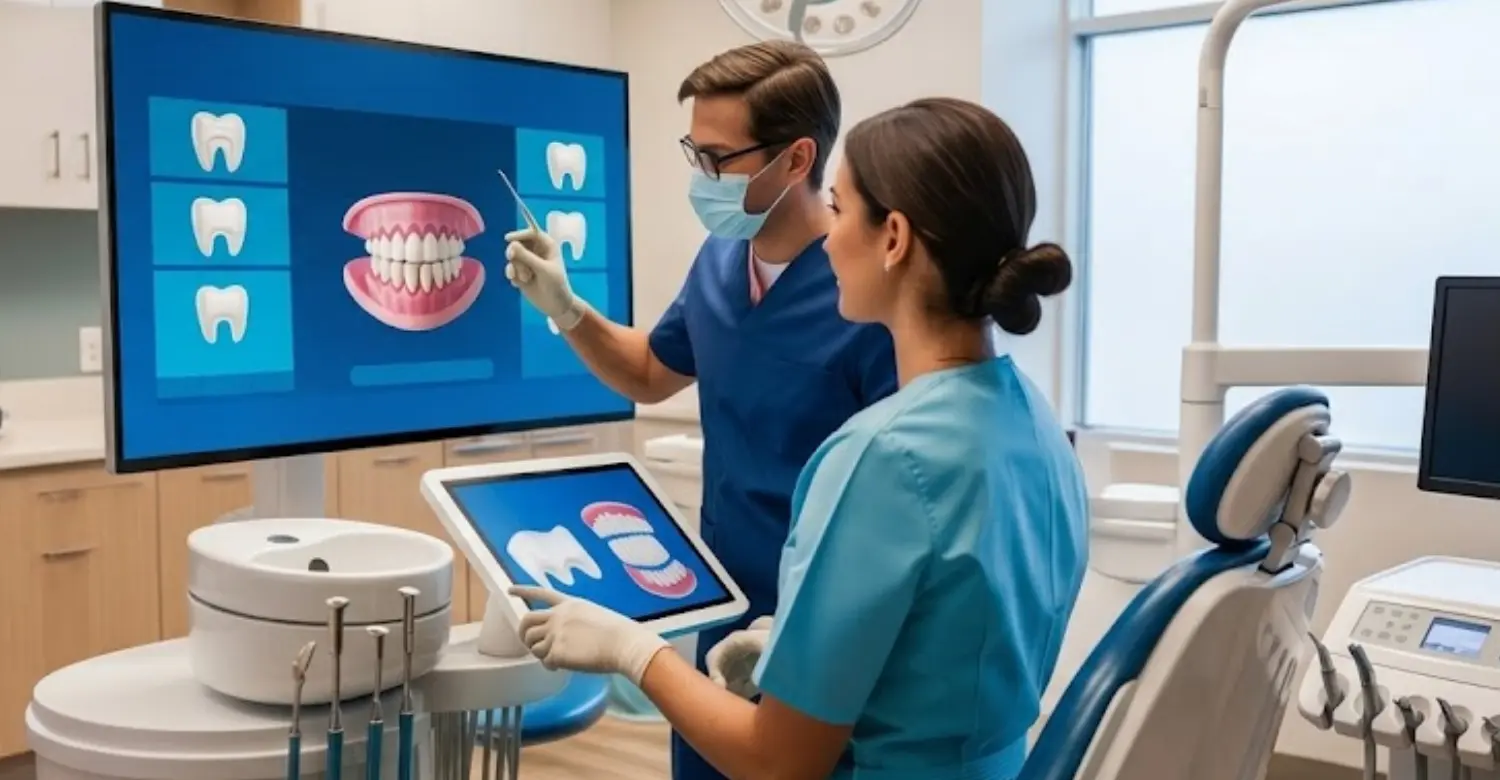
How to Evaluate AI Charting Tools
Evaluation should begin with clinical workflow requirements specific to the practice doing the evaluating. Practices can test sample encounters using realistic terminology drawn from their actual patient population. Security and privacy documentation should also be reviewed carefully before any commitment is made. The ADA's AI standards work supports structured evaluation and validation rather than relying solely on vendor claims about performance.
What We Notice Clinically
Dentists should be able to focus on patients while maintaining documentation quality. The technology should reduce repetitive tasks without creating additional verification burdens that offset the time saved. A reliable workflow combines AI Dental Charting, customization, and dentist oversight into a coherent process. At Vitrin Clinic, modern technology should complement clinical expertise rather than compete with it for the dentist's attention.
Best AI Tools for Dental Charting: What Dentists Should Consider
Dentists should assess accuracy, integration, usability, privacy, customization, and scalability as part of any evaluation. There is no universal best system for every practice. A larger practice may prioritize integration, centralized administration, and specialty-specific workflows across multiple providers. Evaluation should focus on measurable outcomes rather than subjective impressions formed during a brief trial.
Accuracy of AI-Generated Dental Documentation
Accuracy should be tested using realistic dental encounters rather than simplified demonstration scenarios. Generic language tests may not reflect actual clinical performance in a real operation with real patients. Clinicians should record common error types during evaluation. This provides a more meaningful picture than a vendor's general accuracy claim.
Integration With Existing Dental Software
Poor integration can create duplicate entry, undermining much of the time savings a documentation tool is meant to provide. Good integration can reduce unnecessary workflow steps, letting staff focus on higher-value tasks.
Usability for Dentists and Dental Staff
Software should be practical during real appointments, not just impressive during a sales demonstration. Users should not need extensive technical knowledge to operate the system effectively day to day. Staff feedback should be included during evaluation, since front-line users often notice friction that decision-makers miss.
Security, Privacy, and Data Protection
Security should be evaluated before clinical deployment, not treated as an afterthought once a system is already in use. They should also understand whether patient data are used for model training, and under what terms. The WHO emphasizes privacy, transparency, and governance as essential healthcare AI considerations across every application area.
Customization for Different Dental Specialties
Custom templates can support specialty-specific workflows that a generic system might not accommodate well. This improves usability and consistency for practices that treat a wide range of case types. For orthodontic workflows, for example, documentation may involve remote assessment and virtual orthodontic consultations.
Scalability for Growing Dental Practices
Multi-location practices may require centralized administration to keep documentation consistent across sites. Scalability should also include user permissions and workflow management that can grow with the practice.
AI-Assisted Dental Practice Management
Intelligent workflows can potentially connect clinical information with scheduling, patient communication, and administrative processes. The goal is to reduce unnecessary friction between different stages of care, from booking through treatment and follow-up. Not every administrative decision should be delegated to software.
How AI Dental Charting Fits Into Practice Workflows
Documentation begins during the patient encounter and continues through several subsequent stages before it is finalized. Approved information becomes available for future clinical use. This creates a structured documentation cycle that repeats consistently across every patient visit.
Connecting Charting With Scheduling and Patient Management
They may also connect completed documentation with future workflow tasks, such as recall reminders or referral letters. However, integrations should follow appropriate privacy and access controls at every point where data moves between systems.
Reducing Administrative Bottlenecks
Automated drafting may help clinicians complete records sooner, reducing the backlog that can accumulate during busy periods. This can improve information availability for subsequent workflows that depend on a completed record.
Improving Team Productivity
Teams may then focus more attention on patient communication and operational tasks that AI Dental Charting cannot handle. Productivity should be measured rather than assumed, using concrete metrics specific to the practice.
Supporting a More Efficient Patient Journey
Better information flow can reduce repeated questions and delays throughout that journey. Organized records can help teams understand the patient's treatment history without asking the patient to repeat information already on file.
Is AI Dental Charting Accurate?
AI systems can produce useful documentation while still making errors. Errors may involve transcription, terminology, missing context, or incorrect interpretation of what was actually said or meant. The ADA's current standards activity emphasizes validation and independent evaluation for dental AI systems. A safe workflow requires dentists to verify clinically meaningful information before it becomes part of the permanent record.
How Accurate Are AI-Generated Dental Notes?
Performance can change with background noise, speakers, accents, terminology, and conversation complexity from one appointment to the next. Dental practices should conduct their own validation rather than relying entirely on a vendor's published accuracy figures.
Common Sources of AI Documentation Errors
Common problems can include misheard words, omitted information, incorrect terminology, and contextual misunderstandings. Errors may also occur when multiple people speak simultaneously.
Why Dentist Review Is Still Essential
Dentists understand the patient's clinical context in a way that software cannot fully replicate. They can identify errors that software cannot reliably detect.
How Dental Professionals Can Verify AI-Generated Records
Verification should focus on clinically significant information rather than attempting to check every word of a generated note. Dentists should check patient identifiers, findings, diagnoses, procedures, measurements, medications, and treatment plans as a priority. When documenting implant procedures, this can include the number of implants placed during a single session and the clinical factors affecting that decision, as discussed in our guide to how many implants can be placed in a single session.
Clinical Note
The final note should reflect professional judgment, not simply the output of an automated system. AI-generated language should never be treated as automatically authoritative.
AI Dental Charting, Patient Privacy, and Data Security
Dental records contain sensitive health information that requires careful handling at every stage of processing. AI systems can introduce additional data-processing considerations beyond those of traditional record-keeping software. They should also understand who can access generated records, and under what circumstances that access is granted. The WHO specifically emphasizes privacy, confidentiality, consent, transparency, and governance for healthcare AI of every type.
How AI Systems Handle Dental Patient Information
Different systems process data differently, and understanding those differences matters for compliance and trust. Some may process information locally, keeping data within the practice's own systems. Practices should review provider documentation before implementation to understand exactly how their data will be handled.
Data Security Considerations for Dental Practices
Important considerations include encryption, authentication, access controls, retention, backups, and vendor policies.
Access Controls and Patient Record Protection
Only authorized personnel should access clinical records, regardless of how convenient broader access might seem. Role-based permissions can help limit unnecessary access to information staff do not need for their specific role.
Questions Dentists Should Ask AI Software Providers
Dentists should ask where patient data is processed. They should ask whether data are retained and whether they are used for model training beyond the individual practice. Privacy documentation should be reviewed before deployment, not treated as a formality to sign off on quickly.
Tips for Patients: What AI Dental Charting Means for Your Care
AI Dental Charting does not mean that a machine is treating the patient. Patients may notice that documentation becomes faster or more structured, particularly during history-taking. They may also benefit from better-organized records that make it easier for their dentist to reference past visits. Questions about privacy, consent, and record access are reasonable, and a good practice should be prepared to answer them clearly. The WHO emphasizes patient control, privacy, confidentiality, and transparency when AI processes health information of any kind.
Does AI Change How a Dentist Diagnoses a Patient?
It does not automatically replace clinical examination, imaging review, or professional judgment. The dentist interprets symptoms, findings, images, history, and other relevant information as part of reaching a diagnosis.
Can Patients Request Access to Their Dental Records?
Patients' access rights depend on applicable laws and the practice's jurisdiction. Practices should provide information about their record-access procedures so patients know what to expect.
Why Dentist Oversight Still Matters
AI can misunderstand clinical language, particularly language that is ambiguous or highly context-dependent. Dentists can identify errors and correct generated documentation before it becomes part of the permanent record.
How Organized Digital Records Can Support Continuity of Care
Organized records can help clinicians understand previous treatment quickly, even years after it occurred. This can be especially useful when treatment involves multiple appointments spread across an extended period. For example, accurate records can help track dental implant surgery, healing, and follow-up, including questions about pain and recovery after dental implant surgery.
AI Dental Charting vs. Manual Dental Documentation
Manual documentation gives clinicians direct control over every entry, with no intermediate drafting step. However, it can require significant time, particularly for complex appointments involving multiple findings and procedures. The key difference is how information moves from clinical encounter to final record, not whether professional responsibility applies. Neither approach eliminates the need for professional responsibility.
Speed and Efficiency
Automated drafting can reduce repetitive typing that would otherwise consume time after each appointment. The actual time benefit depends on workflow and system performance, and can vary considerably between practices.
Documentation Consistency
Templates can encourage consistent documentation across providers and appointment types. This can make records easier to interpret, particularly for anyone reviewing a chart who was not present at the original visit.
Administrative Workload
AI Dental Charting may reduce repetitive transcription and formatting tasks across the entire documentation workflow. Staff can potentially redirect time toward other responsibilities that require more direct patient interaction.
Human Oversight
Human review remains essential regardless of which documentation approach a practice uses. Dentists must approve the final clinical record, whether it was written manually or generated automatically.
Patient Record Organization
Structured documentation can improve information retrieval across a patient's full treatment history. This can support continuity across appointments, even when different providers are involved over time.
The Future of AI-Powered Dental Documentation
Dental documentation is likely to become increasingly connected with broader digital workflows across the entire practice. Future systems may combine text, voice, imaging, structured measurements, and patient history into a single integrated record. The ADA is already developing standards addressing AI validation and dental image analysis. However, technological progress must remain aligned with safety and clinical accountability at every stage of that evolution.
Predictive Analytics and Dental Records
Predictive systems may eventually identify patterns within longitudinal dental data collected across many years of care. Such applications require careful validation before they are used to inform clinical decisions in any meaningful way. Predictions should support professional decisions rather than replace them.
More Personalized Clinical Workflows
Future platforms may adapt documentation templates according to specialty and appointment type automatically. This could make systems more efficient by reducing the manual customization currently required in many practices.
AI and Multimodal Dental Data
Multimodal AI can process different types of information within a single system. These may include text, images, and structured clinical data gathered from various points in a patient's care. The WHO's recent guidance recognizes the growing relevance of large multimodal models in healthcare.
The Growing Role of Machine Learning in Dentistry
Machine learning may increasingly support documentation, imaging, workflow analysis, and clinical research across the field. Reliable implementation will require strong datasets and appropriate validation at every stage of development and deployment.
How Vitrin Clinic Approaches Modern Dental Technology
Vitrin Clinic can incorporate modern digital workflows while keeping clinical expertise central to every decision. Technology should support communication, documentation, and treatment organization throughout a patient's course of care. It should not replace dentist-led assessment, regardless of how advanced a given system becomes. A responsible technology strategy focuses on practical patient benefits rather than novelty for its own sake. The clinic's approach should therefore emphasize accuracy, review, privacy, and patient-centered care as guiding principles.
Combining Digital Dentistry With Dentist-Led Care
Digital tools can improve information management across every stage of a patient's treatment. Dentists remain responsible for interpretation and treatment decisions. This balance supports responsible technology adoption that benefits patients without sacrificing clinical accountability.
Why Accurate Clinical Documentation Matters at Vitrin Clinic
Accurate documentation supports continuity throughout treatment, particularly for patients receiving care over an extended period. It can help clinicians review previous decisions and current findings side by side. Clear records also support communication across the dental team. This is especially important for patients considering complex treatments such as dental bridges versus implants, where several clinical and financial factors may need to be documented.
Dr. Rifat Alsaman's Approach to Technology and Clinical Decision-Making
Dr. Rifat Alsaman's approach can emphasize technology as clinical support rather than clinical authority. The dentist should remain responsible for reviewing information generated by any automated system. Digital tools should make care more organized rather than less personal for the patient.
Why Choose Vitrin Clinic for Modern Dental Care?
Choosing a dental clinic involves more than technology, however capable that technology may be. Patients should consider clinical experience, treatment planning, communication, technology, and follow-up as a complete picture. Vitrin Clinic combines modern dental workflows with dentist-led treatment planning at every stage of care. Technology can support organization while professionals remain responsible for care from the first visit to the last.
Experienced Dental Professionals
Experienced clinicians bring professional judgment to complex treatment decisions that no software can replicate. Technology cannot replace that expertise, regardless of how sophisticated documentation tools become over time.
Patient-Centered Treatment Planning
Treatment should reflect individual clinical needs rather than a one-size-fits-all approach. Digital tools can support information organization during planning, but the plan itself remains a clinical judgment. This can include restorative choices such as the difference between dental crown treatment and its associated costs.
Modern Dental Technology and Digital Workflows
Digital workflows can improve communication and record organization across the entire practice. The technology should serve clinical goals rather than becoming an end in itself.
Comprehensive Care From Consultation to Follow-Up
Consistent documentation can support continuity across treatment stages, from the first consultation through final follow-up. Organized records help teams understand previous appointments without requiring patients to repeat their history at every visit.
Conclusion
AI is transforming dental documentation by enabling faster notes, organized records, and efficient workflows. AI Dental Charting supports dentists without replacing clinical judgment. Responsible adoption requires accuracy, privacy, transparency, validation, and human oversight. Practices like Vitrin Clinic can use AI as a support tool while dentists remain responsible for clinical decisions and patient care.
Reference
FAQs
Dr. Rifat Alsaman has more than 5 years of clinical experience in dentistry and currently serves as the Head of the Medical Team at Vitrin Clinic. He is dedicated to providing exceptional patient care, overseeing treatment planning, and ensuring the highest clinical standards across the team. His expertise, attention to detail, and commitment to continuous professional development have helped countless patients achieve healthier, more confident smiles.


