Dental Crowns
September 24, 2026
Dental Implants vs Crowns: What Is the Difference and Which Option May Be Right for You?
 Dr. Rifat Alsaman
Dental Implants vs Crowns are often compared by patients with damaged or missing teeth. However, these two treatments solve different dental problems. A crown restores a tooth that still has enough healthy structure. An implant replaces the root of a missing tooth, and a crown can then restore the visible part. The appropriate treatment depends on tooth structure, root health, gum condition, bone volume, bite, and goals. Clinical examination should therefore come before comparing prices or treatment times. Your dentist may recommend preserving a natural tooth when it remains predictably restorable. Research also shows that modern tooth-supported crowns can achieve high five-year survival rates. A 2026 systematic review reported five-year survival above 96% for several zirconia and lithium-disilicate designs. Understanding Dental Implants vs Crowns begins with asking whether your tooth is still restorable. At Vitrin Clinic, treatment planning considers clinical findings before selecting restorative or implant treatment.
What Is the Difference Between a Dental Implant and a Dental Crown?
A dental crown and an implant have different roles in restorative dentistry. A crown covers and reinforces an existing tooth or attaches to an implant abutment. It does not replace a missing natural root. A dental implant is placed into the jawbone after tooth loss or extraction. It can support a crown, bridge, or larger restoration. This distinction matters because patients sometimes compare two treatments that address different problems. A damaged natural tooth may need restoration, while a missing tooth needs replacement. The debate around Dental Implants vs Crowns often fades once this difference becomes clear. The final recommendation depends on whether the natural tooth can be predictably maintained. Your dentist will explain which category your situation falls into after examination.
What Is a Dental Crown?
A dental crown is a custom-made restoration that covers most of a prepared tooth. Dentists may recommend crowns for severely damaged, weakened, fractured, or heavily restored teeth. Crowns can also protect teeth after certain root canal treatments. The dentist first evaluates remaining tooth structure, root health, gum tissues, and bite. Different materials can be used, including zirconia, lithium disilicate, porcelain, and metal-based systems. The material depends on tooth location, functional demands, aesthetics, and available tooth structure. Modern evidence shows strong survival for several ceramic crown materials. A 2026 systematic review found five-year survival above 96% for several zirconia and lithium-disilicate designs. A well-planned crown can therefore help a weakened tooth function for many years.
What Is a Dental Implant?
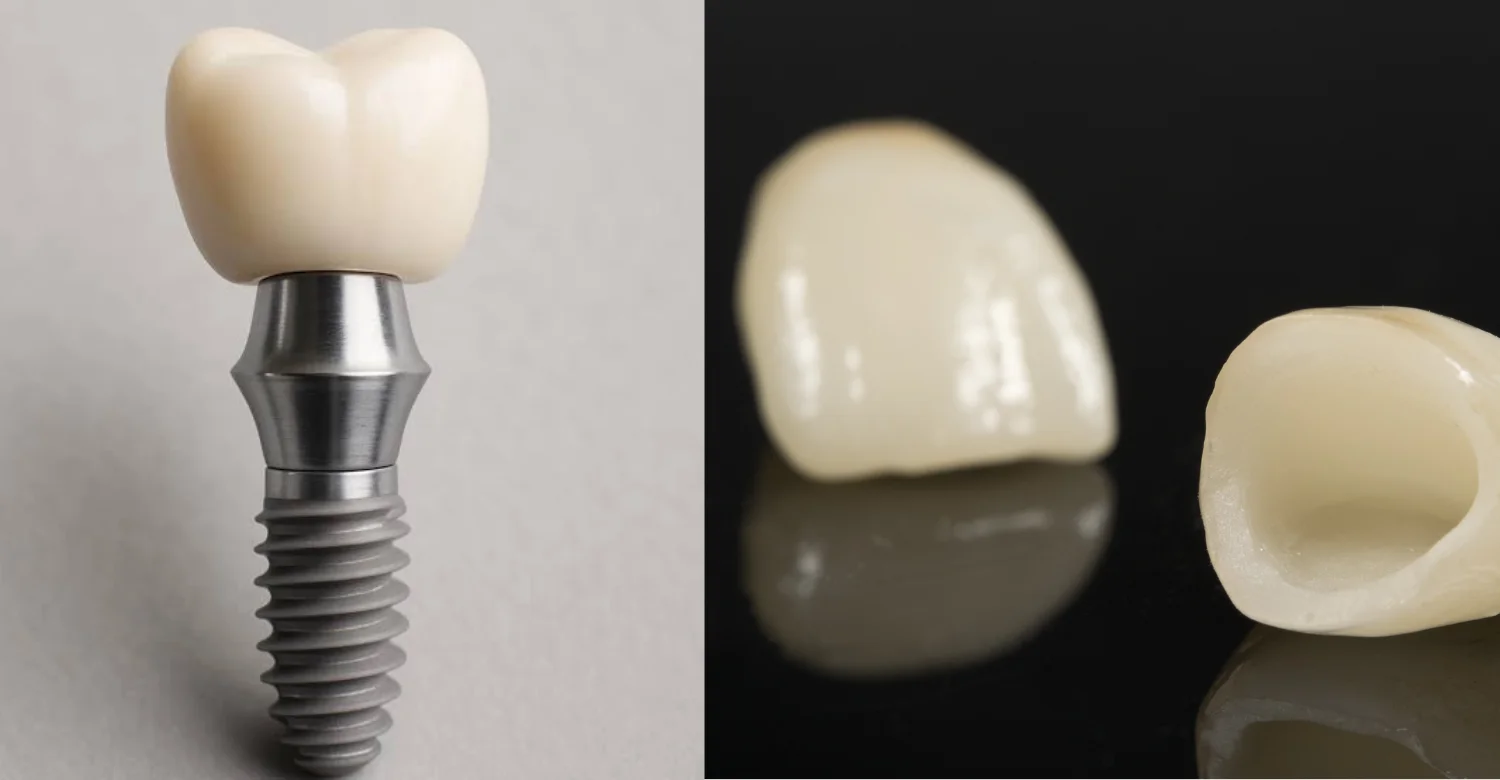
A dental implant is a biocompatible fixture placed inside the jawbone. It replaces the root portion of a missing tooth. After healing, an abutment connects the implant with the final crown. Implant treatment therefore involves several components rather than one restoration. Planning may include dental imaging, bone assessment, bite evaluation, and examination of surrounding tissues. The implant needs suitable biological and mechanical conditions for predictable treatment. Healing allows osseointegration between the implant surface and surrounding bone. An implant does not recreate a natural periodontal ligament. Its biomechanics therefore differ from those of a natural tooth. This difference influences how bite forces are distributed and how the restoration is designed.
What Is an Implant-Supported Crown?
An implant-supported crown replaces the visible portion of one missing tooth. The implant acts as the artificial root, and the abutment connects it to the crown. This approach can replace one missing tooth without preparing adjacent healthy teeth. The restoration can be made from zirconia or other suitable ceramic systems. Treatment planning considers implant position, bone anatomy, gum contours, bite, and aesthetic requirements. For front teeth, soft-tissue planning can be especially important. Many discussions of Dental Implants vs Crowns overlook that implants usually receive crowns too. In that sense, the two treatments often work together rather than compete.
Can a Dental Crown Replace a Missing Tooth?
A conventional crown cannot replace a missing tooth by itself. A crown needs a supporting structure beneath it. That support may be a natural tooth, an implant abutment, or another suitable dental structure. When one tooth is missing, options may include an implant-supported crown or a dental bridge. A removable partial denture can also be considered in selected cases. The appropriate solution depends on oral health, bone conditions, adjacent teeth, treatment goals, and budget. Your dentist can explain the advantages and limitations of each option for your mouth.
Why an Implant and a Crown Are Not Direct Alternatives
An implant and a crown are not interchangeable treatments. A crown usually restores a tooth that remains present. An implant replaces the missing root of a tooth. An implant often receives a crown afterward, so an implant-supported crown combines both components. This distinction helps patients understand treatment quotations more clearly. A quote for a crown may cover only the restoration. An implant quote may include surgery, implant placement, abutment, and final crown. Comparing these two quotes directly can therefore be misleading. Always request an itemized treatment plan before comparing prices.
Explore the process of chewing step by step
Dental Implants vs Crowns: How Do They Compare?
The comparison depends primarily on whether the natural tooth remains restorable. A crown preserves the natural root when the tooth can be treated successfully. An implant replaces a missing or non-restorable tooth. Treatment planning should therefore begin with tooth restorability rather than price. When patients weigh Dental Implants vs Crowns, they should consider procedure, time, appearance, maintenance, and cost. The following sections explain how each treatment performs across these practical areas. Each factor may carry different importance depending on your oral health and personal priorities.
How Each Treatment Works
A crown is cemented or bonded over a prepared natural tooth. An implant is surgically positioned inside the jawbone. After healing, it supports a restoration such as a crown. Crowns can usually be completed faster because implants require biological healing. However, treatment timelines vary considerably between patients. Additional procedures can extend implant treatment. These may include extraction, bone grafting, or temporary restorations. Understanding these mechanics helps patients set realistic expectations before treatment begins.
Tooth Preservation vs Tooth Replacement
Crowns preserve the remaining natural tooth structure and root. Implants replace a missing tooth and its root component. Preserving a restorable natural tooth can avoid extraction and implant surgery. However, some teeth are too damaged for predictable restoration. Fractures, insufficient structure, severe decay, or poor periodontal support can influence restorability. In the context of Dental Implants vs Crowns, preservation versus replacement is the central decision. That decision should be based on clinical findings rather than treatment popularity.
Procedure and Treatment Time
Crown treatment generally involves examination, preparation, scanning or impressions, fabrication, and placement. It is often completed within a few visits. Implant treatment involves planning, possible extraction, implant placement, healing, and restoration. Some implant cases can follow immediate or accelerated protocols. These approaches require suitable clinical conditions, including adequate bone and stability. Healing remains an important factor in many implant cases. A dentist should provide a personalized timeline for each patient. One universal treatment duration should not be promised to everyone.
Appearance and Function
Both treatments can provide natural-looking results when appropriately planned. Crowns can reproduce tooth shape, color, translucency, and surface anatomy. Implant-supported crowns can restore appearance and chewing function after tooth loss. Front-tooth implant treatment requires careful attention to gum contours. The final aesthetic result depends on the restoration, surrounding tissues, tooth position, and laboratory work. Functionally, both options can allow comfortable chewing when the bite is properly adjusted. Patients should discuss their aesthetic expectations early during planning.
Maintenance and Oral Hygiene
Natural teeth with crowns require regular brushing, interdental cleaning, and professional dental care. Implants also require meticulous oral hygiene. Patients should clean around implant-supported restorations according to professional instructions. Plaque accumulation can affect both natural teeth and implant-associated tissues. Crowned teeth can still develop decay where the crown meets the tooth. Implants cannot decay, but surrounding tissues can become inflamed. Maintenance should therefore be considered before treatment begins, not only afterward.
Impact on the Surrounding Teeth
A crown normally restores one existing tooth without affecting its neighbors. A traditional bridge usually requires preparation of supporting neighboring teeth. An implant-supported crown can avoid preparing adjacent healthy teeth. However, implant placement requires adequate anatomy and careful surgical planning. The condition of neighboring teeth also affects treatment selection. If adjacent teeth already need crowns, a bridge may become more reasonable. Your dentist will consider the whole dental arch, not only the affected tooth.
Initial Cost and Long-Term Considerations
Initial prices differ significantly between crowns and implants. Implant treatment usually includes more components and clinical stages. Crowns can have lower initial costs when a natural tooth remains restorable. Long-term costs may include maintenance, replacement, repairs, or additional procedures. Patients comparing Dental Implants vs Crowns should look beyond the first invoice. A meaningful comparison considers the complete treatment pathway over many years. Ask your dentist which future costs are realistic in your situation.
When a Crown May Be Used to Preserve a Natural Tooth
A crown may be considered when sufficient tooth structure remains. The root should also have acceptable periodontal and endodontic conditions. The tooth must have a reasonable restorative prognosis. The dentist may first treat decay, infection, fracture, or problems with previous restorations. Preserving the tooth can avoid extraction when predictable restoration remains possible. A natural tooth keeps its periodontal ligament and sensory feedback. These biological features are one reason preservation is often discussed first.
When an Implant May Be Considered for a Missing or Non-Restorable Tooth
An implant may be considered after tooth loss or when a tooth cannot be predictably restored. Bone volume and quality must be assessed first. Gum health and bite also influence planning. Additional procedures, such as grafting, may sometimes be required. The final restoration is usually an implant-supported crown for a single missing tooth. Implants can also support bridges or dentures when several teeth are missing. Suitability is confirmed only after examination and appropriate imaging.
Learn how thumb sucking can affect teeth
Is a Crown or Implant Better for a Damaged Tooth?
There is no universal answer because damaged teeth differ considerably. The key question is whether the natural tooth remains predictably restorable. Two damaged teeth may look similar yet have very different prognoses. One may have healthy roots, while another has a hidden fracture. For damaged teeth, Dental Implants vs Crowns is really a question of restorability. The sections below explain how dentists assess this.
When a Natural Tooth May Still Be Restored
A damaged tooth may remain suitable for restoration when enough sound structure exists. The dentist evaluates remaining walls, root, periodontal support, and fracture pattern. Decay must also be assessed carefully. Root canal treatment may be required when the pulp is irreversibly damaged. A crown can then provide cuspal or full-coverage protection when indicated. The treatment objective is to preserve function while protecting remaining tooth structure. Some teeth that seem badly broken can still be restored successfully.
How Tooth Structure and Root Health Affect Treatment Choice
Tooth structure provides the foundation for a crown. Insufficient structure can reduce retention and increase mechanical risks. Root health also matters significantly. A tooth with severe root fracture may have limited restorative options. Periodontal support should also be evaluated carefully. A tooth with inadequate bone support may require a different treatment pathway. Dentists often assess how much healthy teeth remain above the gumline. This remaining collar of structure can strongly influence long-term crown stability.
When Extraction and Implant Replacement May Be Considered
Extraction may be considered when a tooth cannot be predictably restored. Examples can include certain vertical root fractures or extensive structural destruction. The decision should follow a complete clinical assessment. After extraction, implant placement may be considered when appropriate. Bone preservation and soft-tissue management can influence future implant planning. Sometimes the dentist may place the implant immediately after extraction. In other cases, a healing period is recommended first.
Why Saving a Restorable Natural Tooth May Be Discussed First
A restorable natural tooth can provide biological and functional advantages. Preservation avoids extraction when predictable treatment remains possible. The natural periodontal ligament also provides sensory feedback during chewing. However, preservation is not appropriate when prognosis is poor. Repeated treatment on a failing tooth may cost more over time. Treatment planning should balance tooth preservation with long-term predictability. An honest discussion of prognosis helps patients make informed decisions.
What Happens When a Tooth Is Too Damaged for a Crown?
A severely damaged tooth may require extraction. The dentist may then discuss replacement options. These can include an implant-supported crown, a dental bridge, or a removable prosthesis. The choice depends on anatomy, neighboring teeth, bone, gum health, and patient preferences. Timing also matters because bone can change after tooth loss. Discussing replacement early can help preserve future treatment options.
Clinical Note
A clinical examination should determine whether restoration or replacement is appropriate. Visual appearance alone cannot reveal hidden fractures, root problems, or bone loss. Examination combined with imaging gives a clearer picture of the tooth's condition.
Dr. Rifat Alsaman, Head of the Medical Team at Vitrin Clinic and cosmetic dentist, on evaluating whether a tooth can be preserved
Dr. Rifat Alsaman emphasizes assessing the remaining tooth structure before selecting a treatment pathway. The examination should consider tooth integrity, root condition, gum health, bite, and restorative feasibility. Preserving a natural tooth may be discussed when its condition supports predictable restoration. When preservation is not feasible, replacement options can then be evaluated. This step-by-step approach helps patients understand why a particular recommendation is made.
Discover what can cause a tight jaw
Crown vs Implant: Which Lasts Longer?
Longevity depends on the restoration, patient, oral environment, and maintenance. A crown does not have one universal lifespan. An implant also does not guarantee a permanent restoration without maintenance. Importantly, implant survival and crown survival measure different outcomes. Longevity questions about Dental Implants vs Crowns therefore need careful interpretation. The following sections explain what research and clinical experience suggest.
How Long Can a Natural-Tooth Crown Last?
Crown longevity varies with material, tooth location, preparation, cementation, oral hygiene, and bite forces. A systematic review reported strong five-year survival for several modern ceramic crown systems. Older systematic reviews also showed high five-year survival for metal-ceramic and all-ceramic crowns. Root-treated teeth restored with crowns have also shown meaningful long-term survival. One systematic review reported an 81% ten-year survival rate for crowned root-treated teeth. Individual results still depend on the tooth and the patient.
How Long Can an Implant-Supported Crown Last?
Implant treatment involves two separate survival questions. The first concerns the implant fixture in the bone. The second concerns the prosthetic crown above the gum. The implant may remain functional while the crown eventually requires repair or replacement. Fracture, wear, loss of retention, and aesthetic changes can affect the restoration. Patients should not interpret implant survival as permanent crown survival. Regular checkups help detect both types of problems early.
Why Implant Survival and Crown Survival Are Different Measurements
An implant is the supporting fixture inside the bone. The crown is the visible restoration above the gum. Each component can experience different complications. An implant can remain stable while its crown develops technical problems. Conversely, a crown can remain intact while biological problems affect the supporting tissues. Clinical studies therefore report these outcomes separately. When reading statistics, patients should check which component the numbers describe.
Factors That Influence Long-Term Success
Long-term outcomes depend on multiple patient and treatment factors. Oral hygiene, gum health, bite forces, smoking, bone conditions, and maintenance all matter. Material selection also influences technical performance. Treatment planning should account for individual risk factors. Many of these factors are partly within the patient's control.
Oral Hygiene and Gum Health
Plaque control is important for both crowns and implants. Inflammation around natural teeth can contribute to periodontal problems. Inflammation around implants can affect peri-implant tissues. Daily brushing and interdental cleaning are therefore essential. Professional maintenance can help identify problems earlier. Good habits built before treatment often continue to protect the result afterward.
Smoking and Lifestyle Factors
Smoking can negatively affect periodontal and implant-related outcomes. It may reduce blood flow and slow tissue healing. Patients should discuss smoking habits openly with their dentist. Other lifestyle factors, such as diet and stress, can also influence oral health. Personalized advice is more appropriate than assuming identical risk for every patient.
Bite Forces and Bruxism
Excessive bite forces can stress crowns and implant restorations. Bruxism, meaning grinding or clenching, may increase mechanical loading. Many people grind at night without realizing it. Patients who grind their teeth should mention this before restorative treatment. A dentist may recommend a night guard or other protective strategies based on individual findings.
Bone and Soft-Tissue Health
Implants require suitable bone and soft-tissue conditions. Bone volume can influence implant position and stability. Soft-tissue contours also affect aesthetics and cleaning access. Bone grafting or other procedures may be considered when clinically indicated. For crowned teeth, healthy supporting bones also contribute to long-term stability.
Regular Dental Maintenance
Regular examinations help monitor restorations and supporting tissues. Dentists can assess margins, bite, gum health, and implant stability. Professional cleaning may also support long-term oral health. Maintenance should continue after treatment rather than ending when the restoration is placed. Your dentist can recommend a suitable recall interval.
What Does Research Say About Implant-Supported Crown Survival?
Research generally demonstrates high survival for implant-supported restorations. However, survival varies according to implant system, restoration design, patient factors, and follow-up duration. Recent research also highlights differences between tooth-supported and implant-supported ceramic restorations. Patients should therefore avoid relying on one universal percentage. The relevant evidence should match the restoration type and clinical situation. Research on Dental Implants vs Crowns is most useful when discussed with your own dentist.
Read more about tingling of the mouth
Dental Crown vs Implant for a Front Tooth
Front teeth have important aesthetic and functional requirements. Treatment planning must consider both the restoration and surrounding soft tissues. Small differences in shape, color, or gum level can be noticeable when smiling. For front teeth, Dental Implants vs Crowns decisions carry extra aesthetic weight.
When Is a Crown Appropriate for a Front Tooth?
A crown may be appropriate when a front tooth remains structurally restorable. The dentist assesses tooth structure, root health, color, gum position, and bite. Ceramic materials can provide natural optical properties. The preparation should preserve appropriate tooth structure whenever possible. In some cases, a veneer or bonding may be more conservative than a full crown.
When Is an Implant Considered for a Missing Front Tooth?
An implant may be considered when a front tooth is missing or non-restorable. Implant placement requires careful three-dimensional planning. Bone and gum contours are especially important in the aesthetic zone. The restoration must harmonize with neighboring teeth. A temporary restoration is often used to shape the gums during healing.
Aesthetic Considerations for Front Teeth
Anterior restorations must match neighboring teeth in shape and shade. Translucency, surface texture, and gingival symmetry can influence the final appearance. Digital planning can help communicate aesthetic goals before treatment. The laboratory and clinician must work together closely. Photographs and shade matching may be used to guide the ceramist.
Gum Contour and Soft-Tissue Considerations
Gum contours strongly influence the appearance of an anterior implant. Thin or deficient tissues can create aesthetic challenges. Implant position also affects the emergence profile of the restoration. Careful planning can help manage these factors. Soft-tissue grafting is sometimes considered to improve gum thickness.
Why Front-Tooth Implant Planning Requires Careful Evaluation
The anterior region can reveal small discrepancies in tooth position. Implant placement should therefore consider bone anatomy and gingival architecture. CBCT can provide three-dimensional information when clinically appropriate. Digital scanning can support restoration planning. Guided surgery may help transfer the digital plan accurately to the mouth.
Can a Root-Treated Front Tooth Receive a Crown?
A root-treated front tooth can sometimes receive a crown. The tooth must have adequate remaining structure and acceptable root conditions. The restoration should protect the tooth from functional stresses. Front teeth receive less chewing force than back teeth, which may allow conservative options. Clinical examination determines whether a crown or another restoration is appropriate.
Explore the connection between tinnitus and teeth
Implant-Supported Crown vs Bridge: What Is the Difference?
Both options can replace a missing tooth. However, they use different supporting structures. Many patients researching Dental Implants vs Crowns eventually compare implants with bridges as well. Understanding both helps clarify the full range of choices.
How an Implant-Supported Crown Replaces One Missing Tooth
An implant-supported crown uses an implant as the artificial root. It does not require neighboring teeth to support the restoration. The implant is placed in the jawbone. After appropriate healing, the final crown is connected. The result stands independently, much like a natural tooth.
How a Traditional Dental Bridge Replaces a Missing Tooth
A traditional bridge uses neighboring teeth as supports. The replacement tooth is connected to crowns placed on those supporting teeth. This approach can avoid implant surgery. However, preparation of supporting teeth is usually required. Bridges can often be completed in a shorter timeframe than implants.
Implant-Supported Crown vs Bridge: Tooth Preparation
An implant-supported crown usually does not require preparation of adjacent healthy teeth. A traditional bridge generally requires preparation of the abutment teeth. Preparation permanently removes some enamel and dentin. The condition of neighboring teeth can therefore influence the decision.
Implant-Supported Crown vs Bridge: Maintenance
Both restorations require regular cleaning. Bridges require cleaning beneath the replacement tooth using threaders or special floss. Implants require cleaning around the implant-supported crown. Patients should receive individualized hygiene instructions. Supporting teeth under a bridge also remain vulnerable to decay.
Implant-Supported Crown vs Bridge: Cost Considerations
Bridge treatment may have a lower initial cost. Implant treatment may require more stages and components. However, price comparisons should consider the complete treatment pathway. Additional procedures can increase implant costs. Future repairs or replacements should also be considered for both options.
When a Dentist May Discuss Each Option
The dentist may discuss implants when adjacent teeth are healthy. A bridge may be considered when neighboring teeth already require crowns. Bone conditions, treatment time, cost, and patient preferences also matter. Medical factors may occasionally make surgery less suitable. The dentist should explain why one option is recommended over another.
Learn about tongue function and oral health
What Is the Cost of Dental Implants vs Crowns?
Treatment prices vary substantially by country and clinical complexity. An implant is generally more expensive because it involves multiple components. A crown on a natural tooth usually involves fewer treatment stages. Price comparisons of Dental Implants vs Crowns are only meaningful when quotes cover similar work. The sections below explain what typically affects the final amount.
Dental Implant vs Crown Cost: What Does Each Price Include?
A crown quote may include preparation, laboratory fabrication, and placement. An implant quote may include surgery, implant fixture, abutment, and crown. Some quotes exclude extraction or bone grafting. Others exclude imaging or temporary teeth. Always request an itemized estimate before making comparisons.
Why Implant Quotes Can Be Higher Than Crown Quotes
Implants require surgical placement and biological healing. They may also require additional imaging or preparatory procedures. The final restoration adds another laboratory component. These factors increase the number of treatment stages. Each stage involves clinical time, materials, and professional expertise.
Costs of the Implant, Abutment, Crown, and Additional Procedures
A complete implant restoration can involve:
Implant fixture
Surgical placement
Abutment
Temporary restoration
Final crown
Imaging
Follow-up
Possible extraction
Possible bone augmentation
The exact combination depends on the individual case. Your dentist can explain which items apply to your treatment.
What Can Increase the Total Treatment Cost?
Additional procedures can substantially change the final quote. These procedures depend on your anatomy and dental history. Knowing them in advance helps avoid surprises.
Tooth Extraction
Extraction may be required before implant placement. Complex extraction can increase treatment time and cost. Surgical extraction may be needed for broken or deeply positioned roots.
Bone Grafting
Bone grafting may be considered when available bone is insufficient. The type and amount of grafting affect cost. Grafting may also add healing time before implant placement.
Sinus Augmentation When Applicable
Posterior upper-jaw implants may sometimes require sinus augmentation. This depends on bone height and implant position. The procedure adds bone beneath the sinus floor to support the implant.
Temporary Restorations
Temporary teeth may be required during healing. The type and duration of temporary restoration influence the overall cost. Front-tooth cases often need temporaries for appearance.
Diagnostic Imaging and Follow-Up
Imaging can be required for diagnosis and implant planning. CBCT may be indicated when three-dimensional information is necessary. Follow-up appointments should also be included in cost planning.
Discover how tongue thrust can affect oral development
How Much Do Dental Implants vs Crowns Cost in the USA, UK, and Turkey?
International prices vary by city, clinic, material, implant system, and included services. The following figures are broad estimates, not fixed treatment quotes. Cross-border comparisons of Dental Implants vs Crowns should always check what is included. Exchange rates can also change relative costs over time.
Average Dental Implant Cost in the USA
A complete single implant with a crown can commonly cost several thousand dollars. The final amount depends on surgery, implant system, restoration, and additional procedures. Current pricing can vary considerably between providers and regions. Specialist fees may also differ from general dental practice fees.
Average Dental Crown Cost in the USA
Private crown prices commonly vary according to material and location. Premium ceramic restorations can cost more than basic options. Laboratory quality and clinical complexity also influence pricing. Dental insurance may cover part of the cost, depending on the plan.
Average Dental Implant Cost in the UK
Private implant treatment can vary significantly across UK practices. The quote may separate implant surgery from the final restoration. Patients should confirm whether consultation, imaging, abutment, and crown are included. Prices in London may differ from those in other regions.
Average Dental Crown Cost in the UK
Private crowns commonly range from several hundred pounds upward. Material selection can substantially affect the final price. Anterior aesthetic crowns may have different laboratory requirements. NHS and private pathways also differ in materials and costs.
Average Dental Implant Cost in Turkey
Turkey offers a broad range of implant treatment prices. Current September 2026 international treatment data lists implant-with-crown offers from approximately $612 in Turkey. This does not mean every clinic or patient will receive that price. Clinical complexity, implant brand, crown material, and included services matter.
Average Dental Crown Cost in Turkey
Single crowns can cost substantially less than implants. Zirconia crowns are commonly priced according to material, laboratory, and clinic. Vitrin Clinic provides treatment planning based on clinical assessment rather than a universal online price. This helps ensure the quote reflects your actual needs.
Dental Implants vs Crowns Cost Comparison: USA vs UK vs Turkey
Country | Single dental implant | Single dental crown |
USA | Approximately $3,000–$6,000 complete, including implant, abutment and crown | Approximately $1,000–$1,800 |
UK | Approximately $1,800–$3,500 complete | Approximately $450–$1,000 privately |
Turkey | Approximately $500–$1,800 including implant and crown | Approximately $120–$300 for zirconia; material and clinic affect the price |
These figures are approximate and can change by clinic and treatment complexity. For Turkey, current international pricing data shows implant-with-crown offers beginning around $612. Patients should compare exactly what each quotation includes. This table on Dental Implants vs Crowns is a starting point, not a final quote.
Find out how tongue thrust can contribute to an open bite
Dental Implants vs Crowns in Turkey
Turkey is frequently considered by international patients seeking restorative and implant treatment. However, treatment quality should be assessed separately from price. Travel, recovery time, and follow-up care also need planning. Choosing between Dental Implants vs Crowns abroad requires the same clinical logic as at home.
Why Patients Search for Dental Implants vs Crowns in Turkey
International patients often compare treatment costs across countries. Turkey offers a wide range of dental clinics and treatment packages. Patients should evaluate clinical credentials, materials, diagnostics, laboratory work, and aftercare. Istanbul in particular hosts many clinics serving international patients.
Dental Implants vs Crowns Istanbul: What Should Patients Compare?
Patients should compare treatment scope rather than headline prices. Important factors include implant brand, crown material, diagnostics, laboratory standards, and follow-up. Travel arrangements should also be considered. When reviewing Dental Implants vs Crowns offers in Istanbul, ask every clinic identical questions. This makes quotes easier to compare fairly.
What Should Be Included in a Turkey Dental Treatment Quote?
Ask whether the quote includes:
Consultation
Imaging
Extraction
Implant fixture
Abutment
Temporary restoration
Final crown
Follow-up
Aftercare
Clarifying these items prevents unexpected costs. It also shows how transparent the clinic is about its treatment planning.
Comparing Materials, Implant Systems, and Laboratory Work
Implant systems differ by manufacturer and design. Crown materials also differ in strength, optical properties, and indications. Laboratory expertise can influence the fit and appearance of the final restoration. Patients should ask for the exact material and implant system in writing. Implant documentation can help future dentists maintain or repair the restoration.
Why a Clinical Examination Should Come Before a Final Price
Online estimates cannot determine restorability or bone requirements. A clinical examination provides information about the actual treatment needed. Imaging may reveal additional factors not visible in photographs. A final quotation should follow appropriate assessment. Preliminary online estimates are useful only for general orientation.

.jpg)
.jpg)
Questions to Ask Before Traveling for Dental Treatment
Ask who will perform the procedure. Ask which implant system will be used. Ask which crown material is included. Ask whether CBCT is available when indicated. Ask about complications, follow-up, and aftercare. Also ask how many visits and days of stay are required.
Understand the link between vitamin A deficiency and tooth development
What Happens During a Dental Crown Procedure?
Crown treatment generally follows several clinical stages. The exact sequence varies according to the tooth condition. Some digital workflows allow certain crowns to be completed faster. Understanding each stage can help reduce anxiety about treatment.
Initial Dental Examination
The dentist evaluates the tooth, gums, bite, and surrounding structures. Existing restorations are also examined. X-rays may be required when clinically indicated. Your concerns and goals are discussed during this visit.
Assessing Tooth Structure and Root Health
The dentist determines whether sufficient tooth structure remains. Root health and periodontal support are also assessed. This evaluation helps determine restorability. If root canal treatment is needed, it is usually completed before the crown.
Tooth Preparation
The tooth is prepared to create space for the restoration. Modern approaches aim to preserve appropriate healthy structure. Preparation depends on the crown material and clinical requirements. Local anesthesia is typically used for comfort during this stage.
Digital or Conventional Impressions
Digital intraoral scanning can capture three-dimensional dental information. Conventional impressions remain appropriate in some situations. The selected technique depends on clinical circumstances and available workflow. Both methods aim to record the prepared tooth accurately.
Temporary Crown When Required
A temporary crown may protect the prepared tooth. It can also maintain appearance and function during laboratory fabrication. Not every clinical situation requires the same temporary approach. Patients should avoid sticky or hard foods on temporary crowns.
Fabrication and Placement of the Final Crown
The laboratory fabricates the final restoration. The dentist checks fit, contacts, shade, shape, and bite. The crown is then cemented or bonded when appropriate. Excess cement is removed to protect the surrounding gums.
Bite and Aesthetic Evaluation
The dentist evaluates occlusion after placement. Aesthetic assessment is especially important for visible teeth. Minor adjustments may be required. Patients should report any high spots or discomfort when biting.
What Happens During Dental Implant Treatment?
Implant treatment involves surgery followed by restorative treatment. The exact sequence depends on anatomy and clinical findings. Treatment may span weeks or months depending on healing requirements. This timeline is one practical difference in Dental Implants vs Crowns.
Initial Examination and Treatment Planning
The dentist evaluates the missing tooth area. Bone, gum tissue, bite, and neighboring teeth are assessed. Medical history is reviewed to identify relevant risk factors. A personalized plan is then prepared.
Digital Imaging and Bone Assessment
X-rays can provide two-dimensional information. CBCT can provide three-dimensional information when clinically appropriate. This can help evaluate bone dimensions and anatomical structures. Nerves and sinuses can be identified before surgery.
Tooth Extraction When Necessary
A non-restorable tooth may require extraction. Implant timing depends on the clinical situation. Immediate placement is possible in selected cases. Other cases benefit from healing or grafting first.
Implant Placement
The implant is surgically positioned in the jawbone. Position and angulation are important for functional and aesthetic outcomes. The procedure is usually performed under local anesthesia. Guided surgery may be used in selected cases.
Healing and Osseointegration
Bone integrates with the implant surface during healing. The duration varies according to treatment conditions. A temporary tooth may be worn during this period when appropriate. Following aftercare instructions supports this healing process.
Abutment Placement
An abutment connects the implant with the restoration. It may be placed during or after the healing period. Some abutments are custom-designed to support better gum contours.
Final Implant-Supported Crown
The final crown is designed according to the implant position. Digital scanning can assist restorative planning. The dentist checks function, contacts, appearance, and occlusion. The crown may be screw-retained or cemented, depending on design.
Follow-Up and Maintenance
Follow-up monitors healing and restoration performance. Long-term maintenance supports implant and oral health. Periodic X-rays may be used to monitor surrounding bone levels.
What Are the Possible Side Effects and Complications?
Every dental treatment has potential complications. The risks differ between crowns and implants. Understanding them helps patients recognize problems early. Many complications are manageable when identified promptly.
Dental Crown Side Effects and Complications
Possible issues include sensitivity, discomfort, fracture, chipping, recurrent decay, or loss of retention. Poorly fitting restorations can also affect periodontal tissues. Appropriate preparation and maintenance reduce avoidable problems. Some teeth may later need root canal treatment after crown preparation.
Dental Implant Side Effects and Complications
Implant complications can include surgical discomfort, infection, implant instability, or biological complications. Technical complications may affect the abutment or crown. Screw loosening is one example of a technical problem. Risk varies among patients.
Gum Inflammation and Tissue Irritation
Plaque accumulation can irritate gingival tissues. Poor crown contours can make cleaning more difficult. Implant restorations also require careful plaque control. Bleeding gums should be reported rather than ignored.
Crown Fracture or Loss of Retention
Crowns can fracture under excessive forces. Loss of retention can also occur. Bruxism may increase mechanical loading. A loose crown should be kept and brought to the dentist.
Implant-Related Biological Complications
Biological complications can affect tissues around implants. Inflammation and bone changes require professional assessment. Early detection is important. Regular checkups make early detection more likely.
Peri-Implant Disease and Bone Changes
Peri-implant disease involves inflammatory changes around implants. Regular maintenance can help monitor peri-implant tissues. Patients should report bleeding or persistent inflammation. Untreated inflammation may progress to bone loss around the implant.
Why Complications Do Not Mean Treatment Failure in Every Case
Some complications can be managed without removing the restoration. A chipped crown may be repairable. An implant crown may require adjustment or replacement. The appropriate response depends on the specific problem. Prompt reporting often allows simpler solutions.
Learn when to stop using a pacifier
How Are Dental Implants and Crowns Evaluated Before Treatment?
Diagnosis is the foundation of treatment planning. A thorough evaluation also supports an informed choice between Dental Implants vs Crowns. The steps below describe a typical assessment.
Dental Examination
The dentist examines teeth, gums, restorations, bite, and oral tissues. Clinical findings guide further diagnostic testing. Tests such as percussion or vitality checks may be used.
Assessment of Teeth and Existing Restorations
Existing crowns, fillings, and root canal treatments are evaluated. The dentist assesses structural integrity and possible recurrent disease. Old restorations may hide decay or cracks underneath.
Gum and Periodontal Evaluation
Gum health affects restorative and implant outcomes. Periodontal inflammation should be addressed when necessary. Pocket depths and gum bleeding are commonly measured.
Dental X-Rays and CBCT When Clinically Appropriate
Dental X-rays can identify root and bone-related findings. CBCT provides three-dimensional information when indicated. Imaging should be selected according to clinical need. This approach avoids unnecessary radiation exposure.
Note : All images used are for editorial and illustrative purposes only and may not originate from the original news provider or associated company.
Evaluation of Bone Volume for Implant Placement
Implants require suitable bone dimensions. The clinician evaluates height, width, and relevant anatomical structures. Insufficient bone may lead to grafting recommendations.
Bite and Occlusion Assessment
Occlusion affects restorative loading. Bruxism and excessive bite forces should be considered. Signs such as tooth wear may indicate grinding habits.
Digital Intraoral Scanning When Appropriate
Digital scanning creates a three-dimensional record of oral structures. It can support treatment planning and restoration design. Many patients find scanning more comfortable than traditional impression materials.
Reviewing Medical and Dental History
A complete history helps identify relevant dental and treatment factors. Previous procedures and current medications should be discussed with the clinician. Certain conditions may influence healing or surgical planning.
Clinical Note
Why Treatment decisions should be based on clinical findings rather than cost alone
The cheapest treatment may not address the actual clinical problem. A crown and implant can have completely different indications. Treatment planning should consider prognosis, function, aesthetics, maintenance, and long-term needs. Choosing Dental Implants vs Crowns by price alone may lead to later problems.
What We Notice Clinically
In daily practice, certain questions and misunderstandings appear repeatedly. Addressing them early often makes treatment decisions easier.
A Common Misconception: An Implant Is Not Simply a More Expensive Crown
An implant and crown perform different functions. An implant replaces the root of a missing tooth. A crown restores the visible tooth structure. An implant-supported crown combines both concepts. Viewing an implant as an upgraded crown can lead to unrealistic expectations.
Patients Sometimes Compare Treatments That Solve Different Problems
A crown may preserve a damaged natural tooth. An implant may replace a missing or non-restorable tooth. The first question should therefore be whether the tooth can be restored. Framing Dental Implants vs Crowns this way often simplifies the consultation.
A Missing Tooth and a Damaged Natural Tooth Require Different Treatment Questions
For a damaged tooth, restorability is central. For a missing tooth, replacement options become central. This distinction can simplify treatment discussions. It also helps patients ask more focused questions.
The Condition of the Natural Tooth Can Change the Treatment Path
A tooth initially considered for extraction may sometimes remain restorable. Conversely, extensive structural damage may make preservation unreliable. Clinical examination determines the appropriate pathway. Findings during treatment can occasionally change the original plan.
The Cheapest Initial Option May Not Represent the Complete Treatment Cost
A low headline price may exclude important procedures. Implant treatment can involve imaging, surgery, abutments, and crowns. Patients should compare complete treatment plans. Hidden extras can make an attractive offer more expensive overall.
Long-Term Maintenance Should Be Included in Treatment Discussions
Both natural teeth and implants require maintenance. Patients should understand cleaning requirements and future monitoring. Long-term planning can help avoid unexpected problems. Maintenance commitment is an essential part of Dental Implants vs Crowns planning.
Dr. Rifat Alsaman’s Clinical Perspective
Why preserving healthy natural tooth structure and assessing restorability are important parts of treatment planning
Dr. Rifat Alsaman considers the condition of the natural tooth before discussing replacement. The evaluation includes tooth structure, roots, gum tissues, bite, and overall restorative feasibility. When preservation is clinically predictable, restorative treatment may be discussed. When preservation is not feasible, replacement options can be considered. This approach keeps treatment focused on long-term oral health.
Tips for Patients Considering a Crown or Dental Implant
A few practical steps can make decisions clearer. The following tips can help you prepare for your consultation.
Ask Whether Your Natural Tooth Can Be Preserved
Ask your dentist whether the tooth remains predictably restorable. Request an explanation of the factors affecting its prognosis. Understanding the reasoning helps you feel confident in the recommendation.
Request an Itemized Treatment Plan
An itemized plan makes treatment comparisons easier. It should identify procedures, materials, laboratory work, and follow-up. Written plans also reduce misunderstandings later.
Ask What Is Included in the Implant Price
Confirm whether extraction, imaging, abutment, crown, and temporary teeth are included. This is particularly important when comparing international clinics. Ask whether follow-up visits carry separate fees.
Compare Materials and Implant Systems
Ask which crown material will be used. Also ask which implant system is planned. Material and system selection should match clinical requirements. Ask why the chosen option suits your case.
Ask About Healing and Treatment Time
Ask how many visits are expected. Ask whether healing time is required. The final timeline depends on clinical findings. Plan work and travel around these timelines.
Discuss Gum and Bone Health
Healthy supporting tissues are important for both restorative and implant treatment. Periodontal problems should be addressed when necessary. Ask whether any preliminary treatment is recommended.
Tell Your Dentist About Bruxism or Teeth Grinding
Bruxism can increase mechanical loading. Your dentist can determine whether additional protection or monitoring is appropriate. Mention jaw pain or morning headaches, which may relate to grinding.
Ask About Long-Term Maintenance
Ask how the restoration should be cleaned. Ask how often professional examinations are recommended. Ask which cleaning tools suit your restoration.
If Traveling Abroad, Plan Follow-Up Care Before Treatment
International patients should understand how follow-up will be managed. Ask who will provide care after returning home. Keep copies of your records, imaging, and implant details.
Medical Tips for Maintaining a Crown or Dental Implant
Good daily care protects your investment and your oral health. These habits apply to both crowns and implants.
Brush and Clean Between Teeth Regularly
Brush twice daily using an appropriate technique. Clean between teeth using floss or interdental aids. Follow professional hygiene instructions. A soft brush and fluoride toothpaste are commonly recommended.
Follow Your Dentist’s Implant or Crown Care Instructions
Different restorations may require different cleaning methods. Follow the instructions provided for your specific restoration. Ask for a demonstration if a technique feels unclear.
Attend Recommended Dental Checkups
Regular examinations can identify early changes. Professional cleaning may also support periodontal health. Keep appointments even when nothing feels wrong.
Protect Teeth From Excessive Bite Forces
Avoid unnecessary excessive loading. Discuss bruxism with your dentist if you grind or clench. Wear any prescribed night guard consistently.
Avoid Using Teeth to Open Packages or Bite Hard Objects
Using teeth as tools can fracture natural teeth and restorations. Hard objects can also damage ceramic surfaces. Avoid chewing ice, pens, or hard shells.
Relief and Recovery After Crowns or Dental Implants
Recovery differs considerably between restorative and surgical treatment. Knowing what to expect helps patients recover comfortably. Recovery experience is another practical point in Dental Implants vs Crowns.
What Mild Discomfort May Occur After a Crown?
Mild sensitivity can occur after crown preparation or placement. Temporary gum tenderness may also occur. These symptoms often settle within days. Persistent or worsening pain should be evaluated.
What Mild Discomfort May Occur After Implant Placement?
Implant surgery can cause temporary swelling, soreness, or bruising. These symptoms generally require monitoring according to professional instructions. Unexpected or worsening symptoms require assessment.
Practical Ways to Support Comfortable Recovery
Follow postoperative instructions carefully. Maintain appropriate oral hygiene. Avoid foods or activities restricted by your dentist. Take prescribed medication according to professional instructions. Rest and hydration can also support healing.
When Post-Treatment Discomfort Should Be Checked
Persistent severe pain requires professional evaluation. Increasing swelling, fever, or significant bleeding should not be ignored. A loose restoration should also be reported.
When Should You Contact a Dentist?
Some symptoms need timely professional attention. Contact your dentist if you notice any of the following.
Severe or Increasing Dental Pain
Severe or worsening pain can indicate an underlying dental problem. Prompt examination can help identify the cause.
Persistent Swelling or Bleeding
Persistent swelling or bleeding requires professional assessment. The cause can vary according to the treatment and clinical situation.
Fever or Signs of Infection
Fever with dental symptoms may indicate infection. Patients should seek prompt professional care.
A Loose Crown or Implant Restoration
A loose restoration should be examined. Continued chewing on it may worsen the problem.
Difficulty Biting After Treatment
A changed bite can sometimes require adjustment. Persistent discomfort should be evaluated by the treating dentist.
Persistent Numbness or Altered Sensation
Persistent altered sensation after dental treatment requires professional assessment. The treating clinician can determine whether further evaluation is needed.
Symptoms That Require Prompt Professional Assessment
Severe pain, swelling, fever, uncontrolled bleeding, or significant sensory changes should be assessed promptly. Do not wait for a routine appointment in these situations.
How Vitrin Clinic Approaches Dental Implants and Crowns
Vitrin Clinic approaches dental implants and crowns through careful diagnosis and individualized treatment planning. The appropriate option depends on factors such as tooth condition, bone support, gum health, and the overall treatment goal.
Personalized Assessment for Damaged or Missing Teeth
At Vitrin Clinic, treatment planning begins with an individualized dental assessment. The team evaluates whether a tooth may be preserved or requires replacement. This assessment guides each patient's choice in Dental Implants vs Crowns.
Digital Dental Diagnostics When Clinically Appropriate
Digital diagnostics can support treatment planning. The selected technology depends on the clinical question being investigated.
CBCT and Digital X-Rays for Implant Planning When Indicated
CBCT can provide three-dimensional information for implant planning. Digital X-rays may also support diagnosis. Imaging is selected when clinically appropriate.
3D Intraoral Scanning for Digital Treatment Planning
Three-dimensional intraoral scanning can capture detailed dental information. It can support digital workflows and restoration planning.
Comparing Tooth-Preserving and Tooth-Replacement Options
Vitrin Clinic can assess restorative and replacement pathways according to individual findings. The goal is to match treatment with clinical needs. Patients receive clear explanations of each option.
Implant and Crown Treatment Planning Based on Individual Clinical Findings
Treatment plans may include crowns, implants, or other restorative options. The appropriate approach depends on examination and diagnostic findings.
Dr. Rifat Alsaman’s Clinical Opinion
How a cosmetic dentist approaches the balance between tooth preservation, function, aesthetics, and long-term maintenance
Dr. Rifat Alsaman, Head of the Medical Team at Vitrin Clinic and cosmetic dentist, considers several factors. These include tooth structure, gum health, bite, aesthetics, function, and long-term maintenance. The treatment pathway should reflect the patient's individual clinical findings. Aesthetic goals are balanced with the biological health of teeth and gums.
How Vitrin Clinic Supports Your Treatment Journey
Support continues from the first consultation through aftercare.
Initial Consultation and Treatment Assessment
The dental team reviews the patient's concerns and clinical needs. The assessment helps determine which treatment options require further investigation.
Digital Treatment Planning
Digital tools can support visualization and restorative planning. The workflow depends on the planned treatment.
Coordinating Diagnostic Information With the Planned Procedure
Clinical examination and imaging findings can be combined during planning. This helps create a more individualized treatment pathway.
Personalized Implant and Restorative Treatment Planning
Treatment recommendations are based on the patient's dental condition. Options can include tooth-preserving or tooth-replacement procedures.
Supporting International Patients Throughout Their Dental Journey
International patients can receive coordinated support throughout their planned treatment journey. The clinic also assists with treatment coordination and aftercare.
Follow-Up and Aftercare Planning
Follow-up is an important part of restorative and implant care. Patients receive guidance regarding maintenance and recommended dental monitoring.
Key Takeaways About Dental Implants vs Crowns
The main points below summarize this guide. They highlight what matters most when comparing Dental Implants vs Crowns.
Dental Implants vs Crowns: The Main Difference
A crown restores an existing tooth or attaches to an implant. An implant replaces the root portion of a missing tooth. They therefore solve different clinical problems.
When a Crown May Be Considered
A crown may be considered when sufficient natural tooth structure remains. Root and periodontal conditions should also support predictable restoration. Preserving the natural tooth is often discussed first.
When an Implant May Be Considered
An implant may be considered for a missing or non-restorable tooth. Bone, gum health, bite, and treatment goals affect suitability.
What Affects Longevity and Side Effects
Material, oral hygiene, bite forces, gum health, smoking, and maintenance can influence outcomes. Individual clinical factors remain important.
What Affects Treatment Cost
Implant cost can include surgery, implant components, restoration, imaging, and additional procedures. Crown cost depends on material, laboratory work, preparation, and clinical complexity.
Why Clinical Examination Comes Before the Final Decision
The treatment should address the actual dental problem. Clinical findings determine whether preservation or replacement is appropriate.
When Professional Dental Evaluation Is Appropriate
Persistent pain, tooth damage, missing teeth, swelling, or functional problems require dental assessment. An individualized examination is more reliable than an online comparison.
At Vitrin Clinic
At Vitrin Clinic, choosing between dental implants and crowns begins with a detailed assessment of the tooth and surrounding oral structures. The appropriate option depends on whether the tooth can be preserved, its structural condition, and the patient's overall treatment needs. The sections explain how Vitrin Clinic evaluates damaged or missing teeth and plans personalized treatment options, including crowns, dental implants, and implant-supported restorations.
Reference
FAQs
Dr. Rifat Alsaman has more than 5 years of clinical experience in dentistry and currently serves as the Head of the Medical Team at Vitrin Clinic. He is dedicated to providing exceptional patient care, overseeing treatment planning, and ensuring the highest clinical standards across the team. His expertise, attention to detail, and commitment to continuous professional development have helped countless patients achieve healthier, more confident smiles.


