

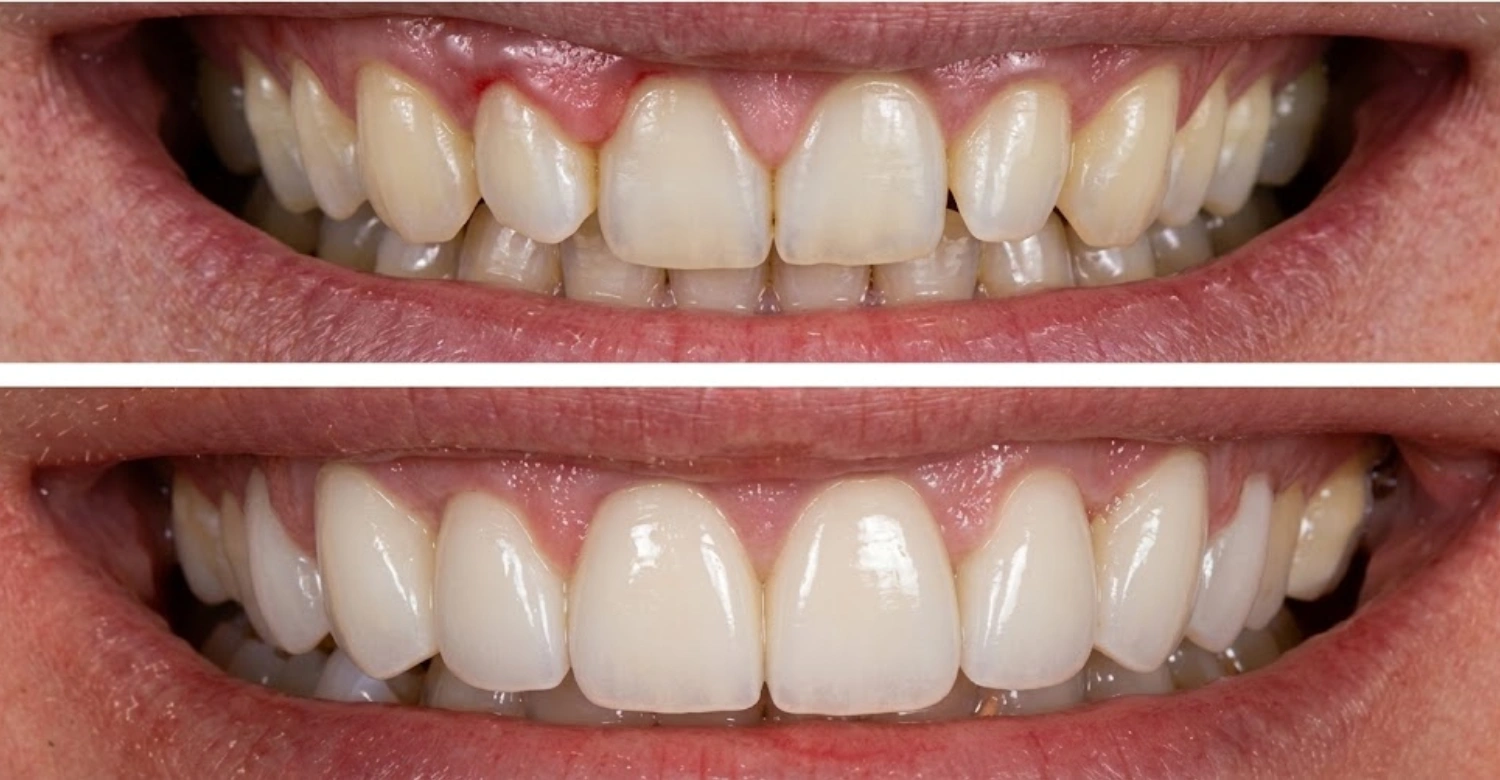
Gum Contouring Before and After Results show how reshaping the gumline can change the way a smile looks. Small adjustments to visible gum tissue can shift the gum-to-tooth ratio and improve overall smile symmetry. Many patients approach this treatment because of a gummy smile, uneven gum lines, teeth that look short, or excessive gum display when they smile.
Outcomes differ from person to person. Gum thickness, tooth proportions, bone levels, periodontal health, and the amount of tissue needing reshaping all play a role. Because of this, results should be reviewed clinically rather than judged from photographs alone. Photos can support a discussion, but they cannot replace an in-person assessment.
Gum Contouring Before and After Results: What Can Patients Expect?
Gum Contouring Before and After can realistically show several visible changes. Patients often notice improved gum symmetry, more balanced tooth visibility, and a smile that appears more proportionate overall. The gumline itself may look more even, and the smile as a whole tends to appear more harmonious.
The final look depends on individual anatomy. It is not simply a matter of removing a fixed amount of gum tissue from every patient. Healthy periodontal tissue and a properly designed treatment plan are what make these outcomes predictable and stable over time.
Some patients describe the change as a Gum Lift Before and After Results moment. The gumline sits higher and the teeth appear longer once healing is complete. This description is informal, but it reflects how noticeable the shift in proportion can be for the right candidate.
What Do Gum Contouring Before and After Photos Usually Show?
Gum Contouring Before and After Photos typically show differences in gumline height and symmetry across the front teeth. For photos to be genuinely comparable, they should be taken under similar lighting, from the same angle, with a comparable facial expression and tooth position.
Patients should be cautious about judging results from heavily edited or digitally enhanced images. These can misrepresent what a Gum Contouring Transformation actually looks like in real healing conditions. Unedited, consistent photography matters far more than a polished single image.
What Makes a Gum Contouring Transformation Look Natural?
A natural-looking Gum Contouring Transformation depends on keeping tooth-to-gum proportions realistic rather than extreme. Reshaping should be gradual and symmetrical across the smile, not concentrated unevenly on a few teeth.
Removing too much tissue can make the result look artificial or overly aggressive. This is why personalized treatment planning matters so much. Every smile has different proportions, and a plan built around one patient's anatomy will not necessarily suit another.
Tips for Patients
- Choose a dentist with experience in cosmetic and periodontal assessment.
- Ask whether your gummy smile is caused primarily by excess gum tissue.
- Request a clear explanation of the proposed gumline.
- Ask to see genuine Gum Contouring Before and After Photos where appropriate.
- Discuss whether crown lengthening or another treatment may be more suitable.
- Ask about healing and aftercare requirements.
- Confirm whether additional treatments are included in the proposed treatment plan.
- Do not choose treatment based solely on the lowest price.
- Prioritize periodontal health and conservative treatment planning.
- Follow all professional aftercare instructions.
Which Dental Problems Can Gum Contouring Address?
Gum contouring is generally considered for a handful of recurring concerns rather than as a one-size-fits-all treatment. These include a gummy smile, uneven gum lines, and teeth that look shorter than they really are because of excess tissue.
Each of these concerns can look similar at first glance, but the underlying cause often differs. A clinical assessment helps confirm which issue is actually present before any Gum Contouring Before and After Results can be planned realistically.
Patients sometimes arrive with more than one of these concerns at once, such as a gummy smile combined with an uneven gumline. In these cases, treatment planning needs to address each factor individually rather than assuming a single adjustment will resolve everything at the same time.
Excessive Gum Display and a Gummy Smile
Excessive visible gum tissue can change how balanced a smile appears, even when the teeth themselves are healthy. Gum Contouring for a Gummy Smile Before and After cases often show a more even gum-to-tooth ratio once treatment is complete.
Not every gummy smile is caused by excess gum tissue, though. Tooth position, lip movement, altered passive eruption, and skeletal factors can all contribute. This is why a clinical assessment is needed before assuming contouring alone will help. Identifying the correct cause early on saves patients from pursuing a treatment that would not actually resolve their main concern.
Uneven or Irregular Gum Lines
Asymmetrical gum levels can make otherwise healthy teeth appear uneven or mismatched in length. Gum Reshaping Before and After comparisons are often used to show how consistent gumline height improves overall smile appearance.
Correcting this asymmetry does not change the teeth themselves. It simply reveals more balanced proportions that were already present beneath excess tissue. This is often one of the more subtle Gum Reshaping Before and After changes. The teeth look the same, but the framing around them shifts noticeably.
Teeth That Appear Short Because of Excess Gum Tissue
Excess gingival coverage can make teeth look shorter than they actually are, even when the teeth themselves are a normal length beneath the tissue. In some of these cases, crown lengthening or another procedure may be more appropriate than simple gum contouring alone, particularly if bone levels are also involved.
A clinical exam is the only reliable way to tell which approach fits, since the underlying cause is not always visible from the surface. Choosing the right approach at this stage has a direct effect on the final Gum Contouring Before and After a patient can expect. Getting it right the first time helps avoid repeat treatment later.
How Is Gum Contouring Performed?
Gum contouring generally follows a sequence rather than a single step. Assessment comes first, followed by treatment planning and smile analysis, and finally the actual reshaping of gum tissue. Skipping any stage can affect both safety and the eventual Gum Contouring Before and After Results.
Understanding this sequence helps patients know what to expect at each appointment, rather than assuming the visible reshaping happens on the very first visit.
Initial Dental and Periodontal Assessment
Before any cosmetic treatment, gum health is assessed carefully. This includes gum thickness, gumline position, tooth proportions, periodontal condition, bone levels when clinically indicated, and any existing restorations.
Active periodontal disease or inflammation needs to be addressed first. Treating cosmetic concerns before resolving underlying gum disease can compromise healing. It can also affect the long-term stability of any Gum Contouring Before and After Results.
Treatment Planning and Smile Analysis
The dentist determines the appropriate gumline position through digital photography and smile analysis. This step maps out where tissue should be reshaped and by how much, based on the patient's own proportions.
Where appropriate, digital planning technology can help visualize potential changes before treatment begins, giving patients a clearer idea of what a realistic outcome might look like. This stage is where expectations are set. It plays a large part in how satisfied patients feel with their eventual Gum Contouring Before and After.
Gum Tissue Reshaping
Reshaping excess gingival tissue follows the same basic principles in every case, but the details vary. The technique used depends on individual anatomy and how much tissue is involved, so no two treatment plans are identical. Some patients need adjustment across the whole smile, while others need work on just a few teeth. This variation is part of why Gum Contouring Before and After Results look different from one patient to the next. Even the same starting concern can lead to a different plan.
Gum Contouring vs. Crown Lengthening
Simple gum contouring adjusts gum tissue only, while crown lengthening may involve changes to both gum tissue and supporting bone when needed. A clinical examination is necessary to determine which procedure actually suits the case, since the two are not interchangeable. Choosing incorrectly between them can affect both healing time and how stable the final gumline position turns out to be.
Understanding Gum Contouring Procedure Results
Gum Contouring Procedure Results are not always visible right away. The appearance immediately after treatment is not the final result, and patients should expect the look of the gumline to change as healing progresses.
Early tissue healing and the eventual gumline appearance are closely linked. Rushing to judge results before healing is complete often leads to an inaccurate impression of the outcome.
What Changes Immediately After Treatment?
Mild swelling or redness can temporarily affect how the gums look right after treatment. The gumline may appear different during this early stage than it will once healing settles. This is completely normal, rather than a sign of a problem.
Patients should avoid forming final opinions about their Gum Contouring Before and After Results immediately after the procedure. The tissue is still adjusting and will continue to change shape over the following days and weeks.
What Do Final Gum Contouring Results Look Like?
The final appearance becomes clearer as tissues heal and stabilize over the following weeks. Symmetry, tooth proportions, and gumline definition are the key signs of a successful outcome at this stage. These are the details worth reviewing when comparing genuine Gum Contouring Before and After.
A realistic result should also preserve periodontal health, not just visual appearance. Aesthetics and gum health need to move together for the outcome to last.
Gum Contouring Recovery and Results: What Is the Healing Process Like?
Gum Contouring Recovery and Results are closely tied to how well early healing is managed. Sensitivity, tenderness, or mild swelling are common short-term effects that usually fade within the first stretch of recovery.
Following the dentist's specific aftercare instructions matters more than general assumptions about healing. Every treated area responds differently, so patients should avoid irritating the gum tissue while it is still settling.
Oral Hygiene During Recovery
Maintaining oral hygiene without traumatizing healing tissue is a balance patients need guidance on. Professional instructions about brushing and cleaning around the treated area should be followed closely rather than adjusted independently. Being either too gentle or too aggressive can affect healing speed.
Attending any recommended follow-up appointment allows the dentist to check healing progress and confirm everything is on track.
When Should Patients Expect to See the Final Result?
Healing time varies depending on how much treatment was done and how an individual's tissue responds. Some patients notice quicker visual changes; others take longer, and this difference does not necessarily reflect how successful the treatment ultimately turns out to be. It is not a race.
Early visual improvement is not the same as final tissue stabilization. The two stages should not be confused when reviewing results.
What Are the Benefits of Gum Contouring?
When a patient is a suitable candidate, gum contouring can offer several practical benefits beyond appearance alone. These include a more balanced smile, better tooth proportions, and a cleaner gumline that is easier to maintain.
The sections below break down these benefits individually, since Gum Contouring Before and After Results tend to combine several small improvements rather than one dramatic change.
Improved Smile Symmetry
Correcting irregular gum levels can noticeably improve visual balance across the smile, making the teeth appear more evenly framed. When one side of the gumline sits higher or lower than the other, even healthy, well-aligned teeth can look mismatched. Addressing this asymmetry is often one of the clearest visible changes in Gum Contouring Before and After. It affects how the whole smile is perceived, rather than any single tooth.
Better Tooth-to-Gum Proportions
Reshaping excess gum tissue can make teeth look more proportionate relative to the gumline, which often improves overall smile aesthetics. Teeth that were previously covered by extra tissue can appear longer and better balanced once reshaping is complete. This is one of the main reasons patients pursue treatment, since proportion has a strong effect on how a smile reads at a glance.
A More Defined Gumline
Controlled reshaping creates a more consistent gingival contour, which supports a cleaner, more defined smile line. A well-defined gumline frames the teeth more clearly and can make routine oral hygiene easier to maintain. There is less irregular tissue for plaque to accumulate around.
Potential Improvement in Smile Confidence
Many patients report feeling more comfortable with their smile afterward, though this is a personal outcome rather than a guaranteed emotional result. This benefit is closely tied to how natural the Gum Contouring Before and After look once healing is finished. Confidence tends to follow naturally when the visible changes feel proportionate and match a patient's expectations from the planning stage.
Clinical Note
Gum contouring is not suitable for every patient with a gummy smile. A comprehensive clinical assessment should determine whether the concern comes from excess gingival tissue or another anatomical factor. Treating the wrong cause rarely produces a satisfying result.
Underlying periodontal disease, inadequate attached gingiva, bone levels, tooth position, or excessive lip movement can all change the treatment approach. Photographs can illustrate aesthetic change, but they cannot replace a clinical examination, particularly when several contributing factors are present at once.
Dr. Rifat Alsaman's cosmetic dentistry perspective is that treatment should balance aesthetics with periodontal health and long-term stability, not aesthetics alone.
Gum Contouring Patient Results: What Should You Look For?
Gum Contouring Patient Results can be assessed by looking for a few consistent signs of a natural outcome. These include symmetrical gum margins, appropriate tooth proportions, natural-looking contours, healthy-looking gingival tissue, and consistent treatment across the smile.
Patients should also ask whether photographs represent actual patients and whether the images were taken after adequate healing, since early post-treatment photos can be misleading.
How to Evaluate Gum Contouring Smile Before and After Images
When reviewing Gum Contouring Smile Before and After images, compare the same teeth and gum areas directly rather than judging the smile as a whole. Consistency in photography conditions matters just as much as the result itself. Different lighting or camera angles can make an outcome look better or worse than it actually is.
Final results should always be assessed after healing is complete, not from early post-procedure photos. Comparing images taken at the same stage of recovery gives a far more accurate sense of genuine Gum Contouring Before and After. This is more reliable than comparing a "before" photo to an early, still-healing "after" photo.
Gum Contouring Before and After: How Long Do They Last?
Properly performed treatment can provide long-lasting Gum Contouring Before and After Results in terms of gumline shape. Stability depends on periodontal health, oral hygiene, inflammation control, and how an individual's tissue responds over time.
Regular dental check-ups help maintain these results. Natural changes in the gums and teeth can still occur over the years regardless of earlier treatment. Patients who keep up with cleanings and periodontal care tend to see their Gum Contouring Before and After hold up better over the long term.
How Much Does Gum Contouring Cost?
Cost varies according to the number of teeth treated, the amount of tissue requiring reshaping, the complexity of the case, the technique used, and whether additional procedures are needed. Two patients with similar concerns can still receive different quotations once these factors are weighed individually.
An individual assessment is necessary for an accurate quotation. No single universal price can represent every patient's Gum Contouring Before and After Results, since cases differ so widely. A consultation remains the only reliable way to get figures specific to a particular smile.
How Long Does Gum Contouring Take?
Treatment time depends on the number of teeth involved and the complexity of the reshaping required. A straightforward case may take less time than one involving several teeth or additional procedures such as crown lengthening.
The procedure itself is separate from the full healing period. Consultation, treatment, and follow-up typically happen at different stages, not all at once. Patients should plan for this timeline rather than expecting Gum Contouring Before and After on the same day as the appointment.
What We Notice Clinically
Beyond photographs, clinicians assess gum thickness, tissue position, tooth dimensions, periodontal health, symmetry, and facial proportions together. These details shape what realistic Gum Contouring Before and After Results can look like for a given patient. Two patients with a similar-looking gummy smile can require very different treatment plans once these clinical factors are considered. This is why a visual impression alone is never enough to plan treatment.
Dr. Rifat Alsaman's Clinical Perspective
Dr. Rifat Alsaman, Head of the Medical Team at Vitrin Clinic and a cosmetic dentist, focuses on planning gum contouring around facial and dental proportions. His approach favours proportion over simply reducing visible gum tissue.
According to Dr. Rifat Alsaman, the objective should be a balanced gumline that complements the natural shape and position of the teeth. He evaluates whether gum contouring alone is sufficient or whether another treatment may be more appropriate. His emphasis stays on conservative planning and preserving healthy periodontal tissue.
Vitrin Clinic: Personalized Cosmetic Gum Contouring Planning
At Vitrin Clinic, personalized smile assessment comes before any gum contouring recommendation. The dental team evaluates gum symmetry, tooth proportions, and overall smile aesthetics as part of this process.
Digital dental technology and treatment planning tools are used where relevant to support this assessment. Dr. Rifat Alsaman, Head of the Medical Team at Vitrin Clinic and a cosmetic dentist, oversees this process to keep planning realistic and patient-specific.
Patient education and realistic expectations matter throughout, since every recommendation should be based on individual anatomy rather than a standard template. The clinic's approach favours conservative treatment and clear communication about what genuine Gum Contouring Before and After Results can realistically achieve for a given smile.
If you are considering treatment, arranging a consultation is the clearest way to find out whether gum contouring suits your smile. A proper assessment can also clarify whether a related option, such as crown lengthening, might serve your goals better than contouring alone.


