Dental Implant
September 30, 2026
Tooth Extraction vs Dental Implant: Which Option Is Right for a Missing or Damaged Tooth?
 Dr. Rifat Alsaman
Choosing between tooth extraction vs dental implant depends on whether your natural tooth can still be saved and what you want after it is gone. Extraction removes a damaged tooth, while an implant replaces a missing one. In many cases the two work together, but only a clinical examination can confirm the best path.
What Is the Difference Between Tooth Extraction and a Dental Implant?
The main difference between the two procedures is purpose. Extraction takes a tooth out; it removes a problem but leaves a gap. An implant puts something back, rebuilding the missing root and crown. Understanding this helps patients see that the two are often steps in the same plan rather than competing choices.
What Is Tooth Extraction?
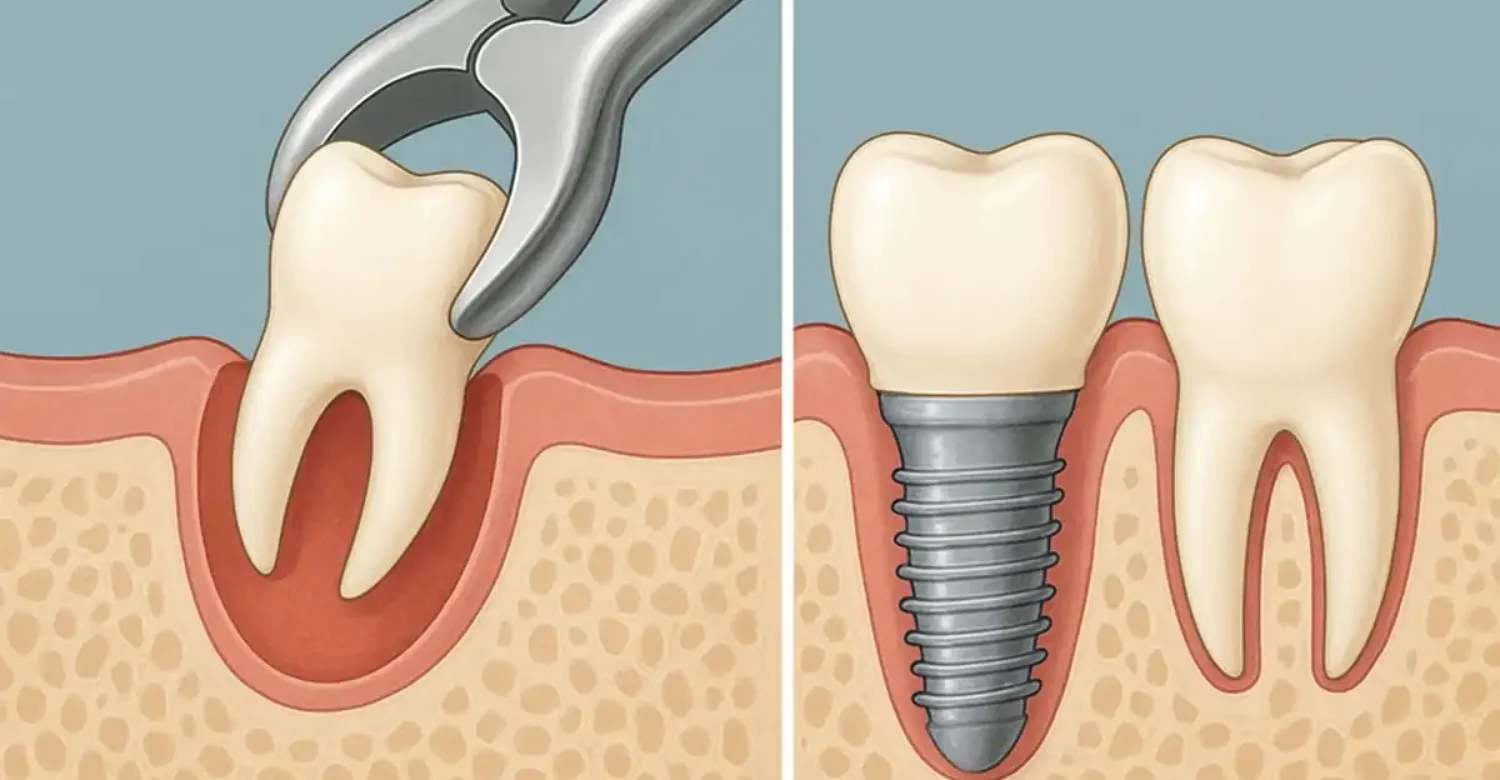
Tooth extraction is the removal of a tooth from its socket in the jawbone. It is usually done under local anesthesia. A simple extraction lifts out a visible tooth, while a surgical extraction may need a small gum incision, removal of some bone, or dividing the tooth into sections. It is recommended when a tooth cannot be saved.
What Is a Dental Implant?
A dental implant is a small titanium or ceramic post placed in the jawbone to act as an artificial tooth root. Over several months, the bone bonds to the implant. An abutment and a custom crown are then attached on top. The result looks, feels, and functions much like a natural tooth.
Extraction vs Implant: How Do They Differ?
In the extraction vs implant comparison, extraction is a removal procedure and an implant is a replacement procedure. Extraction is usually completed in one visit, while implant treatment happens in stages over several months. When a tooth is removed and later replaced, the decision becomes a question of timing rather than choosing one or the other.
Tooth Removal vs Implant: What Happens After Each Procedure?
When comparing tooth removal vs implant recovery, extraction healing involves a blood clot forming in the socket, with the gum closing over several weeks and the bone continuing to remodel for months. After an implant, the bone gradually bonds to the post before the crown is attached. Both require careful aftercare and follow-up visits.
Find out what causes it when All My Teeth Hurt Suddenly
When Is Tooth Extraction Recommended?
In the tooth extraction vs dental implant decision, extraction is recommended only when a tooth cannot be saved predictably or poses a risk to your oral health. Dentists usually consider it a last resort after evaluating restorative options such as fillings, root canal treatment, or crowns.
Severe Tooth Decay
When decay destroys most of the tooth structure or reaches below the gumline, there may not be enough healthy tooth left to support a filling or crown. If the tooth cannot be rebuilt reliably, extraction may be the safest option. It prevents infection from spreading and clears the way for replacement.
Advanced Gum Disease
Advanced periodontitis destroys the gums and bone that hold teeth in place. When bone loss leaves a tooth very loose, painful, or repeatedly infected, keeping it may no longer be predictable. Extraction may be recommended, although treating the gum disease first is essential before placing any implant.
Cracked or Non-Restorable Teeth
A crack that extends below the gumline or splits the root usually cannot be repaired. Teeth with vertical root fractures or severe structural breakdown often fail even after restoration attempts. In these cases, extraction removes the source of pain and infection, and replacement options can then be planned.
Failed Root Canal Treatment
Some root-canal-treated teeth develop persistent infection or fractures despite treatment. Retreatment or minor root surgery may sometimes save them. When these options are unlikely to succeed, or the remaining tooth structure is too weak, extraction followed by replacement may be the more predictable solution.
Impacted or Problematic Teeth
Teeth that cannot erupt properly, most commonly wisdom teeth, may cause pain, infection, cysts, or damage to neighboring teeth. Removing them is often recommended to protect surrounding structures. Teeth that block orthodontic treatment or grow in awkward positions may also be extracted as part of a broader plan.
Clinical Note
Extraction removes the damaged tooth, but it does not replace the missing tooth or restore the lost tooth root. That is why comparing the two procedures on their own never gives the complete picture. Removing a tooth solves one problem, while replacement addresses the gap that remains.
Note : All images used are for editorial and illustrative purposes only and may not originate from the original news provider or associated company.
Learn why you might see Saliva Blood When Spitting
When Is a Dental Implant Recommended?
In the tooth extraction vs dental implant discussion, an implant is recommended when a tooth is already missing or must be removed and the patient wants a fixed, long-term replacement. Suitability depends on healthy gums, enough jawbone, and general health, all of which are checked before treatment.
Replacing a Missing Tooth
An implant can replace a tooth lost to decay, gum disease, injury, or a congenital absence. Unlike a bridge, it does not require reshaping the neighboring teeth. It stands on its own, restoring the gap with a replacement anchored directly in the jawbone.
Replacing a Tooth After Extraction
When a tooth must be removed, an implant is often planned as the next step. Depending on the site, it may be placed during the same visit or after the socket heals. Planning the replacement before extraction helps preserve bone and gum shape for the best final result.
Restoring Chewing Function
A missing tooth can make chewing less efficient and push you to favor one side of the mouth. Because an implant is anchored in bone, it can handle normal biting forces. Patients can usually return to eating a wide variety of foods comfortably once treatment is complete.
Supporting Long-Term Oral Function
By replacing the root as well as the crown, an implant helps stimulate the jawbone during chewing, which may help limit bone loss in that area. It also restores a complete bite, supporting balanced function and reducing extra stress on the remaining teeth over the long term.
Preventing Shifting of Adjacent Teeth
When a gap is left open, neighboring teeth can tilt or drift into the space, and the opposing tooth may over-erupt. This can affect your bite, make cleaning harder, and complicate future treatment. Filling the space with an implant helps keep the surrounding teeth in their proper positions.
Tips for the Patients
Before deciding whether an implant can be placed immediately after extraction or needs to be delayed, you should have a thorough examination and appropriate imaging, such as a 3D scan. These show bone volume, infection, and nearby structures. This makes implant planning after extraction safer and more predictable.
Ready to transform your smile?
Talk to our team and get a personal FREE treatment plan.
Tooth Extraction vs Dental Implant: What Are the Main Differences?
Comparing tooth extraction vs dental implant side by side shows clear differences in purpose, steps, healing, bone effects, appearance, and long-term needs. Knowing these differences helps patients understand why dentists often combine both procedures instead of treating them as alternatives.
Purpose of Each Treatment
Extraction aims to remove a tooth that is causing pain, infection, or damage and cannot be saved. An implant aims to restore what was lost, replacing the root and crown to rebuild function and appearance. One solves the problem, and the other rebuilds the smile.
Procedure and Treatment Steps
A routine extraction is usually completed in one short appointment under local anesthesia. Implant treatment involves several stages: assessment and imaging, implant placement, a healing period for bone integration, and finally attachment of the abutment and crown. Bone grafting may be added when needed.
Healing and Recovery
After a simple extraction, discomfort usually eases within a few days, although the socket continues healing for several weeks. Implant surgery often causes similar short-term soreness. However, the bone needs a few months to bond with the implant before the final crown can be attached.
Effect on Jawbone
After extraction, the jawbone in that area gradually shrinks because it no longer receives stimulation from a tooth root. Much of this change happens in the first months. An implant acts as an artificial root, which helps maintain the surrounding bone when placed with sufficient bone support.
Appearance and Function
Extraction alone leaves a visible or functional gap, which may affect your smile, speech, or chewing. A well-planned implant crown is custom-shaped and color-matched to your natural teeth. It restores both appearance and bite function, so the result looks and feels close to natural.
Long-Term Considerations
Over time, the comparison also includes maintenance. An untreated gap may lead to bone loss and shifting teeth. An implant needs good hygiene and regular checkups to prevent gum inflammation around it. Smoking, uncontrolled diabetes, and poor oral hygiene can affect long-term implant health.
Understand the potential effects of Prion Diseases and Oral Health
Can You Save the Natural Tooth Instead of Choosing Extraction or an Implant?
Before settling on tooth extraction vs dental implant, it is worth asking whether the natural tooth can be saved. A healthy, restorable natural tooth is generally the first choice. Modern treatments can often rescue teeth that once would have been removed.
When Tooth Preservation May Be Possible
Preservation may be possible when enough healthy tooth structure remains, the root is intact, and the surrounding bone and gums are stable. Teeth with deep decay, infected nerves, or moderate damage can often be treated successfully with root canal therapy and a durable restoration.
Root Canal Treatment and Tooth Restoration
Root canal treatment removes infected or inflamed pulp, cleans and seals the root canals, and relieves pain. The tooth is then restored with a filling or crown to protect it. When successful, this keeps your natural root in place, which helps preserve the surrounding bone.
Dental Crowns for Damaged Teeth
A crown covers and strengthens a tooth weakened by large fillings, cracks, or root canal treatment. It restores shape and function while protecting the remaining structure from fracture. For many damaged teeth, a crown is what makes long-term preservation possible instead of extraction.
When Saving the Tooth May Not Be Predictable
Saving a tooth may not be predictable when a crack extends into the root or there is too little structure to hold a crown. Severe bone loss or repeated infection despite treatment are further warning signs. In these cases, repeated attempts may cost more and still fail, so removal and replacement can be wiser.
Tips for the Patients
Before proceeding with extraction, ask your dentist whether the tooth can be restored, what the expected prognosis is, and which alternatives exist. Understanding the pros and cons of each option makes the decision clearer and helps you choose confidently.
Tooth Extraction and Implant vs Keeping the Tooth: How Do You Decide?
Deciding on tooth extraction and implant vs keeping tooth depends on the condition of the tooth, the health of the bone and gums, your goals, and future maintenance needs. A careful tooth extraction vs dental implant assessment compares the long-term outlook of saving the tooth against removing and replacing it.
Assessing the Condition of the Tooth
The dentist checks how much healthy structure remains, the depth of decay, any cracks, and the condition of the root and previous treatments. X-rays and sometimes 3D imaging show hidden damage. Together, these findings indicate whether restoration is likely to last.
Evaluating Bone and Gum Health
Healthy bone and gums are needed both to keep a natural tooth and to support an implant. The dentist measures gum pockets, checks for infection, and assesses bone height and width. Gum disease must be controlled first, and bone grafting may be needed if the bone is insufficient.
Considering Function and Appearance
Your chewing needs, the tooth's position, and how visible it is when you smile all matter. Front teeth need careful attention to aesthetics and gum shape, while back teeth need strength for heavy biting. The chosen option should meet both functional and aesthetic expectations.
Understanding Long-Term Treatment Needs
Every option carries future needs. A saved tooth may later require a new crown or retreatment. An implant needs regular cleaning and checkups, and a gap may lead to bone loss or shifting teeth. Looking at each option over many years helps you choose the most sustainable one.
Understand the risks of Acidic Sugar-Free Candy and Tooth Erosion
What Are the Advantages and Limitations of Tooth Extraction?
In the tooth extraction vs dental implant comparison, extraction is quick and relieves problems, but it has important limitations. Knowing what extraction can and cannot achieve helps patients plan properly and avoid surprises later.
Potential Advantages of Extraction
Extraction can quickly relieve severe pain and remove the source of infection. It also eliminates a tooth that could damage neighboring teeth or bone. It is usually a short procedure with manageable recovery. For teeth that cannot be saved, it can be the most predictable way to restore oral health.
What Extraction Does Not Replace
Extraction removes the tooth, but it does not replace the crown you chew with or the root that supports the bone. The gap remains unless a replacement is planned. This is why extraction alone is usually considered a first step rather than the end of treatment.
Possible Changes After Tooth Removal
After tooth removal, the jawbone in the area gradually shrinks. Neighboring teeth may tilt into the space, and the opposing tooth may over-erupt. Chewing may become less efficient, and missing front teeth can affect appearance and speech. These changes tend to progress over time.
Why Tooth Replacement May Be Considered
Replacement helps restore chewing, protect your bite, and keep neighboring teeth in position. Options include implants, bridges, and removable dentures, each with different benefits. When planning treatment, discussing replacement early can help preserve bone and improve the final result.
Tips for the Patients
If a tooth is extracted, discuss replacement options with your dentist rather than leaving the space untreated without professional evaluation. Ask about timing, bone preservation, and which option suits your mouth. A clear plan protects the surrounding teeth and your future treatment choices.
Explore the link between Long-Distance Endurance Exercise and Tooth Erosion
What Are the Advantages and Limitations of Dental Implants?
In the tooth extraction vs dental implant comparison, implants offer stable, natural-looking replacement, but they require surgery, healing time, and suitable conditions. Understanding both the benefits and the limitations helps patients set realistic expectations before starting treatment.
Implant Stability and Function
Once integrated with the bone, an implant is fixed firmly in place and does not rely on neighboring teeth. It supports normal biting and chewing forces. Implants do not move like removable dentures, which gives patients confidence when eating and speaking.
Natural-Looking Tooth Replacement
The crown on an implant is custom-designed to match the color, shape, and size of your natural teeth. With careful planning of the gum contour, the result blends into your smile. This is especially important for visible front teeth, where aesthetics matter most.
Implant Healing and Osseointegration
Osseointegration is the process by which bone grows onto and bonds with the implant surface. It usually takes around three to six months, depending on bone quality and location. During this time a temporary tooth may be used. Proper integration is essential for long-term stability.
Factors That Can Affect Implant Success
Success depends on enough healthy bone, controlled gum disease, and good oral hygiene. Smoking, uncontrolled diabetes, certain medications, and teeth grinding can increase the risk of complications. Careful case selection and planning improve outcomes in implant treatment.
Can You Get a Dental Implant Immediately After Tooth Extraction?
Sometimes, yes. In tooth extraction vs dental implant planning, an implant can occasionally be placed on the same day the tooth is removed. This depends on the condition of the socket, the bone, the gums, and whether infection is present, so not every patient qualifies.
What Is an Immediate Dental Implant?
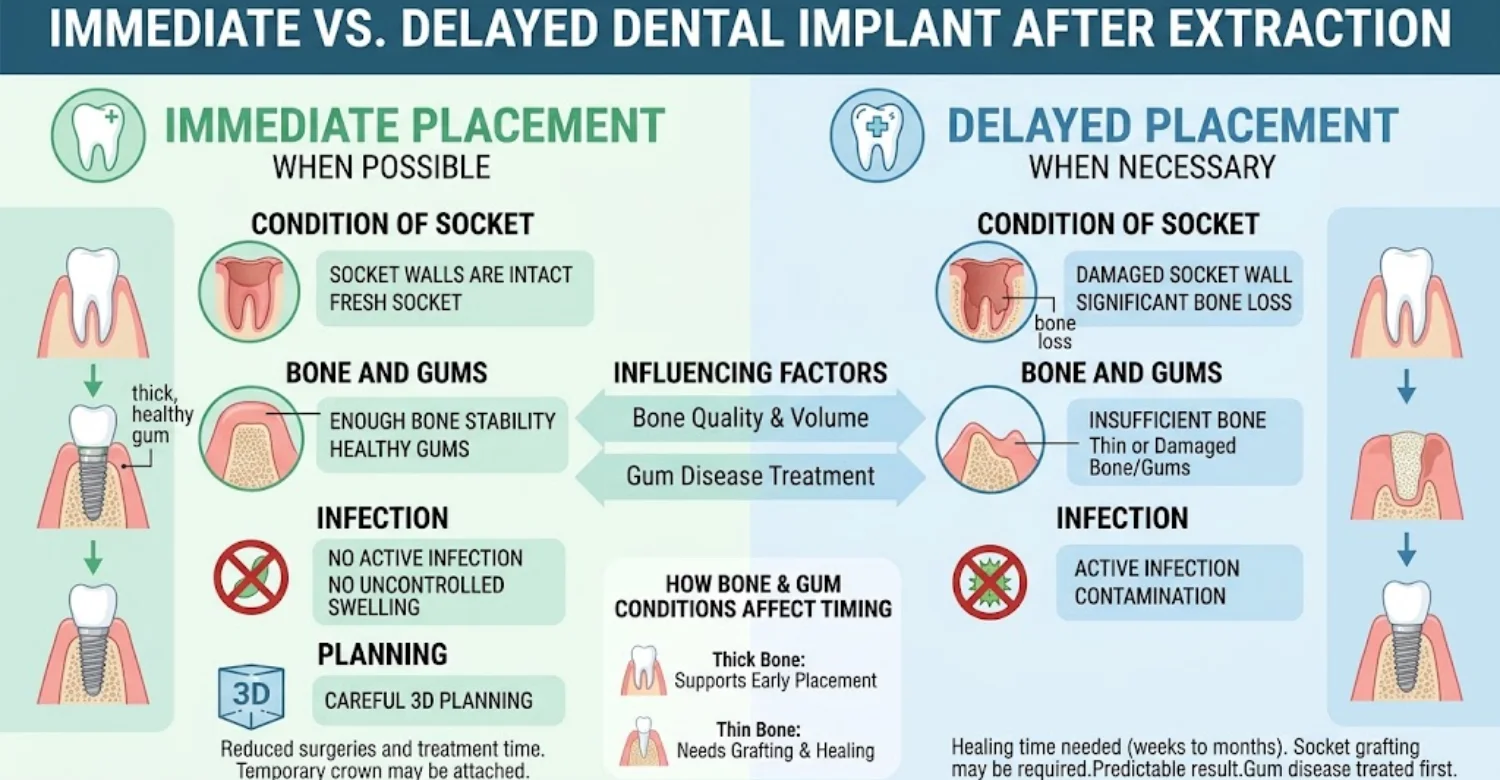
An immediate implant is placed into the fresh socket right after the tooth is removed, during the same appointment. This can reduce the number of surgeries and the overall treatment time. In selected cases, a temporary crown may also be attached, depending on implant stability.
When Immediate Implant Placement May Be Possible
Immediate placement may be possible when the socket walls are intact, enough bone exists beyond the root tip for stability, and the gums are healthy. There should also be no active infection that cannot be controlled. Good general health and careful 3D planning are also important.
When Delayed Implant Placement May Be Necessary
Delayed placement may be needed when there is active infection, significant bone loss, a damaged socket wall, or insufficient bone for stability. The socket is allowed to heal, sometimes with bone grafting, for weeks to several months before the implant is placed.
How Bone and Gum Conditions Affect Timing
Thick, healthy bone and gums support earlier placement, while thin or damaged bone may need grafting and more healing time. Gum disease must be treated first. Bone quality and volume directly influence when an implant can be placed safely and how predictable the result will be.
Clinical Note
Immediate implant placement is not appropriate for every extraction site. The dentist must evaluate the socket, bone, gums, any infection, and the overall treatment plan. When it comes to implant timing, the safest choice is guided by clinical findings rather than speed alone.
How Much Does Tooth Extraction vs Dental Implant Treatment Cost?
When comparing tooth extraction vs dental implant costs, extraction is far less expensive, while an implant involves several stages and components. Prices also vary widely by country. The table below shows approximate private prices in US dollars for Turkey, the UK, and the US.
Treatment | Turkey (USD) | UK (USD) | US (USD) |
Simple tooth extraction | ~$35 – $190 | ~$125 – $400 (private) | Around $600 on average |
Surgical extraction | ~$100 – $400 | ~$265 – $800 | Around $1,200 on average |
Single implant with crown | ~$450 – $2,000 | ~$2,400 – $4,650 | ~$3,000 – $6,000 |
Prices are approximate and rounded. Pound and euro figures were converted to dollars at recent approximate exchange rates. Final costs depend on each patient's case and treatment plan.
Factors That Affect Tooth Extraction Cost
Extraction cost depends on whether the extraction is simple or surgical and on the tooth's position. Impacted or broken teeth cost more, and wisdom teeth are often more complex. Imaging, sedation, and the case's difficulty also affect the final fee.
Factors That Affect Dental Implant Cost
Implant cost depends on the implant brand, the crown material, and the number of implants. It also depends on whether bone grafting or a sinus lift is needed, on imaging such as 3D scans, and on whether a temporary tooth is required. Complex cases with bone loss usually involve additional steps and higher costs.
Why Implant Treatment Usually Involves Multiple Steps
Implant treatment is staged because the bone needs time to heal and bond with the implant. Assessment, imaging, extraction, possible grafting, placement, healing, and final crown fitting each happen at a specific time. This step-by-step approach improves stability and long-term success.
What Can Be Included in an Implant Treatment Plan?
A complete plan may include the consultation, X-rays and 3D scans, extraction, and bone grafting if needed. It then covers the implant post, the abutment, a temporary tooth, the final crown, and follow-up visits. Knowing what is included makes it easier to compare quotes accurately.
Tips for the Patients
Ask for a complete treatment plan that explains the extraction, implant, abutment, crown, imaging, and any additional procedures that may be needed. A transparent plan lets you compare quotes for extraction and implant treatment fairly and avoid unexpected charges later.
Find out when Subperiosteal Implants for Maxillary Reconstruction are used
What Should You Consider Before Choosing Extraction or an Implant?
Before deciding on tooth extraction vs dental implant, consider the condition of your tooth, your bone and gum health, your overall oral health, the timeline, your goals, and long-term care. Reviewing all of these with your dentist leads to a choice that fits your needs.
Condition of the Natural Tooth
The first question is whether the tooth can be saved predictably. The amount of healthy structure, the condition of the root, cracks, and previous treatments all matter. If a tooth can be restored with a good prognosis, keeping it is often preferable.
Bone and Gum Health
Enough healthy bone and stable gums are needed to support an implant. Bone loss may require grafting before or during implant placement, and active gum disease must be treated first. These factors affect both timing and the predictability of the result.
Overall Oral Health
Decay in other teeth, gum disease, grinding habits, and oral hygiene all influence treatment success. Addressing these issues first protects both natural teeth and implants. A healthy mouth provides the best foundation for any restorative treatment.
Treatment Timeline
Extraction is quick, but implant treatment may take several months from start to finish, especially when grafting or healing time is needed. Immediate implants can shorten the timeline in suitable cases. Knowing the expected duration helps you plan around work, travel, and events.
Functional and Aesthetic Goals
Think about what matters most to you: comfortable chewing, a natural-looking smile, or avoiding removable appliances. Front teeth require extra attention to appearance and gum contour. Sharing your goals helps your dentist recommend the most suitable option.
Long-Term Maintenance
Natural teeth, implants, and other replacements all need ongoing care. Implants require daily cleaning and regular professional checkups to keep the surrounding gums healthy. Choosing an option you can maintain comfortably supports long-term success.
Tips for the Patients
Discuss all available treatment options with your dentist, and ask why a particular approach is recommended for your specific tooth. Whether the right answer is extract or implant, understanding the reasoning helps you make a confident decision.
Spot the early signs of Tongue Cancer
How Does Vitrin Clinic Approach Tooth Extraction and Dental Implant Treatment?
At Vitrin Clinic, the tooth extraction vs dental implant decision starts with the natural tooth, not with the procedure name. Our team evaluates whether the tooth can be preserved and then plans extraction, implant timing, and replacement around each patient's oral health and goals.
.jpg)
.jpg)
.jpg)
.jpg)
Personalized Dental Examination
Each patient receives a detailed dental examination covering the affected tooth, the neighboring teeth, the gums, the bite, and overall oral health. We also review your medical history and concerns. This personalized assessment forms the basis for every treatment recommendation at Vitrin Clinic.
Digital Imaging and Treatment Planning
Digital X-rays and 3D imaging allow us to assess bone volume, root condition, infection, and nearby structures accurately. This information helps plan implant position and size and shows whether grafting is needed. The result is safer, more precise, and more predictable treatment.
Tooth Preservation Assessment
Before recommending extraction, Vitrin Clinic assesses whether the tooth can be saved with root canal treatment, a crown, or other restorations. When preservation offers a good long-term prognosis, it is discussed first. Extraction is recommended only when saving the tooth is not predictable.
Extraction and Implant Treatment Planning
When extraction is necessary, we plan the replacement at the same time. The plan covers how to remove the tooth gently, whether bone preservation or grafting is needed, and which implant and crown suit the site. Planning both steps together helps achieve better function and aesthetics.
Immediate vs Delayed Implant Evaluation
Our team evaluates the socket, bone, gums, and any infection to decide whether an implant can be placed immediately or should be delayed. Immediate placement is used only when clinically suitable. Otherwise, the site is allowed to heal properly before implant placement.
Follow-Up and Aftercare
Follow-up visits monitor healing, implant integration, and gum health, with clear aftercare instructions at each stage. Dr. Rifat Alsaman, Head of the Medical Team at Vitrin Clinic and a Cosmetic Dentist, explains that planning at Vitrin Clinic evaluates the natural tooth first. It then determines whether preservation, extraction, immediate implantation, or delayed implantation is appropriate for each tooth extraction vs dental implant case. Vitrin Clinic evaluates the tooth, surrounding bone, and gums to build an individualized plan based on each patient's dental needs.
Clinical Note
The choice between extraction, tooth preservation, and implant replacement should be based on a clinical examination rather than the treatment name alone. Every tooth and every patient is different. Imaging, bone quality, gum health, and the patient's goals together determine the right approach.
Resource:
FAQs
Dr. Rifat Alsaman has more than 5 years of clinical experience in dentistry and currently serves as the Head of the Medical Team at Vitrin Clinic. He is dedicated to providing exceptional patient care, overseeing treatment planning, and ensuring the highest clinical standards across the team. His expertise, attention to detail, and commitment to continuous professional development have helped countless patients achieve healthier, more confident smiles.


