
Choosing between a root canal vs filling depends mainly on how deep tooth decay has travelled. Decay begins in the outer enamel and, if left untreated, moves into the dentin and finally reaches the pulp, the soft tissue that holds the tooth's nerves and blood vessels. A filling repairs a tooth whose pulp is still healthy. Root canal treatment removes infected or irreversibly inflamed pulp so the tooth can be saved. Understanding root canal vs filling helps you spot warning signs early and ask the right questions. This guide covers the differences, causes, symptoms, costs and recovery, and explains how Vitrin Clinic evaluates each tooth before recommending treatment.
What Is the Difference Between Root Canal vs Filling?
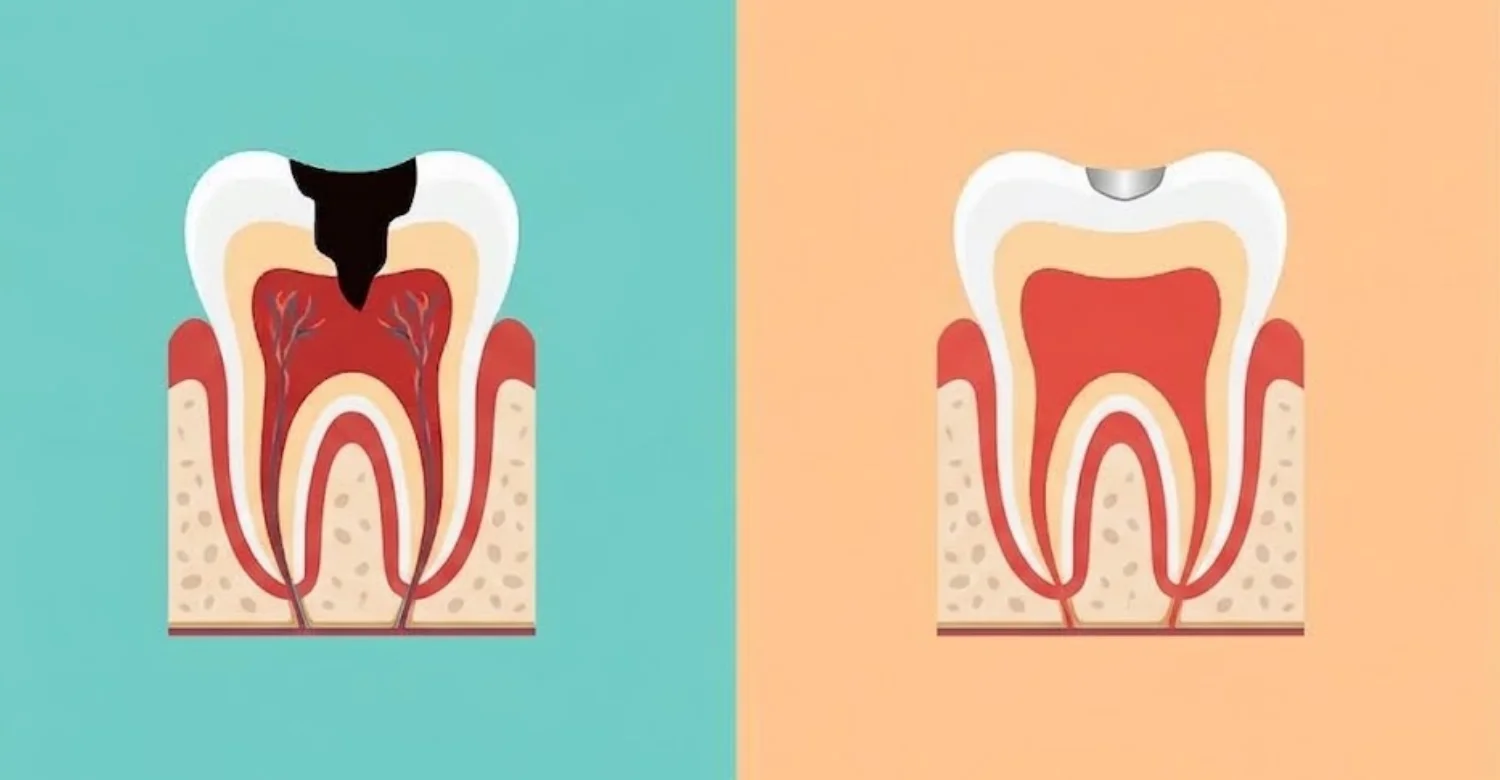
A filling repairs a cavity in the outer layers of a tooth, while a root canal treats the pulp inside it. The main difference in root canal vs filling is pulp health. If the pulp can recover, a filling is usually enough. If it is infected or irreversibly inflamed, a root canal is needed.
What Is a Dental Filling?
A dental filling is a restoration that repairs a tooth damaged by decay. The dentist removes the decayed tissue, cleans the cavity, and fills it with a material such as tooth-colored composite to restore the tooth's shape and function. A filling is generally appropriate when decay has not permanently damaged the pulp.
What Is a Root Canal?
Root canal treatment removes damaged pulp from inside the tooth. The pulp contains nerves, blood vessels and connective tissue that keep the tooth alive. When bacteria infect the pulp, or inflammation becomes irreversible, it cannot heal on its own. The dentist then cleans, shapes, disinfects and seals the canals to save the natural tooth.
Filling or Root Canal: What Is the Main Difference?
Choosing a filling or root canal comes down to purpose. A filling restores lost tooth structure, while a root canal treats the pulp and the root canal system. In root canal vs filling decisions, the dentist weighs five factors: pulp condition, decay depth, treatment complexity, tooth preservation and the final restoration.
Pulp Condition
Pulp condition is the most important deciding factor. A healthy or reversibly inflamed pulp can recover once the decay is removed, so a filling is often enough. An infected, necrotic or irreversibly inflamed pulp cannot heal, even after the decay is cleaned away. In that case, root canal treatment is needed to remove the damaged tissue and protect the tooth.
Depth of Tooth Decay
Decay limited to the enamel and dentin is usually treated with a filling. Decay that reaches the pulp, or comes very close to it, may require root canal treatment. Depth alone does not decide the treatment, though. What matters is how the pulp has responded to the decay, which the dentist confirms through careful testing and imaging.
Treatment Complexity
A filling is usually a straightforward procedure completed in a single visit. A root canal is more involved. The dentist must locate, clean, shape and seal narrow canals inside the roots. Depending on the tooth's anatomy and how severe the infection is, a root canal may be completed in one visit or may need several.
Tooth Preservation
Both treatments share the same goal: keeping your natural tooth. A filling preserves a tooth whose pulp is still healthy. A root canal saves a tooth that might otherwise need extraction because of infection or irreversible pulp damage. Keeping natural teeth helps maintain chewing function, jaw bone support and the alignment of neighboring teeth.
Final Restoration
A filling is itself the final restoration, so no further work is usually needed. After a root canal, the tooth still needs a restoration to seal and protect it. This may be a filling or, particularly for back teeth with limited remaining structure, a crown. A crown strengthens the tooth and helps it withstand chewing forces.
Note : All images used are for editorial and illustrative purposes only and may not originate from the original news provider or associated company.
Explore digital dental implants and modern implant planning
Causes of the Condition
Both treatments trace back to damage that reaches the tooth. Decay usually creates the need for a filling. Decay, cracks or trauma that reach the pulp create the need for a root canal. Understanding these causes explains every root canal vs filling decision and shows how many dental problems can be prevented.
What Causes Tooth Decay?
Tooth decay develops when bacteria in plaque produce acids that dissolve enamel and dentin. Frequent sugar intake, poor oral hygiene, dry mouth and acid exposure all raise the risk. Decay can also return around older restorations. Controlling these factors lowers the chance of needing any dental treatment in the first place.
Plaque and Oral Bacteria
Plaque is a sticky, colorless film of bacteria that forms on teeth every day. When it is not removed by brushing and cleaning between the teeth, bacteria feed on sugars and release acids. Over time, these acids dissolve minerals from enamel, weaken the tooth surface and create the first signs of decay.
Frequent Sugar Consumption
Every time you eat or drink something sugary, oral bacteria produce acid. Frequent snacking and sipping sugary drinks keep the mouth acidic for long periods, giving enamel little time to recover. For this reason, how often you consume sugar matters as much as the total amount, especially between meals.
Poor Oral Hygiene
Irregular brushing and skipping cleaning between the teeth allow plaque to build up and harden. It collects mainly along the gumline, between teeth and in the deep grooves of back teeth. These are the areas where decay most often begins. Brushing twice daily with fluoride toothpaste greatly reduces this risk.
Dry Mouth
Saliva protects teeth by washing away food, neutralizing acids and helping repair early enamel damage. Dry mouth can be caused by certain medications, some medical conditions or dehydration. It removes this natural protection and significantly increases the risk of tooth decay, particularly around the gumline and existing fillings.
Acid Exposure
Acids soften enamel and make it easier for decay to develop. Common sources include soft drinks, sports drinks, frequent citrus, and stomach acid from reflux or repeated vomiting. Softened enamel wears away more easily, and it becomes more vulnerable to bacterial acids when oral hygiene is not consistent.
Recurrent Decay Around Existing Restorations
Decay can develop again at the edges of old fillings or crowns. Small gaps or worn margins allow bacteria to slip underneath the restoration. This recurrent decay is often hidden and painless at first, so it is usually detected during a dental examination or on X-rays taken at routine checkups.
What Causes Pulp Damage?
The pulp becomes damaged when bacteria or injury reach the inside of the tooth. Deep decay is the most common cause. Cracks, trauma, repeated procedures and severe wear can also irritate the pulp. Once the damage becomes irreversible, a filling alone can no longer resolve the problem.
Deep Tooth Decay
When decay reaches the inner dentin close to the pulp, bacteria and their toxins begin to irritate it. At first, the pulp may become inflamed but still able to recover. If the decay continues to advance, bacteria can eventually enter the pulp, causing irreversible inflammation or infection that requires root canal treatment.
Cracked or Fractured Teeth
Cracks create pathways that allow bacteria to travel toward the pulp. A cracked tooth often causes sharp pain when biting or when releasing a bite. Some cracks are extremely small and hard to see, so the dentist may use magnification, special lighting and bite tests to find them.
Dental Trauma
A blow to the mouth from a fall, sport or accident can damage the pulp's blood supply, even without a visible fracture. The pulp may slowly die. The tooth can darken or become painful weeks or even months after the injury, so follow-up checks after dental trauma are important.
Repeated Dental Procedures
A tooth that has been filled, refilled or treated several times may experience cumulative stress on the pulp. Each procedure adds some irritation, and the pulp's ability to recover can decrease over time. This is one reason why dentists aim to keep restorations conservative and to prevent new decay.
Severe Tooth Wear
Grinding, clenching, acid erosion and aggressive brushing can gradually thin the protective enamel and dentin. As these layers wear down, the pulp sits closer to the surface. This increases sensitivity and makes the pulp more vulnerable to irritation, especially if decay or cracks develop in the worn areas.
Bacterial Infection Reaching the Pulp
When bacteria enter the pulp through decay, cracks or leaking restorations, infection develops inside the tooth. The pulp may become inflamed and eventually die. Without treatment, the infection can spread through the root canals and reach the bone around the root tip, where it may form an abscess.
Find out more about drill-free tooth decay treatment
Problems Caused by the Condition
Untreated decay rarely stays the same. It usually spreads deeper, turning a small problem that needs a simple filling into one that affects the pulp. Timing often decides the outcome of root canal vs filling, because earlier treatment tends to be simpler, more comfortable and better at preserving natural tooth structure.
What Happens If Tooth Decay Is Left Untreated?
Left untreated, decay moves from enamel into dentin and toward the pulp. Symptoms may begin as mild sensitivity and progress to toothache, pulp inflammation, infection and abscess. Each stage makes treatment more complex. This is why dentists recommend treating cavities as soon as they are found, even without pain.
Progression of Decay
Decay progresses slowly through hard enamel, then speeds up once it reaches the softer dentin underneath. A cavity that looks small on the surface may be much larger inside. Without treatment, it can grow noticeably between checkups and move steadily closer to the pulp, increasing the likelihood of more extensive treatment.
Increased Sensitivity
As decay approaches the pulp, the tooth often reacts more strongly to cold, heat or sweet foods. Brief sensitivity that fades quickly is common with moderate decay. It is an early warning sign that should prompt a dental visit before the damage reaches the pulp and the symptoms become stronger.
Toothache
A toothache that becomes more frequent, more intense or longer-lasting suggests the decay is beginning to affect the pulp. Painkillers may temporarily ease the discomfort, but they do not treat the cause. Any recurring toothache should be examined promptly to determine how far the decay has progressed.
Pulp Inflammation
Inflammation of the pulp is called pulpitis. In its early stage, it may be reversible, and the pulp can recover once the decay is removed and the tooth is filled. If the inflammation becomes irreversible, the pulp can no longer heal, and root canal treatment is usually required.
Pulp Infection
When bacteria invade the pulp, infection develops and the pulp may die. A dead pulp sometimes stops hurting for a while, which can give a false sense that the problem has resolved. However, the infection remains inside the tooth and can continue to spread toward the surrounding bone.
Dental Abscess
A dental abscess is a collection of pus that forms when infection spreads from the pulp into the tissues around the root. It may cause swelling, throbbing pain, a bad taste, gum pimples and sometimes fever. An abscess will not heal on its own and needs prompt dental treatment.
Can Untreated Decay Lead to a Root Canal?
Yes. When decay is left untreated, it continues toward the pulp. Once bacteria cause irreversible inflammation or infection, a filling is no longer enough. Treating decay early often keeps the root canal vs filling choice in favor of a simpler filling and prevents more extensive damage to the tooth.
Discover how full-arch dental implants can restore missing teeth
When Do You Need Root Canal Instead of Filling?
When do you need root canal instead of filling? Generally, when the pulp is infected, necrotic or irreversibly inflamed. Signs may include persistent or spontaneous pain, lingering sensitivity, pain on biting or swelling. The final root canal vs filling decision, however, is based on examination and testing, not on symptoms alone.
Signs That a Filling May Be Enough
A filling may be enough when decay has not caused irreversible pulp damage, sensitivity is mild and short-lived, the tooth can be restored, and there is no sign of infection around the root. These conditions can only be confirmed through a dental examination and, when needed, X-rays.
Decay Has Not Caused Irreversible Pulp Damage
If testing shows the pulp is healthy or only mildly irritated, the dentist can remove the decay and place a filling. Once the source of irritation is gone, the pulp usually settles and recovers. This allows the tooth to stay alive and function normally without the need for root canal treatment.
Mild or Short-Lasting Sensitivity
Sensitivity to cold, heat or sweets that disappears within a few seconds after the trigger is removed often indicates a pulp that is still capable of recovery. This type of brief response is typical of decay in the dentin, and it usually improves after the cavity has been properly treated.
Tooth Remains Structurally Restorable
For a filling to succeed, enough healthy tooth structure must remain after the decay is removed. The remaining walls need to support the filling securely and withstand daily chewing forces without cracking. If too much structure has been lost, a larger restoration, such as a crown, may be recommended instead.
No Evidence of Infection Around the Root
A filling is suitable when examination and X-rays show no abscess, no bone changes around the root tip, and no gum swelling or drainage. These findings suggest the problem is limited to the crown of the tooth and has not spread into the pulp or the surrounding tissues.
Signs That a Root Canal May Be Needed
Certain signs suggest the pulp may be irreversibly damaged or infected. These include persistent pain, lingering hot or cold sensitivity, spontaneous toothache, pain when chewing, swelling and infection around the root. Any of these warning signs calls for a prompt dental evaluation to confirm the pulp's condition.
Persistent Tooth Pain
Pain that continues for days, or keeps returning even after it seems to settle, suggests ongoing inflammation inside the pulp rather than simple surface sensitivity. Persistent pain often means the pulp is struggling to recover. It should be evaluated with clinical tests to determine whether the damage has become irreversible.
Prolonged Hot or Cold Sensitivity
Sensitivity that lingers for a long time after a hot or cold stimulus has been removed is a common sign of irreversible pulp inflammation. Unlike brief sensitivity, this lingering pain indicates the pulp is severely irritated. Heat sensitivity that is relieved by cold can also point toward serious pulp damage.
Spontaneous Toothache
A toothache that starts on its own, without eating, drinking or any other trigger, often points to significant pulp damage. Pain that wakes you at night or throbs for no clear reason is particularly concerning. Spontaneous pain is one of the signs dentists take most seriously when assessing pulp health.
Pain When Biting or Chewing
Tenderness or pain when biting may indicate inflammation or infection in the tissues around the root. However, it can also be caused by a cracked tooth or a filling that sits slightly too high. For this reason, bite testing and careful examination are needed to identify the true cause.
Swelling Around the Tooth
Swelling of the gum near a tooth, or of the face or jaw, may indicate that infection has spread beyond the pulp into the surrounding tissues. Swelling should never be ignored. Rapidly increasing swelling, especially with fever or difficulty swallowing, requires urgent medical or dental attention.
Evidence of Pulp Infection or Irreversible Inflammation
Clinical tests may show that the pulp does not respond at all, which suggests it has died. They may also show an exaggerated, lingering response consistent with irreversible damage. Together with symptoms and X-rays, these test results help the dentist confirm that root canal treatment is the appropriate choice.
Abscess or Infection Around the Root
X-rays may reveal bone loss or a dark area at the root tip, which indicates infection. Some patients also notice a small pimple on the gum that releases pus, or a persistent bad taste. These signs show that infection has spread beyond the tooth and requires root canal treatment.
Can Symptoms Alone Determine the Treatment?
No. Symptoms are helpful, but they do not always reflect the pulp's true condition. Some teeth with damaged or dead pulp cause little or no pain. That is why root canal vs filling decisions rely on clinical examination, pulp testing and X-rays when indicated, rather than on pain levels alone.
Learn about the role of good bacteria in the mouth
Deep Filling vs Root Canal
In deep filling vs root canal decisions, the central question is whether the pulp can recover. A deep filling may work when decay is close to the pulp but the pulp remains healthy. Root canal treatment is the better option in root canal vs filling when the pulp is irreversibly inflamed, infected or necrotic.
When Is a Deep Filling Appropriate?
A deep filling is appropriate when decay is extensive but the pulp shows no irreversible damage. After removing the decay, the dentist may place a protective lining to shield the pulp before the filling. The tooth must also have enough structure left to support a lasting, well-sealed restoration.
Deep Decay Without Irreversible Pulp Damage
Decay can be deep and still leave the pulp healthy. When clinical tests show a normal response and there is no spontaneous or lingering pain, the dentist can often remove the decay and place a deep filling. This conservative approach keeps the pulp alive and preserves more natural tooth structure.
Pulp Remains Capable of Recovery
A pulp that is only reversibly inflamed can heal once the irritation from decay is removed. After a deep filling, any sensitivity should gradually decrease over the following days or weeks. Regular follow-up allows the dentist to confirm that the pulp is recovering as expected and remains healthy.
Tooth Can Be Restored After Removing Decay
After all decay is removed, enough sound tooth structure must remain to support the filling and maintain a tight seal against bacteria. A good seal prevents new decay from forming underneath. If the remaining walls are too thin or weak, a crown may be needed for protection.
When Is Root Canal Treatment More Appropriate?
Root canal treatment is more appropriate when the pulp can no longer heal. This includes irreversible inflammation, infection, necrosis and infection spreading around the root. The tooth must also remain restorable. If it cannot be restored, the dentist may discuss other options, including extraction and tooth replacement.
Irreversible Pulp Inflammation
When the pulp is inflamed beyond the point of recovery, removing the decay and placing a filling will not relieve the problem. Patients often experience lingering or spontaneous pain. Root canal treatment removes the inflamed tissue, relieves the pain and prevents the inflammation from developing into an infection.
Pulp Infection
Once bacteria have entered the pulp, a filling alone cannot eliminate the infection inside the tooth. The infected tissue must be removed, and the canals must be thoroughly cleaned and disinfected. Root canal treatment achieves this and stops the infection from spreading to the bone around the root.
Necrotic Pulp
A necrotic pulp is one that has died, often because of long-standing decay or trauma. The tooth may not hurt, and it may appear darker than neighboring teeth. However, dead tissue inside the tooth can harbor bacteria and lead to infection, so root canal treatment is usually recommended.
Infection Extending Around the Tooth Root
When infection spreads from the pulp into the bone at the root tip, it may cause swelling, tenderness or an abscess. X-rays often show changes in the surrounding bone. Root canal treatment removes the source of infection inside the tooth, which allows the surrounding bone and tissues to heal.
Tooth Remains Suitable for Restoration
Root canal treatment only makes sense if the tooth can be restored afterward. Enough healthy structure must remain to support a filling or crown and to function well for many years. If the tooth is too badly broken down, the dentist will explain other treatment options.
Can a Deep Filling Cause Sensitivity?
Yes. Some temporary sensitivity to cold, heat or biting is common after a deep filling, because the decay and the treatment irritated the pulp. It usually fades over days or a few weeks. Sensitivity that persists, worsens or becomes spontaneous needs evaluation, as the pulp may not be recovering.
Explore the connection between Helicobacter pylori infection and oral health
Root Canal vs Filling Cost
Root canal vs filling cost differs mainly because the two treatments differ in complexity. A filling repairs part of the tooth's crown. A root canal treats the inside of the tooth and usually needs a final restoration as well. The exact price depends on the tooth, its condition and the treatment required.
What Affects Filling Cost?
The cost of a filling depends on the size and depth of the cavity, the tooth's location, the chosen material and the complexity of the restoration. A small filling on a front tooth usually costs differently from a large filling on a back tooth that covers several surfaces.
Size and Depth of Cavity
Larger and deeper cavities require more time to clean, more filling material and sometimes a protective lining to shield the pulp. The dentist must also shape the filling carefully to restore the tooth's contours. All these steps increase the work involved and can affect the final cost of the filling.
Tooth Location
Back teeth are harder to reach and must withstand stronger chewing forces than front teeth. Front teeth, on the other hand, require careful shade matching for a natural appearance. The location of the tooth affects the technique, materials and time needed, which in turn influences the cost of treatment.
Filling Material
Filling materials differ in cost, appearance and durability. Tooth-colored composite is widely used because it blends with natural teeth and bonds directly to tooth structure. Other materials may be recommended for certain situations. The dentist will explain which material best suits the tooth's location, size and function.
Complexity of Restoration
A filling that covers several surfaces of the tooth, replaces a broken cusp or requires detailed reshaping involves more time and skill than a small, simple filling. Restoring proper contact with neighboring teeth and a comfortable bite adds to the complexity, and this can be reflected in the cost.
What Affects Root Canal Cost?
Root canal cost depends on the type of tooth, the number of canals, the complexity of treatment, the severity of infection and the final restoration required. Molars usually have more canals than front teeth, which generally makes their treatment longer and more complex than treatment of front teeth.
Type of Tooth
Front teeth usually have a single, relatively straight root, which makes treatment simpler. Premolars and molars often have two or more roots with more complex shapes. They are also located further back in the mouth, where access is more difficult. These differences affect both treatment time and cost.
Number of Root Canals
Every canal inside the tooth must be located, cleaned, shaped, disinfected and sealed. A tooth with one canal requires less work than a molar with three or four canals. The more canals a tooth has, the longer the procedure usually takes, which directly affects the overall cost.
Complexity of Treatment
Some canals are curved, very narrow or partially blocked by calcification, which makes them harder to clean and seal. Retreating a tooth that has already had a root canal is also more complex. These situations require extra time, precision and sometimes additional visits, which can increase the cost.
Severity of Infection
A severe or long-standing infection may require more thorough disinfection, medication placed inside the canals between visits, or closer follow-up to confirm healing. In some cases, additional appointments are needed before the canals can be sealed. More extensive infection generally means more treatment time and a higher overall cost.
Final Restoration Required
After a root canal, the tooth must be restored to protect it and return it to full function. Some teeth need only a filling, while others, especially back teeth with limited remaining structure, need a crown. The type of final restoration adds to the total cost of treatment.
Root Canal vs Filling Cost: Why Do Prices Differ?
Root canal treatment is generally more complex than a filling. It requires more time, specialized instruments and precise cleaning of the canals. It may also need an additional restoration, such as a crown. Because every tooth is different, root canal vs filling cost should be confirmed individually after an examination.
Read more about hot mouth sensation and possible causes
Patient's Perspective
Patients often notice different sensations depending on how deep the damage is. Early decay may cause mild sensitivity or no symptoms at all, while pulp damage tends to cause stronger, longer-lasting pain. Knowing these differences helps patients describe their symptoms, although the root canal vs filling decision always requires a dental examination.
What Does a Tooth That Needs a Filling Feel Like?
A tooth that needs a filling may feel sensitive to sweets, cold or heat. It may cause mild discomfort or trap food in a rough spot. Early decay often causes no symptoms, which is why regular checkups and X-rays are important for detecting cavities before they grow.
Sensitivity
A tooth that needs a filling often gives a brief, sharp twinge when you drink something cold, eat something sweet or have a hot drink. The sensation usually fades within seconds once the trigger is gone. This quick response typically means decay has reached the dentin but not yet damaged the pulp.
Mild Discomfort
Some people notice a dull, occasional ache in the tooth, especially while eating or chewing on that side. The discomfort is usually mild and comes and goes. Although it may be easy to ignore, it is a sign that the tooth should be checked before the decay progresses further.
Food Getting Trapped
If food repeatedly catches in the same spot, it may indicate a cavity, a chipped tooth or a broken filling. You might also feel a rough edge or small hole with your tongue. Trapped food encourages bacteria to grow, which can speed up decay if the problem is not treated.
Possible Absence of Symptoms in Early Decay
Early cavities often cause no pain or sensitivity at all. Many are discovered only during a routine examination or on dental X-rays. This is why regular checkups are so valuable. Detecting decay before symptoms appear usually means a smaller, simpler filling and less risk to the pulp.
What Does a Tooth That May Need a Root Canal Feel Like?
A tooth that may need a root canal often causes persistent or spontaneous pain, sensitivity that lingers, pain when biting, or swelling and tenderness nearby. However, some affected teeth cause few symptoms or none, so testing is needed to confirm the actual condition of the pulp.
Persistent Pain
The pain from a tooth that may need a root canal is often constant or keeps returning over days. It may feel deep, throbbing or hard to pinpoint. Persistent pain suggests that the pulp is significantly inflamed and may not be able to recover, so it needs a prompt dental assessment.
Prolonged Sensitivity
Unlike the brief twinge of a simple cavity, sensitivity to hot or cold may linger for a long time after the trigger is gone. This lingering discomfort is a common sign of irreversible pulp inflammation. Some patients also find that heat makes the pain worse, while cold temporarily relieves it.
Pain While Biting
Pain when chewing, biting down or tapping on the tooth may indicate inflammation or infection in the tissues surrounding the root. The tooth may also feel slightly raised or different from neighboring teeth. Because cracks can cause similar pain, the dentist will test the tooth carefully to find the cause.
Spontaneous Pain
Spontaneous pain begins without any obvious trigger. It may start while resting, reading or even sleeping, and it can wake you at night. This type of pain is one of the clearest signs of serious pulp involvement, and it should be evaluated by a dentist as soon as possible.
Swelling or Tenderness
Swollen, tender or red gums near the tooth, or swelling of the face or jaw, may signal infection spreading beyond the pulp. Some patients also notice a small gum pimple or bad taste. Swelling requires prompt attention, and rapidly increasing swelling needs urgent care.
Common Patient Concerns
Patients comparing root canal vs filling often worry about discomfort, cost, time, saving the tooth and whether a crown will be needed. Discussing these concerns openly with the dental team helps patients understand their options and feel confident about their treatment plan before any procedure begins.
Treatment Discomfort
Both fillings and root canals are performed under local anesthesia, so the tooth is numb during treatment. Many patients are surprised that modern root canal treatment often feels similar to having a filling. In fact, a root canal usually relieves the pain caused by infection or inflammation inside the tooth.
Cost
A root canal usually costs more than a filling because it is more complex and often requires a final restoration, such as a crown. The exact cost depends on the tooth and the treatment needed. The dental team can provide a clear estimate after examining the tooth and reviewing X-rays.
Treatment Duration
A filling is usually completed in a single appointment. A root canal may be finished in one visit or may need two or more, depending on the tooth's anatomy and how severe the infection is. The final restoration, such as a crown, may require an additional appointment.
Whether the Tooth Can Be Saved
Many patients worry about losing their tooth. In most cases, teeth with damaged or infected pulp can be saved with root canal treatment, as long as enough tooth structure remains to restore them. The dentist will assess restorability before recommending treatment and explain the expected outcome.
Whether a Crown or Additional Restoration Is Required
After a root canal, some teeth need a crown to protect them from fracture. This is more common for back teeth, which handle strong chewing forces, and for teeth that have lost a lot of structure. Front teeth with minimal damage may only need a filling.


Doctor's Perspective
From a clinical point of view, the right choice depends on accurate diagnosis. The dentist combines examination, history, tests and imaging to judge pulp health and whether the tooth can be restored. This structured approach ensures the root canal vs filling decision matches the tooth's real condition rather than assumptions.
How Is the Tooth Evaluated?
Evaluation includes a clinical examination, a review of medical and dental history, pulp sensitivity testing, bite testing, checking for cracks, dental X-rays when indicated, and assessment of the surrounding tissues. Together, these findings show whether the pulp is healthy, reversibly inflamed, irreversibly damaged or infected.
Clinical Examination
The dentist carefully inspects the tooth and the surrounding area. They look for visible decay, broken or leaking fillings, discoloration, fractures, gum swelling and signs of infection. The examination also includes checking how the tooth fits with the opposite teeth when biting, which can reveal pressure-related problems.
Medical and Dental History
The dentist asks when the symptoms started, what triggers the pain, how long it lasts and whether it wakes you at night. Previous fillings, root canals, trauma or grinding habits are also noted. Your medical history matters too, since some conditions and medications can affect treatment planning.
Pulp Sensitivity Testing
Cold tests or electric pulp tests show how the pulp responds to stimulation. A normal, brief response suggests a healthy pulp. A lingering, exaggerated response may indicate irreversible inflammation, while no response at all can suggest the pulp has died. Results are compared with neighboring healthy teeth.
Bite Testing
The dentist asks you to bite on a special instrument or gently taps on the tooth. Pain during these tests may indicate inflammation or infection around the root. Pain when releasing a bite on a specific cusp may point toward a cracked tooth rather than a pulp problem.
Examination for Cracks
Cracks can be very difficult to see with the naked eye. The dentist may use magnification, strong light, special dyes or targeted bite tests to detect them. Identifying a crack is essential, because its depth and direction affect whether the tooth can be saved and which treatment is appropriate.
Dental X-Rays When Indicated
X-rays show details that cannot be seen during a visual examination. They reveal how deep the decay goes, how close it is to the pulp, the shape and number of roots, and whether there are bone changes around the root tip that suggest infection or an abscess.
Evaluation of Surrounding Tissues
The dentist examines the gums and the bone around the tooth for swelling, tenderness, deep pockets or drainage. These signs can indicate infection spreading from the pulp or gum disease affecting the tooth. Evaluating the surrounding tissues helps ensure that the underlying problem is correctly identified and treated.
How Does the Dentist Decide Between Filling or Root Canal?
To decide between a filling or root canal, the dentist assesses pulp health, the depth of decay, the remaining tooth structure, signs of infection and whether the tooth can be restored. The root canal vs filling choice comes from these findings together, not from any single symptom or factor.
Assess Pulp Health
The first step is determining whether the pulp is healthy, reversibly inflamed, irreversibly inflamed or necrotic. This assessment combines your symptoms with pulp tests and X-rays. A healthy or reversibly inflamed pulp generally allows a filling, while irreversible damage or necrosis usually requires root canal treatment.
Determine Depth of Decay
The dentist measures how far the decay has spread using both clinical examination and X-rays. Decay confined to the enamel and outer dentin is usually managed with a filling. Decay that has reached or come very close to the pulp requires closer evaluation of the pulp's condition.
Evaluate Remaining Tooth Structure
The dentist considers how much healthy tooth will remain after removing the decay. Strong, thick walls can support a filling well. If the tooth has been weakened by large cavities, fractures or previous treatment, a crown may be needed to protect it, whether or not a root canal is performed.
Look for Signs of Infection
The dentist checks for swelling, tenderness, gum pimples, drainage and bone changes on X-rays. Any of these signs suggests that infection has spread beyond the tooth. When infection is present, a filling alone cannot solve the problem, and root canal treatment is usually needed to remove its source.
Determine Whether the Tooth Is Restorable
Before recommending any treatment, the dentist confirms that the tooth can be restored and will function well over the long term. If the tooth is too badly broken or cracked below the gumline, saving it may not be possible, and the dentist will discuss alternative treatment options.
What Happens After a Root Canal?
After the canals are cleaned, disinfected and sealed, the tooth is restored. Depending on the tooth and how much structure remains, it may need an additional protective restoration such as a crown. Follow-up visits confirm healing and the long-term success of treatment.
Cleaning and Sealing the Root Canal System
During treatment, the dentist removes the infected or inflamed pulp, then cleans, shapes and disinfects each canal. Once the canals are clean, they are filled and sealed with a biocompatible material. This seal prevents bacteria from re-entering the canals and allows the surrounding tissues to heal properly.
Restoring the Tooth
After the canals are sealed, the access opening in the crown of the tooth must be closed. This is usually done with a filling that restores the tooth's shape and seals it against bacteria. A proper restoration is essential, because leakage can allow bacteria to re-contaminate the canals.
Possible Need for Additional Protective Restoration
Depending on the tooth and how much structure remains, an additional restoration such as a crown may be recommended. Back teeth and teeth that have lost significant structure are more likely to need one. A crown covers and strengthens the tooth, reducing the risk of fracture during chewing.
Importance of Follow-Up Care
Follow-up visits allow the dentist to check that symptoms have resolved and that the tissues around the root are healing. X-rays may be taken to confirm bone healing where infection was present. Regular checkups also help protect the treated tooth and detect any new problems early.
Find out how long after eating you should brush your teeth
When Is It Serious and Requires a Checkup?
Some symptoms should never be ignored. Persistent pain, swelling, pus or a broken tooth can indicate deep decay or infection. Seeking care early may keep the root canal vs filling choice simpler and protect the tooth, while a spreading infection needs urgent medical or dental attention.
Warning Signs That Require Dental Evaluation
Book a dental evaluation if you notice any of the signs below. Each can signal decay reaching the pulp or infection developing around the tooth. Early assessment often allows simpler treatment and prevents the problem from becoming more painful, more complex and more expensive to treat.
Persistent Toothache
A toothache that lasts more than a day or two, or keeps coming back, should be examined. Persistent pain often means the pulp is inflamed or infected. Delaying care can allow the damage to progress, which may turn a treatable problem into one requiring more extensive treatment.
Severe or Prolonged Sensitivity
Strong sensitivity, or sensitivity that lingers after eating or drinking something hot or cold, suggests the pulp may be involved. Occasional mild sensitivity is common, but severe or lingering reactions should be evaluated to find out whether the pulp is still healthy or has been irreversibly damaged.
Pain While Chewing
Pain when biting or chewing may indicate inflammation around the root, an infection or a cracked tooth. Avoiding that side of the mouth may seem like a solution, but the underlying problem will not resolve on its own. A dental examination can identify the cause and prevent further damage.
Swollen Gums
Swelling of the gum around a single tooth can signal a localized infection, such as an abscess, or gum inflammation caused by trapped food or plaque. Swollen gums may also be tender or bleed easily. The dentist can determine the cause and recommend the appropriate treatment.
Facial Swelling
Swelling of the face, cheek or jaw may mean that a dental infection has spread beyond the tooth into the surrounding tissues. This is more serious than gum swelling alone. Facial swelling should be assessed promptly, and it becomes urgent if it increases quickly or is accompanied by fever.
Pus or Drainage
Pus, a bad taste in the mouth, or a small pimple on the gum that releases fluid indicates an active infection. The drainage may temporarily reduce pain, but the infection remains. Prompt treatment is needed to remove the source of infection and prevent it from spreading further.
Deep Cavity
A visible hole, dark spot or area where food repeatedly gets stuck may be a deep cavity. Even if it does not hurt, a deep cavity can be close to the pulp. Treating it early gives the best chance of saving the pulp with a filling rather than a root canal.
Cracked or Broken Tooth
A cracked, chipped or broken tooth can expose the inner layers to bacteria and irritation. Even small fractures may cause sharp pain when biting or sensitivity to temperature. Prompt assessment helps determine the extent of the damage and whether the pulp has been affected.
Recurrent Dental Infection
Infections that keep returning around the same tooth, such as repeated swelling or recurring gum pimples, indicate that the source of infection has not been resolved. These cases require thorough evaluation, including X-rays, to identify the cause and plan effective treatment that stops the infection from recurring.
When Is Urgent Dental Care Needed?
Seek urgent care immediately if you experience any of the signs below. They may indicate a spreading infection, which can become serious. Difficulty breathing or swallowing requires emergency medical care right away, without waiting for a routine dental appointment or trying to manage symptoms at home.
Rapidly Increasing Facial Swelling
Swelling that grows quickly over hours, spreads toward the eye or neck, or makes the face feel tight and hard may indicate an infection spreading into deeper tissues. This situation needs same-day care. Do not wait for the swelling to settle on its own or rely on painkillers.
Difficulty Breathing
Difficulty breathing associated with dental or facial swelling is a medical emergency. It may mean the infection is affecting the airway. Go to the nearest emergency department or call emergency services immediately. Do not wait for a dental appointment in this situation.
Difficulty Swallowing
Trouble swallowing, pain when swallowing or a feeling of tightness in the throat alongside dental swelling may indicate that infection is spreading toward the throat and neck. This requires emergency medical assessment without delay, as it can quickly become dangerous if left untreated.
Fever Associated With Significant Dental Swelling
Fever combined with significant dental swelling suggests that the body is fighting an infection that may be spreading beyond the tooth. Feeling generally unwell, having chills or feeling very tired are further warning signs. Prompt treatment is needed to control the infection and prevent complications.
Signs of a Spreading Infection
Signs of a spreading infection include worsening swelling, redness or warmth of the skin, swollen glands in the neck, difficulty opening the mouth, fever and feeling unwell. Any combination of these symptoms requires immediate professional care to control the infection and protect your overall health.
When the Patient Should Rest
Most patients return to normal activities soon after either treatment. Recovery needs differ slightly in root canal vs filling care, because a root canal involves the inside of the tooth and sometimes an area of infection. For this reason, some patients benefit from taking it easy for a short time.
Is Rest Necessary After a Filling?
Routine fillings usually do not require significant rest, and most people return to work or school straight away. Numbness generally wears off within a few hours. Mild temporary sensitivity or discomfort may occur, especially after deeper fillings. Avoid chewing on the numb side until normal feeling returns.
Is Rest Necessary After Root Canal Treatment?
Many patients resume normal activities the same or next day. Those with significant infection or longer procedures may benefit from taking it easy. One practical difference in root canal vs filling recovery is chewing. Avoid excessive chewing on the treated tooth until the recommended restoration is completed, and follow individualized instructions.
Discover how many times you should chew your food
Rest Tips
A comfortable recovery depends on simple daily habits.
Follow your dental team's advice carefully after treatment.
These tips apply whether you had a root canal or a filling.
They help reduce discomfort and support healing.
They protect the treated tooth while it settles after treatment.
How Can Patients Recover Comfortably?
A comfortable recovery starts with following your dental team's post-treatment instructions. If chewing feels uncomfortable, choose softer foods and avoid hard foods on the treated tooth when advised, especially before the final restoration is placed. Keep brushing gently, take recommended medication as directed, and avoid irritating the treated area. Attend all follow-up appointments, and contact the dental team promptly if pain or swelling worsens.
About Vitrin Clinic
Vitrin Clinic provides careful diagnosis and treatment for decayed and painful teeth. The team evaluates pulp health, decay depth and tooth structure before recommending treatment, so every root canal vs filling decision is based on clear clinical findings. Our goal is to preserve natural teeth whenever possible.
What We Notice Clinically
Dr. Rifat Alsaman, Head of the Medical Team at Vitrin Clinic and a Cosmetic Dentist, notes that the clinical difference in root canal vs filling lies in the pulp. A filling repairs damaged tooth structure, while a root canal treats the pulp itself. Deep decay does not automatically mean a root canal is required, so pulp health must be evaluated before choosing treatment.
Clinical Note
The condition of the dental pulp is a key factor in choosing root canal vs filling. Symptoms alone cannot always determine pulp health. Some damaged teeth cause little pain, while others with noticeable sensitivity can still recover. Clinical testing and imaging provide the clearest answer for each tooth.
Tips for the Patients
Do not delay treatment for deep cavities.
Seek evaluation for persistent tooth sensitivity or pain.
Ask whether the pulp is healthy or irreversibly damaged.
Follow recommended diagnostic tests.
Complete the recommended restoration after root canal treatment.
Maintain good oral hygiene.
Attend regular dental checkups.
Resource:
https://pubmed.ncbi.nlm.nih.gov/38461884/
FAQs

Dr. Rifat Alsaman has more than 5 years of clinical experience in dentistry and currently serves as the Head of the Medical Team at Vitrin Clinic. He is dedicated to providing exceptional patient care, overseeing treatment planning, and ensuring the highest clinical standards across the team. His expertise, attention to detail, and commitment to continuous professional development have helped countless patients achieve healthier, more confident smiles.


