General Dentistry
October 6, 2026
Smart Peptides and Dental Caries: Could They Change How We Prevent Tooth Decay?
 Dr. Rifat Alsaman
Smart peptides and dental caries are now studied together because tooth decay is a dynamic disease, not a single event. Bacterial biofilms turn dietary sugars into acids, and those acids pull minerals from enamel. Teeth constantly shift between demineralization and remineralization. Researchers are therefore testing peptides that may protect or rebuild weakened enamel. Some approaches look promising, yet most remain outside routine dental practice. This expert guide explains the science honestly. It does not present peptides as a guaranteed cure.
Smart Peptides and Dental Caries: What Is the Connection?
Smart peptides & dental caries are connected through one idea: targeted biology. In dental research, smart peptides are short amino acid chains designed to recognize a specific target. That target may be enamel mineral, calcium ions, or a bacterial surface. Because of this precision, peptides may guide mineral back into weakened enamel or disrupt harmful biofilms. The concept is especially interesting for early-stage decay. At that point, enamel is weakened but still intact, so preservation remains possible.
What Are Smart Peptides?
Peptides are small chains of amino acids, the same building blocks that form proteins. Your saliva already contains natural peptides that help protect teeth. Smart peptides go one step further. Scientists select or engineer them to perform a defined task, such as binding to enamel crystals. Some are biomimetic, meaning they imitate proteins involved in natural enamel formation. In discussions of smart peptides and dental caries, this difference matters. Natural peptides protect broadly, whereas engineered systems aim at one precise job.
Why Are Researchers Studying Peptides for Tooth Decay?
Traditional dentistry often repairs damage after it happens. A filling restores function, but it cannot return lost natural tissue. Moreover, every restoration may need replacement over time. Researchers therefore want tools that act earlier. Work on smart peptides & dental caries focuses on two goals. The first is enamel remineralization, which means returning minerals to weakened areas. The second is targeted antibacterial activity against decay-causing bacteria. Both goals support prevention and minimally invasive care rather than drilling.

Note: All images used are for editorial and illustrative purposes only and may not originate from the original news provider or associated company.
Find out the facts on does at-home teeth whitening damage enamel?
How Can Smart Peptides Potentially Help Prevent Dental Caries?
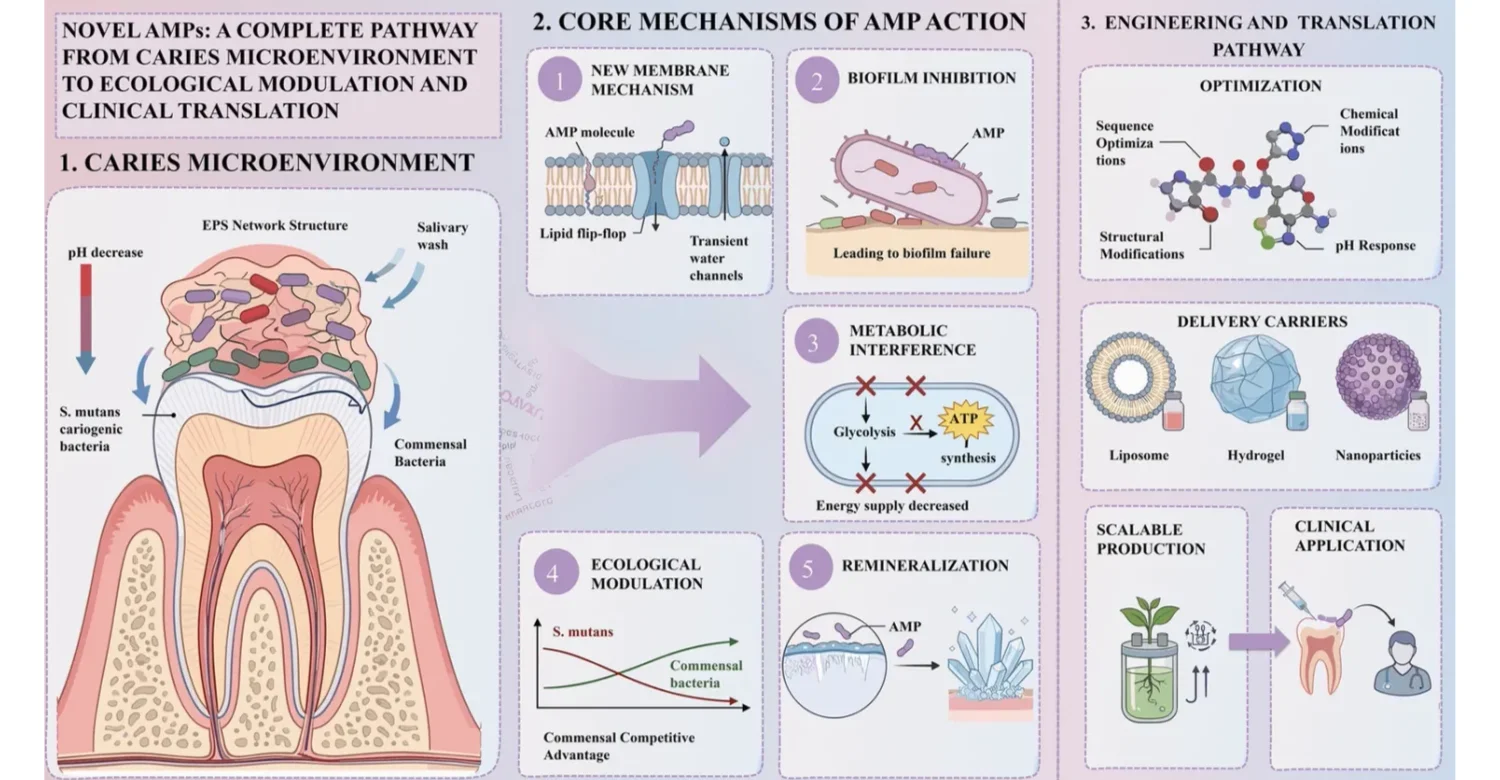
Research on smart peptides for dental caries points to several possible mechanisms. Some peptides may attract calcium and phosphate, encouraging mineral deposition in weakened enamel. Others may interfere with the bacteria that produce damaging acids. However, these are different molecules with different actions. No single peptide does everything. Therefore, smart peptides and dental caries research should be viewed as a family of approaches, not one therapy. Clinical evidence also varies widely between them, so careful interpretation is essential.
Supporting Enamel Remineralization
Enamel demineralization occurs when acids dissolve calcium and phosphate from the tooth surface. Saliva naturally returns these minerals between meals. Peptides for enamel remineralization aim to strengthen that natural process. Certain biomimetic peptides may form a scaffold inside an early lesion. This scaffold may then concentrate minerals where they are needed. Within smart peptides & dental caries research, this is the most studied idea. Still, it applies to early mineral loss only. It cannot fill a large, established cavity.
Supporting Enamel Repair
Mature enamel contains no living cells. As a result, it cannot regenerate the way bone or skin can. Peptides for enamel repair try to work around this limit. Researchers design them to imitate proteins that guide crystal growth during tooth development. In laboratory models, some peptides encourage organized, enamel-like mineral layers. However, this is mineral repair at a microscopic scale. It is not the rebuilding of a missing cusp or wall. Lost tooth structure still requires restorative treatment.
Potential Effects on Cariogenic Bacteria
Cariogenic bacteria, such as Streptococcus mutans, ferment sugars and release acids. Those acids lower plaque pH and dissolve enamel minerals. Some peptide technologies are designed to disrupt bacterial membranes or weaken biofilm structure. A few experimental peptides even aim at specific species while sparing helpful bacteria. This selective approach is one reason smart peptides and dental caries attract scientific interest. Nevertheless, not every peptide is antibacterial. Many remineralizing peptides have no direct effect on bacteria at all.
Find out the anatomical answer to are teeth part of the integumentary system?
Tips for Patients
Use fluoride regularly: Brush twice a day with fluoride toothpaste to help strengthen enamel and prevent decay.
Control plaque: Brush thoroughly and clean between your teeth every day to reduce harmful bacterial buildup.
Eat sensibly: Limit frequent sugary and acidic foods and drinks to reduce repeated acid attacks on your teeth.
Visit your dentist regularly: Routine checkups can identify early signs of caries before they become more advanced.
Keep up with proven prevention: Although smart peptides and dental caries research is promising, established preventive measures remain essential.
Stay open to new technology: Future peptide-based products may complement your routine, but they are unlikely to replace the basic habits that already protect your teeth.
Smart Peptides and Tooth Decay: Can They Reverse a Cavity?
The honest answer depends on the stage of decay. Discussions of smart peptides and tooth decay often blur four different conditions. These are early enamel demineralization, non-cavitated lesions, cavitated decay, and deep dentinal caries. Remineralization may help the first two. In contrast, an established cavity usually requires restorative treatment. Smart peptides & dental caries research therefore does not promise “regrowing” a badly damaged tooth. Once structure has broken down, minerals alone cannot rebuild the lost shape.
What Happens During Early Tooth Decay?
Decay begins when plaque biofilm accumulates on a tooth surface. Bacteria within that biofilm metabolize sugars and produce acids. Consequently, the pH at the enamel surface falls. Minerals then dissolve from beneath the outer layer, creating a subsurface lesion. Clinically, this often appears as a dull white spot. At this stage, the surface is still intact. However, if acid attacks continue, the weakened enamel eventually collapses. A visible cavity forms, and bacteria gain access to softer dentin.
When Can Remineralization Be Effective?
Remineralization works best when the enamel surface remains unbroken. Early lesions without cavitation can often be arrested or partly reversed. Success depends on healthy saliva, regular fluoride exposure, effective plaque removal, and less frequent sugar intake. Research on smart peptides and dental caries builds on these same foundations. However, patients cannot reliably judge lesion depth at home. A dentist must examine the tooth and confirm that the lesion is suitable. Only then is conservative management a safe choice.
Learn what to expect before and after extraction with immediate dentures
.webp)
Peptides for Dental Caries Prevention: What Could Future Dentistry Look Like?
Future dentistry may rely more on prevention than repair. Peptides for dental caries prevention could appear in several forms. Possible applications include preventive enamel treatments, biomimetic remineralization systems, bioactive dental materials, and targeted anti-biofilm approaches. Smart peptides and dental caries research supports each of these directions. However, progress depends on strict conditions. Each technology must prove clinical benefit, safety, and durability in the mouth. It must also gain regulatory approval before reaching everyday practice.
Could Peptides Work Alongside Fluoride?
Fluoride remains the best-supported agent for caries prevention. Emerging peptide technology does not automatically replace it. Instead, the two may complement each other. Fluoride strengthens the enamel surface and slows mineral loss. Certain peptides may help guide minerals deeper into an early lesion. Some studies on smart peptides & dental caries have tested this combination. Even so, laboratory findings are not clinical recommendations. Patients should keep using fluoride as advised unless their dentist recommends otherwise.
Could Peptides Help High-Risk Patients?
Caries risk differs greatly between individuals. Therefore, assessment comes before any preventive choice. Higher risk is linked to frequent sugar exposure, reduced salivary flow, and poor plaque control. Orthodontic appliances and previous decay also raise risk. In theory, these patients could benefit most from added remineralizing support. However, one emerging product cannot offset an unfavourable diet or a dry mouth. A complete prevention plan matters more. It should address causes first and then consider additional technologies.
Peptide-Based Treatment for Dental Caries: What Treatments Are Being Studied?
The phrase “peptide-based treatment for dental caries” covers several distinct technologies. It does not describe one standardized clinical procedure. Some approaches focus on rebuilding mineral in early lesions. Others aim to control harmful bacteria. A third group adds peptides to dental materials. Within smart peptides and dental caries research, each group has its own evidence base. A few approaches have reached clinical use in some countries, while many remain in laboratories. The sections below explain each one.
Biomimetic Peptides for Enamel Mineralization
Biomimetic peptides are designed to interact with calcium and phosphate ions. Some self-assemble into fine fiber networks inside an early lesion. These networks may act as a template for new mineral crystals. Others imitate amelogenin, the main protein that shapes developing enamel. The aim is organized mineral, not random deposits. Structure matters because enamel strength comes from tightly aligned crystals. Disorganized mineral may look repaired yet wear quickly. Therefore, researchers measure hardness and durability as well as mineral gain.
Peptide-Based Antibacterial Strategies
Peptide-Enhanced Dental Materials
Researchers are also exploring materials that carry bioactive peptides. Examples include adhesives, sealants, varnishes, and restorative resins. In principle, such materials could release or display peptides at vulnerable sites. These sites include filling margins, fissures, and areas around orthodontic brackets. As a result, protection would be delivered exactly where decay tends to start. This branch of smart peptides and dental caries research is still young. Most findings come from laboratory testing, so clinical performance remains unproven.
Discover key habits in 6 ways to keep your gums healthy
Smart Peptide Therapy for Tooth Decay: What Are Its Current Limitations?
Smart peptide therapy for tooth decay faces real obstacles. Laboratory findings, animal studies, early trials, and established protocols represent very different levels of proof. Several questions remain open. These include long-term durability, stability in saliva, delivery methods, cost, patient safety, clinical effectiveness, and regulatory approval. The mouth is a harsh environment with enzymes, acids, and constant wear. Consequently, a result seen in a test tube may not survive there. Smart peptides & dental caries research must clear these hurdles first.
Clinical Note
smart peptides are an emerging area of dental research. They are not a universal replacement for fluoride, professional preventive care, fillings, or other established caries treatments. The right treatment depends on whether a lesion is active, arrested, non-cavitated, or cavitated. Importantly, patients should never self-treat a suspected cavity with experimental peptide products. Any discussion of smart peptides & dental caries must begin with evidence-based diagnosis. Treatment planning is then tailored to the individual tooth and patient.
How Does Peptide-Based Dental Caries Treatment Compare With Conventional Care?
Peptide-based dental caries treatment and conventional care are not true competitors. Conventional care covers every stage of decay and rests on decades of evidence. Peptide approaches, in contrast, mainly target the earliest stage. Their evidence base is smaller and still growing. Therefore, the comparison changes with lesion severity. When weighing smart peptides and dental caries options, the stage of the lesion decides the answer. The three sections below compare both approaches for early, cavitated, and advanced decay.
Early Non-Cavitated Lesions
Early non-cavitated lesions are managed without drilling whenever possible. Established care includes professional fluoride application and fluoride toothpaste at home. Diet modification reduces the number of daily acid attacks. Improved biofilm control removes the source of those acids. In addition, sealants or resin infiltration may be suitable for selected lesions. This is where remineralization technologies could have a future role. Peptide products may eventually support these measures. However, they would add to proven methods rather than replace them.
Cavitated Lesions
Once the enamel surface breaks, the situation changes. A cavity shelters plaque that brushing cannot reach. As a result, the lesion usually keeps progressing. Restorative treatment is therefore often required. Where appropriate, dentists use minimally invasive techniques that remove only diseased tissue. Small adhesive fillings preserve more healthy structure than older designs. Peptide-based remineralization cannot simply replace lost tooth structure. It may harden weakened mineral, but it cannot rebuild a missing wall or restore proper shape.
Advanced Dental Caries
Advanced caries extends deep into dentin and may approach the pulp. At this stage, treatment becomes more comprehensive. The dentist must assess whether the pulp is healthy, inflamed, or infected. Symptoms such as lingering pain or swelling guide this decision. Depending on the findings, options may include a deep restoration, pulp therapy, or root canal treatment. Severely damaged teeth may also need a crown. Endodontic assessment is arranged when indicated. Remineralizing agents have no meaningful role in these cases.
Check the safety and effectiveness of whitening with braces at home
Smart Peptides in Dentistry: Where Could the Technology Go Next?
Smart peptides in dentistry are likely to develop in gradual, realistic steps. Dramatic claims about regrowing teeth are not supported by current evidence. Instead, progress may come in three areas. These are more targeted remineralization, bioactive preventive materials, and personalized caries prevention. Each builds on existing preventive dentistry. Research on smart peptides and dental caries continues to expand across all three. Even so, timelines are uncertain. Every new application must pass clinical trials before patients can rely on it.
More Targeted Remineralization
Future peptides may be designed to recognize specific tooth surfaces. For example, one sequence could bind to demineralized enamel but ignore healthy enamel. Another might target exposed dentin or root surfaces. This selectivity could allow more controlled mineral deposition. Minerals would form where they are needed and in a more ordered pattern. In theory, repaired areas would then resist acid and wear better. However, these designs are still being refined. Durable results in real mouths must be demonstrated.
Bioactive Preventive Materials
Peptide technologies may eventually appear in familiar formats. Future toothpastes, gels, coatings, varnishes, or dental materials could potentially incorporate them. Some products with peptide-based ingredients already exist in certain markets. Their supporting evidence varies considerably, though. Therefore, availability alone does not prove effectiveness. Each product depends on sound clinical evidence and regulatory approval for its claimed use. Patients should ask what a product has been shown to do. They should also ask for which type of lesion.
Personalized Caries Prevention
Prevention is becoming more individual. In future, dentists may combine caries-risk assessment with targeted technologies. A patient with dry mouth, for instance, might receive different support from a teenager wearing braces. Smart peptides and dental caries research fits naturally into this model. Peptide-based products could become one option among several. Overall, dentistry is moving toward disease prevention and preservation of natural tooth structure. The aim is fewer fillings over a lifetime, not simply better fillings.
What Are the Benefits of Peptides for Preventing Tooth Decay?
The potential benefits of peptides for preventing tooth decay are encouraging but not guaranteed. They may support early enamel remineralization and encourage biomimetic mineral formation. Some may also target cariogenic biofilms. Together, these effects align with minimally invasive dentistry. If effective technologies are developed, patients might need fewer extensive interventions later. For now, smart peptides & dental caries research offers possibilities rather than promises. Benefits will depend on the specific peptide and the quality of supporting trials.
What Patients Should Realistically Expect
Realistic expectations protect patients from disappointment. Emerging peptide approaches do not deliver instant enamel regeneration. Existing cavities cannot necessarily be reversed, whatever a label suggests. Results depend on the condition of the tooth and the specific technology used. An early white spot behaves very differently from a broken surface. Furthermore, any improvement is usually gradual and requires good daily habits. Conventional prevention therefore remains essential. Fluoride, plaque control, and a sensible diet still form the foundation of healthy teeth.
Read about the risks of tooth gems and enamel damage
Before and After: What Can Patients Expect From Caries Management?
Caries management does not always produce a dramatic visual change. In many cases, the best result is one that nobody notices. “Before and after” may mean an early lesion that stabilizes and stops progressing. It may mean a lower risk of future decay or preserved natural enamel. When necessary, it means a cavitated tooth restored to comfortable function. Smart peptides and dental caries research shares this goal. The priority is keeping healthy tooth structure, not simply changing appearance.
What We Notice Clinically
Dr. Rifat Alsaman, Head of the Medical Team at Vitrin Clinic and a cosmetic dentist, prioritizes preserving natural tooth structure whenever clinically appropriate. He views smart peptides & dental caries research as promising. However, he separates promising studies from treatments with sufficient evidence for routine care. Dr. Rifat Alsaman also stresses that minimally invasive dentistry never means avoiding necessary treatment once decay has progressed. In his view, individualized diagnosis must guide every decision. A technology should never be recommended simply because it is new.
Why Choose Vitrin Clinic for Comprehensive Dental Care?
At Vitrin Clinic, diagnosis and individualized treatment planning are central to patient care. Patients with suspected decay receive a proper clinical assessment before any treatment is chosen. Modern diagnostics, such as CBCT/3D imaging and intraoral scanning, are used where clinically indicated. Preventive, restorative, cosmetic, and periodontal services are coordinated when appropriate. Dr. Rifat Alsaman, Head of the Medical Team at Vitrin Clinic and a cosmetic dentist, supports this multidisciplinary approach. Emerging options, including smart peptides and dental caries technologies, are considered according to evidence and individual need.
Ready to transform your smile?
Talk to our team and get a FREE treatment plan.
References:
FAQs
Dr. Rifat Alsaman has more than 5 years of clinical experience in dentistry and currently serves as the Head of the Medical Team at Vitrin Clinic. He is dedicated to providing exceptional patient care, overseeing treatment planning, and ensuring the highest clinical standards across the team. His expertise, attention to detail, and commitment to continuous professional development have helped countless patients achieve healthier, more confident smiles.


