General Dentistry
September 22, 2026
Tooth Decay Stages: What Happens to My Teeth From Early Damage to an Abscess?
 Dr. Rifat Alsaman
Tooth decay stages describe how a healthy tooth can gradually break down. Left untreated, decay often begins as a small change in the enamel. It may progress deeper over time. Each stage can feel different. Early decay may cause no obvious symptoms at all. Recognizing which stage a tooth is in can help determine the right treatment. This might mean fluoride, monitoring, a filling, or something more advanced. Not every case follows the exact same timeline. Both children and adults can develop cavities, though risk factors may differ between age groups.
Tooth Decay Stages: How Does a Cavity Develop?
Tooth decay stages reflect a gradual process. Mineral loss leads to structural damage over time. Progression typically moves from initial demineralization to enamel decay, then dentin decay. From there it can reach pulp damage, and potentially a tooth abscess. Identifying which stage a tooth has reached matters for treatment planning. It also helps avoid unnecessary procedures. The main progression includes: initial demineralization, enamel decay, dentin decay, pulp damage, and tooth abscess. Understanding this progression helps patients make more informed decisions about timing and treatment intensity.
Stage 1 - Initial Demineralization
Initial demineralization is the earliest stage of tooth decay. Acids produced by oral bacteria remove minerals from enamel. This can leave a white or chalky area without pain. Because there's little discomfort, this stage is easy to miss. A professional look is often needed to catch it. At this point, preventive measures and fluoride treatment may be enough. Restorative work usually isn't necessary yet. A professional assessment can determine whether the enamel remains structurally intact.
Stage 2 - Enamel Decay
Enamel decay means the tooth's protective outer layer has started breaking down. This marks a further step in decay progression. Signs may include discoloration, roughness, or mild sensitivity. Many people still feel little or no pain at this stage. Left untreated, enamel damage can progress toward a cavity. Dental caries is the clinical term for this. This stage often goes unnoticed because symptoms are subtle. Catching enamel decay early keeps treatment options simpler.
Stage 3 - Dentin Decay
Dentin decay occurs once damage reaches the softer layer beneath enamel. Decay can progress more quickly at this point. Familiar symptoms often appear here. These include sensitivity to cold drinks and discomfort with sweets. Food may get trapped in a hole. Occasional toothache is also common. Because dentin is less resistant than enamel, the cavity can widen faster. A dental filling often becomes necessary at this stage.
Stage 4 - Pulp Damage
Pulp damage marks a more advanced point in tooth decay stages. The dental pulp is the inner part of the tooth. It contains nerves and blood vessels. Deep decay can irritate or damage this tissue. Patients often describe lingering tooth pain and strong sensitivity. Pain may start without an obvious trigger. Difficulty sleeping is a common complaint at this stage. When the pulp cannot recover, root canal therapy may be needed.
Stage 5 - Tooth Abscess
A tooth abscess is the most advanced stage of decay. It involves an infection with a collection of pus around or within the tooth. It often develops when pulp infection goes untreated. Possible symptoms include severe or persistent pain. Swelling around the tooth is common, along with gum tenderness. A bad taste or drainage may occur, and fever is possible in some cases. An abscess requires prompt professional assessment rather than home treatment alone.
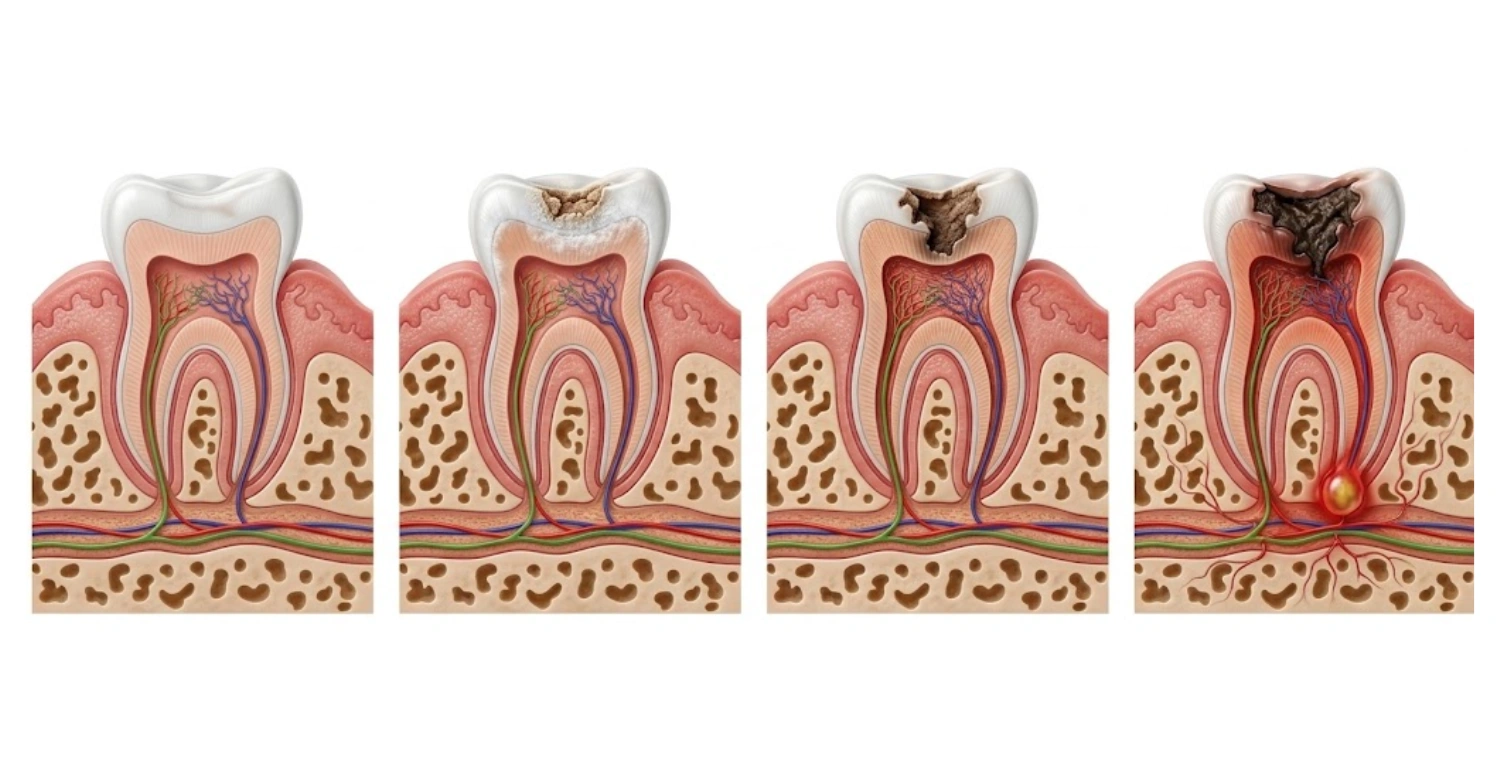
Note: All images used are for editorial and illustrative purposes only and may not originate from the original news provider or associated company.
Discover the relationship between oral health and overall well-being
Where Can Tooth Decay Show Up in My Mouth?
Decay isn't limited to one visible spot. It can affect different surfaces and locations across the mouth. Recognizing less obvious areas helps catch problems earlier. Common sites include between teeth and in grooves on back teeth. Decay can also appear near the gumline or around existing fillings. Exposed root surfaces are another common location. Some of these areas are difficult to see without a dental examination. Imaging may be used when clinically indicated.
Why Can Decay Between My Teeth Be Hard to Notice?
Early decay between teeth may not be visible in a mirror. This makes it one of the trickier stages to self-detect. Food trapping or discomfort while flossing can be early clues. These surfaces sit hidden from direct view. Dental X-rays are sometimes used when clinically indicated. They can reveal what the eye can't see. Waiting for visible signs often means the decay has already progressed further than expected.
Can Tooth Decay Affect Children Differently?
Children move through the same basic tooth decay stages as adults. There isn't a fundamentally different disease process at play. Several factors can influence how quickly decay appears in kids. These include frequent sugary snacks and oral hygiene difficulties. Developing brushing habits also play a role, as do primary teeth. Untreated decay in baby teeth can still affect eating and comfort. Age-appropriate dental assessment and prevention remain important.
Learn more about food allergies and oral health
What Causes Tooth Decay to Progress From One Stage to Another?
Several factors influence how quickly decay advances. These range from everyday habits to more significant risk factors. Understanding these contributors helps explain why people have different experiences with decay. The sections below move from common factors toward more structural ones. This covers sugar exposure, plaque buildup, saliva flow, and tooth anatomy. Recognizing which factors apply to your routine can guide more targeted prevention.
Frequent Exposure to Sugars and Acid
Oral bacteria use fermentable carbohydrates for energy. Acid is produced as a byproduct of this process. Repeated exposure to sugar means repeated acid attacks on enamel. This accelerates early decay. Frequency may matter just as much as the total amount consumed. Each exposure triggers a new acid cycle. Spacing out sugary foods gives enamel more time to recover between exposures.
Inadequate Plaque Removal
Dental plaque is a sticky film of bacteria. It forms continuously on tooth surfaces. When it isn't removed effectively, it tends to remain in certain spots. These include grooves, between teeth, and near the gumline. Persistent plaque creates more opportunity for acid-related enamel damage. This pushes decay further along the tooth decay stages. Regular, thorough cleaning disrupts this buildup before it causes lasting harm.
Reduced Saliva or Dry Mouth
Saliva plays a protective role in the mouth. It buffers acid and washes away food debris and bacteria. Dry mouth can reduce this natural buffering and cleansing. This allows decay to progress more easily. Possible contributing factors include dehydration and mouth breathing. Certain medications may also play a role. Saliva flow varies from person to person. Some individuals face a higher baseline risk as a result.
Deep Grooves, Crowding, or Difficult-to-Clean Areas
Tooth anatomy and positioning can make certain surfaces harder to clean. Deep grooves on molars are one example. Overlapping or crowded teeth create similar challenges, as do tight contact points. These areas are common starting points for early decay. Brushing alone may not fully clear them. Individualized preventive advice can be genuinely useful here. It should be tailored to a person's specific tooth shape and alignment.
Tips for Patients
Brush twice daily with fluoride toothpaste, especially before bed.
Clean between your teeth daily, even if the areas look healthy.
If cold or sweet foods trigger pain, note which tooth and how long the pain lasts.
Reduce frequent snacking on sugary or acidic foods throughout the day.
Do not place aspirin or other substances directly on a painful tooth.
During your consultation at Vitrin Clinic, ask whether the affected tooth needs imaging or monitoring.
Explore the connection between thyroid eye disease and oral health
What Other Symptoms Can Happen With Tooth Decay?
Symptoms tend to line up with specific stages. They don't form one universal list. Early on, you might have no symptoms at all. Discomfort can become noticeable as decay reaches deeper layers. Recognizing which symptom pattern matches which stage helps set realistic expectations. Some signs, like brief sensitivity, may point to earlier stages. Persistent or spontaneous pain often signals that decay has advanced further.
Why Does My Tooth Hurt With Cold or Sweet Foods?
Brief sensitivity to cold or sweet foods often connects to affected tooth structures. This is common at earlier stages of decay. This kind of pain typically fades quickly once the trigger is removed. Persistent or lingering pain is different. It may signal that decay has reached deeper layers. This requires further evaluation from a dental professional. Pay attention to how long the discomfort lasts, not just that it happens.
Why Does My Tooth Hurt When I Bite?
Pain when biting can relate to several things. Deeper decay, inflammation, cracks, or infection are all possible causes. Biting pain does not automatically mean advanced decay. A crack or gum issue could be responsible instead. Several conditions can produce similar sensations. A professional examination is usually the most reliable way to identify the source.
Why Is My Toothache Keeping Me Awake?
Deeper inflammation can produce spontaneous or persistent pain. This kind of pain is hard to ignore, especially at night. This pattern often reflects later stages of decay, where the pulp is affected. Relying only on pain relief isn't enough at this point. This symptom is a strong reason to arrange professional assessment soon. Ongoing sleep disruption from tooth pain usually signals that the underlying problem needs attention.
Discover more about polyarteritis nodosa and oral health
What Can I Do at Home if I Think I Have Tooth Decay?
Home care may support oral health. It cannot rebuild a large cavity once decay has advanced. Low-risk actions include brushing twice daily with fluoride toothpaste. Cleaning between teeth daily is equally important. Reduce frequent sugary snacks and drinks, and drink water regularly. Avoid repeated exposure of the affected tooth to acidic or sugary foods. These habits can slow progression and support overall oral health. Home care should not replace professional assessment when symptoms persist.
Can Fluoride Help Early Tooth Decay?
Fluoride treatment involves applying concentrated fluoride to the teeth. This strengthens enamel and supports remineralization. It can help reverse very early decay, particularly initial demineralization. Minerals are encouraged to redeposit into weakened enamel. It's important to distinguish early mineral loss from an established cavity. Fluoride cannot simply fill a large structural gap in the tooth. At that point, restorative treatment becomes the more appropriate option.
Learn about HIV symptoms and oral health
What Assistive Tools May Help With Tooth Decay Prevention?
Certain tools can make daily plaque control easier. They support tooth decay prevention at every stage. Options include electric toothbrushes and interdental brushes. Dental floss, fluoride toothpaste, and water flossers are also useful where appropriate. Each tool suits different needs. Some people find interdental brushes easier than floss. Others benefit more from a water flosser. The best combination depends on tooth position, dexterity, and individual oral health needs.
When Should I Stop Managing Tooth Decay at Home and See a Dentist?
There's a clear point where self-care should shift to professional assessment. Seek dental care if you notice persistent toothache or lingering sensitivity. Visible holes or dark areas are also warning signs. Swelling, pain when biting, and a bad taste or drainage all warrant attention. Broken or weakened tooth structure is another sign. This often means decay has progressed beyond what home care can manage. Facial swelling, fever, or difficulty breathing call for urgent assessment right away.
Explore the science behind ferroptosis in periodontitis
How Is Tooth Decay Treated at Different Stages?
Treatment depends on several factors. These include depth, location, symptoms, and remaining tooth structure. Whether infection is present also matters. Options generally move from least invasive to more involved. This starts with preventive measures and progresses toward restorative or surgical care. Matching treatment to the actual stage helps preserve healthy tooth structure. It also addresses the underlying problem effectively.
Fluoride Treatment and Preventive Care
Fluoride treatment and improved oral hygiene may be appropriate at the earliest stages. This applies particularly to initial demineralization. Restorative work often isn't necessary yet at this point. In selected early cases, monitoring may be recommended instead. This allows time to see whether preventive measures are enough. This approach works best when the enamel remains structurally intact.
Dental Fillings for Cavities
Dental fillings are commonly used once decay has reached an established cavity. The basic process involves removing damaged tooth structure. The area is then cleaned and restored with suitable material. The bite is checked afterward for comfort. Results vary depending on the size and location of the cavity. Expectations should stay realistic rather than assuming a specific cosmetic outcome.
Root Canal Treatment for Deep Decay
Root canal treatment becomes relevant when decay reaches the pulp. This is one of the more advanced tooth decay stages. The procedure removes infected or irreversibly inflamed pulp tissue. It then seals the internal space to prevent further infection. The general aim is to preserve the natural tooth whenever possible. Extraction isn't the first option here. This allows many patients to keep their original tooth despite significant internal damage.
Treatment When a Tooth Cannot Be Restored
In some cases, severely damaged teeth may require removal. This happens when insufficient healthy structure remains to support restoration. This decision depends on examination and imaging when indicated. Extraction isn't presented as inevitable even in advanced decay. Many teeth can still be saved with root canal treatment or fillings. Each case is evaluated individually.
Find out more about sialadenitis and salivary gland inflammation
What Benefits Can I Expect After Tooth Decay Treatment?
Benefits vary according to the specific treatment used. Possible improvements include reduced sensitivity and relief from decay-related pain. Restored chewing function is another common benefit. Treatment also protects remaining tooth structure and reduces the risk of further progression. The expected result depends heavily on the stage and condition of the tooth. Outcomes for early intervention often differ from those following more advanced procedures.
What Might My Tooth Look and Feel Like After a Filling?
A filling may restore the damaged area and improve day-to-day function. This closes the gap left by mid-stage decay. Mild temporary sensitivity can sometimes occur afterward. This is particularly true with temperature changes. It typically settles within a short period. Persistent pain beyond the expected adjustment window should be reported. This may indicate the filling needs adjustment.
What Can I Expect After Root Canal Treatment?
Some discomfort may occur temporarily after root canal treatment. This is common in the days immediately following the procedure. The tooth is typically restored afterward, often with a filling or crown. This protects the treated structure and restores function. Symptom resolution isn't always immediate or guaranteed. Most patients see steady improvement over time. Any unusual or worsening pain should prompt a follow-up visit.
What We Notice Clinically
Early decay can be easy to overlook. Symptoms may be minimal even when structural damage is present. The same amount of visible discoloration doesn't necessarily reflect the same depth of decay. Dr. Rifat Alsaman, Head of the Medical Team at Vitrin Clinic and cosmetic dentist, emphasizes an important point. Treatment decisions should be based on the condition of the tooth, not pain intensity alone. A tooth can have significant decay with limited symptoms. Another tooth may feel painful for reasons requiring a different diagnosis. Clinical examination and appropriate imaging remain essential for an accurate assessment.
Discover the possible causes of loss of taste
Clinical Note
Tooth decay should be assessed according to depth, location, symptoms, and remaining structure. Appearance alone isn't enough. Dr. Rifat Alsaman, Head of the Medical Team at Vitrin Clinic and cosmetic dentist, notes an important risk. Delaying treatment because a tooth "doesn't hurt yet" may allow the problem to progress unnoticed. Cosmetic concerns should not replace evaluation of the tooth's underlying health. This note is meant to inform patients about the value of timely assessment.
How Can You Prevent Tooth Decay From Coming Back?
Tooth decay prevention works best as an ongoing routine. It isn't a one-time fix, especially after treating any stage of decay. Core habits include twice-daily brushing with fluoride toothpaste. Daily interdental cleaning is equally important. Limit frequent sugar exposure and schedule regular dental examinations. Managing dry mouth and using fluoride when recommended also help. Since individual risk varies, prevention strategies may need to be adjusted over time.
Can Changing My Eating Habits Lower My Risk?
Reducing frequent sugary exposures throughout the day can meaningfully lower risk. The focus should be on frequency and timing. An unrealistic "never eat sugar" approach is hard to sustain long-term. Choosing water as an everyday alternative to sugary drinks is one practical change. Small, consistent adjustments to eating patterns often matter more than occasional strict restriction.
How Often Should I Have My Teeth Checked?
Dental examination frequency varies according to individual risk. There isn't one universal interval for everyone. Factors influencing this include previous cavities and oral hygiene habits. Age, dry mouth, and existing restorations also play a role. Someone with a history of rapid decay progression may need more frequent visits. A dental professional can recommend a personalized checkup schedule.
How Does Vitrin Clinic Approach Tooth Decay Assessment?
Assessment at Vitrin Clinic typically includes clinical examination and evaluation of symptoms. Tooth structure is also assessed carefully. Digital imaging is used when clinically indicated. Individualized treatment planning follows from there. The appropriate treatment always depends on the actual stage of decay present. Dr. Rifat Alsaman, Head of the Medical Team at Vitrin Clinic and cosmetic dentist, is involved in this process. The goal is addressing the underlying dental problem while preserving healthy tooth structure.
Learn what can cause a yellow tongue
Takeaway: Understanding the Tooth Decay Stages Can Help You Act Earlier
The tooth decay stages progress from initial demineralization through enamel and dentin decay. From there, they move toward pulp damage and possible abscess formation. Symptoms don't always reflect how deep decay actually runs. This is why relying on pain alone can be misleading. Early assessment may allow less invasive management in appropriate cases. If you notice persistent sensitivity, pain, discoloration, or swelling, arrange a dental assessment. Don't wait for symptoms to worsen further.
Explore salivary gland stones and their symptoms
References:
FAQs
Dr. Rifat Alsaman has more than 5 years of clinical experience in dentistry and currently serves as the Head of the Medical Team at Vitrin Clinic. He is dedicated to providing exceptional patient care, overseeing treatment planning, and ensuring the highest clinical standards across the team. His expertise, attention to detail, and commitment to continuous professional development have helped countless patients achieve healthier, more confident smiles.


