Dental Care Guide
October 4, 2026
What Are the Early Signs of Dental Problems? Early Signs of Tooth and Gum Problems
 Dr. Rifat Alsaman
The Early Signs of Dental Problems are small changes that often appear before severe pain develops. Many dental conditions develop gradually, so subtle changes in teeth, gums, or bites deserve attention. Bleeding gums, recurring sensitivity, and new discoloration are among the most common first clues. Gingivitis is generally reversible with effective plaque control and professional care. Noticing changes early usually means more treatment choices and simpler care. Regular dental visits help identify problems before they become more advanced.
What Are the Early Signs of Dental Problems?
Early Signs of Dental Problems include sensitivity, bleeding gums, discoloration, bad breath, and subtle bite changes. Each sign has several possible causes, so examination matters. A single sore spot after hard food often settles within days. A change that returns in the same place deserves a dental check. Compare new changes with how your mouth usually feels, and note when and where they occur.
What counts as an early sign of a dental problem?
An early sign is any new, mild, or repeated change in your teeth, gums, or bite. It often appears before obvious damage or pain. Examples include a twinge with cold water, bleeding while flossing, or a rough edge. Food catching in a new spot can also be an early clue. Telling your dentist which tooth is affected and when it started narrows the possible causes. Even small changes are worth noting if they repeat.
Why early dental problems may cause little or no pain
Enamel has no nerves, so early decay usually causes no discomfort. Gum disease is also often painless until it becomes advanced. Many Early Signs of Dental Problems are therefore easy to miss. A lack of pain does not mean a tooth is healthy. Regular examinations find changes that you cannot feel. This is why routine visits matter even when you feel well.
Early signs versus symptoms found during a dental examination
Some Early Signs of Dental Problems you notice yourself, such as bleeding or sensitivity. Others, like early decay between teeth, appear only on examination or X-rays. Photos can record color changes and chips, but not decay under fillings or bone loss. A dentist combines what you report with clinical findings. Both together give the most accurate picture.
Why noticing early signs of dental problems can matter for treatment options
Spotting the Early Signs of Dental Problems often allows smaller, simpler treatment. Very early decay may need fluoride rather than a filling. Gingivitis can often be reversed before bone loss begins. Delayed care may lead to larger fillings, root canals, or crowns. Early action usually protects more natural tooth structure.
Understand the function and treatments for a frenum in the mouth
What Are the Most Common Early Signs of Dental Problems?
The most common Early Signs of Dental Problems involve sensitivity, gum changes, and tooth surface changes. Bad breath, trapped food, and bite changes are also frequent. One symptom can have several causes, such as decay, recession, or a crack. The sections below describe what patients notice most often. Persistent or recurring signs deserve a dental review.
Tooth sensitivity to cold, hot, sweet, or acidic foods
Sensitivity to temperature or sweets is one of the most frequent early clues. A brief twinge that fades in seconds often reflects exposed dentin. Pain lasting minutes after cold may suggest deeper nerve irritation. Sensitivity can come from decay, recession, enamel wear, or recent dental work. Mild sensitivity after a new filling often fades within a few weeks. Sensitivity that grows over time needs a dental review.
Mild or occasional tooth pain
Mild pain that comes and goes can still signal early decay or a crack. Pain on biting may come from a cracked tooth, a high filling, or gum inflammation. Occasional pain should be checked if it keeps returning. Note what triggers it and how long it lasts. These details help your dentist test the right tooth. Pain relief may mask the problem without fixing it.
White, brown, or dark changes on the tooth surface
Chalky white spots can show early mineral loss. Brown or dark areas may be stained, old restorations, or more advanced decay. Color alone cannot tell which, so examination is needed. A dentist checks whether the surface is soft or intact. X-rays may be used when decay is suspected but not visible. Photos taken over time can help show whether a spot is changing.
Bleeding, swollen, red, or tender gums
Healthy gums are firm, pale pink, and rarely bleed. Red, puffy, or bleeding gums usually signal inflammation caused by plaque. Bleeding may increase at first when you start flossing inflamed gums. It usually reduces within two weeks if plaque control improves. Ongoing bleeding should be assessed by a dentist. Smokers may bleed less, so inflammation can be hidden.
Persistent bad breath or a bad taste
A bad taste or breath that brushing does not fix may point to gum infection or decay. Bacteria on the tongue and dry mouth can also contribute. Ongoing bad breath deserves a broader oral review. A dentist can check gums, teeth, and tongue to find the source. Treating the cause usually improves breath more than mouthwash alone.
Food getting trapped between teeth
Regular food trapping can mean a new gap, a cavity, or a worn filling contact. Trapped food can also irritate the gums and cause soreness. A new trapping spot is worth mentioning at your next visit. Floss or interdental brushes help remove debris gently. Persistent trapping may need a filling or contact repair. Leaving debris in place can lead to decay and gum soreness.
Rough, chipped, cracked, or worn tooth surfaces
Chips, cracks, and flattened edges often come from grinding, trauma, or acid wear. A rough edge felt with the tongue may also be a damaged filling. Sharp edges can irritate the tongue and cheeks. Early repair can prevent larger fractures. Repeated breakage may signal clenching or bite overload.
Changes in the way your teeth meet when you bite
A bite that feels uneven or new may relate to a loose tooth, a fracture, or jaw strain. If teeth suddenly meet differently, something may have moved or broken. Inflammation around a tooth can also make it feel high. Bite changes help dentists locate the problem. Persistent changes need assessment.
Mild gum recession or teeth appearing longer
Teeth looking longer usually means the gums have pulled back. Recession exposes root surfaces that can become sensitive. Roots lack enamel, so they also decay more easily. Recession may follow gum disease or aggressive brushing. A dentist can measure it and track changes over time. A soft toothbrush and gentle technique help limit further recession.
Tooth or gum sensitivity that keeps returning
Sensitivity that repeatedly returns suggests an ongoing cause rather than passing irritation. A single episode is less informative than a repeated pattern. Keep a short note of triggers, timing, and location. Bring these notes to your appointment. They help your dentist separate decay, recession, and cracks.
Find out how to quit smoking with nicotine gum
What Are the Early Signs of Tooth Decay?
Tooth decay begins with mineral loss, often before any pain appears. Each time bacteria produce acid from sugar, enamel loses minerals. Saliva and fluoride can replace them if acid attacks are not too frequent. Sipping sugary drinks all day keeps teeth under repeated attack. Early signs include white spots, mild sensitivity, and slight color change.
Can tooth decay begin without pain?
Yes, early decay is usually painless because enamel has no nerves. NIDCR explains that early mineral loss can sometimes be stopped or reversed with fluoride . Pain often appears only when decay reaches the dentin. Decay between teeth is often found only on X-rays. Regular check-ups catch these silent changes. Waiting for pain often means waiting until treatment is larger.
White spots and early enamel mineral loss
Chalky white spots, often near the gumline, can mark early demineralization. Other causes are possible, so a dentist should confirm. With fluoride and better cleaning, these spots may harden again. Saliva carries calcium and phosphate back to weakened enamel. Sealants may also protect deep grooves on back teeth. Reducing sugar frequency gives the enamel more time to recover.
Sensitivity to sweets, cold, or hot foods and drinks
A twinge with sweets or temperature can mean decay is nearing the dentin. Note which tooth reacts and how long it lasts. Brief sensitivity may also come from recession or worn enamel. Lingering pain suggests deeper involvement. Examination and X-rays help confirm the cause.
Brown or black discoloration and visible changes
Brown or black spots may be stained or established decay. Children often develop decay in chewing grooves and baby teeth. Adults more often develop decay around old fillings and exposed roots. A dentist can check whether the surface is soft or intact. Visible holes usually indicate decay that needs treatment.
When a small cavity becomes a deeper tooth problem
Untreated decay spreads into dentin and eventually toward the nerve. A white spot can often be reversed, but a hole cannot regrow. Pain usually increases as decay deepens. Treatment also becomes larger as it progresses. The stages below explain how decay changes over time. Early treatment usually saves time, discomfort, and cost.
Early decay before a cavity forms
Before a cavity forms, enamel is weakened but still intact. This stage can often be managed with fluoride and diet changes. Reducing how often you eat sugar is especially helpful. A dentist may monitor the area at regular visits. Treatment starts only if the lesion progresses.
Decay after a cavity develops
Once enamel breaks down into a hole, the damage is permanent. The usual treatment is removing the decay and placing a filling. Earlier fillings are usually smaller and simpler. Delaying treatment allows decay to spread further. Food trapping or sensitivity may increase at this stage.
Signs that decay may have reached the tooth pulp
Lingering pain, night pain, or throbbing may mean decay has reached the pulp. Swelling or a gum pimple suggests possible infection. A tooth that suddenly stops hurting may have a dying nerve. These signs need prompt dental assessment. Root canal treatment may be needed to save the tooth.
What Are the Early Warning Signs of Gum Disease?
Gum disease often starts quietly with bleeding, redness, and mild swelling. Plaque along the gumline triggers inflammation within days. If plaque hardens into tartar, only professional cleaning can remove it. Smoking can hide bleeding, so disease may progress unnoticed. Without care, gum disease can lead to recession, loose teeth, and bone loss.
Bleeding gums when brushing or cleaning between teeth
Healthy gums rarely bleed with gentle cleaning. Bleeding while flossing usually means plaque has been sitting between the teeth. It is a common sign of gingivitis. Do not stop cleaning because of bleeding. Persistent bleeding should be discussed with a dentist. Bleeding often improves within two weeks of thorough daily cleaning.
Red, swollen, or tender gums
Inflamed gums look red, feel puffy, and may be sore. Gums near crowns, fillings, or braces are especially prone to plaque buildup. These changes often improve with better plaque removal. Professional cleaning removes tartar that brushing cannot. Ongoing swelling needs a periodontal check.
Persistent bad breath or an unpleasant taste
Bacteria in gum pockets can produce lasting bad breath and an unpleasant taste. This is a common sign of active gum disease. Mouthwash may mask it only briefly. A dentist can measure pocket depths to find the source. Treating the gums usually improves breath.
Early gum recession and changes around the teeth
Recession can make teeth look longer or create notches near the gumline. Exposed roots may feel sensitive to cold air or drinks. Recession may follow gum disease or aggressive brushing. A periodontal chart records recession, pockets, and bleeding over time. Comparing charts shows whether gum health is stable.
How gingivitis differs from periodontitis
Gingivitis affects only the gums and is reversible. Periodontitis involves loss of attachment and bone around the teeth. Lost bone cannot fully regrow, so early care matters. Smoking and diabetes increase the risk of periodontitis. The sections below explain both stages. A periodontal examination shows which stage is present.
Why early gum inflammation may be reversible
At the gingivitis stage, no bone has been lost yet. Thorough daily cleaning removes the plaque driving inflammation. Professional cleaning removes hardened tartar. Bleeding often reduces within one to two weeks. Gums can then return to a healthy state.
Signs that gum disease may be becoming more advanced
Loose teeth, spreading gaps, pus, and receding gums suggest advanced disease. Bite changes may also appear as supporting tissue weakens. These signs need prompt periodontal assessment. Treatment may include deep cleaning or specialist care. Regular maintenance visits then help keep the gums stable.
What Other Early Signs of Dental Problems Should You Watch For?
Beyond teeth and gums, other Early Signs of Dental Problems involve saliva, soft tissues, jaw function, and restorations. These deserve equal attention. Symptoms in these areas often overlap with other conditions. Clinical tests and imaging help identify the cause. The sections below describe what to look for.
Dry mouth and changes in saliva
Thick saliva, a sticky feeling, or frequent thirst may signal reduced saliva. Dry mouth makes eating, speaking, and swallowing harder. It also raises decay risk because saliva neutralizes acid. Many medicines, including some for blood pressure and mood, reduce saliva. Tell your dentist about every medicine you take. Sipping water and avoiding sugary drinks can help protect teeth.
Mouth sores, ulcers, or persistent red or white patches
Most minor ulcers heal within one to two weeks. Trauma from teeth or appliances can irritate soft tissues. Red or white patches have many causes and cannot be diagnosed by appearance. Any sore, patch, or lump lasting longer should be professionally checked. Avoid repeatedly self-treating a lesion that does not heal.
Jaw discomfort, facial pain, or pain when chewing
Aching jaws, clicking, or facial pain while chewing may relate to clenching or the jaw joint. Pain may also come from a tooth or tired chewing muscles. Examination helps identify which structure is involved. Stress and grinding often contribute to muscle tenderness. Dental causes should always be excluded. Keeping a note of when pain occurs helps identify triggers.
Cracked, worn, or repeatedly breaking teeth
Flattened, chipped, or cracked teeth often reflect grinding or acid wear. Teeth or fillings that keep breaking may signal bite overload. Finding the cause helps protect future repairs. A night guard may be suggested after assessment. Early protection can prevent deeper fractures.
Tooth mobility or changes in bite
Healthy teeth move very slightly within their supporting tissues. Noticeable wobbling or shifting is not normal in adults. It may reflect gum disease, bone loss, or trauma. A bite that suddenly changes should also be checked. Both deserve timely assessment. Early assessment improves the chance of keeping the tooth.
Changes that may be related to dental appliances or restorations
New soreness near a denture, brace, or crown may come from pressure or a loose part. Dark lines, gaps, or food trapping around fillings may signal leakage or new decay. Braces and retainers also create extra plaque traps. Restoration edges need periodic checks. Adjustments are often simple.
Learn about causes and symptoms of oral stomatitis
What Causes the Early Signs of Dental Problems?
Most Early Signs of Dental Problems trace back to plaque, diet, saliva, habits, and mechanical stress. Several causes often act together. Understanding them helps you reduce your risk. Some causes are habits you can change. Others, such as medicines or medical conditions, need professional guidance.
Dental plaque and oral bacteria
Plaque is a sticky film of bacteria that forms constantly. It is the main driver of both tooth decay and gum disease. Fresh plaque brushes off easily. Older plaque becomes thicker and more harmful. Within days, it can start hardening into tartar. Daily brushing and interdental cleaning disrupt plaque before it matures.
Frequent sugar and acidic food or drink exposure
Each sugar exposure triggers a fresh acid attack on enamel. Frequent snacking leaves little time for saliva to repair it. Sodas, juices, and sports drinks can also dissolve enamel directly. How often you eat matters as much as how much. Limiting sweets to mealtimes reduces risk. Drinking water after acidic drinks helps rinse the teeth.
Inadequate brushing and interdental cleaning
Missed areas let plaque build up and mature. Toothbrush bristles cannot fully reach between teeth. Floss or interdental brushes clean the spaces where problems often start. Brushing twice daily with fluoride toothpaste is essential. Daily interdental cleaning addresses most remaining risks.
Gum inflammation and tartar buildup
Tartar holds bacteria against the gums and keeps them inflamed. It cannot be removed by brushing alone. Professional cleaning removes it so the gums can heal. Without removal, inflammation may progress to periodontitis. Regular cleanings help prevent buildup.
Dry mouth and reduced saliva protection
Less saliva means weaker acid buffering and slower enamel repair. Decay can then progress faster, especially near the gumline. Medicines are a common cause of reduced saliva. Drinking water supports comfort and rinses food away. Persistent dryness needs clinical review. Your dentist may recommend extra fluoride for added protection.
Tooth grinding, clenching, and mechanical stress
Grinding and clenching load teeth repeatedly, often during sleep. Over time this causes wear, cracks, and jaw soreness. Many people are unaware that they grind. A dentist may spot flattened edges or muscle tenderness. A night guard may protect the teeth.
Smoking and tobacco exposure
Tobacco reduces blood flow to the gums and weakens healing. Smokers face a higher risk of gum disease and tooth loss. Smoking can also mask gum bleeding. It stains teeth and slows recovery after treatment. Stopping smoking improves gum health over time. Tobacco use also raises the risk of oral lesions.
Existing fillings, crowns, braces, and other dental appliances
Restorations and appliances create edges where plaque collects. Rough or overhanging margins are especially prone to buildup. New decay can develop around them without obvious symptoms. Gums near appliances may bleed if cleaning is incomplete. Regular checks keep these areas healthy.
Who Is More Likely to Develop Early Dental Problems?
Anyone can develop dental problems, but some habits and conditions raise risk. People with these risks may notice Early Signs of Dental Problems sooner. Risk factors raise the chance of disease but do not cause it alone. Regular care can offset much of that risk. Knowing your risk helps set the right check-up interval.
People with inconsistent oral hygiene
Irregular brushing and flossing allow plaque to build up. These patients often notice bleeding gums and early decay first. Plaque that is not removed can harden into tartar. Consistent daily routines lower risk significantly. Professional cleaning helps reset gum health. Simple reminders can help build a steady routine.
People with frequent sugary snacks or drinks
Frequent sugar exposure keeps enamel under constant acid stress. Small snacks spread across the day are more harmful than one sweet meal. These patients benefit from fluoride and diet adjustments. Water between meals helps rinse sugars away. Sealants may protect vulnerable grooves.
People with dry mouth or reduced saliva flow
Reduced saliva raises the risk of decay and sore tissues. Some medicines and medical conditions cause dry mouth. Saliva substitutes and extra fluoride may be recommended. Sipping water can improve comfort. A dentist can review possible causes and risk factors.
People who smoke or use tobacco
Tobacco users have a higher risk of gum disease and oral lesions. Tobacco narrows blood vessels and impairs healing. It also makes gum treatment results less predictable. Regular soft-tissue checks are especially important. Quitting reduces risk over time.
Children, teenagers, and adults with different oral health risks
Children often get decay in chewing grooves and baby teeth. Teenagers face decay from snacks and plaque around braces. Adults face more gum disease, root decay, and wear. Check-ups and advice should match each life stage. Age alone does not diagnose any condition.
People with diabetes or other relevant risk factors
Diabetes is linked with a higher risk of serious gum disease. Good blood sugar control and regular dental visits both help. Some medicines and conditions also raise oral risk. Sharing your medical history helps your dentist plan monitoring. Gum health may need closer review. Bleeding or swollen gums should be reported promptly.
Why risk factors do not diagnose a dental condition
A risk factor raises the chance of disease but does not prove it exists. Two people with the same habit may have very different risks. Only an examination can confirm a diagnosis. Risk assessment works best alongside clinical findings. Statistics describe groups, not individual patients.
Understand the causes and treatment for trench mouth
Which Early Signs of Dental Problems Should You Not Ignore?
Some Early Signs of Dental Problems need prompt attention because they suggest progression or infection. Persistence, swelling, and worsening pain are key warnings. A change lasting more than one to two weeks deserves a dental visit. Short-lived irritation that fully resolves is less concerning. The sections below separate routine from urgent signs.
Signs that should prompt a routine dental appointment
Mild Early Signs of Dental Problems, such as minor bleeding or small chips, can usually wait for a routine visit. New food trapping and mild sensitivity also fit here. Book sooner if they worsen or spread. Write down when each sign starts. Routine care often prevents larger problems.
Persistent pain or sensitivity that does not settle
Pain or sensitivity lasting beyond two weeks is not passing irritation. It may reflect decay, a crack, or nerve inflammation. Pain that wakes you at night needs prompt review. Note triggers and duration before your visit. Examination can identify the cause. Delaying review may allow a small problem to grow.
Repeated gum bleeding, swelling, or recession
Ongoing gum bleeding or new recession suggests active gum disease. Swelling indicates inflammation that should be assessed promptly. A periodontal assessment can measure how far disease has progressed. Early treatment prevents further bone loss. Do not stop cleaning because of bleeding.
A loose tooth or a sudden bite change
Adult teeth should not feel loose. Mobility may signal bone loss from gum disease or injury. A sudden bite change may reflect a fracture, infection, or jaw problem. Both need prompt professional assessment. Early review improves the chance of saving the tooth. Avoid chewing hard foods on the affected side until assessed.
Persistent mouth ulcers, red patches, white patches, or unusual lumps
Any lesion that does not heal within two weeks needs examination. Most are harmless, but some require further testing. Appearance alone cannot show whether a patch is safe. Avoid repeatedly self-treating a lasting lesion. Early review is the safest approach.
Severe toothache, swelling, fever, or signs of infection
Severe pain with swelling or fever suggests an infection that needs urgent care. Fever may mean the infection is spreading. NHS guidance treats facial or neck swelling with breathing or swallowing difficulty as an emergency . Share symptoms, timing, and medicines when you call. The sections below explain where to seek help. Do not rely on painkillers alone in these situations.
When urgent dental care is appropriate
Seek urgent dental care for severe pain, swelling, a knocked-out tooth, or a broken tooth. Same-day assessment can prevent complications. A knock to the mouth can damage nerves without obvious signs. Bring any broken pieces if possible. Mention fever or recent dental work.
When facial swelling or difficulty breathing or swallowing requires emergency medical care
Swelling spreading toward the eye, neck, or floor of the mouth is an emergency. Go to emergency services if breathing or swallowing is affected. Do not wait for a dental appointment in these cases. Fast treatment can prevent serious complications. Dental follow-up comes after the emergency is controlled.
When mouth trauma or uncontrolled bleeding needs urgent assessment
Bleeding that does not stop with firm pressure needs urgent care. Significant facial injury also needs prompt medical assessment. Injured teeth may need splinting or nerve checks. Keep a knocked-out adult tooth moist and seek care quickly. Timely treatment improves outcomes.
Read a complete guide on how to care for your dentures
Can the Early Signs of Dental Problems Go Away on Their Own?
Some Early Signs of Dental Problems improve once a trigger is removed, but many do not. Sensitivity after whitening or a sore spot from food may settle within days. Decay and gum disease rarely resolve without care. Symptoms that disappear and return often reflect an ongoing cause. Monitoring means recording changes and reviewing them with a dentist.
Signs that may improve with better oral hygiene
Mild gum bleeding, redness, and some bad breath often improve with better cleaning. Gingivitis bleeding usually reduces within one to two weeks. Improvement should be steady, not partial or temporary. Note whether symptoms have reduced and by how much. Bleeding that persists needs professional review. Professional cleaning may still be needed to remove tartar.
Why symptom relief does not always mean the underlying problem is gone
Pain can fade while decay or infection continues. A tooth that stops hurting may have a dying nerve. A broken filling may stop hurting but remain vulnerable. Quiet periods do not mean the cause has healed. Only examination confirms whether the problem has been resolved.
When temporary improvement still warrants a dental examination
If a sign has improved but has happened before, book a check. Repeated episodes suggest an underlying cause. Dated notes help your dentist judge progress. Prevention still matters after symptoms settle. Early review keeps treatment simpler. A brief check can confirm that nothing is progressing.
What Relief Can You Use While Waiting for Dental Care?
Simple measures can ease discomfort until your appointment. They manage symptoms but do not treat the underlying cause. Keep cleaning gently, because skipping brushing worsens inflammation. Avoid testing the sore tooth repeatedly. Rising pain, swelling, fever, or a bad taste mean home care is not enough.
Safe short-term measures for mild tooth or gum discomfort
Gentle brushing, warm salt-water rinses, and soft foods can ease mild discomfort. A desensitizing toothpaste may help sensitive teeth. Dental wax can cover a sharp chipped edge briefly. Avoid chewing on the painful side. Seek care if symptoms persist. These steps are only a bridge until your appointment.
Gentle oral hygiene while signs or symptoms are present
Continue brushing twice daily with a soft brush and fluoride toothpaste. Use gentle circular strokes rather than hard scrubbing. Clean between teeth gently instead of avoiding the area. Good hygiene reduces plaque and inflammation. It also supports healing after treatment.
Food and drink choices that may reduce irritation
Choose soft, mild, cool, or room-temperature foods. Very hot or cold drinks can trigger sharp sensitivity. Limit sugary and acidic foods while symptoms are present. Avoid crunchy or spicy foods near sore areas. Drinking water helps rinse food away.
What to avoid when a tooth or gum is painful
Avoid placing aspirin on the gums, because it can burn the tissue. Avoid chewing hard foods or ice. Do not probe the area with fingers or sharp objects. Avoid repeatedly tapping the tooth to test it. These habits can worsen irritation.
Over-the-counter pain relief and important precautions
Paracetamol or ibuprofen may ease pain if they are suitable for you. Always follow label doses and daily limits. Some pain relievers are unsuitable with certain conditions or medicines. Ask a pharmacist if you are unsure what is safe. Allergies and interactions should be checked first. Pregnant patients and people with health conditions should seek advice first.
Common side effects and medication considerations
Ibuprofen can irritate the stomach and is unsuitable for some people. Taking too much paracetamol can damage the liver. Combining products may cause accidental overdose. Use the lowest effective dose for the shortest time. Ask a pharmacist about interactions with other medicines.
Why pain relief does not replace dental treatment
Painkillers reduce discomfort but cannot repair decay, cracks, or infection. Relief may hide a worsening problem. The cause still needs professional treatment. Delaying care can make treatment larger. Book an assessment even if pain improves.
Learn all about how teeth whitening works
What happens during a dental examination?
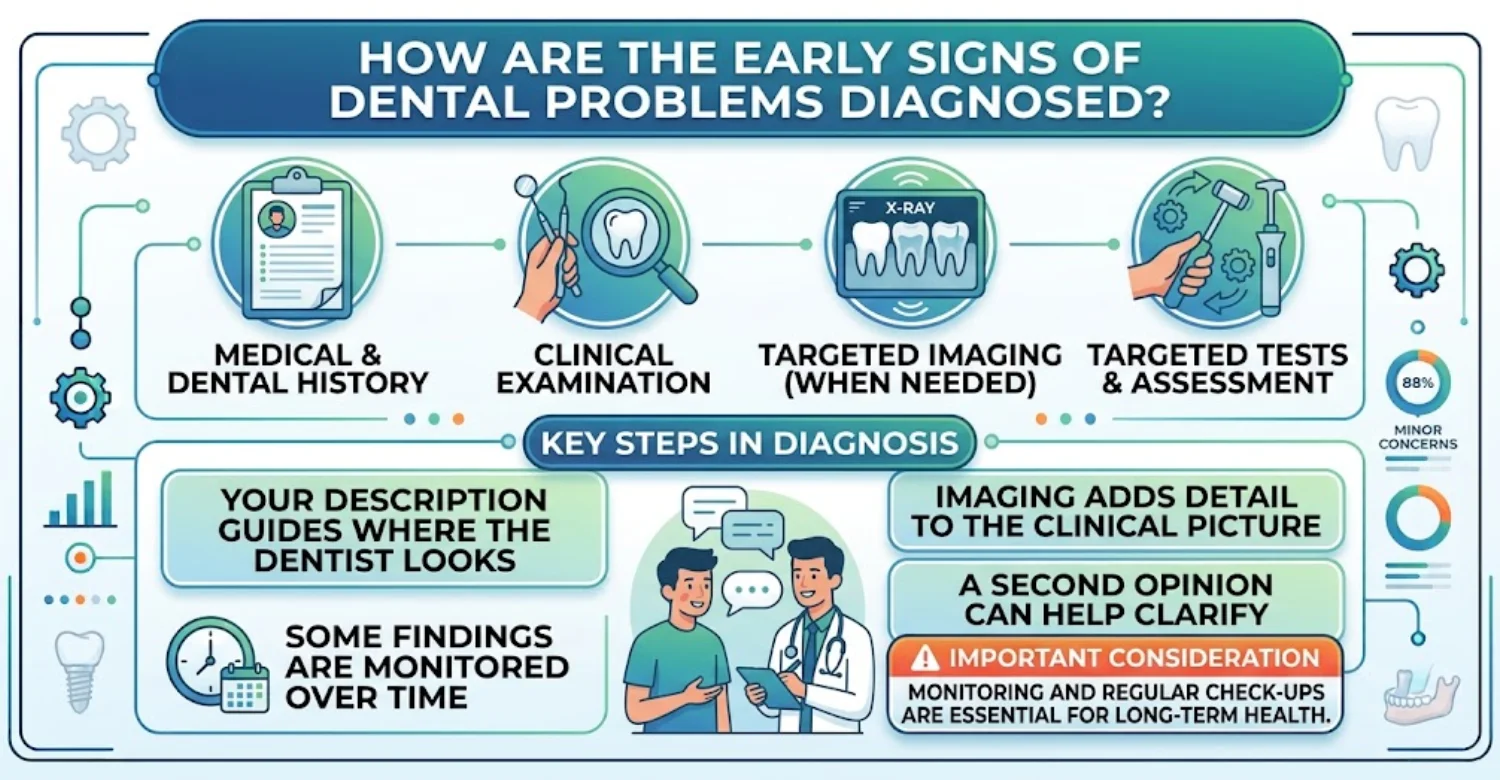
The dentist reviews your history and checks your teeth, gums, bite, and soft tissues. Visual checks and gentle probing confirm or rule out likely causes. Bite testing can reveal cracks or inflamed ligaments. X-rays are taken only when clinically justified. Findings are then explained before treatment. Most routine examinations are quick and comfortable.
Questions your dentist may ask about symptoms and timing
Expect questions about when symptoms started and what triggers them. You may be asked how long pain lasts and whether it wakes you. Previous fillings, crowns, or root canals are also relevant. Mention medicines and medical conditions. Clear answers speed up diagnosis.
Checking the teeth, gums, bite, and surrounding oral tissues
Teeth are checked for decay, cracks, and wear. A thin probe measures the space around each tooth. Deeper pockets and bleeding indicate gum disease activity. The tongue, cheeks, and jaw joints are also examined. This broad view prevents missed causes.
When dental X-rays may be appropriate
X-rays show decay between teeth, under fillings, and in bone. They also reveal infection at the tooth roots. They are used when hidden problems are suspected. Their frequency depends on each patient’s risk. Digital X-rays use lower radiation than older film. Previous X-rays help the dentist compare changes over time.
When CBCT or other advanced imaging may be considered
CBCT scans show teeth and bone in three dimensions. They may help with complex root canals, implant planning, or unclear pain. They are not used for routine check-ups. Imaging is chosen only when it adds useful information. This avoids unnecessary radiation and cost.
Distinguishing tooth decay, gum disease, sensitivity, cracks, and other causes
Similar symptoms can arise from very different problems. Pain at the gumline suggests recession or root decay. Pain on biting suggests a crack or ligament inflammation. CDC reports that gingivitis is reversible, while periodontitis involves supporting-tissue destruction. Tests help separate these causes. The right test depends on the symptom and its location.
Read about how to relieve throbbing tooth pain
What Treatments Are Used for Early Dental Problems?
Treatment depends on the diagnosis and how advanced the problem is. Preventive care stops damage from starting or progressing. Restorative care repairs damage that has already occurred. Small, inactive lesions may be monitored rather than treated immediately. Early problems often need simpler, less invasive care.
Fluoride-based approaches for early enamel changes
Fluoride helps enamel reabsorb minerals and resist acid. It can halt or reverse very early decay. Options include varnish, high-fluoride toothpaste, and rinses. Your dentist will match them to your risk. Diet changes improve their effect. Follow-up visits show whether the enamel is hardening again.
Dental fillings for cavities
A filling removes decayed tissue and seals the space. This stops decay spreading and restores the tooth’s shape. Composite fillings are tooth-colored and bond to the tooth. Material choice depends on size, location, and chewing load. Earlier fillings are usually smaller. Sensitivity after a new filling usually settles within a few weeks.
Professional cleaning and gum-care treatment
Professional cleaning removes plaque and tartar that brushing cannot reach. It allows inflamed gums to heal. It is the foundation of treating gingivitis. Home care advice is tailored to problem areas. Regular cleanings help maintain results.
Scaling and root planing when clinically indicated
Deep cleaning removes tartar from root surfaces inside gum pockets. It is used when gum disease has progressed beyond gingivitis. Local anesthesia may be used for comfort. Pocket depths are rechecked afterward. Maintenance visits help keep pockets stable.
Treatment for cracked, worn, or damaged teeth
Options range from bonding small chips to crowns for larger cracks. A crown covers a tooth weakened by large fillings or fractures. A night guard may protect teeth from grinding. Treatment aims to preserve natural tooth structure. Bite adjustments may also be needed. Cracks treated early are less likely to reach the root.
Root canal treatment when the tooth pulp is affected
Root canal treatment removes inflamed or infected pulp and seals the canals. It differs from a filling, which treats only hard tissue. It often allows the natural tooth to be kept. A crown may be advised afterward for protection. Follow-up confirms healing. Modern techniques make the procedure comfortable for most patients.
Treatment for advanced gum disease or infection
Advanced cases may need deep cleaning, specialist care, or surgery. Infections may require drainage or antibiotics when indicated. Smoking and diabetes can affect healing. Regular maintenance is essential after treatment. Specialist referral may be recommended.
Why treatment depends on the underlying diagnosis
The same symptom can need very different treatment. Accurate diagnosis ensures treatment fits the actual cause. Treated teeth and gums still need good daily care. Regular reviews help catch new problems early. Patients should understand the reason for each step.
.jpg)
.jpg)
.jpg)
.jpg)
.jpg)
.jpg)
.jpg)
.jpg)
.jpg)
What We Notice Clinically
In practice, patients often notice Early Signs of Dental Problems long before seeking care. Many patients feel a bite difference or food trapping before seeing damage. A patient may suspect one tooth, but tests point to another. Treatment history also changes how new symptoms are interpreted. Consistent records help track small changes between visits.
Patients often notice sensitivity or bleeding before significant pain
Sensitivity and bleeding are often the first noticeable signals. Pain usually appears later, once problems are more advanced. Repeated sensitivity in one tooth often points to a specific cause. Bleeding during flossing often signals gingivitis. Both deserve attention even without pain. Reporting them early often leads to simpler care.
An early sign does not always identify its exact cause
An early sign shows that something has changed, not exactly what. Cold sensitivity may come from decay, recession, a crack, or worn enamel. Referred pain can make the wrong tooth seem responsible. Examination is needed to identify the cause. Borderline findings may be monitored before treatment.
Pain severity does not reliably indicate how early or advanced a problem is
Severe pain can come from a small problem. Advanced disease, such as periodontitis, can be painless. Pain level alone can therefore be misleading. Persistence and other signs matter as much as pain. The examination gives a more reliable picture. Regular check-ups help close this gap.
The difference between a new sign and a recurring pattern
A new sign may be a temporary irritation. A recurring pattern suggests an ongoing cause that needs investigation. Recording dates and triggers helps show the pattern. Patient questions also reveal useful details. Planned reviews confirm whether change is occurring.
Common misconceptions about bleeding gums, bad breath, and tooth sensitivity
Bleeding gums are not a reason to stop flossing. Bad breath is not always caused by food or the stomach. Sensitivity is not always harmless or purely cosmetic. Each may signal gum disease or decay. A dental check clarifies the cause.
Clinical Note: Dr. Rifat Alsaman’s Perspective
Subtle changes are worth discussing before they become emergencies. A calm, structured assessment usually gives the clearest answers. History, examination, and imaging work together. Findings guide the plan rather than assumptions. Patients are encouraged to ask questions.
Dr. Rifat Alsaman, on why subtle oral changes deserve appropriate evaluation
From Dr. Rifat Alsaman’s perspective, subtle Early Signs of Dental Problems deserve evaluation proportionate to their persistence. Treatment recommendations should follow clinical findings rather than symptoms alone. Digital diagnostics can support clearer communication about options. A written plan clarifies what is known and what happens next.
When clinical examination is more useful than relying on symptoms alone
Symptoms guide the search, but examination confirms the cause. This is especially true when several teeth could be involved. Referred pain and overlapping symptoms can mislead. Tests and imaging add objective information. Treatment based on findings is more reliable.
Understand the causes and treatment for gum pockets treatment
Evidence-Based Evaluation of Early Signs of Dental Problems
Reliable guidance on the Early Signs of Dental Problems comes from public health bodies and peer-reviewed research. Strong evidence supports clear statements, while weaker evidence calls for cautious wording. Systematic reviews generally provide stronger evidence than single studies. Recommendations change as research develops. Population data describe groups, not individual diagnoses.
How dental professionals assess early tooth decay and gum disease
Decay is assessed through visual checks, surface texture, and X-rays. Gum disease is assessed through probing, bleeding, and bone levels. Findings are compared with previous records. Guidelines help frame prevention and treatment decisions. Dentists adapt them to each patient.
The role of regular examinations in finding problems before advanced signs develop
Regular examinations detect painless decay and early gum changes. Intervals are typically set according to individual risk. Higher-risk patients may need more frequent visits. Early detection often allows simpler treatment. Check-ups also reinforce home care. Missing visits allows silent problems to progress.
Evidence from NIDCR, CDC, ADA, NHS, and peer-reviewed dental literature
This article draws on NIDCR, CDC, ADA, and NHS guidance. NIDCR describes how early decay can be reversed with fluoride . CDC explains the difference between gingivitis and periodontitis . NHS guidance defines when swelling becomes an emergency. Peer-reviewed literature supports these recommendations.
GREAT opportunities for explaining dental signs responsibly
Responsible content names its sources and states its limits. Clinical review adds expertise and trust. Honest uncertainty is better than false reassurance or alarm. Clear next steps help patients feel informed. The points below support responsible writing.
Cite authoritative guidance for tooth decay and periodontal disease
Claims about decay reversal and gum disease stages should cite recognized authorities. NIDCR and CDC provide accessible references . Sources should be dated so readers know they are current. Relevant sources should match the condition discussed. Citations help readers verify information.
Distinguish association, risk factors, and established causes
Smoking and diabetes are associated with higher gum disease risk. Plaque, however, is an established direct cause. Risk factors raise likelihood without proving disease exists. Clear wording prevents readers from drawing wrong conclusions. This distinction supports accurate patient education.
Use clinically reviewed references and current evidence
References should be current and reviewed by qualified clinicians. Outdated advice can mislead patients about treatment choices. Advice on fluoride and imaging is updated over time. Transparent limitations remind readers that online content cannot replace examination. Regular content review keeps guidance accurate.
Explore options and fit for a bottom denture
Tips for Patients
Small daily habits and clear communication protect oral health. These practical tips help you act on Early Signs of Dental Problems. Reducing sugar frequency, stopping smoking, and drinking water all lower risk. Bring previous X-rays and treatment notes to new appointments. Home care should never delay needed treatment.
Keep a simple record of when signs or symptoms start and what triggers them
A short diary of Early Signs of Dental Problems helps your dentist see patterns. Record the date, location, trigger, and intensity. Note how long each episode lasts. Track whether symptoms improve or worsen. Bring these notes to your appointment.
Continue gentle brushing with fluoride toothpaste
Brush twice daily for two minutes, even when gums feel sore. Fluoride toothpaste strengthens enamel and supports early repair. Spit after brushing rather than rinsing, so fluoride stays on the teeth. Use a soft brush with gentle pressure. Hard scrubbing can wear enamel and push gums back. Replace your toothbrush when the bristles start to splay.
Clean between the teeth according to professional advice
Floss or interdental brushes reach spaces a toothbrush misses. Your dentist can recommend the right type and size. Correct technique matters more than the tool. Daily use reduces decay and gum inflammation. Mild bleeding at first usually improves. Water flossers may help people with braces or bridges.
Avoid repeatedly testing a painful or sensitive tooth
Pressing or tapping a sore tooth can increase irritation. Biting on hard objects to test it may cause fractures. Note the symptom instead. Let your dentist perform controlled tests. This gives more accurate results.
Prepare questions and relevant dental history before an appointment
List your questions in advance so nothing is forgotten. Include medical conditions, medicines, and allergies. Mention old fillings, crowns, or root canals and their approximate age. Bring previous X-rays if available. Good preparation speeds up a focused consultation.
Seek professional assessment instead of self-diagnosing from early signs alone
Online information about Early Signs of Dental Problems can explain possibilities but cannot examine your mouth. Many conditions share similar symptoms. A dentist can confirm the actual cause. If a sign lasts over two weeks or worsens, book an appointment. Early assessment keeps treatment simpler.
Note : All images used are for editorial and illustrative purposes only and may not originate from the original news provider or associated company.
Average Dental Care Costs for Early Signs of Dental Problems:
US
UK
Turkey
Costs for assessing and treating the Early Signs of Dental Problems vary widely by country and clinic. Rent, wages, and local demand shape dental fees. Public systems like the NHS use fixed fee bands for eligible patients. Private clinics set their own prices. The figures below are planning references only.
What determines the cost of evaluating and treating early dental problems?
Diagnosis, complexity, materials, imaging, and location all influence cost. Ceramic crowns usually cost more than metal or composite options. Laboratory work can add fabrication costs. Clinician experience and equipment also affect fees. Earlier treatment is often simpler and less expensive. A written plan makes these factors easier to compare.
Average or typical published dental cost comparison
The table below summarizes published price ranges for common services. Figures vary between clinics and cities. They do not replace a personal quote.
Dental service | US | UK | Turkey |
Routine examination / initial assessment | About $50–350; CareCredit reports a $203 national average for an exam including cleaning and X-rays | About $70–180 for private check-ups in published Bupa examples; NHS England Band 1 is approximately $28 | Varies by clinic; panoramic X-rays in one Istanbul listing are around $17, while consultation pricing may be unlisted |
Routine cleaning | About $80–109 in Humana’s 2026 Orlando example | About $73–210 in published Bupa examples | About $64–221 in published Istanbul clinic listings |
Composite filling | About $90–333, depending on material, tooth, and number of surfaces | About $119–263 in published Bupa examples | About $29–130 depending on filling type and number of surfaces |
Root canal treatment | About $679–1,733, with a reported 2026 national average of $978 | About $375–925 in published Bupa examples, depending on tooth and practice | Published Istanbul listings show roughly $40–128 for selected root-canal ranges, depending on tooth and provider |
Cost ranges are planning references, not fixed treatment quotes
Published ranges help with budgeting but cannot predict your final fee. Final fees depend on diagnosis, complexity, materials, imaging, and aftercare. Only an examination produces an accurate quote. Prices may also change over time. Always request a written plan.
Why dental costs differ between the US, UK, and Turkey
Labor costs, regulation, insurance systems, and exchange rates all differ. These factors explain much of the price gap. For overseas care, add flights, accommodation, and time off work. Aftercare arrangements also affect real value. Compare total costs, not only treatment fees. Quality and safety standards should always be checked as well.
What may be included or excluded from a quoted dental price
Check whether consultation, imaging, anesthesia, and follow-up are included. A low headline price may hide extra charges. Ask how complications are handled after you return home. Itemized quotes give a fairer comparison. The points below explain common cost factors.
X-rays, CBCT, consultation, anesthesia, laboratory fees, and restorations
Each of these items may be billed separately. Some quotes exclude imaging entirely. Laboratory fees often apply to crowns. Request an itemized written plan before agreeing to treatment. This avoids unexpected costs.
Why treatment complexity can change the final cost
A molar root canal usually costs more than one on a front tooth. Curved canals, infection, or retreatment add time and cost. Larger fillings may need crowns. Gum disease may need several sessions. Complexity is often clear only after examination.
Why international dental costs should be compared by treatment scope, not headline price alone
Compare the full plan, including materials, guarantees, and aftercare. Equal scope makes international comparisons meaningful. Include travel and accommodation costs. Ask about follow-up after you return home. A cheaper quote may cover less treatment.
Learn about different types of partial dentures
How Vitrin Clinic Evaluates Early Signs of Dental Problems
At Vitrin Clinic, the Early Signs of Dental Problems are assessed through history, examination, and imaging when needed. Patients often have several findings at once. An individual assessment ranks them by urgency and links related problems. Treatment then follows the findings. Each step is explained before it begins.
Individualized assessment of teeth, gums, oral tissues, chewing muscles, and joints
Assessment covers teeth, gums, soft tissues, chewing muscles, and jaw joints. This broad view prevents missed causes of symptoms. Your description explains timing and triggers. Clinical findings confirm the source. Together, they give the clearest diagnosis.
Digital X-rays, CBCT, and 3D scanning when clinically appropriate
Digital X-rays use lower radiation than older film. CBCT and 3D scans are added only for specific clinical needs. Imaging is chosen to answer a defined question. Digital images let patients see what the dentist sees. This makes options easier to understand. Images also provide a record for future comparison.
Identifying the likely source of signs and symptoms before recommending treatment
The goal is to identify the cause before suggesting any procedure. This keeps treatment focused and avoids unnecessary work. Uncertain findings may be monitored first. Complex cases may need specialist input. Patients are informed at every stage.
Treatment options based on clinical findings rather than symptoms alone
Recommendations rely on confirmed findings, not guesses from symptoms. This reduces the risk of treating the wrong tooth. Options are compared by benefit, durability, and cost. Function and appearance are both considered. Patients can ask about alternatives.
Relevant treatment pathways for tooth decay, gum disease, damaged teeth, and related concerns
Pathways may include fluoride care, fillings, gum treatment, crowns, or root canal therapy. CDC reports that periodontitis involves supporting-tissue destruction . Gum inflammation is often controlled first. Restorative work then follows in a logical order. Referral is arranged when specialist care is needed.
How Vitrin Clinic Supports Your Treatment Journey
Support extends beyond the dental chair, from planning to aftercare. This is especially helpful for patients travelling for treatment. Sharing records before arrival reduces delays. Coordinated scheduling fits assessment, treatment, and healing into the visit. Clear communication helps patients plan work and recovery.
Pre-treatment consultation and individualized assessment
A consultation reviews your history, concerns, and expectations. Records and X-rays can be shared before arrival. This helps prepare a personalized treatment plan. Questions are answered before any treatment. The plan is then confirmed after examination. Patients can share photos and concerns in advance.
Digital diagnostics and treatment planning
Digital imaging and scans support precise planning. They help patients visualize the proposed treatment. A clear written sequence shows what happens at each visit. Patients can then plan travel and recovery. Changes are discussed openly.
Personalized coordination for international patients
International patients often have limited time. Coordination fits assessments, treatment, and healing into the visit. Medical, travel, and language needs are considered. Practical arrangements are handled with the patient. This keeps the focus on treatment and recovery.
Appointment, transport, and accommodation coordination
Appointments, transfers, and accommodation can be aligned in one plan. Arranged transport helps patients reach appointments on time. Staying near the clinic simplifies follow-up visits. Bookings should match the treatment schedule. This reduces travel stress.
Treatment follow-up and aftercare support
Follow-up checks confirm healing and address concerns. Aftercare instructions cover eating, cleaning, pain control, and warning signs. Written guidance helps patients follow them at home. Remote follow-up can continue after departure. Patients know whom to contact if problems arise. Clear contact details are provided before departure.
When an early sign may require a focused dental evaluation
Persistent, recurring, or worsening Early Signs of Dental Problems justify a focused evaluation. Signs lasting over two weeks deserve review. New swelling or bite changes need prompt attention. Early review often keeps treatment simpler. It also protects more natural tooth structure.
How clinical findings guide the choice of treatment
Confirmed findings determine which treatment fits best. This links each recommendation to a clear clinical reason. Documented findings also help future dentists. Patients understand why each step is proposed. Informed decisions lead to better outcomes.
Connecting patients with appropriate restorative, periodontal, endodontic, or preventive care
Patients are directed to the type of care their findings require. Restorative care repairs damaged teeth. Periodontal care treats gum disease. Endodontic care treats the pulp, and preventive care protects healthy teeth. Specialists collaborate on complex cases.
Ready to transform your smile?
Talk to our team and get a personal FREE treatment plan.
Key Takeaways
Recognizing the Early Signs of Dental Problems helps you seek care while treatment is simpler. Persistent or worsening signs should be checked first. Symptoms alone cannot establish a diagnosis. Prevention and early evaluation work together. The points below summarize the essentials.
The most important early signs of dental problems to watch for
Key signs include sensitivity, bleeding gums, color changes, and bad breath. Chips, food trapping, and bite changes also matter. Lasting mouth sores or patches need review. Persistent signs deserve examination. Brief, resolved irritation is less concerning. Noting when each sign started helps your dentist.
Why early dental problems can be subtle or painless
Enamel has no nerves, and gum disease often develops silently. Regular examinations find Early Signs of Dental Problems you cannot feel. Pain level is not a reliable severity guide. Serious problems can be painless. Check-ups remain valuable even when you feel fine.
Which signs may indicate tooth decay, gum disease, or another oral problem
White spots and sensitivity suggest decay. Bleeding and swelling suggest gum disease. Lasting patches or lumps need soft-tissue review. Jaw pain may involve muscles or joints. Examination confirms which applies.
What relief measures may help temporarily
Soft foods, gentle cleaning, and salt-water rinses can ease discomfort. Suitable pain relievers may help when used correctly. Avoid very hot, cold, or hard foods. These measures do not treat the cause. Book an assessment if symptoms persist.
Important medical and dental tips for protecting oral health
Brush with fluoride toothpaste twice daily. Clean between your teeth every day. Limit sugar frequency and avoid tobacco. Tell your dentist about medicines and medical conditions. Attend check-ups at the recommended intervals. Drinking water between meals also supports saliva flow.
Common side effects and considerations related to short-term pain relief
Pain relievers can cause stomach, liver, or interaction problems. Follow label doses and daily limits carefully. Ask a pharmacist about other medicines you take. Use the lowest effective dose for the shortest time. Never place aspirin on the gums.
When temporary relief is reasonable and when professional evaluation is needed
Relief is reasonable for brief, mild symptoms. Persistent, severe, or recurring symptoms need a dental evaluation. Improvement does not always mean the cause is gone. Regular check-ups confirm resolution. Rising pain or swelling needs prompt care.
Why diagnosis should come before treatment
Treating without a diagnosis risks targeting the wrong cause. Confirmed findings lead to more reliable outcomes. Early diagnosis allows smaller repairs. Preserving natural tooth structure supports long-term strength. Patients should understand each proposed step. A clear diagnosis also helps compare treatment options fairly.
When to contact a dentist and when emergency medical care is more appropriate
Contact a dentist for persistent pain, bleeding, sensitivity, or damage. Seek urgent dental care for severe pain or a broken tooth. Go to emergency services for spreading swelling or difficulty breathing or swallowing. Uncontrolled bleeding also needs urgent help. Do not wait in emergencies.
At Vitrin Clinic
Our treatments at Vitrin Clinic combine careful assessment, clear planning, and practical support. Patients can expect a review of history, a full examination, and imaging if needed. Findings are explained before any treatment begins. Gum inflammation or active decay is often controlled before restorative work. Digital planning supports clearer discussions about options. International patients can send records early and plan enough days for healing. Follow-up dates and remote contact are agreed before departure. Every treatment choice follows documented clinical findings.
Reference
FAQs
Dr. Rifat Alsaman has more than 5 years of clinical experience in dentistry and currently serves as the Head of the Medical Team at Vitrin Clinic. He is dedicated to providing exceptional patient care, overseeing treatment planning, and ensuring the highest clinical standards across the team. His expertise, attention to detail, and commitment to continuous professional development have helped countless patients achieve healthier, more confident smiles.


