General Dentistry
October 18, 2026
What Causes a Swollen Jaw, and How Can You Find Relief?
 Dr. Rifat Alsaman

A swollen jaw is usually a sign that something nearby is inflamed, infected, or injured. The cause may be a tooth, the gums, a salivary gland, a lymph node, or the jaw joint itself. Some cases settle within days, while others need prompt dental or medical treatment. According to the World Health Organization, oral diseases affect around 3.5 billion people worldwide. That makes dental problems one of the most common reasons for swelling around the lower face. This guide explains the main causes, warning signs, safe relief measures, and professional treatment options. It also covers typical costs in the US, UK, and Turkey, so you can plan your next step with confidence.
Ready to transform your smile?
Talk to our team and get a personal FREE treatment plan.
What Is a Swollen Jaw?
A swollen jaw is an abnormal enlargement of the tissues around the lower face, jawline, cheek, or under the chin. It happens when fluid, inflammatory cells, pus, or blood collect in those tissues. Swelling is a symptom rather than a diagnosis. Your body produces it in response to infection, injury, blockage, or an allergic trigger.
What Does Jaw Swelling Look and Feel Like?
Jaw swelling often looks like puffiness or asymmetry, where one side of the face appears fuller than the other. The skin may look stretched, shiny, red, or warm. It can feel soft and tender, or firm and tight. Some people notice a distinct lump, while others feel a diffuse fullness.
Is Jaw Swelling the Same as Facial Swelling?
Jaw swelling is a type of facial swelling, but the two terms are not identical. Facial swelling can affect the eyelids, lips, forehead, or entire face. Jaw swelling refers specifically to the lower face, jawline, angle of the jaw, and area under the chin. Dental infections often begin as localized jaw swelling.
Can a Swollen Jaw Occur Without Pain?
Yes, swelling can occur without pain, and this does not always mean it is harmless. A chronic dental abscess may drain through a small gum opening, relieving pressure and pain. A blocked salivary gland may cause painless fullness between meals. Slowly enlarging lymph nodes or cysts may also be painless.
How Quickly Can Jaw Swelling Develop?
Jaw swelling can develop within minutes, hours, or over several weeks. Allergic angioedema may appear within minutes of exposure to a trigger. Dental abscesses commonly cause noticeable swelling within one to three days. Postoperative swelling usually peaks 48 to 72 hours after surgery.
.jpg)
.jpg)
.jpg)
.jpg)
.jpg)
Swollen Jaw Causes and Symptoms
A swollen jaw most often comes from the teeth and gums, but several medical conditions can produce similar signs. Understanding the cause matters because treatment varies widely. An abscess needs drainage, while an allergic reaction needs antihistamines or emergency care.
What Are the Most Common Causes of a Swollen Jaw?
The most common causes are dental infections, gum disease, and problems with wisdom teeth. Salivary gland conditions, swollen lymph nodes, and injuries are also frequent. Less often, swelling comes from jaw joint disorders, allergies, medicines, or viral illnesses. WHO estimates that around 2 billion people have untreated decay in permanent teeth.
Dental Abscesses and Bacterial Infections
A dental abscess is a pocket of pus caused by bacterial infection. It usually starts when deep decay, a crack, or trauma lets bacteria reach the tooth's pulp. The infection then spreads to the bone around the root tip. As pus builds up, the surrounding tissues swell.
Gum Disease and Infected Gum Tissue
Gum disease can cause localized swelling when bacteria collect in deep pockets around teeth. This may form a periodontal abscess, which looks like a shiny, tender bump on the gum. WHO estimates that severe periodontal disease affects around 19% of adults worldwide. In the US, CDC data show about 42% of adults aged 30 and over have periodontitis.
Impacted Wisdom Teeth and Pericoronitis
Wisdom teeth often lack space to erupt fully, leaving gum tissue partly covering the crown. Food and bacteria become trapped under this flap, causing pericoronitis. The condition most commonly affects young adults aged 20 to 29. It almost always involves lower wisdom teeth.
Salivary Gland Inflammation or Blockage
Salivary glands can swell when saliva cannot drain freely or when the gland becomes infected. Salivary stones, called sialoliths, are a common cause of blockage. Around 80% of salivary stones form in the submandibular gland, located under the jaw. Swelling often worsens during meals, when saliva production increases.
Swollen Lymph Nodes Around the Jaw
Lymph nodes under the jaw filter fluid from the mouth, teeth, throat, and face. They often enlarge when the body fights a nearby infection. Roughly 300 of the body's approximately 800 lymph nodes lie in the head and neck. This explains why mouth and throat infections so often cause tender lumps under the jaw.
Jaw Injury, Bruising, or Fracture
A blow to the face can cause bruising, bleeding into tissues, and rapid swelling. Falls, sports injuries, road accidents, and assaults are common causes. The mandible is one of the most frequently fractured facial bones. Any suspected fracture needs urgent assessment and imaging.
Temporomandibular Joint Disorders and Muscle Inflammation
Temporomandibular joint disorders, or TMD, affect the joint and muscles that move the jaw. The US National Institute of Dental and Craniofacial Research estimates that 5% to 12% of people have TMD. Women are affected roughly twice as often as men. TMD usually causes pain and stiffness rather than major swelling.
Allergic Reactions and Medication-Related Swelling
Allergic reactions can cause angioedema, a deep swelling of the lips, face, tongue, or throat. Triggers include foods, insect stings, latex, and some medicines. ACE inhibitor blood pressure medicines cause angioedema in about 0.1% to 0.7% of users. Swelling of the tongue or throat is a medical emergency.
Viral Infections and Other Medical Conditions
Viral infections can inflame salivary glands or lymph nodes and cause jaw swelling. Mumps is the classic example, causing parotid swelling in front of the ear. CDC reports that parotitis develops in roughly 31% to 65% of people infected with mumps. Other causes include Epstein-Barr virus, Sjögren's syndrome, cysts, and, rarely, tumors.
What Symptoms Can Accompany a Swollen Jaw?
Accompanying symptoms help clinicians narrow down the cause. Dental infections often bring toothache, bad taste, and fever. Gland problems usually cause swelling linked to eating. Lymph node swelling often follows a sore throat or cold.
Pain, Tenderness, and Redness
Pain and tenderness are the most common companions of jaw swelling. Throbbing pain often suggests pressure from pus inside a tooth or abscess. Redness and warmth of the overlying skin signal active inflammation. Pain that spreads to the ear, temple, or neck is common with lower molar infections.
Tooth Sensitivity, Bad Taste, or Pus
Sensitivity to hot or cold may indicate inflamed pulp inside a tooth. Pain when biting usually suggests infection around the root. A salty, bitter, or foul taste often means pus is draining into the mouth. You may see a small pimple-like bump, called a sinus tract, on the gum.
Fever, Fatigue, and Swollen Glands
Fever, chills, and fatigue suggest that infection is affecting the whole body. A temperature above 38°C (100.4°F) with facial swelling warrants same-day assessment. Tender lymph nodes under the jaw often accompany dental and throat infections. Feeling generally unwell, sometimes called malaise, can indicate a spreading infection.
Difficulty Chewing or Opening the Mouth
Limited mouth opening, called trismus, occurs when infection or inflammation affects the chewing muscles. Normal adult mouth opening is roughly 35 to 50 millimeters, about three fingers wide. Opening less than two fingers wide often signals significant inflammation. Progressive restriction of opening needs urgent dental or medical review.
Dry Mouth or Pain When Eating
Pain or swelling during meals is a classic sign of salivary gland blockage. Saliva builds up behind the obstruction, causing the gland to swell. The swelling may then shrink slowly over one to two hours. Healthy adults produce roughly 0.5 to 1.5 liters of saliva daily.
Which Risk Factors Increase the Chance of Jaw Swelling?
Several factors increase the risk of jaw swelling. The most important are untreated dental problems and poor oral hygiene. Recent dental surgery, dehydration, weakened immunity, and facial trauma also play a role.
Untreated Tooth Decay and Existing Gum Disease
Untreated decay is the leading pathway to dental abscesses. CDC data show roughly one in four US adults aged 20 to 64 has untreated cavities. Decay progresses from enamel to dentin and then to the pulp. Once the pulp becomes infected, abscess formation is likely.
Recent Dental Procedures or Oral Surgery
Some swelling is normal after extractions, implant placement, or gum surgery. It reflects the body's natural healing response to surgical trauma. However, surgery also creates a small risk of infection or dry socket. Dry socket affects roughly 1% to 5% of routine extractions.
Dehydration and Reduced Saliva Flow
Saliva continuously flushes bacteria from the mouth and salivary ducts. Dehydration thickens saliva and slows its flow, increasing the risk of gland infection and stones. Hundreds of common medicines list dry mouth as a side effect. These include antihistamines, antidepressants, and blood pressure drugs.
Weakened Immunity and Certain Medical Conditions
A weakened immune system makes infections more likely and more severe. People with diabetes are around two to three times more likely to develop periodontitis. Chemotherapy, long-term steroids, HIV, and immunosuppressant drugs also raise risk. In these patients, dental infections can spread faster.
Jaw Trauma and Poor Oral Hygiene
Facial trauma can cause immediate swelling and may damage teeth, causing later infection. A tooth injured years earlier may die slowly and form a painless abscess. Poor oral hygiene allows plaque to accumulate and drive both decay and gum disease.
Why Is My Jaw Swollen on One Side?
A swollen jaw on one side usually points to a localized problem, such as a single infected tooth. Most dental, gland, and lymph node problems affect only one side at a time. Swelling on both sides is more typical of viral infections like mumps, allergies, or systemic conditions.
What Causes One-Sided Jaw Swelling?
The most common causes of one-sided swelling are dental abscesses, pericoronitis, and gum infections. A blocked or infected salivary gland on one side is another frequent cause. Reactive lymph nodes usually appear on the same side as the infection.
What Does Sudden Jaw Swelling on One Side Mean?
Sudden one-sided swelling often signals an acute dental abscess or a blocked salivary gland. If swelling appears within minutes of eating, a salivary stone is likely. Swelling that develops over hours with throbbing pain suggests infection. Sudden swelling with breathing or swallowing difficulty requires emergency care immediately.
Why Is My Jaw Swollen Near the Ear?
Swelling near the ear usually involves the parotid gland, nearby lymph nodes, or the jaw joint. The parotid is the largest salivary gland and sits just in front of the ear. Infected upper or lower back teeth may also produce swelling that extends toward the ear.
Parotid Salivary Gland Problems
Parotid problems cause swelling in front of and below the ear, sometimes lifting the earlobe. Bacterial parotitis often affects older, dehydrated, or post-surgical patients. Pus may appear inside the cheek near the upper second molar, where the duct opens. Mumps causes parotid swelling, often on both sides.
Ear-Related Inflammation and Nearby Lymph Nodes
Ear infections can enlarge the lymph nodes in front of and behind the ear. These nodes feel like small, tender, movable lumps. External ear infections can also cause swelling that spreads toward the jaw angle. Scalp infections and skin conditions may affect the same lymph nodes.
Jaw Joint Pain and Swelling Near the Ear
The temporomandibular joint sits directly in front of the ear canal. When inflamed, it may cause mild swelling, clicking, and pain while chewing. Many people with TMD mistake jaw joint pain for an earache. Teeth grinding, arthritis, and injury commonly trigger joint inflammation.
Why Is My Jaw Swollen Under the Chin?
Swelling under the chin or jaw often involves the submandibular gland, lymph nodes, or lower teeth. A submandibular stone causes swelling that increases at mealtimes. Swelling under the tongue and chin together can indicate Ludwig's angina, a dangerous infection. This combination needs emergency care.
Can a Swollen Jaw on One Side Be Caused by a Tooth Infection?
Yes, a tooth infection is one of the most common causes of one-sided swelling. The infection usually stays on the same side as the affected tooth. Lower molar infections often cause swelling along the jawline or beneath it. Upper tooth infections may cause cheek swelling that extends toward the eye.
When Does One-Sided Jaw Swelling Need Urgent Assessment?
One-sided swelling needs urgent assessment if it is spreading, hard, hot, or increasingly painful. Fever, difficulty opening the mouth, or trouble swallowing also signal urgency. Swelling that closes the eye or reaches the neck requires same-day care. Breathing difficulty, drooling, or a raised tongue needs emergency services immediately.
Can a Tooth Infection Cause a Swollen Jaw?
Yes, a tooth infection is one of the leading causes of a swollen jaw. Bacteria from a decayed, cracked, or previously treated tooth can spread into bone and soft tissues. In the US, dental conditions cause roughly two million emergency department visits each year, according to ADA research.
How Does a Dental Abscess Cause Jaw Swelling?
An abscess forms when bacteria infect the pulp and spread beyond the root tip. Pus collects in the bone and seeks the path of least resistance. It may break through the thin bone into gum, cheek, or deeper facial tissues. As fluid accumulates, the tissue swells and stretches.
What Is the Difference Between a Toothache and a Dental Abscess?
A toothache is a symptom, while an abscess is a specific infection with pus. Toothache may come from sensitivity, a cavity, or inflamed pulp without infection. An abscess usually causes constant throbbing pain, pain when biting, and swelling. Bad taste, fever, and a gum bump are more typical of abscesses.
Can You Have a Tooth Infection Without a Toothache?
Yes, many tooth infections cause little or no pain. When the pulp dies completely, nerve signals stop, so pain may disappear. A chronic abscess may drain through a gum opening, preventing pressure buildup. Some infections are discovered only on routine X-rays.
What Are the Signs That a Dental Infection Is Spreading?
Spreading infection is a serious situation that can become life-threatening. Warning signs include expanding swelling, fever, feeling unwell, and difficulty swallowing or opening the mouth. Seek urgent care if you notice any of the signs described below.
Increasing Facial or Jaw Swelling
Swelling that grows larger over hours or days suggests the infection is spreading. Watch for swelling extending toward the eye, ear, or neck. Firm, board-like swelling is particularly concerning. Drawing a line around the swollen edge with a pen can help track change.
Fever, Malaise, or Swollen Lymph Nodes
Fever above 38°C (100.4°F) means the body is mounting a systemic response. Malaise, chills, and fatigue often accompany it. Tender, enlarged lymph nodes under the jaw show the immune system is actively fighting. Combined with dental swelling, these signs justify urgent dental or medical care.
Difficulty Swallowing or Opening the Mouth
Difficulty swallowing suggests infection may be reaching the throat or floor of the mouth. Limited mouth opening indicates involvement of the chewing muscles. Drooling, a muffled voice, or a raised tongue are red flags. Go to an emergency department immediately if they appear.
Can a Dental Infection Spread to the Jawbone or Neck?
Yes, dental infections can spread into the jawbone, causing osteomyelitis. They can also reach deep spaces of the neck. Ludwig's angina is a severe infection of the floor of the mouth. Studies attribute most Ludwig's angina cases, often over 70%, to dental sources. Mortality exceeded 50% before antibiotics but is now much lower with prompt treatment.
Why Won't a Dental Abscess Usually Go Away on Its Own?
An abscess rarely resolves on its own because the source of bacteria remains inside the tooth. Dead pulp tissue provides a protected reservoir that the immune system cannot reach. Antibiotics may reduce symptoms temporarily but cannot clean the inside of the tooth. Without root canal treatment or extraction, infection usually returns.
Swollen Jaw Lymph Nodes: What Do They Mean?
Swollen lymph nodes near the jaw usually mean your immune system is fighting a nearby infection. They are most often reactive, temporary, and harmless. Common triggers include colds, sore throats, ear infections, and dental problems. Occasionally, persistent or unusual nodes reflect a more serious condition.
Why Do Lymph Nodes Swell Near the Jaw?
Lymph nodes swell because immune cells multiply inside them while filtering germs. The submandibular and submental nodes drain the teeth, gums, tongue, and lips. When bacteria or viruses arrive from these areas, the nodes enlarge and become tender. Studies suggest palpable neck nodes are found in up to 40% of healthy children.
How Can You Tell a Swollen Lymph Node From Dental Swelling?
A swollen lymph node usually feels like a distinct, rounded, movable lump under the skin. Dental swelling is more diffuse and often blends into the cheek or gum. Dental swelling commonly comes with toothache, gum changes, or bad taste. Lymph nodes may enlarge with or without dental symptoms.
Can Tooth Infections Cause Swollen Lymph Nodes Under the Jaw?
Yes, tooth infections commonly cause tender lymph nodes under the jaw. The nodes on the same side as the infected tooth are usually affected. They often enlarge within a few days of the infection starting. Once the tooth is treated, the nodes typically return to normal.
How Long Do Swollen Jaw Lymph Nodes Usually Last?
Reactive lymph nodes typically shrink within two to six weeks after the infection clears. They may remain slightly palpable for longer without causing concern. Tenderness usually settles before size returns fully to normal. Nodes that keep growing or persist beyond this period need evaluation.
When Should a Doctor Examine Persistent or Hard Lymph Nodes?
A doctor should examine nodes that are hard, fixed, painless, or steadily enlarging. Nodes larger than about 1.5 centimeters warrant closer assessment. Night sweats, unexplained weight loss, or persistent fever are additional warning signs. Smokers and heavy drinkers have higher risk of head and neck cancers.
Ready to transform your smile?
Talk to our team and get a personal FREE treatment plan.
Jaw Swelling After Dental Treatment
Some swelling after dental treatment is a normal part of healing. It is most common after surgical procedures such as extractions, implants, and gum surgery. Swelling should gradually improve rather than worsen after the first few days.
Is Jaw Swelling Normal After a Tooth Extraction?
Yes, mild to moderate swelling is normal after extraction, especially for back teeth. It results from the body's inflammatory response to surgical tissue handling. Simple extractions usually cause minimal swelling. Surgical extractions involving bone removal tend to cause more.
How Long Does Swelling Last After Wisdom Tooth Removal?
Swelling after wisdom tooth removal usually peaks 48 to 72 hours after surgery. It typically settles significantly within five to seven days. Bruising may appear and fade over one to two weeks. Cold compresses during the first 24 hours can help limit swelling.
Can Jaw Swelling Occur After Dental Implants?
Yes, swelling is common after implant surgery, particularly when bone grafting is involved. It usually peaks within two to three days and resolves within a week. Long-term implant survival exceeds 95% at ten years in many studies. Late swelling around an implant may signal peri-implantitis, an infection of surrounding tissues.
Why Is My Jaw Swollen After a Root Canal?
Swelling after a root canal may reflect inflammation or a flare-up of existing infection. Instruments and disinfectants can irritate tissues beyond the root tip. Research suggests flare-ups occur in roughly 8% of root canal treatments. Most flare-ups resolve with pain relief, and sometimes drainage or antibiotics.
How Can You Distinguish Expected Healing From a Complication?
Expected healing follows a predictable pattern of peak swelling, then steady improvement. Complications usually break this pattern by worsening after the third day. New symptoms, such as fever or pus, are also warning signs.
Swelling That Gradually Improves
Normal swelling peaks around day two or three and then steadily decreases. Pain should become easier to control with each passing day. Mild stiffness and bruising may linger but should not worsen. Eating and opening the mouth should gradually become more comfortable.
Increasing Pain, Fever, or Persistent Swelling
Swelling that increases after day three may indicate infection. Severe pain starting two to four days after extraction often suggests dry socket. Fever above 38°C (100.4°F) is not part of normal healing. Swelling lasting beyond ten days also needs evaluation.
New Pus, Unpleasant Taste, or Worsening Redness
Pus, a foul taste, or worsening redness are classic signs of infection. Bad breath that does not improve with gentle rinsing may also indicate a problem. Red streaks or spreading warmth on the skin are more serious. These signs require same-day dental contact.
When Should You Contact Your Dentist After a Procedure?
Contact your dentist if swelling worsens after day three or lasts beyond a week. Also call if you develop fever, pus, severe pain, or trouble opening your mouth. Persistent bleeding or numbness lasting more than a day should be reported. Seek emergency help immediately for breathing or swallowing difficulty.
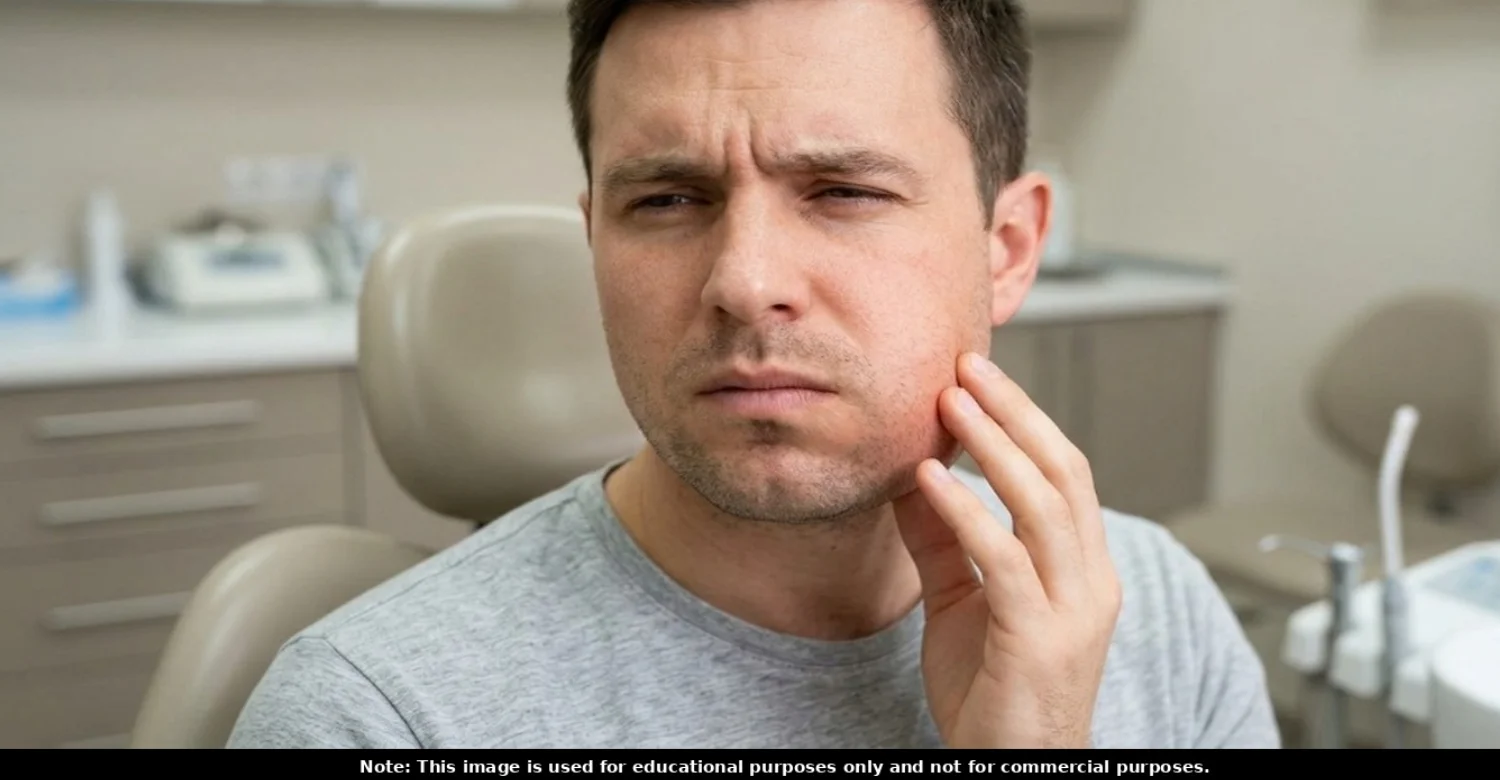
Note : All images used are for editorial and illustrative purposes only and may not originate from the original news provider or associated company.
What We Notice Clinically
In everyday practice, patterns of swelling often tell a clear story when examined carefully. Location, timing, and associated symptoms guide the first steps of diagnosis. We also see recurring misunderstandings that delay treatment.
Why the Location and Timing of Jaw Swelling Matter
Location often points directly to the responsible structure. Swelling under the jaw suggests lower teeth or the submandibular gland. Swelling near the ear suggests the parotid gland or jaw joint. Timing adds more clues, since meal-related swelling suggests a salivary cause.
How Tooth Pain, Gum Changes, and Facial Swelling Help Guide Assessment
Tooth pain combined with swelling strongly suggests a dental source. Gum swelling, bleeding, or a draining bump helps identify the affected tooth. Facial swelling shows how far the infection has spread. Together, these findings help determine urgency and treatment.
Why Jaw Swelling Without Pain Should Not Always Be Ignored
Painless swelling can come from chronic infections, cysts, gland disorders, or growths. Because it does not hurt, people often delay seeking care. Chronic dental infections can quietly destroy bone over months. Rarely, painless lumps are tumors that benefit from early diagnosis.
Common Misconceptions About Jaw Swelling
Several common beliefs lead patients to delay effective treatment. Many assume that disappearing pain means healing. Others believe antibiotics alone can cure a dental abscess. Some assume all swelling comes from the teeth.
Pain Relief Does Not Necessarily Mean an Infection Has Resolved
Pain may stop when a tooth's nerve dies or an abscess begins draining. The infection, however, often continues spreading into bone. Painkillers can also mask worsening symptoms. Clinical improvement should be judged by reduced swelling and confirmed by examination.
Antibiotics Alone May Not Remove the Source of a Dental Infection
Antibiotics cannot reach bacteria inside a dead tooth's pulp effectively. They may reduce swelling temporarily, but symptoms often return. The American Dental Association advises against routine antibiotics for most localized tooth infections. Definitive treatment means removing the source through root canal treatment or extraction.
Not All Jaw Swelling Comes From the Teeth
Salivary glands, lymph nodes, skin infections, allergies, and the jaw joint can all cause swelling. Viral illnesses and, rarely, tumors may also produce lumps. A healthy dental examination may therefore lead to medical referral. Correct diagnosis prevents unnecessary dental treatment.
Clinical Note: Dr. Rifat Alsaman's Perspective on Evaluating Jaw Swelling
The following clinical note summarizes the approach our medical team uses when assessing patients with jaw swelling. It highlights the importance of diagnosis before treatment and of recognizing non-dental causes.
Why Identifying the Underlying Cause Matters Before Choosing Treatment
Treating the wrong cause can delay recovery and allow infection to spread. A tooth may be extracted unnecessarily when the problem is actually glandular. Conversely, a dental abscess treated only with antibiotics often returns. Dr. Alsaman stresses confirming the diagnosis with clinical findings and appropriate imaging.
When Dental Findings May Require Medical Referral
Referral is considered when dental examination does not explain the swelling. Hard, fixed lumps, persistent nodes, or gland swelling may need medical evaluation. Signs of spreading infection may require hospital care. Patients with complex medical histories may also need coordinated care.
How Is a Swollen Jaw Diagnosed?
Diagnosis combines a detailed history, a clinical examination, and targeted tests when needed. Most dental causes can be identified during one appointment with X-rays. Non-dental causes may need ultrasound, blood tests, or specialist review.
What Questions Will a Dentist or Doctor Ask?
Your clinician will ask about when the swelling began and how it has changed. They will ask about pain, recent dental work, injuries, and medicines. Questions about fever, swallowing, and general health help assess severity.
When the Swelling Started and Whether It Is Getting Worse
Timing helps distinguish acute infection from chronic or slow-growing conditions. Your clinician will ask whether swelling is increasing, stable, or improving. Rapid progression raises concern for spreading infection. Fluctuating swelling linked to meals suggests salivary causes.
Recent Dental Work, Toothache, Injury, or New Medication
Recent extractions, root canals, or implants may explain postoperative swelling. A history of toothache points toward a dental abscess. Recent injury raises the possibility of fracture or bruising. New medicines, especially ACE inhibitors, may suggest drug-related angioedema.
Associated Fever, Swallowing Problems, or Other Symptoms
Fever suggests systemic infection that may need antibiotics. Swallowing or breathing difficulty indicates possible airway involvement. Dry mouth, dry eyes, or joint pain may point toward Sjögren's syndrome. Weight loss or night sweats may prompt further investigation.
What Happens During a Clinical Examination?
The clinician examines your face, mouth, jaw, and neck systematically. They assess swelling size, firmness, warmth, and tenderness. Teeth and gums are checked for decay, mobility, and drainage.
Examination of the Teeth, Gums, and Oral Tissues
The dentist inspects each tooth for decay, cracks, and failing restorations. Gentle tapping and cold tests help identify an inflamed or dead tooth. Gum pockets are measured to detect periodontal disease. The tongue, cheeks, and floor of the mouth are checked for swelling.
Assessment of the Jaw Joint, Facial Muscles, and Lymph Nodes
The clinician feels the jaw joints while you open and close. Clicking, tenderness, or restricted movement suggests TMD. Chewing muscles are palpated for tenderness or tightness. Neck and jaw lymph nodes are assessed for size, tenderness, and mobility.
Evaluation of Salivary Glands and Mouth Opening
The parotid and submandibular glands are gently pressed to check saliva flow. Cloudy saliva or pus from a duct suggests gland infection. A palpable stone may be felt along the duct. Mouth opening is measured to assess trismus.
Which Tests May Be Needed to Find the Cause?
Tests are chosen according to the suspected cause. Dental X-rays are the most common first step. CBCT, ultrasound, blood tests, or cultures may follow when needed.
Dental X-Rays to Investigate Tooth and Root Problems
Periapical and panoramic X-rays reveal decay, bone loss, and infection around roots. They help identify which tooth is responsible for swelling. Digital dental X-rays use very low radiation doses. A single periapical image delivers roughly the radiation of one day of natural background exposure.
CBCT Imaging When Three-Dimensional Dental Assessment Is Indicated
Cone-beam computed tomography, or CBCT, produces three-dimensional images of the teeth and jaws. It helps assess complex infections, impacted teeth, and cracked roots. CBCT is also valuable for planning implants and surgery.
Ultrasound or Other Medical Imaging for Selected Soft-Tissue or Gland Problems
Ultrasound is often the first imaging choice for salivary glands and lymph nodes. It is radiation-free and can detect stones, abscesses, and cysts. Medical CT scans help assess deep neck infections. MRI may be used for suspected tumors or complex soft-tissue problems.
Blood Tests or Microbiological Tests When Clinically Appropriate
Blood tests can show infection levels, inflammation, and blood sugar control. They are useful for severe infections or suspected systemic illness. Pus samples may be cultured to identify bacteria and guide antibiotic choice. Viral tests may confirm mumps or other infections.
Which Specialist Should You See for Jaw Swelling?
The right specialist depends on the suspected cause and severity. Dentists manage most tooth and gum problems. Emergency services are essential for airway or severe infection warning signs.
Dentist for Suspected Dental or Gum Problems
See a dentist if swelling follows toothache, gum pain, or dental treatment. Dentists can diagnose and treat abscesses, gum infections, and wisdom tooth problems. Many clinics offer same-day emergency appointments.
Doctor or ENT Specialist for Selected Medical, Ear, or Salivary Gland Causes
See a doctor if swelling seems unrelated to your teeth. ENT specialists manage salivary gland stones, chronic gland infections, and ear-related problems. They also investigate persistent lumps and lymph nodes.
Emergency Medical Services for Airway or Severe Infection Warning Signs
Call emergency services for breathing difficulty, swallowing problems, or rapidly spreading swelling. A swollen tongue or throat may block the airway. Severe illness with high fever or confusion may indicate sepsis. Never delay emergency care for a dental appointment.
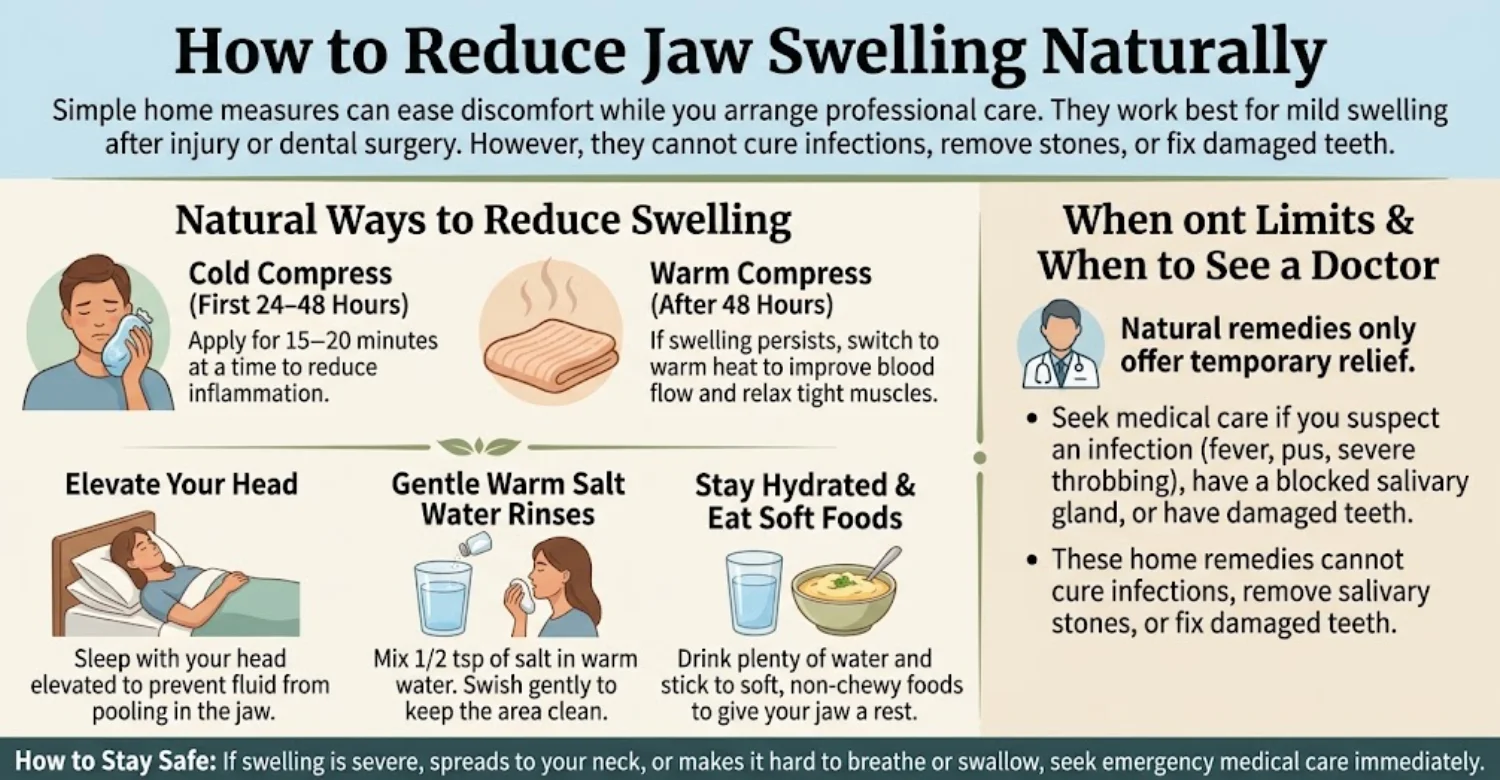
Which Home Remedies May Help Relieve Jaw Swelling?
Cold compresses, soft foods, hydration, gentle hygiene, and head elevation can all help. Their usefulness depends on the cause of swelling. For suspected infection, these measures only buy time until treatment.
Apply a Cold Compress for Recent Injury or Postoperative Swelling as Advised
Cold narrows blood vessels and limits fluid buildup in injured tissues. Apply a wrapped ice pack for 15 to 20 minutes, then rest for 20 minutes. Cold works best during the first 24 to 48 hours after injury or surgery.
Use Warm Compresses Only When Appropriate for the Suspected Cause
Warmth increases blood flow and may ease muscle tension or salivary gland blockage. Dentists sometimes advise warm compresses after the first 48 hours following surgery. Warm compresses can also help with TMD-related muscle stiffness.
Eat Soft Foods and Avoid Excessive Chewing
Soft foods reduce strain on inflamed jaw muscles, joints, and teeth. Good options include yogurt, soups, scrambled eggs, mashed vegetables, and smoothies. Avoid hard, crunchy, sticky, or very hot foods.
Drink Enough Water and Maintain Gentle Oral Hygiene
Water keeps saliva flowing, which helps flush bacteria from the mouth and glands. Most adults need roughly 2 to 3 liters of fluids daily, depending on activity and climate. Continue brushing gently, avoiding painful areas if necessary.
Keep Your Head Elevated When Resting if It Improves Comfort
Raising your head with an extra pillow may reduce fluid pooling in facial tissues. This is particularly helpful during the first nights after oral surgery. Throbbing pain often feels worse when lying flat.
Can Saltwater Rinses Help With Jaw Swelling?
Warm saltwater rinses can soothe gums and help keep surgical sites clean. Dissolve half a teaspoon of salt in a cup of warm water. Rinse gently, especially within 24 hours of an extraction, to protect the blood clot.
How Can You Relieve Jaw Pain Without Making the Condition Worse?
Rest your jaw, avoid wide yawning, and limit gum chewing. Use appropriate over-the-counter pain relief as directed on the label. Avoid pressing, massaging, or poking a swollen area.
Which Natural Remedies Should You Avoid?
Some popular remedies can damage tissue or allow infection to spread. Avoid anything that burns tissues, breaks the skin, or delays care. The following remedies are particularly risky.
Do Not Apply Aspirin Directly to Teeth or Gums
Placing aspirin on the gum causes a chemical burn known as an aspirin burn. The tissue turns white, peels, and becomes more painful. Aspirin only relieves pain when swallowed as directed.
Do Not Squeeze, Puncture, or Drain a Swelling Yourself
Squeezing or puncturing a swelling can push bacteria deeper into tissues. It also risks bleeding, scarring, and new infection. Abscess drainage should be done by a professional using sterile instruments.
Do Not Use Heat on Suspected Spreading Infection Without Professional Advice
Heat may draw infection outward toward the skin surface. In some cases, it can encourage spread into deeper tissues. Use cold rather than heat for suspected dental infections.
Do Not Delay Dental Care to Try Home Remedies
Dental abscesses do not heal with clove oil, garlic, or herbal rinses. Delaying treatment allows infection to damage bone and spread further. Early treatment is usually simpler, cheaper, and more successful.
Ready to transform your smile?
Talk to our team and get a personal FREE treatment plan.
Medical Tips and Relief for a Swollen Jaw
Medicines can relieve pain and inflammation while you wait for definitive treatment. Choosing the right medicine depends on your age, health, and other medications. Antibiotics are needed only in specific situations.
What Can You Do for Swollen Jaw Relief While Waiting for an Appointment?
Use cold compresses, soft foods, rest, fluids, and suitable pain relief. Keep your head elevated and maintain gentle oral hygiene. Seek urgent help immediately if warning signs develop.
Which Pain Relievers May Help With Jaw Pain and Swelling?
Paracetamol and ibuprofen are the most commonly recommended over-the-counter options. Studies show combining ibuprofen with paracetamol relieves dental pain more effectively than many opioids. The American Dental Association's 2024 guideline recommends this combination as first-line treatment.
Paracetamol (Acetaminophen): Uses and Precautions
Paracetamol relieves pain and fever but has little anti-inflammatory effect. It is gentle on the stomach and suitable for many people. Exceeding the maximum daily dose can cause serious liver damage.
Ibuprofen and Other Anti-Inflammatory Medicines: Benefits and Limitations
Ibuprofen reduces both pain and inflammation, making it useful for dental swelling. It should be taken with food to protect the stomach. It may not suit people with stomach ulcers, kidney disease, asthma sensitivity, or heart conditions.
Why Medication Choice Depends on Age, Medical History, Pregnancy, and Other Medicines
Safe medicine choice varies between individuals. NSAIDs are generally avoided in later pregnancy. Children need doses based on weight and age. Blood thinners, steroids, and some blood pressure medicines interact with NSAIDs.
When Are Antibiotics Needed for Jaw Swelling?
Antibiotics are usually needed when infection spreads beyond the tooth or causes systemic signs. Examples include fever, spreading swelling, swollen lymph nodes, or trismus. They are also used for some patients with weakened immunity.
Why Should You Never Take Leftover Antibiotics Without Medical Advice?
Leftover antibiotics may be the wrong drug, dose, or duration for your infection. Incomplete courses encourage antibiotic resistance. CDC data show dentists write around 10% of US outpatient antibiotic prescriptions. One study found about 81% of dental preventive prescriptions were unnecessary.
What Are the Possible Side Effects of Medicines Used for Jaw Swelling?
All medicines carry potential side effects, even common over-the-counter options. Most are mild, but some can be serious. Knowing the risks helps you use medicines safely and recognize problems early.
Gastrointestinal Problems and Other Risks Associated With NSAIDs
NSAIDs can cause indigestion, stomach ulcers, and bleeding, especially with long-term use. Risk is higher in older adults and those taking steroids or blood thinners. NSAIDs may also affect kidney function and blood pressure.
Allergic Reactions and Possible Drug Interactions
Allergic reactions may cause rash, itching, or swelling of the face and lips. Penicillin allergy is reported by about 10% of people, though most are not truly allergic. Antibiotics can interact with blood thinners and other medicines.
Antibiotic-Associated Diarrhea and Other Adverse Effects
Antibiotics can disrupt gut bacteria and cause diarrhea. Clindamycin carries a particularly high risk of Clostridioides difficile infection. One Minnesota study linked about 15% of community cases to dental antibiotic prescriptions.
When Medication-Related Swelling Requires Emergency Help
Seek emergency help if swelling affects the tongue, lips, or throat after taking medicine. Difficulty breathing, wheezing, or dizziness may signal anaphylaxis. Use an adrenaline auto-injector if prescribed, then call emergency services.
How Can You Use Pain Relief Safely Without Masking a Worsening Problem?
Follow label doses and keep a record of when you take each medicine. Track whether swelling is changing, not just whether pain is controlled. Painkillers should bridge the gap to treatment for a few days only.
How Is a Swollen Jaw Treated Professionally?
Professional treatment targets the underlying cause rather than just the swelling. Dental infections need source removal, while gland and allergic problems need different approaches. Most patients improve quickly once the cause is treated.
How Does Treatment Depend on the Cause of Jaw Swelling?
Abscesses need drainage and root canal treatment or extraction. Gum infections need cleaning and periodontal care. Salivary stones may need hydration, massage, or removal. Fractures need stabilization, and allergies need antihistamines or emergency treatment.
What Is the Treatment for Jaw Swelling Due to a Tooth Infection?
Treatment focuses on draining pus and removing the source of infection. Options include drainage, root canal treatment, and extraction. Antibiotics are added when the infection has spread or the patient is unwell.
Drainage of a Dental Abscess When Indicated
Drainage releases pus and relieves pressure, often bringing rapid pain relief. It may be done through the tooth or via a small gum incision. Local anesthetic keeps the procedure comfortable.
Root Canal Treatment to Save a Restorable Tooth
Root canal treatment removes infected pulp, cleans the canals, and seals them. It allows you to keep your natural teeth. Studies report tooth survival of roughly 86% to 93% several years after root canal treatment.
Tooth Extraction When the Tooth Cannot Be Retained
Extraction is recommended when a tooth is too damaged, fractured, or loose to save. Removing the tooth eliminates the source of infection. Swelling usually improves within days afterward.
Antibiotics When Clinically Indicated
Antibiotics are prescribed for spreading infection, fever, or medically vulnerable patients. Amoxicillin is commonly used, with alternatives for penicillin allergy. ADA guidance recommends antibiotics alongside, not instead of, dental treatment.
How Are Gum Infections and Wisdom Tooth Problems Treated?
Gum abscesses are treated by drainage and deep cleaning of the affected pocket. Pericoronitis is managed by cleaning under the gum flap and antiseptic rinses. Recurrent pericoronitis often leads to wisdom tooth removal.
How Are Salivary Gland Problems and Swollen Lymph Nodes Managed?
Salivary problems are managed with hydration, warm compresses, gland massage, and sour sweets to stimulate saliva. Small stones may pass naturally, while larger ones need removal. Bacterial gland infections often need antibiotics.
What Treatment Is Needed for Jaw Injuries or Fractures?
Minor bruising needs cold compresses, rest, and soft foods. Fractures often require stabilization with wires, splints, or plates and screws. Healing usually takes about six weeks.
How Are Allergic Reactions and Medication-Related Swelling Treated?
Mild allergic swelling may respond to antihistamines and avoid the trigger. Severe reactions need adrenaline and emergency care. ACE inhibitor angioedema requires stopping the medicine under medical supervision.
How Long Does Jaw Swelling Take to Improve After Treatment?
Dental infection swelling usually improves within 48 to 72 hours of drainage or source removal. Complete resolution often takes one to two weeks. Postoperative swelling typically settles within a week.
What Should You Do if Jaw Swelling Persists Despite Treatment?
Return to your clinician if swelling does not improve within a few days. Persistent swelling may indicate incomplete drainage, a missed cause, or resistant bacteria. Further imaging or specialist referral may be needed.
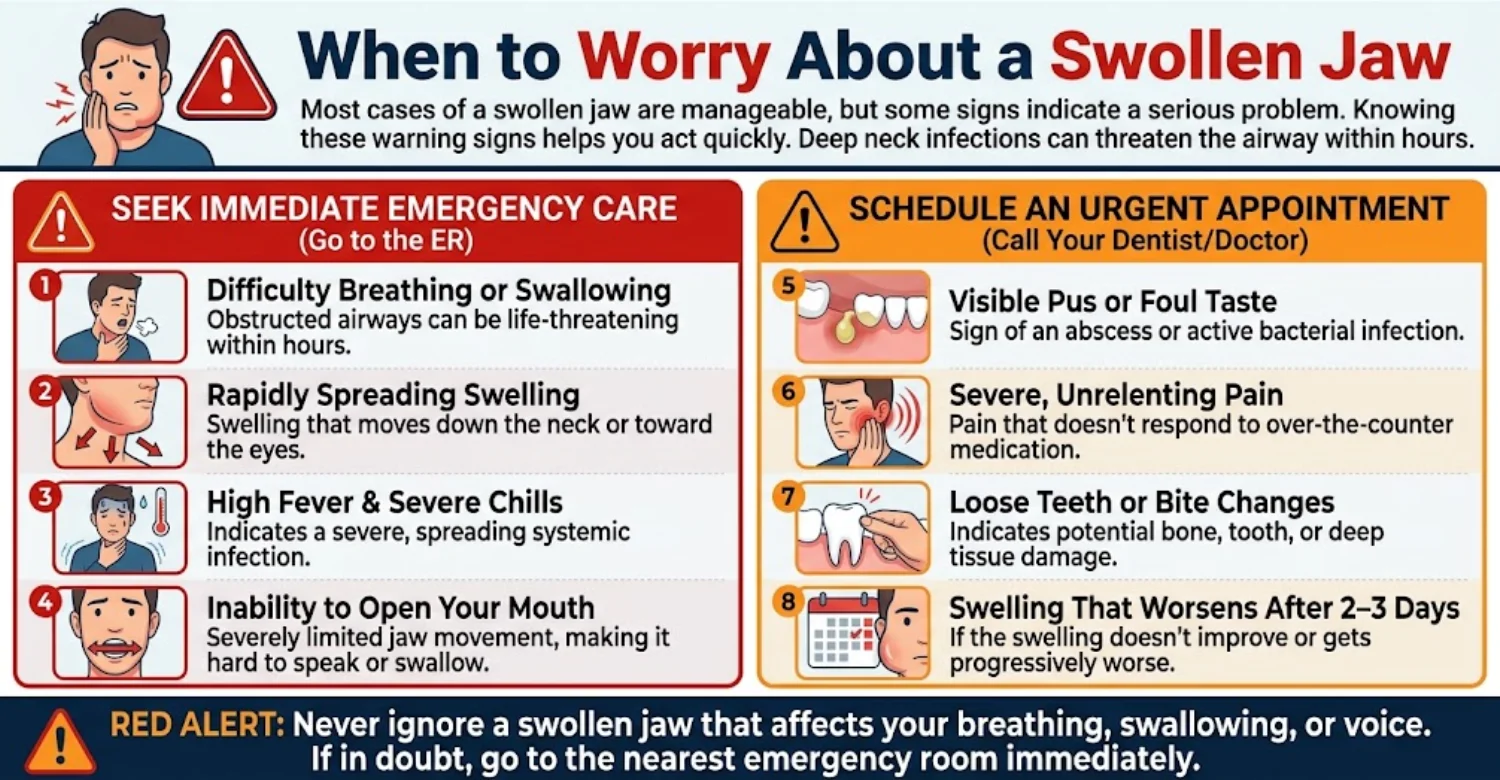
Which Swollen Jaw Symptoms Require Emergency Medical Attention?
Emergency symptoms include breathing difficulty, swallowing problems, and rapidly spreading swelling. Severe illness or confusion may indicate sepsis. Call emergency services immediately if these appear.
Difficulty Breathing or Swallowing
Breathing or swallowing difficulty may mean swelling is narrowing the airway. Drooling, noisy breathing, or a muffled voice are serious signs. Seek emergency care immediately.
Swelling of the Tongue, Lips, Throat, or Floor of the Mouth
A raised tongue or swelling beneath it may indicate Ludwig's angina. Lip and throat swelling may signal angioedema or anaphylaxis. Emergency treatment is essential.
Rapidly Spreading Facial or Neck Swelling
Swelling that spreads within hours toward the eye or neck is dangerous. It indicates infection moving into deep tissue spaces. Hospital treatment may include imaging, drainage, and intravenous antibiotics.
Severe Illness, Confusion, or Signs of a Serious Infection
High fever, rapid heartbeat, confusion, or extreme weakness may signal sepsis. Sepsis is a life-threatening response to infection that requires immediate treatment. Call emergency services without hesitation.
When Should You Seek Urgent Dental Care?
Urgent dental care is needed within 24 hours for suspected abscesses and worsening dental symptoms. Many clinics reserve same-day emergency slots. Early treatment prevents spread and reduces complications.
Suspected Dental Abscess or Pus
A gum bump, pus, or foul taste suggests an abscess. These signs need prompt drainage and source treatment. Do not wait for symptoms to settle.
Fever With Jaw Swelling or Worsening Toothache
Fever with dental swelling indicates the infection is affecting your whole body. Worsening toothache suggests increasing pressure or spread. Both warrant urgent assessment.
Difficulty Opening the Mouth or Eating and Drinking
Restricted opening suggests infection affecting the chewing muscles. Inability to eat or drink risks dehydration. These patients may need hospital care.
Increasing Swelling After Dental Treatment
Swelling that increases after the third day following treatment is not normal. It may indicate infection or other complications. Contact your dentist promptly for review.
When Should Persistent Jaw Swelling Be Checked by a Doctor?
Persistent swelling lasting beyond two to three weeks should be examined. This is especially important if no dental cause is found. Early investigation rules out serious conditions.
A Lump That Persists, Enlarges, or Feels Hard or Fixed
Hard, fixed, or growing lumps need prompt medical evaluation. They may represent cysts, gland tumors, or, rarely, cancer. Early diagnosis greatly improves outcomes.
Unexplained Swelling, Numbness, or Recurrent Symptoms
Numbness of the lip or chin without dental treatment needs investigation. Recurrent swelling suggests an unresolved underlying problem. A doctor can arrange appropriate imaging and tests.
Swelling Accompanied by Unexplained Weight Loss or Other Systemic Symptoms
Weight loss, night sweats, or persistent fatigue with swelling need medical review. These may indicate systemic illness, including lymphoma. Prompt investigation is essential.
Can a Swollen Jaw Resolve Without Treatment?
Some causes resolve naturally, including minor bruising and reactive lymph nodes. Mild postoperative swelling also settles with time. However, dental abscesses and blocked glands usually need treatment.
How Quickly Should You Act if Jaw Swelling Develops Suddenly?
Act immediately if sudden swelling affects breathing or swallowing. For sudden swelling with pain or fever, seek care the same day. Sudden meal-related swelling can be reviewed within a few days.
What Complications Can Occur if Jaw Swelling Is Left Untreated?
Untreated swelling can lead to spreading infection, bone damage, and recurrent problems. Serious complications are uncommon but potentially life-threatening. Early treatment prevents most of them.
How Can a Dental Infection Spread Into Nearby Tissues?
Pus spreads along tissue planes between muscles and bones. It can reach the cheek, eye socket, floor of the mouth, and neck. Infections of lower molars commonly spread downward.
Can Severe Dental Infections Affect the Jawbone or Deep Neck Spaces?
Yes, infections can cause osteomyelitis, a painful bone infection. They can also reach deep neck spaces, threatening the airway. Dental sources are a leading cause of deep neck infections in adults.
Can Untreated Salivary Gland Problems Cause Recurrent Swelling?
Yes, untreated stones and chronic infections often cause repeated swelling episodes. Recurrent inflammation can scar the gland and reduce saliva production. Persistent cases may eventually need gland removal.
Why Is Early Assessment Important When Symptoms Keep Worsening?
Worsening symptoms show the body is not controlling the problem. Early assessment allows simpler, less invasive treatment. It also reduces the risk of hospitalization.
.jpg)
.jpg)
.jpg)
How Can You Prevent Jaw Swelling?
Most dental causes of a swollen jaw are preventable with good daily habits and regular checkups. Hydration, injury protection, and early care for symptoms also help. Prevention is far simpler than treating a spreading infection.
How Does Daily Oral Hygiene Reduce Dental Infection Risk?
Daily hygiene removes plaque, the bacterial film that drives decay and gum disease. Less plaque means fewer cavities, healthier gums, and fewer abscesses. Consistent habits matter more than any single product.
Brush With Fluoride Toothpaste and Clean Between Teeth
Brush twice daily for two minutes with fluoride toothpaste. Research shows fluoride toothpaste reduces cavities by roughly 24% compared with non-fluoride paste. Clean between teeth daily with floss or interdental brushes.
Attend Routine Dental Examinations
Regular checkups detect decay and gum disease before they cause swelling. Most people benefit from examinations every 6 to 12 months. X-rays can reveal hidden infections early.
Seek Early Care for Toothache, Gum Bleeding, or Tooth Sensitivity
Early symptoms are warnings that a problem is developing. Treating a small cavity is far simpler than treating an abscess. Bleeding gums often signal reversible gingivitis.
How Can You Reduce the Risk of Post-Treatment Swelling?
Follow your dentist's aftercare instructions carefully. Use cold compresses, take prescribed medicines, and eat soft foods. Do not spit forcefully or use straws for the first 24 hours.
How Can Hydration and Salivary Gland Care Support Oral Health?
Good hydration keeps saliva flowing and helps prevent gland stones and infections. Sip water regularly throughout the day. Sugar-free gum or sour sweets can stimulate saliva.
What Protective Measures Help Prevent Jaw Injuries?
Wear a mouthguard during contact sports and high-risk activities. Studies suggest athletes without mouthguards face roughly 1.6 to 1.9 times higher orofacial injury risk. Use seatbelts and helmets consistently.
When Should Recurrent Jaw Swelling Be Investigated?
Investigate swelling that returns more than once or twice. Recurrence suggests an untreated cause, such as a failing root canal or salivary stone. Imaging and specialist review can identify the source.
How Much Does Swollen Jaw Treatment Cost in the US, UK, and Turkey?
The cost of swollen jaw treatment varies by country, clinic, and underlying cause. A simple dental examination may be relatively inexpensive, while an abscess requiring drainage or a complex infection requiring surgery can cost considerably more. The figures below are approximate private-sector estimates for budgeting, not guaranteed quotes.
What Is the Average Cost of Diagnosing a Swollen Jaw?
Diagnosis usually involves a clinical examination and, when indicated, dental X-rays. Additional imaging, such as cone-beam computed tomography (CBCT), may increase the total cost.
Diagnostic Service | United States (USD) | United Kingdom (USD) | Turkey (USD) |
Private dental examination | 100–300 | $50–$150 | 20–80 |
Periapical X-ray | 25–50 | $15–$40 | Varies by clinic |
Panoramic X-ray | 100–250 | Varies by clinic | May be included in a consultation package |
CBCT scan | 250–600 | Additional fee; varies by clinic | Additional fee; varies by clinic |
These are illustrative estimates. Imaging fees may be bundled with consultations or charged separately.
United States: Approximately 100–300 for a Private Dental Examination
US emergency dental examinations typically cost 100–300 before additional imaging or treatment. Periapical X-rays may cost 25–50 each, while panoramic imaging and CBCT scans can increase the total expense.
United Kingdom: Approximately $50–$150 for a Private Dental Examination
Private UK examinations typically cost $50–$150. Small dental X-rays may cost $15–$40 each. In England, NHS urgent dental treatment costs $27.90 in 2026/27, although additional treatment may require another charge.
Turkey: Approximately 20–80 for a Private Dental Examination
Private examinations in Turkey commonly cost 20–80. Some clinics include panoramic imaging in consultation packages, while others charge separately. Patients should confirm the imaging requirements and total price before booking.
How Much Does Treatment for a Dental Infection Cost in Each Country?
Treatment costs depend on the infection's severity, the affected tooth, and the procedure required. Root canal treatment may preserve an infected tooth, while extraction or drainage may be necessary in other cases.
Treatment | United States (USD) | United Kingdom (USD) | Turkey (USD) |
Emergency dental examination | 100–300 | $50–$150 privately | 20–80 |
Abscess drainage | 200–500 | Private fees vary; eligible NHS urgent treatment costs $27.90 in England | Obtain a clinic-specific quote |
Root canal treatment | 600–1,500 | $300–$1,200 privately; $76.60 under NHS Band 2 in England | 100–300 per tooth |
Simple tooth extraction | 150–400 | $100–$200 privately; $76.60 under NHS Band 2 in England | 50–200 |
Dental crown, if required | 1,000–2,000 | $500–$1,000 | Approximately 150–285, depending on the crown and clinic |
Private prices are approximate planning estimates and may vary significantly. NHS charges in England are per course of treatment, not separate fees for every procedure. Eligibility, availability, and the treatment provided determine the actual charge.
US: Approximately 600–1,500 for Root Canal Treatment
US root canal treatment commonly costs 600–1,500, depending on the tooth and complexity. Simple extractions often cost 150–400, while crowns may add 1,000–2,000. Emergency examinations, imaging, and medication may increase the final bill.
UK: Approximately $300–$1,200 for Private Root Canal Treatment
Private root canal treatment typically costs approximately $300–$1,200, depending on the tooth and provider. Simple extractions may cost $100–$200, while crowns may cost $500–$1,000.
In England, NHS Band 2 costs $76.60 in 2026/27 and can include root canal treatment and extractions when clinically indicated. Eligible urgent dental treatment costs $27.90, but further treatment may incur additional charges.
Turkey: Approximately 100–300 for Root Canal Treatment
Root canal treatment in Turkey may cost approximately 100–300 per tooth. Simple extractions commonly cost 50–200, depending on the case and clinic. Crowns and other restorations may be charged separately.
Which Factors Affect the Total Cost of Treating a Swollen Jaw?
The final cost depends on the cause of swelling, its severity, and the treatment required. Diagnostic tests, additional procedures, and follow-up appointments can all affect the total.
Cost Factor | Why It Matters | Possible Financial Impact |
Underlying cause | Infection, trauma, salivary gland problems, and other conditions require different approaches | Determines the treatment pathway |
Severity of swelling | Extensive infections may require drainage or hospital care | Can increase costs substantially |
Diagnostic imaging | X-rays or CBCT may be necessary | Adds imaging fees |
Abscess drainage | May be needed to manage a dental abscess | Adds procedural costs |
Root canal or extraction | Depends on whether the affected tooth can be preserved | Adds treatment fees |
Medication | Prescribed medication depends on the diagnosis and clinical findings | May increase the total |
Follow-up visits | Healing and infection resolution may need monitoring | Creates additional expenses |
Specialist or hospital care | Complex cases may require referral | Can significantly increase costs |
Does Dental Insurance or Public Healthcare Cover Swollen Jaw Treatment?
Coverage depends on the country, eligibility, and insurance policy. Many US dental plans cover part of the cost of examinations, root canal treatment, or extractions, subject to deductibles, co-payments, and annual limits.
In England, eligible NHS patients may receive urgent treatment for $27.90 or treatment under Band 2 for $76.60 in 2026/27. These charges do not apply identically across all UK nations. Patients should confirm local charges and eligibility before treatment.
Is Dental Treatment in Turkey Less Expensive Than in the US or UK?
Private dental treatment in Turkey can be substantially less expensive than comparable care in the US or UK. However, prices depend on the procedures included, materials used, clinic standards, and follow-up arrangements.
Patients should compare complete treatment plans rather than advertised starting prices. International patients should also account for flights, accommodation, and possible return visits.
What Should Patients Check Before Comparing International Treatment Prices?
Before booking, request a written, itemised estimate that explains the full scope of treatment.
What to Check | Questions to Ask |
Diagnosis and imaging | Are the examination and necessary X-rays included? |
Emergency treatment | Is drainage or another urgent procedure included if needed? |
Additional procedures | Are root canal treatment, extraction, or crowns charged separately? |
Medication | Are prescribed medicines included in the estimate? |
Follow-up appointments | How many visits are included, and what do additional visits cost? |
Travel arrangements | Will further visits be necessary after returning home? |
Unexpected findings | How will the clinic explain and price any additional treatment? |
Why Should Treatment Costs Be Confirmed After a Clinical Assessment?
An accurate estimate requires a confirmed diagnosis. Dental X-rays or other tests may reveal problems that affect the recommended treatment. A clinical assessment helps determine whether the swelling requires routine dental treatment, urgent intervention, or specialist care.
Sudden or rapidly increasing jaw swelling, difficulty swallowing or breathing, or swelling extending into the neck requires urgent medical attention. Do not delay emergency assessment while comparing treatment prices.
How Vitrin Clinic Evaluates and Treats Dental Causes of Jaw Swelling
At the Vitrin Clinic, every case begins with identifying the true cause of swelling. Our team combines clinical examination, digital imaging, and careful history-taking. Treatment is recommended only after the diagnosis is clear.
How Does Vitrin Clinic Assess Jaw Swelling When a Dental Cause Is Suspected?
We review your symptoms, medical history, and recent dental treatment. The dentist examines your teeth, gums, glands, joints, and lymph nodes. Imaging is then used to confirm the source.
Which Diagnostic Steps May Be Recommended After an Initial Consultation?
Diagnostic steps depend on your findings. Most patients need a detailed examination and digital X-rays. Some benefit from three-dimensional imaging.
Dental and Gum Examination
Each tooth is checked for decay, cracks, and sensitivity. Gum pockets are measured to detect periodontal infection.
Digital Dental X-Rays or CBCT When Clinically Indicated
Digital X-rays show infection around roots with low radiation. CBCT is used when three-dimensional detail is needed.
Identification of Dental Problems That May Require Definitive Treatment
The findings identify which teeth or gum areas need treatment. This allows a targeted and efficient plan.
Which Dental Treatments May Be Considered After the Cause Is Confirmed?
Treatment options depend on the tooth's condition and your preferences. Saving natural teeth is preferred whenever predictable.
Root Canal Treatment for Suitable Infected Teeth
Root canal treatment removes infection while preserving the natural tooth. A crown may be recommended afterward.
Extraction When a Tooth Cannot Be Saved
Extraction removes non-restorable teeth and the infection source. Replacement options are discussed afterward.
Periodontal Treatment for Relevant Gum Conditions
Deep cleaning and gum therapy treat periodontal infections. Maintenance visits help prevent recurrence.
When Should Patients With Jaw Swelling Be Referred for Medical Assessment?
We refer patients when findings suggest non-dental causes or severe infection. Persistent lumps, gland problems, and airway concerns need medical specialists. Patient safety always comes first.
How Are Treatment Recommendations and Individual Cost Estimates Prepared?
Recommendations are based on examination and imaging results. Each patient receives a clear, itemized cost estimate. We explain alternatives so you can choose confidently.
How Vitrin Clinic Supports Your Treatment Journey
We support patients from the first consultation through recovery. Clear communication and coordinated care make treatment easier and more predictable.
How Does the Consultation Process Help Clarify Your Next Steps?
The consultation explains your diagnosis, treatment options, and expected timelines. You can ask questions and discuss concerns openly.
How Is a Personalized Dental Treatment Plan Developed?
Your plan reflects your clinical findings, health, and goals. It outlines each stage, its purpose, and its cost.
How Can Digital Diagnostics Support Treatment Planning When Appropriate?
Digital X-rays and CBCT provide precise detail for accurate planning. They help reduce surprises during treatment.
How Are International Patient Appointments and Treatment Coordination Arranged?
Our team coordinates appointments to fit your travel schedule. We can help with scheduling, communication, and practical arrangements.
What Should Patients Know About Follow-Up and Recovery After Dental Treatment?
You receive written aftercare instructions and follow-up guidance. Most swelling settles within a week after treatment.
How Can Patients Access Appropriate Care if Symptoms Worsen After Returning Home?
Contact our team promptly if symptoms change after you return home. For emergency warning signs, seek local emergency care immediately.






Tips for Patients
Practical steps can help you get the right care quickly and safely. Use these tips when jaw swelling appears.
What Should You Do First When You Notice a Swollen Jaw?
Check for breathing, swallowing, or rapidly spreading swelling first. If present, seek emergency care immediately. Otherwise, contact a dentist and note your symptoms.
What Information Should You Record Before Seeing a Dentist or Doctor?
Clear notes help your clinician reach a diagnosis faster. Record the details below.
When the Swelling Began and Whether It Is Spreading
Note the date and time swelling started. Daily photos show whether it is spreading.
Pain Severity, Fever, Toothache, and Other Symptoms
Rate pain from zero to ten and record temperatures. Note any toothache, bad taste, or swallowing difficulty.
Recent Dental Procedures, Injuries, and Medication Changes
List recent treatments, injuries, and new medicines. Include doses and start dates.
What Should You Avoid While Your Jaw Is Swollen?
Avoid squeezing the swelling, applying aspirin to gums, and using unadvised heat. Avoid smoking, alcohol, and hard foods. Do not take leftover antibiotics.
How Can You Manage Discomfort Safely Until Your Appointment?
Use cold compresses, soft foods, and appropriate pain relief. Stay hydrated and rest with your head elevated. Monitor symptoms closely for changes.
What Questions Should You Ask Your Dentist About Diagnosis, Relief, Treatment, and Side Effects?
Ask what is causing the swelling and how it was confirmed. Ask about treatment options, risks, and costs. Ask which warning signs require urgent return.
Ready to transform your smile?
Talk to our team and get a personal FREE treatment plan.
Key Takeaways
A swollen jaw has many causes, but most are dental and treatable. Early diagnosis is the key to fast, safe recovery.
What Are the Most Important Causes of a Swollen Jaw?
Dental abscesses, gum disease, and wisdom tooth problems are most common. Salivary glands, lymph nodes, injuries, and allergies are other important causes.
Which Symptoms Suggest a Dental Infection or Another Underlying Condition?
Toothache, bad taste, and pus suggest dental infection. Meal-related swelling suggests gland problems, while persistent hard lumps need medical review.
Which Relief Measures May Help, and Why Are Home Remedies Not a Substitute for Treatment?
Cold compresses, soft foods, and pain relief ease symptoms. They cannot remove infection, so professional treatment remains essential.
Which Warning Signs Require Emergency Care or Urgent Dental Assessment?
Breathing or swallowing difficulty and spreading swelling need emergency care. Fever, pus, or trismus need urgent dental assessment.
Why Should Treatment and Cost Estimates Be Based on the Confirmed Cause?
Different causes need different treatments with different costs. Confirmed diagnosis prevents unnecessary procedures and unexpected expenses.
At Vitrin Clinic
At Vitrin Clinic, our treatment begins with a careful examination and digital imaging to identify the cause of jaw swelling before recommending appropriate care. If you notice a swollen jaw, contact us for a personalised assessment. If you experience difficulty breathing or swallowing, seek emergency medical care immediately.
Reference
FAQs
Dr. Rifat Alsaman has more than 5 years of clinical experience in dentistry and currently serves as the Head of the Medical Team at Vitrin Clinic. He is dedicated to providing exceptional patient care, overseeing treatment planning, and ensuring the highest clinical standards across the team. His expertise, attention to detail, and commitment to continuous professional development have helped countless patients achieve healthier, more confident smiles.


